The Wanderer an example of the elegiac mood
- Slides: 20
The Wanderer --an example of the elegiac mood --expresses the poet’s profound feelings toward their ancestors --the poet speaks of his long search for a new home
The Wife’s Lament (from the Exeter manuscript) --the woman may have been a „peace-weaver” (a woman married off to make peace between warring tribes) --the woman’s themes and language resemble those of of male „wraeccas” (wretches) in other Old English poems --they have been separated by the man’s family
Beowulf --linguistic evidence shows that it was originally composed in the dialect of what was then Mercia, the Midlands of England --the poet was reviving the heroic language, style and pagan world of ancient Germanic oral poetry --an extraordinary number of hapax legomena (words that occur only once in a language) --deals not with native Englishmen but with their Germanic forebears, two south Scandinavian tribes, the Danes and the Geats --concerns a time after the inital invasion of England by Germanic tribes in the middle of the fifth century but before the Anglo-Saxon migration was completed
„Although Hrothgar and Beowulf are portrayed as morally upright and enlightened pagans, they fully espouse and frequently affirm the values of Germanic heroic poetry. In the poetry depicting this warrior society, the most important of human relationships was that which existed between the warrior—the thane—and his lord, a relationship based less on subordination of one man’s will to another’s than on mutual trust and respect. ” –The Norton Anthology of English Literature
„Hrothgar’s anguish over the murders committed by Grendel is not only for the loss of his men but also for the shame of his inability either to kill Grendel or to exact a ‚death-price’ from the killer…the poem turns on Beowulf’s three great fights against preternatural evil, which inhabits the dangerous and demonic space surrounding human society. ” –Norton Anthology
Beowulf So these noble warriors lodged in their delights blissfully — until their lonely opponent made evil upon them, the fiend from hell. That ferocious spirit was named Grendel, the notorious border-strider, who held the moors, the swampy stronghold, the lair of water-monsters, an unhappy creature, keeping them a long while, since the Shaper had condemned him as the kin of Cain—that killing had the Eternal Lord avenged, after the man had struck down Abel. Cain rejoiced not in that felony, but he banished him far away, the Measurer for those wicked deeds, from the kindred of men. From there was conceived all sorts of monstrous things, ogres and elves and revenants, likewise the giants who struggled against God for many ages— who gave them back their just deserts. (ll. 99 -114)
Then my tribesmen instructed me, the best of our wise men, that I should seek you, Prince Hrothgar, because they knew my skillful power, they observed it themselves when I came back from sorties, splattered by my enemies, where I bound up five warriors, and destroyed a tribe of giants, and among the waves struck down water-beasts by night, enduring many close calls, avenging malice against the Weders—they asked for their woes— I ground down our oppressors and now, against Grendel, I must pay him back alone, that wretched monster, that demon. (ll, 415 -26 a) “
“Just now I wish to ask you one thing, lord of the Bright-Danes, Hedge of the Scyldings, one single favor, that you do not refuse me this— shelter of warriors, generous friend of your people, now that I have come so far, that I be allowed to cleanse Heorot, alone, with this band of my warriors, this troop of hardened men. I have learned as well that this monster, out of recklessness, reckons naught of weaponry. So I shall disdain them, so that Hygelac might be most pleased at heart, my lord of men, not bearing any blade or broad shield with yellow boss into the battle, but I must grapple with the fiend with grip alone, contend life against life, hate against hatred. There he must trust in the judgment of the Lord, he whom death seizes. (ll. 426 b-41)
I reckon that he will, if he is allowed to win in the war-hall, fearlessly devour Geatish warriors, just as he has often devoured your glorious troops. There will be no need at that moment to cover my head, but he will have covered enough, blotted with blood, if death seizes me— he will bear me to bloody slaughter, thinking to taste me— the solitary stalker will eat without the slightest regret, marking his swampy lair. There will be no need to sorrow for long over cleaning my corpse! Just send Hygelac, if the contest conquers me, this best of battle-clothes that wards my breast, finest of garments. It is an heirloom of Hrethel, the work of Weland. The way of the world always goes as it must!” (ll. 442 -55)
„Famous for his deeds a warrior may be, but it remains a mystery where his life will end, when he may no longer dwell in the mead-hall among his own. So it was with Beowulf, when he faced the cruelty and cunning of the mound-guard. He himself was ignorant of how his departure from the world would happen. „ lines 3062 -3068
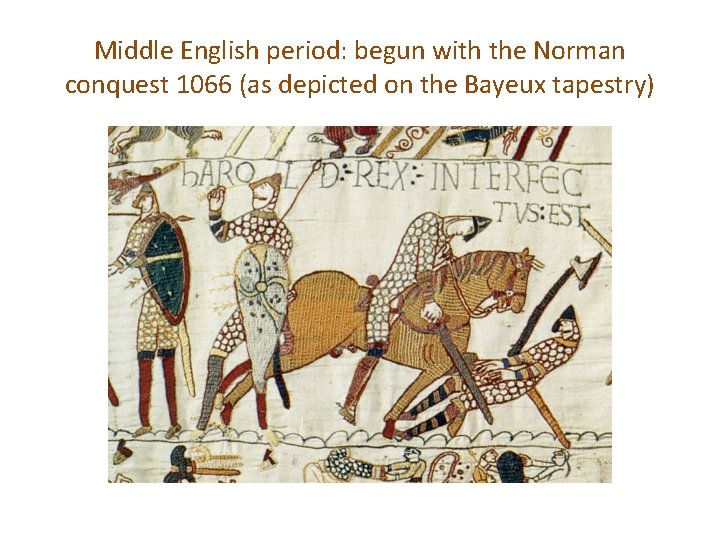
Middle English period: begun with the Norman conquest 1066 (as depicted on the Bayeux tapestry)
“In 1066 the death of the childless Anglo-Saxon ruler Edward the Confessor occasioned the most important change in English political life. Edward’s mother was Norman, giving the duke of Normandy a hereditary claim to the English throne. Before his death, Edward…directed that his throne be given to William, the reigning Duke of Normandy. But the Anglo-Saxon assembly…vetoed Edward’s last wishes, choosing instead Harold Godwinson. ” –The Western Heritage, 275 =NORMAN CONQUEST, BATTLE OF HASTINGS, OCTOBER 1066
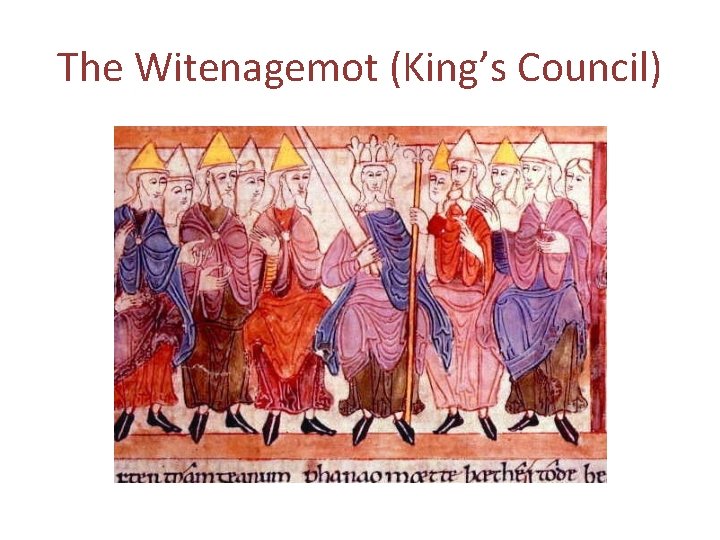
The Witenagemot (King’s Council)
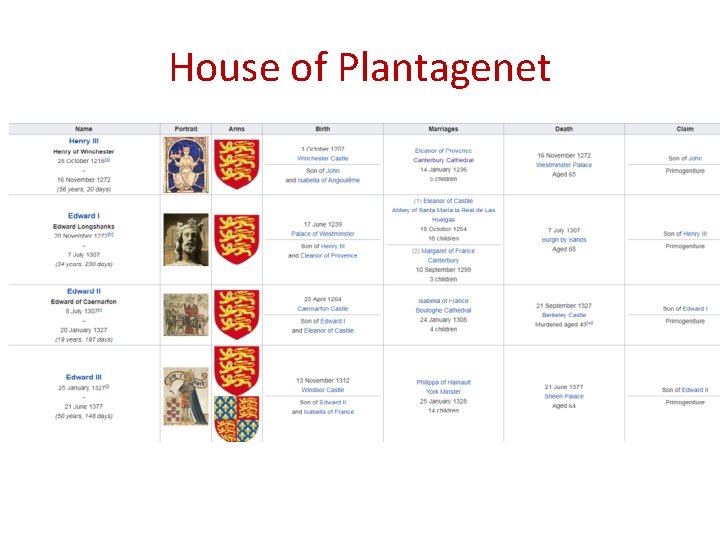
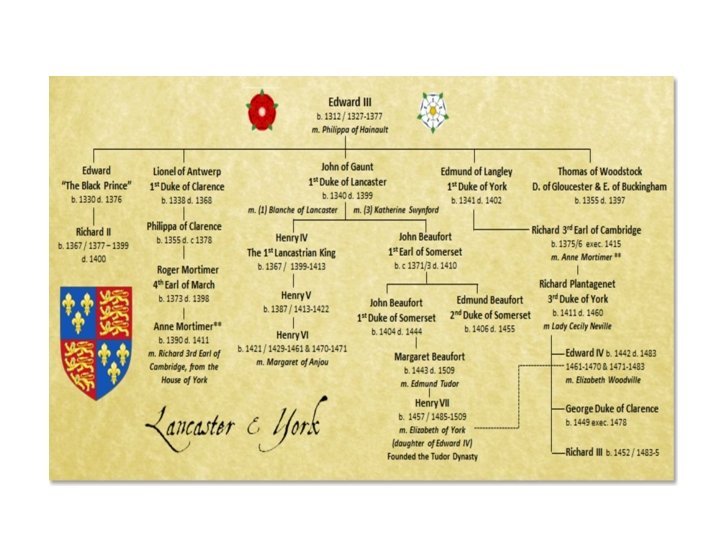
William—his son Henry I—(chaos from 1135 -1154 „The Anarchy”) his daughter Matilda, her son Henry II (steered English monarchy toward an oppressive rule (married Eleanor of Aquitaine) established Angevin/Plantagenet dynasty which lasted until death of Richard III (House of York) in 1485— Richard the Lion-Hearted and John (Robin Hood) (Crusades)
House of Plantagenet
“As Henry II acquired new lands abroad, he became more autocratic at home. He forced his will on the clergy in the Constitution of Clarendon. These measures…gave the king control over the election of bishops. The result was strong political resistance from both the nobility and the clergy. The archbishop of Canterbury, Thomas á Becket, once Henry’s compliant chancellor, broke openly with the king and fled to Louis VII…(Two hundred years later, Geoffrey Chaucer, writing in an age made cynical by the Black Death and the Hundred Years’ War, had the pilgrims of his Canterbury Tales journey to the shrine of Thomas á Becket. )” The Western Heritage, 278
“The circumstances of writers in the English vernacular changed greatly in the years after the Norman Conquest. The collapse of the written standard established by West-Saxon monks and the exclusion of English writings from the main centres of power and patronage…” The Oxford Illustrated History of English Literature, 22 -23 LITERARY LANGUAGE SHIFTED TO PREDOMINANCE OF LATIN AND FRENCH, INFLUENCING THE EVOLUTION OF ANGLO-SAXON TO THE MIDDLE ENGLISH OF CHAUCER AND HIS CONTEMPORARIES
The Owl and the Nightingale --written by an anonymous cleric in the 12 th century --representative of the rivalry between France and England, thus of the transition between Old English and Middle English and also between elegiac poetry and chivalric poetry --earliest example in English of „debate poetry” or verse contest
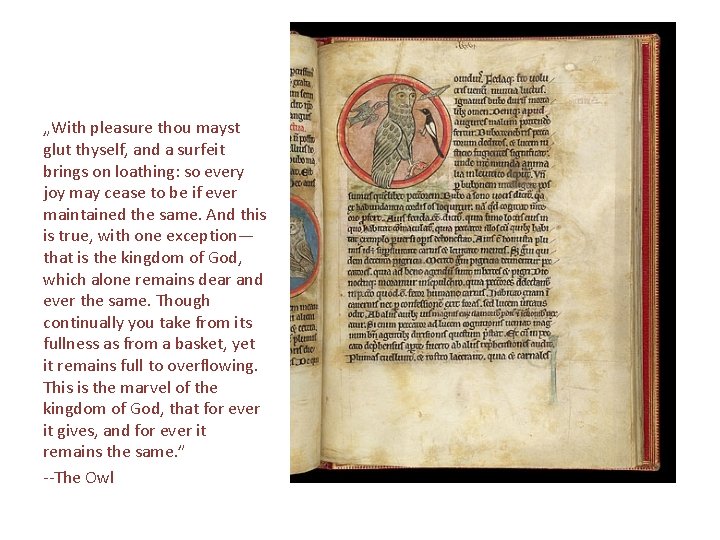
„With pleasure thou mayst glut thyself, and a surfeit brings on loathing: so every joy may cease to be if ever maintained the same. And this is true, with one exception— that is the kingdom of God, which alone remains dear and ever the same. Though continually you take from its fullness as from a basket, yet it remains full to overflowing. This is the marvel of the kingdom of God, that for ever it gives, and for ever it remains the same. ” --The Owl