
WHAT IS POETRY Answer on your whiteboard SCANSION

WHAT IS POETRY? Answer on your whiteboard!
SCANSION: LATIN POETRY IS MEANT TO BE HEARD! Poetry = ? ? ? …word choice …brevity …style …RHYTHM Scansion means reading a line of Latin poetry in the correct meter. Meter is the pattern of long and short syllables that make up a line of poetry, creating its rhythm. Listen as I read the following poems out loud in Latin meter…On your whiteboard, write what you notice about the sound of the poems!

CATULLUS 1 Cui dono lepidum novum libellum arida modo pumice expolitum? Corneli, tibi: namque tu solebas meas esse aliquid putare nugas. Iam tum, cum ausus es unus Italorum omne aevum tribus explicare cartis. . . Doctis, Iuppiter, et laboriosis! Quare habe tibi quid hoc libelli— qualecumque, quod, o patrona virgo, plus uno maneat perenne saeclo! Catullus dedicates his book of poetry to the historian Cornelius Nepos.
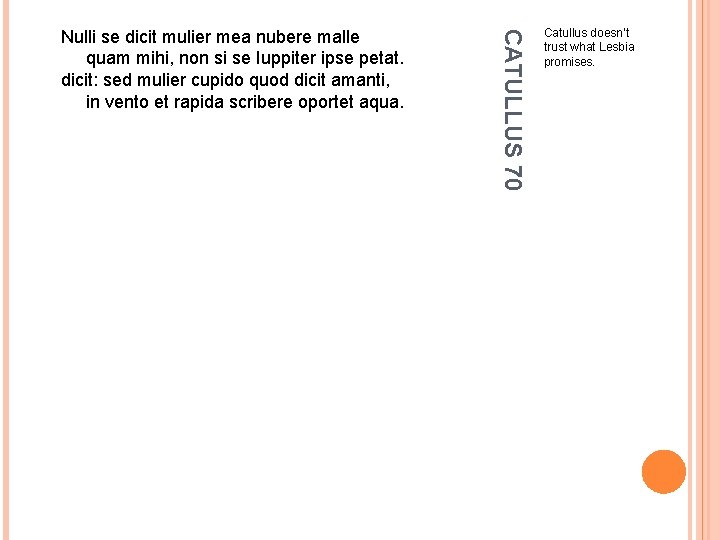
CATULLUS 70 Nulli se dicit mulier mea nubere malle quam mihi, non si se Iuppiter ipse petat. dicit: sed mulier cupido quod dicit amanti, in vento et rapida scribere oportet aqua. Catullus doesn’t trust what Lesbia promises.
NOTICE ANYTHING INTERESTING YET? If not, listen to some more!. . . (Questions to answer: • What’s the rhythm like? • How is it like or unlike English poetry? • Does it sound how you would expect it to as you look at the text I am reading, or are there any odd points to the pronunciation? )
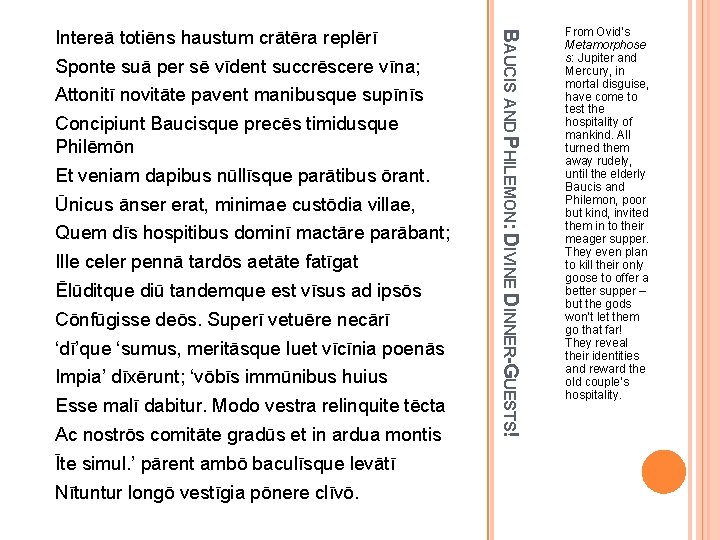
Sponte suā per sē vīdent succrēscere vīna; Attonitī novitāte pavent manibusque supīnīs Concipiunt Baucisque precēs timidusque Philēmōn Et veniam dapibus nūllīsque parātibus ōrant. Ūnicus ānser erat, minimae custōdia villae, Quem dīs hospitibus dominī mactāre parābant; Ille celer pennā tardōs aetāte fatīgat Ēlūditque diū tandemque est vīsus ad ipsōs Cōnfūgisse deōs. Superī vetuēre necārī ‘dī’que ‘sumus, meritāsque luet vīcīnia poenās Impia’ dīxērunt; ‘vōbīs immūnibus huius Esse malī dabitur. Modo vestra relinquite tēcta Ac nostrōs comitāte gradūs et in ardua montis Īte simul. ’ pārent ambō baculīsque levātī Nītuntur longō vestīgia pōnere clīvō. BAUCIS AND PHILEMON: DIVINE DINNER-GUESTS! Intereā totiēns haustum crātēra replērī From Ovid’s Metamorphose s: Jupiter and Mercury, in mortal disguise, have come to test the hospitality of mankind. All turned them away rudely, until the elderly Baucis and Philemon, poor but kind, invited them in to their meager supper. They even plan to kill their only goose to offer a better supper – but the gods won’t let them go that far! They reveal their identities and reward the old couple’s hospitality.
CATULLUS 101 Multas per gentes et multa per aequora vectus advenio has miseras, frater, ad inferias, ut te postremo donarem munere mortis et mutam nequiquam alloquerer cinerem. quandoquidem fortuna mihi tete abstulit ipsum. heu miser indigne frater adempte mihi, nunc tamen interea haec, prisco quae more parentum tradita sunt tristi munere ad inferias, accipe fraterno multum manantia fletu, atque in perpetuum, frater, ave atque vale. Catullus mourns the death of his brother as he visits his brother’s grave
CATULLUS 5 Vivamus mea Lesbia, atque amemus, rumoresque senum severiorum omnes unius aestimemus assis! soles occidere et redire possunt: nobis cum semel occidit brevis lux, nox est perpetua una dormienda. da mi basia mille, deinde centum, dein mille altera, dein secunda centum, deinde usque altera mille, deinde centum. dein, cum milia multa fecerimus, conturbabimus illa, ne sciamus, aut ne quis malus invidere possit, cum tantum sciat esse basiorum. Catullus demands kisses.
OBSERVATIONS? What do you notice about the sound of Latin poetry? Rhythm? Pronunciation? Form?
SYLLABIFICATION Latin meters are made of long and short syllables. What is a syllable? Syllable = a single vowel sound (plus any consonant(s) that comes before it and sometimes any consonant(s) after it. ) E. g. , agricola: a – gri – co – la E. g. , insulae: in – su – lae E. g. , amant: a – mant Practice: cunctantem = ? ? Practice: collis = ? ? Practice: carpsēre = ? ? Practice: leōnēs = ? ?
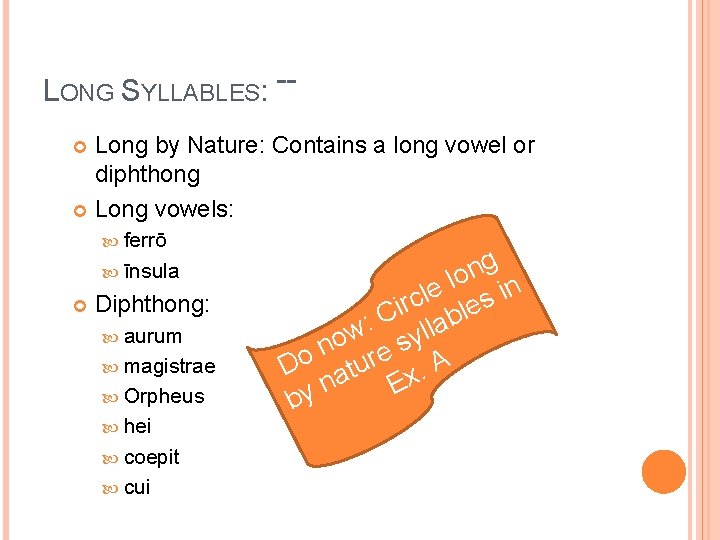
LONG SYLLABLES: ˉˉ Long by Nature: Contains a long vowel or diphthong Long vowels: ferrō īnsula Diphthong: aurum magistrae Orpheus hei coepit cui g n o n l e i l c s r i e l C b : a l l w y o n s e o r D atu x. A n E y b
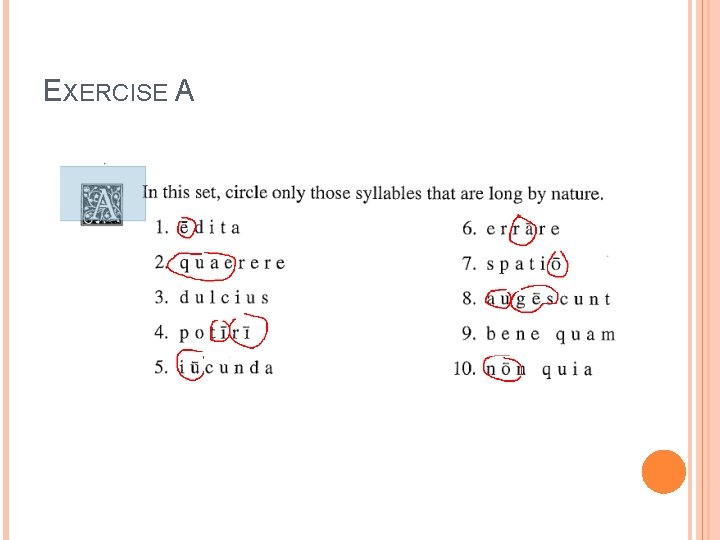
EXERCISE A

LONG SYLLABLES: ˉˉ Long by Position: a short vowel followed by two or more consonant sounds (“h” doesn’t count) � amant � nox � pontō � occupat � mersae That includes when the two+ consonants are from the next word… D o by now po : C s itio ircle � in mē in n sy lon Ex l g Exception: . B lable s P/B/T/D/C/or/G � ut pono followed by L/R – doesn’t have to be long � ut legam l l a cle x. C � ad regionem r � corpora i : C in E w o � silvamque n ables o D yll s g n lo

EXERCISE B
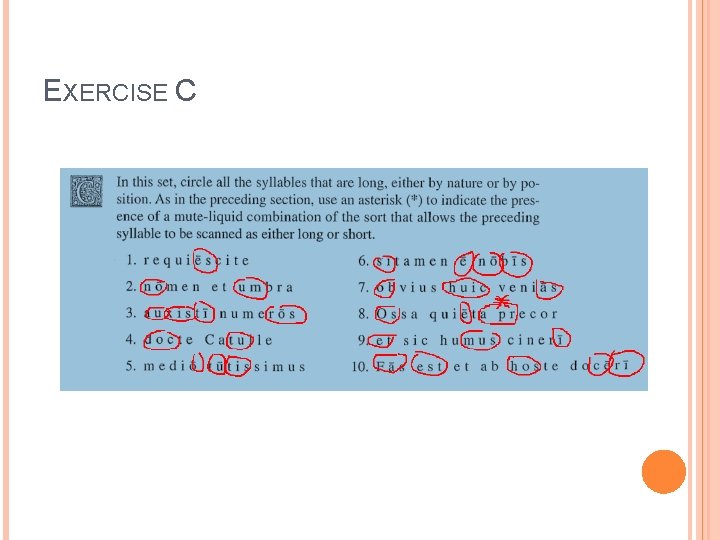
EXERCISE C
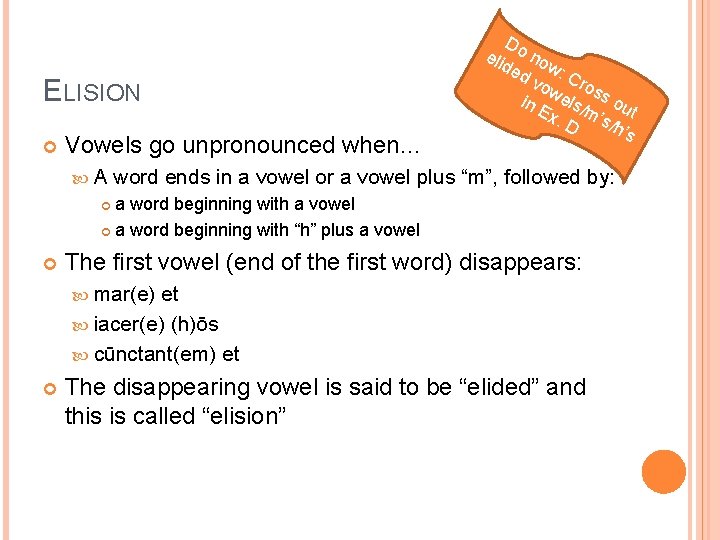
ELISION Vowels go unpronounced when… Do elid no ed w: C vo we ross in Ex ls/m’ out . D s/h ’s A word ends in a vowel or a vowel plus “m”, followed by: a word beginning with a vowel a word beginning with “h” plus a vowel The first vowel (end of the first word) disappears: mar(e) et iacer(e) (h)ōs cūnctant(em) et The disappearing vowel is said to be “elided” and this is called “elision”
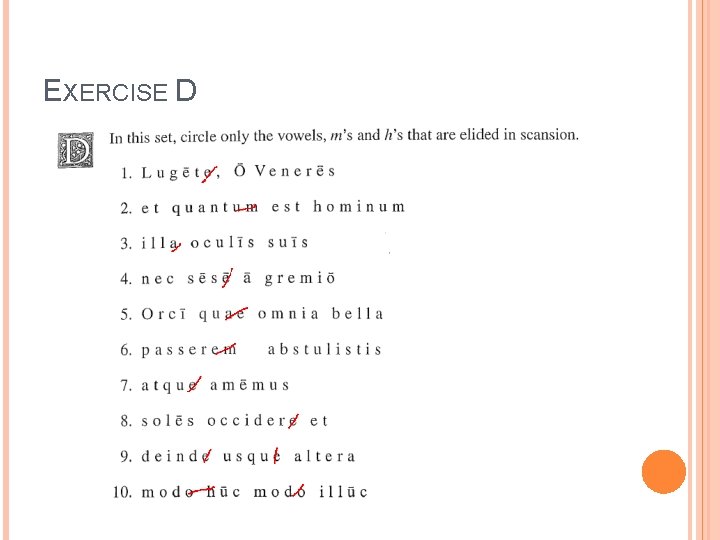
EXERCISE D
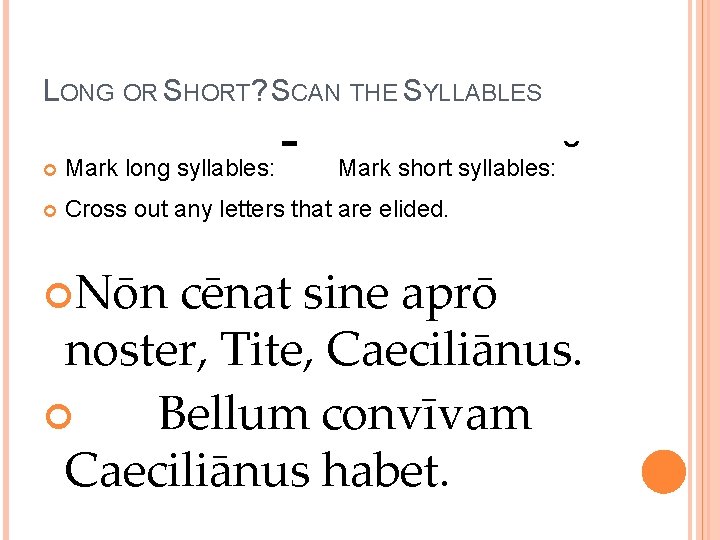
LONG OR SHORT? SCAN THE SYLLABLES ˉ Mark long syllables: Mark short syllables: Cross out any letters that are elided. Nōn ˘ cēnat sine aprō noster, Tite, Caeciliānus. Bellum convīvam Caeciliānus habet.
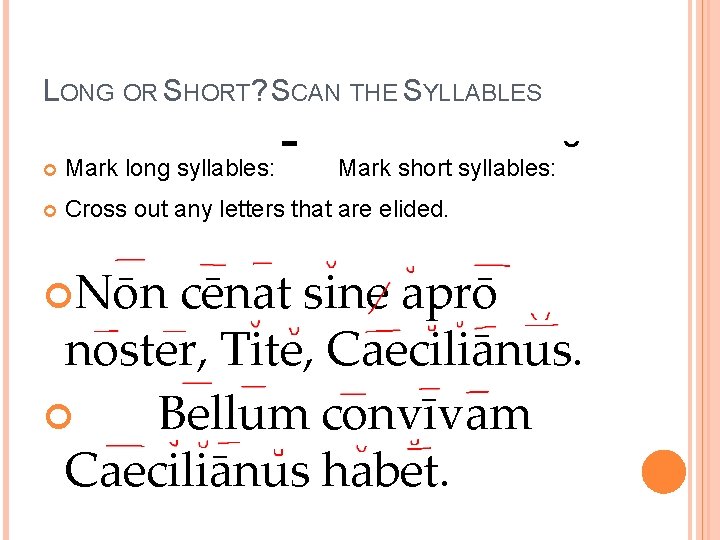
LONG OR SHORT? SCAN THE SYLLABLES ˉ Mark long syllables: Mark short syllables: Cross out any letters that are elided. Nōn ˘ cēnat sine aprō noster, Tite, Caeciliānus. Bellum convīvam Caeciliānus habet.
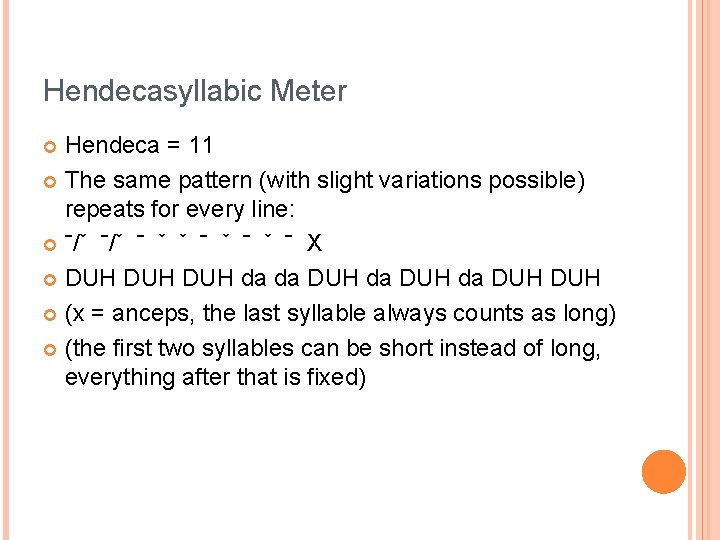
Hendecasyllabic Meter Hendeca = 11 The same pattern (with slight variations possible) repeats for every line: ˉ/ˇ ˉ ˇ ˉ X DUH DUH da da DUH (x = anceps, the last syllable always counts as long) (the first two syllables can be short instead of long, everything after that is fixed)
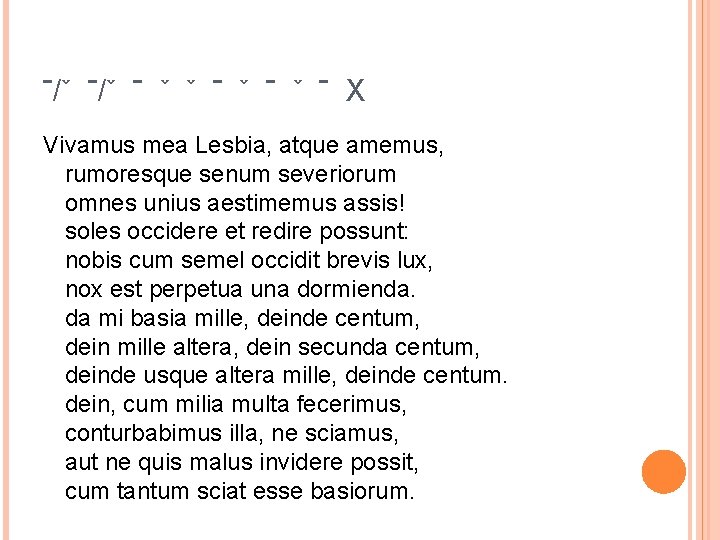
ˉ/ˇ ˉ ˇ ˉ X Vivamus mea Lesbia, atque amemus, rumoresque senum severiorum omnes unius aestimemus assis! soles occidere et redire possunt: nobis cum semel occidit brevis lux, nox est perpetua una dormienda. da mi basia mille, deinde centum, dein mille altera, dein secunda centum, deinde usque altera mille, deinde centum. dein, cum milia multa fecerimus, conturbabimus illa, ne sciamus, aut ne quis malus invidere possit, cum tantum sciat esse basiorum.
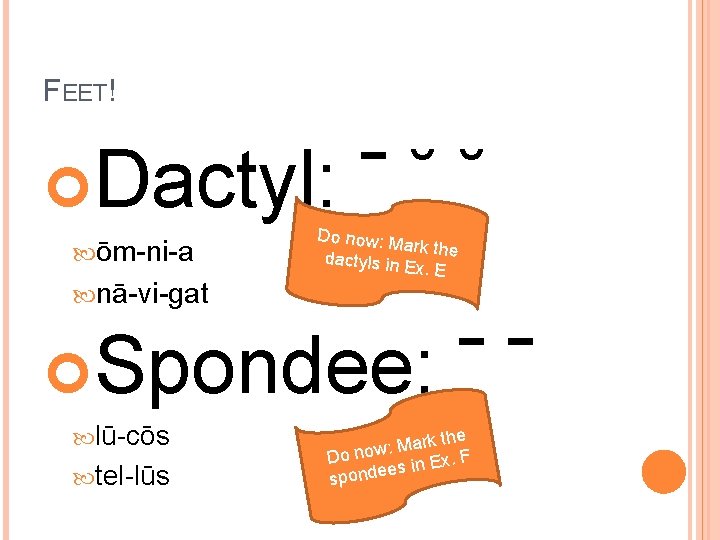
FEET! Dactyl: ˉ ˘ ˘ ōm-ni-a nā-vi-gat Do now: M ark the dactyls in E x. E Spondee: ˉ ˉ lū-cōs tel-lūs rk the a M : w Do no x. F E n i s e sponde
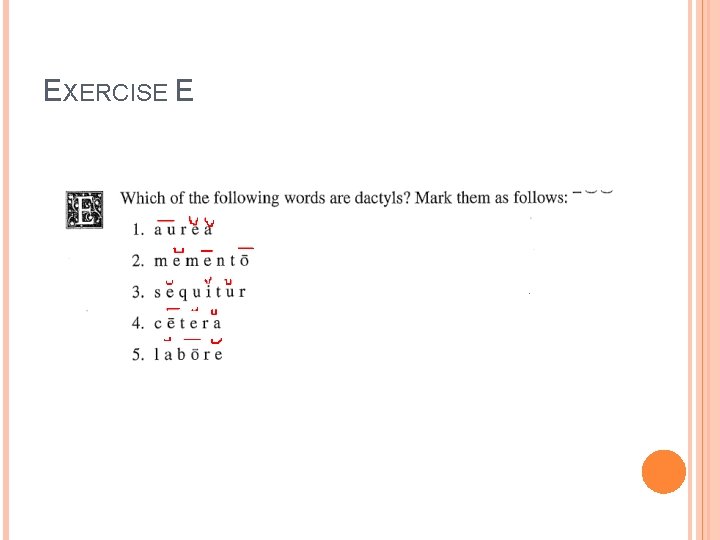
EXERCISE E
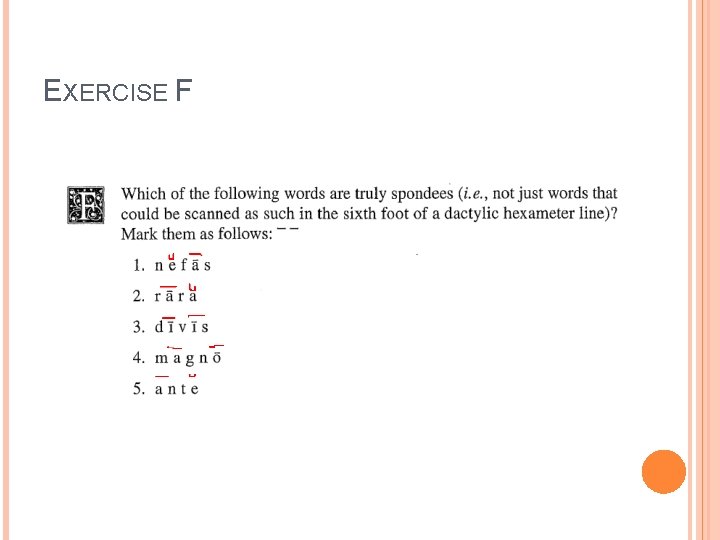
EXERCISE F
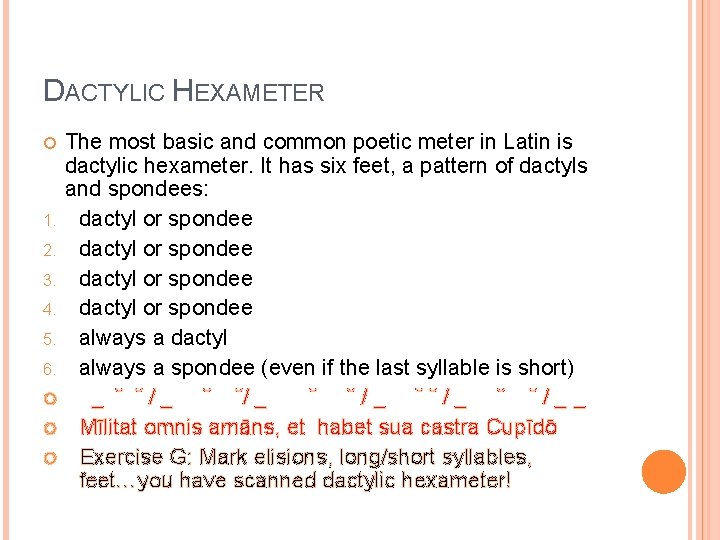
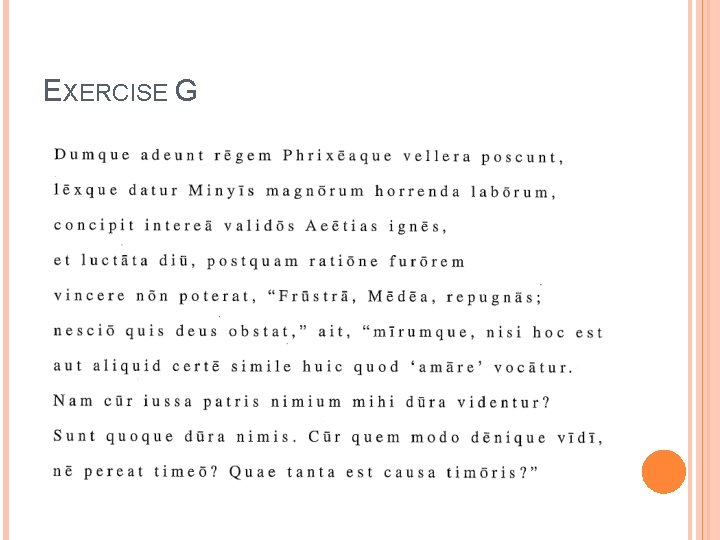
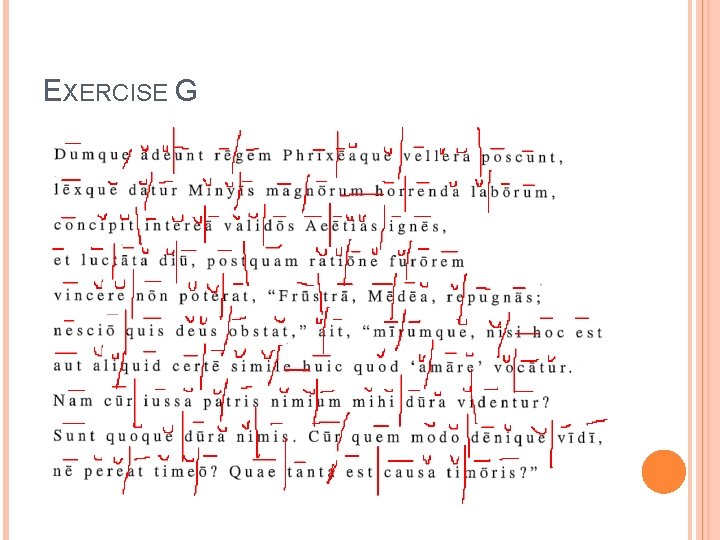
DACTYLIC HEXAMETER 1. 2. 3. 4. 5. 6. The most basic and common poetic meter in Latin is dactylic hexameter. It has six feet, a pattern of dactyls and spondees: dactyl or spondee always a dactyl always a spondee (even if the last syllable is short) _ ˘ ˘ / _ ˘ ˘/ _ ˘ ˘ / _ ˘ ˘ / _ _ Mīlitat omnis amāns, et habet sua castra Cupīdō Exercise G: Mark elisions, long/short syllables, feet…you have scanned dactylic hexameter!
EXERCISE G
EXERCISE G
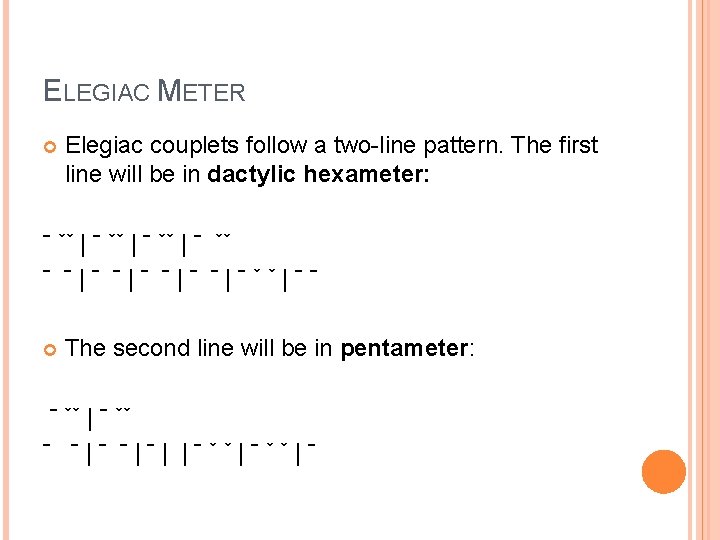
ELEGIAC METER Elegiac couplets follow a two-line pattern. The first line will be in dactylic hexameter: ˉ ˇˇ | ˉ ˇˇ ˉ ˉ | ˉ ˇ ˇ | ˉ ˉ The second line will be in pentameter: ˉ ˇˇ | ˉ ˇˇ ˉ ˉ | ˉ | | ˉ ˇ ˇ | ˉ
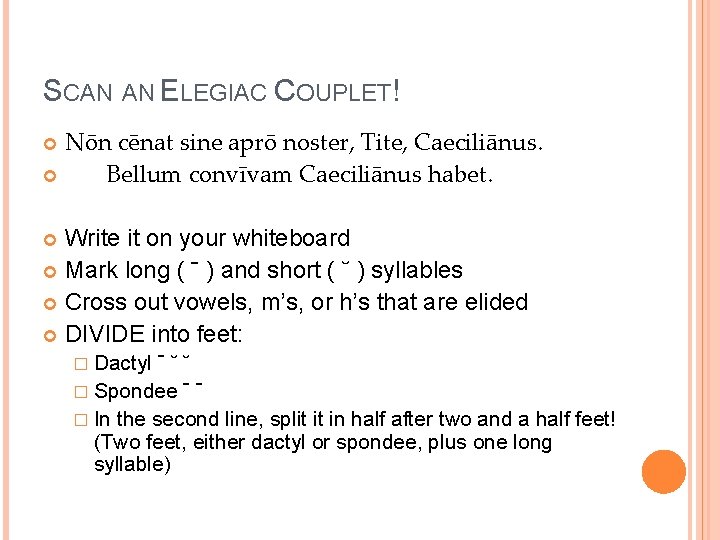
SCAN AN ELEGIAC COUPLET! Nōn cēnat sine aprō noster, Tite, Caeciliānus. Bellum convīvam Caeciliānus habet. Write it on your whiteboard Mark long ( ˉ ) and short ( ˘ ) syllables Cross out vowels, m’s, or h’s that are elided DIVIDE into feet: � Dactyl ˉ ˘ ˘ � Spondee ˉ ˉ � In the second line, split it in half after two and a half feet! (Two feet, either dactyl or spondee, plus one long syllable)
SCANSION RACE! pār erat inferior versus—rīsisse Cupīdō dīcitur atque ūnum surripuisse pedem.
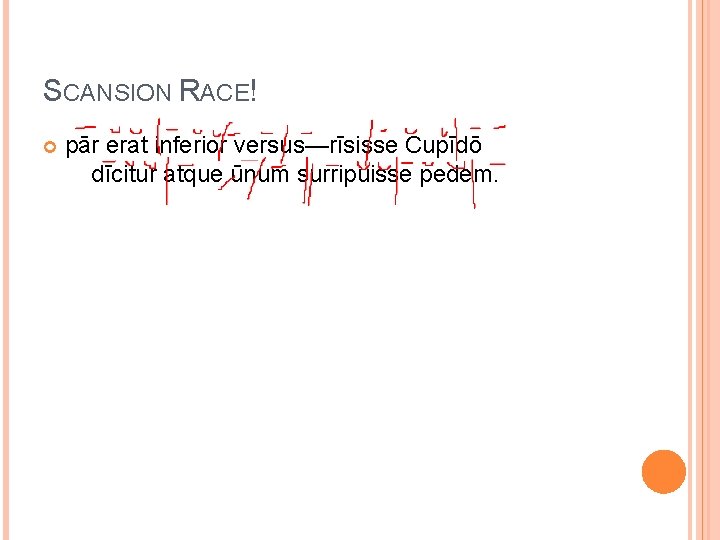
SCANSION RACE! pār erat inferior versus—rīsisse Cupīdō dīcitur atque ūnum surripuisse pedem.
SCANSION RACE! 'Quis tibi, saeve puer, dedit hōc in carmina iūris? Pīeridum vātes, nōn tua turba sumus.
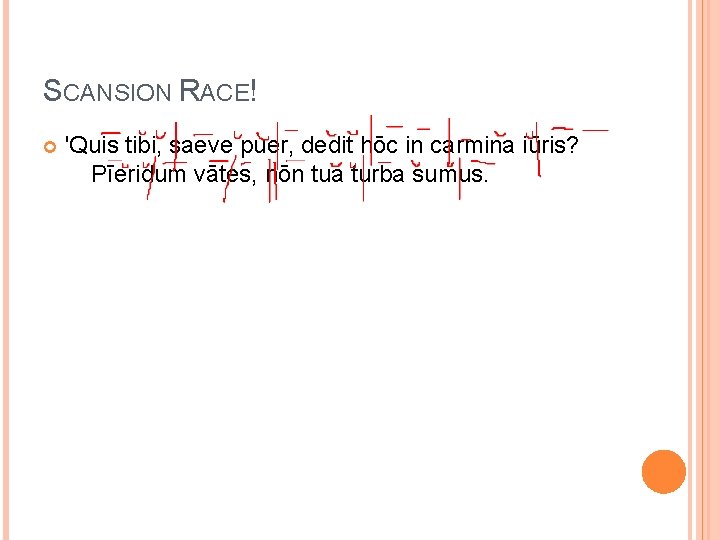
SCANSION RACE! 'Quis tibi, saeve puer, dedit hōc in carmina iūris? Pīeridum vātes, nōn tua turba sumus.
SCANSION RACE! quid, sī praeripiat flāvae Venus arma Minervae, ventilet accensās flāva Minerva facēs?
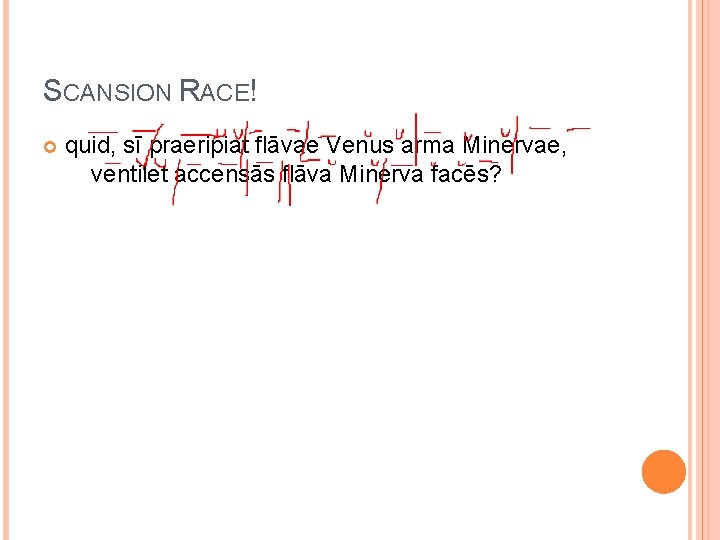
SCANSION RACE! quid, sī praeripiat flāvae Venus arma Minervae, ventilet accensās flāva Minerva facēs?
SCANSION RACE! quis probet in silvis Cererem regnāre iugōsis, lēge pharētrātae Virginis arva colī?
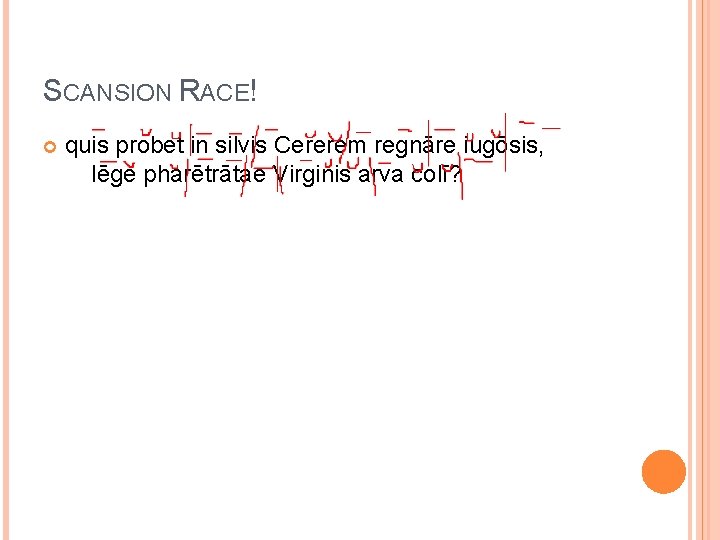
SCANSION RACE! quis probet in silvis Cererem regnāre iugōsis, lēge pharētrātae Virginis arva colī?
SCANSION RACE! crīnibus insignem quis acūtā cuspide Phoebum instruat, Āoniam Marte movente lyram?
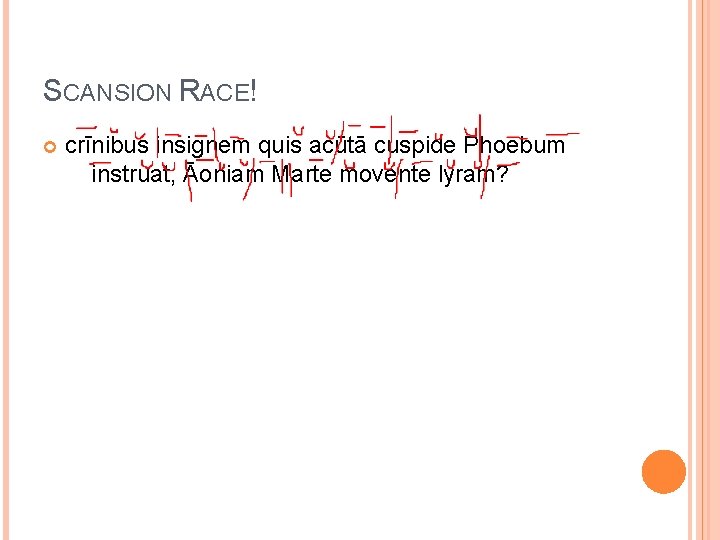
SCANSION RACE! crīnibus insignem quis acūtā cuspide Phoebum instruat, Āoniam Marte movente lyram?
- Slides: 39