The Resorgimento of Italy Unification A Reluctant Nation
- Slides: 32
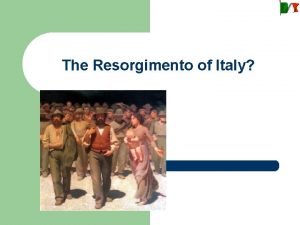
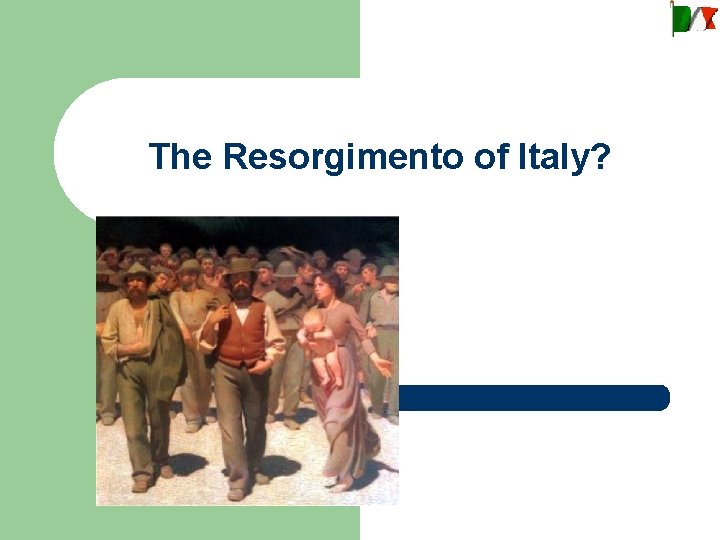
The Resorgimento of Italy?
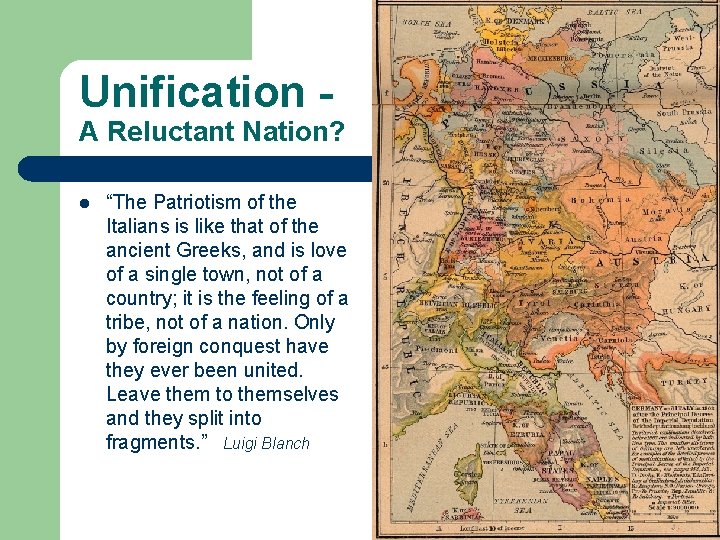
Unification - A Reluctant Nation? l “The Patriotism of the Italians is like that of the ancient Greeks, and is love of a single town, not of a country; it is the feeling of a tribe, not of a nation. Only by foreign conquest have they ever been united. Leave them to themselves and they split into fragments. ” Luigi Blanch
Invaders Queue up & Divide the Peninsular amongst themselves l l l 80 City States in Medieval Italy Consolidated into 10 Provinces during Renaissance - Machiavelli’s handbook French Invasion of 1494 – Venice crushed l l Spanish Counter-invasion – Florence isolated l l With help of jealous neighbours Medici help Spanish The Borgias and the Papacy Ottoman Turks and Greek Corsairs Austrian Habsburgs
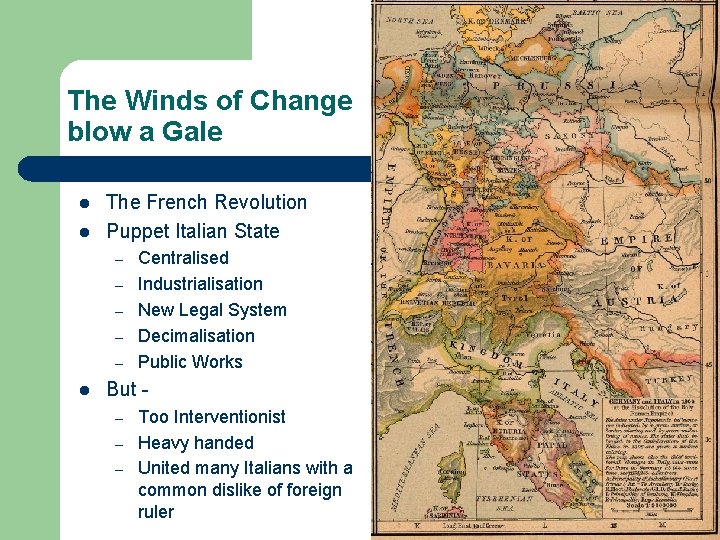
The Winds of Change blow a Gale l l The French Revolution Puppet Italian State – – – l Centralised Industrialisation New Legal System Decimalisation Public Works But – – – Too Interventionist Heavy handed United many Italians with a common dislike of foreign ruler
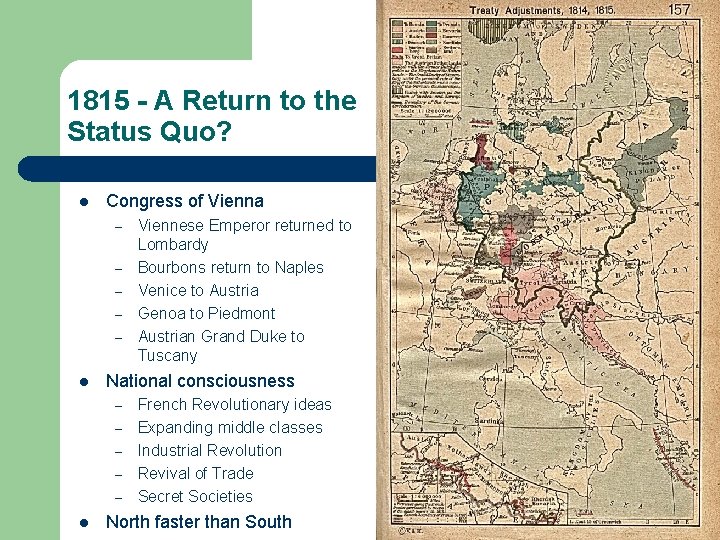
1815 - A Return to the Status Quo? l Congress of Vienna – – – l National consciousness – – – l Viennese Emperor returned to Lombardy Bourbons return to Naples Venice to Austria Genoa to Piedmont Austrian Grand Duke to Tuscany French Revolutionary ideas Expanding middle classes Industrial Revolution Revival of Trade Secret Societies North faster than South
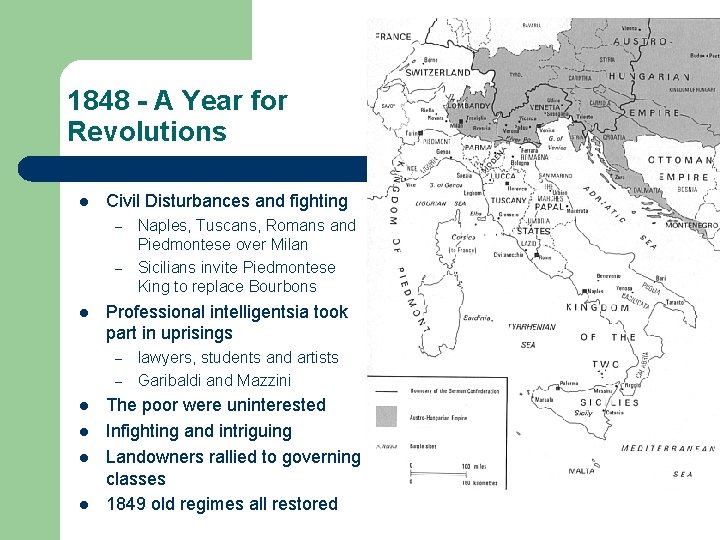
1848 - A Year for Revolutions l Civil Disturbances and fighting – – l Professional intelligentsia took part in uprisings – – l l Naples, Tuscans, Romans and Piedmontese over Milan Sicilians invite Piedmontese King to replace Bourbons lawyers, students and artists Garibaldi and Mazzini The poor were uninterested Infighting and intriguing Landowners rallied to governing classes 1849 old regimes all restored
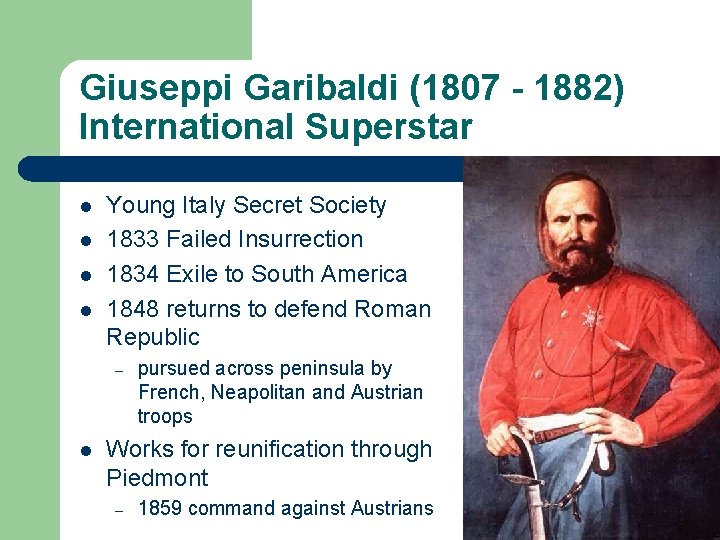
Giuseppi Garibaldi (1807 - 1882) International Superstar l l Young Italy Secret Society 1833 Failed Insurrection 1834 Exile to South America 1848 returns to defend Roman Republic – l pursued across peninsula by French, Neapolitan and Austrian troops Works for reunification through Piedmont – 1859 command against Austrians
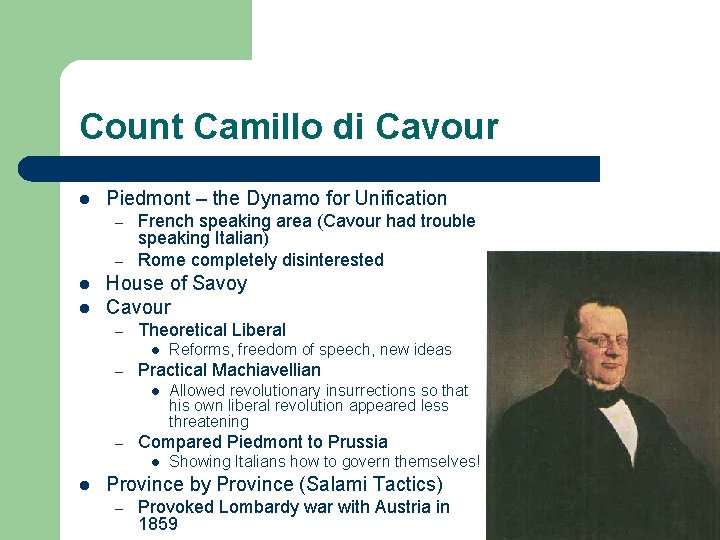
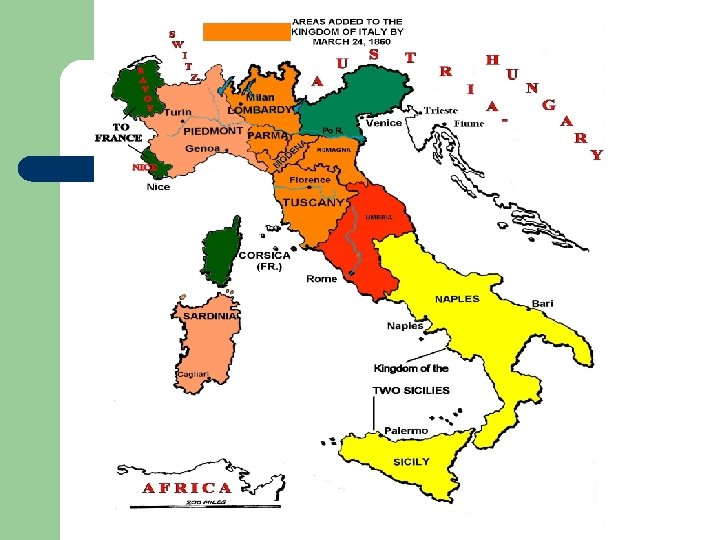
Count Camillo di Cavour l Piedmont – the Dynamo for Unification – – l l French speaking area (Cavour had trouble speaking Italian) Rome completely disinterested House of Savoy Cavour – Theoretical Liberal l – Practical Machiavellian l – Allowed revolutionary insurrections so that his own liberal revolution appeared less threatening Compared Piedmont to Prussia l l Reforms, freedom of speech, new ideas Showing Italians how to govern themselves! Province by Province (Salami Tactics) – Provoked Lombardy war with Austria in 1859
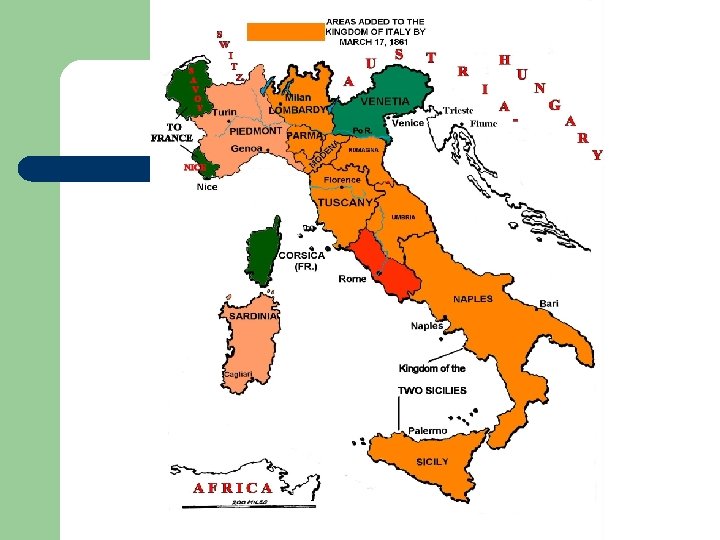
Cavour gives Garibaldi free reign l Traded Nice and Savoy to France – – l Garibaldi’s invasion of Sicily 1860 – – l Bitterly resented by many in Piedmont Given free reign to invade Italian States in return by Louis Napoleon (especially Bourbon States) Cavour ready to disown if necessary Ready to endorse if successful Race for control of Central Italy – – – Cavour afraid that Garibaldi won’t hand over newly won Sicily Race for Naples (Garibaldi gets there first) Cavour starts uprisings in Papal States l l Asks Garibaldi to hand over Naples and Sicily to avoid a civil war Anti-Clerical Garibaldi
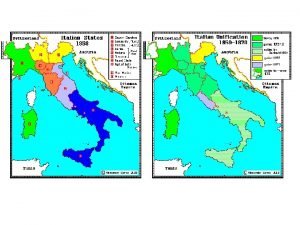
Italy is born l Peninsular under Cavour’s control except – – l l Venice – Austria Rome – Papal Control (French Army) Plebiscites to justify resorgimento Constitutional Monarchy – – 1848 Articles of Sardinia King Vittorio Emanuele II l l l – Power between King and Parliament left deliberately vague King appointed Ministers and signed statutes King could issue Proclamations Appointed Senate - Conservative Plebiscites undermined ‘Divine Rule’ Cavour’s balancing act l l Garibaldi’s Revolutionaries preferred Monarch to Pope Catholics preferred Catholic King to heathen Garibaldi
Parliamentary Democracy? l 300, 000 voters out of 22 Million – l Weak Party Politics – – – l l Widespread corruption and intimidation Coalition Governments Alliances were all If PMs plans failed – just change the plan and the coalition! Parties owed allegiance to strong personalities rather than to ideology – However two loose groupings: Conservative Liberal versus Radical-Democrat – – – Deregulation versus Radical Reforms Radicals had instituted much of the nationalist unification feeling Liberals consolidated and reflected most ‘Educated’ opinion
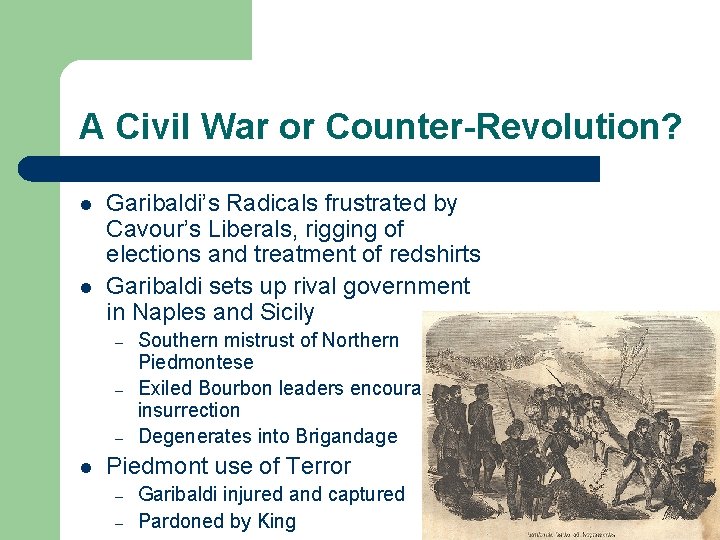
A Civil War or Counter-Revolution? l l Garibaldi’s Radicals frustrated by Cavour’s Liberals, rigging of elections and treatment of redshirts Garibaldi sets up rival government in Naples and Sicily – – – l Southern mistrust of Northern Piedmontese Exiled Bourbon leaders encourage insurrection Degenerates into Brigandage Piedmont use of Terror – – Garibaldi injured and captured Pardoned by King
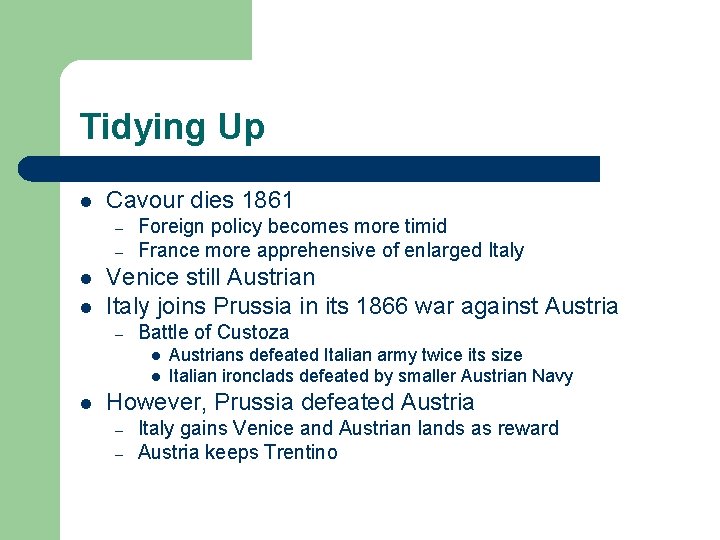
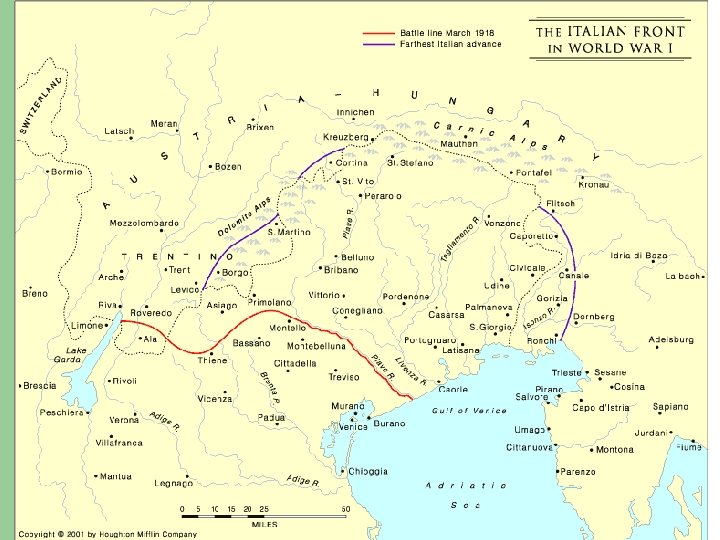
Tidying Up l Cavour dies 1861 – – l l Foreign policy becomes more timid France more apprehensive of enlarged Italy Venice still Austrian Italy joins Prussia in its 1866 war against Austria – Battle of Custoza l l l Austrians defeated Italian army twice its size Italian ironclads defeated by smaller Austrian Navy However, Prussia defeated Austria – – Italy gains Venice and Austrian lands as reward Austria keeps Trentino
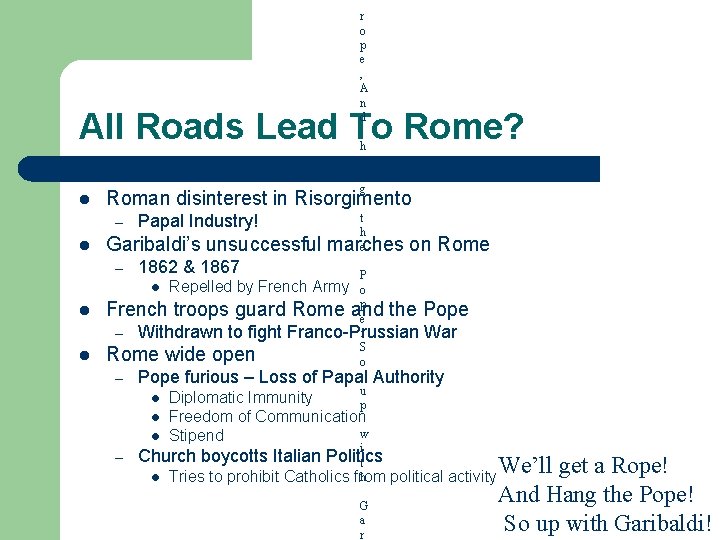
r o p e , A n d All Roads Lead To Rome? l h a n g Roman disinterest in Risorgimento – l 1862 & 1867 P l Repelled by French Army o p e : Withdrawn to fight Franco-Prussian S o French troops guard Rome and the Pope – l t h e Garibaldi’s unsuccessful marches on Rome – l Papal Industry! War Rome wide open – Pope furious – Loss of Papal Authority l l l – u Diplomatic Immunity p Freedom of Communication w Stipend i Church boycotts Italian Politics t l h Tries to prohibit Catholics from political activity G a r We’ll get a Rope! And Hang the Pope! So up with Garibaldi!
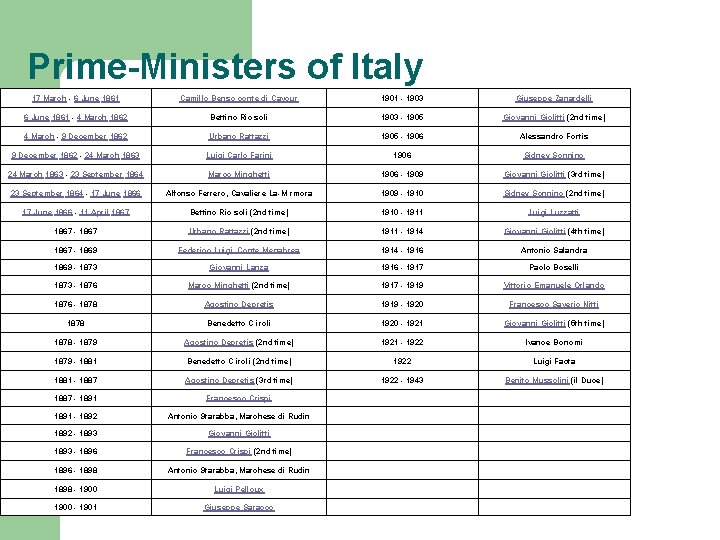
Prime-Ministers of Italy 17 March - 6 June 1861 Camillo Benso conte di Cavour 1901 - 1903 Giuseppe Zanardelli 6 June 1861 - 4 March 1862 Bettino Ric soli 1903 - 1905 Giovanni Giolitti (2 nd time) 4 March - 9 December 1862 Urbano Rattazzi 1905 - 1906 Alessandro Fortis 9 December 1862 - 24 March 1863 Luigi Carlo Farini 1906 Sidney Sonnino 24 March 1863 - 23 September 1864 Marco Minghetti 1906 - 1909 Giovanni Giolitti (3 rd time) 23 September 1864 - 17 June 1866 Alfonso Ferrero, Cavaliere La-M rmora 1909 - 1910 Sidney Sonnino (2 nd time) 17 June 1866 - 11 April 1867 Bettino Ric soli (2 nd time) 1910 - 1911 Luigi Luzzatti 1867 - 1867 Urbano Rattazzi (2 nd time) 1911 - 1914 Giovanni Giolitti (4 th time) 1867 - 1869 Federico Luigi, Conte Menabrea 1914 - 1916 Antonio Salandra 1869 - 1873 Giovanni Lanza 1916 - 1917 Paolo Boselli 1873 - 1876 Marco Minghetti (2 nd time) 1917 - 1919 Vittorio Emanuele Orlando 1876 - 1878 Agostino Depretis 1919 - 1920 Francesco Saverio Nitti 1878 Benedetto C iroli 1920 - 1921 Giovanni Giolitti (5 th time) 1878 - 1879 Agostino Depretis (2 nd time) 1921 - 1922 Ivanoe Bonomi 1879 - 1881 Benedetto C iroli (2 nd time) 1922 Luigi Facta 1881 - 1887 Agostino Depretis (3 rd time) 1922 - 1943 Benito Mussolini (il Duce) 1887 - 1891 Francesco Crispi 1891 - 1892 Antonio Starabba, Marchese di Rudin 1892 - 1893 Giovanni Giolitti 1893 - 1896 Francesco Crispi (2 nd time) 1896 - 1898 Antonio Starabba, Marchese di Rudin 1898 - 1900 Luigi Pelloux 1900 - 1901 Giuseppe Saracco
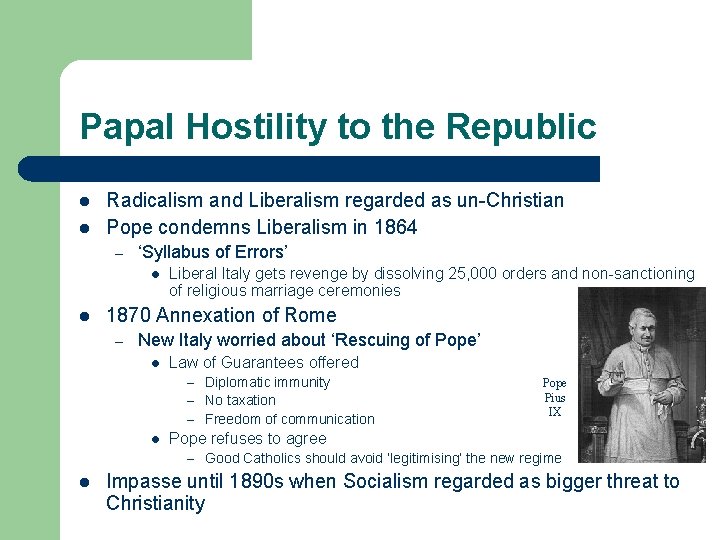
Papal Hostility to the Republic l l Radicalism and Liberalism regarded as un-Christian Pope condemns Liberalism in 1864 – ‘Syllabus of Errors’ l l Liberal Italy gets revenge by dissolving 25, 000 orders and non-sanctioning of religious marriage ceremonies 1870 Annexation of Rome – New Italy worried about ‘Rescuing of Pope’ l Law of Guarantees offered – Diplomatic immunity – No taxation – Freedom of communication l Pope Pius IX Pope refuses to agree – Good Catholics should avoid ‘legitimising’ the new regime l Impasse until 1890 s when Socialism regarded as bigger threat to Christianity
Parliamentary Dominance of Fractious Liberals l Tiny electorate – l About 500 voters per constituency Working class removed from political life – Franchise l l Aristocracy removed from political life – l Catholic embargo Party Bosses – – – Personality based Fluid loyalties Corrupt l l Property + Literacy + Male + >25 Giolitti Blackmail dossiers Fragile Alliances – – 29 governments between 1870 and 1911 However, often same personnel shift between governments
Degrees of Liberalism l Conservative Liberals – – l More Laissez-Faire Free Trade Balance Budget Strong armed forces Left Liberals – – Extend Franchise State Education l – l More anti-clerical Public Works through government expenditure Centrists
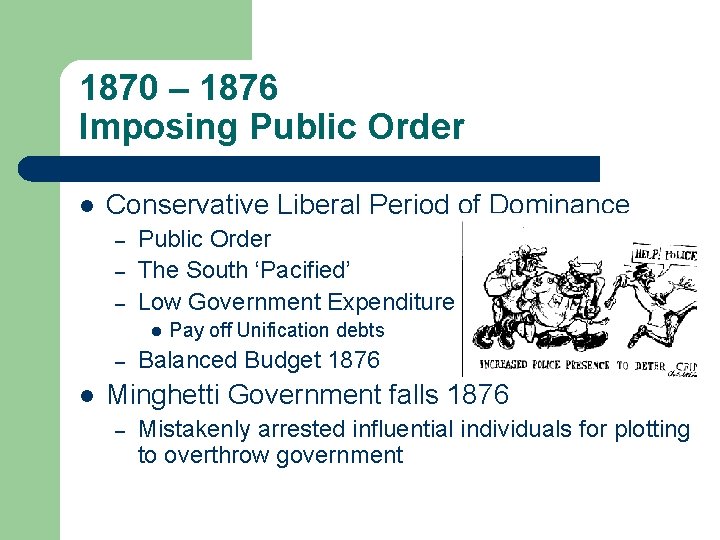
1870 – 1876 Imposing Public Order l Conservative Liberal Period of Dominance – – – Public Order The South ‘Pacified’ Low Government Expenditure l – l Pay off Unification debts Balanced Budget 1876 Minghetti Government falls 1876 – Mistakenly arrested influential individuals for plotting to overthrow government
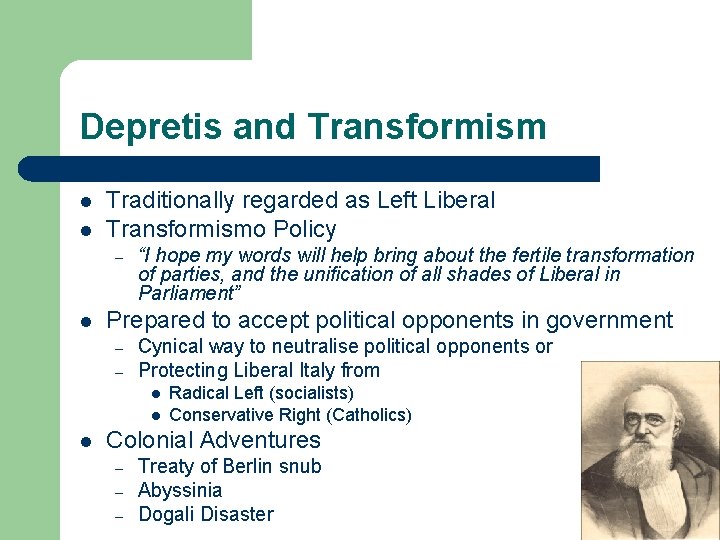
Depretis and Transformism l l Traditionally regarded as Left Liberal Transformismo Policy – l “I hope my words will help bring about the fertile transformation of parties, and the unification of all shades of Liberal in Parliament” Prepared to accept political opponents in government – – Cynical way to neutralise political opponents or Protecting Liberal Italy from l l l Radical Left (socialists) Conservative Right (Catholics) Colonial Adventures – – – Treaty of Berlin snub Abyssinia Dogali Disaster
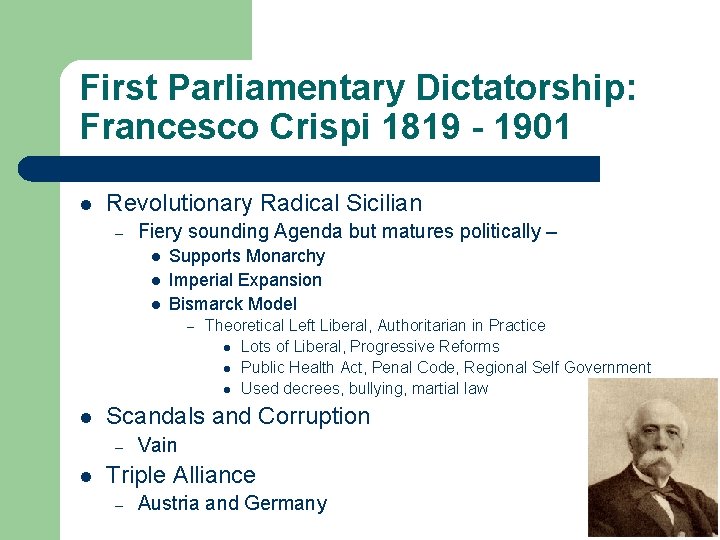
First Parliamentary Dictatorship: Francesco Crispi 1819 - 1901 l Revolutionary Radical Sicilian – Fiery sounding Agenda but matures politically – l l l Supports Monarchy Imperial Expansion Bismarck Model – l Scandals and Corruption – l Theoretical Left Liberal, Authoritarian in Practice l Lots of Liberal, Progressive Reforms l Public Health Act, Penal Code, Regional Self Government l Used decrees, bullying, martial law Vain Triple Alliance – Austria and Germany
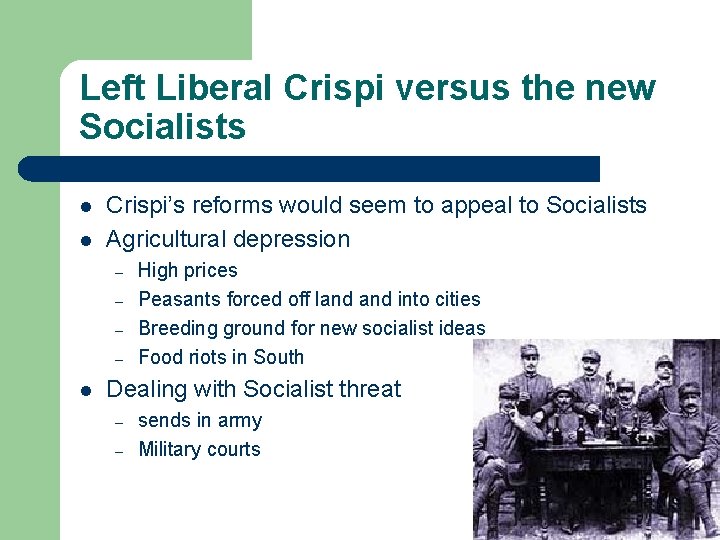
Left Liberal Crispi versus the new Socialists l l Crispi’s reforms would seem to appeal to Socialists Agricultural depression – – l High prices Peasants forced off land into cities Breeding ground for new socialist ideas Food riots in South Dealing with Socialist threat – – sends in army Military courts
Power Corrupts? Crispi: l “We Italians are authoritarian to the very marrow of our bones, and by tradition, habit and education we have become conditioned either to command too much or to obey too much. We may learn from books and from foreigners that liberty is something to be desired for its own sake, but we never, absolutely never, feel that is true deep down in our hearts!"
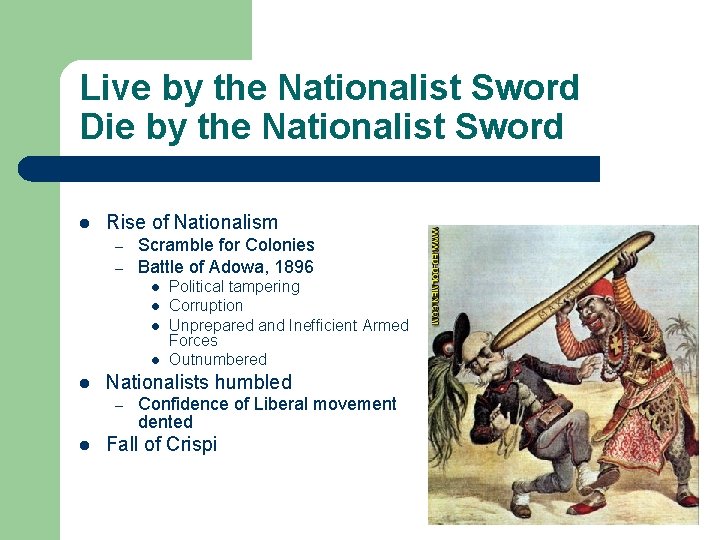
Live by the Nationalist Sword Die by the Nationalist Sword l Rise of Nationalism – – Scramble for Colonies Battle of Adowa, 1896 l l l Nationalists humbled – l Political tampering Corruption Unprepared and Inefficient Armed Forces Outnumbered Confidence of Liberal movement dented Fall of Crispi
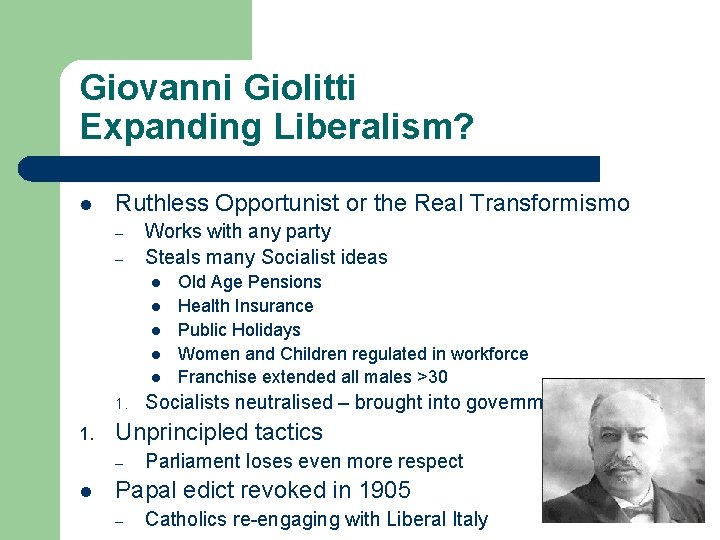
Giovanni Giolitti Expanding Liberalism? l Ruthless Opportunist or the Real Transformismo – – Works with any party Steals many Socialist ideas l l l 1. Socialists neutralised – brought into government Unprincipled tactics – l Old Age Pensions Health Insurance Public Holidays Women and Children regulated in workforce Franchise extended all males >30 Parliament loses even more respect Papal edict revoked in 1905 – Catholics re-engaging with Liberal Italy
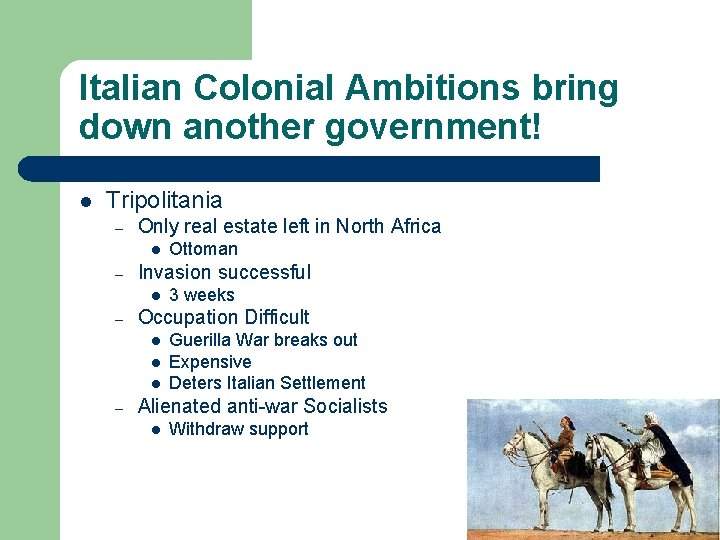
Italian Colonial Ambitions bring down another government! l Tripolitania – Only real estate left in North Africa l – Invasion successful l – 3 weeks Occupation Difficult l l l – Ottoman Guerilla War breaks out Expensive Deters Italian Settlement Alienated anti-war Socialists l Withdraw support
1913 General Election l l Newly enfranchised masses Liberals win 318 out of 511 seats – l Seemingly Victorious Secret Electoral Deal – Giolitti and Catholics l Liberals would not support divorce – Support Religious schools and reopening orders – l l Anti-Clerical Liberals livid Transformismo dead Giolitti resigned expecting to make a new coalition l l Out of power for next six years Professor Antonio Salandra outmanoeuvres wily Giolitti
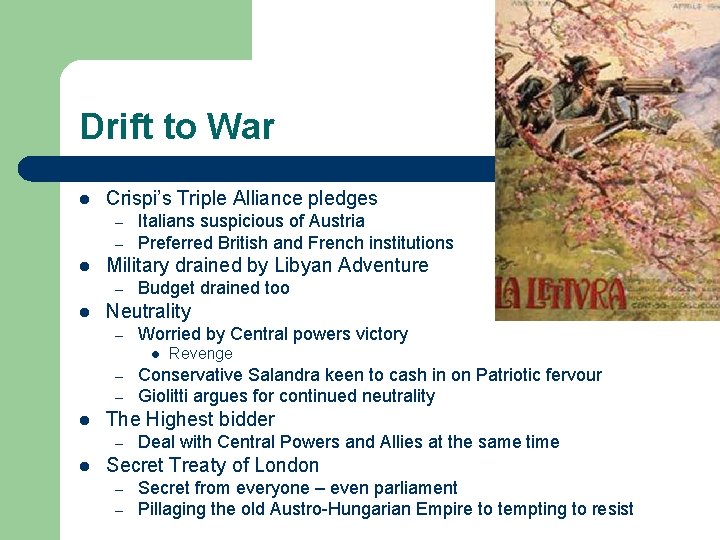
Drift to War l Crispi’s Triple Alliance pledges – – l Military drained by Libyan Adventure – l Italians suspicious of Austria Preferred British and French institutions Budget drained too Neutrality – Worried by Central powers victory l – – l Conservative Salandra keen to cash in on Patriotic fervour Giolitti argues for continued neutrality The Highest bidder – l Revenge Deal with Central Powers and Allies at the same time Secret Treaty of London – – Secret from everyone – even parliament Pillaging the old Austro-Hungarian Empire to tempting to resist