The Islamic University of Gaza Faculty of Engineering
- Slides: 31
The Islamic University of Gaza Faculty of Engineering Civil Engineering Department Numerical Analysis ECIV 3306 Chapter 21 Newton-Cotes Integration Formula
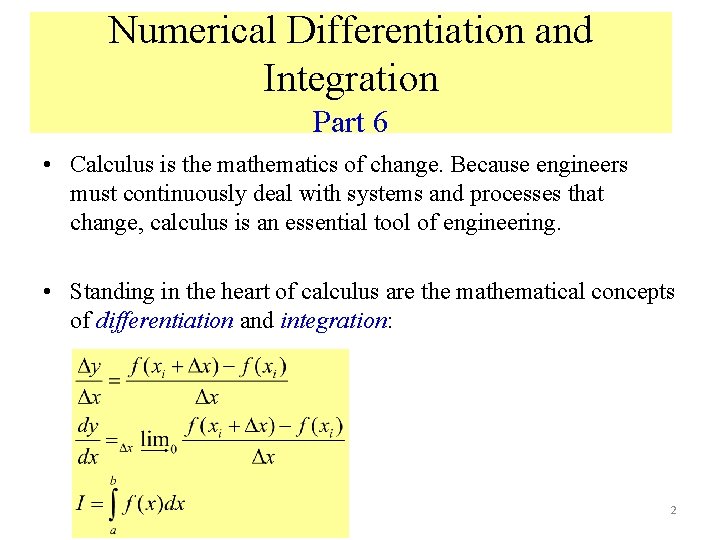
Numerical Differentiation and Integration Part 6 • Calculus is the mathematics of change. Because engineers must continuously deal with systems and processes that change, calculus is an essential tool of engineering. • Standing in the heart of calculus are the mathematical concepts of differentiation and integration: 2
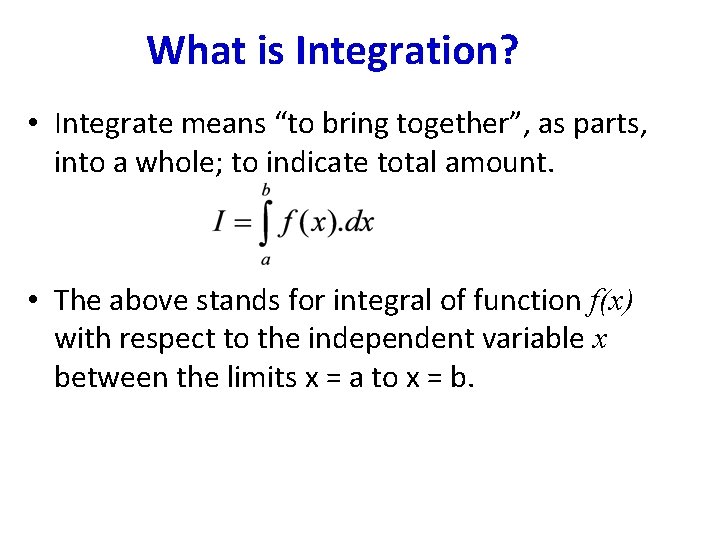
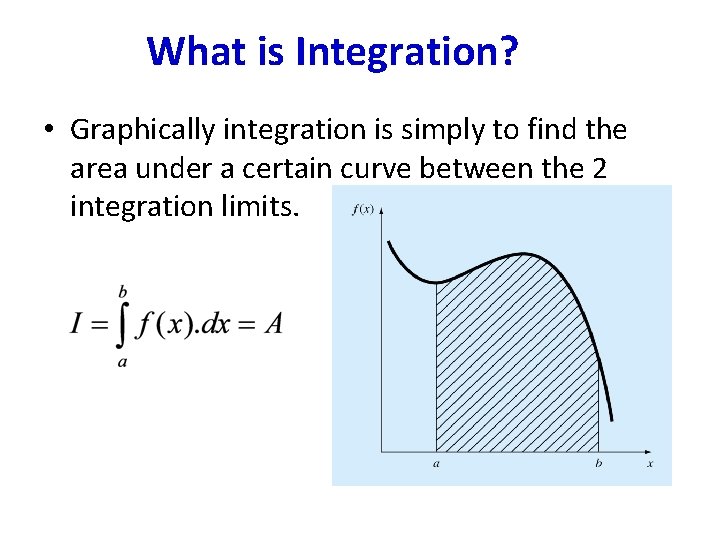
What is Integration? • Integrate means “to bring together”, as parts, into a whole; to indicate total amount. • The above stands for integral of function f(x) with respect to the independent variable x between the limits x = a to x = b.
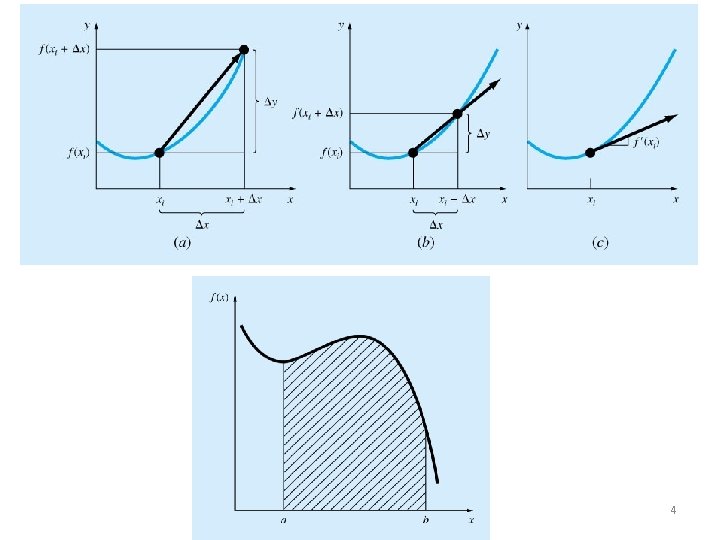
4
What is Integration? • Graphically integration is simply to find the area under a certain curve between the 2 integration limits.
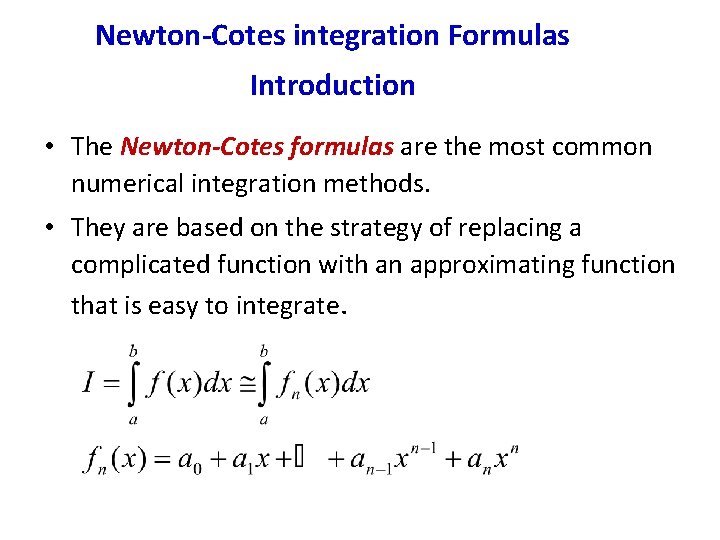
Newton-Cotes integration Formulas Introduction • The Newton-Cotes formulas are the most common numerical integration methods. • They are based on the strategy of replacing a complicated function with an approximating function that is easy to integrate.
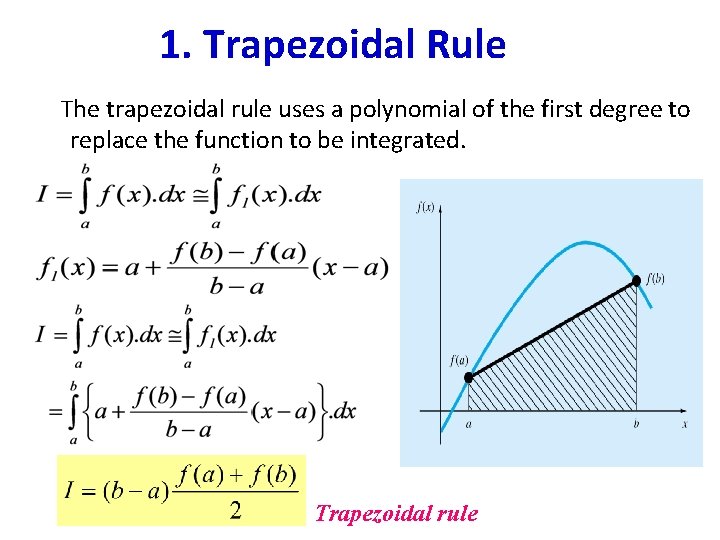
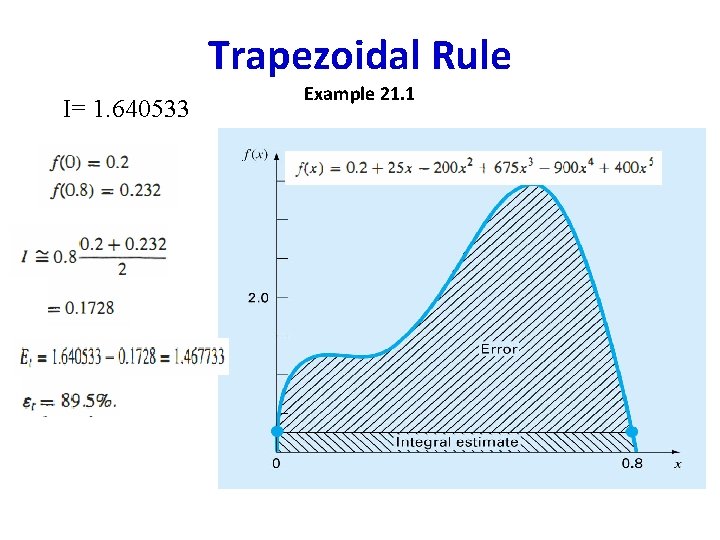
1. Trapezoidal Rule The trapezoidal rule uses a polynomial of the first degree to replace the function to be integrated. Trapezoidal rule
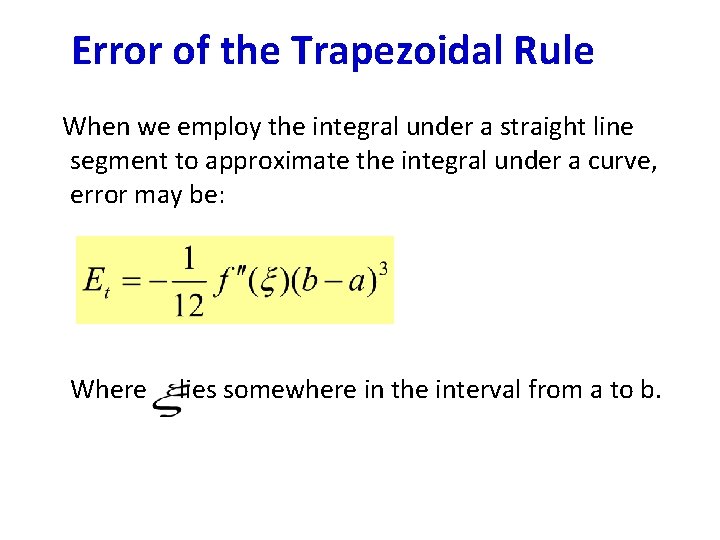
Error of the Trapezoidal Rule When we employ the integral under a straight line segment to approximate the integral under a curve, error may be: Where lies somewhere in the interval from a to b.
Trapezoidal Rule I= 1. 640533 Example 21. 1
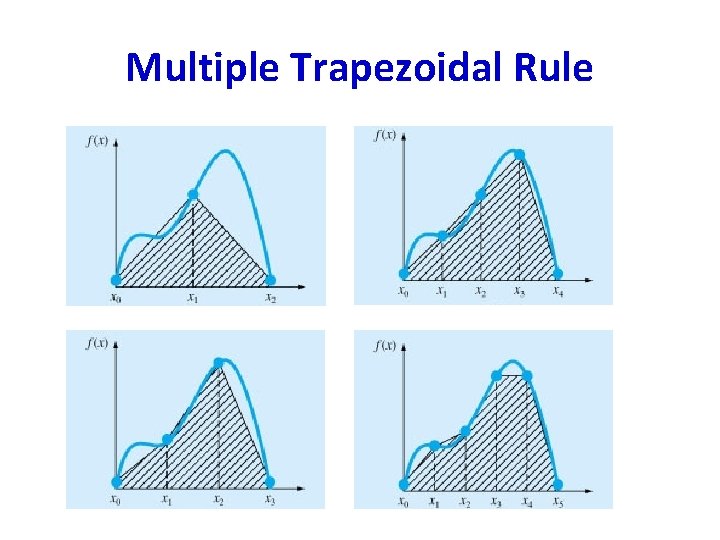
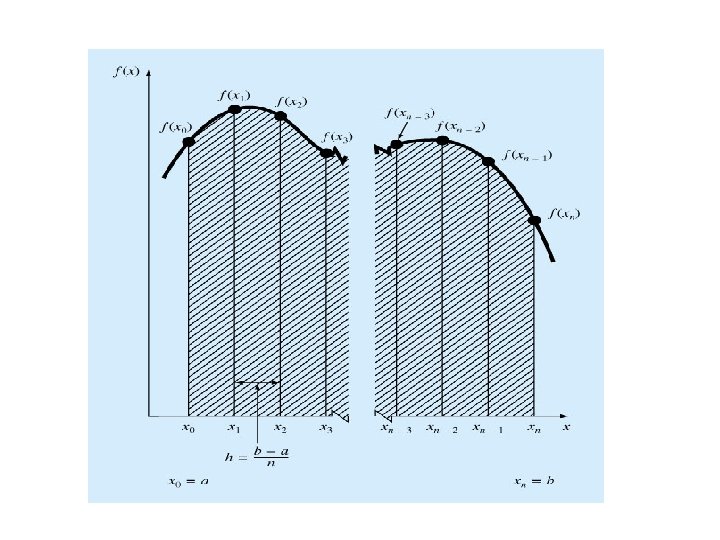
Multiple Trapezoidal Rule • One way to improve the accuracy of the trapezoidal rule is to divide the integration interval from a to b into a number of segments and apply the method to each segment. • The areas of individual segments can then be added to yield the integral for the entire interval.
Multiple Trapezoidal Rule
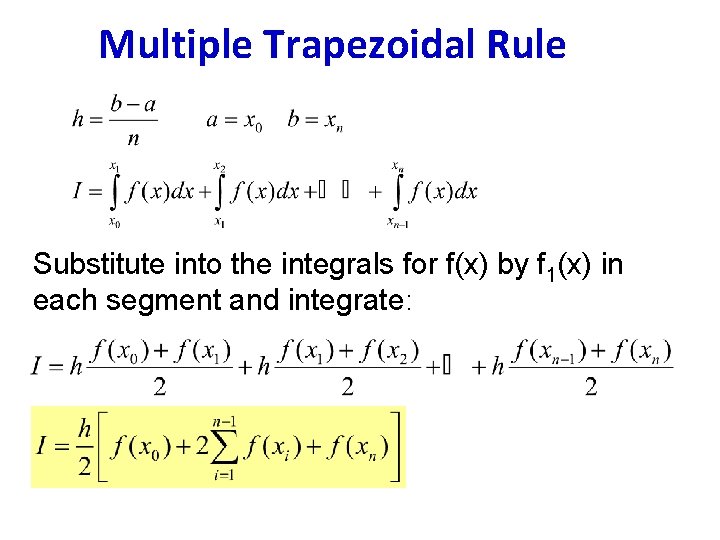
Multiple Trapezoidal Rule Substitute into the integrals for f(x) by f 1(x) in each segment and integrate:
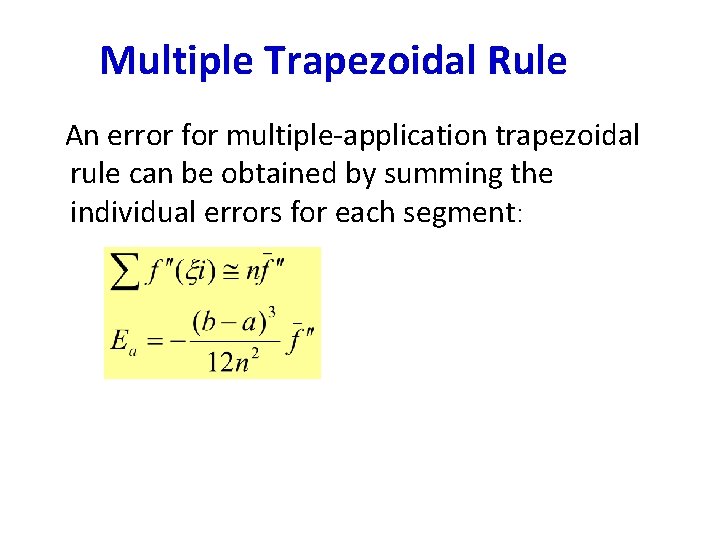
Multiple Trapezoidal Rule An error for multiple-application trapezoidal rule can be obtained by summing the individual errors for each segment:
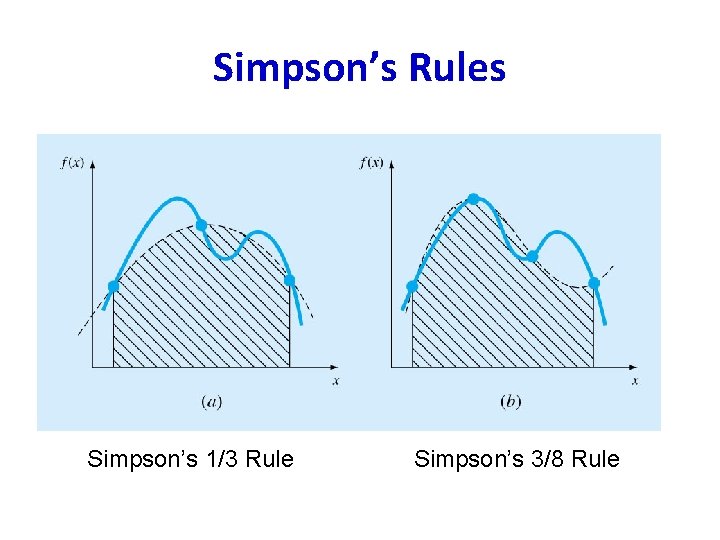
Simpson’s Rules More accurate estimate of an integral is obtained if a high-order polynomial is used to connect the points. The formulas that result from taking the integrals under such polynomials are called Simpson’s Rules.
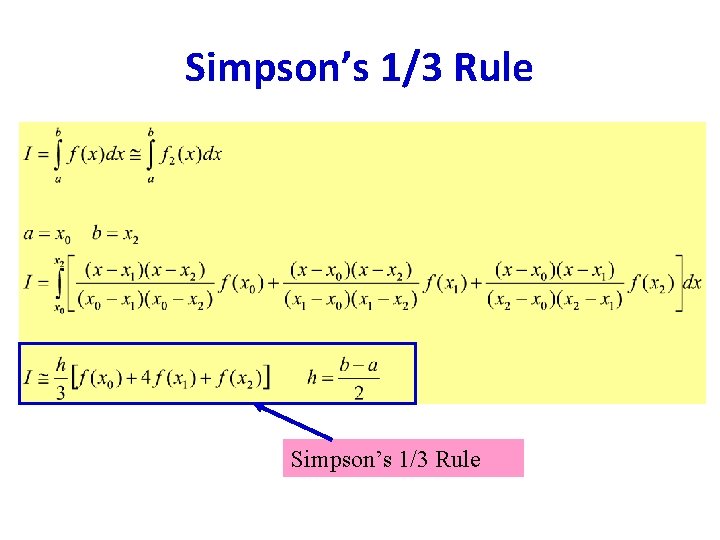
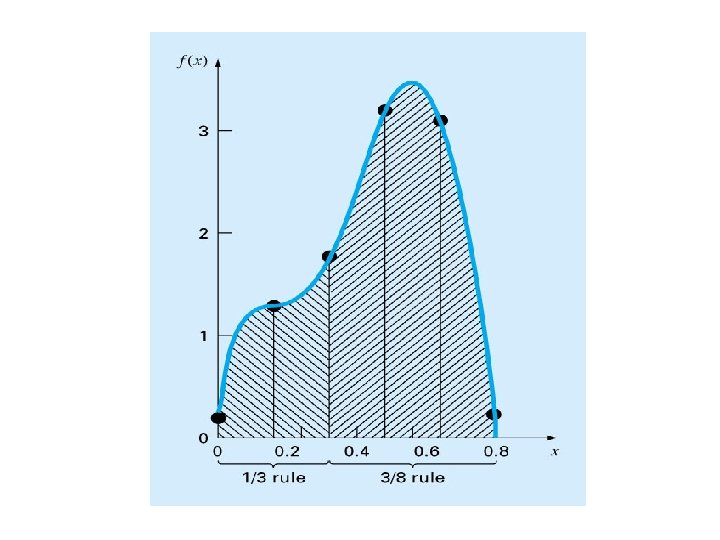
Simpson’s Rules • Simpson’s 1/3 Rule Results when a second-order interpolating polynomial is used. • Simpson’s 3/8 Rule Results when a third-order (cubic) interpolating polynomial is used.
Simpson’s Rules Simpson’s 1/3 Rule Simpson’s 3/8 Rule
Simpson’s 1/3 Rule
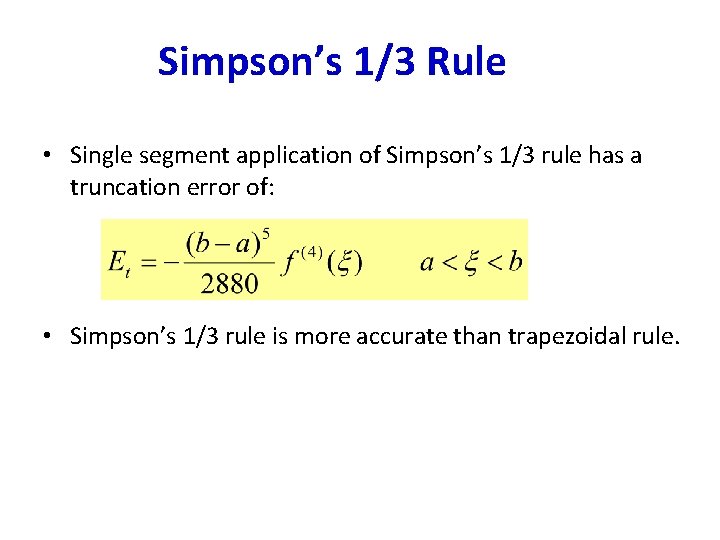
Simpson’s 1/3 Rule • Single segment application of Simpson’s 1/3 rule has a truncation error of: • Simpson’s 1/3 rule is more accurate than trapezoidal rule.
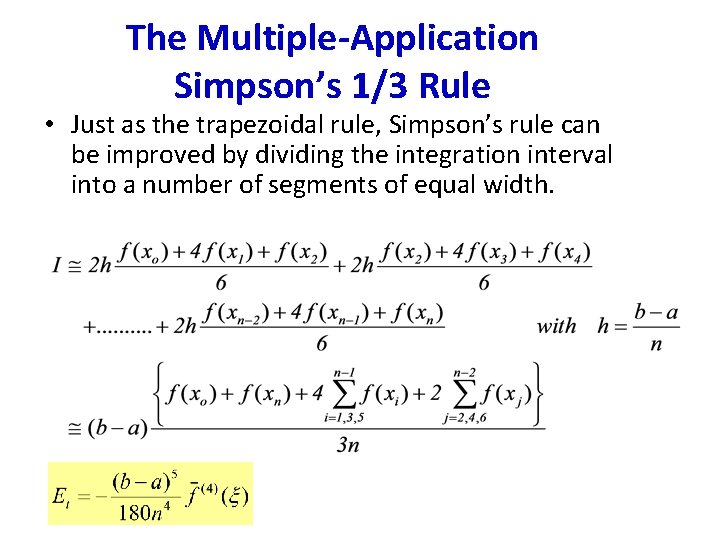
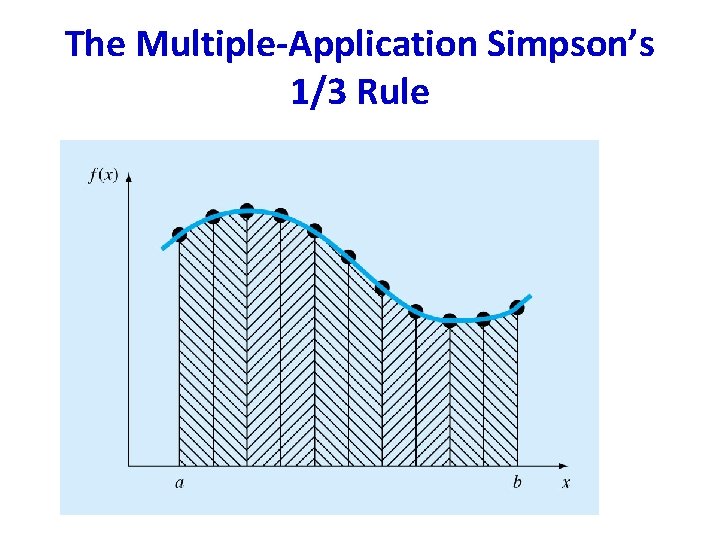
The Multiple-Application Simpson’s 1/3 Rule • Just as the trapezoidal rule, Simpson’s rule can be improved by dividing the integration interval into a number of segments of equal width.
The Multiple-Application Simpson’s 1/3 Rule
The Multiple-Application Simpson’s 1/3 Rule • However, it is limited to cases where values are equi-spaced. • Further, it is limited to situations where there an even number of segments and odd number of points
The Multiple-Application Simpson’s 1/3 Rule
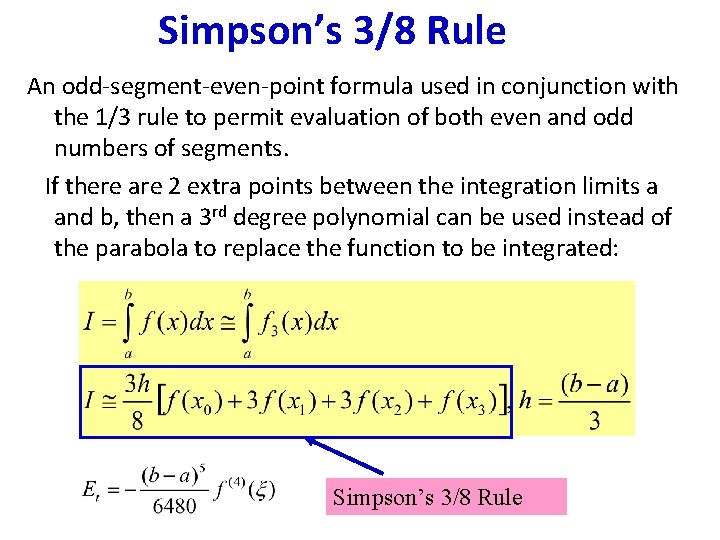
Simpson’s 3/8 Rule An odd-segment-even-point formula used in conjunction with the 1/3 rule to permit evaluation of both even and odd numbers of segments. If there are 2 extra points between the integration limits a and b, then a 3 rd degree polynomial can be used instead of the parabola to replace the function to be integrated: Simpson’s 3/8 Rule
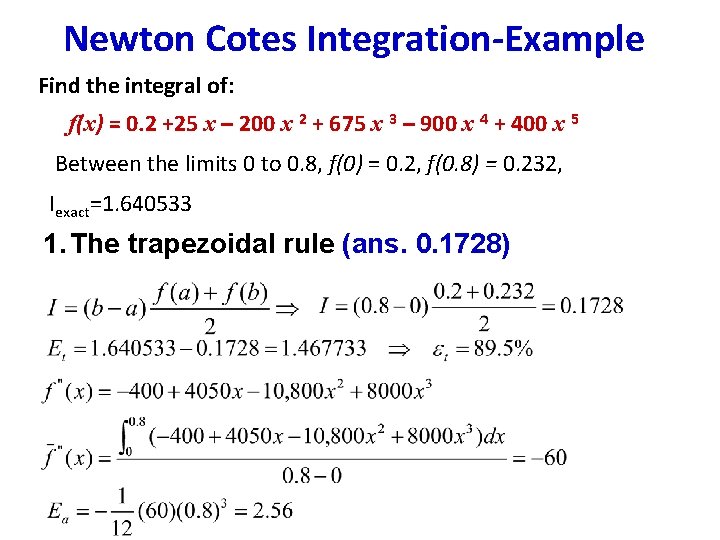
Newton Cotes Integration-Example Find the integral of: f(x) = 0. 2 +25 x – 200 x 2 + 675 x 3 – 900 x 4 + 400 x 5 Between the limits 0 to 0. 8, f(0) = 0. 2, f(0. 8) = 0. 232, Iexact=1. 640533 1. The trapezoidal rule (ans. 0. 1728)
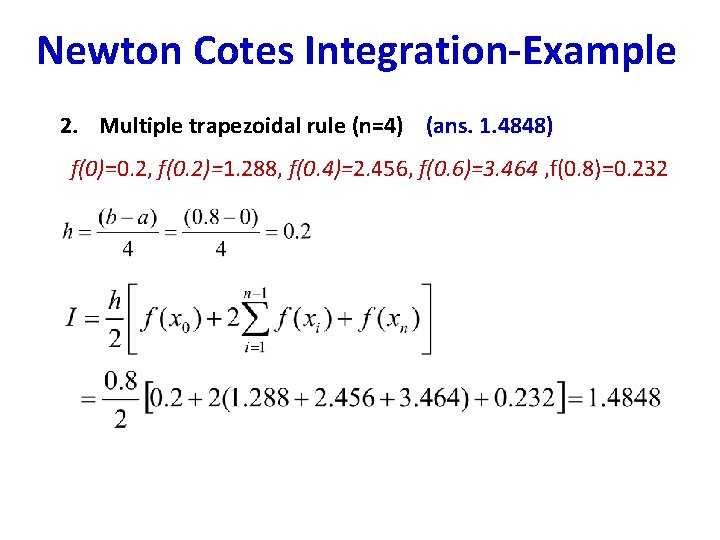
Newton Cotes Integration-Example 2. Multiple trapezoidal rule (n=4) (ans. 1. 4848) f(0)=0. 2, f(0. 2)=1. 288, f(0. 4)=2. 456, f(0. 6)=3. 464 , f(0. 8)=0. 232
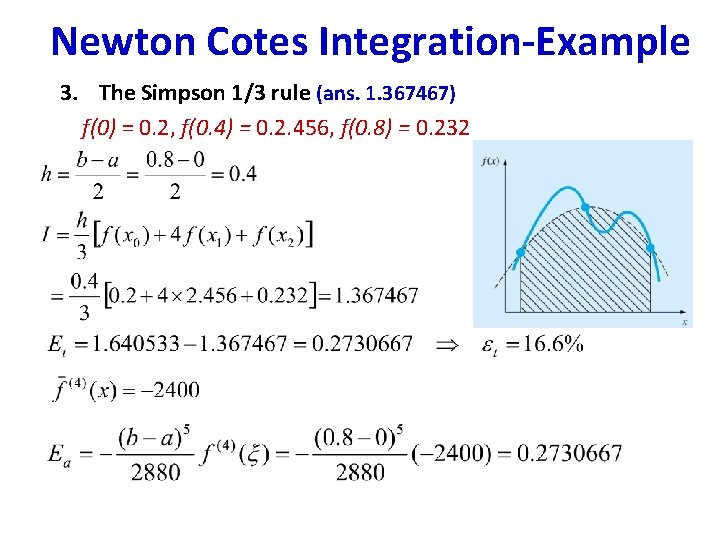
Newton Cotes Integration-Example 3. The Simpson 1/3 rule (ans. 1. 367467) f(0) = 0. 2, f(0. 4) = 0. 2. 456, f(0. 8) = 0. 232
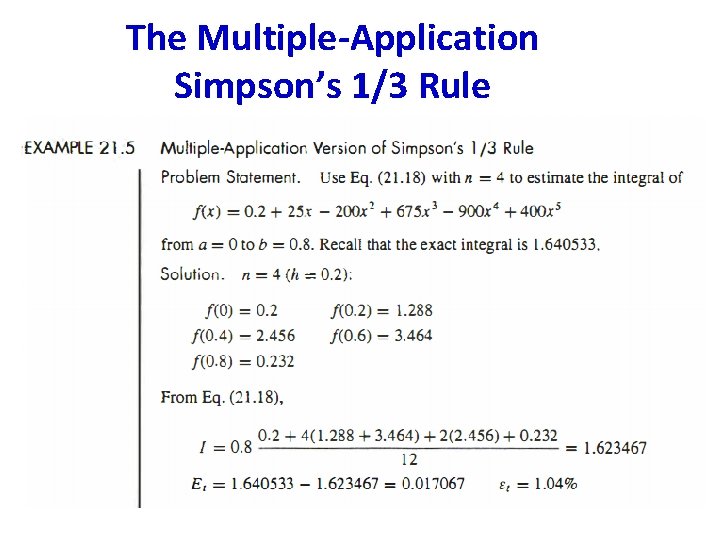
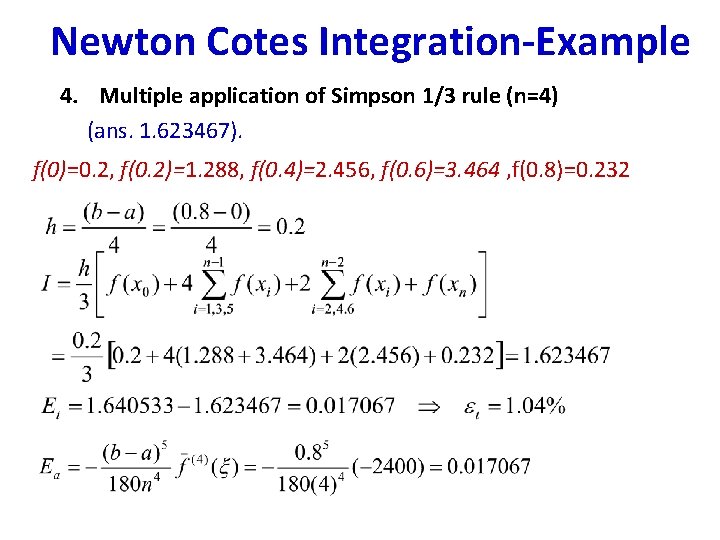
Newton Cotes Integration-Example 4. Multiple application of Simpson 1/3 rule (n=4) (ans. 1. 623467). f(0)=0. 2, f(0. 2)=1. 288, f(0. 4)=2. 456, f(0. 6)=3. 464 , f(0. 8)=0. 232
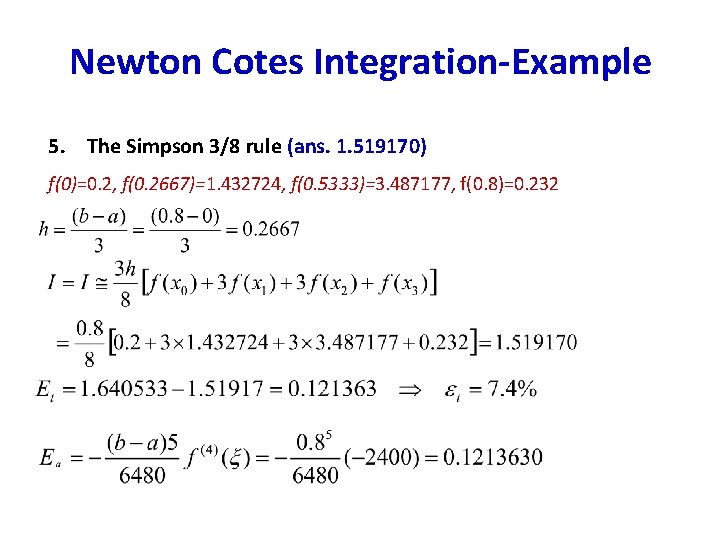
Newton Cotes Integration-Example 5. The Simpson 3/8 rule (ans. 1. 519170) f(0)=0. 2, f(0. 2667)=1. 432724, f(0. 5333)=3. 487177, f(0. 8)=0. 232
H. W Read Examples; 21. 6 - 21. 7 Solve problems; 21. 3 - 21. 10 - 21. 21