The Implications of Preference Crystallization on Career Decision



- Slides: 21
The Implications of Preference Crystallization on Career Decision. Making Itamar Gati Hebrew University of Jerusalem and Aviva Shimoni Beit Berl Academic College
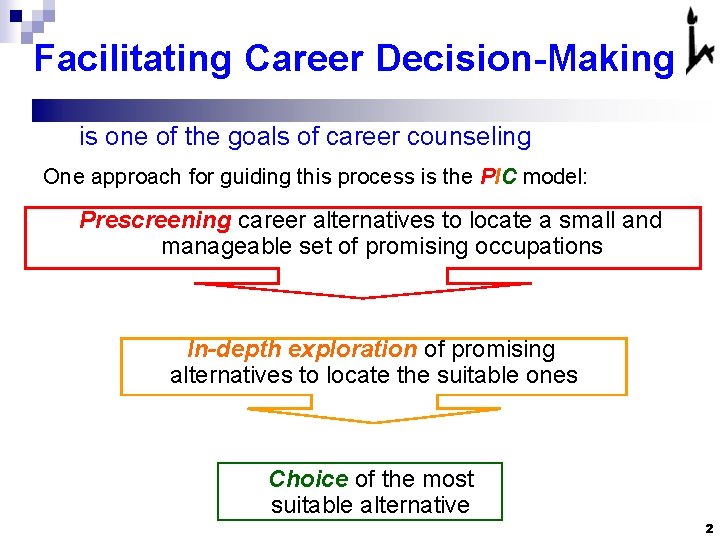
Facilitating Career Decision-Making is one of the goals of career counseling One approach for guiding this process is the PIC model: Prescreening career alternatives to locate a small and manageable set of promising occupations In-depth exploration of promising alternatives to locate the suitable ones Choice of the most suitable alternative 2
Prescreening The goal to locate a small group of promising alternatives which merit an in-depth exploration The means clients’ career-related preferences (including interests, length of training, team work, verbal ability, etc. ) The 3 Facets of Preferences: 1. 2. 3. The relative importance of each aspect The level regarded as optimal Additional, less desirable, but yet acceptable level(s) – reflecting the willingness to compromise 3
Assessing the Crystallization of Preferences refers to the degree to which individuals are aware of what they regard as desirable, undesirable, and unacceptable, and which aspects are important, less important, and unimportant to them. Why is this important? n The degree of preference crystallization is an indicator of decision-making readiness n uncrystallized preferences can lead to nonoptimal choices 4
The Goal 1. Defining the concept of preference crystallization as expressed in terms of career -related aspects by adopting and adapting concepts from vocational interest 2. Developing a theoretically-based and empirically-tested quantitative model for assessing clients’ degree of preference crystallization 3. Validating the proposed indicators using experts’ judgments and client’s self-reports 5
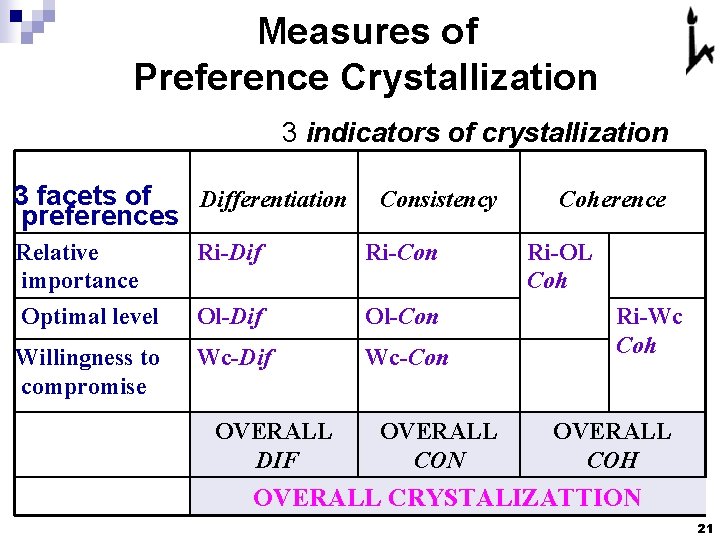
The Proposed Indicators of Preference Crystallization Differentiation between the aspects’ ratings, reflected by the variance and the resolution of the client’s preferences Consistency between the ratings of related aspect couples (e. g. , travel - work environment) Coherence among the 3 facets of preferences (relative importance and optimal level, and relative importance and willingness to compromise) 6
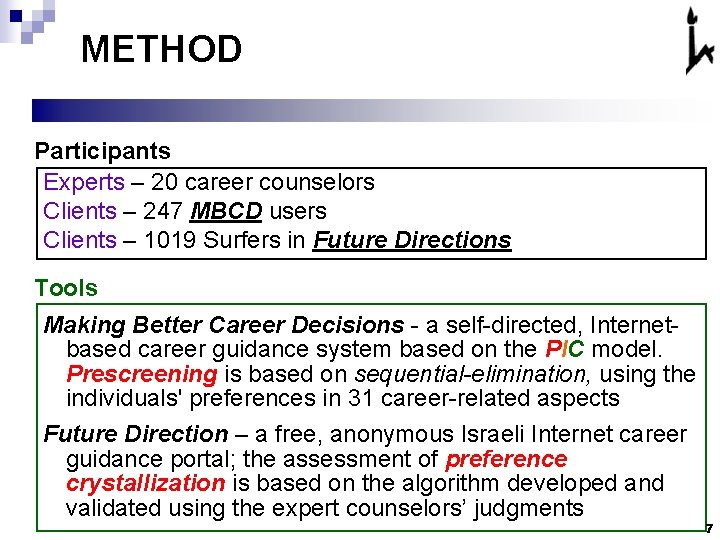
METHOD Participants Experts – 20 career counselors Clients – 247 MBCD users Clients – 1019 Surfers in Future Directions Tools Making Better Career Decisions - a self-directed, Internetbased career guidance system based on the PIC model. Prescreening is based on sequential-elimination, using the individuals' preferences in 31 career-related aspects Future Direction – a free, anonymous Israeli Internet career guidance portal; the assessment of preference crystallization is based on the algorithm developed and validated using the expert counselors’ judgments 7
Making Better Career Decisions http: //mbcd. intocareers. org 8
Future Directions http: //www. kivunim. com An Israeli website in Hebrew, designed for assisting deliberating individuals in making their career decisions. It is a public service and is offered free of charge. 9
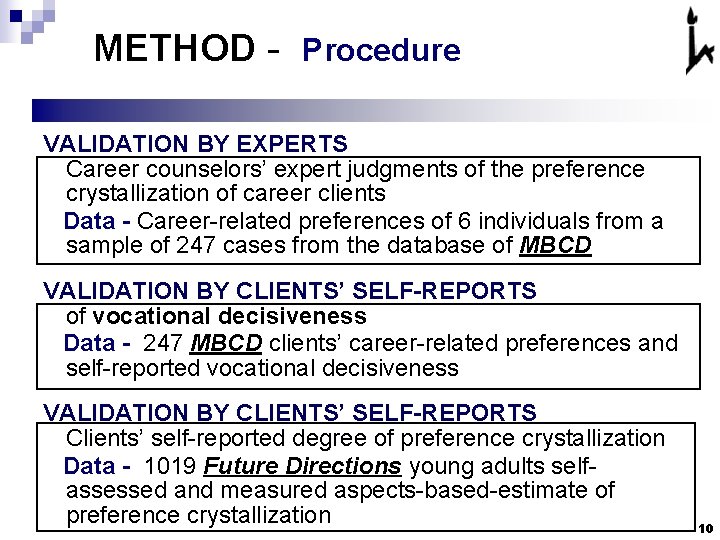
METHOD - Procedure VALIDATION BY EXPERTS Career counselors’ expert judgments of the preference crystallization of career clients Data - Career-related preferences of 6 individuals from a sample of 247 cases from the database of MBCD VALIDATION BY CLIENTS’ SELF-REPORTS of vocational decisiveness Data - 247 MBCD clients’ career-related preferences and self-reported vocational decisiveness VALIDATION BY CLIENTS’ SELF-REPORTS Clients’ self-reported degree of preference crystallization Data - 1019 Future Directions young adults selfassessed and measured aspects-based-estimate of preference crystallization 10
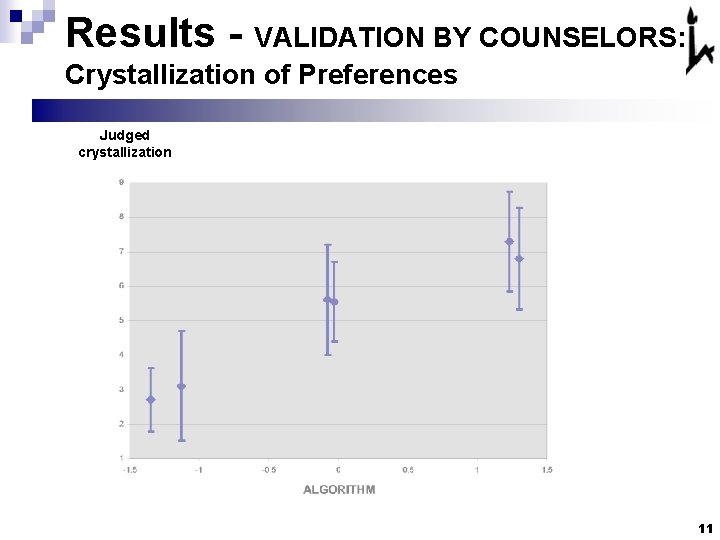
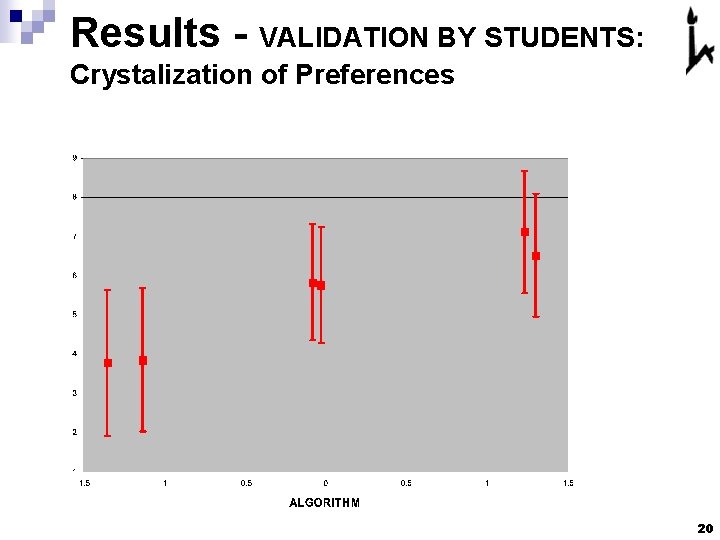
Results - VALIDATION BY COUNSELORS: Crystallization of Preferences Judged crystallization 11
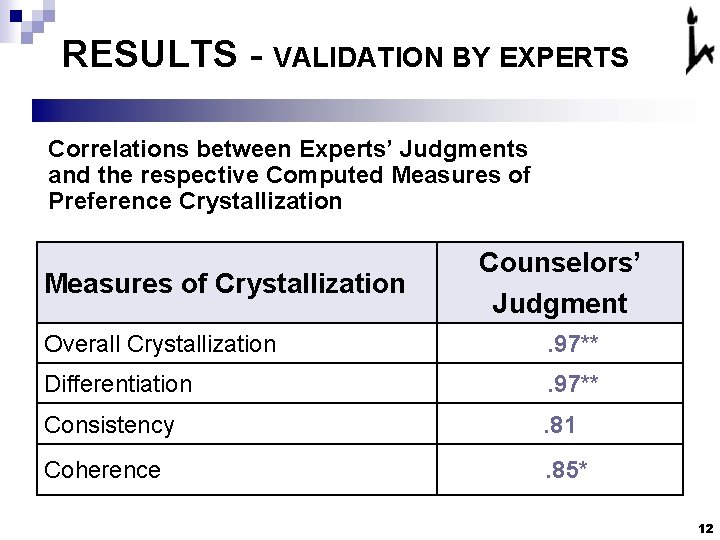
RESULTS - VALIDATION BY EXPERTS Correlations between Experts’ Judgments and the respective Computed Measures of Preference Crystallization Measures of Crystallization Counselors’ Judgment Overall Crystallization . 97** Differentiation . 97** Consistency . 81 Coherence . 85* 12
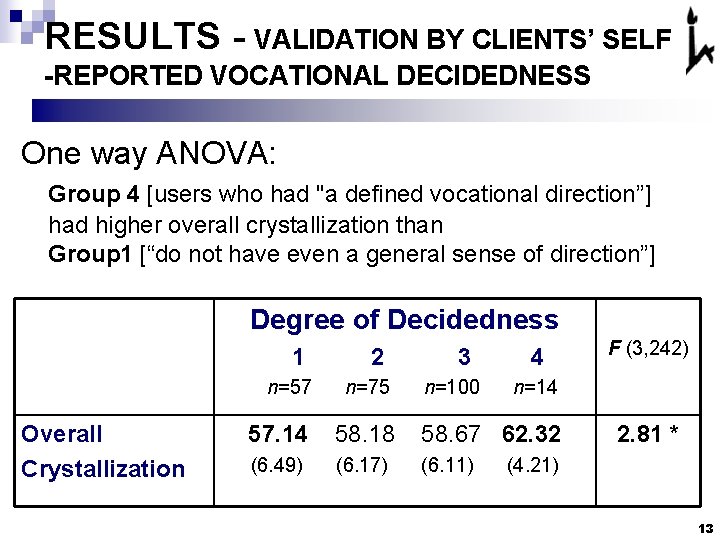
RESULTS - VALIDATION BY CLIENTS’ SELF -REPORTED VOCATIONAL DECIDEDNESS One way ANOVA: Group 4 [users who had "a defined vocational direction”] had higher overall crystallization than Group 1 [“do not have even a general sense of direction”] Degree of Decidedness 1 Overall Crystallization 2 3 n=100 4 n=57 n=75 57. 14 58. 18 58. 67 62. 32 (6. 49) (6. 17) (6. 11) F (3, 242) n=14 2. 81 * (4. 21) 13
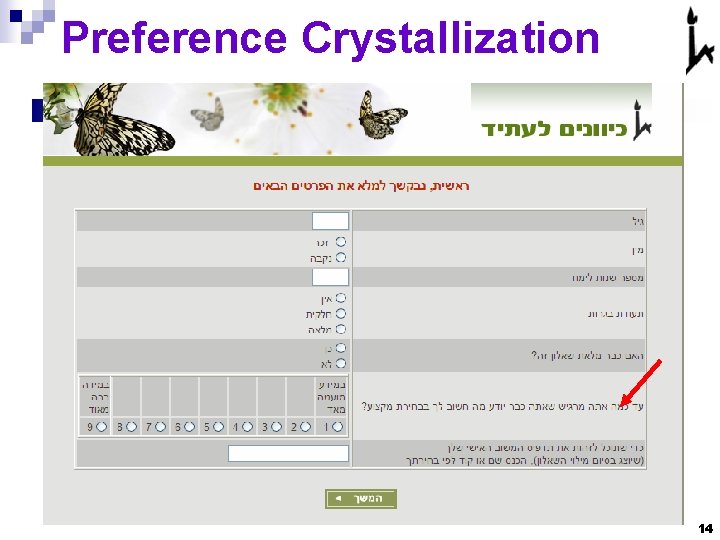
Preference Crystallization 14
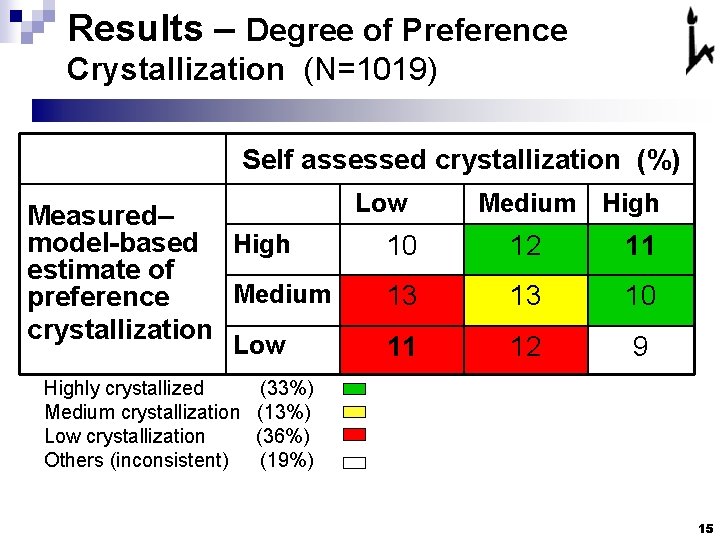
Results – Degree of Preference Crystallization (N=1019) Self assessed crystallization (%) Low Measured– model-based High 10 estimate of Medium 13 preference crystallization Low 11 Highly crystallized Medium crystallization Low crystallization Others (inconsistent) Medium High 12 11 13 10 12 9 (33%) (13%) (36%) (19%) 15
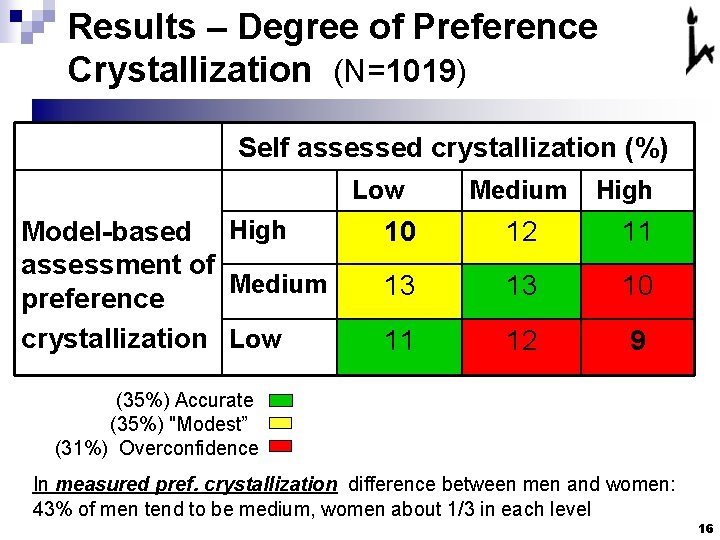
Results – Degree of Preference Crystallization (N=1019) Self assessed crystallization (%) Low Model-based High assessment of Medium preference crystallization Low Medium High 10 12 11 13 13 10 11 12 9 (35%) Accurate (35%) "Modest” (31%) Overconfidence In measured pref. crystallization difference between men and women: 43% of men tend to be medium, women about 1/3 in each level 16
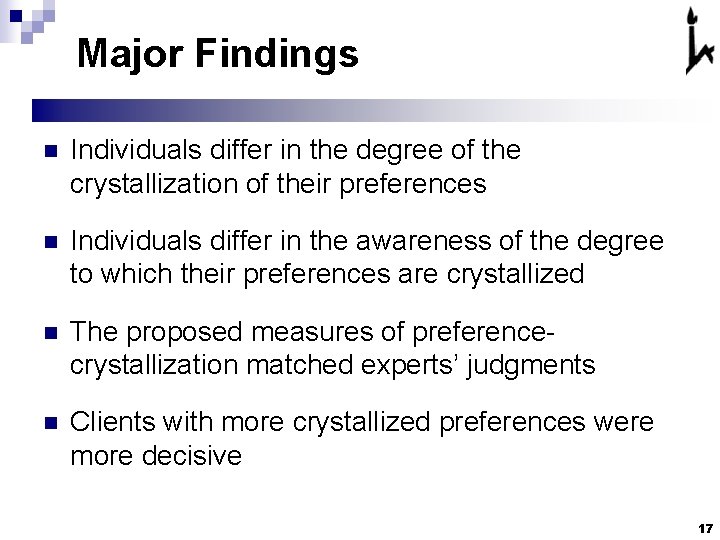
Major Findings n Individuals differ in the degree of the crystallization of their preferences n Individuals differ in the awareness of the degree to which their preferences are crystallized n The proposed measures of preferencecrystallization matched experts’ judgments n Clients with more crystallized preferences were more decisive 17
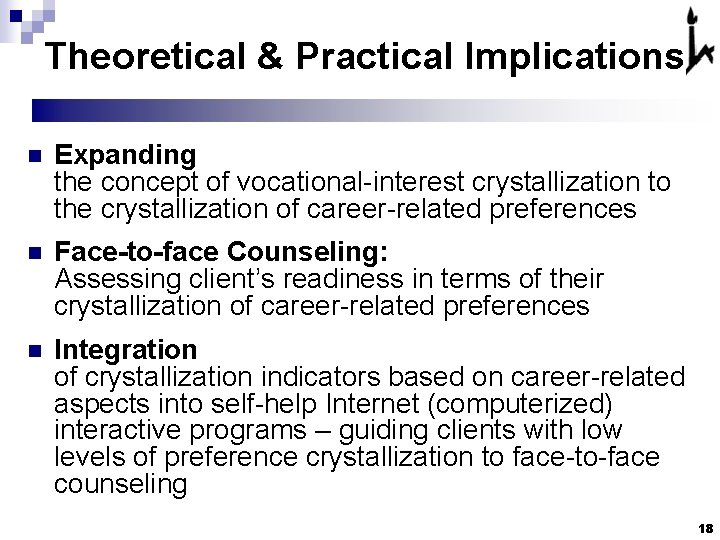
Theoretical & Practical Implications n Expanding the concept of vocational-interest crystallization to the crystallization of career-related preferences n Face-to-face Counseling: Assessing client’s readiness in terms of their crystallization of career-related preferences n Integration of crystallization indicators based on career-related aspects into self-help Internet (computerized) interactive programs – guiding clients with low levels of preference crystallization to face-to-face counseling 18
www. cddq. org Itamar. gati@huji. ac. il 19
Results - VALIDATION BY STUDENTS: Crystalization of Preferences 20
Measures of Preference Crystallization 3 indicators of crystallization 3 facets of Differentiation preferences Consistency Relative importance Ri-Dif Ri-Con Optimal level Ol-Dif Ol-Con Willingness to compromise Wc-Dif Wc-Con OVERALL DIF OVERALL CON Coherence Ri-OL Coh Ri-Wc Coh OVERALL COH OVERALL CRYSTALIZATTION 21