Technology Transfer Workshop Laser Microdissection Introduction to LMD


- Slides: 15
Technology Transfer Workshop Laser Microdissection Introduction to LMD Technology Patrick Wojtkiewicz, Ph. D. North Louisiana Crime Lab (318) 227 -2889 pwojtkie@NLCL. org
Technology Transfer Workshop Microscope
Technology Transfer Workshop Basic Microscopy • Terminology – Magnification - apparent increase in size of the object, based upon microscope’s objective, ocular, and body tube. – Refraction – change in direction (velocity) of light as it passes from one medium to another (refractive index) – Illumination – method of applying light to the sample from the light source. • Köhler (Brightfield) • Vertical illuminator (Fluorescence)
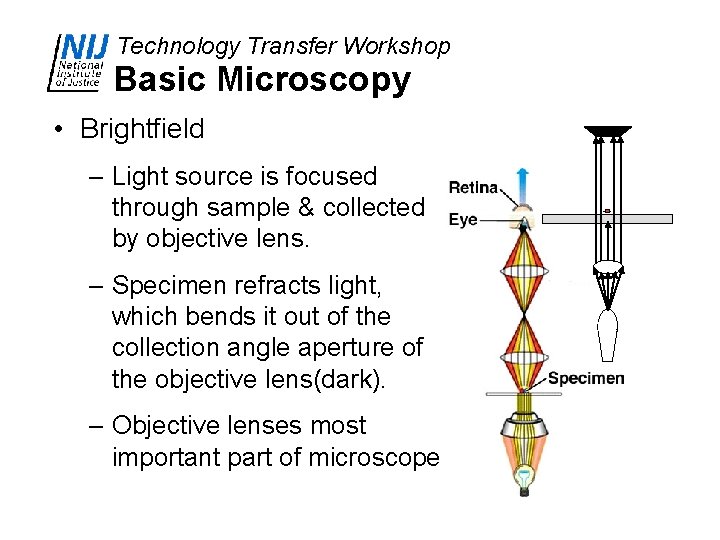
Technology Transfer Workshop Basic Microscopy • Brightfield – Light source is focused through sample & collected by objective lens. – Specimen refracts light, which bends it out of the collection angle aperture of the objective lens(dark). – Objective lenses most important part of microscope
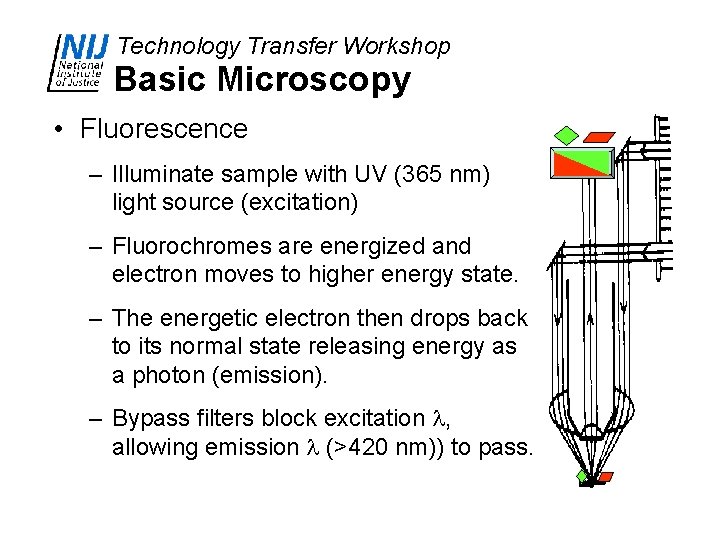
Technology Transfer Workshop Basic Microscopy • Fluorescence – Illuminate sample with UV (365 nm) light source (excitation) – Fluorochromes are energized and electron moves to higher energy state. – The energetic electron then drops back to its normal state releasing energy as a photon (emission). – Bypass filters block excitation , allowing emission (>420 nm)) to pass.
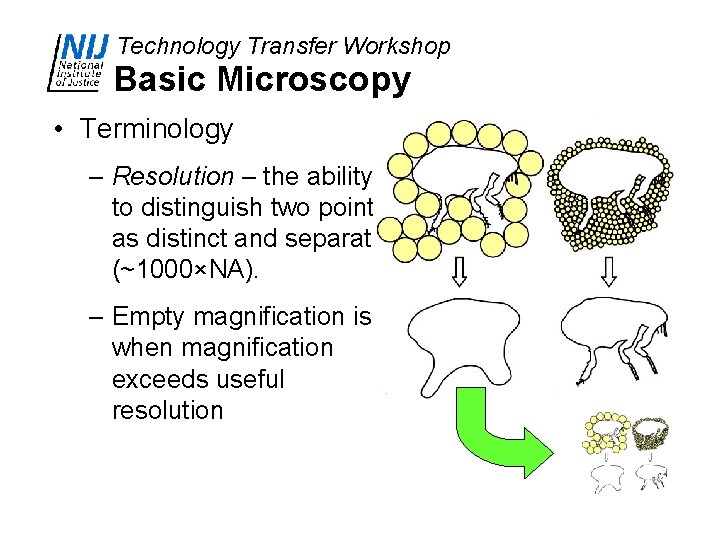
Technology Transfer Workshop Basic Microscopy • Terminology – Resolution – the ability to distinguish two points as distinct and separate (~1000×NA). – Empty magnification is when magnification exceeds useful resolution
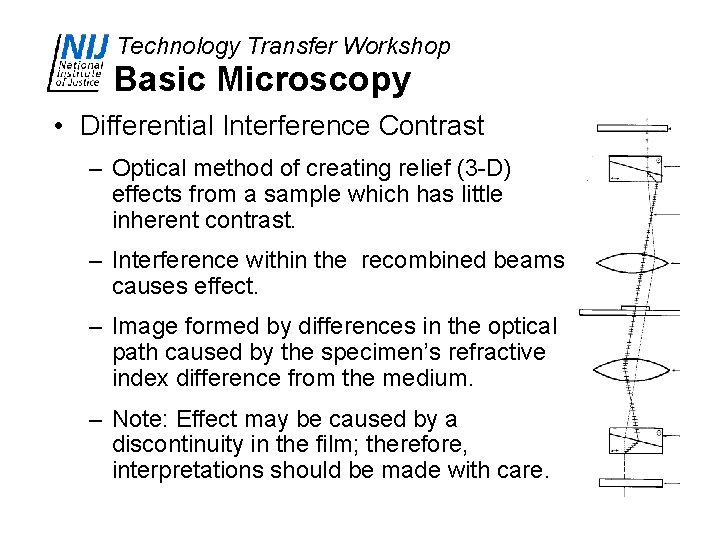
Technology Transfer Workshop Basic Microscopy • Differential Interference Contrast – Optical method of creating relief (3 -D) effects from a sample which has little inherent contrast. – Interference within the recombined beams causes effect. – Image formed by differences in the optical path caused by the specimen’s refractive index difference from the medium. – Note: Effect may be caused by a discontinuity in the film; therefore, interpretations should be made with care.
Technology Transfer Workshop Concept of LMD
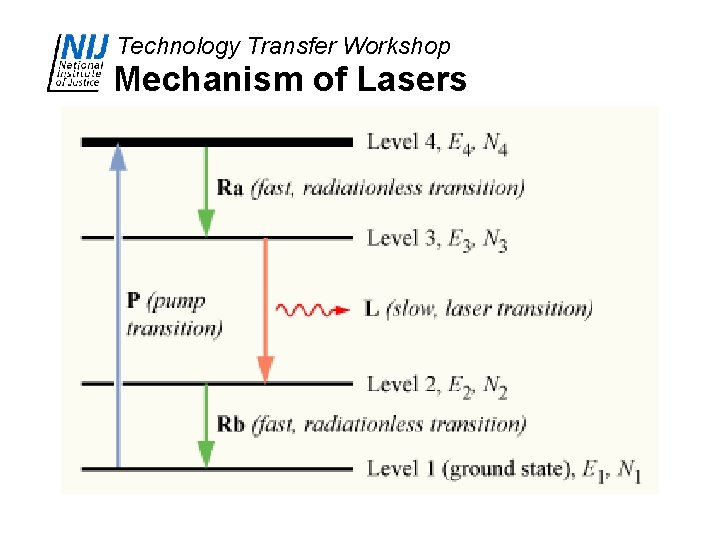
Technology Transfer Workshop Mechanism of Lasers
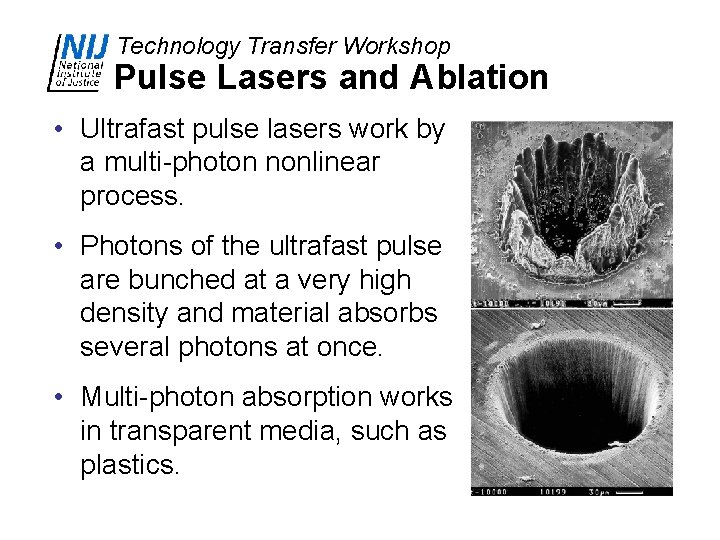
Technology Transfer Workshop Pulse Lasers and Ablation • Ultrafast pulse lasers work by a multi-photon nonlinear process. • Photons of the ultrafast pulse are bunched at a very high density and material absorbs several photons at once. • Multi-photon absorption works in transparent media, such as plastics.
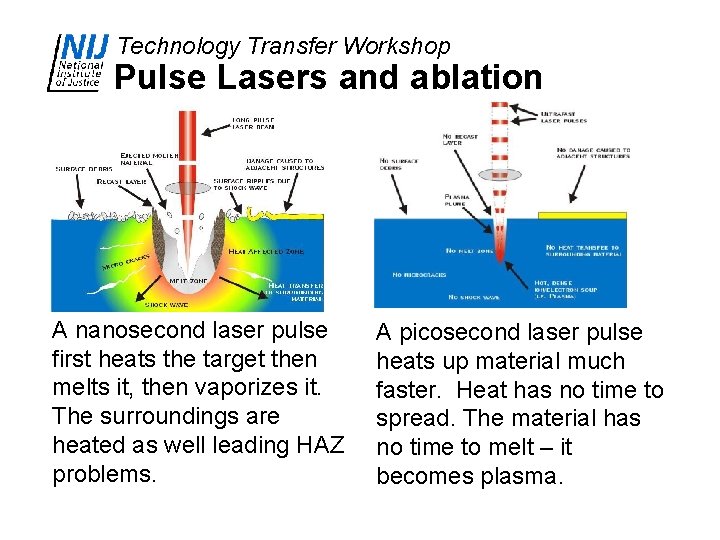
Technology Transfer Workshop Pulse Lasers and ablation A nanosecond laser pulse first heats the target then melts it, then vaporizes it. The surroundings are heated as well leading HAZ problems. A picosecond laser pulse heats up material much faster. Heat has no time to spread. The material has no time to melt – it becomes plasma.
Technology Transfer Workshop Advantages of Fast Pulse Lasers • The fast laser pulse (1. 0 – 4. 0 ns) is greater the heat diffusion time (~0. 5 ns). • Material briefly melts – then energy strips electrons from molecules (plasma). • Nearly all of the energy of the pulse is used in plasma formation, not heating surrounding material. • Little debris or recast material. • Little collateral damage to surrounding area.
Technology Transfer Workshop Laser Microdissection • History – Relatively brief history forensics but well established in the medical field – First occurrence of laser microdissection was in 1996 – Primarily used to excise individual cells or groups of cells embedded in other tissue – First report on its forensic applications was at the AAFS meeting in 2004 but was initially used in 2003.
Technology Transfer Workshop Types of LMD Microscopes • Leica – Automated microscope – Brightfield, fluorescence, alternative optics – Slides have film coating – Laser cuts plastic film, which allows the cut sample to drop into a tube. Up to four different samples can be placed on stage. – UV laser does cutting ( 355 nm diode, 80 hz; 337 nm gas, 30 hz). – Laser beam is directed though objective by prisms.
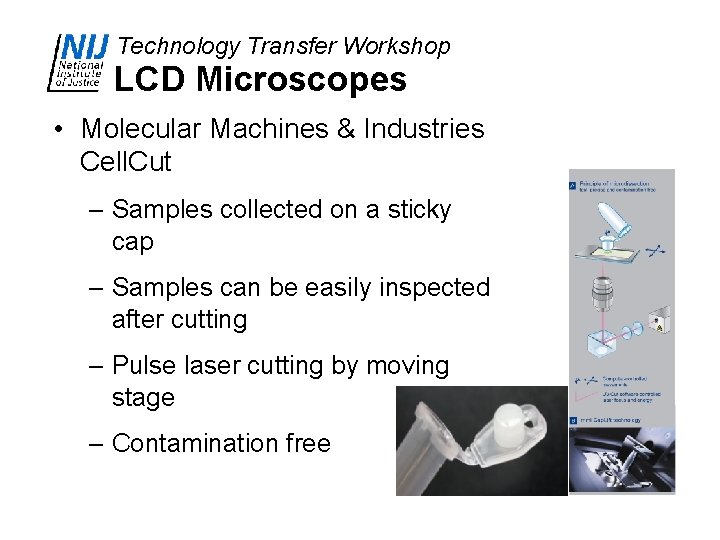
Technology Transfer Workshop LCD Microscopes • Molecular Machines & Industries Cell. Cut – Samples collected on a sticky cap – Samples can be easily inspected after cutting – Pulse laser cutting by moving stage – Contamination free