Technion Israel Institute of Technology Faculty of Education


- Slides: 35
Technion - Israel Institute of Technology Faculty of Education in Science and Technology Kesher Cham – R&D Center for Mathematics Education Mathematical News Snapshots Project MNS by Nitsa Movshovitz-Hadar in collaboration with Batya Amit. Additional contributors (in alphabetical order): Yochai Danon, Yuval Kelly, Yuval Nov, Atara Shriki, Boaz Silverman, Varda Zigerson, Clara Ziskin, and Ohad Zohar. Last update: 31. 10. 2017 Regular updates are required in the following slides: Slide 9: bullet 4; Slide 10: Wayne Gould; Slide 13: “Is there a solution? ”; Slide 25: links; Slide 26: “Has it been proven? Or is there a counter-example? ”
Terms and conditions of use • This presentation was developed for research purposes, and can be used only with written authorization from its authors. • You may not copy, duplicate, or redistribute any part of this document without written permission from its authors. • For permission please send an email to: keshercham. technion@gmail. com with the subject line: Permission to use the MNS [MNS name] Israel Science Foundation Updated 2. 12. 2016 Sudoku MNS © All Rights Reserved 2
Israel Science Foundation Technion - Israel Institute of Technology Technion Institute for Research and Development Sudoku: More than just fun © All rights reserved by “Kesher Cham", Technion
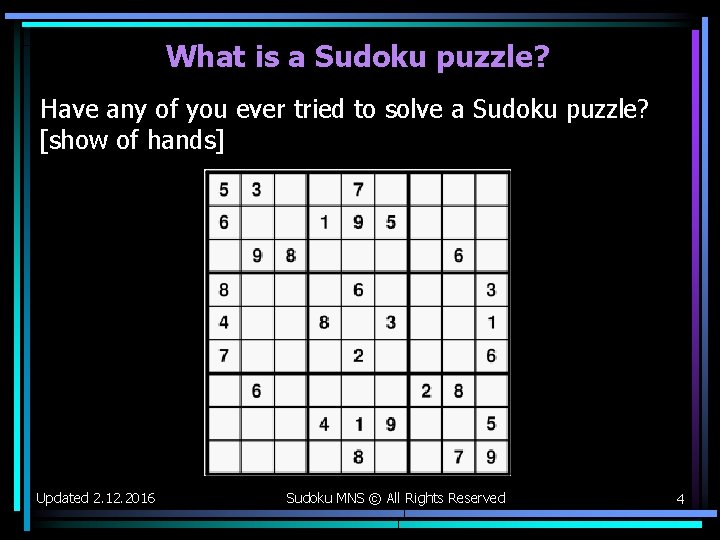
What is a Sudoku puzzle? Have any of you ever tried to solve a Sudoku puzzle? [show of hands] Updated 2. 12. 2016 Sudoku MNS © All Rights Reserved 4
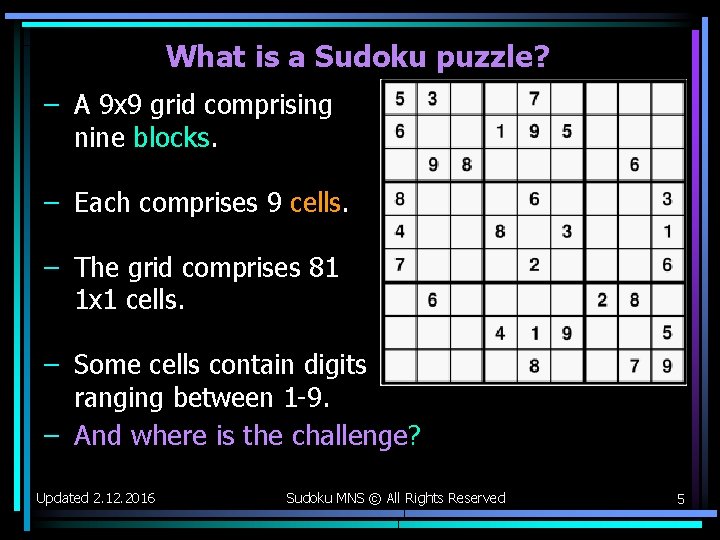
What is a Sudoku puzzle? – A 9 x 9 grid comprising nine blocks. – Each comprises 9 cells. – The grid comprises 81 1 x 1 cells. – Some cells contain digits ranging between 1 -9. – And where is the challenge? Updated 2. 12. 2016 Sudoku MNS © All Rights Reserved 5
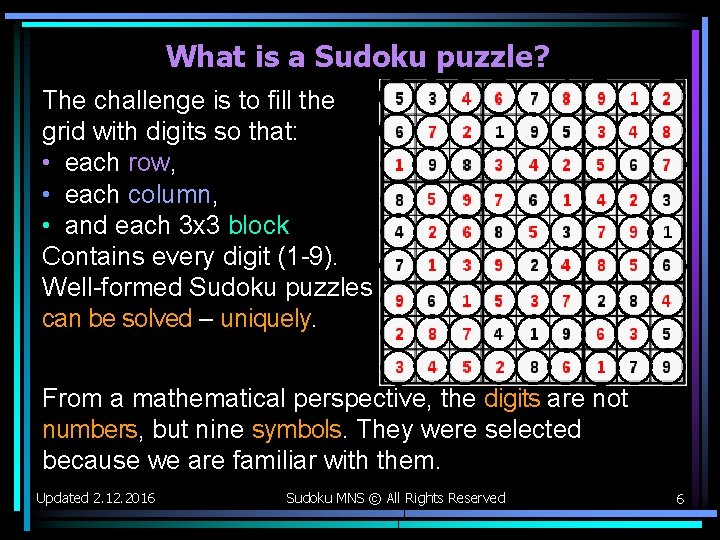
What is a Sudoku puzzle? The challenge is to fill the grid with digits so that: • each row, • each column, • and each 3 x 3 block Contains every digit (1 -9). Well-formed Sudoku puzzles can be solved – uniquely. From a mathematical perspective, the digits are not numbers, but nine symbols. They were selected because we are familiar with them. Updated 2. 12. 2016 Sudoku MNS © All Rights Reserved 6
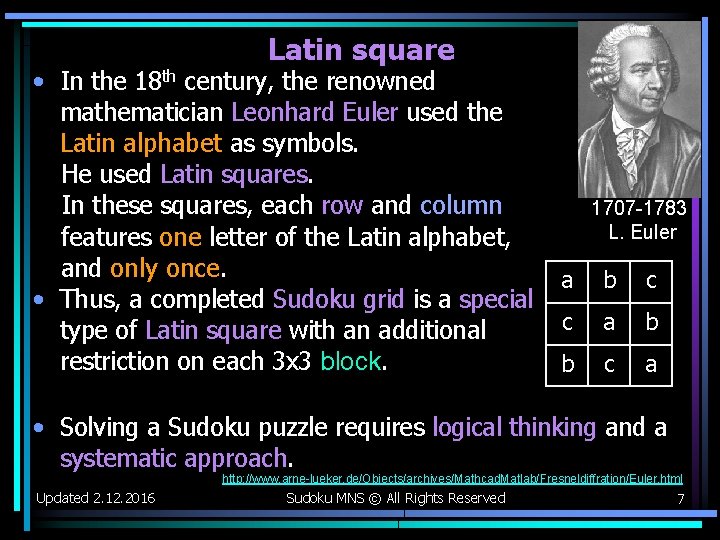
Latin square • In the 18 th century, the renowned mathematician Leonhard Euler used the Latin alphabet as symbols. He used Latin squares. In these squares, each row and column features one letter of the Latin alphabet, and only once. • Thus, a completed Sudoku grid is a special type of Latin square with an additional restriction on each 3 x 3 block. 1707 -1783 L. Euler a b c c a b b c a • Solving a Sudoku puzzle requires logical thinking and a systematic approach. http: //www. arne-lueker. de/Objects/archives/Mathcad. Matlab/Fresneldiffration/Euler. html Updated 2. 12. 2016 Sudoku MNS © All Rights Reserved 7
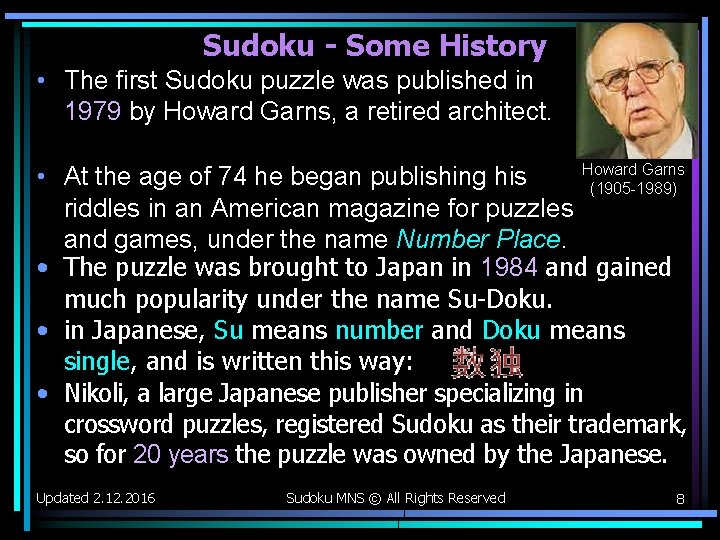
Sudoku - Some History • The first Sudoku puzzle was published in 1979 by Howard Garns, a retired architect. Howard Garns • At the age of 74 he began publishing his (1905 -1989) riddles in an American magazine for puzzles and games, under the name Number Place. • The puzzle was brought to Japan in 1984 and gained much popularity under the name Su-Doku. • in Japanese, Su means number and Doku means single, and is written this way: • Nikoli, a large Japanese publisher specializing in crossword puzzles, registered Sudoku as their trademark, so for 20 years the puzzle was owned by the Japanese. Updated 2. 12. 2016 Sudoku MNS © All Rights Reserved 8
Sudoku - Some History • Garns died in 1989 and did not live to see his puzzle become an international success. • Today, every respectable newspaper in the world publishes Sudoku puzzles regularly. In the daily press, web pages, and mobile apps – Sudoku is everywhere. • Sudoku books dominate the bestseller market more than any other puzzle book – even crosswords. • 2006: The first World Sudoku Championship. The 2018 games will be held in the Czech Republic: http: //en. wikipedia. org/wiki/World_Sudoku_Championship • Online Sudoku competitions are available as well: http: //www. sudokufun. com/ • Children's Sudoku puzzles are 4 x 4 and are called Shidoku (shi means 4 in Japanese). Updated 2. 12. 2016 Sudoku MNS © All Rights Reserved 9
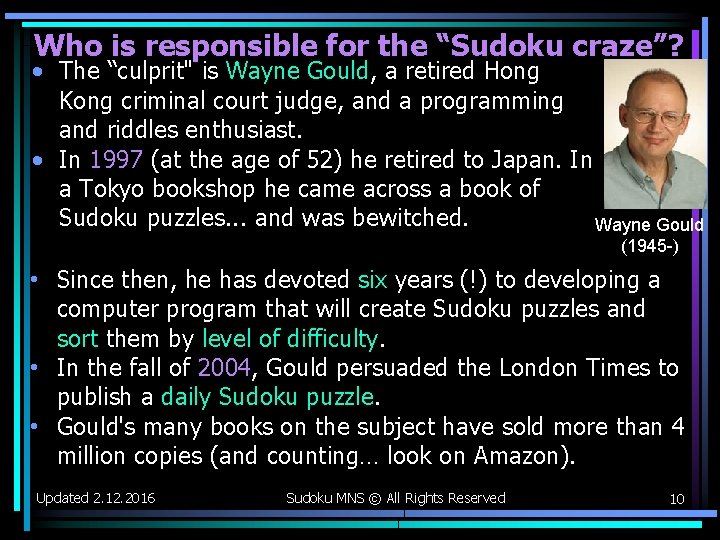
Who is responsible for the “Sudoku craze”? • The “culprit" is Wayne Gould, a retired Hong Kong criminal court judge, and a programming and riddles enthusiast. • In 1997 (at the age of 52) he retired to Japan. In a Tokyo bookshop he came across a book of Sudoku puzzles. . . and was bewitched. Wayne Gould (1945 -) • Since then, he has devoted six years (!) to developing a computer program that will create Sudoku puzzles and sort them by level of difficulty. • In the fall of 2004, Gould persuaded the London Times to publish a daily Sudoku puzzle. • Gould's many books on the subject have sold more than 4 million copies (and counting… look on Amazon). Updated 2. 12. 2016 Sudoku MNS © All Rights Reserved 10
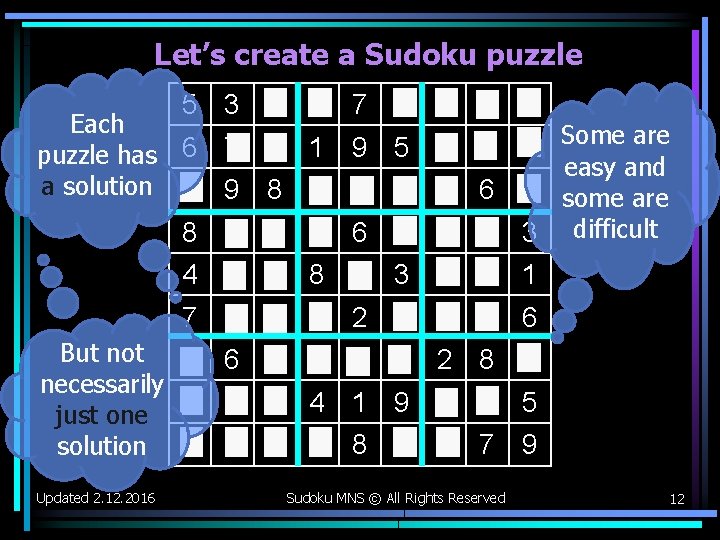
How is a Sudoku puzzle created? �Given a completed grid, it is possible to derive many Sudoku puzzles at different levels, by omitting some of the digits. �Some may not have just one solution. �Is it possible that there is no solution at all? - Only in the case of contradicting data. But this will not happen if the puzzle is built by omitting digits from a completed grid. �Let's look at an example: Updated 2. 12. 2016 Sudoku MNS © All Rights Reserved 11
Let’s create a Sudoku puzzle 5 3 4 6 7 8 9 1 2 Each puzzle has 6 a solution 1 7 2 1 9 5 3 4 8 Some are 9 8 3 4 2 5 6 8 5 9 7 6 1 4 2 easy and 7 some are 3 difficult 4 2 6 8 5 3 7 9 1 7 1 3 9 2 4 8 5 6 But not 9 necessarily 2 just one solution 3 Updated 2. 12. 2016 6 1 5 3 7 2 8 4 8 7 4 1 9 6 3 5 4 5 2 8 6 1 7 9 Sudoku MNS © All Rights Reserved 12
A question arises • Given a completed Sudoku grid, how many different puzzles exist for which the given grid is the only solution? • This is the type of question that mathematicians love to tackle. • This question has not yet been resolved! (as of the date of the last update) Updated 2. 12. 2016 Sudoku MNS © All Rights Reserved 13
Are there countless Sudoku puzzles? • How many completed 9 x 9 grids of Sudoku exist? • In 2005 mathematicians Bertram Felgenhauer and Frazer Jarvis, by using an exhaustive computer search, arrived at the number 6, 670, 903, 752, 021, 072, 936, 960 • In light of this, the number of well-formed Sudoku puzzles is h-u-g-e. • Looks like Sudoku puzzles are guaranteed longevity. . . Updated 2. 12. 2016 Sudoku MNS © All Rights Reserved 14
And another question arises • Typically, enough data is provided to ensure a single solution. • It's natural to think that the more data there is, the easier the puzzle, and it is more likely that the solution is unique. • Is that so? - This is another type of question that mathematicians enjoy tackling. Updated 2. 12. 2016 Sudoku MNS © All Rights Reserved 15
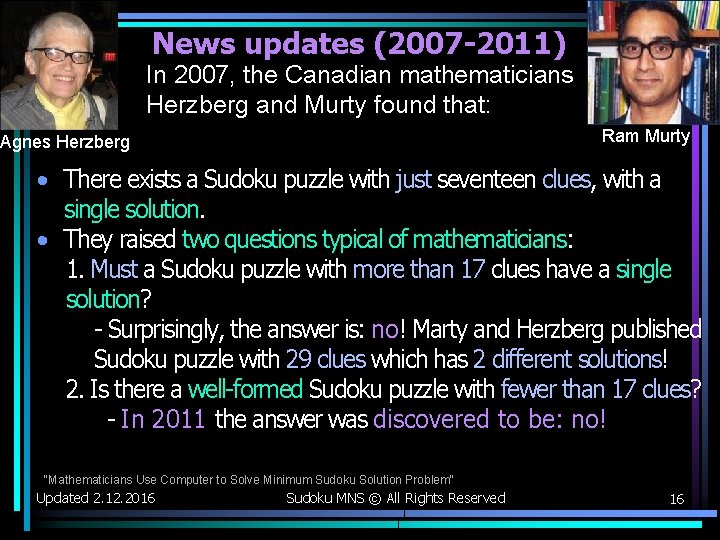
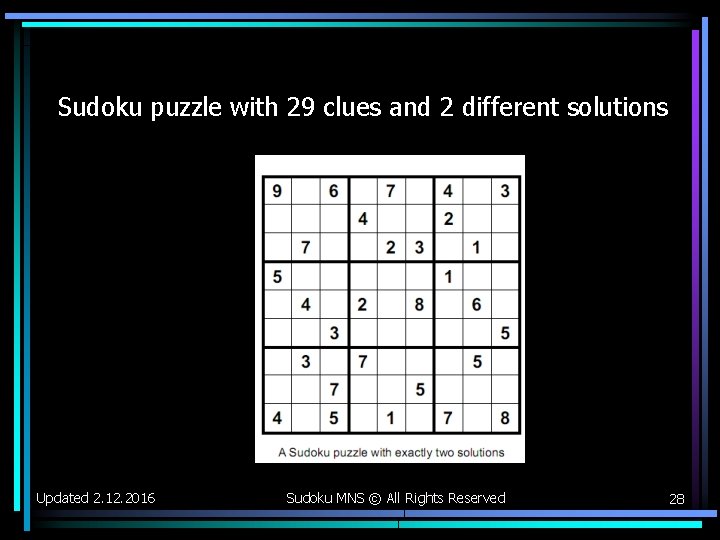
News updates (2007 -2011) In 2007, the Canadian mathematicians Herzberg and Murty found that: Ram Murty Agnes Herzberg • There exists a Sudoku puzzle with just seventeen clues, with a single solution. • They raised two questions typical of mathematicians: 1. Must a Sudoku puzzle with more than 17 clues have a single solution? - Surprisingly, the answer is: no! Marty and Herzberg published Sudoku puzzle with 29 clues which has 2 different solutions! 2. Is there a well-formed Sudoku puzzle with fewer than 17 clues? - In 2011 the answer was discovered to be: no! "Mathematicians Use Computer to Solve Minimum Sudoku Solution Problem" Updated 2. 12. 2016 Sudoku MNS © All Rights Reserved 16
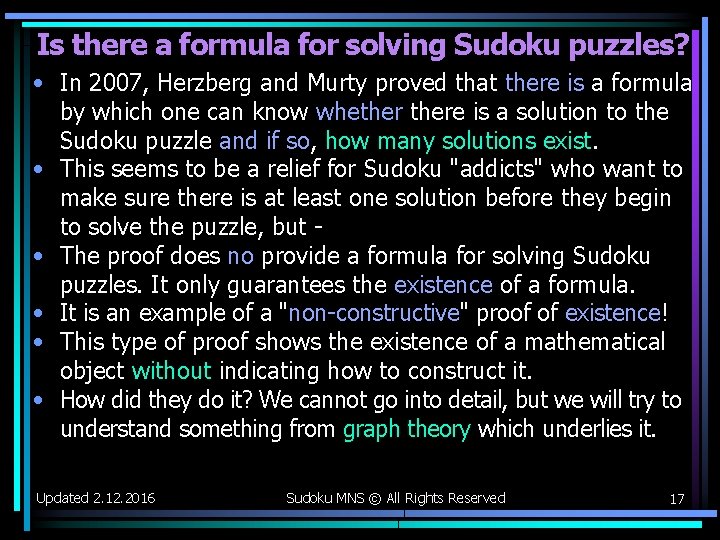
Is there a formula for solving Sudoku puzzles? • In 2007, Herzberg and Murty proved that there is a formula by which one can know whethere is a solution to the Sudoku puzzle and if so, how many solutions exist. • This seems to be a relief for Sudoku "addicts" who want to make sure there is at least one solution before they begin to solve the puzzle, but • The proof does no provide a formula for solving Sudoku puzzles. It only guarantees the existence of a formula. • It is an example of a "non-constructive" proof of existence! • This type of proof shows the existence of a mathematical object without indicating how to construct it. • How did they do it? We cannot go into detail, but we will try to understand something from graph theory which underlies it. Updated 2. 12. 2016 Sudoku MNS © All Rights Reserved 17
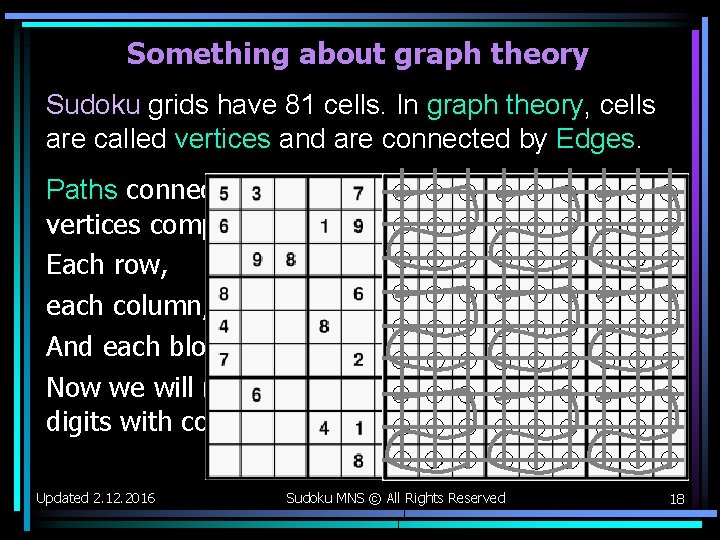
Something about graph theory Sudoku grids have 81 cells. In graph theory, cells are called vertices and are connected by Edges. Paths connect the 9 vertices comprising: Each row, each column, And each block. Now we will replace the digits with colors. Updated 2. 12. 2016 Sudoku MNS © All Rights Reserved 18
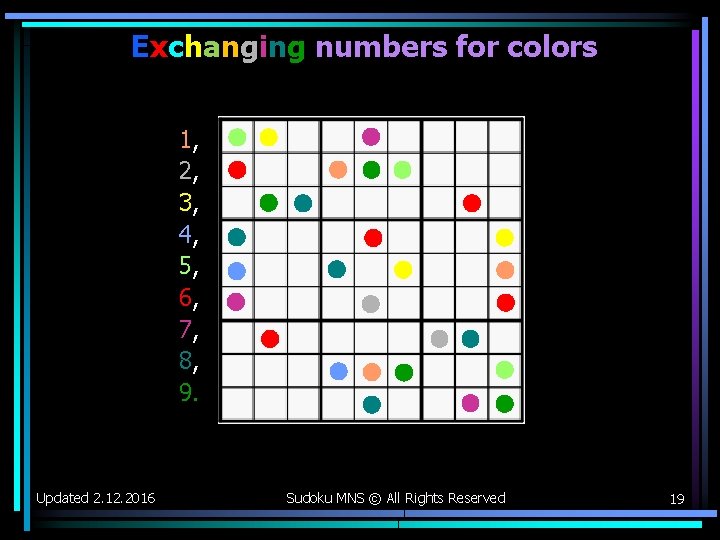
Exchanging numbers for colors 1, 2, 3, 4, 5, 6, 7, 8, 9. Updated 2. 12. 2016 Sudoku MNS © All Rights Reserved 19
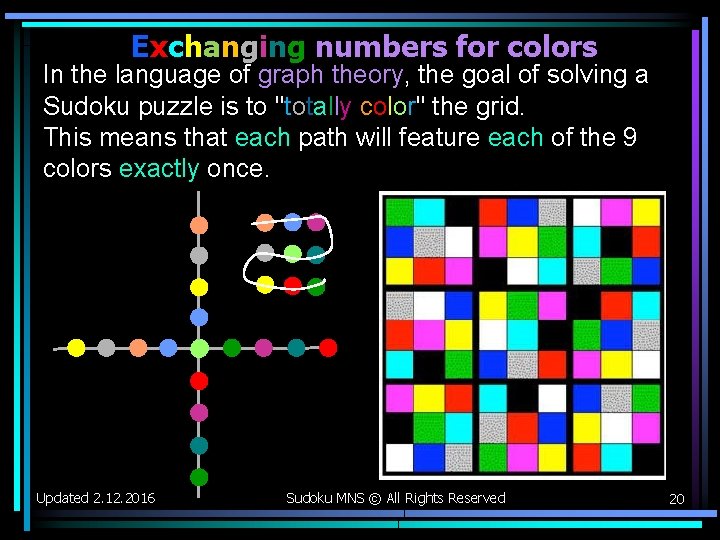
Exchanging numbers for colors In the language of graph theory, the goal of solving a Sudoku puzzle is to "totally color" the grid. This means that each path will feature each of the 9 colors exactly once. Updated 2. 12. 2016 Sudoku MNS © All Rights Reserved 20
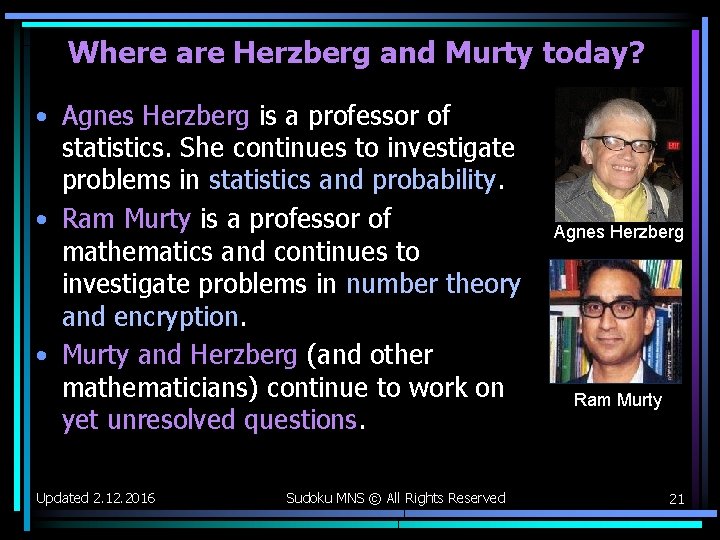
Where are Herzberg and Murty today? • Agnes Herzberg is a professor of statistics. She continues to investigate problems in statistics and probability. • Ram Murty is a professor of mathematics and continues to investigate problems in number theory and encryption. • Murty and Herzberg (and other mathematicians) continue to work on yet unresolved questions. Updated 2. 12. 2016 Sudoku MNS © All Rights Reserved Agnes Herzberg Ram Murty 21
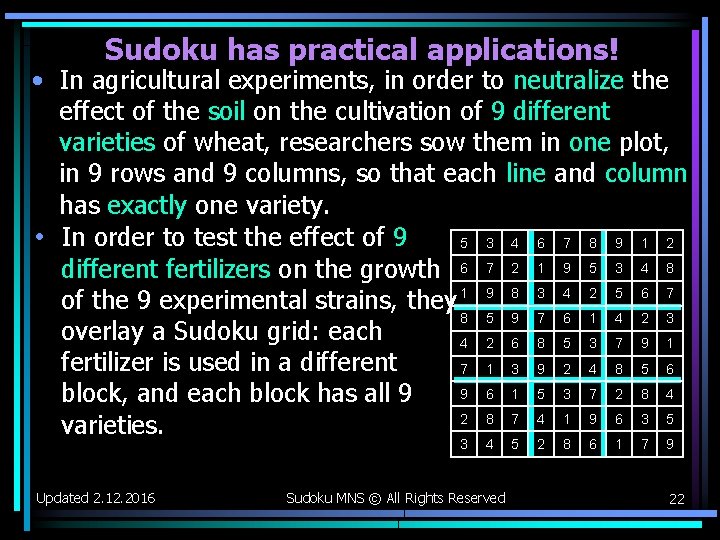
Sudoku has practical applications! • In agricultural experiments, in order to neutralize the effect of the soil on the cultivation of 9 different varieties of wheat, researchers sow them in one plot, in 9 rows and 9 columns, so that each line and column has exactly one variety. • In order to test the effect of 9 5 3 4 6 7 8 9 1 2 different fertilizers on the growth 6 7 2 1 9 5 3 4 8 of the 9 experimental strains, they 1 9 8 3 4 2 5 6 7 8 5 9 7 6 1 4 2 3 overlay a Sudoku grid: each 4 2 6 8 5 3 7 9 1 fertilizer is used in a different 7 1 3 9 2 4 8 5 6 9 6 1 5 3 7 2 8 4 block, and each block has all 9 2 8 7 4 1 9 6 3 5 varieties. 3 Updated 2. 12. 2016 4 Sudoku MNS © All Rights Reserved 5 2 8 6 1 7 9 22
Sudoku and human health • In Britain, it was announced that solving Sudoku puzzles for one hour helps burn 90 calories. • The researcher, Tim Foster, says, “Our brain consumes 0. 1 calories per minute to survive. Like every part of our body, our brain requires more energy in an effort, and so the amount of calories consumed increases to 1. 5 calories per minute. " http: //www. dailymail. co. uk/health/article-1230721/Try-Sudoku-diet-How-burn-90 -calories-hour-leaving-armchair. html • In many countries, the Ministry of Health and relevant journals recommend solving Sudoku puzzles to prevent Alzheimer's disease. Updated 2. 12. 2016 Sudoku MNS © All Rights Reserved 23
Use of Sudoku for espionage • Steganography = Concealed writing. It is a method of writing secret information, hidden behind images, objects, or notes, so that only the sender and the intended receiver can suspect its existence. • A familiar method of concealing information is writing in transparent ink between the lines in a letter written on paper. • To disguise information in an email, the letters that make up the secret information are of a slightly different color. Only the intended recipient knows about this. An unsuspecting reader does not even notice the difference. • Unlike encrypted information, steganographic information does not arouse suspicion. • In 2009, a steganography method was revealed in which a 162 x 162 Sudoku grid serves as a key for hiding digital information. http: //www. computer. org/portal/web/csdl/doi/10. 1109/ARTCom. 2009. 116 Updated 2. 12. 2016 Sudoku MNS © All Rights Reserved 24
Is there a formula for solving Sudoku puzzles? • On December 23, 2008, Science News reported that three researchers - Elser, Bauschke, and their doctoral student Schaad - had devised a program to solve the Sudoku puzzle using an algorithm called: The projection algorithm Computer program that solves Sudoku puzzles • So far the program has successfully solved every 9 x 9 Sudoku puzzle given to it. Updated 2. 12. 2016 Sudoku MNS © All Rights Reserved 25
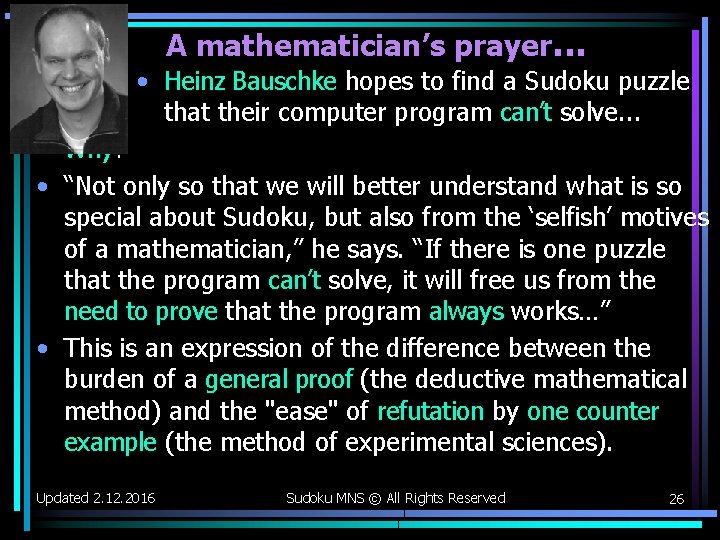
A mathematician’s prayer. . . • Heinz Bauschke hopes to find a Sudoku puzzle that their computer program can’t solve. . . • Why? • “Not only so that we will better understand what is so special about Sudoku, but also from the ‘selfish’ motives of a mathematician, ” he says. “If there is one puzzle that the program can’t solve, it will free us from the need to prove that the program always works…” • This is an expression of the difference between the burden of a general proof (the deductive mathematical method) and the "ease" of refutation by one counter example (the method of experimental sciences). Updated 2. 12. 2016 Sudoku MNS © All Rights Reserved 26
Sudoku: More than just fun The End (of the MNS) But this is just the beginning – Come and learn more about the mathematics of Sudoku and Latin squares, and the news posted on the subject by surfing the web. Updated 2. 12. 2016 Sudoku MNS © All Rights Reserved 27
Sudoku puzzle with 29 clues and 2 different solutions Updated 2. 12. 2016 Sudoku MNS © All Rights Reserved 28
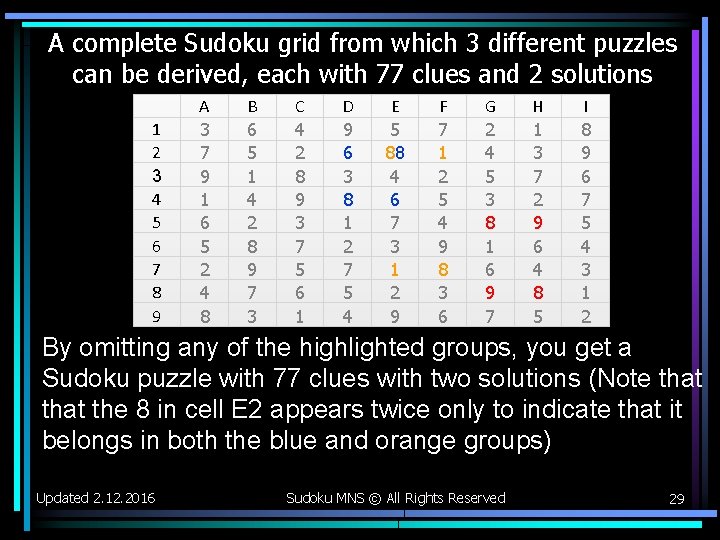
A complete Sudoku grid from which 3 different puzzles can be derived, each with 77 clues and 2 solutions 1 2 3 4 5 6 7 8 9 A 3 7 9 1 6 5 2 4 8 B 6 5 1 4 2 8 9 7 3 C 4 2 8 9 3 7 5 6 1 D 9 6 3 8 1 2 7 5 4 E 5 88 4 6 7 3 1 2 9 F 7 1 2 5 4 9 8 3 6 G 2 4 5 3 8 1 6 9 7 H 1 3 7 2 9 6 4 8 5 I 8 9 6 7 5 4 3 1 2 By omitting any of the highlighted groups, you get a Sudoku puzzle with 77 clues with two solutions (Note that the 8 in cell E 2 appears twice only to indicate that it belongs in both the blue and orange groups) Updated 2. 12. 2016 Sudoku MNS © All Rights Reserved 29
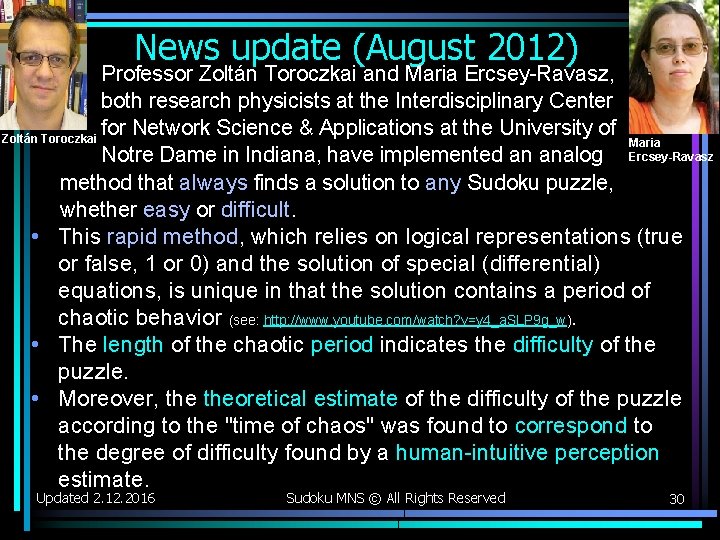
News update (August 2012) Professor Zoltán Toroczkai and Maria Ercsey-Ravasz, both research physicists at the Interdisciplinary Center for Network Science & Applications at the University of Zoltán Toroczkai Maria Notre Dame in Indiana, have implemented an analog Ercsey-Ravasz method that always finds a solution to any Sudoku puzzle, whether easy or difficult. • This rapid method, which relies on logical representations (true or false, 1 or 0) and the solution of special (differential) equations, is unique in that the solution contains a period of chaotic behavior (see: http: //www. youtube. com/watch? v=y 4_a. SLP 9 g_w). • The length of the chaotic period indicates the difficulty of the puzzle. • Moreover, theoretical estimate of the difficulty of the puzzle according to the "time of chaos" was found to correspond to the degree of difficulty found by a human-intuitive perception estimate. Updated 2. 12. 2016 Sudoku MNS © All Rights Reserved 30
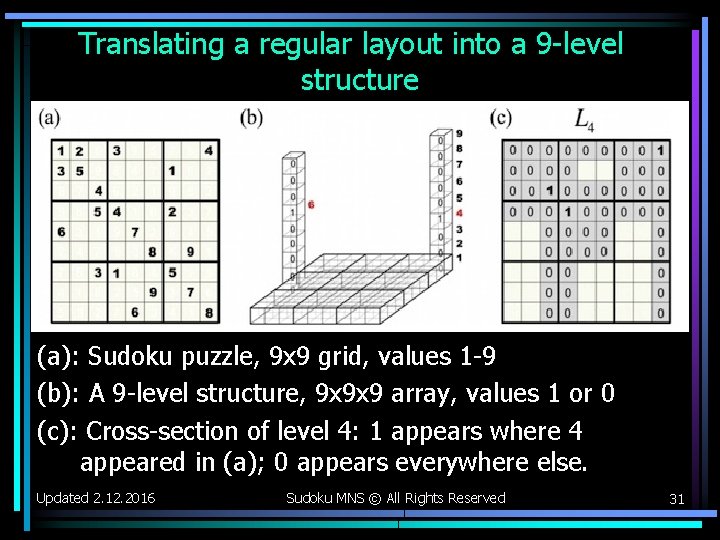
Translating a regular layout into a 9 -level structure (a): Sudoku puzzle, 9 x 9 grid, values 1 -9 (b): A 9 -level structure, 9 x 9 x 9 array, values 1 or 0 (c): Cross-section of level 4: 1 appears where 4 appeared in (a); 0 appears everywhere else. Updated 2. 12. 2016 Sudoku MNS © All Rights Reserved 31
The motive for working on the rapid method • In previous studies, Toroczkai and Ercsey-Ravasz found that the estimated time needed to solve an easy Sudoku puzzle in the most "primitive" method (exhaustive search), by using the best supercomputer (Sequoia) is 105 seconds or 27 hours, while the estimated time needed to solve a difficult puzzle can reach 1027 seconds or 2. 7 x 10²³ hours, or 3 x 10¹⁹ years. • As a frame of reference, the age of our universe is 1. 3 x 10¹⁰ years, so they hoped to find a quicker solving method. . . • As in mathematics, once a solution was found, a new problem arose - a much more general problem. • This is the complexity of the method for solving the "family" of more general problems to which the Sudoku puzzle belongs The problem is known as: Is NP = P? This is an open problem in mathematics. . . still! Updated 2. 12. 2016 Sudoku MNS © All Rights Reserved 32
References and recommended reading References for Murty and Herzberg's research: • http: //en. wikipedia. org/wiki/Sudoku#History • Herzberg, A. M. & Murty, R. (2007). “Sudoku Squares and Chromatic Polynomials. ” Notices of the American Mathematical Society, Vol. 54, no. 6, June-July, 2007. • http: //www. ams. org/notices/200706/tx 070600708 p. pdf • http: //www. newswise. com/articles/view/530718/ Sources related to the update (August 2012): • http: //plus. maths. org/content/chaos-sudoku? nl=0 • M. Ercsey-Ravasz and Z. Toroczkai. "The Chaos Within Sudoku. " Scientific Reports, 2, 755 (2012). | doi: 10. 1038/srep 00725 | arxiv. org: 1208. 0370 Updated 2. 12. 2016 Sudoku MNS © All Rights Reserved 33
References and recommended reading • http: //en. wikipedia. org/wiki/Sudoku#Mathematics_of_Sudoku On an initiative to create Sudoku puzzles and its benefits http: //www. humanfactor. co. il/article. phtml? a_id=391&c_id=75#. UNF Ql 2 -Ty 6 M On Sudoku championships http: //en. wikipedia. org/wiki/World_Sudoku_Championship • http: //www. sudokufun. com/ • http: //www. sciencenews. org/view/generic/id/39529/title/Math_Trek__ The_Sudoku_solution Updated 2. 12. 2016 Sudoku MNS © All Rights Reserved 34
References and recommended reading • http: //en. wikipedia. org/wiki/World_Sudoku_Championship • http: //www. sudokufun. com/ About Sudoku Solutions • http: //www. youtube. com/watch? v=Mly. Tqx. Vk. QE&feature=emshare_vi deo_in_list_user&list=PLt 5 Afw. LFPx. WIUYl. Cb 5 ip 9 f_s 4 qm 1 zi 8 kc • http: //www. sciencenews. org/view/generic/id/39529/title/Math_Trek_ _The_Sudoku_solution • http: //www. zmescience. com/research/studies/sudoku-mathematicsminimum-solution • http: //theconversation. edu. au/good-at-sudoku-heres-some-youllnever-complete-5234 About Sudoku: letters and smiles • http: //plus. maths. org/content/forget-sudoku-and-smile-camera Updated 2. 12. 2016 Sudoku MNS © All Rights Reserved 35