Teaching for Excellence in L 3 NCEA and





- Slides: 21
Teaching for Excellence in L 3 NCEA and Scholarship Ian Torrie
Presentation outline 1. 2. 3. 4. 5. 6. 7. Requirements for success at the highest level Recommended background for Scholarship The best predictors for success in Scholarship Essential resources for Scholarship Where to find Scholarship practice questions Atomic structure and bonding extension ideas Aqueous solution extension ideas
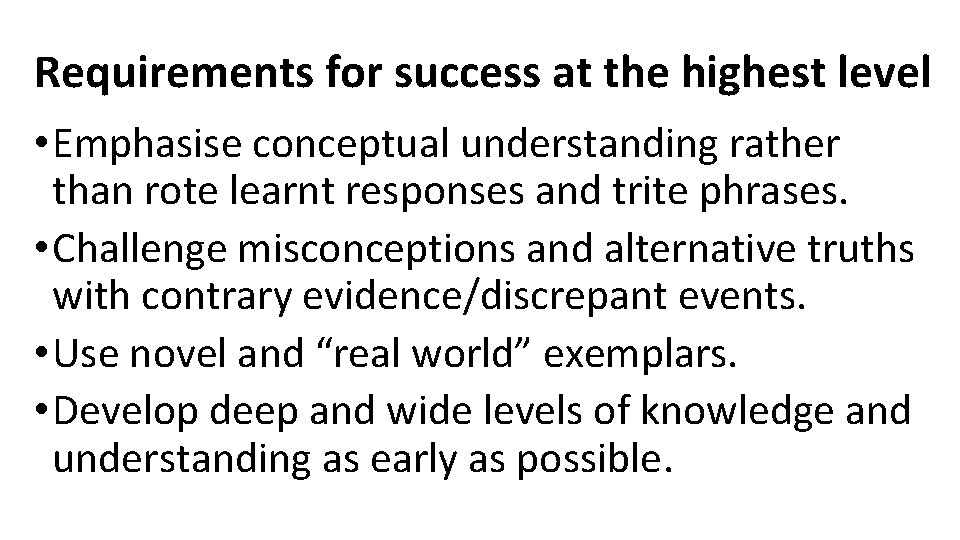
Requirements for success at the highest level • Emphasise conceptual understanding rather than rote learnt responses and trite phrases. • Challenge misconceptions and alternative truths with contrary evidence/discrepant events. • Use novel and “real world” exemplars. • Develop deep and wide levels of knowledge and understanding as early as possible.
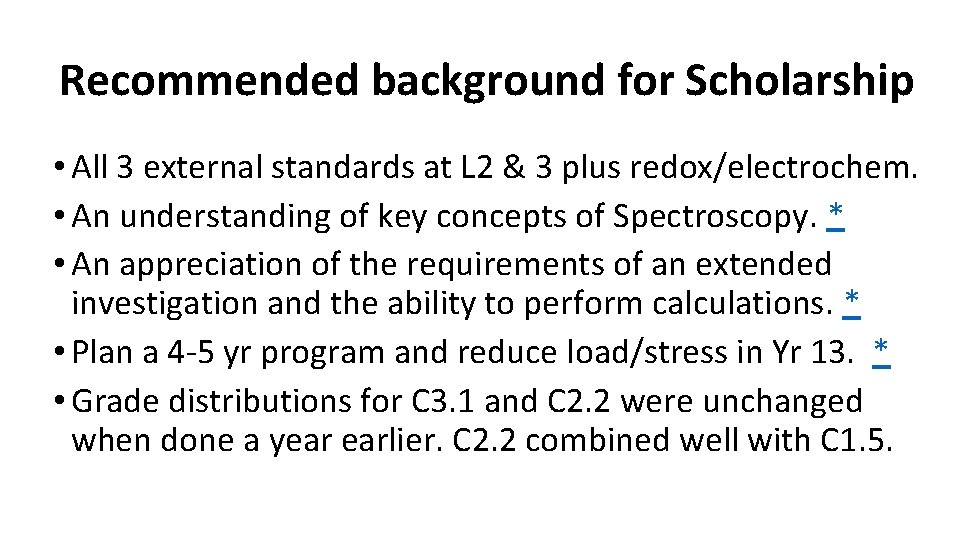
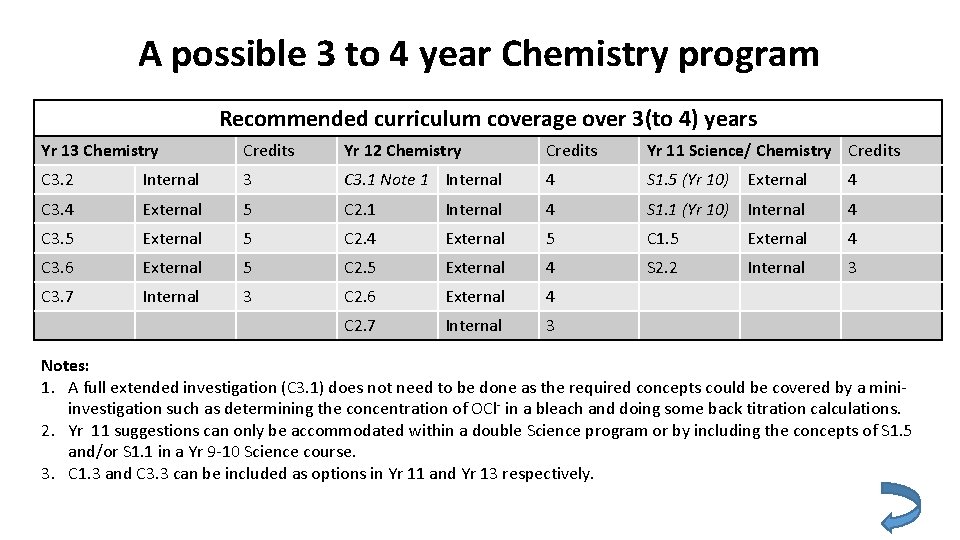
Recommended background for Scholarship • All 3 external standards at L 2 & 3 plus redox/electrochem. • An understanding of key concepts of Spectroscopy. * • An appreciation of the requirements of an extended investigation and the ability to perform calculations. * • Plan a 4 -5 yr program and reduce load/stress in Yr 13. * • Grade distributions for C 3. 1 and C 2. 2 were unchanged when done a year earlier. C 2. 2 combined well with C 1. 5.
The best predictors for success in Scholarship • Successful involvement in Olympiad training program. • Previous attempts at Scholarship (acceleration). • A regular and consistent high user of Bestchoice. • Completion of scholarship exemplars. • Regular attendance at Scholarship tutorials. • Excellence grades in L 1 Chemistry – particularly C 1. 5 • An enthusiastic and committed teacher. Note: There is a relatively low correlation between gaining Ex. in all three Level 3 Externals and scholarship success.
Essential resources for scholarship • ESA Scholarship Chemistry AME Workbook – Dr Jan Giffney • Several good US or UK “A-level” textbooks e. g Advanced Chemistry by Clugstone & Flemming; The Molecular Science by Moore, Stanitski et al • RSC website “Learn Chemistry” http: //www. rsc. org/learn-chemistry • “Thinking Tasks” by Bob Bucat UWA (Chem. Togi resource) • RSC resource – “Chemistry for the gifted and talented” by Tim Jolliff • Resource CD from “STCC Teaching Scholarship Course” • Good sources of questions - particularly context based.
Where to find Scholarship practice questions • Previous Scholarship examinations • NZIC parallel papers • AME Scholarship Chemistry workbook • Bestchoice www. bestchoice. co. nz • Old NZEST papers • Context based books – e. g Sand. Castles & Mud Hats • Old scholarship papers (print copies? ) • 1 st year University texts (particularly context driven) NOTE: The last 5 cover content but not style of question.
Atomic structure & bonding extension • Describing shapes of s, p, d orbitals can help understanding of electron configuration and why 4 s 2 sub-level is filled before 3 d 10. • All bonding is electrostatic and is characterised by coulombs Law (F = k. Qq/r 2) which is an inverse square law so size really does matter. • Use nett electrostatic force to justify trends so only 3 factors need to be considered: nuclear charge, distance, electron-electron repulsion. • Avoid phrases such as “effective nuclear charge” and “shielding by inner shell electrons” which give the impression that the nuclear attraction is shared between electrons and that somehow orbiting electrons can block a force that acts at a distance. In reality, addition of another electron does not result in a fractional decrease in the electrostatic attraction to any given electron, but it does increase the electron repulsion which effectively reduces the nett attractive force.
Size does matter • Where trends conflict e. g. IE down a group, the increased radius factor will outweigh the increased nuclear charge because it is a squared function. • Match the following atoms and ions to the radii given: Atom or ion: Ga; Ga 3+; Se 2 -; Se; S Radius (ppm): 122; 198; 62; 103; 135 • CO 2 is a discrete molecule whereas Si. O 2 is a covalent network structure as Si is too large to allow effective overlap of the π orbitals to form double bond. • Both NCl 3 and PCl 3 exist but only PCl 5 exists because of steric hindrance of the Cl electron clouds around the smaller central N atom PLUS the energy gap required to promote valence electrons from 3 p 3 d (cf 2 p 3 s as no 2 d) is small enough to be “recovered” by the formation of two extra bonds.
Hybridisation • Carbon forms 4 bonds despite only having two half filled orbitals in ground state because of sp 3 hybrid resulting from promotion of an electron from 2 s to 2 p. • “Octet rule” only applies to first two rows (note exceptions such as BF 3 and NO 2) because promotion energy requirements are too high to promote e- s whereas the ground state of S(3 s 23 p 4) can hybridise to either 3 s 23 p 3(SF 4) or 3 s 13 p 33 d 2(SF 6). Use formal charge to identify stable canonical form • Lewis diagram for SO 42 - includes two double bonds rather than 4 single bonds because this arrangement has the lowest formal charge, FC, where FC (= no of valence e-s –[(no of non-bonded e-s) + (1/2 no of bonded e-s)].
Minor variations in geometry of shapes • H 2 C=O is 116 o because of greater repulsion from multiple bonds NO 2 is 134 o because of smaller repulsion from unpaired electron. • CH 4 is 109. 5 o > NH 3 is 107. 3 o > H 2 O is 104. 5 because the lone pair repulsion> bonded pair repulsion. • Br. F 3 is T-shaped rather than trigonal planar for same reason as above. • H 2 O 104. 5 o > H 2 S 92. 2 o > H 2 Se 89. 5 o because of decreasing electronegativity of central atom. Justify measured bond lengths • All bond lengths and angles within SO 2, NO 3 - and CO 32 - are identical because of resonance hybrid from the contributing canonical forms.
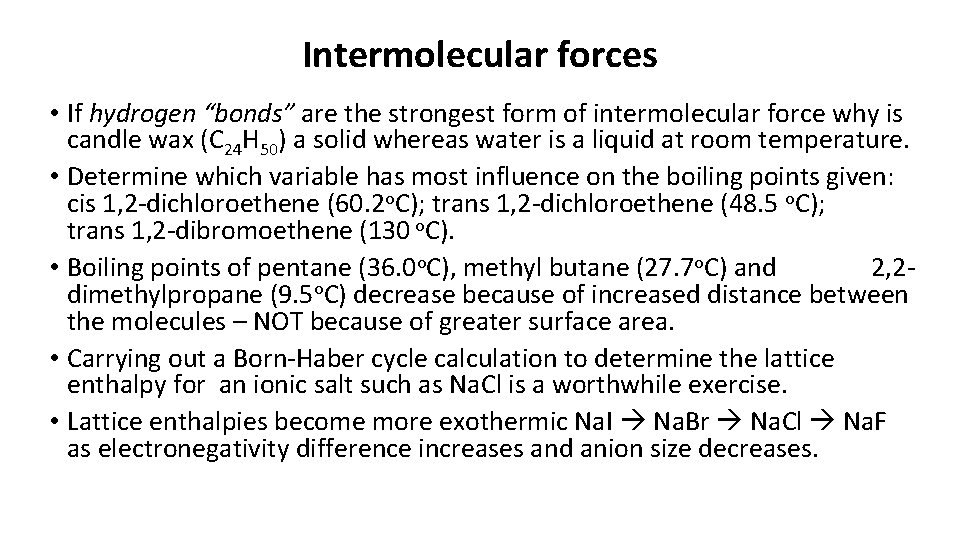
Intermolecular forces • If hydrogen “bonds” are the strongest form of intermolecular force why is candle wax (C 24 H 50) a solid whereas water is a liquid at room temperature. • Determine which variable has most influence on the boiling points given: cis 1, 2 -dichloroethene (60. 2 o. C); trans 1, 2 -dichloroethene (48. 5 o. C); trans 1, 2 -dibromoethene (130 o. C). • Boiling points of pentane (36. 0 o. C), methyl butane (27. 7 o. C) and 2, 2 dimethylpropane (9. 5 o. C) decrease because of increased distance between the molecules – NOT because of greater surface area. • Carrying out a Born-Haber cycle calculation to determine the lattice enthalpy for an ionic salt such as Na. Cl is a worthwhile exercise. • Lattice enthalpies become more exothermic Na. I Na. Br Na. Cl Na. F as electronegativity difference increases and anion size decreases.
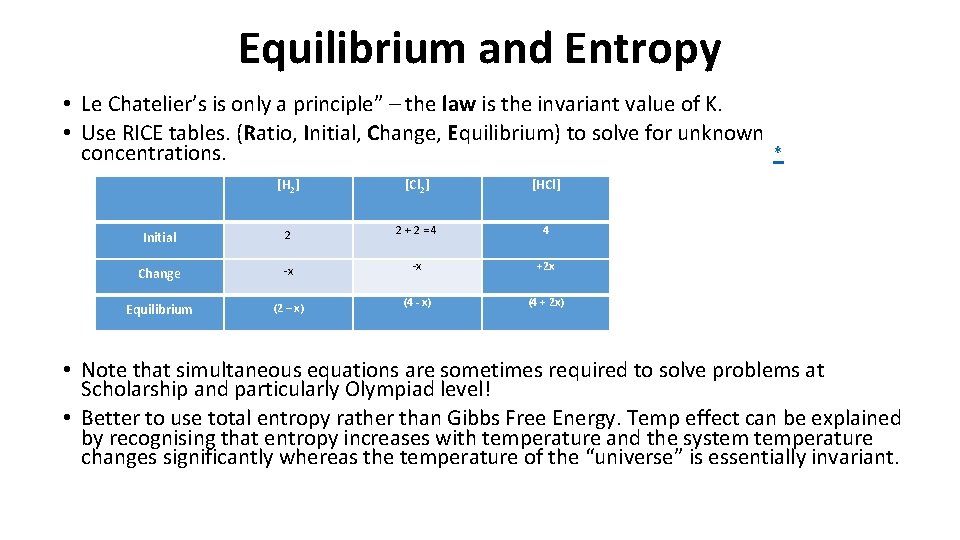
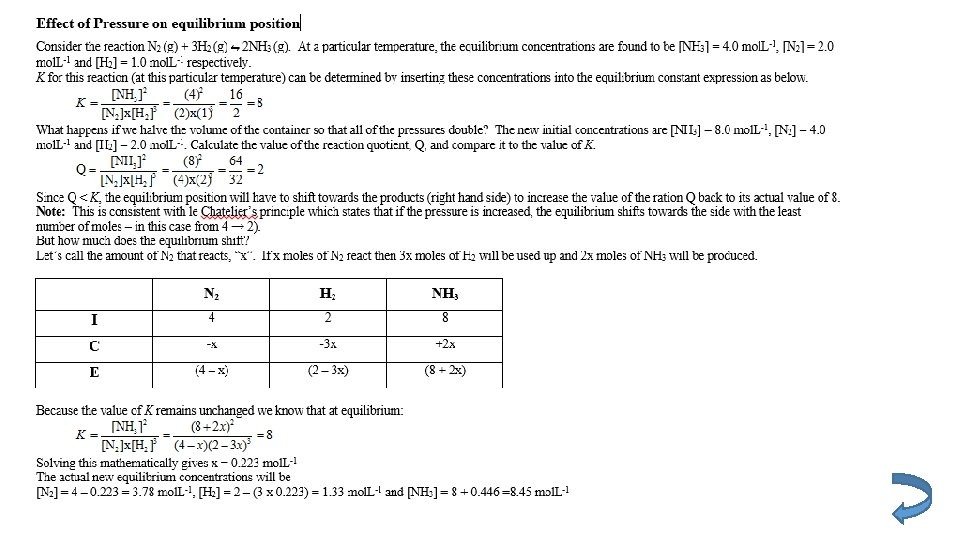
Equilibrium and Entropy • Le Chatelier’s is only a principle” – the law is the invariant value of K. • Use RICE tables. (Ratio, Initial, Change, Equilibrium) to solve for unknown concentrations. * [H 2] [Cl 2] [HCl] Initial 2 2+2=4 4 Change -x -x +2 x Equilibrium (2 – x) (4 - x) (4 + 2 x) • Note that simultaneous equations are sometimes required to solve problems at Scholarship and particularly Olympiad level! • Better to use total entropy rather than Gibbs Free Energy. Temp effect can be explained by recognising that entropy increases with temperature and the system temperature changes significantly whereas the temperature of the “universe” is essentially invariant.
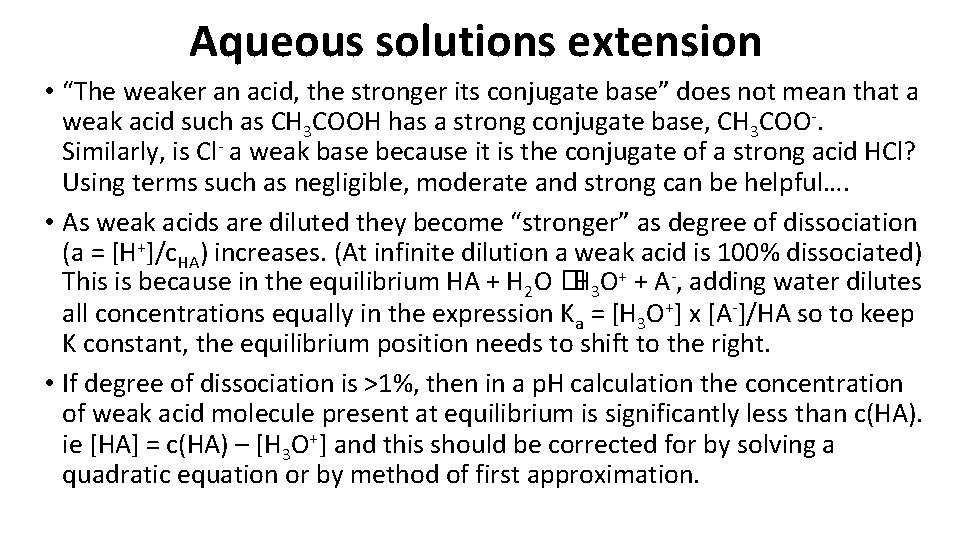
Aqueous solutions extension • “The weaker an acid, the stronger its conjugate base” does not mean that a weak acid such as CH 3 COOH has a strong conjugate base, CH 3 COO-. Similarly, is Cl- a weak base because it is the conjugate of a strong acid HCl? Using terms such as negligible, moderate and strong can be helpful…. • As weak acids are diluted they become “stronger” as degree of dissociation (a = [H+]/c. HA) increases. (At infinite dilution a weak acid is 100% dissociated) This is because in the equilibrium HA + H 2 O �H 3 O+ + A-, adding water dilutes all concentrations equally in the expression Ka = [H 3 O+] x [A-]/HA so to keep K constant, the equilibrium position needs to shift to the right. • If degree of dissociation is >1%, then in a p. H calculation the concentration of weak acid molecule present at equilibrium is significantly less than c(HA). ie [HA] = c(HA) – [H 3 O+] and this should be corrected for by solving a quadratic equation or by method of first approximation.
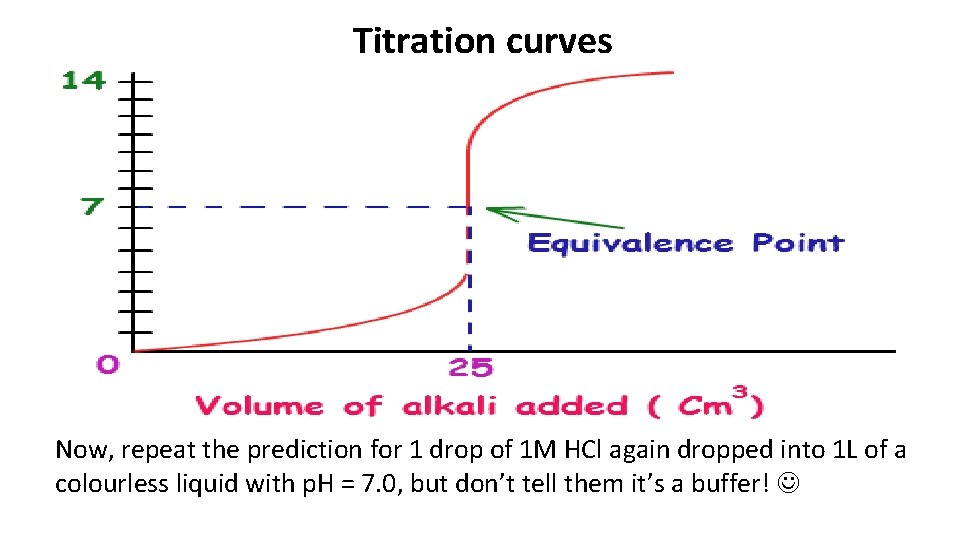
Titration curves • Predict the p. H change when 1 drop of 1 M HCl is dropped into 1 L of H 2 O. • Most students predict somewhere between 6. 9 and 7. 0. Reality is p. H≈4. • n(H+) added = C x V = 1. 0 x 0. 0001 = 1 x 10 -4 mol. This added to the original 1 x 10 -7 mol present in the p. H 7 water means new conc. is 1 x 10 -4. • Why doesn’t the 2 nd drop have the same effect – because you are again adding 1 x 10 -4 mol but this time you only doubling the starting conc. instead of increasing it by 1, 000 times so p. H only changes from 4 to 3. 7. • Similarly, near the start of the titration adding one drop of base to the acid only causes H+ concentration to change from say 0. 100 to 0. 1001 M resulting in negligible p. H change even though there is no buffer system. Now, repeat the prediction for 1 drop of 1 M HCl again dropped into 1 L of a colourless liquid with p. H = 7. 0, but don’t tell them it’s a buffer!
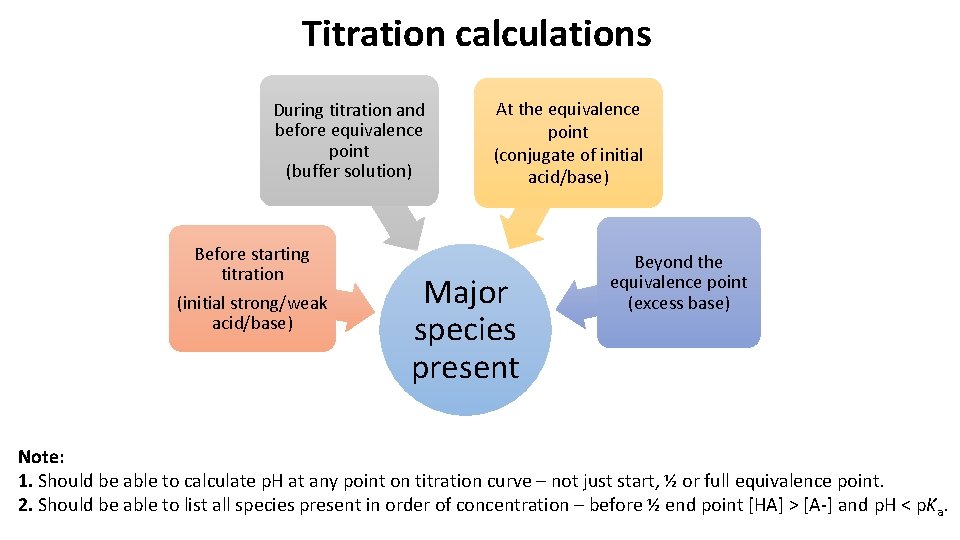
Titration calculations During titration and before equivalence point (buffer solution) Before starting titration (initial strong/weak acid/base) At the equivalence point (conjugate of initial acid/base) Major species present Beyond the equivalence point (excess base) Note: 1. Should be able to calculate p. H at any point on titration curve – not just start, ½ or full equivalence point. 2. Should be able to list all species present in order of concentration – before ½ end point [HA] > [A-] and p. H < p. Ka.
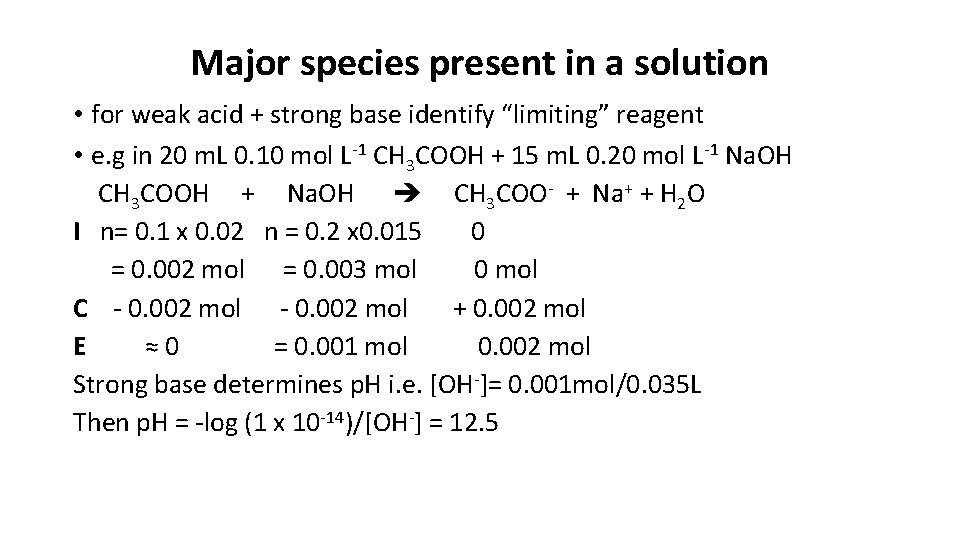
Major species present in a solution • for weak acid + strong base identify “limiting” reagent • e. g in 20 m. L 0. 10 mol L-1 CH 3 COOH + 15 m. L 0. 20 mol L-1 Na. OH CH 3 COOH + Na. OH CH 3 COO- + Na+ + H 2 O I n= 0. 1 x 0. 02 n = 0. 2 x 0. 015 0 = 0. 002 mol = 0. 003 mol 0 mol C - 0. 002 mol + 0. 002 mol E ≈0 = 0. 001 mol 0. 002 mol Strong base determines p. H i. e. [OH-]= 0. 001 mol/0. 035 L Then p. H = -log (1 x 10 -14)/[OH-] = 12. 5
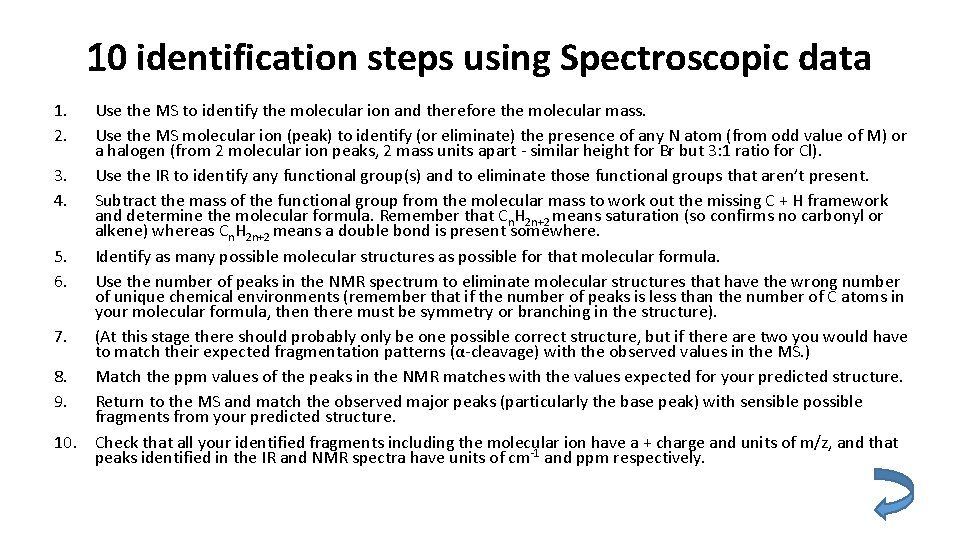
10 identification steps using Spectroscopic data 1. 2. Use the MS to identify the molecular ion and therefore the molecular mass. Use the MS molecular ion (peak) to identify (or eliminate) the presence of any N atom (from odd value of M) or a halogen (from 2 molecular ion peaks, 2 mass units apart - similar height for Br but 3: 1 ratio for Cl). 3. Use the IR to identify any functional group(s) and to eliminate those functional groups that aren’t present. 4. Subtract the mass of the functional group from the molecular mass to work out the missing C + H framework and determine the molecular formula. Remember that Cn. H 2 n+2 means saturation (so confirms no carbonyl or alkene) whereas Cn. H 2 n+2 means a double bond is present somewhere. 5. Identify as many possible molecular structures as possible for that molecular formula. 6. Use the number of peaks in the NMR spectrum to eliminate molecular structures that have the wrong number of unique chemical environments (remember that if the number of peaks is less than the number of C atoms in your molecular formula, then there must be symmetry or branching in the structure). 7. (At this stage there should probably only be one possible correct structure, but if there are two you would have to match their expected fragmentation patterns (α-cleavage) with the observed values in the MS. ) 8. Match the ppm values of the peaks in the NMR matches with the values expected for your predicted structure. 9. Return to the MS and match the observed major peaks (particularly the base peak) with sensible possible fragments from your predicted structure. 10. Check that all your identified fragments including the molecular ion have a + charge and units of m/z, and that peaks identified in the IR and NMR spectra have units of cm-1 and ppm respectively.
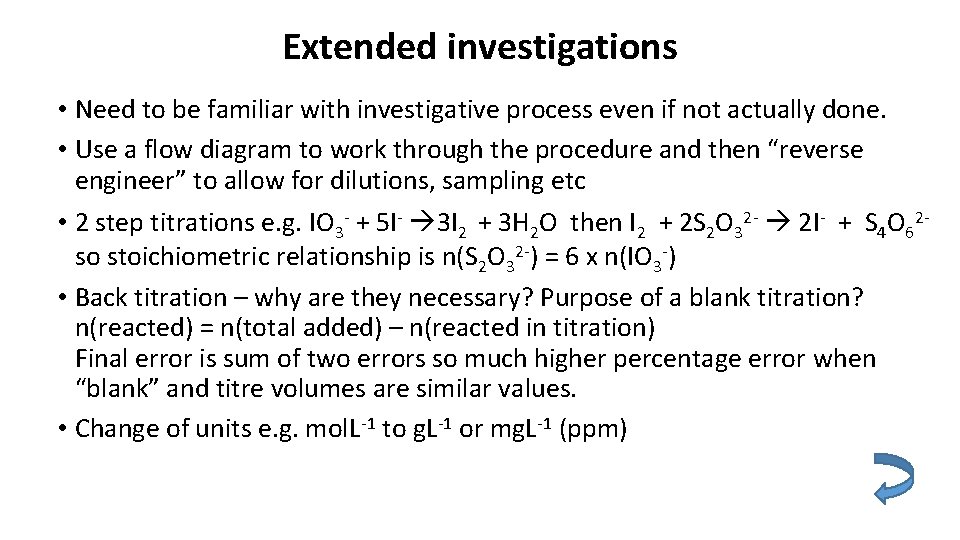
Extended investigations • Need to be familiar with investigative process even if not actually done. • Use a flow diagram to work through the procedure and then “reverse engineer” to allow for dilutions, sampling etc • 2 step titrations e. g. IO 3 - + 5 I- 3 I 2 + 3 H 2 O then I 2 + 2 S 2 O 32 - 2 I- + S 4 O 62 so stoichiometric relationship is n(S 2 O 32 -) = 6 x n(IO 3 -) • Back titration – why are they necessary? Purpose of a blank titration? n(reacted) = n(total added) – n(reacted in titration) Final error is sum of two errors so much higher percentage error when “blank” and titre volumes are similar values. • Change of units e. g. mol. L-1 to g. L-1 or mg. L-1 (ppm)
A possible 3 to 4 year Chemistry program Recommended curriculum coverage over 3(to 4) years Yr 13 Chemistry Credits Yr 12 Chemistry Credits Yr 11 Science/ Chemistry Credits C 3. 2 Internal 3 C 3. 1 Note 1 Internal 4 S 1. 5 (Yr 10) External 4 C 3. 4 External 5 C 2. 1 Internal 4 S 1. 1 (Yr 10) Internal 4 C 3. 5 External 5 C 2. 4 External 5 C 1. 5 External 4 C 3. 6 External 5 C 2. 5 External 4 S 2. 2 Internal 3 C 3. 7 Internal 3 C 2. 6 External 4 C 2. 7 Internal 3 Notes: 1. A full extended investigation (C 3. 1) does not need to be done as the required concepts could be covered by a miniinvestigation such as determining the concentration of OCl- in a bleach and doing some back titration calculations. 2. Yr 11 suggestions can only be accommodated within a double Science program or by including the concepts of S 1. 5 and/or S 1. 1 in a Yr 9 -10 Science course. 3. C 1. 3 and C 3. 3 can be included as options in Yr 11 and Yr 13 respectively.