Sys ML v 2 Planning Requirements Working Group

- Slides: 42
Sys. ML v 2 Planning & Requirements Working Group Meeting December 8 & 10, 2015 http: //www. omgwiki. org/OMGSys. ML/doku. php? id=sysmlroadmap: sysml_assessment_and_roadmap_working_group Sandy Friedenthal
Sys. ML Background § § Sys. ML v 1 adopted in 2006 Facilitated awareness and adoption of MBSE Much learned from applications of MBSE using Sys. ML Work in process to develop requirements for next generation of Sys. ML (v 2) 2
System Modeling Asessment & Roadmap WG Status § § Sponsored by OMG SE DSIG Objective: Develop RFP for next generation of Sys. ML (v 2) Current focus on requirements and concepts INCOSE MBSE Themed article published August ‘ 15 on the capabilities, effectiveness measures, and driving requirements for a systems modeling environment (SME) 3
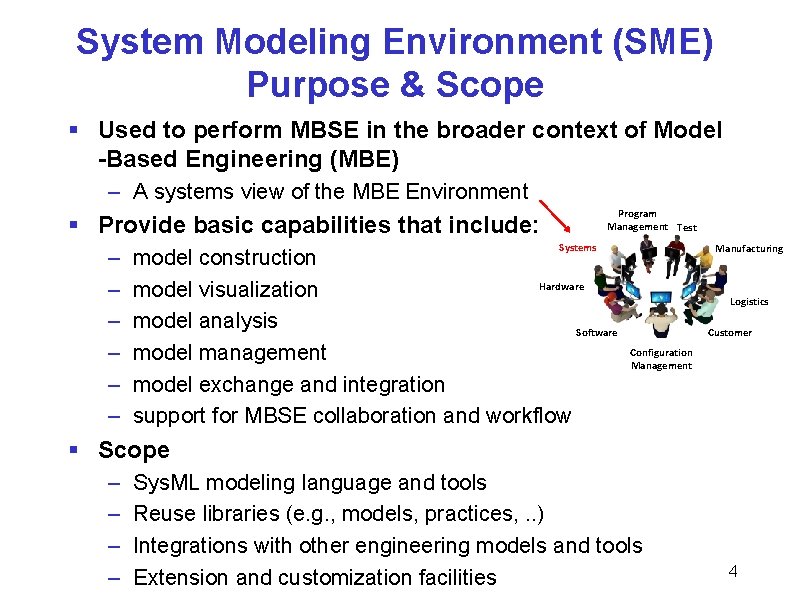
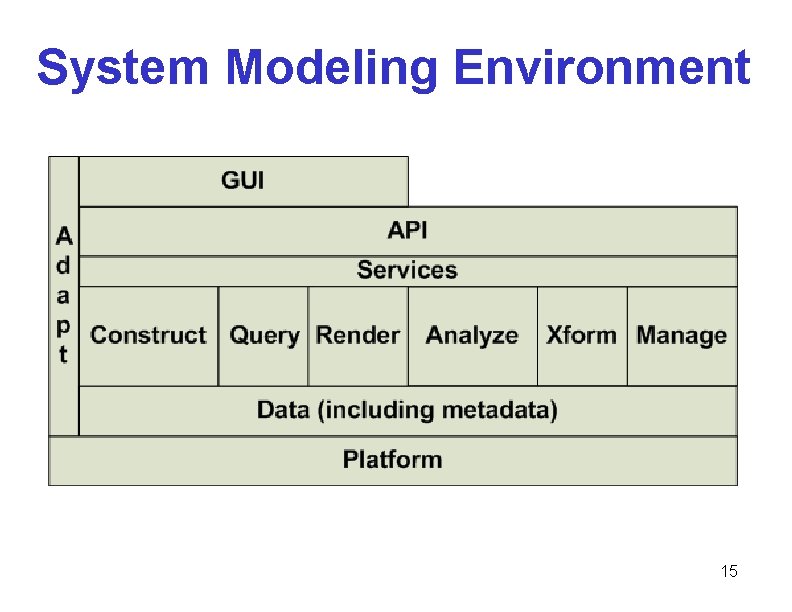
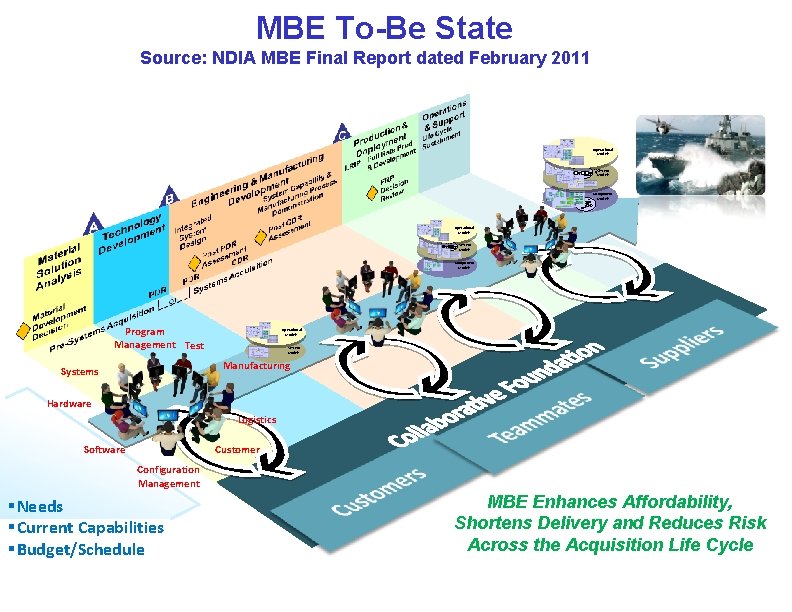
System Modeling Environment (SME) Purpose & Scope § Used to perform MBSE in the broader context of Model -Based Engineering (MBE) – A systems view of the MBE Environment Program Management Test § Provide basic capabilities that include: – – – Systems model construction Hardware model visualization model analysis Software model management model exchange and integration support for MBSE collaboration and workflow Manufacturing Logistics Customer Configuration Management § Scope – – Sys. ML modeling language and tools Reuse libraries (e. g. , models, practices, . . ) Integrations with other engineering models and tools Extension and customization facilities 4
Meeting Objectives & Follow-up § Overall – Refine, integrate, and illustrate System Modeling Environment (SME) Concept to support requirements development for Sys. ML v 2 RFP § Concept Leads & Presentors to discuss: – Limitations of Sys. ML v 1. 4 – Effectiveness measures as a basis for evaluating concepts – Services needed to support concept – Illustrate how concept supports Hybrid SUV change scenario – Feedback from Cambridge meeting in Sept 15 § Follow-up – Continue to refine and vet the concepts – Establish the baseline SME Concept by the Reston meeting in March, 2016 and document in white paper 5 – Develop plan for Sys. ML v 2 RFP
Agenda Tuesday, December 8, 2015 09: 00 - 09: 30 Introduction - Sandy Friedenthal 09: 30 - 10: 30 Change scenario use case review - John Watson/Sandy 10: 30 - 11: 00 Break Concept reviews 11: 00 - 12: 00 Modeling Formalism [R 2] - Yves Bernard 12: 00 - 13: 00 Lunch 13: 00 - 14: 00 Analysis Concept [R 2] - Manas Bajaj 14: 00 - 14: 30 Analysis Profile RFC - Conrad Bock 14: 30 - 15: 00 Break 15: 00 - 16: 00 Model Construction [R 4] - Ron Williamson 16: 00 - 17: 00 Model Visualization [R 3] - Chris Schreiber, Josh Feingold 17: 00 - 17: 15 Summary and Updated Agenda for Thursday 6
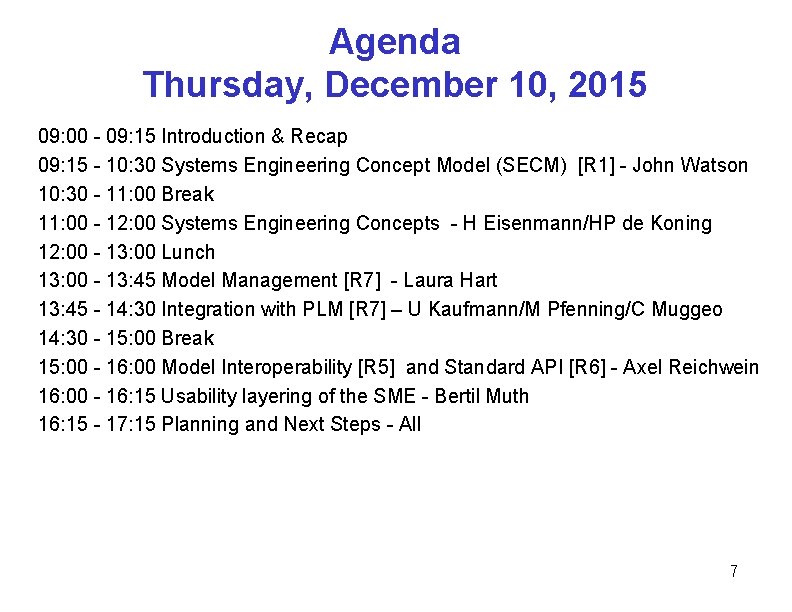
Agenda Thursday, December 10, 2015 09: 00 - 09: 15 Introduction & Recap 09: 15 - 10: 30 Systems Engineering Concept Model (SECM) [R 1] - John Watson 10: 30 - 11: 00 Break 11: 00 - 12: 00 Systems Engineering Concepts - H Eisenmann/HP de Koning 12: 00 - 13: 00 Lunch 13: 00 - 13: 45 Model Management [R 7] - Laura Hart 13: 45 - 14: 30 Integration with PLM [R 7] – U Kaufmann/M Pfenning/C Muggeo 14: 30 - 15: 00 Break 15: 00 - 16: 00 Model Interoperability [R 5] and Standard API [R 6] - Axel Reichwein 16: 00 - 16: 15 Usability layering of the SME - Bertil Muth 16: 15 - 17: 15 Planning and Next Steps - All 7
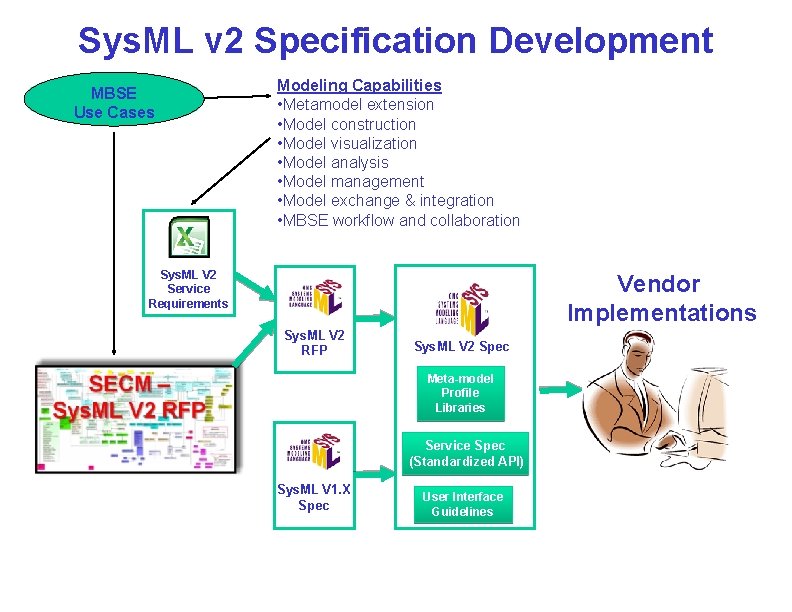
Sys. ML v 2 Specification Development MBSE Use Cases Modeling Capabilities • Metamodel extension • Model construction • Model visualization • Model analysis • Model management • Model exchange & integration • MBSE workflow and collaboration Sys. ML V 2 Service Requirements Vendor Implementations Sys. ML V 2 RFP Sys. ML V 2 Spec Meta-model Profile Libraries Service Spec (Standardized API) Sys. ML V 1. X Spec User Interface Guidelines
SYSTEM MODELING ENVIRONMENT (SME) 9
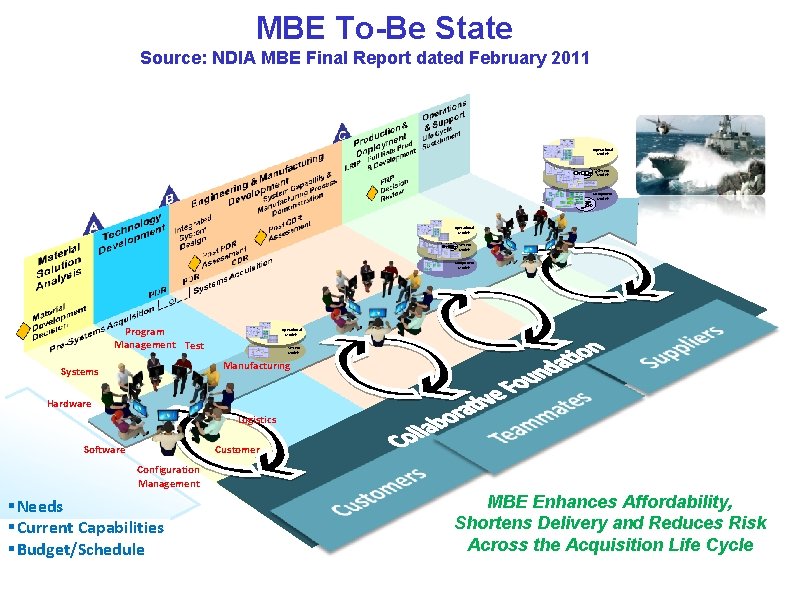
MBE To-Be State Source: NDIA MBE Final Report dated February 2011 Operational Models System Models Analysis Models ò )( U G s Hardware Models Component Models S SET Q R CLR Q Operational Models Analysis Models U(s) G(s) ò System Models Component Models Program Management Test Operational Models System Models Manufacturing Systems Hardware Logistics Customer Software Configuration Management § Needs § Current Capabilities § Budget/Schedule MBE Enhances Affordability, Shortens Delivery and Reduces Risk Across the Acquisition Life Cycle
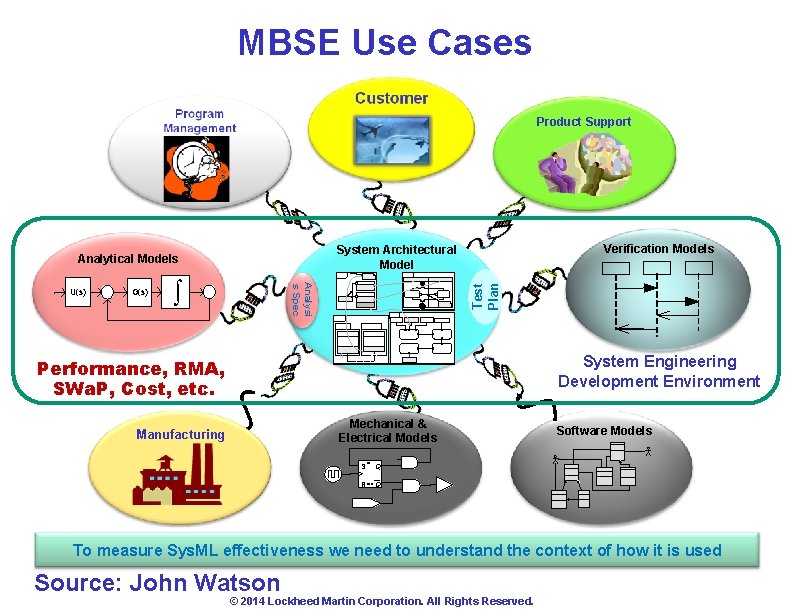
MBSE Use Cases Product Support ò Test Plan G(s) Analysi s Spec U(s) Verification Models System Architectural Model Analytical Models System Engineering Development Environment Performance, RMA, SWa. P, Cost, etc. Mechanical & Electrical Models Manufacturing S SET Software Models Q R CLR Q To measure Sys. ML effectiveness we need to understand the context of how it is used Source: John Watson © 2014 Lockheed Martin Corporation. All Rights Reserved.
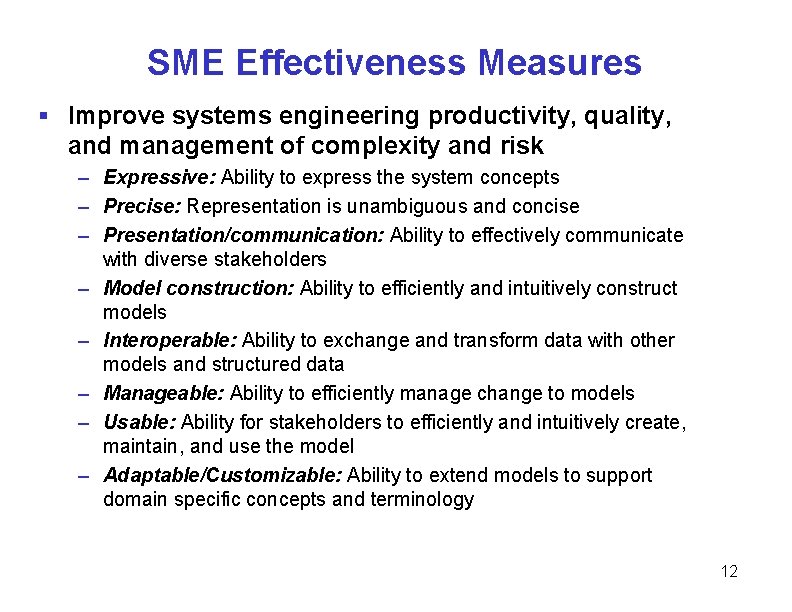
SME Effectiveness Measures § Improve systems engineering productivity, quality, and management of complexity and risk – Expressive: Ability to express the system concepts – Precise: Representation is unambiguous and concise – Presentation/communication: Ability to effectively communicate with diverse stakeholders – Model construction: Ability to efficiently and intuitively construct models – Interoperable: Ability to exchange and transform data with other models and structured data – Manageable: Ability to efficiently manage change to models – Usable: Ability for stakeholders to efficiently and intuitively create, maintain, and use the model – Adaptable/Customizable: Ability to extend models to support domain specific concepts and terminology 12
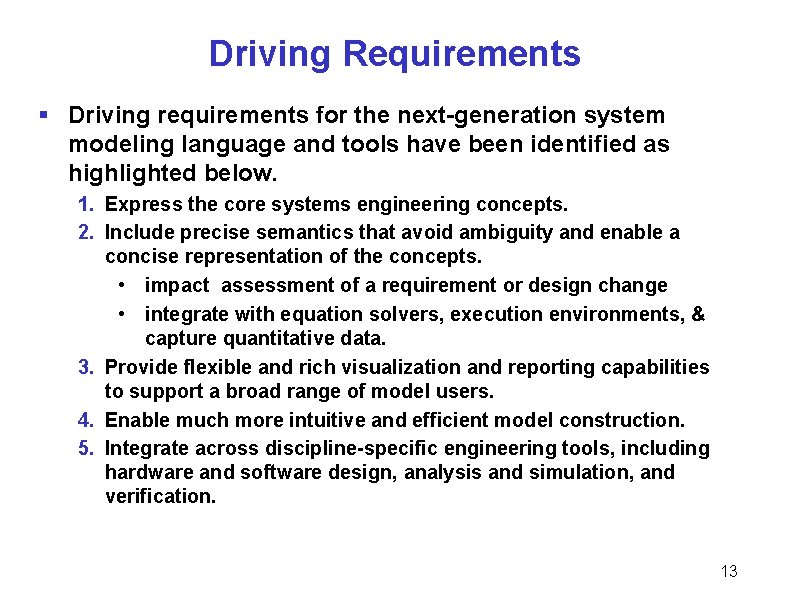
Driving Requirements § Driving requirements for the next-generation system modeling language and tools have been identified as highlighted below. 1. Express the core systems engineering concepts. 2. Include precise semantics that avoid ambiguity and enable a concise representation of the concepts. • impact assessment of a requirement or design change • integrate with equation solvers, execution environments, & capture quantitative data. 3. Provide flexible and rich visualization and reporting capabilities to support a broad range of model users. 4. Enable much more intuitive and efficient model construction. 5. Integrate across discipline-specific engineering tools, including hardware and software design, analysis and simulation, and verification. 13
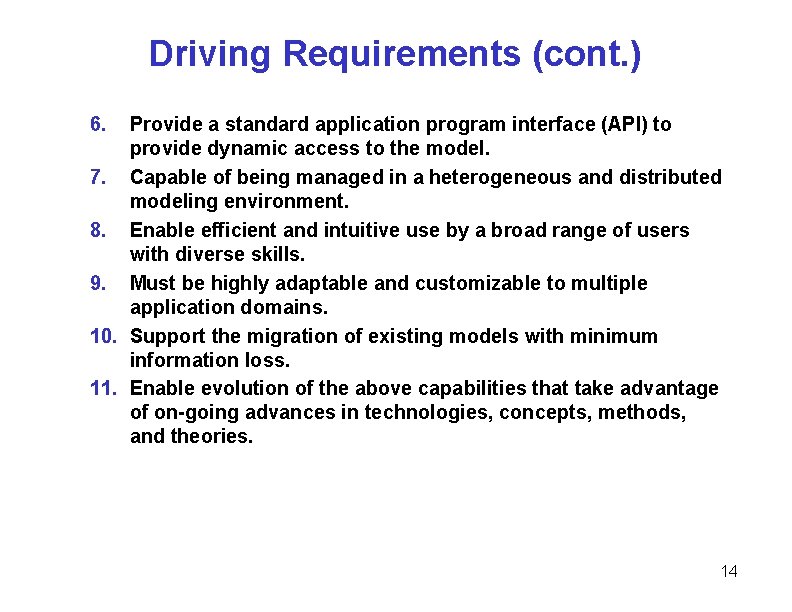
Driving Requirements (cont. ) 6. Provide a standard application program interface (API) to provide dynamic access to the model. 7. Capable of being managed in a heterogeneous and distributed modeling environment. 8. Enable efficient and intuitive use by a broad range of users with diverse skills. 9. Must be highly adaptable and customizable to multiple application domains. 10. Support the migration of existing models with minimum information loss. 11. Enable evolution of the above capabilities that take advantage of on-going advances in technologies, concepts, methods, and theories. 14
System Modeling Environment 15
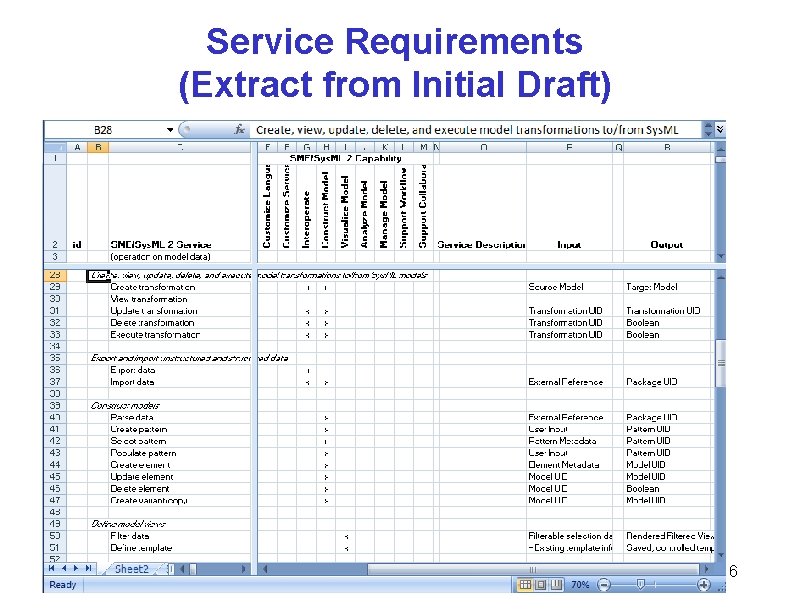
Service Requirements (Extract from Initial Draft) 16
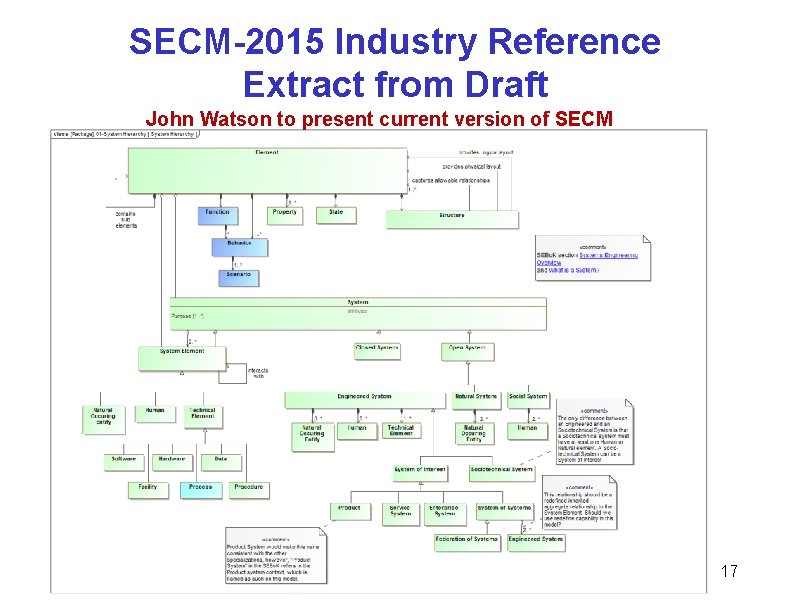
SECM-2015 Industry Reference Extract from Draft John Watson to present current version of SECM 17
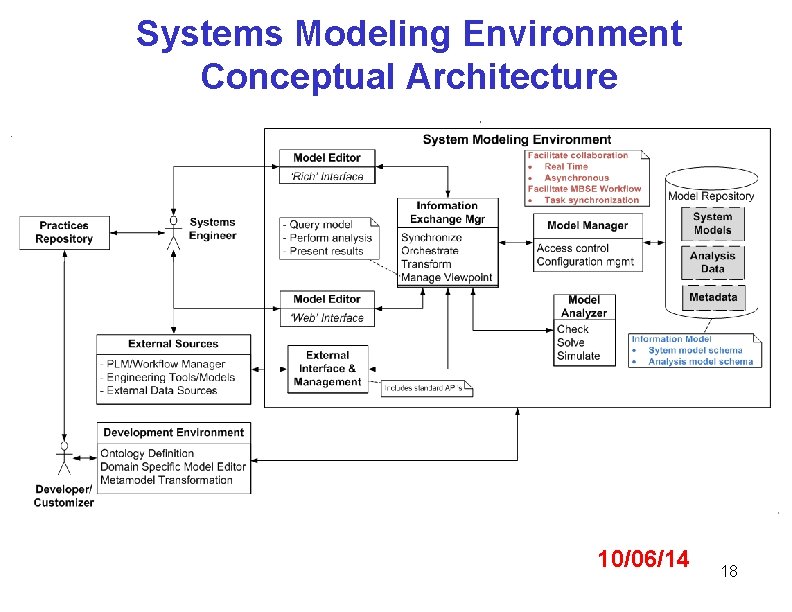
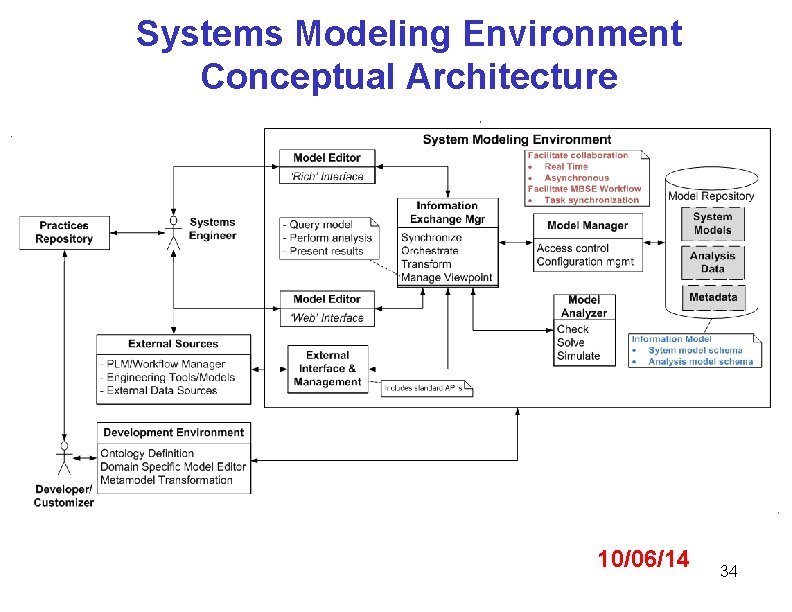
Systems Modeling Environment Conceptual Architecture 10/06/14 18
Next Steps § Develop SME concept – March 2016 § Vet among the community § Derive requirements and issue Sys. ML v 2 RFP – March 2017 19
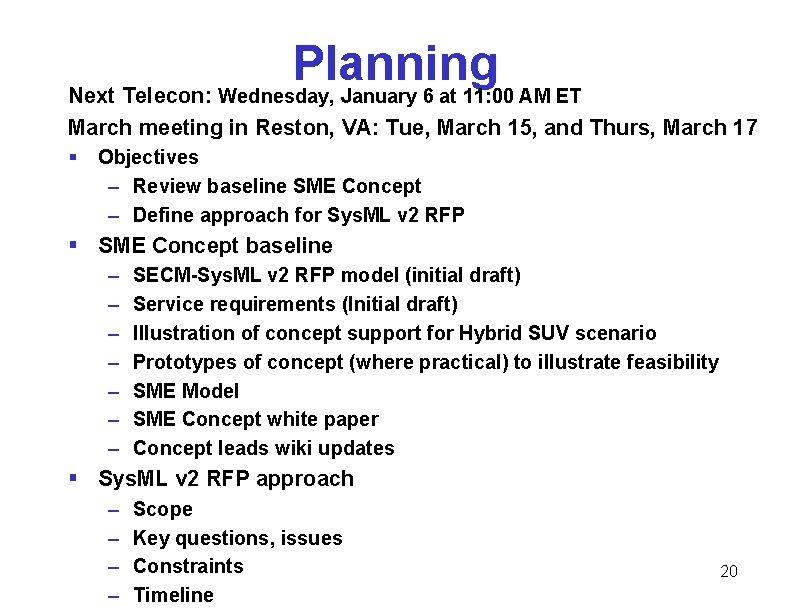
Planning Next Telecon: Wednesday, January 6 at 11: 00 AM ET March meeting in Reston, VA: Tue, March 15, and Thurs, March 17 § Objectives – Review baseline SME Concept – Define approach for Sys. ML v 2 RFP § SME Concept baseline – – – – SECM-Sys. ML v 2 RFP model (initial draft) Service requirements (Initial draft) Illustration of concept support for Hybrid SUV scenario Prototypes of concept (where practical) to illustrate feasibility SME Model SME Concept white paper Concept leads wiki updates § Sys. ML v 2 RFP approach – – Scope Key questions, issues Constraints Timeline 20
Sys. ML v 2 Planning & Requirements Working Group Meeting September 24, 2015 http: //www. omgwiki. org/OMGSys. ML/doku. php? id=sysmlroadmap: sysml_assessment_and_roadmap_working_group Sandy Friedenthal Eldad Palachi
Sys. ML Background § § Sys. ML v 1 adopted in 2006 Facilitated awareness and adoption of MBSE Much learned from applications of MBSE using Sys. ML General agreement the time is right to begin work on the next generation of Sys. ML (v 2) 22
Sys. ML v 2 Work Group Status § § Sponsored by OMG SE DSIG Objective: Develop RFP for next generation Sys. ML v 2 Current focus on requirements and concepts INCOSE MBSE Themed article published August ‘ 15 on the capabilities, effectiveness measures, and driving requirements for a systems modeling environment (SME) 23
Meeting Objectives § Concept Leads/Presentors – Present draft concepts for the System Modeling Environment (SME) § Participants – Identify issues and missing concepts to provide to § Follow-up – Continue to refine and vet the concepts – Establish the baseline SME Concept by the Reston meeting in March, 2016 • Document in white paper – Use to help derive requirements for Sys. ML v 2 RFP 24
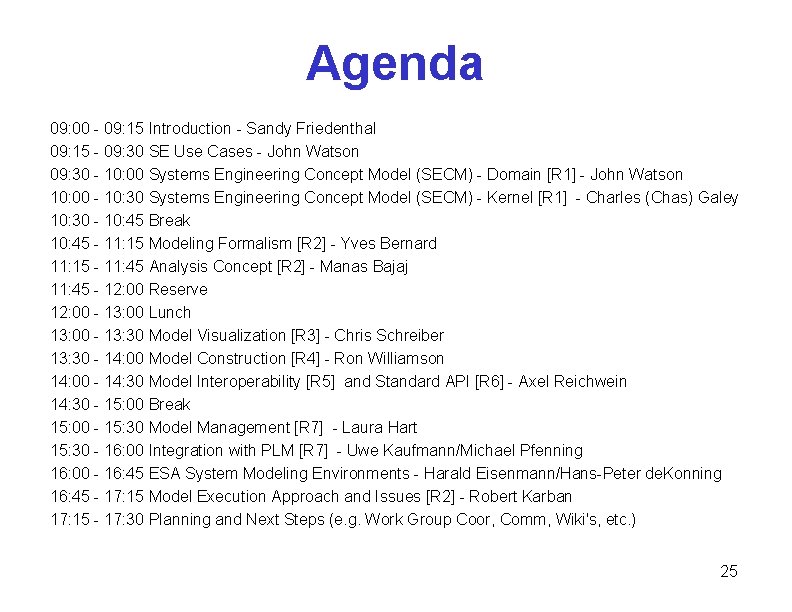
Agenda 09: 00 - 09: 15 Introduction - Sandy Friedenthal 09: 15 - 09: 30 SE Use Cases - John Watson 09: 30 - 10: 00 Systems Engineering Concept Model (SECM) - Domain [R 1] - John Watson 10: 00 - 10: 30 Systems Engineering Concept Model (SECM) - Kernel [R 1] - Charles (Chas) Galey 10: 30 - 10: 45 Break 10: 45 - 11: 15 Modeling Formalism [R 2] - Yves Bernard 11: 15 - 11: 45 Analysis Concept [R 2] - Manas Bajaj 11: 45 - 12: 00 Reserve 12: 00 - 13: 00 Lunch 13: 00 - 13: 30 Model Visualization [R 3] - Chris Schreiber 13: 30 - 14: 00 Model Construction [R 4] - Ron Williamson 14: 00 - 14: 30 Model Interoperability [R 5] and Standard API [R 6] - Axel Reichwein 14: 30 - 15: 00 Break 15: 00 - 15: 30 Model Management [R 7] - Laura Hart 15: 30 - 16: 00 Integration with PLM [R 7] - Uwe Kaufmann/Michael Pfenning 16: 00 - 16: 45 ESA System Modeling Environments - Harald Eisenmann/Hans-Peter de. Konning 16: 45 - 17: 15 Model Execution Approach and Issues [R 2] - Robert Karban 17: 15 - 17: 30 Planning and Next Steps (e. g. Work Group Coor, Comm, Wiki's, etc. ) 25
SYSTEM MODELING ENVIRONMENT (SME) 26
MBE To-Be State Source: NDIA MBE Final Report dated February 2011 Operational Models System Models Analysis Models ò )( U G s Hardware Models Component Models S SET Q R CLR Q Operational Models Analysis Models U(s) G(s) ò System Models Component Models Program Management Test Operational Models System Models Manufacturing Systems Hardware Logistics Customer Software Configuration Management § Needs § Current Capabilities § Budget/Schedule MBE Enhances Affordability, Shortens Delivery and Reduces Risk Across the Acquisition Life Cycle
MBSE Use Cases Product Support ò Test Plan G(s) Analysi s Spec U(s) Verification Models System Architectural Model Analytical Models System Engineering Development Environment Performance, RMA, SWa. P, Cost, etc. Mechanical & Electrical Models Manufacturing S SET Software Models Q R CLR Q To measure Sys. ML effectiveness we need to understand the context of how it is used Source: John Watson © 2014 Lockheed Martin Corporation. All Rights Reserved.
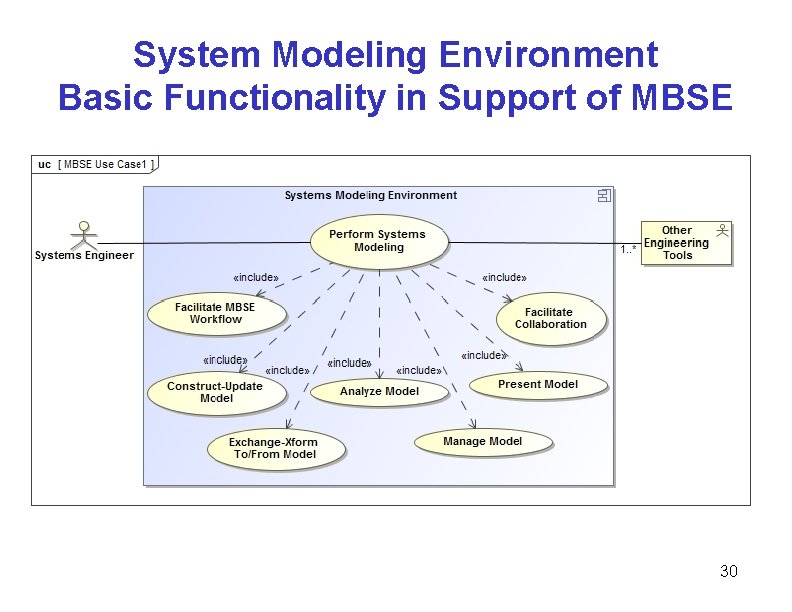
System Modeling Environment (SME) § Used by system modelers to perform MBSE in the broader context of Model-Based Engineering (MBE) § Provide basic capabilities that include: – model construction – model visualization – model analysis – model management – model exchange and integration – support for MBSE collaboration and workflow § Scope – Sys. ML modeling language and tools – Reuse libraries (e. g. , models, practices, . . ) – Integrations with other engineering models and tools 29
System Modeling Environment Basic Functionality in Support of MBSE 30
Effectiveness Measures § Improve systems engineering productivity, quality, and management of complexity and risk – Expressive: Ability to express the system concepts – Precise: Representation is unambiguous and concise – Presentation/communication: Ability to effectively communicate with diverse stakeholders – Model construction: Ability to efficiently and intuitively construct models – Interoperable: Ability to exchange and transform data with other models and structured data – Manageable: Ability to efficiently manage change to models – Usable: Ability for stakeholders to efficiently and intuitively create, maintain, and use the model – Adaptable/Customizable: Ability to extend models to support domain specific concepts and terminology 31
Driving Requirements § Driving requirements for the next-generation system modeling language and tools have been identified as highlighted below. 1. Express the core systems engineering concepts. 2. Include precise semantics that avoid ambiguity and enable a concise representation of the concepts. • impact assessment of a requirement or design change • integrate with equation solvers, execution environments, & capture quantitative data. 3. Provide flexible and rich visualization and reporting capabilities to support a broad range of model users. 4. Enable much more intuitive and efficient model construction. 5. Integrate across discipline-specific engineering tools, including hardware and software design, analysis and simulation, and verification. 32
Driving Requirements (cont. ) 6. Provide a standard application program interface (API) to provide dynamic access to the model. 7. Capable of being managed in a heterogeneous and distributed modeling environment. 8. Enable efficient and intuitive use by a broad range of users with diverse skills. 9. Must be highly adaptable and customizable to multiple application domains. 10. Support the migration of existing models with minimum information loss. 11. Enable evolution of the above capabilities that take advantage of on-going advances in technologies, concepts, methods, and theories. 33
Systems Modeling Environment Conceptual Architecture 10/06/14 34
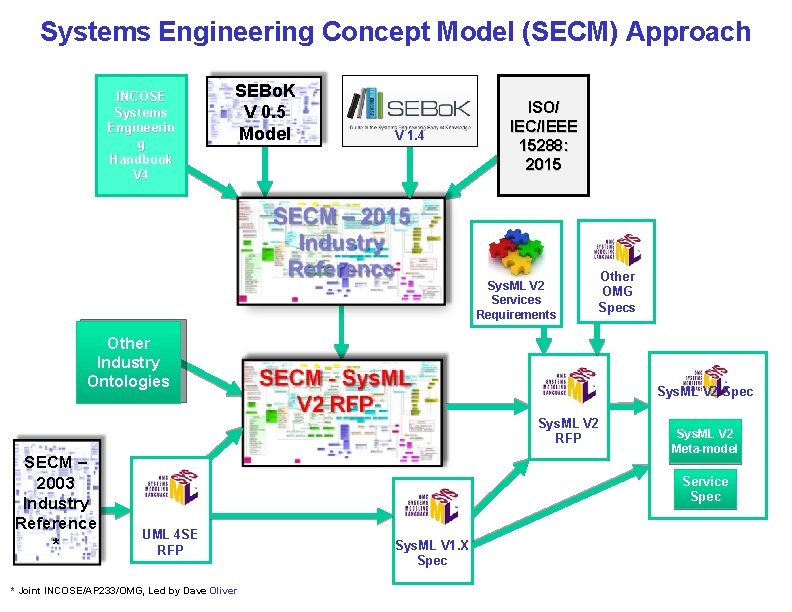
Systems Engineering Concept Model (SECM) Approach INCOSE Systems Engineerin g Handbook V 4 SEBo. K V 0. 5 Model V 1. 4 ISO/ IEC/IEEE 15288: 2015 Sys. ML V 2 Services Requirements Other OMG Specs Other Industry Ontologies Sys. ML V 2 Spec Sys. ML V 2 RFP SECM – 2003 Industry Reference * Sys. ML V 2 Meta-model Service Spec UML 4 SE RFP * Joint INCOSE/AP 233/OMG, Led by Dave Oliver Sys. ML V 1. X Spec
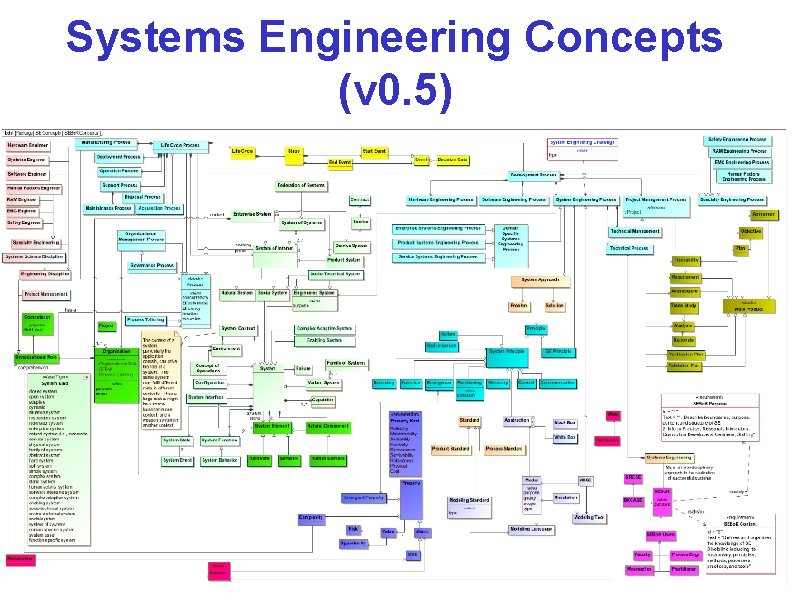
Systems Engineering Concepts (v 0. 5)
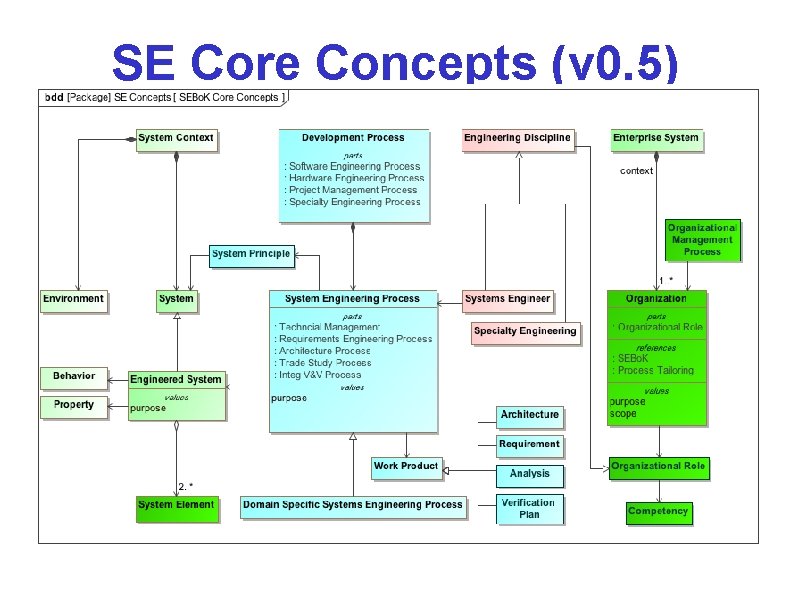
SE Core Concepts (v 0. 5)
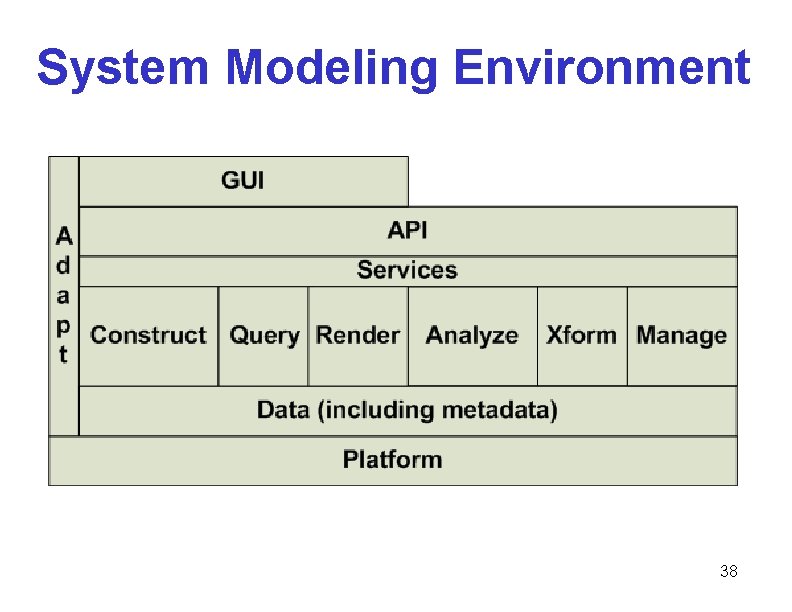
System Modeling Environment 38
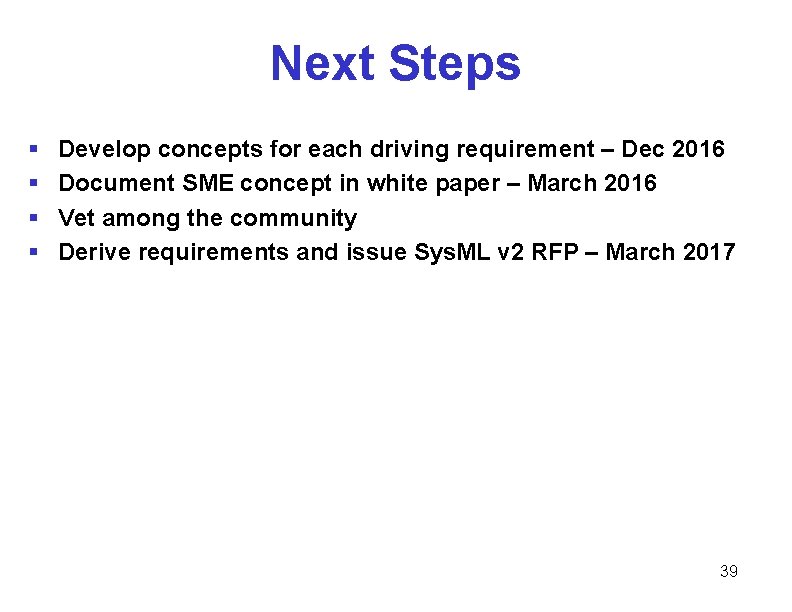
Next Steps § § Develop concepts for each driving requirement – Dec 2016 Document SME concept in white paper – March 2016 Vet among the community Derive requirements and issue Sys. ML v 2 RFP – March 2017 39
BACKUP 40
Systems Modeling Environment Concept Development Approach § For each capability area – Assess current state and limitations – Develop concept – Determine near term, mid term, and long term improvements • Leverage current activities, research, and initiatives – Develop a follow-up plan to prototype and validate concept § Integrate each capability concept into an overall system modeling environment concept and roadmap that supports MBSE in the context of Virtual Engineering 41
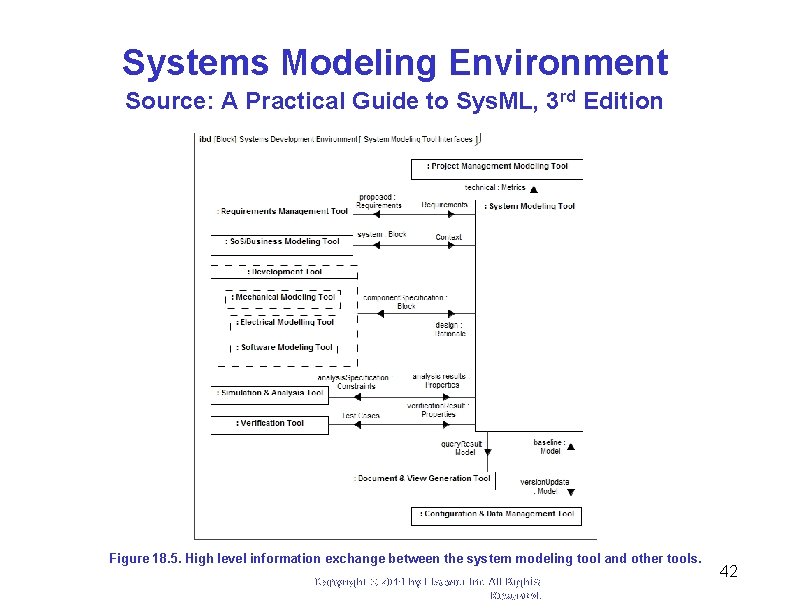
Systems Modeling Environment Source: A Practical Guide to Sys. ML, 3 rd Edition Figure 18. 5. High level information exchange between the system modeling tool and other tools. Copyright © 2014 by Elsevier Inc All Rights Reserved. 42