Synaptic Cleft Information Transfer Figure 11 18 Termination
- Slides: 19
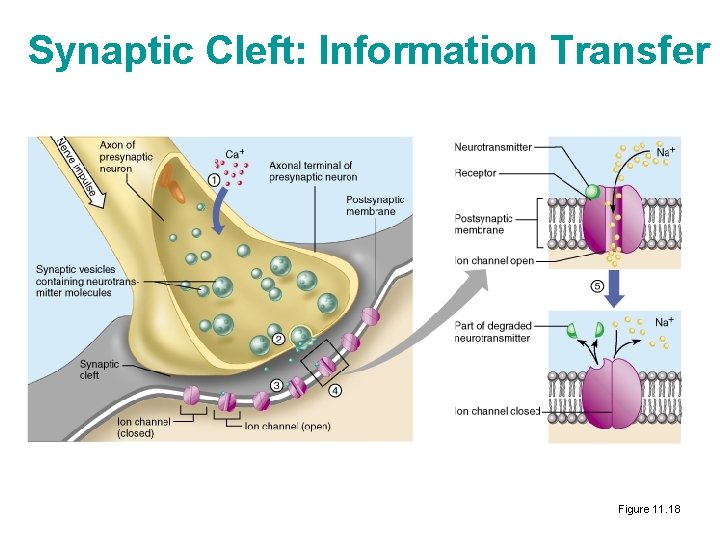
Synaptic Cleft: Information Transfer Figure 11. 18
Termination of Neurotransmitter Effects • Neurotransmitter bound to a postsynaptic neuron: – Produces a continuous postsynaptic effect – Blocks reception of additional “messages” – Must be removed from its receptor • Removal of neurotransmitters occurs when they: – Are degraded by enzymes – Are reabsorbed by astrocytes or the presynaptic terminals – Diffuse from the synaptic cleft
Synaptic Delay • Neurotransmitter must be released, diffuse across the synapse, and bind to receptor • Synaptic delay – time needed to do this (0. 3 -5. 0 ms) • Synaptic delay is the rate-limiting step of neural transmission
Postsynaptic Potentials • Neurotransmitter receptors mediate changes in membrane potential according to: – The amount of neurotransmitter released – The amount of time the neurotransmitter is bound to receptor • The two types of postsynaptic potentials are: – EPSP – excitatory postsynaptic potentials – IPSP – inhibitory postsynaptic potentials
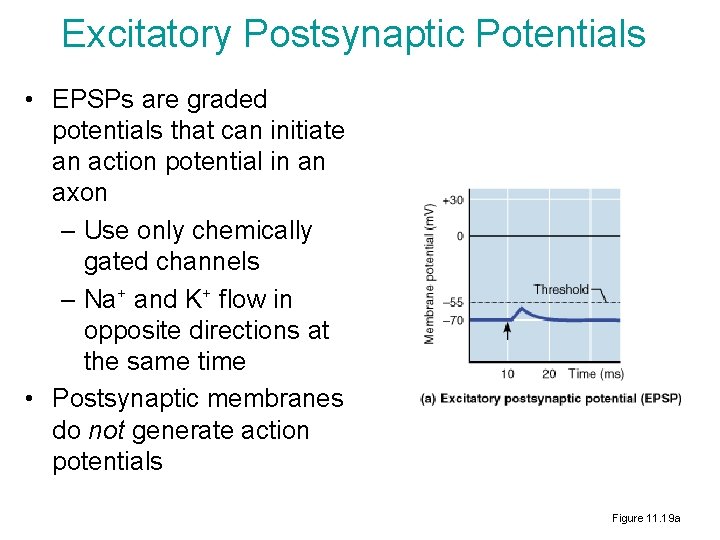
Excitatory Postsynaptic Potentials • EPSPs are graded potentials that can initiate an action potential in an axon – Use only chemically gated channels – Na+ and K+ flow in opposite directions at the same time • Postsynaptic membranes do not generate action potentials Figure 11. 19 a
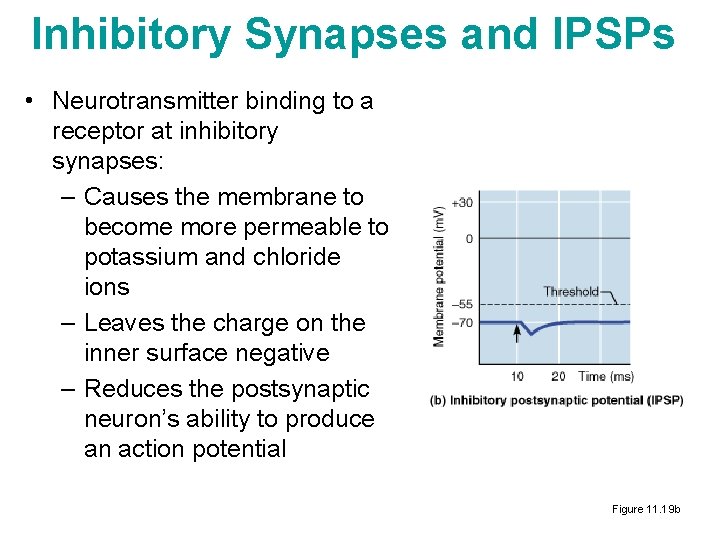
Inhibitory Synapses and IPSPs • Neurotransmitter binding to a receptor at inhibitory synapses: – Causes the membrane to become more permeable to potassium and chloride ions – Leaves the charge on the inner surface negative – Reduces the postsynaptic neuron’s ability to produce an action potential Figure 11. 19 b
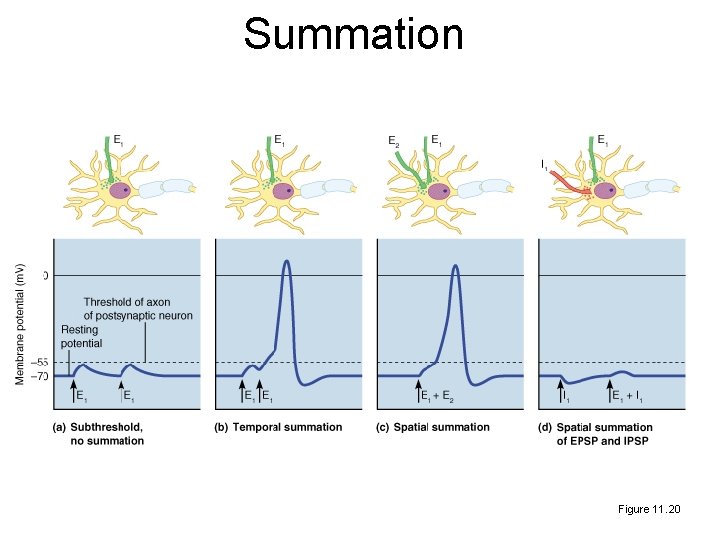
Summation • A single EPSP cannot induce an action potential • EPSPs must summate temporally or spatially to induce an action potential • Temporal summation – presynaptic neurons transmit impulses in rapid-fire order • Spatial summation – postsynaptic neuron is stimulated by a large number of terminals at the same time • IPSPs can also summate with EPSPs, canceling each other out
Summation Figure 11. 20
Neurotransmitters • Chemicals used for neuronal communication with the body and the brain • 50 different neurotransmitter have been identified • Classified chemically and functionally
Chemical Neurotransmitters LEARN CHART • • • Acetylcholine (ACh) Biogenic amines Amino acids Peptides Novel messengers
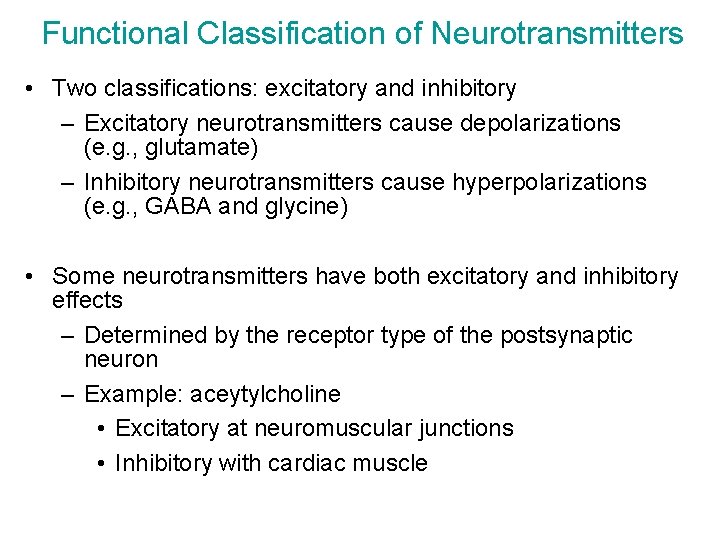
Functional Classification of Neurotransmitters • Two classifications: excitatory and inhibitory – Excitatory neurotransmitters cause depolarizations (e. g. , glutamate) – Inhibitory neurotransmitters cause hyperpolarizations (e. g. , GABA and glycine) • Some neurotransmitters have both excitatory and inhibitory effects – Determined by the receptor type of the postsynaptic neuron – Example: aceytylcholine • Excitatory at neuromuscular junctions • Inhibitory with cardiac muscle
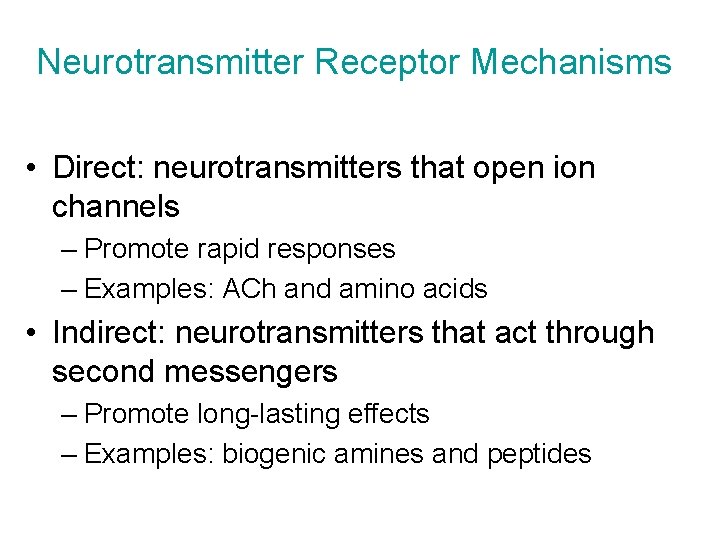
Neurotransmitter Receptor Mechanisms • Direct: neurotransmitters that open ion channels – Promote rapid responses – Examples: ACh and amino acids • Indirect: neurotransmitters that act through second messengers – Promote long-lasting effects – Examples: biogenic amines and peptides
ANIMATIONS • • • Salutatory conduction http: //www. blackwellscience. com/matthews/actionp. html terminal end http: //www. mind. ilstu. edu/flash/synapse_1. swf Inhibitory http: //www. blackwellscience. com/matthews/neurotrans. h tml • Paxil and serotonin • http: //www. paxil. com/flash/depression. swf
Serotonin Animation
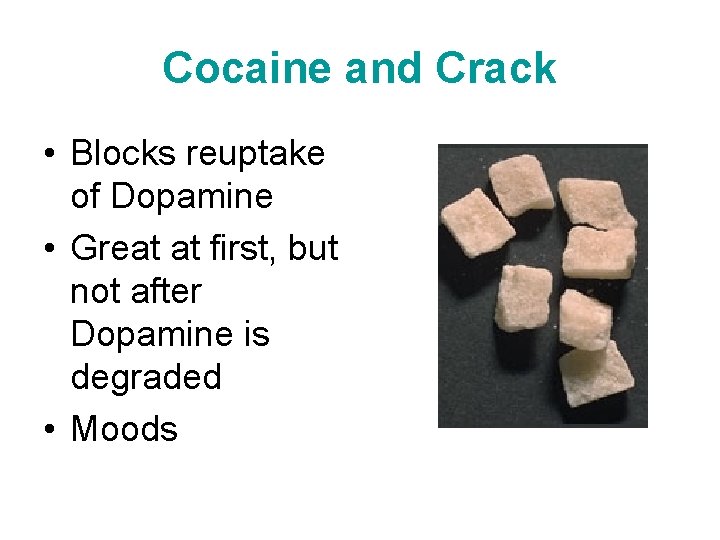
Cocaine and Crack • Blocks reuptake of Dopamine • Great at first, but not after Dopamine is degraded • Moods
G Protein-Linked Receptors: Mechanism • Neurotransmitter binds to G protein-linked receptor • G protein is activated and GTP is hydrolyzed to GDP • The activated G protein complex activates adenylate cyclase • Adenylate cyclase catalyzes the formation of c. AMP from ATP • c. AMP, a second messenger, brings about various cellular responses
Neural Integration: Neuronal Pools • Functional groups of neurons that: – Integrate incoming information – Forward the processed information to its appropriate destination
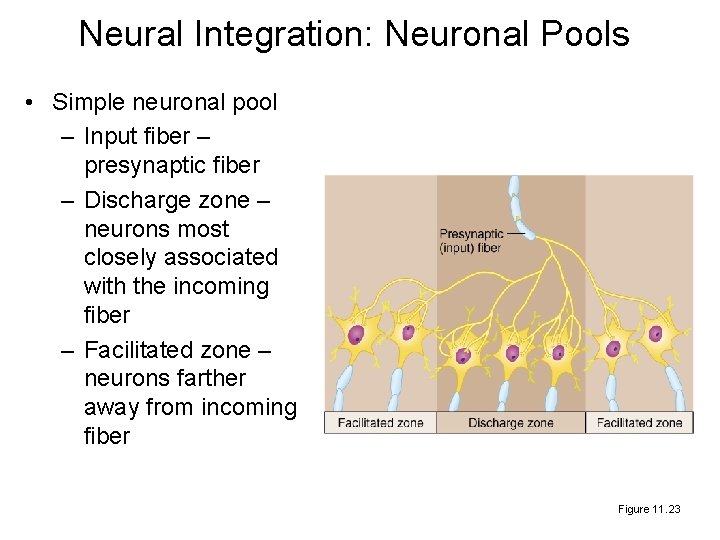
Neural Integration: Neuronal Pools • Simple neuronal pool – Input fiber – presynaptic fiber – Discharge zone – neurons most closely associated with the incoming fiber – Facilitated zone – neurons farther away from incoming fiber Figure 11. 23
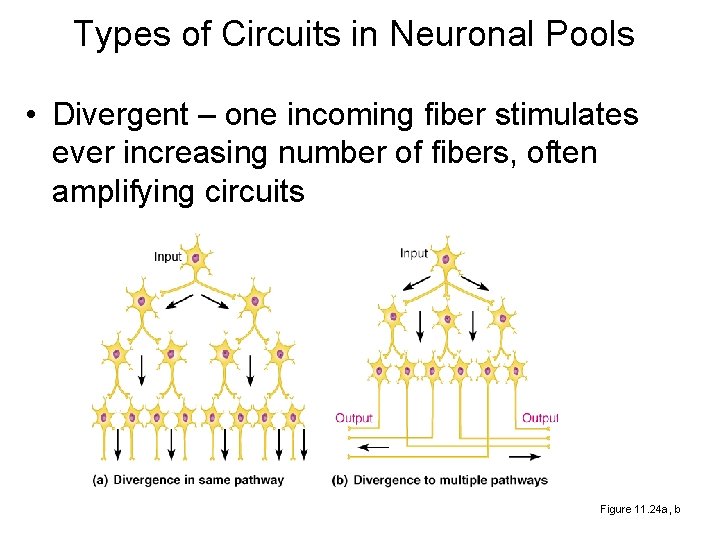
Types of Circuits in Neuronal Pools • Divergent – one incoming fiber stimulates ever increasing number of fibers, often amplifying circuits Figure 11. 24 a, b