
NERVOUS SYSTEM AND ANIMAL BEHAVIOR What factors influence
NERVOUS SYSTEM AND ANIMAL BEHAVIOR • • • What factors influence behavior? How does evolution influence behavior? Explain examples of learned vs. innate behaviors?
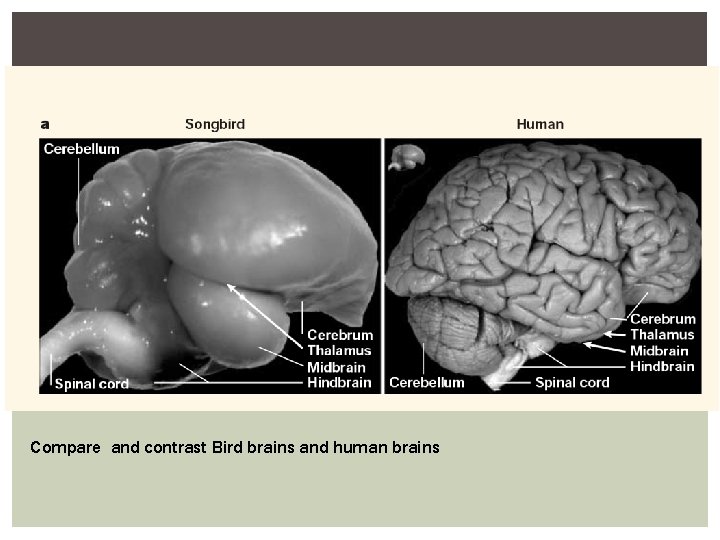
Compare and contrast Bird brains and human brains
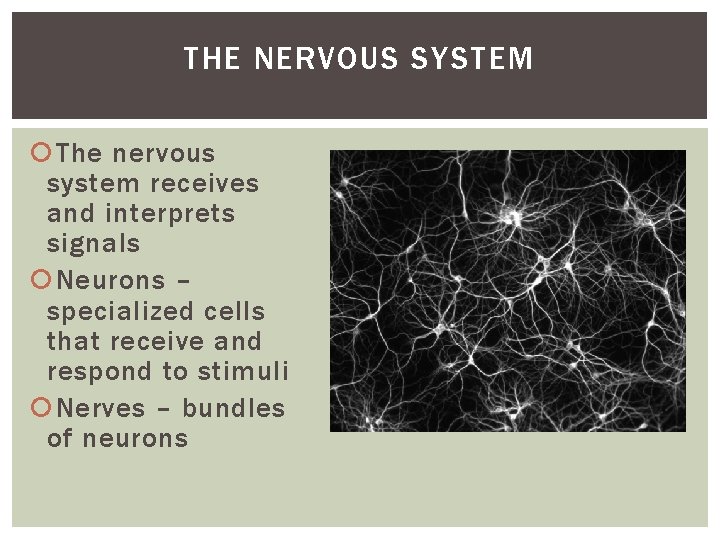
THE NERVOUS SYSTEM The nervous system receives and interprets signals Neurons – specialized cells that receive and respond to stimuli Nerves – bundles of neurons
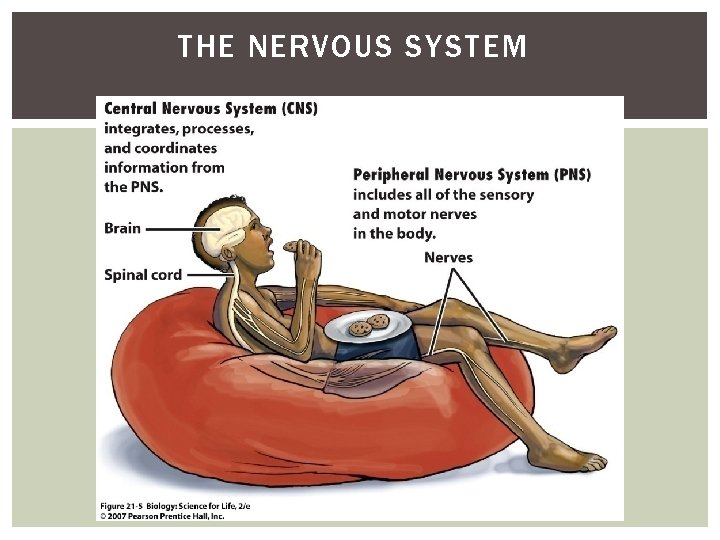
THE NERVOUS SYSTEM
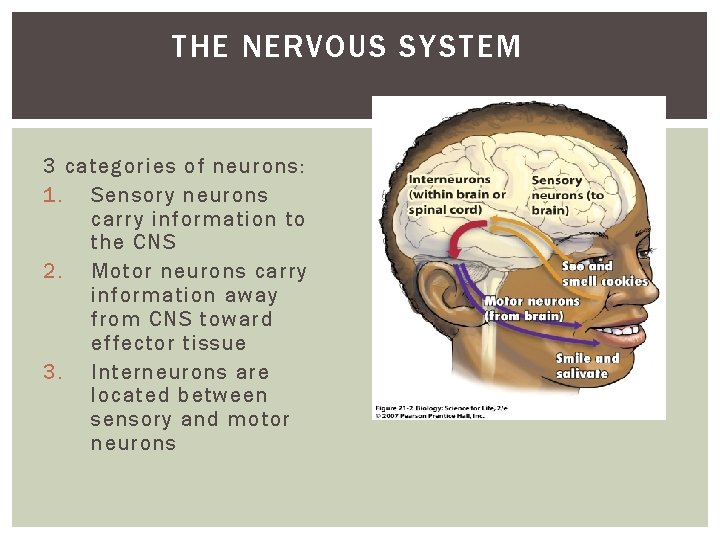
THE NERVOUS SYSTEM 3 categories of neurons: 1. Sensory neurons carry information to the CNS 2. Motor neurons carry information away from CNS toward effector tissue 3. Interneurons are located between sensory and motor neurons
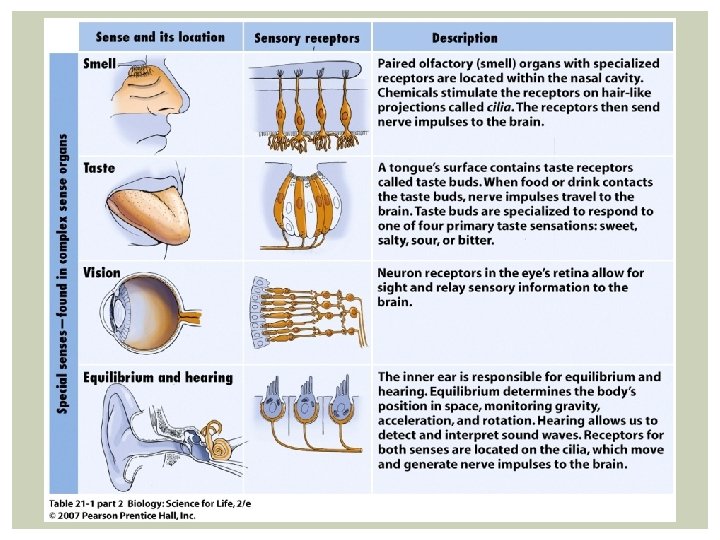
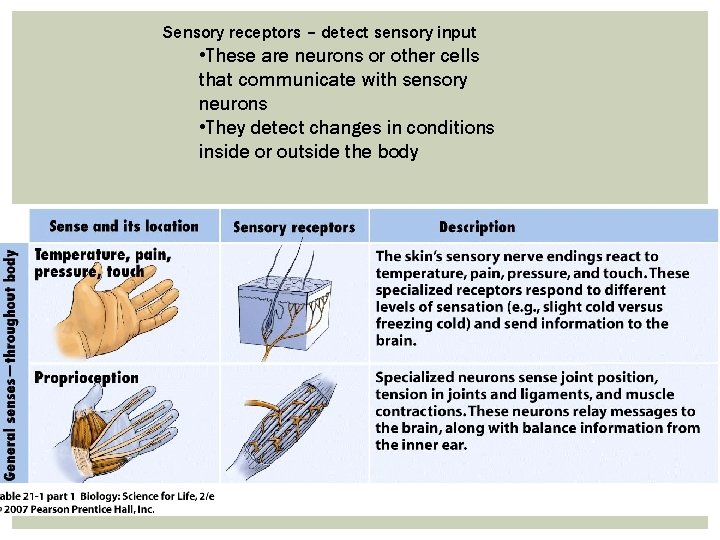
Sensory receptors – detect sensory input • These are neurons or other cells that communicate with sensory neurons • They detect changes in conditions inside or outside the body
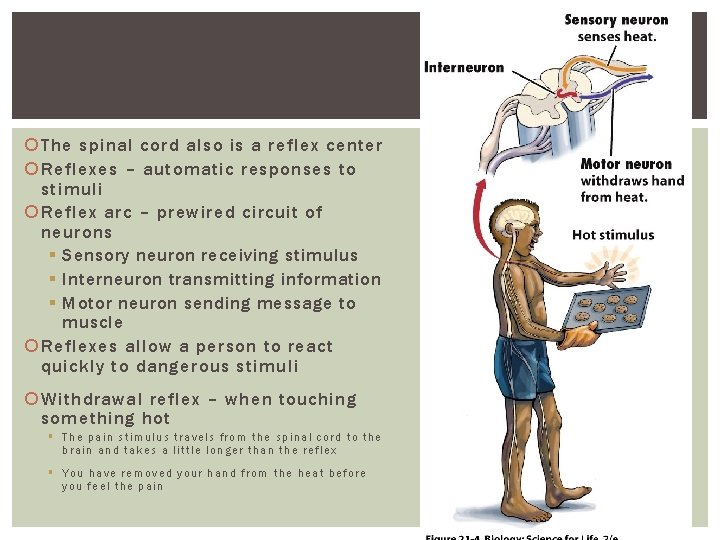
The spinal cord also is a reflex center Reflexes – automatic responses to stimuli Reflex arc – prewired circuit of neurons § Sensory neuron receiving stimulus § Interneuron transmitting information § Motor neuron sending message to muscle Reflexes allow a person to react quickly to dangerous stimuli Withdrawal reflex – when touching something hot § The pain stimulus travels from the spinal cord to the brain and takes a little longer than the reflex § You have removed your hand from the heat before you feel the pain
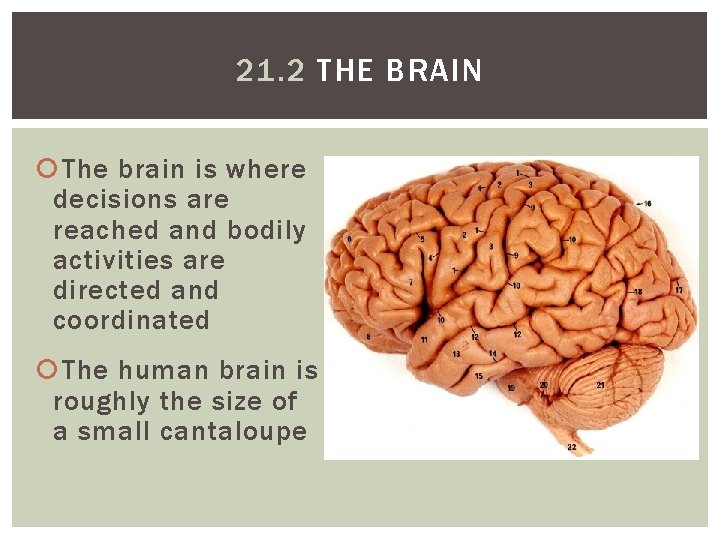
21. 2 THE BRAIN The brain is where decisions are reached and bodily activities are directed and coordinated The human brain is roughly the size of a small cantaloupe
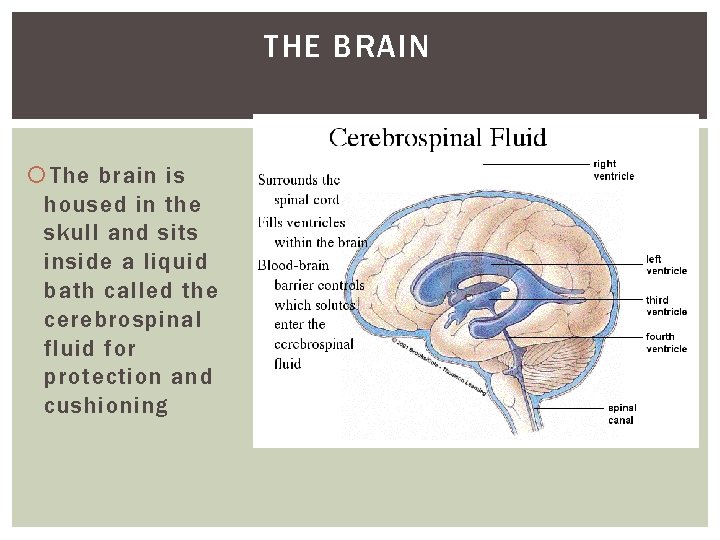
THE BRAIN The brain is housed in the skull and sits inside a liquid bath called the cerebrospinal fluid for protection and cushioning
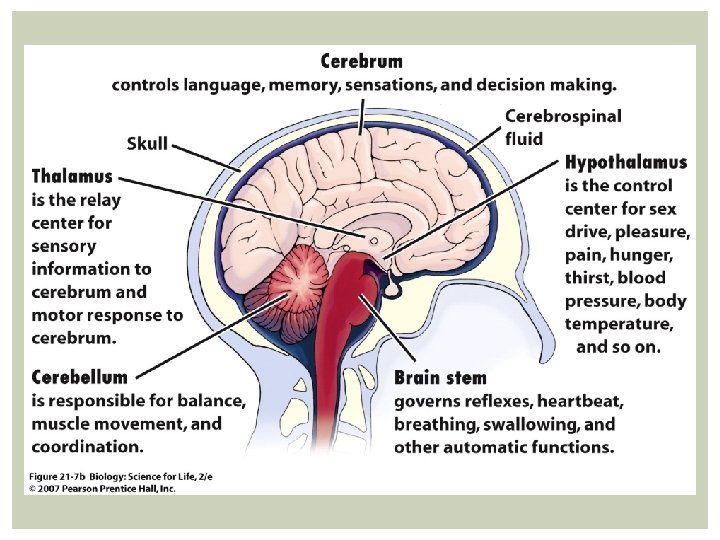
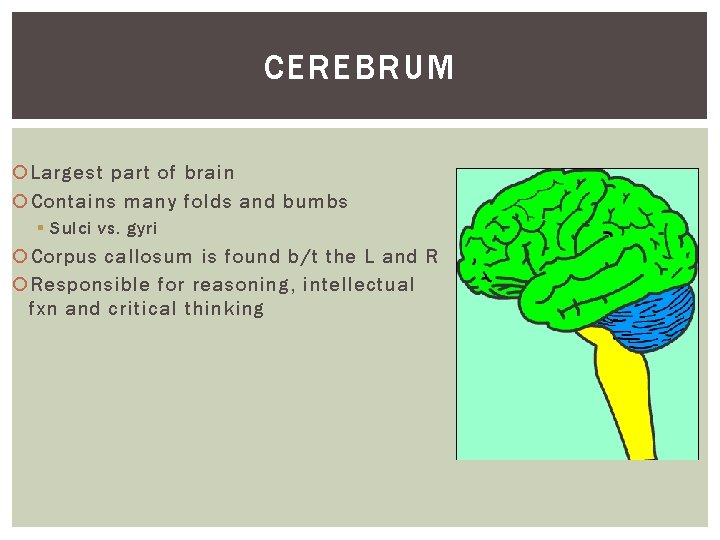
CEREBRUM Largest part of brain Contains many folds and bumbs § Sulci vs. gyri Corpus callosum is found b/t the L and R Responsible for reasoning, intellectual fxn and critical thinking
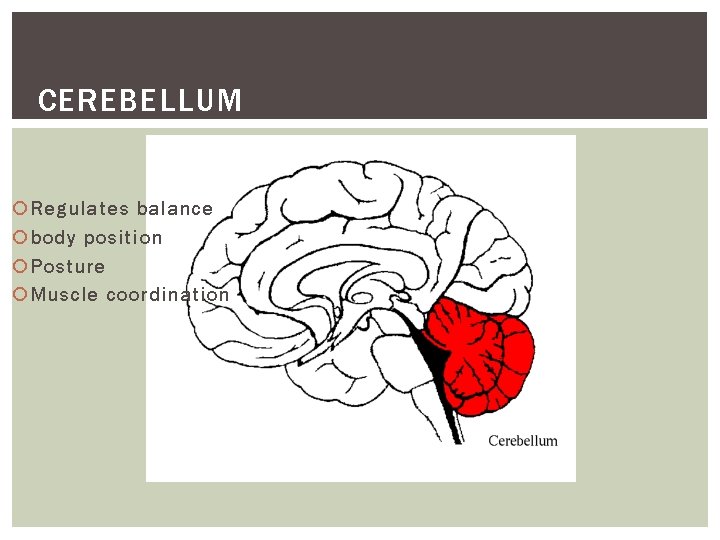
CEREBELLUM Regulates balance body position Posture Muscle coordination
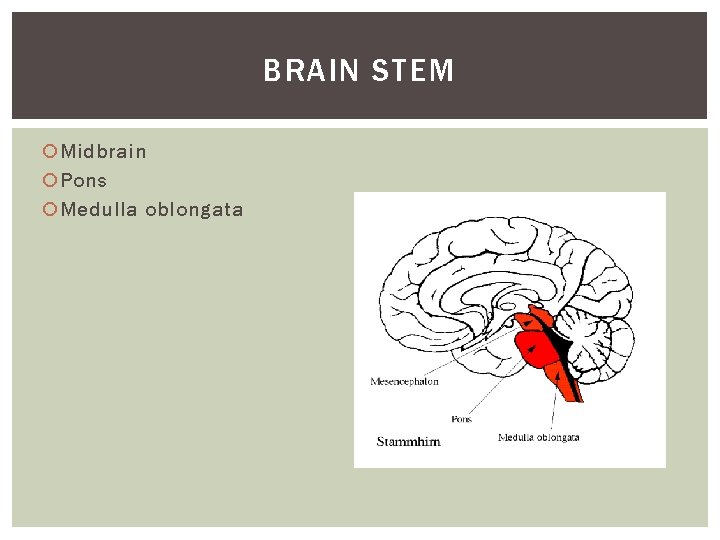
BRAIN STEM Midbrain Pons Medulla oblongata
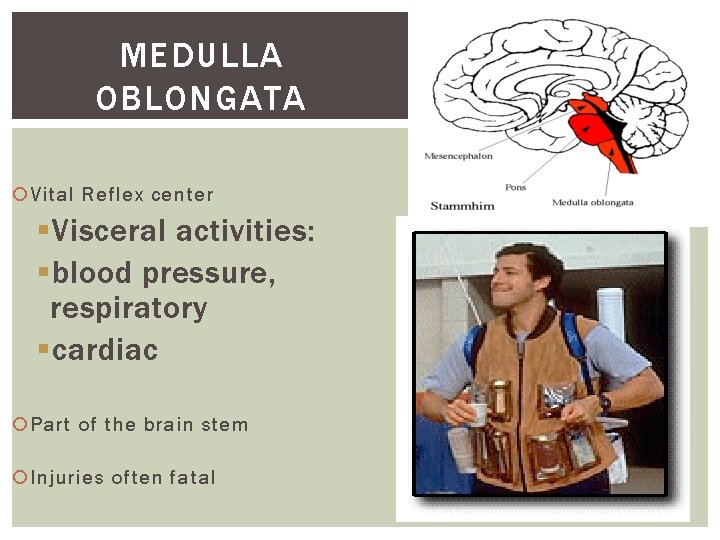
MEDULLA OBLONGATA Vital Reflex center § Visceral activities: § blood pressure, respiratory § cardiac Part of the brain stem Injuries often fatal
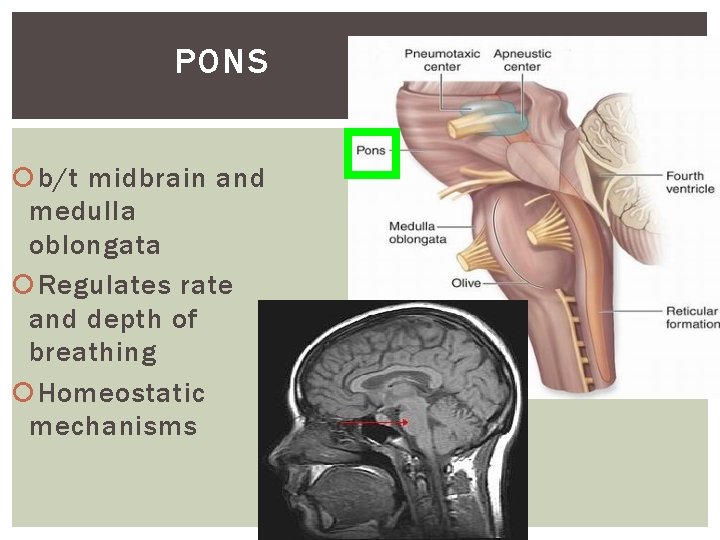
PONS b/t midbrain and medulla oblongata Regulates rate and depth of breathing Homeostatic mechanisms
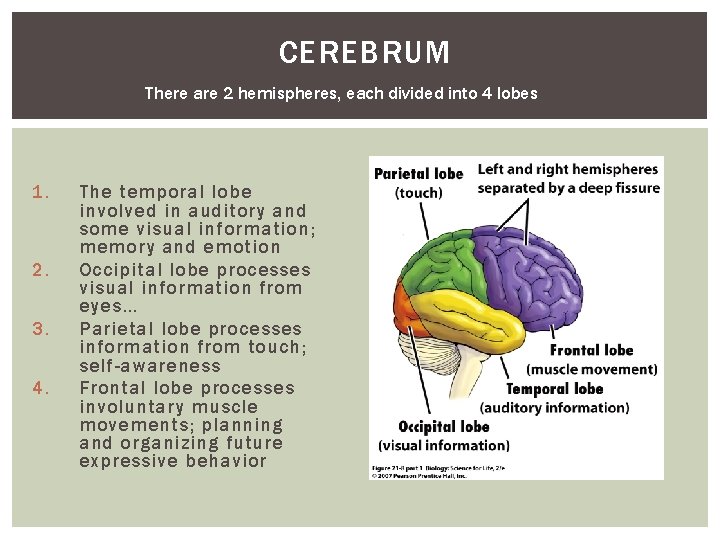
CEREBRUM There are 2 hemispheres, each divided into 4 lobes 1. 2. 3. 4. The temporal lobe involved in auditory and some visual information; memory and emotion Occipital lobe processes visual information from eyes… Parietal lobe processes information from touch; self-awareness Frontal lobe processes involuntary muscle movements; planning and organizing future expressive behavior
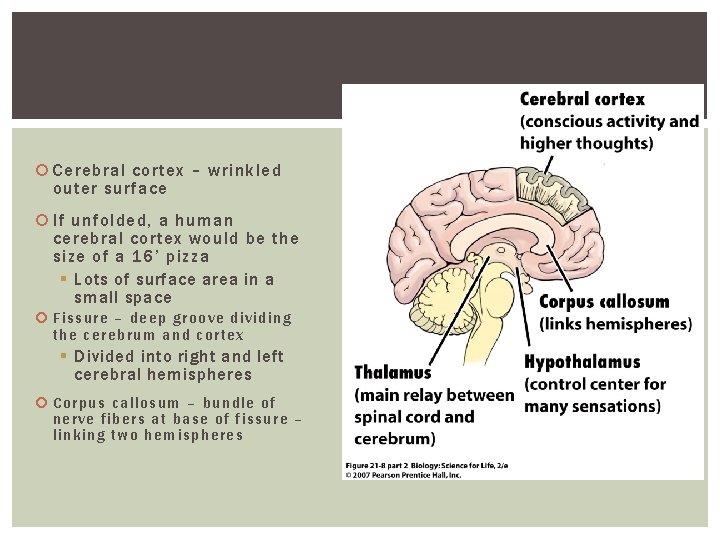
Cerebral cortex – wrinkled outer surface If unfolded, a human cerebral cortex would be the size of a 16’ pizza § Lots of surface area in a small space Fissu re – deep groove dividing t he c ereb r um and cortex § Divided into right and left cerebral hemispheres Corpus callosum – bundle of nerve fibers a t base of fissur e – linking two hemispheres
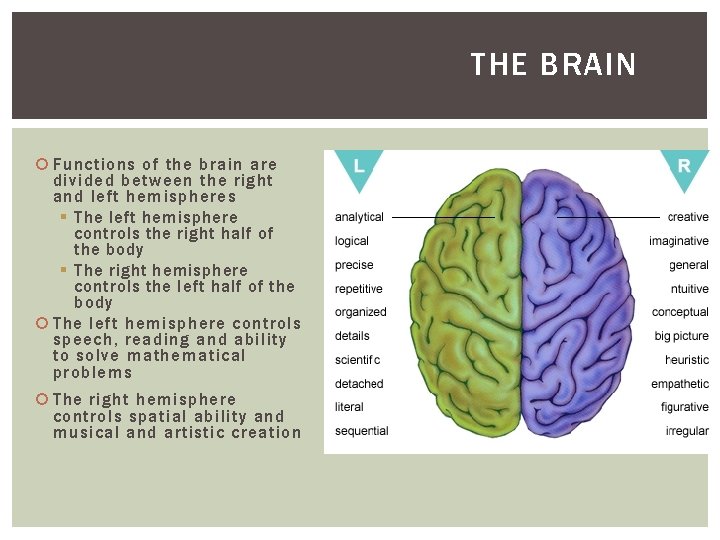
THE BRAIN Functions of the brain are divided between the right and left hemispheres § The left hemisphere controls the right half of the body § The right hemisphere controls the left half of the body The left hemisphere controls speech, reading and ability to solve mathematical problems The right hemisphere controls spatial ability and musical and artistic creation
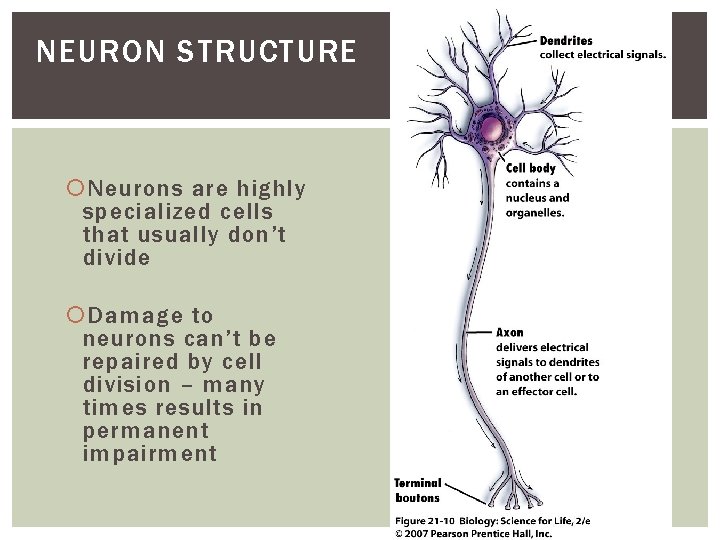
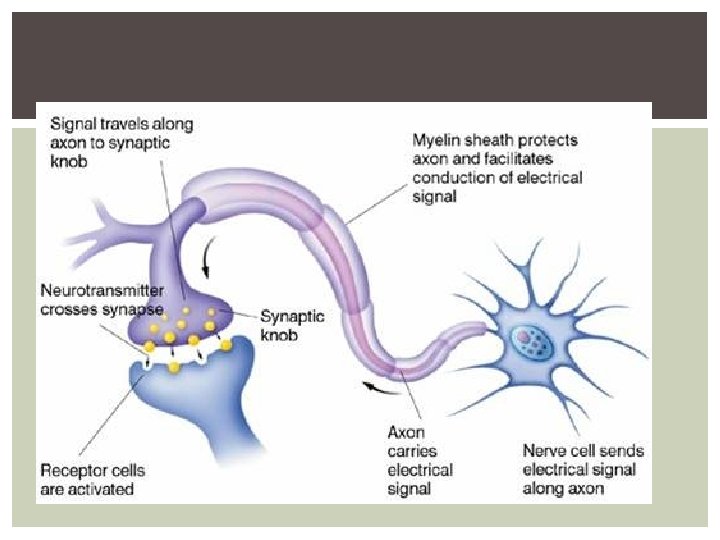
NEURON STRUCTURE Neurons are highly specialized cells that usually don’t divide Damage to neurons can’t be repaired by cell division – many times results in permanent impairment
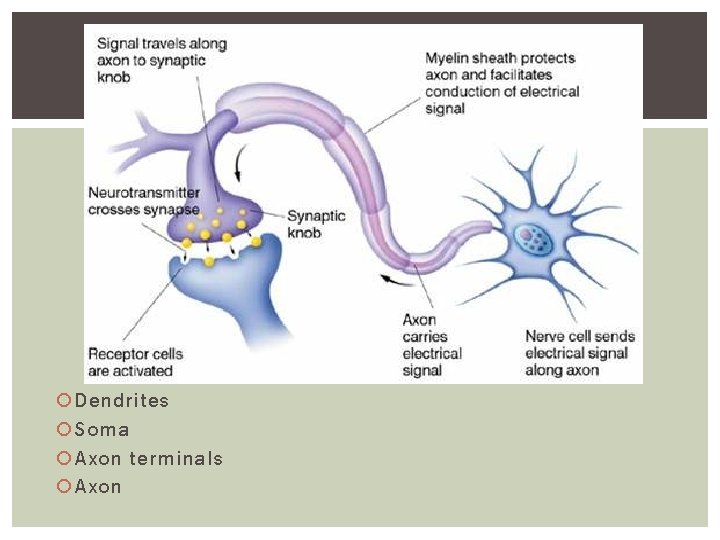
Dendrites Soma Axon terminals Axon
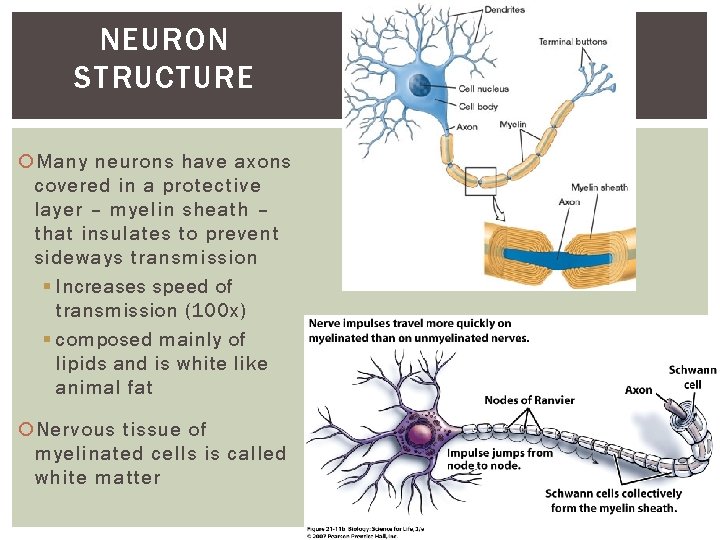
NEURON STRUCTURE Many neurons have axons covered in a protective layer – myelin sheath – that insulates to prevent sideways transmission § Increases speed of transmission (100 x) § composed mainly of lipids and is white like animal fat Nervous tissue of myelinated cells is called white matter
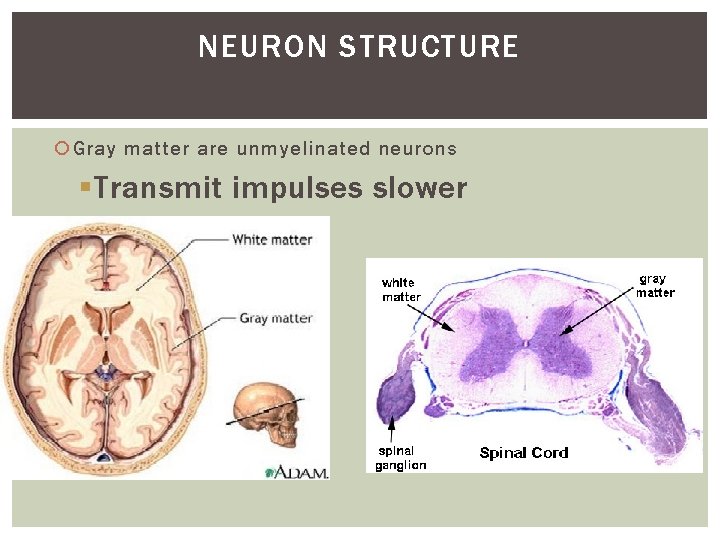
NEURON STRUCTURE Gray matter are unmyelinated neurons § Transmit impulses slower
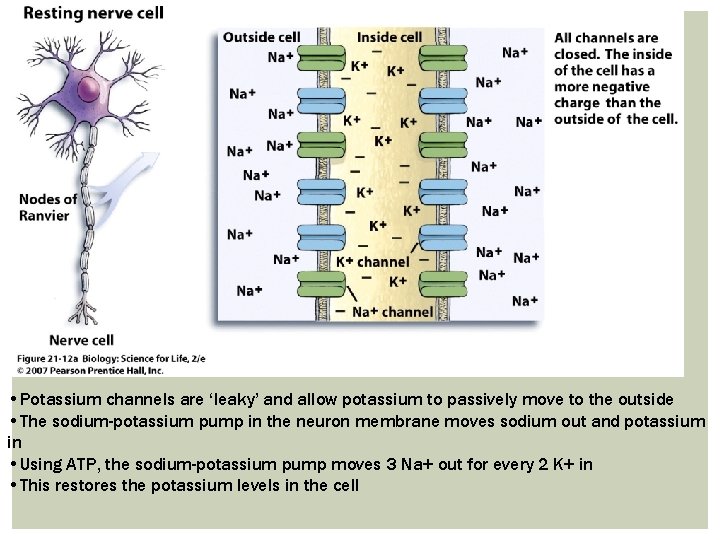
• Potassium channels are ‘leaky’ and allow potassium to passively move to the outside • The sodium-potassium pump in the neuron membrane moves sodium out and potassium in • Using ATP, the sodium-potassium pump moves 3 Na+ out for every 2 K+ in • This restores the potassium levels in the cell
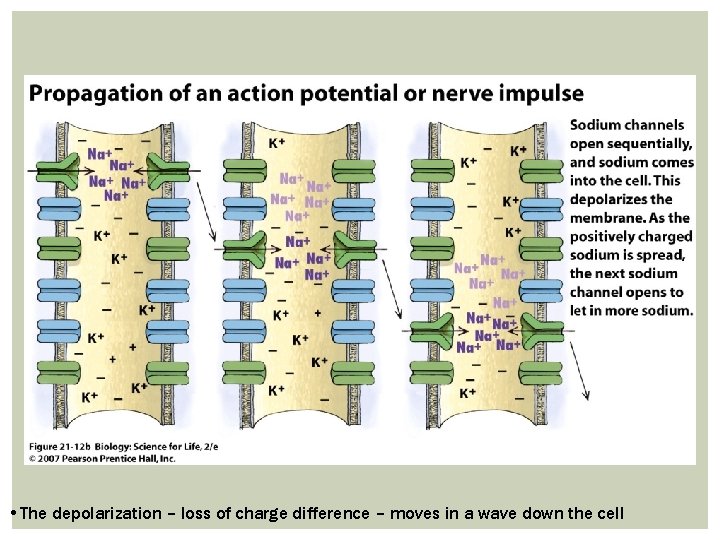
• The depolarization – loss of charge difference – moves in a wave down the cell
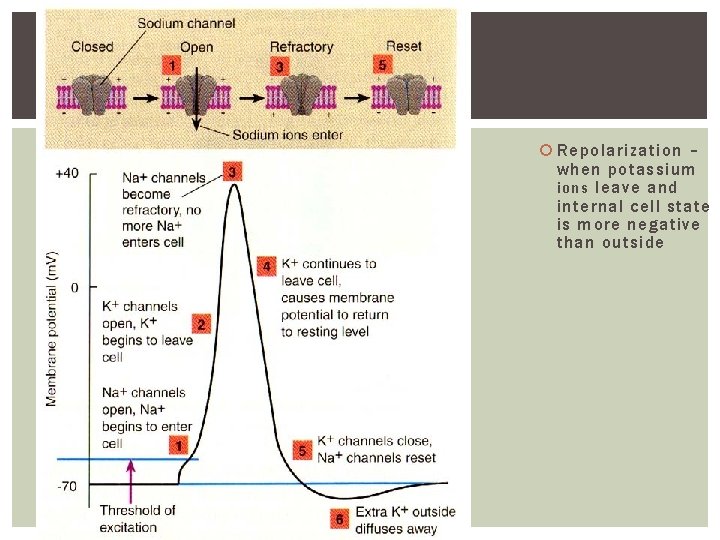
Repolarization – when potassium io ns leave and internal cell state is more negative than outside
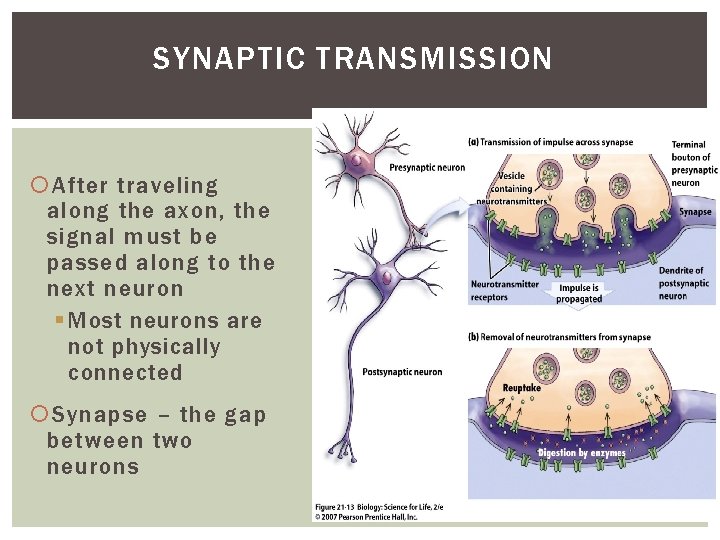
SYNAPTIC TRANSMISSION After traveling along the axon, the signal must be passed along to the next neuron § Most neurons are not physically connected Synapse – the gap between two neurons
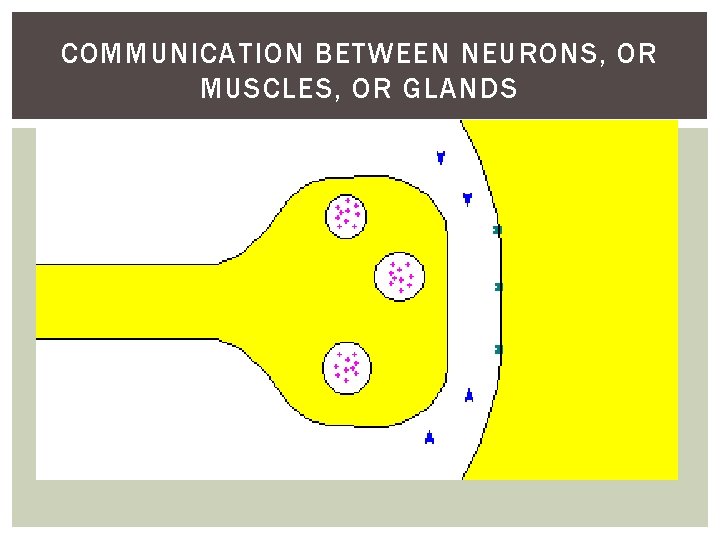
COMMUNICATION BETWEEN NEURONS, OR MUSCLES, OR GLANDS
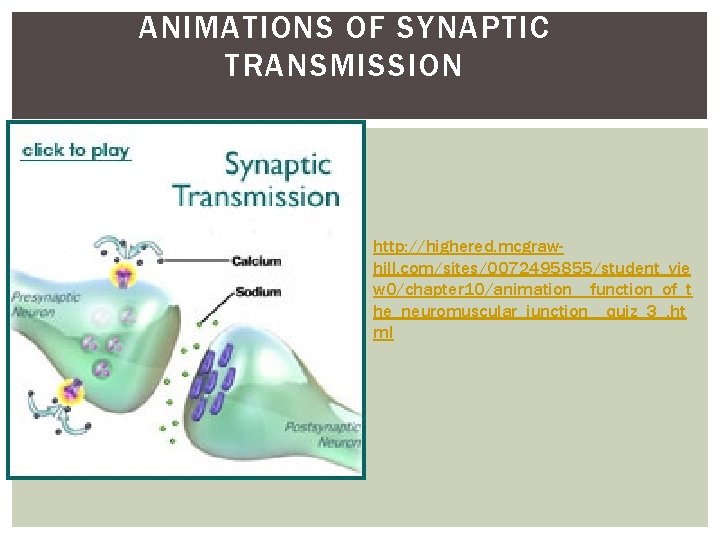
ANIMATIONS OF SYNAPTIC TRANSMISSION http: //highered. mcgrawhill. com/sites/0072495855/student_vie w 0/chapter 10/animation__function_of_t he_neuromuscular_junction__quiz_3_. ht ml
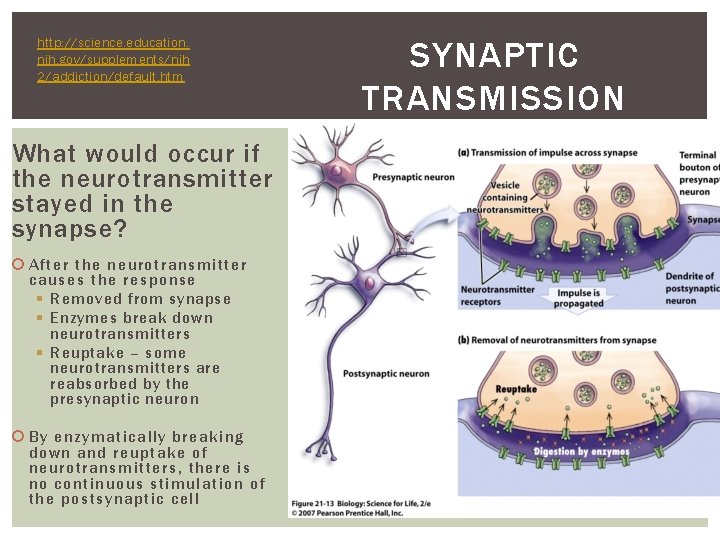
http: //science. education. nih. gov/supplements/nih 2/addiction/default. htm What would occur if the neurotransmitter stayed in the synapse? After the neurotransmitter causes the response § Removed from synapse § Enzymes break down neurotransmitters § Reuptake – some neurotransmitters are reabsorbed by the presynaptic neuron By enzymatically breaking down and reuptake of neurotransmitters, there is no continuous stimulation of the postsynaptic cell SYNAPTIC TRANSMISSION
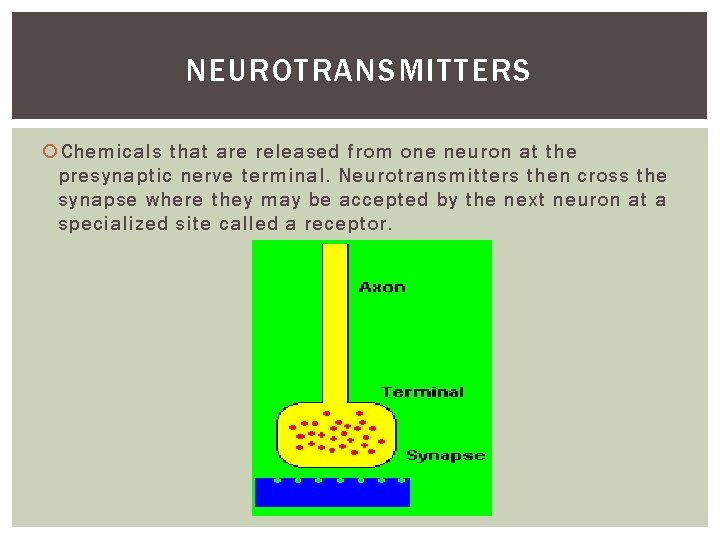
NEUROTRANSMITTERS Chemicals that are released from one neuron at the presynaptic nerve terminal. Neurotransmitters then cross the synapse where they may be accepted by the next neuron at a specialized site called a receptor.
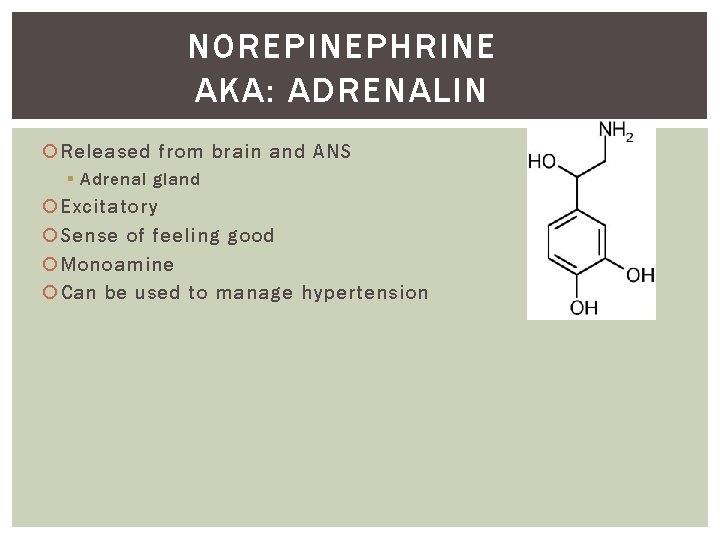
NOREPINEPHRINE AKA: ADRENALIN Released from brain and ANS § Adrenal gland Excitatory Sense of feeling good Monoamine Can be used to manage hypertension
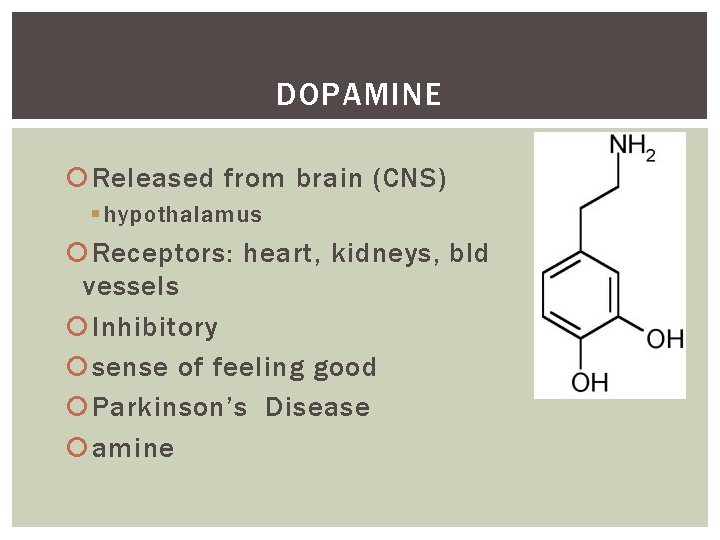
DOPAMINE Released from brain (CNS) § hypothalamus Receptors: heart, kidneys, bld vessels Inhibitory sense of feeling good Parkinson’s Disease amine
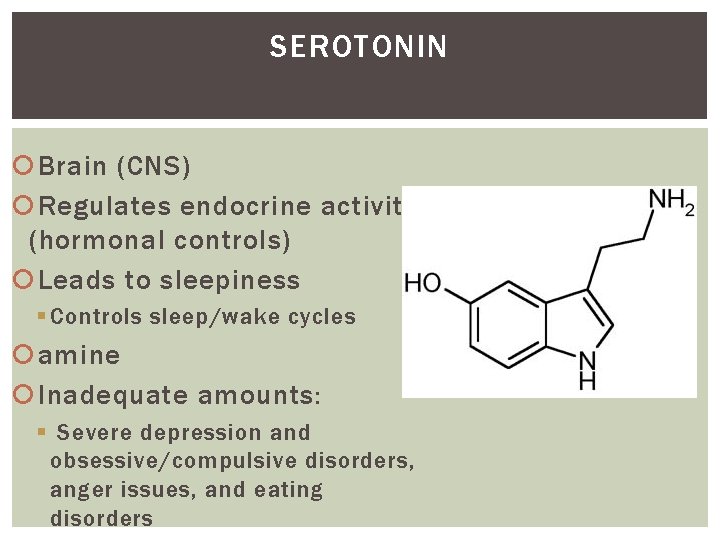
SEROTONIN Brain (CNS) Regulates endocrine activity (hormonal controls) Leads to sleepiness § Controls sleep/wake cycles amine Inadequate amounts: § Severe depression and obsessive/compulsive disorders, anger issues, and eating disorders
ENDORPHINS Neuropeptide Produced in brain (CNS) Pain relief: inhibitory Released in times of pain or stress Elevated levels cause disease known as Addison’s disease Structure is similar to? ? ? § morphine
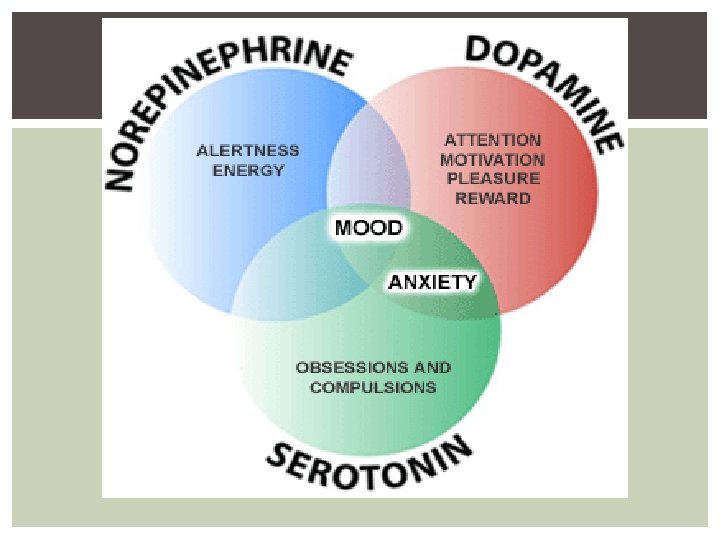
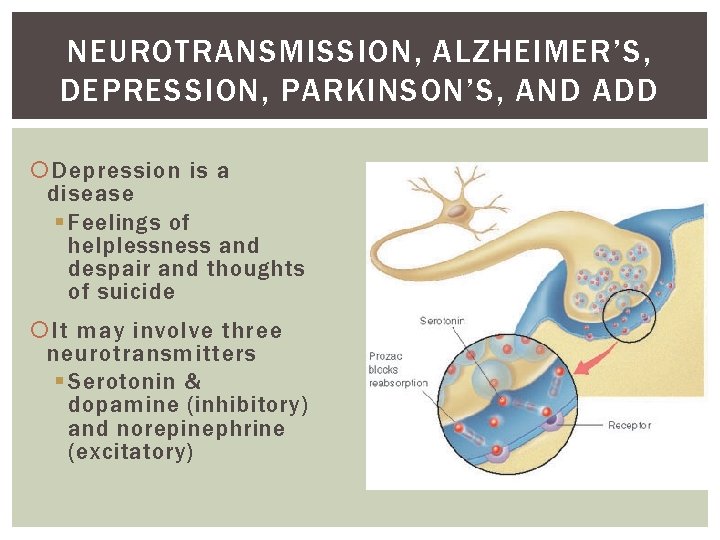
NEUROTRANSMISSION, ALZHEIMER’S, DEPRESSION, PARKINSON’S, AND ADD Depression is a disease § Feelings of helplessness and despair and thoughts of suicide It may involve three neurotransmitters § Serotonin & dopamine (inhibitory) and norepinephrine (excitatory)
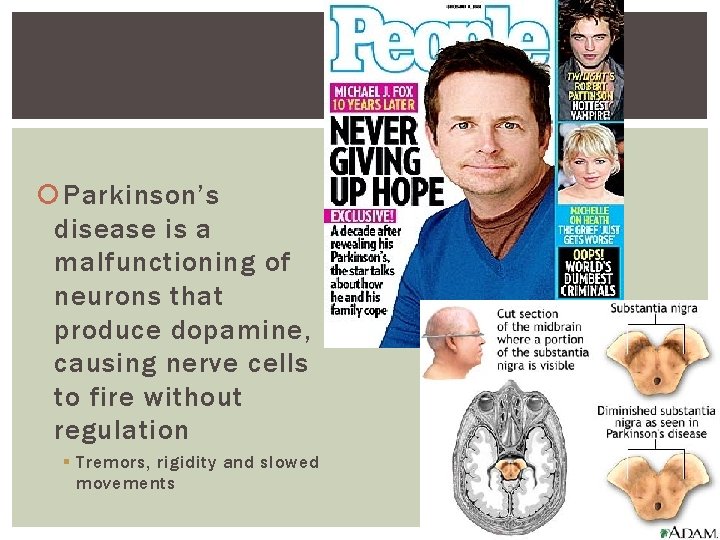
Parkinson’s disease is a malfunctioning of neurons that produce dopamine, causing nerve cells to fire without regulation § Tremors, rigidity and slowed movements
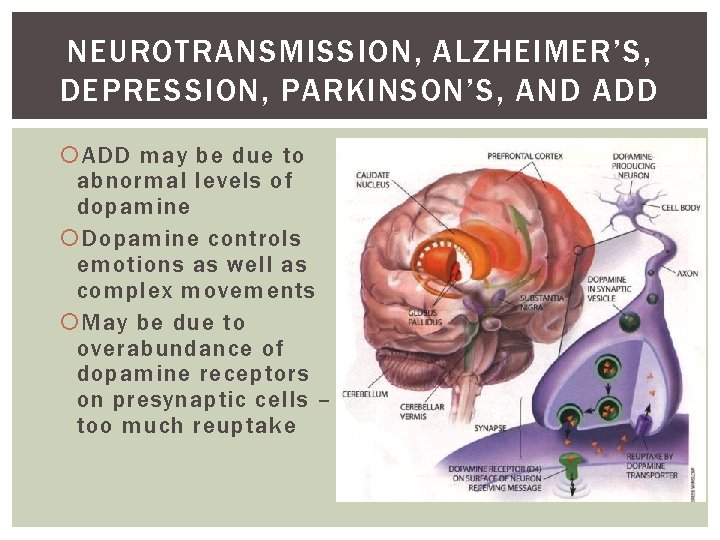
NEUROTRANSMISSION, ALZHEIMER’S, DEPRESSION, PARKINSON’S, AND ADD may be due to abnormal levels of dopamine Dopamine controls emotions as well as complex movements May be due to overabundance of dopamine receptors on presynaptic cells – too much reuptake
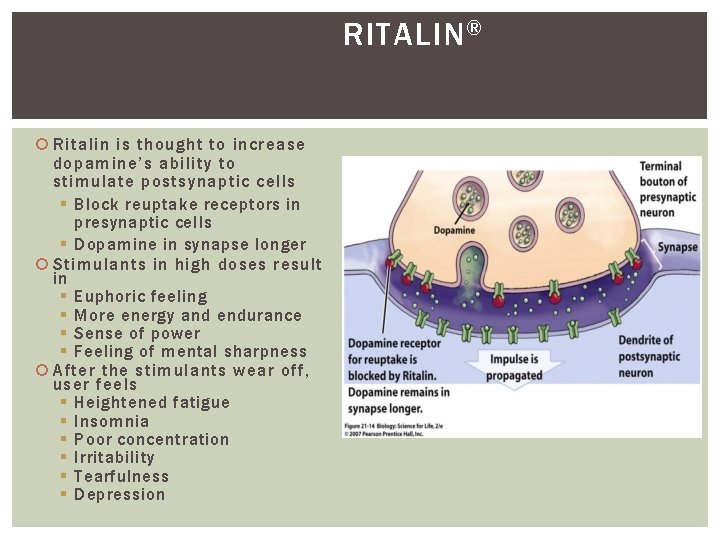
RITALIN ® Ritalin is thought to increase dopamine’s ability to stimulate postsynaptic cells § Block reuptake receptors in presynaptic cells § Dopamine in synapse longer Stimulants in high doses result in § Euphoric feeling § More energy and endurance § Sense of power § Feeling of mental sharpness After the stimulants wear off, user feels § Heightened fatigue § Insomnia § Poor concentration § Irritability § Tearfulness § Depression
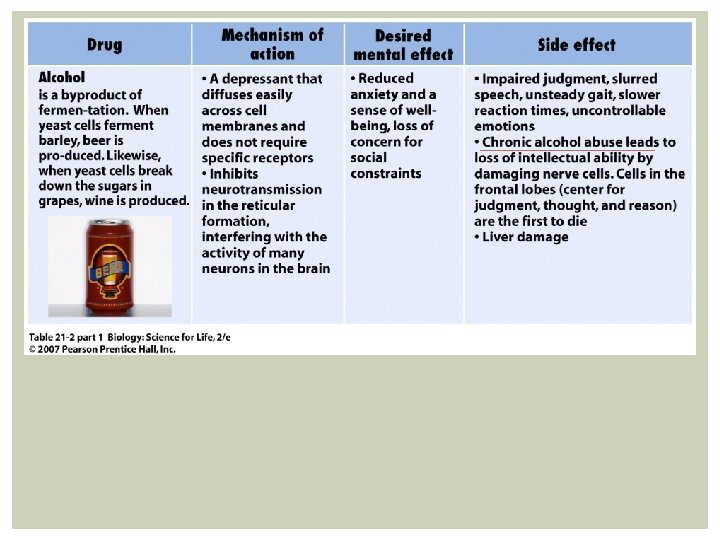
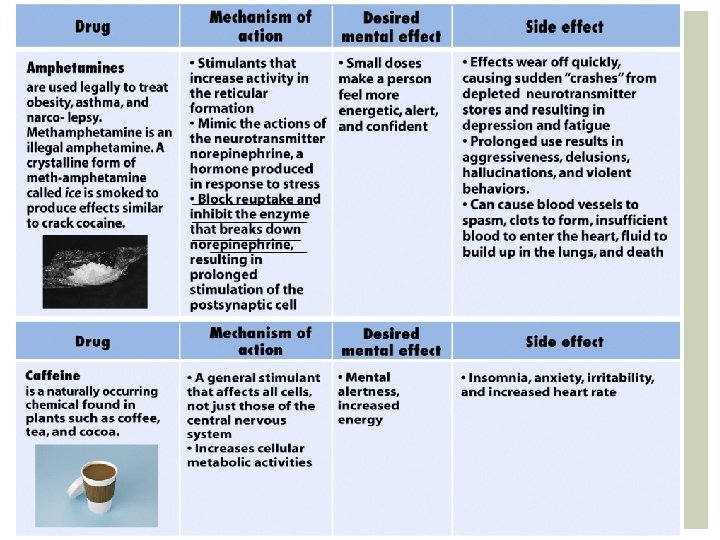
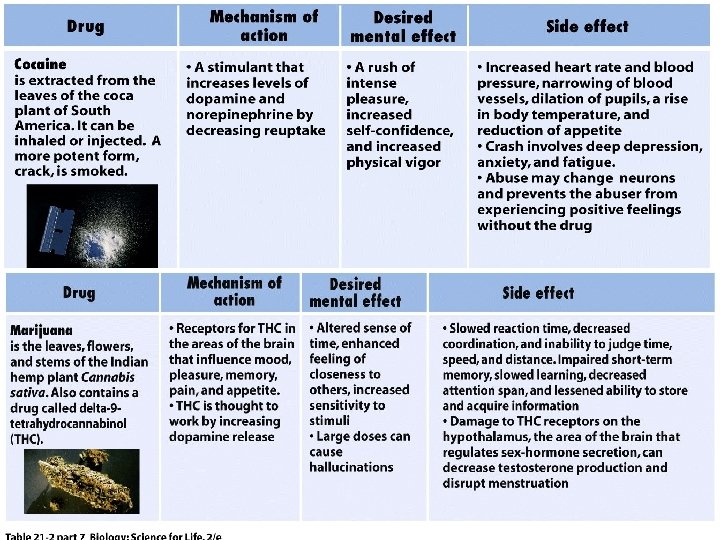
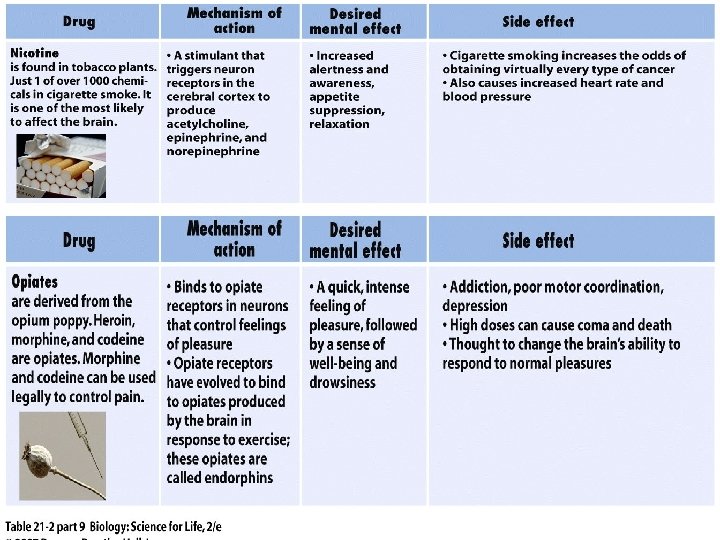
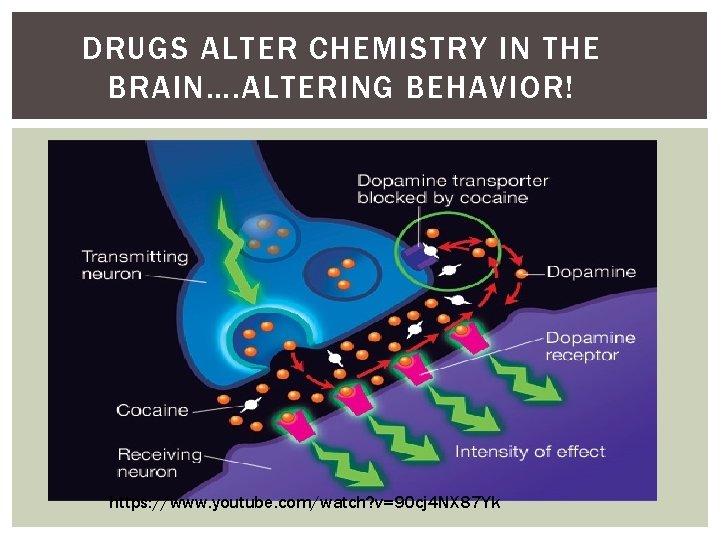
DRUGS ALTER CHEMISTRY IN THE BRAIN…. ALTERING BEHAVIOR! https: //www. youtube. com/watch? v=90 cj 4 NX 87 Yk
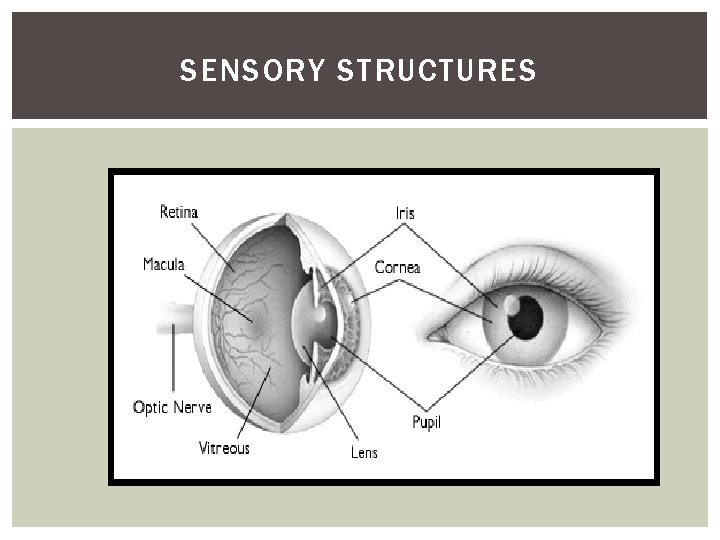
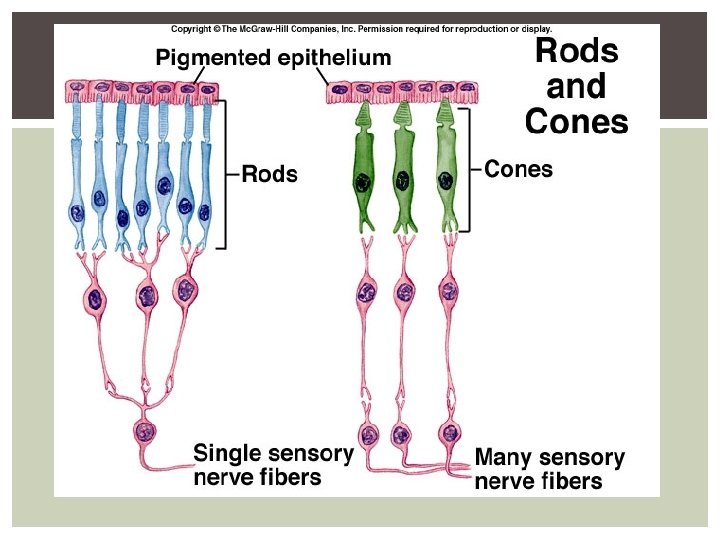
SENSORY STRUCTURES
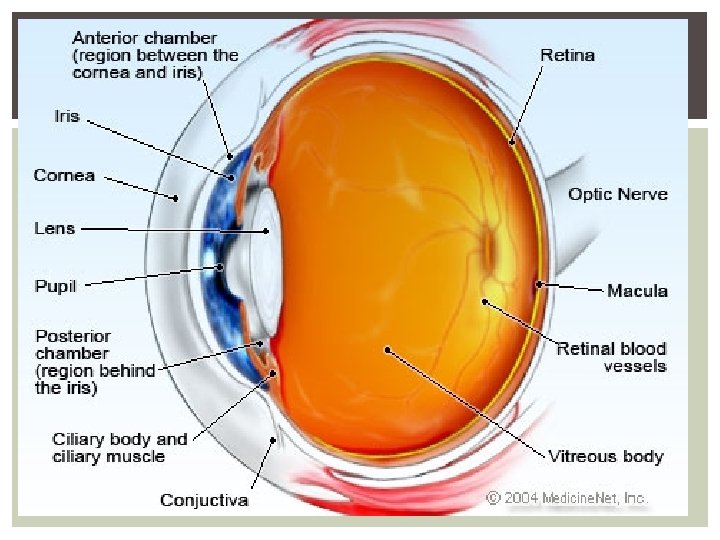
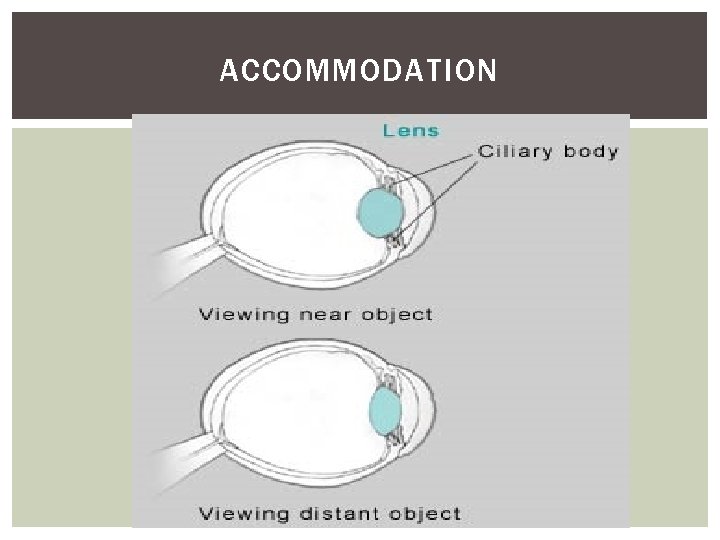
ACCOMMODATION
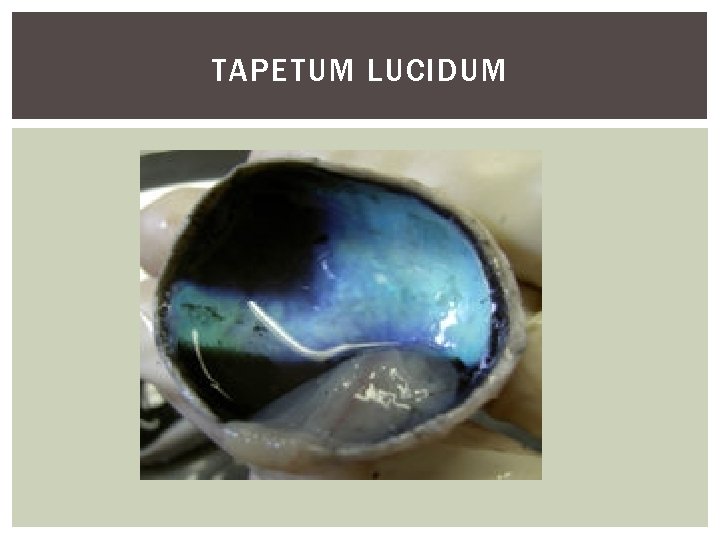
TAPETUM LUCIDUM
ANIMAL BEHAVIOR Behavior: an action that an individual carries out in a response to a stimulus Stimulus: action or agent that changes activity of an organism Response: biological reaction resulting from a stimulus
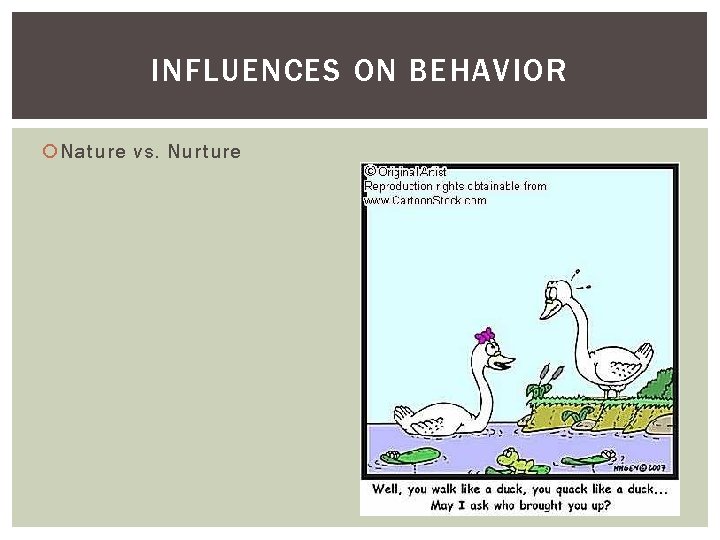
INFLUENCES ON BEHAVIOR Nature vs. Nurture
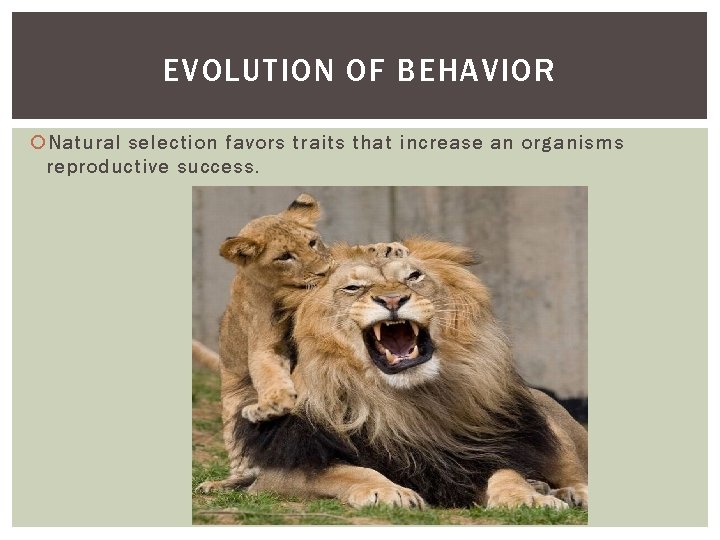
EVOLUTION OF BEHAVIOR Natural selection favors traits that increase an organisms reproductive success.
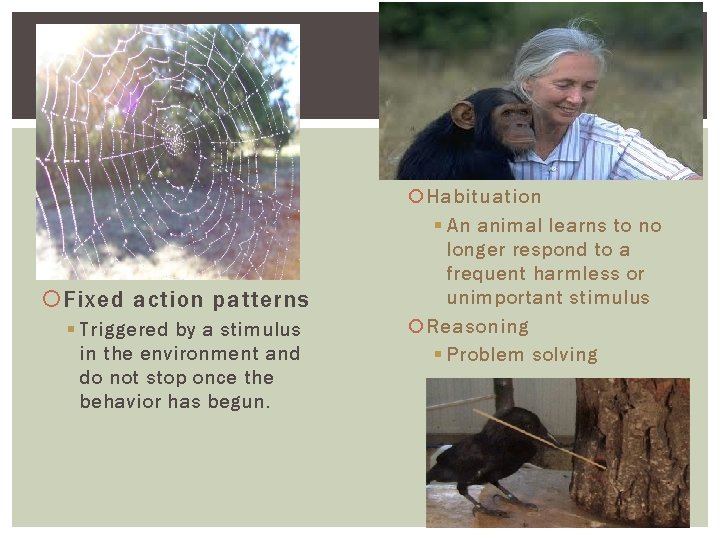
Innate behavior Fixed action patterns § Triggered by a stimulus in the environment and do not stop once the behavior has begun. Learned behavior Habituation § An animal learns to no longer respond to a frequent harmless or unimportant stimulus Reasoning § Problem solving

ASSOCIATIVE LEARNING Classical Condition Operant conditioning
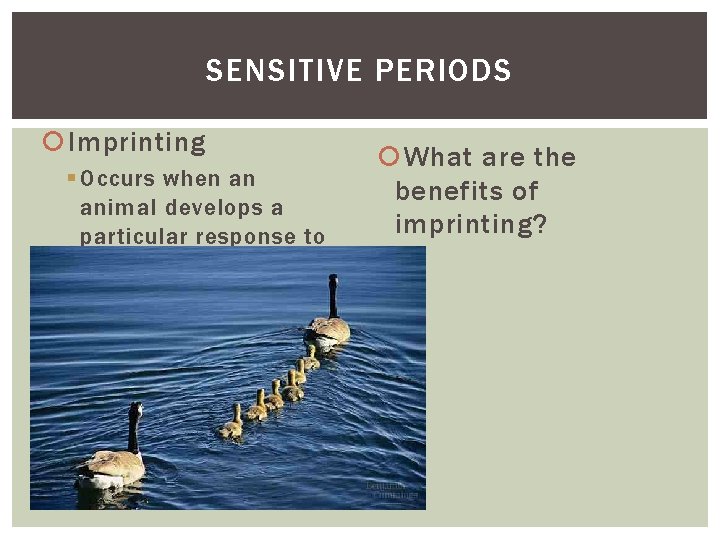
SENSITIVE PERIODS Imprinting § Occurs when an animal develops a particular response to an object or organism only during a brief period early in life. What are the benefits of imprinting?
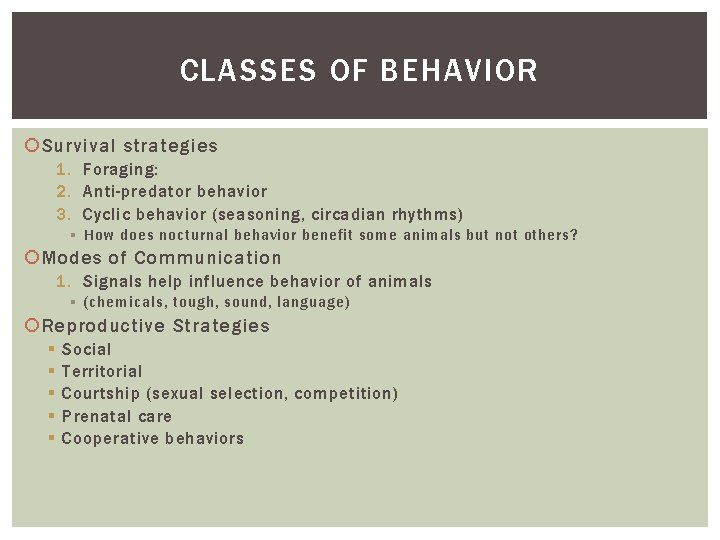
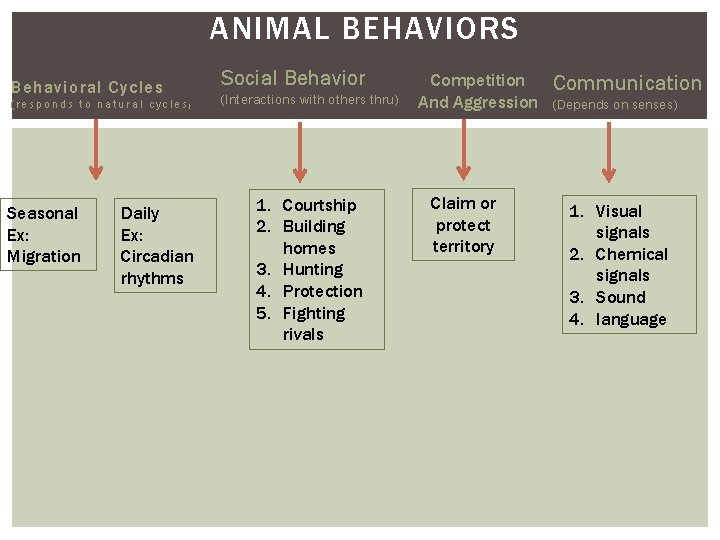
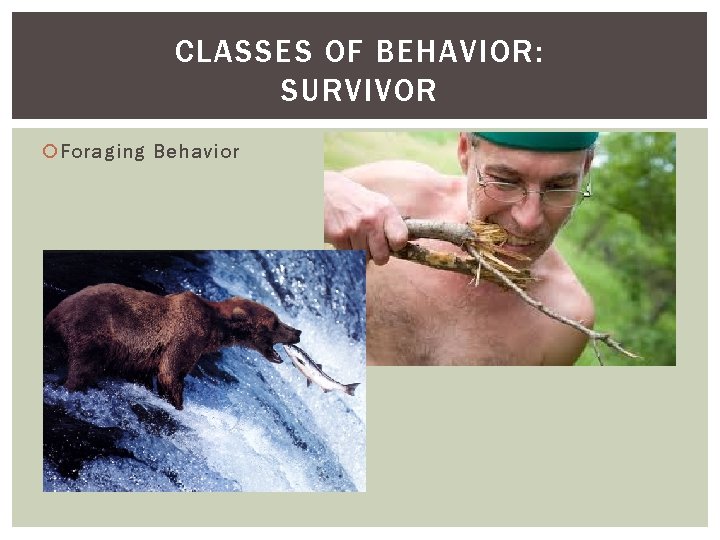
CLASSES OF BEHAVIOR Survival strategies 1. Foraging: 2. Anti-predator behavior 3. Cyclic behavior (seasoning, circadian rhythms) § How does nocturnal behavior benefit some animals but not others? Modes of Communication 1. Signals help influence behavior of animals § (chemicals, tough, sound, language) Reproductive Strategies § § § Social Territorial Courtship (sexual selection, competition) Prenatal care Cooperative behaviors
FORAGING Woodpecker https: //www. youtube. com/watch? v=wug. Uc 0 fi 54 k
ANTI-PREDATORY BEHAVIOR https: //www. youtube. com/watch? v=Ram. V-Aj. ID 8 E
REVIEW QUESTIONS Please answer questions on ½ y. o. p. 1. What is the fundamental unit of the Nervous System? 2. What part of the brain is responsible for motor coordination and balance. 3. What part of the brain controls vital organs? (like breathing rate/depth) 4. How do neurons communicate with each other? 5. What are the two categories of animal behaviors? 6. Describe how behaviors are influenced?
ANIMAL BEHAVIOR Behavior: § an action or series of actions performed by an organism in response to a stimulus Response: § The organism response to the stimulus –(action or agent that causes or changes activity of organism) § Noise frightens § Bacteria causes an immune response
HOW DOES THE BODY RESPOND? Sensory systems gather information about the environment The info will trigger responses to the nervous system which a produces a response
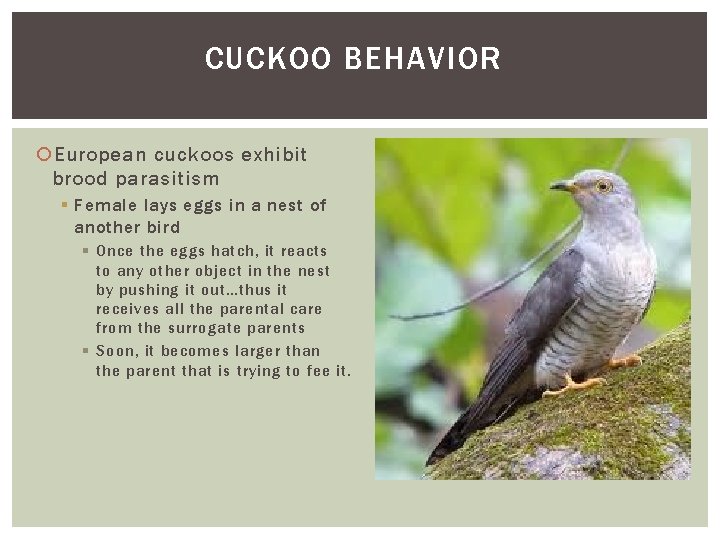
CUCKOO BEHAVIOR European cuckoos exhibit brood parasitism § Female lays eggs in a nest of another bird § Once the eggs hatch, it reacts to any other object in the nest by pushing it out…thus it receives all the parental care from the surrogate parents § Soon, it becomes larger than the parent that is trying to fee it.
INFLUENCES ON BEHAVIOR (INTERNAL VS. EXTERNAL) Genes (Nature) § May increase the likelihood that an organism will display a behavior § Tongue rolling, nocturnal activity, aggressiveness Environment (Nurture) § Helps to determine what traits are displayed
EVOLUTION OF BEHAVIOR Natural selection Traits are favored that increase an individual’s reproductive success. Over time, those beneficial traits become more and more common in the population Lions Male lions will kill all lion cubs after taking over a tribe. Why?
Innate Learned behavior
ANIMAL BEHAVIORS Behavioral Cycles (responds to natural cycles) Seasonal Ex: Migration Daily Ex: Circadian rhythms Social Behavior (Interactions with others thru) 1. Courtship 2. Building homes 3. Hunting 4. Protection 5. Fighting rivals Competition And Aggression Claim or protect territory Communication (Depends on senses) 1. Visual signals 2. Chemical signals 3. Sound 4. language
CLASSES OF BEHAVIOR: SURVIVOR Foraging Behavior
CLASSES OF BEHAVIOR: COMMUNICATION Sight
CLASSES OF BEHAVIOR: REPRODUCTIVE STRATEGIES
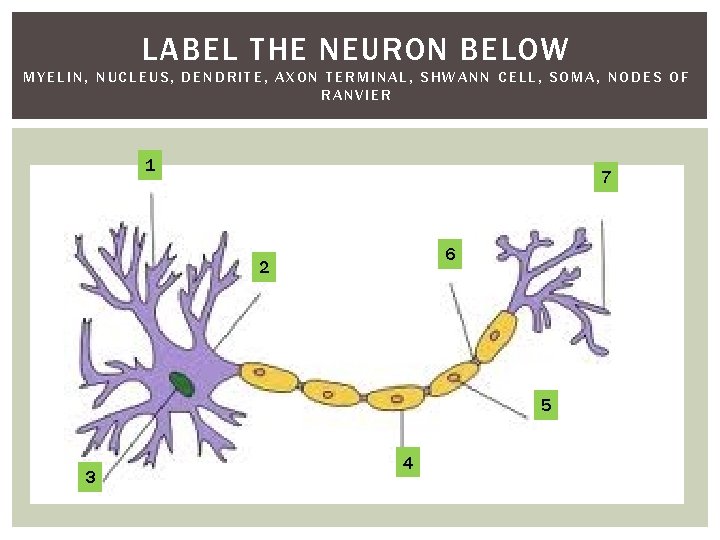
LABEL THE NEURON BELOW MYELIN, NUCLEUS, DENDRITE, AXON TERMINAL, SHWANN CELL, SOMA, NODES OF RANVIER 1 7 6 2 5 3 4
CEREBELLUM, CEREBRUM, OR BRAIN STEM 1. Medulla oblongata located here. 2. Regulates balance 3. Cerebral cortex is located here 4. Capacity for intellectual function resides here 5. Breathing rate is regulated here 6. Has folded layers with bumps and grooves 7. Regulates posture 8. Contains the corpus collosum 9. Pons located here 10. Leads to spinal cord
- Slides: 73