SYIAH ASAL USUL CIRI KHASNYA Dr Syamsuddin Arif




- Slides: 25
SYI‘AH : ASAL USUL & CIRI KHASNYA Dr Syamsuddin Arif
What ? The word “ shi‘ah ” ( )ﺷﻴﻌﺔ and its meanings: Literal: group, division (tribal, ethnic, etc. ) Political: supporters, party (members, loyalists) Religious: sect, ideology (‘aqidah) > theology
Who ? Literal: ‘Abdullah ibn ‘Abbas, Abu Dharr al-Ghiffari, Salman al-Farisi, Malik al-Ashtar Political: al-Mukhtar (the revolt leader of Kufah) - Zayd (ibn Ali ibn Husayn)’s revolt in Kufah - Yahya (ibn Zayd ibn Ali)’s revolt in Herat - ‘Abdullah (ibn Mu‘awiyah ibn
Why ? Political discontents (due to perceived injustice) Racism (anti-Arab sentiments) Tribalism (rivalry and dispute) Personal interest/ambition/agenda Hypocricy (anti-Islam, crypto-Jew, Manichean etc. )
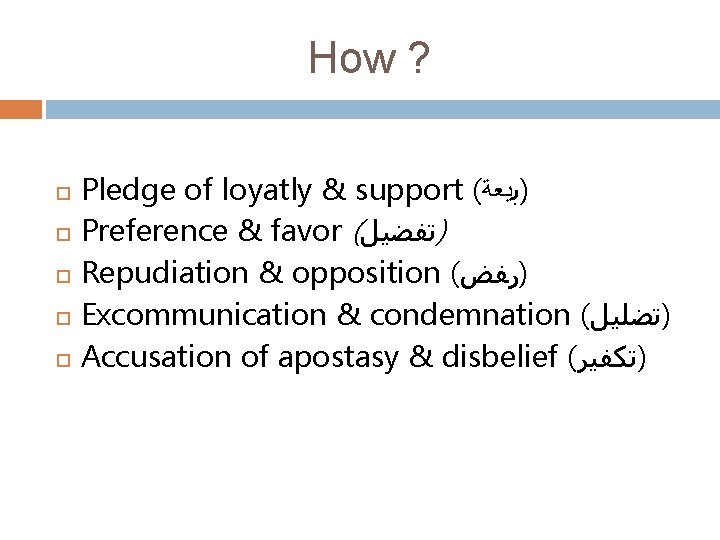
How ? Pledge of loyatly & support ( )ﺑﻴﻌﺔ Preference & favor ( )ﺗﻔﻀﻴﻞ Repudiation & opposition ( )ﺭﻔﺾ Excommunication & condemnation ( )ﺗﻀﻠﻴﻞ Accusation of apostasy & disbelief ( )ﺗﻜﻔﻴﺮ
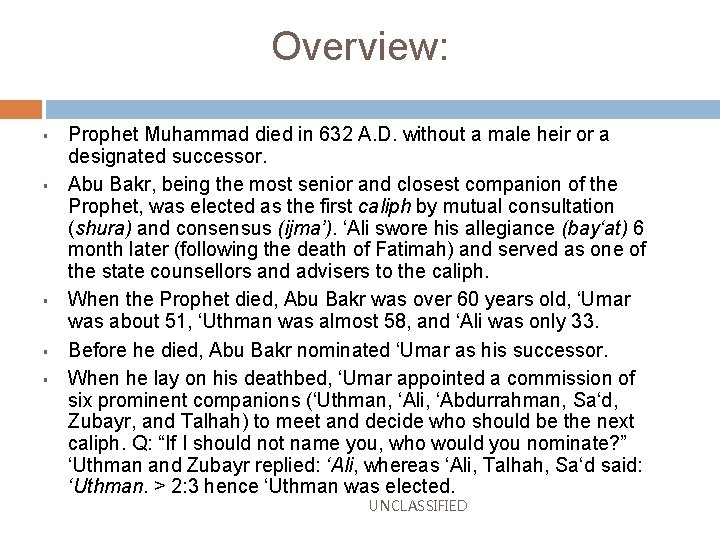
Overview: § § § Prophet Muhammad died in 632 A. D. without a male heir or a designated successor. Abu Bakr, being the most senior and closest companion of the Prophet, was elected as the first caliph by mutual consultation (shura) and consensus (ijma’). ‘Ali swore his allegiance (bay‘at) 6 month later (following the death of Fatimah) and served as one of the state counsellors and advisers to the caliph. When the Prophet died, Abu Bakr was over 60 years old, ‘Umar was about 51, ‘Uthman was almost 58, and ‘Ali was only 33. Before he died, Abu Bakr nominated ‘Umar as his successor. When he lay on his deathbed, ‘Umar appointed a commission of six prominent companions (‘Uthman, ‘Ali, ‘Abdurrahman, Sa‘d, Zubayr, and Talhah) to meet and decide who should be the next caliph. Q: “If I should not name you, who would you nominate? ” ‘Uthman and Zubayr replied: ‘Ali, whereas ‘Ali, Talhah, Sa‘d said: ‘Uthman. > 2: 3 hence ‘Uthman was elected. UNCLASSIFIED
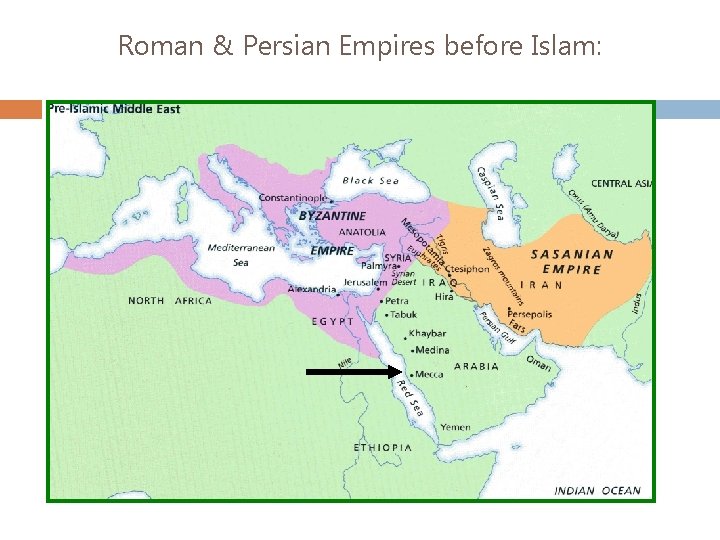
Roman & Persian Empires before Islam:
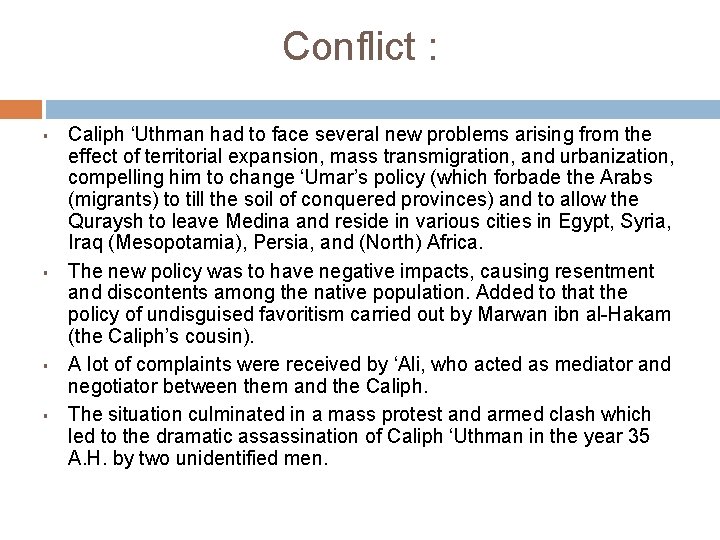
Conflict : § § Caliph ‘Uthman had to face several new problems arising from the effect of territorial expansion, mass transmigration, and urbanization, compelling him to change ‘Umar’s policy (which forbade the Arabs (migrants) to till the soil of conquered provinces) and to allow the Quraysh to leave Medina and reside in various cities in Egypt, Syria, Iraq (Mesopotamia), Persia, and (North) Africa. The new policy was to have negative impacts, causing resentment and discontents among the native population. Added to that the policy of undisguised favoritism carried out by Marwan ibn al-Hakam (the Caliph’s cousin). A lot of complaints were received by ‘Ali, who acted as mediator and negotiator between them and the Caliph. The situation culminated in a mass protest and armed clash which led to the dramatic assassination of Caliph ‘Uthman in the year 35 A. H. by two unidentified men.
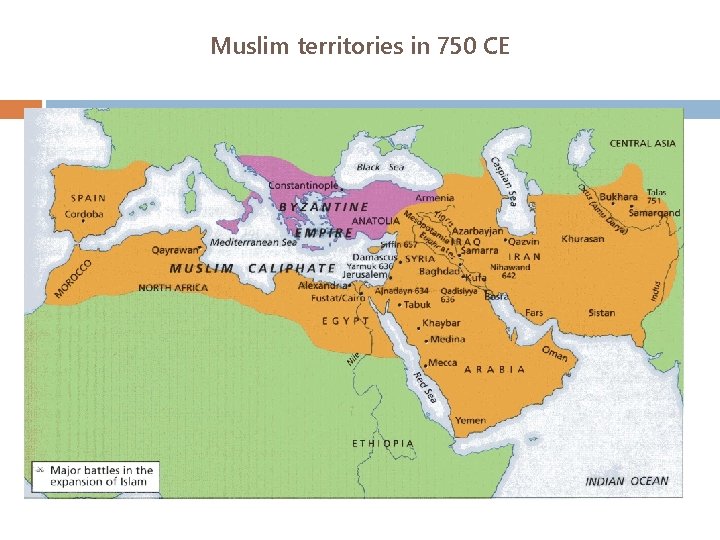
Muslim territories in 750 CE
Civil war : Following the death of Caliph ‘Uthman, all the Companions in Medina gave their allegiance to ‘Ali as the new caliph. Ashtar pledged the support of the people of Kufah, Zubayr and Talhah on behalf of the Muhajirin and Abu Ayyub for the Ansar. However, there were at least three men of Quraysh who refused to recognize ‘Ali as caliph, namely: Marwan ibn al-Hakam, al-Walid ibn ‘Uqbah, and Mu‘awiyah ibn Abi Sufyan, who later managed to gather troops to seek vengeance and demanded that their clan be allowed to retain their posts. Zubayr and Talhah withdrew their allegiance, formed an army and set out for Mecca and soon Ummul Mu’minin ‘A’ishah joined them, marching to
Thus, … 661 C. E. – Caliph ‘Ali was assassinated by one of the rebels. Mu‘awiyah ibn Abi Sufyan, the governor of Syria, emerged as caliph after offering Ali’s son al-Hasan an impressive retirement to step aside. Death of Ali and his son al-Hasan led to the transfer of caliphate to Damascus, which marked the beginning of first Muslim dynasty (the Umayyad). 680 C. E. –Yazid succeeded his father Mu‘awiyah as caliph of the Umayyad. Al-Hasan’s brother, al-Husayn revolted against Yazid in an attempt to re-establish the right of Ali’s family to rule. In this act, Shi‘a transformed into a religious sect. Yazid has Husayn killed, turning Husayn into a martyr in the eyes of the Shi‘ites. The massacre of Husayn and his supporters at Karbala in 680 C. E. marked the beginning of Shi’a as a religiopolitical movement. 750 C. E. - Umayyad dynasty fell to the efforts of a Shi‘ite. Abbas alliance. Some Umayyad family members fled to Spain
Seterusnya … 755 C. E. – ‘Abbas promised Husayn’s great-grandson Ja‘far that Ja‘far could claim his right as caliph, but ‘Abbas died before the deal was set and Jafar was murdered by ‘ Abbas’ son al-Mansur who then founded the ‘Abbasid Caliphate. 945 -1050 C. E. – The Shiite Buyid family took control of western Iran and Iraq, thusly controlling the Abbasid caliph until the arrival of the Sunni Turks in 1050 C. E. 1258 C. E. – Mongolian invaders killed the last of the Abbasid family in Bagdad. The Mongolian conquests led to relative tolerance between the Sunnis and Shiites who were forced to work together to fight off the invaders. 1501 C. E. – The Safavid Dynasty (1502 -1736) was established in Persia by Ismail I, who proclaimed Shi‘ism as the official, state religion, thereby ending the tolerance between Sunnis and Shiites and resulting in long-lasting conflict with the Sunni Ottomans. 1587 C. E. – Abbas I, the greatest ruler in the Safavid Dynasty, was declared as shah at age 16.
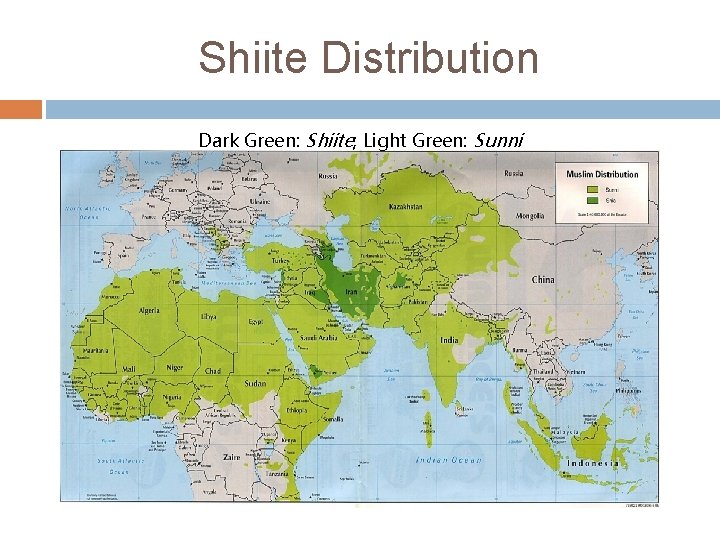
Sunni and Shia Today Population statistics (Sunni 90%, Shia 10%) Cult of Martyrdom- the 12 Imams Concept of the Mahdi Concealing Faith for Self Protection Temporary Marriages Frequency of Prayer
Differences UNCLAS SIFIED SUNNI: § § § 85 -90% of Muslims Leadership by consensus (of Muhammad’s followers) No organized clergy; authority from below to above Literal interpretation of the Qur’an (apparent meaning) Majority status throughout duration of the caliphate SHI’ITE (SHI’A): § § § 10 -15% of Muslims Leaders only descended from family of Muhammad Authoritarian: guidance from Imams (above) to below Leadership determines (hidden) meaning of Qur’an Oppressed, tragic minority: greater emphasis on martyrdom, and use of dissimulation (taqiyyah)
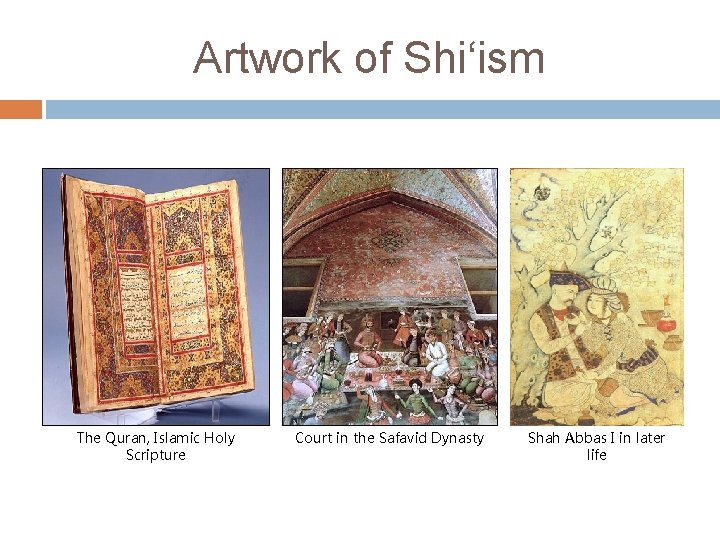
Artwork of Shi‘ism The Quran, Islamic Holy Scripture Court in the Safavid Dynasty Shah Abbas I in later life
Holidays Sunni: Eid al-Adha, Eid al-Fitr Shia: Eid al-Adha, Eid al-Fitr, Ashura- a day of mourning. Men would beat their chests, and cut their bodies with knives. As most religious elite ban the cutting practice it still happens, they encourage the Shia to donate blood instead to commemorate the blood spilled at the battle of Karbala.
Holy Places Sunni: Mecca, Medina, Jerusalem Shia: Mecca, Medina, Jerusalem, Najaf (Site of Ali’s Tomb), Karbala
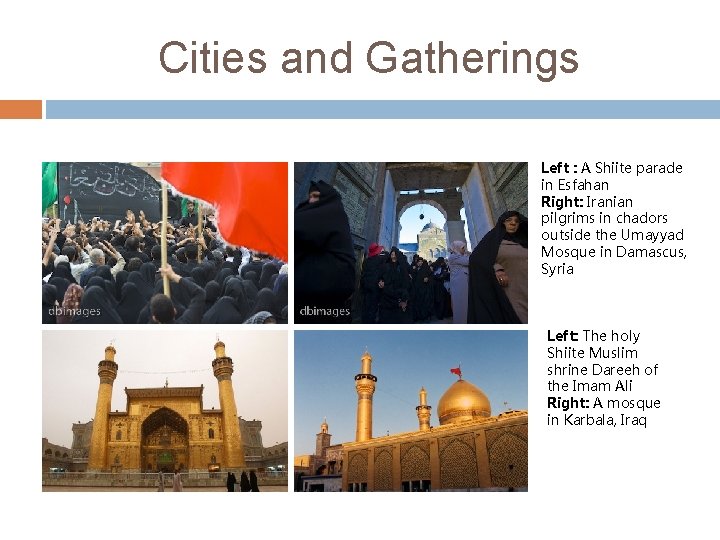
Cities and Gatherings Left : A Shiite parade in Esfahan Right: Iranian pilgrims in chadors outside the Umayyad Mosque in Damascus, Syria Left: The holy Shiite Muslim shrine Dareeh of the Imam Ali Right: A mosque in Karbala, Iraq
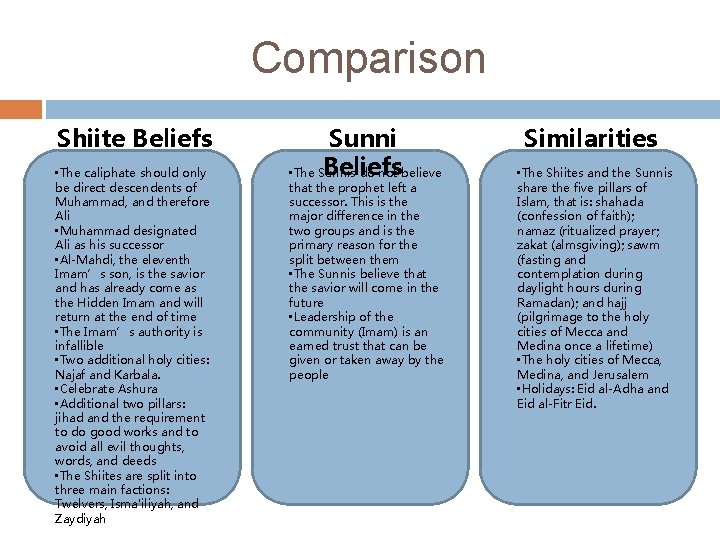
Comparison Shiite Beliefs • The caliphate should only be direct descendents of Muhammad, and therefore Ali • Muhammad designated Ali as his successor • Al-Mahdi, the eleventh Imam’s son, is the savior and has already come as the Hidden Imam and will return at the end of time • The Imam’s authority is infallible • Two additional holy cities: Najaf and Karbala. • Celebrate Ashura • Additional two pillars: jihad and the requirement to do good works and to avoid all evil thoughts, words, and deeds • The Shiites are split into three main factions: Twelvers, Isma'iliyah, and Zaydiyah Sunni Beliefs • The Sunnis do not believe that the prophet left a successor. This is the major difference in the two groups and is the primary reason for the split between them • The Sunnis believe that the savior will come in the future • Leadership of the community (Imam) is an earned trust that can be given or taken away by the people Similarities • The Shiites and the Sunnis share the five pillars of Islam, that is: shahada (confession of faith); namaz (ritualized prayer; zakat (almsgiving); sawm (fasting and contemplation during daylight hours during Ramadan); and hajj (pilgrimage to the holy cities of Mecca and Medina once a lifetime) • The holy cities of Mecca, Medina, and Jerusalem • Holidays: Eid al-Adha and Eid al-Fitr Eid.
Change Over Time The first subsect of Shia’ism develops under Zayd who leads an unsuccessful rebellion against the Umayyad caliph in 740 CE. The Zaydis, sometimes called Fivers, believe that Ali, Husan and Husayn are the first three rightful caliphs. However, after them, they believe that the caliphate is open to whoever of Ali’s descendents can ascertain themselves through revolt. The primary difference between this subsect and the majority of Shiites is that they believe Zayd is the fifth Imam while most Shiites believe his brother Al-Baqir is the fifth Imam. In the early to mid 750’s, when the Umayyad dynasty is defeated, the Shiite sect begins to further divide. The Sevener Shiites, or the Ismailis, develop with the death of Jafar, the sixth Shiite Imam. They believe that Jafar was the last Imam and his heir, the seventh Imam, will come back at the end of time. The majority of the Shiites who are neither Seveners nor Fivers are considered to be Twelver Shiites believe that the line of rightful Imams ends with Hasan al-
Shiites Today Iran is primarily made up of Shiites with the total percentage reaching about 89%. Hizbollah, which are made up of Shiites, forced the Israelis out of Southern Lebanon. The Shiites and the Sunnis are still at war with one another. Numerous bombings and killings have occurred as a result of their long-term conflict. Iran has a Shiite theocratic republic. Their supreme leader, which is the political office in which the person rules for life, is Ali Hoseini-Khameni.
Shiite Distribution Dark Green: Shiite; Light Green: Sunni
Syi‘ah Bukan mazhab aqidah > Asy’ariyyah Bukan mazhab fiqih > Syafi’iyyah Bukan tariqah > Qadiriyyah Bukan organisasi > Muhammadiyah etc