Successfully supporting Carers Chris Larkin and Natalie Halford


- Slides: 26
Successfully supporting Carers? Chris Larkin and Natalie Halford
Overview • Introduction – some facts • What does the policy say? • Stroke Association initiatives • What have we learnt?
What is a carer? A carer is anyone who cares, unpaid, for a friend or family member who due to illness, disability, a mental health problem or an addiction cannot cope without their support Carers Trust
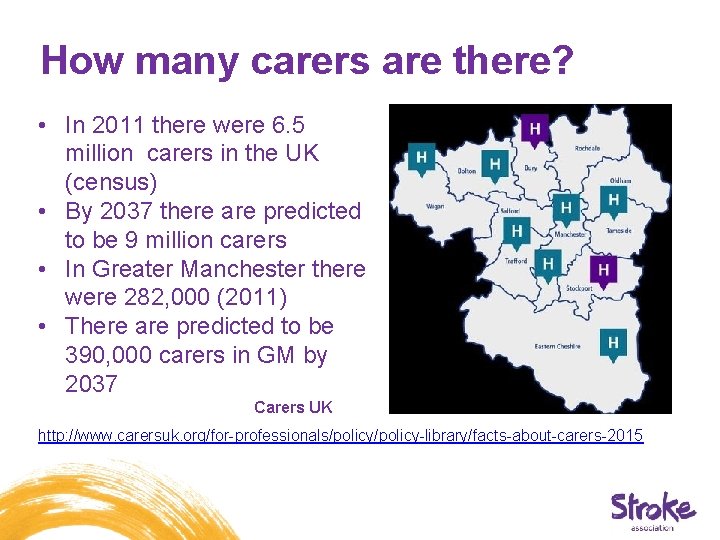
How many carers are there? • In 2011 there were 6. 5 million carers in the UK (census) • By 2037 there are predicted to be 9 million carers • In Greater Manchester there were 282, 000 (2011) • There are predicted to be 390, 000 carers in GM by 2037 Carers UK http: //www. carersuk. org/for-professionals/policy-library/facts-about-carers-2015
Half of stroke survivors depend on others for everyday activities Some two thirds of all carers experience relationship difficulties with their partner after a stroke. The current number of carers in GM is about three times the size of the paid NHS and social care workforce ODN 12 month review report: Feedback from stroke survivors has identified more support for carers as a key gap in provision The care provided unpaid, by the nations’ carers is worth an estimated £ 119 bn per year – considerably more than total spending on the NHS in England
Stroke policy QM 13. Long-term care and support A range of services are in place and easily accessible to support the individual long-term needs of individuals and their carers Emotional, Practical Support, Information, Peer Support Carers of patients with stroke are provided with a named point of contact for stroke information, written information about the patient's diagnosis and management plan, and sufficient practical training to enable them to provide care (NICE QS, 2010)
What should happen before the person I care for is discharged? • An assessment should be carried out to see if they are medically fit to be discharged. • A discharge assessment should be carried out to see if they need support once discharged. • A carer’s assessment should be carried out (or at least arranged), to see whether the carer needs support once the person being cared for is discharged. • A written care and support plan should be given to the stroke survivor (and a support plan for the carer if they have had your own carer’s assessment), which outlines the support required and how this will be provided. • The support outlined in the care and support plan (for the stroke survivor) and the support plan (for the carer) should be put in place. Carers UK
The Care Act • In April 2015 The Care Act replaced most previous law regarding carers & people being cared for • It outlines the way local authorities should carry out carer’s assessments & needs assessments; • how LAs determine who is eligible for support; • how LAs charge for residential care and community care; • Places new obligations on LAs.
Salford’s Devolution Locality Plan “Over 10% of the population of Salford provide unpaid care to family members and others – around 26, 000 people, not taking account of the approximately 3, 500 young carers. This reflected a 4. 3% increase on the previous Census, with a 25. 2% increase in those caring for 20 -49 hours per week and a 13% increase in those caring for 50 hours or more. In effect, some 70% of the health and social care ‘workforce’ in Salford are unpaid carers – a great asset of skills, knowledge, determination and resilience. They are already providing a huge amount of care outside hospitals and care homes, and preventing very costly admissions to them. National figures indicate that each carer saves the state an average of around £ 20, 000 per year, suggesting a minimum of £ 468 million worth of care being provided by unpaid carers in Salford. Yet, health and social care workforce planning has historically focussed exclusively on paid health and social care staff. Whether those caring are paid or unpaid, they all deserve equitable recognition, support and development. Carers should be treated as the major part of a suitably skilled workforce with appropriate working conditions, in order to achieve the transformation and new ways of working to which Salford aspires. ”
Carers rights? • Entitled to an assessment • Do people recognise themselves as carers? • Do people want to be carers? • Recognition of carers as individuals in their own right
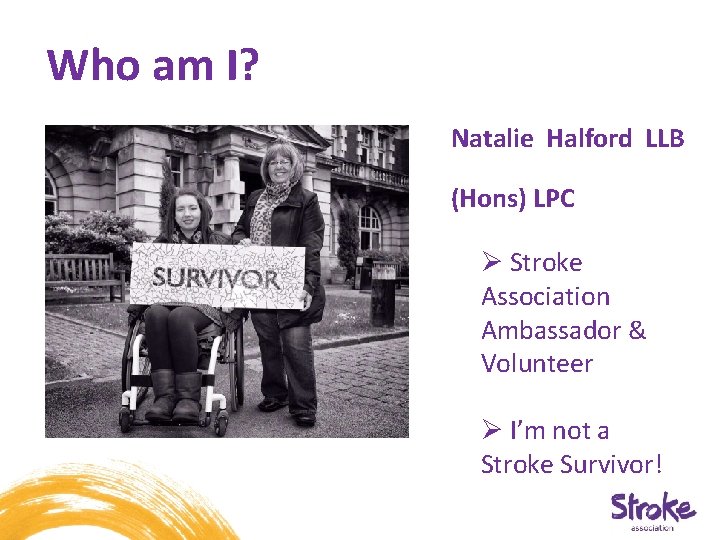
Who am I? Natalie Halford LLB (Hons) LPC Ø Stroke Association Ambassador & Volunteer Ø I’m not a Stroke Survivor!
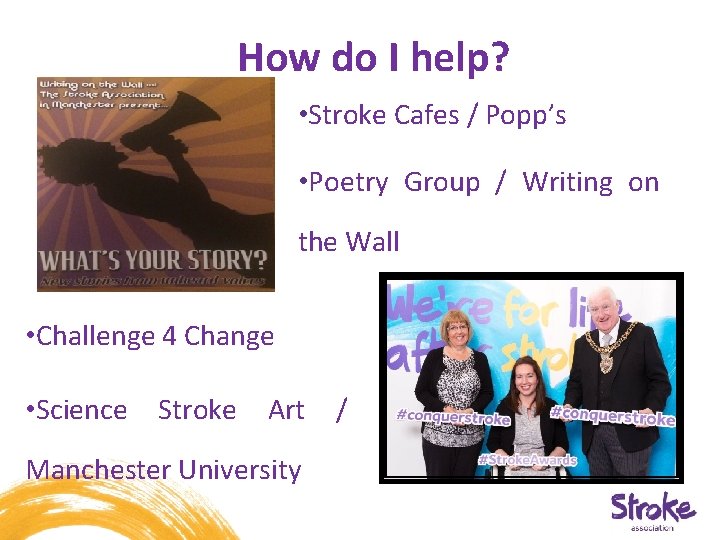
How do I help? • Stroke Cafes / Popp’s • Poetry Group / Writing on the Wall • Challenge 4 Change • Science Stroke Art Manchester University /
OSCARSS What is the OSCARSS study? OSCARSS aims to improve existing support provided by the Stroke Association to carers. The Stroke Association want to ensure that all carers benefit from the same personalised, high quality support. 2 Stages: • Development to create an approach that the Stroke Association can use to support carers after stroke. • Evaluation putting this new approach into action at selected Stroke Association sites and evaluate if and how it improves outcomes for carers of stroke survivors.
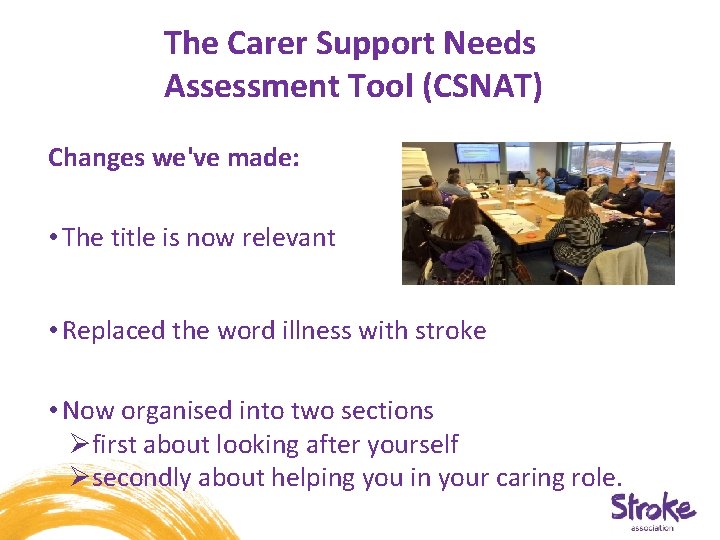
The Carer Support Needs Assessment Tool (CSNAT) Changes we've made: • The title is now relevant • Replaced the word illness with stroke • Now organised into two sections Øfirst about looking after yourself Øsecondly about helping you in your caring role.
Are patients / service users effective in research for service development? Yes!. . Why? • From a generic tool we now have a more personalised one • It identifies a carers needs effectively • Prioritises the carers needs above that of the stroke survivors • Potentially improves the conceptual process of participant recruitment to measure the effectiveness of the study
Training for carers • Based on the now closed Department of Health Caring with Confidence program • Consultation of staff who delivered that program • Many years of working with and in support of carers of stroke survivors
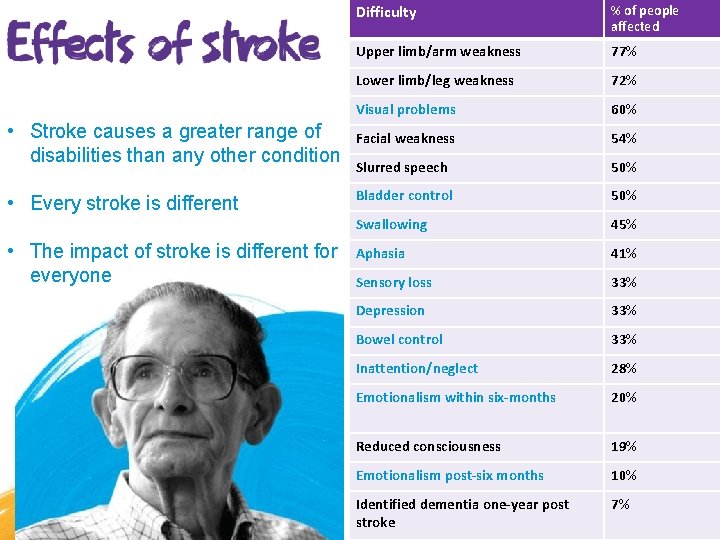
• Stroke causes a greater range of disabilities than any other condition • Every stroke is different • The impact of stroke is different for everyone Difficulty % of people affected Upper limb/arm weakness 77% Lower limb/leg weakness 72% Visual problems 60% Facial weakness 54% Slurred speech 50% Bladder control 50% Swallowing 45% Aphasia 41% Sensory loss 33% Depression 33% Bowel control 33% Inattention/neglect 28% Emotionalism within six-months 20% Reduced consciousness 19% Emotionalism post-six months 10% Identified dementia one-year post stroke 7%
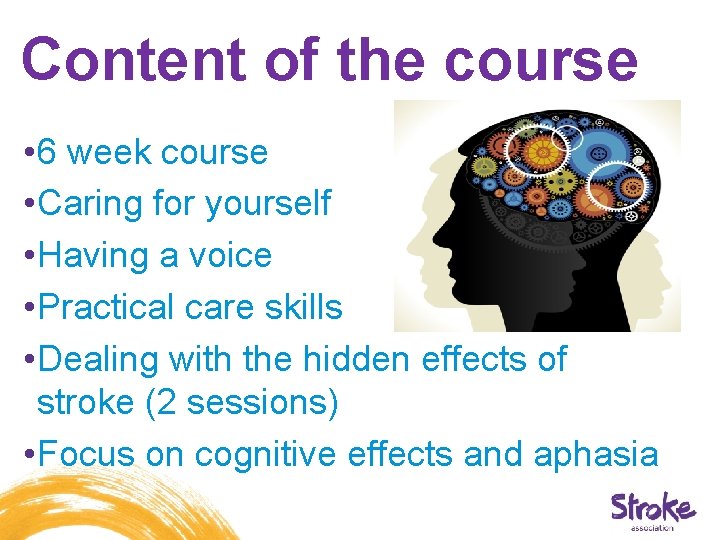
Content of the course • 6 week course • Caring for yourself • Having a voice • Practical care skills • Dealing with the hidden effects of stroke (2 sessions) • Focus on cognitive effects and aphasia
Other intiatives • Post Stroke Education Programmes • Aimed at stroke survivors but inclusive of wider family members • Reduce impact of stroke via increased knowledge • Increase ability to cope with residual effects • Partnership initiatives with Psychology Services • Stroke & carer specific • 6 week programme in Oldham • Plans for 6 week programme in Central Lancs delivered jointly with the IAPT service • SPPARC • Carers of stroke survivors with aphasia • Recognised standardised programme developed by SLT • Increases understanding and reduces frustrations
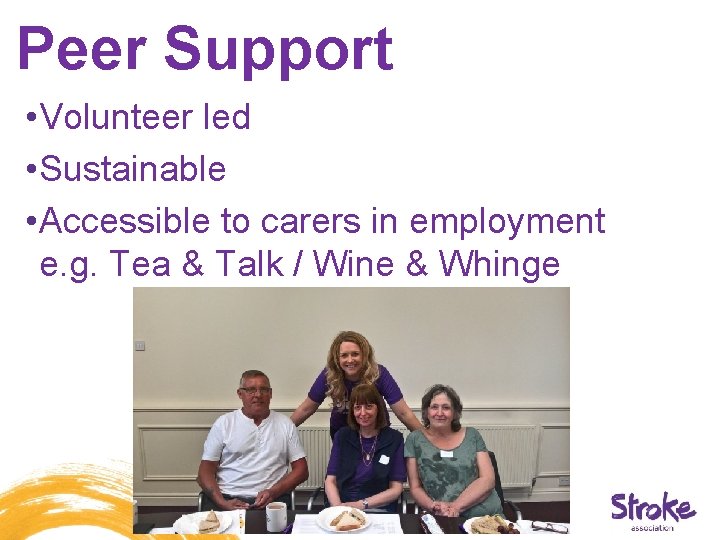
Peer Support • Volunteer led • Sustainable • Accessible to carers in employment e. g. Tea & Talk / Wine & Whinge
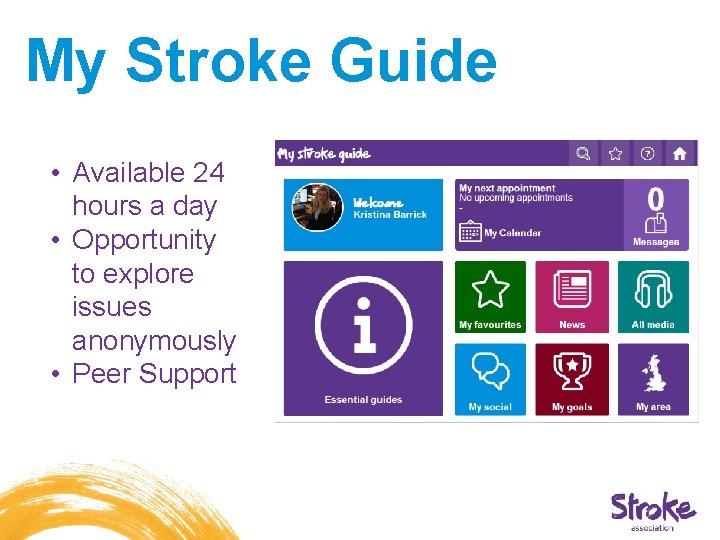
My Stroke Guide • Available 24 hours a day • Opportunity to explore issues anonymously • Peer Support
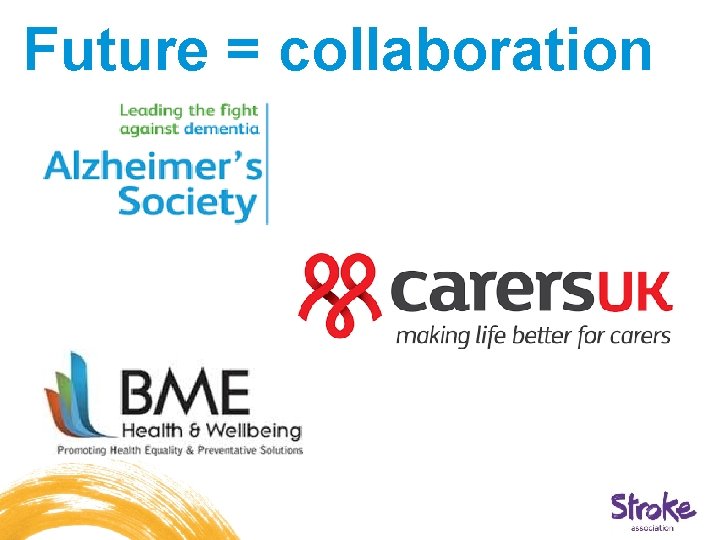
Future = collaboration
Key learning • Stroke specific to reflect the particular challenges faced • Joint work with stroke survivors can work well but opportunities to be alone are vital • Practical and specific support e. g. assertiveness skills • Peer support between carers with a commonality of shared experience is incredibly valuable
“After wife’s discharge from hospital I felt lost and hopeless. I contacted the Stroke Association and you sent a coordinator. She helped me to find the right people to get my wife the help she needed. I feel that it would not have happened without her help. ” “We were lucky to be put in touch with you when my husband had a stroke outside our area last year. Talking to someone who understands the situation and being able to ask questions gave confidence to return to normal activities. ”