Strategy Choice And Implementation Tools 1 3 1

- Slides: 40
Strategy Choice And Implementation Tools 1
3. 1 Introduction • The strategic choice is concerned with • choosing a strategy based on the foundation laid by strategic analysis. Elements associated with making strategic choices are – Generation of options – Evaluation of options – Selection of options 2
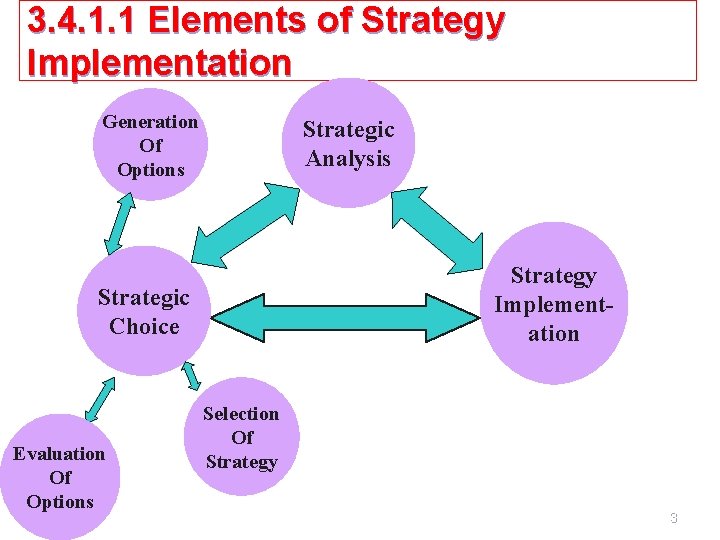
3. 4. 1. 1 Elements of Strategy Implementation Generation Of Options Strategic Analysis Strategy Implementation Strategic Choice Evaluation Of Options Selection Of Strategy 3
• Generation of strategic options involves • • identifying as many as possible of potential courses of action. Evaluation of strategic involves testing of the alternatives listed for suitability, feasibility & acceptability (evaluation criteria). Selection of strategy result in a single strategy or strategy set that will be the target for the strategic implementation element for the process 4
3. 2 Generation of strategic options • This element of the strategic choice • • process aims to generate strategic options for subsequent evaluation. This is done in a number of ways, by identifying the: What basis? – Which direction? – How options? 5
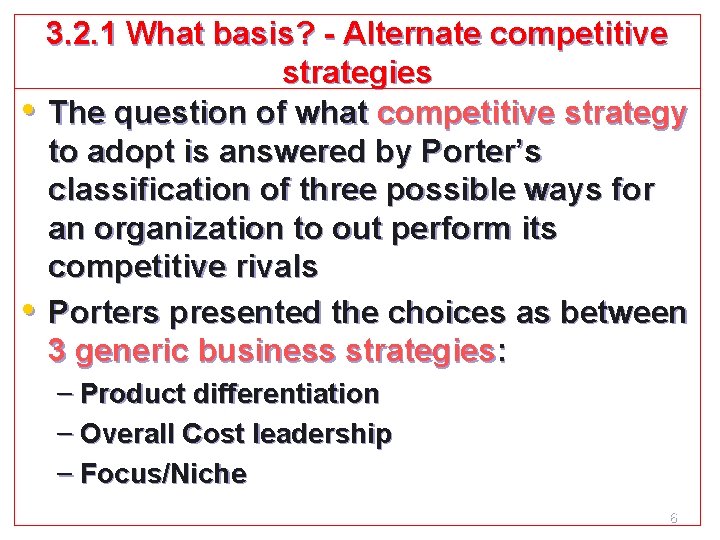
3. 2. 1 What basis? - Alternate competitive strategies • The question of what competitive strategy to adopt is answered by Porter’s classification of three possible ways for an organization to out perform its competitive rivals • Porters presented the choices as between 3 generic business strategies: – Product differentiation – Overall Cost leadership – Focus/Niche 6
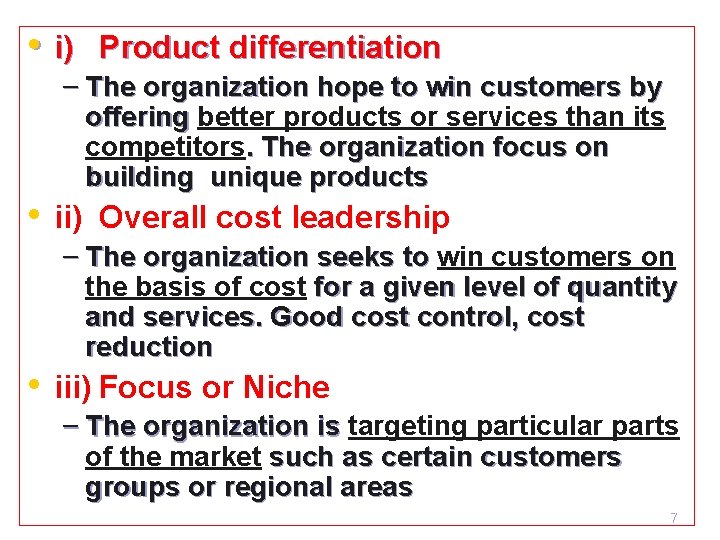
• i) Product differentiation – The organization hope to win customers by offering better products or services than its competitors. The organization focus on building unique products • ii) Overall cost leadership – The organization seeks to win customers on the basis of cost for a given level of quantity and services. Good cost control, cost reduction • iii) Focus or Niche – The organization is targeting particular parts of the market such as certain customers groups or regional areas 7
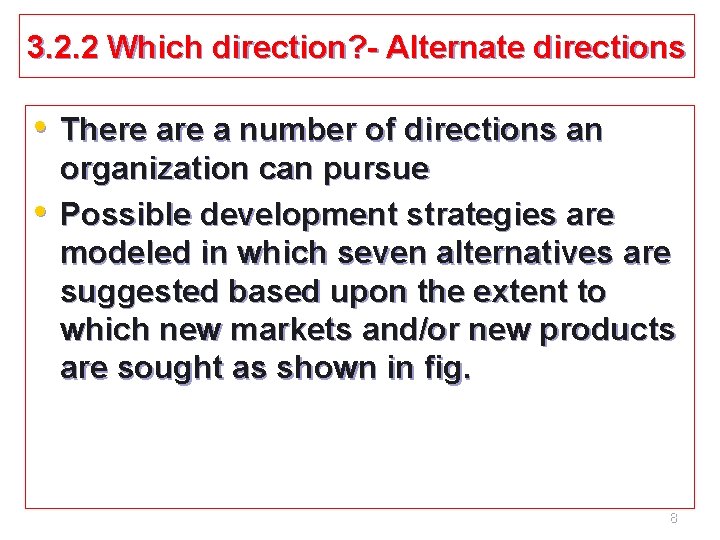
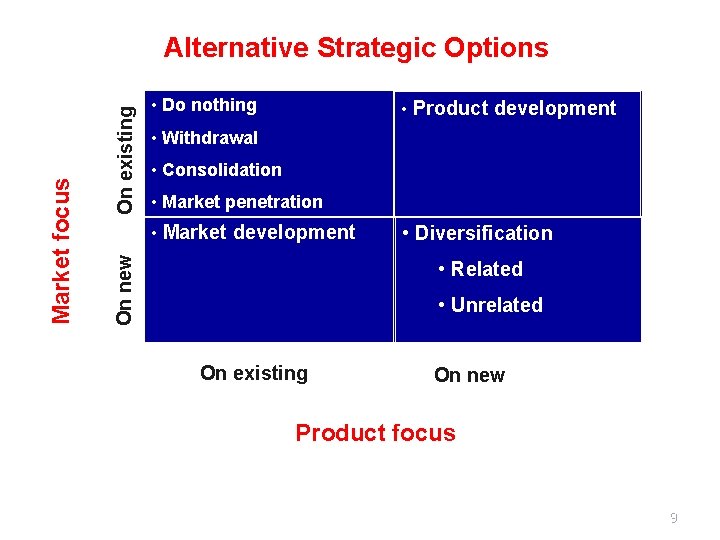
3. 2. 2 Which direction? - Alternate directions • There a number of directions an • organization can pursue Possible development strategies are modeled in which seven alternatives are suggested based upon the extent to which new markets and/or new products are sought as shown in fig. 8
On existing • Do nothing • Product development • Withdrawal • Consolidation • Market penetration • Market development On new Market focus Alternative Strategic Options • Diversification • Related • Unrelated On existing On new Product focus 9
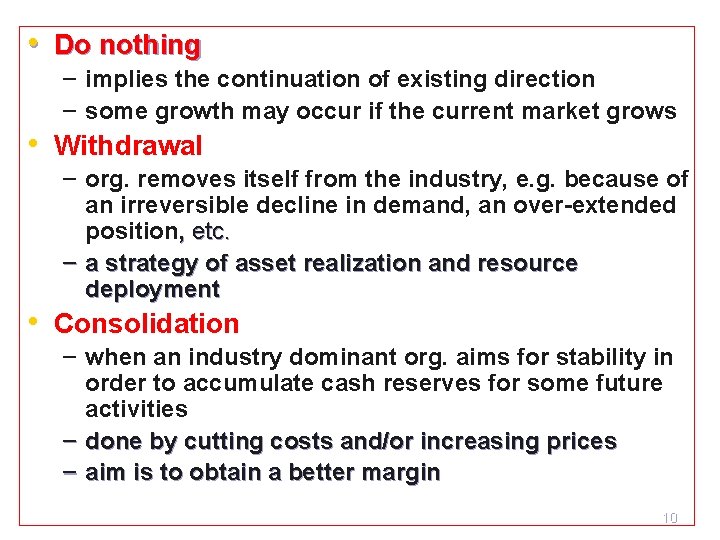
• Do nothing – implies the continuation of existing direction – some growth may occur if the current market grows • Withdrawal – org. removes itself from the industry, e. g. because of an irreversible decline in demand, an over-extended position, etc. – a strategy of asset realization and resource deployment • Consolidation – when an industry dominant org. aims for stability in order to accumulate cash reserves for some future activities – done by cutting costs and/or increasing prices – aim is to obtain a better margin 10
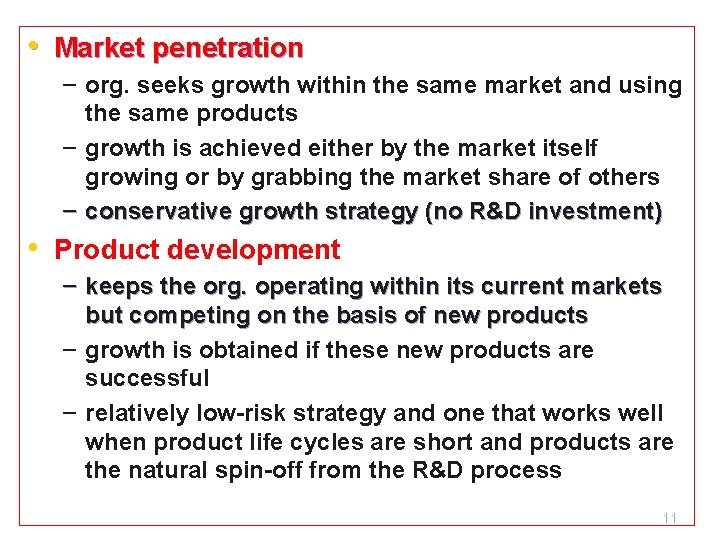
• Market penetration – org. seeks growth within the same market and using the same products – growth is achieved either by the market itself growing or by grabbing the market share of others – conservative growth strategy (no R&D investment) • Product development – keeps the org. operating within its current markets but competing on the basis of new products – growth is obtained if these new products are successful – relatively low-risk strategy and one that works well when product life cycles are short and products are the natural spin-off from the R&D process 11
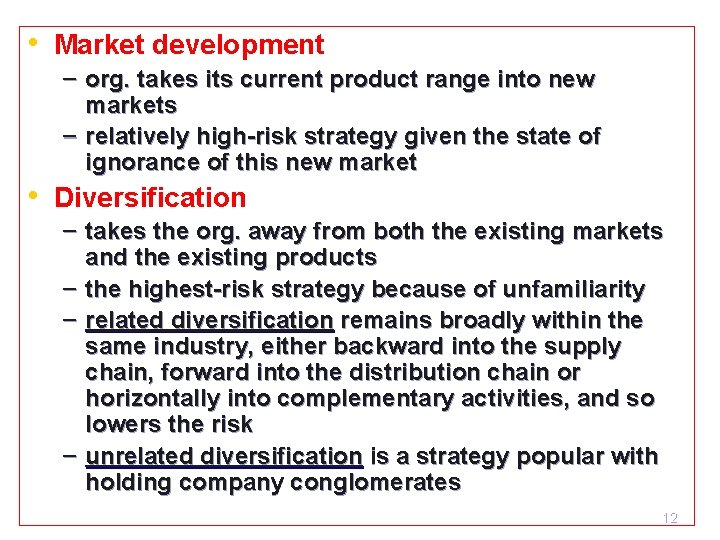
• Market development – org. takes its current product range into new markets – relatively high-risk strategy given the state of ignorance of this new market • Diversification – takes the org. away from both the existing markets and the existing products – the highest-risk strategy because of unfamiliarity – related diversification remains broadly within the same industry, either backward into the supply chain, forward into the distribution chain or horizontally into complementary activities, and so lowers the risk – unrelated diversification is a strategy popular with holding company conglomerates 12
• 3. 2. 3 How? - Alternate methods Possible ways to implement growth strategies: – internal development of growth over time (this is slow) – external development via mergers and acquisitions (expensive but fast in gaining access to markets – joint ventures • The trade-offs between cost/ risk/ speed shape the choice between these alternatives 13
3. 3 Strategy evaluation & choice 3. 3. 1 Introduction • Once the strategic options have been generated there • • must exists a framework within which they can be evaluated for – suitability – feasibility – fit to the organization 3. 3. 1. 1 Evaluation Process The evaluation process seeks to judge the appropriateness of the options with regard to organ. ’s environment, culture and capabilities The evaluation process can use some of the tools covered under strategic analysis, e. g. MCC matrix 14
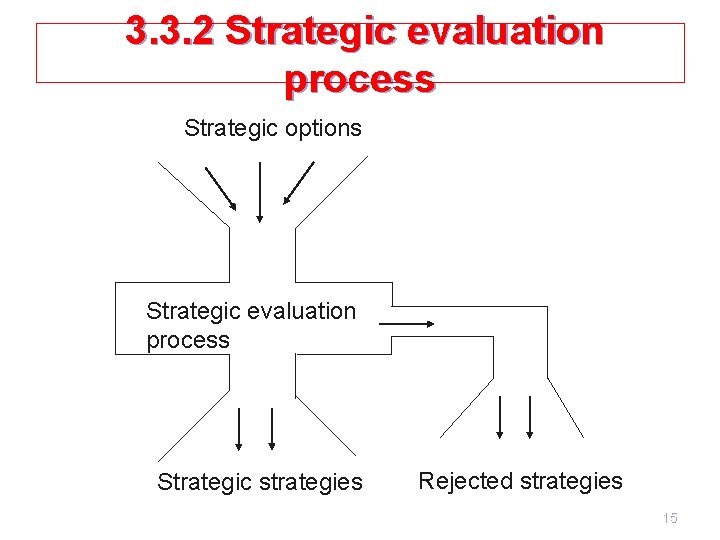
3. 3. 2 Strategic evaluation process Strategic options Strategic evaluation process Strategic strategies Rejected strategies 15
3. 3. 3 Criteria for Evaluating options • The criteria against which the possibilities are evaluated – Does the option take advantage of the strength the organization? – Does the option avoid depending upon a weakness the organization suffers? – Does the option offer the organization the chance to gain a competitive advantage? – Is this strategy consistent with other strategies selected? – Does this option address a mission-related opportunity presented by the evolving market? – Is this option’s level of risk acceptable? – Is this option consistent with policy guidelines? 16
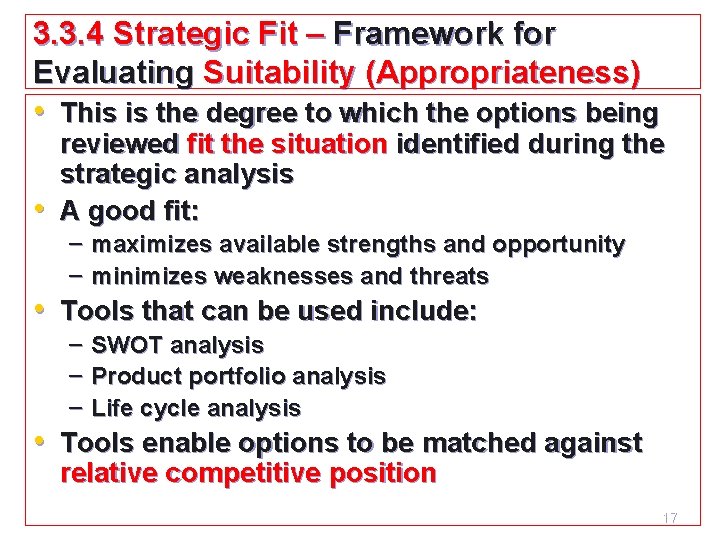
3. 3. 4 Strategic Fit – Framework for Evaluating Suitability (Appropriateness) • This is the degree to which the options being • reviewed fit the situation identified during the strategic analysis A good fit: – maximizes available strengths and opportunity – minimizes weaknesses and threats • Tools that can be used include: – – – SWOT analysis Product portfolio analysis Life cycle analysis • Tools enable options to be matched against relative competitive position 17
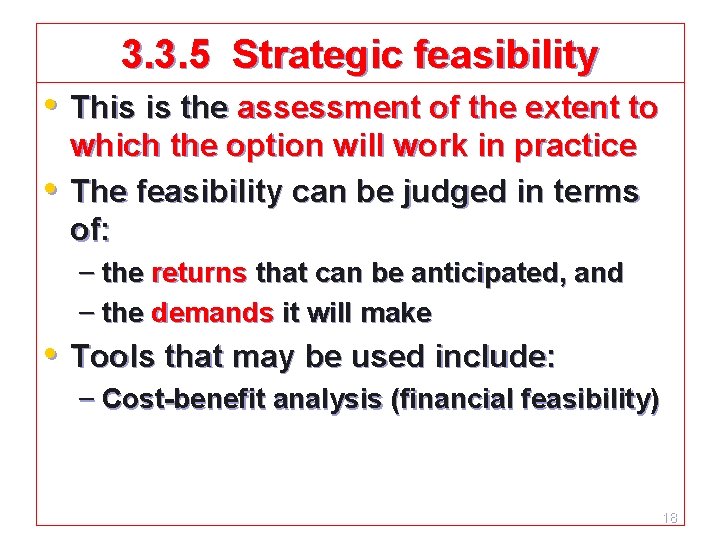
3. 3. 5 Strategic feasibility • This is the assessment of the extent to • which the option will work in practice The feasibility can be judged in terms of: – the returns that can be anticipated, and – the demands it will make • Tools that may be used include: – Cost-benefit analysis (financial feasibility) 18
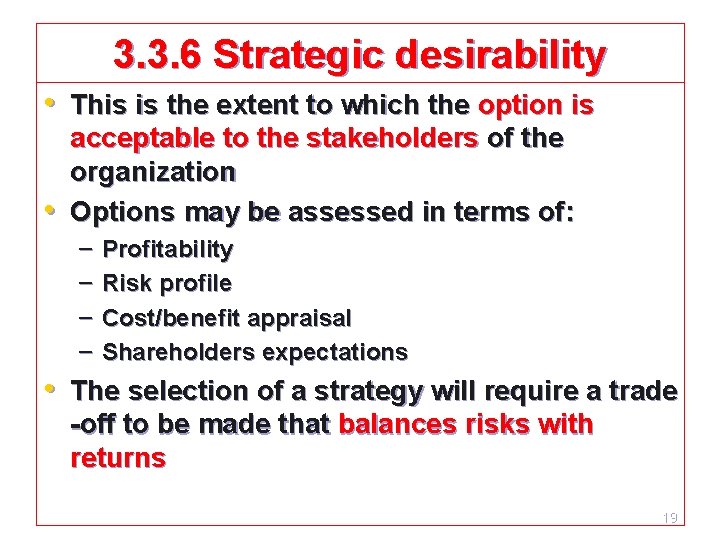
3. 3. 6 Strategic desirability • This is the extent to which the option is • acceptable to the stakeholders of the organization Options may be assessed in terms of: – – Profitability Risk profile Cost/benefit appraisal Shareholders expectations • The selection of a strategy will require a trade -off to be made that balances risks with returns 19
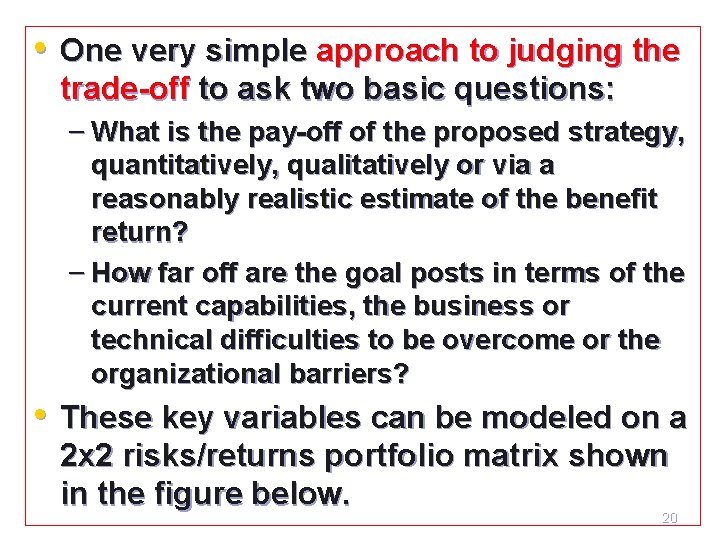
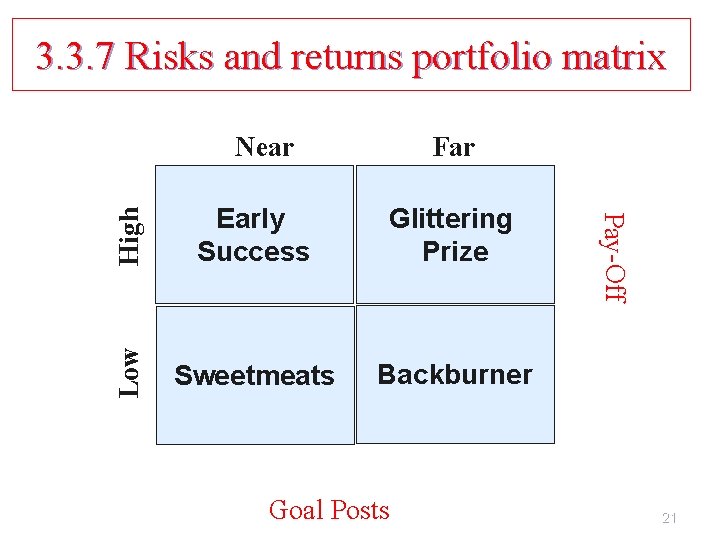
• One very simple approach to judging the trade-off to ask two basic questions: – What is the pay-off of the proposed strategy, quantitatively, qualitatively or via a reasonably realistic estimate of the benefit return? – How far off are the goal posts in terms of the current capabilities, the business or technical difficulties to be overcome or the organizational barriers? • These key variables can be modeled on a 2 x 2 risks/returns portfolio matrix shown in the figure below. 20
3. 3. 7 Risks and returns portfolio matrix Early Success Glittering Prize Sweetmeats Backburner Goal Posts Pay-Off High Far Low Near 21
• Early success initiatives are needed to • • build confidence and provide returns to finance the glittering prizes that are of significant competitive value but more organizationally draining To balance the strain sweetmeats are needed to reap the limited but easily achieved rewards, whereas the backburners are to be postponed until either the difficulty factor reduces or the pay-off factor increases (become a sweetmeat or a glittering prize) Most of the tools are a common-sense method of prioritizing 22
3. 4 Strategic Implementation Tools 23
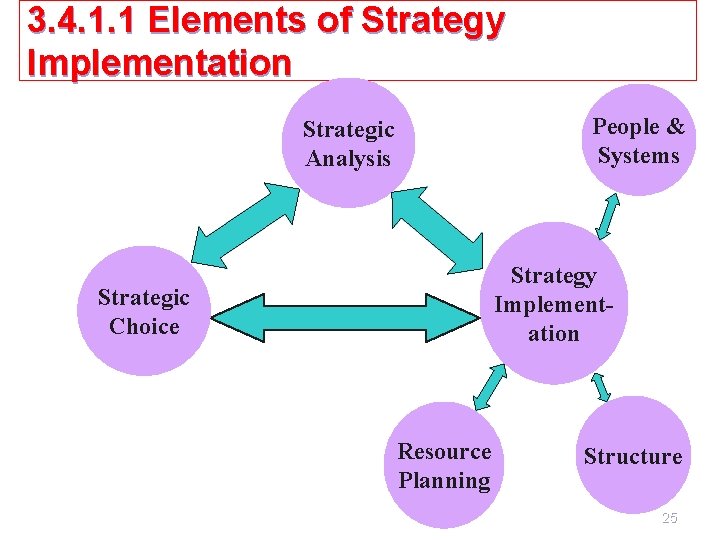
3. 4. 1 Introduction • Other views of strategic management do not distinguish strategy implementation and strategy planning – the two are inextricably linked • Assuming the two are separate, implementation will deal with: – Resources required – Organizational structure required – Systems and HR 24
3. 4. 1. 1 Elements of Strategy Implementation People & Systems Strategic Analysis Strategy Implementation Strategic Choice Resource Planning Structure 25
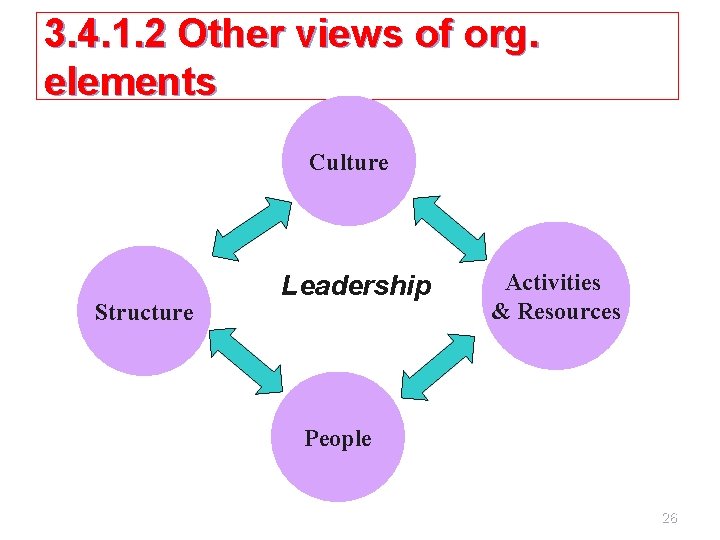
3. 4. 1. 2 Other views of org. elements Culture Structure Leadership Activities & Resources People 26
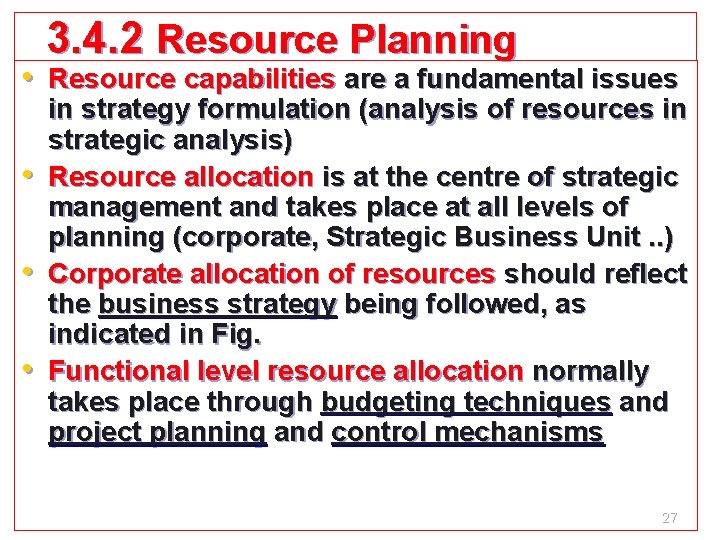
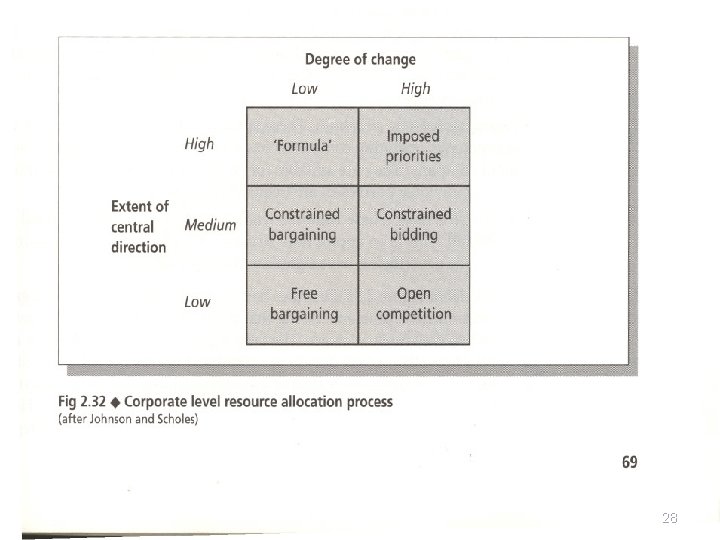
3. 4. 2 Resource Planning • Resource capabilities are a fundamental issues • • • in strategy formulation (analysis of resources in strategic analysis) Resource allocation is at the centre of strategic management and takes place at all levels of planning (corporate, Strategic Business Unit. . ) Corporate allocation of resources should reflect the business strategy being followed, as indicated in Fig. Functional level resource allocation normally takes place through budgeting techniques and project planning and control mechanisms 27
28
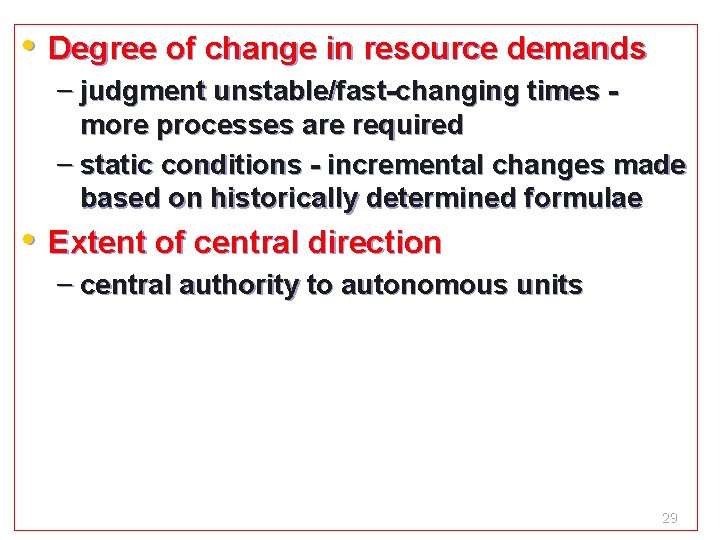
• Degree of change in resource demands – judgment unstable/fast-changing times more processes are required – static conditions - incremental changes made based on historically determined formulae • Extent of central direction – central authority to autonomous units 29
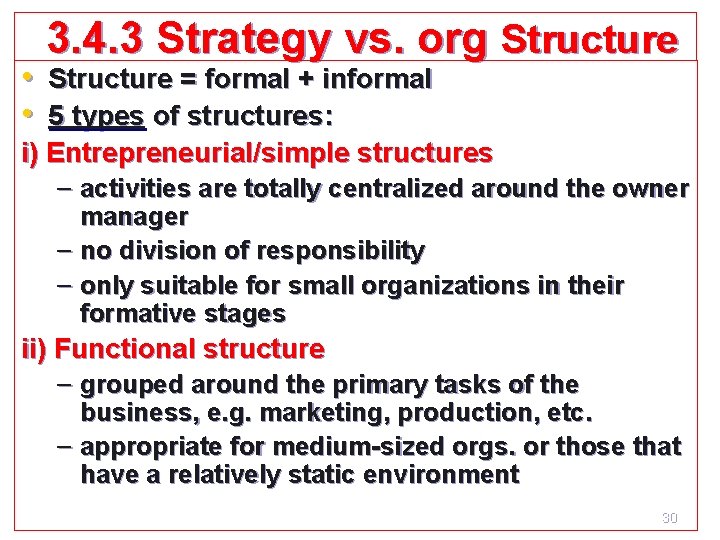
3. 4. 3 Strategy vs. org Structure • Structure = formal + informal • 5 types of structures: i) Entrepreneurial/simple structures – activities are totally centralized around the owner manager – no division of responsibility – only suitable for small organizations in their formative stages ii) Functional structure – grouped around the primary tasks of the business, e. g. marketing, production, etc. – appropriate for medium-sized orgs. or those that have a relatively static environment 30
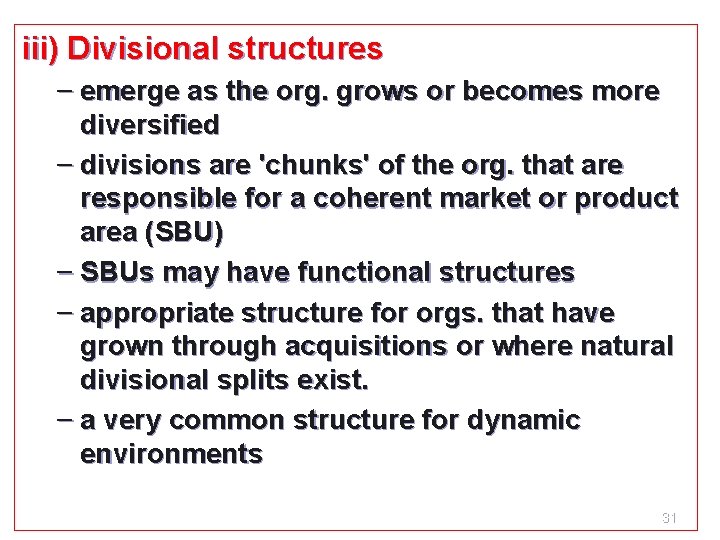
iii) Divisional structures – emerge as the org. grows or becomes more diversified – divisions are 'chunks' of the org. that are responsible for a coherent market or product area (SBU) – SBUs may have functional structures – appropriate structure for orgs. that have grown through acquisitions or where natural divisional splits exist. – a very common structure for dynamic environments 31
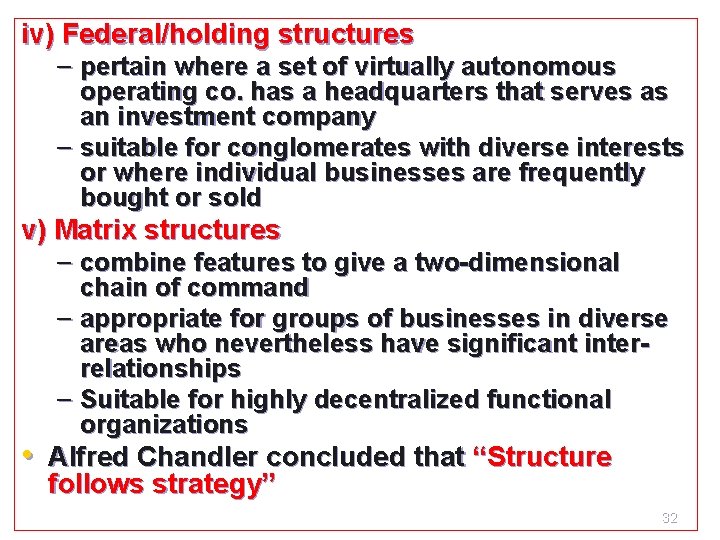
iv) Federal/holding structures – pertain where a set of virtually autonomous operating co. has a headquarters that serves as an investment company – suitable for conglomerates with diverse interests or where individual businesses are frequently bought or sold v) Matrix structures – combine features to give a two-dimensional chain of command – appropriate for groups of businesses in diverse areas who nevertheless have significant interrelationships – Suitable for highly decentralized functional organizations • Alfred Chandler concluded that “Structure follows strategy” 32
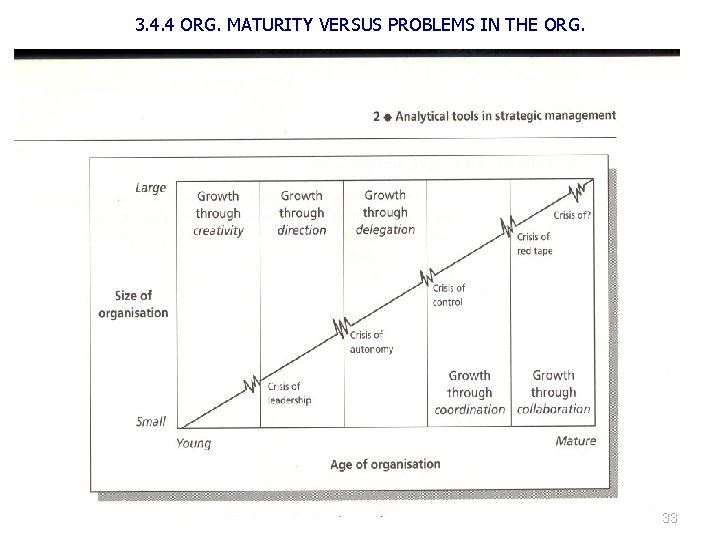
3. 4. 4 ORG. MATURITY VERSUS PROBLEMS IN THE ORG. 33
• Fig. shows how the stage of maturity may • determine the problems being faced & hence the parameters surrounding structure choice Selected structure must allow strategy integration at the centre and strategy differentiation at the periphery – Where there is a strong focus upon understanding the core competencies then structural decisions will be made in the light of how the structure will support those as well as the general issue of how structures add value • Hence strategy – structure relationship is twoway 34
• • Alfred Chandler concluded that “Structure follows strategy” However relationship is more complex: Strategy, structure & other orgnal. contexts have complex r/ships through human interactions/actions – i. e. contexts cannot be perceived independently of human action – These contexts have both enabling and constraining effects on human interactions and actions • Human interactions/actions have both intended and unintended consequences on organizational contexts • 35
3. 4. 5 People and Systems • If strategy is taken as a consistent pattern of resource decisions; that pattern happens through people operating within activity systems making resource decisions • To deal successfully with the people and systems aspects of any strategic implementation it is necessary to achieve a cultural change for the organizational acceptance of the 'new' information, control, regulatory, and political systems 36
• Control and feedback systems allow the org. to detect that the strategy is succeeding or failing and to take corrective actions in order to implement that strategy more successfully, or to modify the strategy itself • Control systems need to provide: – Effective monitoring of performance – Devolution of responsibilities to the appropriate level of the organization – Agreed performance targets – Highlights of both successful and unsuccessful outcomes 37
• Regulatory systems are those that assist in bringing about strategic change since they promote changes in individuals' behaviour, including: – Incentive and reward system of monetary rewards (e. g. bonuses) & non-monetary rewards (e. g. status enhancements) – Training schemes to ensure that the organization is able to implement the chosen strategy 38
• Management style or culture determines how these regulatory systems can be put into effect, just as it determines many other aspects of strategic management. Management style can be classified as: – Entrepreneurial or – Autocratic or – Mechanistic Conservative Democratic or Organic 39
• Successful strategy implementation • depends fundamentally upon the successful gaining of acceptance of the required behaviour changes Change may be achieved: – directly, by altering the attitudes, beliefs & values of individuals, or – indirectly, by changing the structure, goals or technology of the organisation • Read on Change management in more detail from the course text books. 40