Strategic Management Referring to models and theories in



- Slides: 40
Strategic Management
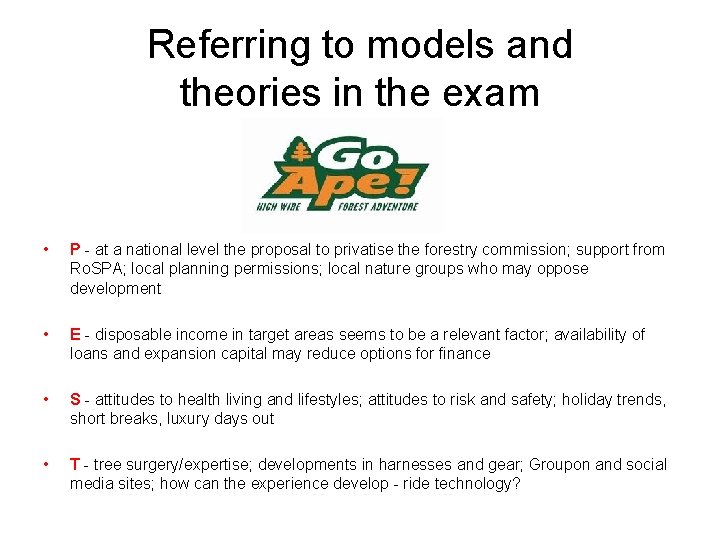
Referring to models and theories in the exam • P - at a national level the proposal to privatise the forestry commission; support from Ro. SPA; local planning permissions; local nature groups who may oppose development • E - disposable income in target areas seems to be a relevant factor; availability of loans and expansion capital may reduce options for finance • S - attitudes to health living and lifestyles; attitudes to risk and safety; holiday trends, short breaks, luxury days out • T - tree surgery/expertise; developments in harnesses and gear; Groupon and social media sites; how can the experience develop - ride technology?
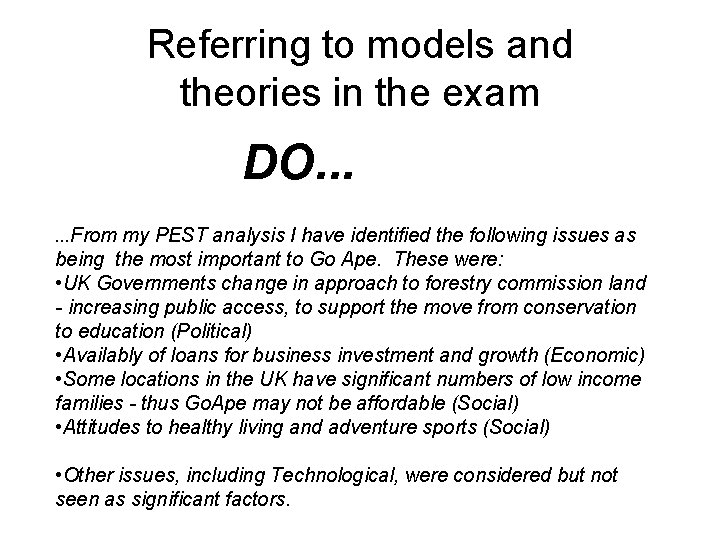
Referring to models and theories in the exam DO. . . From my PEST analysis I have identified the following issues as being the most important to Go Ape. These were: • UK Governments change in approach to forestry commission land - increasing public access, to support the move from conservation to education (Political) • Availably of loans for business investment and growth (Economic) • Some locations in the UK have significant numbers of low income families - thus Go. Ape may not be affordable (Social) • Attitudes to healthy living and adventure sports (Social) • Other issues, including Technological, were considered but not seen as significant factors.
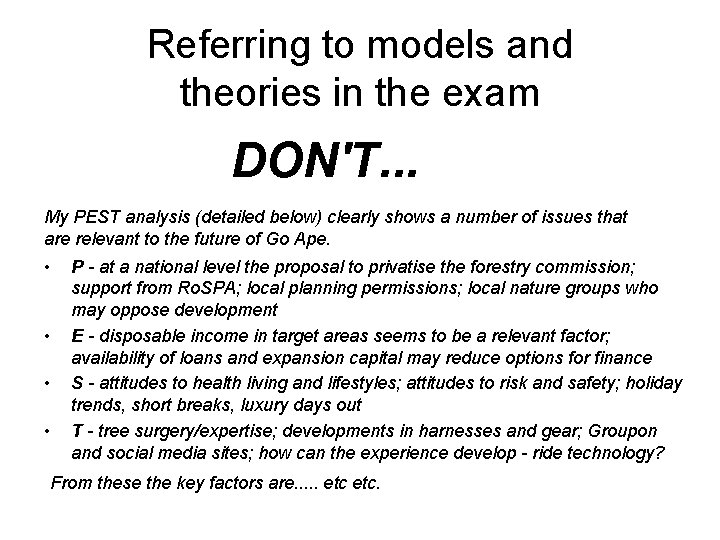
Referring to models and theories in the exam DON'T. . . My PEST analysis (detailed below) clearly shows a number of issues that are relevant to the future of Go Ape. • • P - at a national level the proposal to privatise the forestry commission; support from Ro. SPA; local planning permissions; local nature groups who may oppose development E - disposable income in target areas seems to be a relevant factor; availability of loans and expansion capital may reduce options for finance S - attitudes to health living and lifestyles; attitudes to risk and safety; holiday trends, short breaks, luxury days out T - tree surgery/expertise; developments in harnesses and gear; Groupon and social media sites; how can the experience develop - ride technology? From these the key factors are. . . etc.
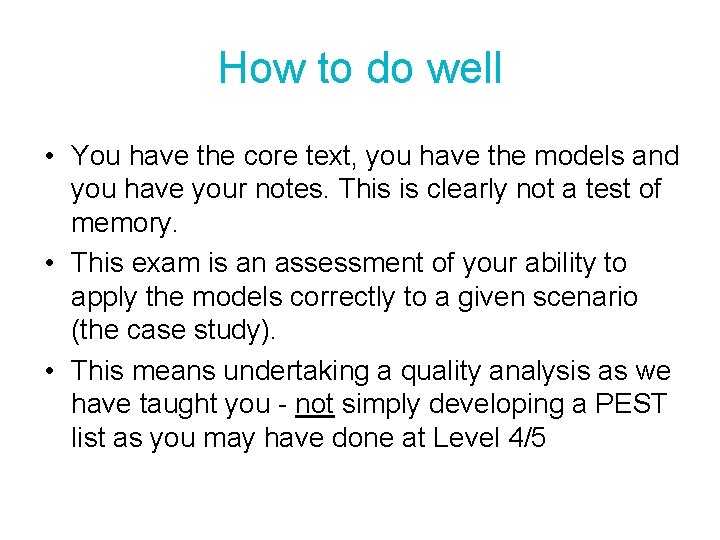
How to do well • You have the core text, you have the models and you have your notes. This is clearly not a test of memory. • This exam is an assessment of your ability to apply the models correctly to a given scenario (the case study). • This means undertaking a quality analysis as we have taught you - not simply developing a PEST list as you may have done at Level 4/5
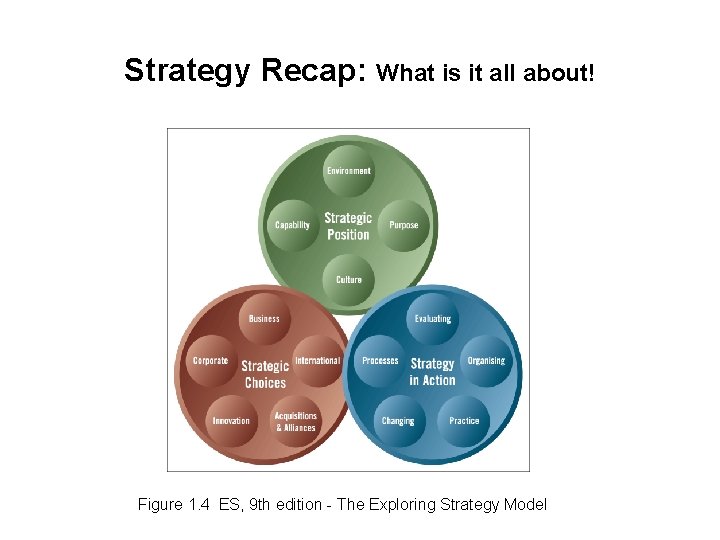
Strategy Recap: What is it all about! Figure 1. 4 ES, 9 th edition - The Exploring Strategy Model
Where do we start? - the environment • Research, finding out what on earth is going on – Primary, Secondary, internal, external • Making sense of the information – PESTEL, PEST - the value is in the significance not the length of the list. The value is in relating the factors to the organisation's environment as specifically as possible. – Porters 5 Forces, comparative industry structure analysis, strategic groups, critical success factors. Again the value is not in the list but in trying to make some sense of it all and applying it as specifically as possible to the organisation or the case. P. S. We KNOW you have looked at these at L 4 and L 5. It is the quality of your analysis that is important!
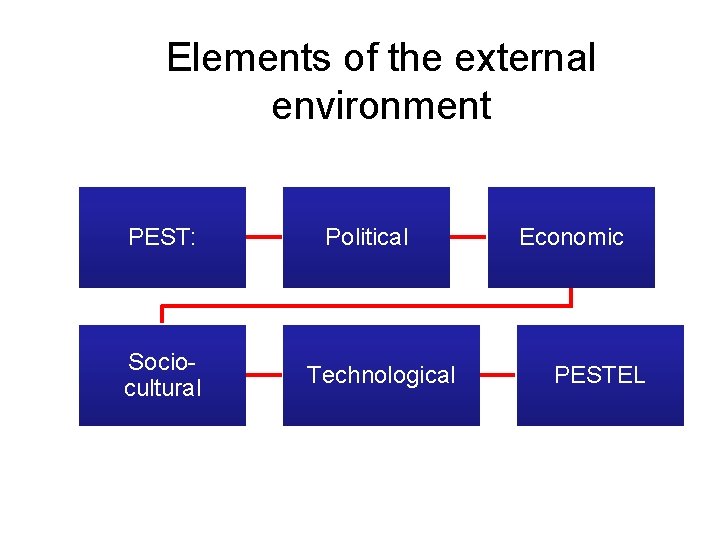
Elements of the external environment PEST: Sociocultural Political Technological Economic PESTEL
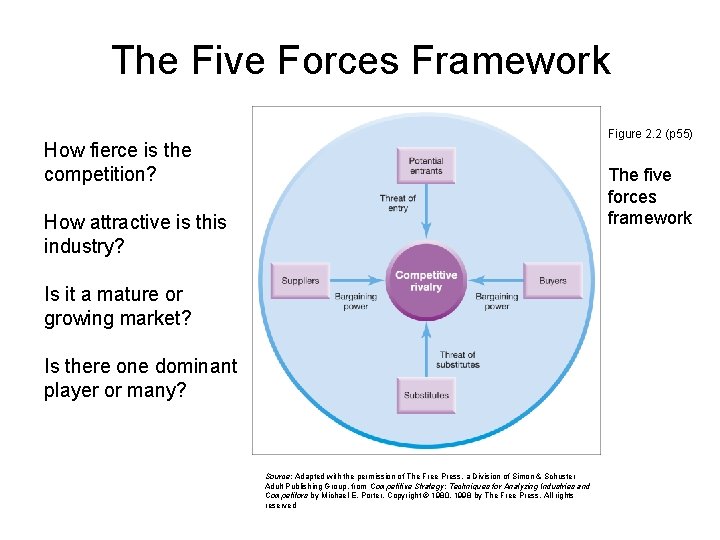
The Five Forces Framework Figure 2. 2 (p 55) How fierce is the competition? The five forces framework How attractive is this industry? Is it a mature or growing market? Is there one dominant player or many? Source: Adapted with the permission of The Free Press, a Division of Simon & Schuster Adult Publishing Group, from Competitive Strategy: Techniques for Analyzing Industries and Competitors by Michael E. Porter. Copyright © 1980, 1998 by The Free Press. All rights reserved
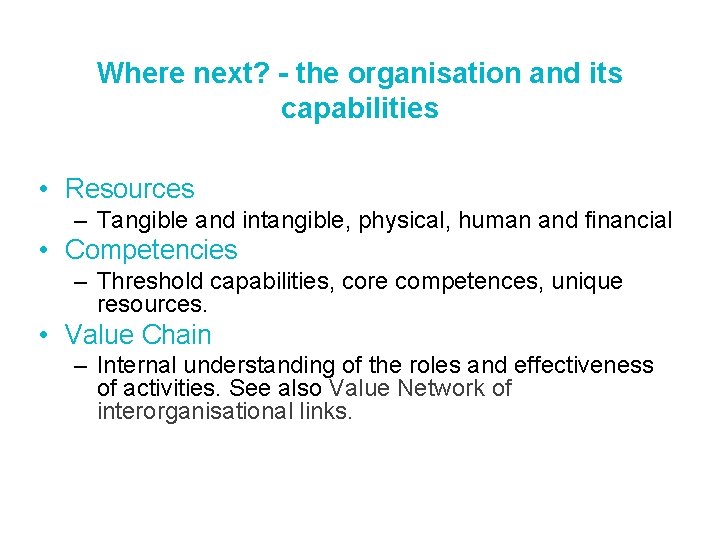
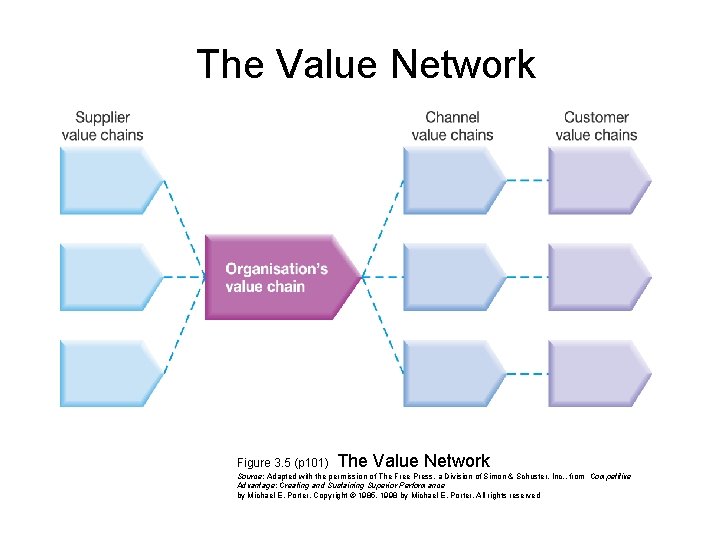
Where next? - the organisation and its capabilities • Resources – Tangible and intangible, physical, human and financial • Competencies – Threshold capabilities, core competences, unique resources. • Value Chain – Internal understanding of the roles and effectiveness of activities. See also Value Network of interorganisational links.
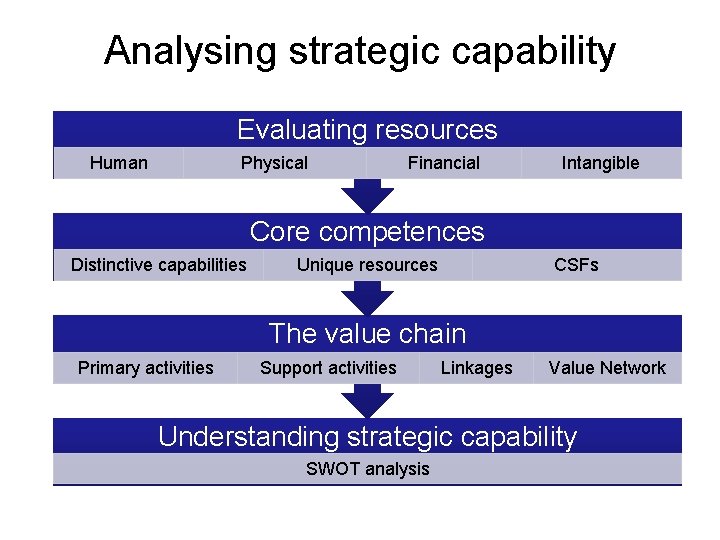
Analysing strategic capability Evaluating resources Human Physical Financial Intangible Core competences Distinctive capabilities Unique resources CSFs The value chain Primary activities Support activities Linkages Value Network Understanding strategic capability SWOT analysis
Components of strategic capabilities (don't forget intangible) Table 3. 1 (p 85) Components of strategic capabilities
Threshold and distinctive capabilities Threshold capabilities • are those needed for an organisation to meet the necessary requirements to compete in a given market and achieve parity with competitors in that market – ‘qualifiers’. Distinctive capabilities • are those that critically underpin competitive advantage and that others cannot imitate or obtain – ‘winners’.
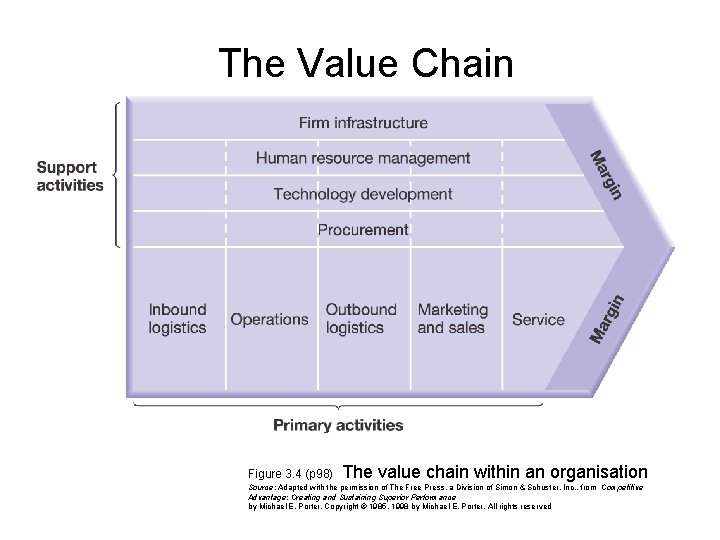
The Value Chain Figure 3. 4 (p 98) The value chain within an organisation Source: Adapted with the permission of The Free Press, a Division of Simon & Schuster, Inc. , from Competitive Advantage: Creating and Sustaining Superior Performance by Michael E. Porter. Copyright © 1985, 1998 by Michael E. Porter. All rights reserved
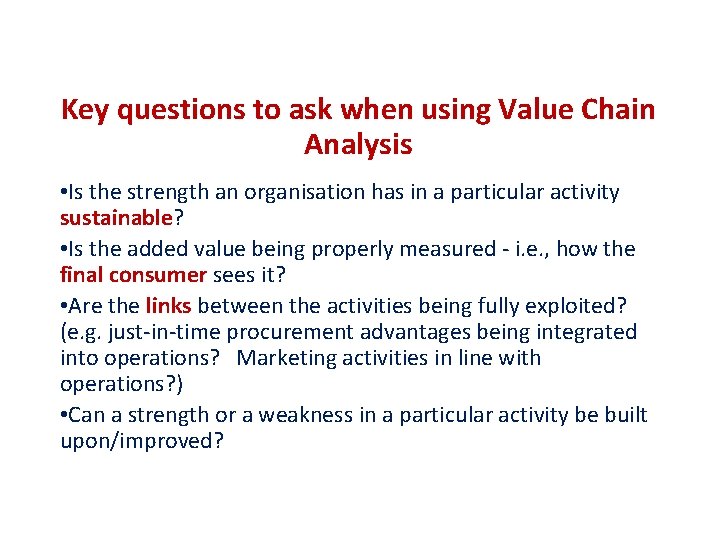
Key questions to ask when using Value Chain Analysis • Is the strength an organisation has in a particular activity sustainable? • Is the added value being properly measured - i. e. , how the final consumer sees it? • Are the links between the activities being fully exploited? (e. g. just-in-time procurement advantages being integrated into operations? Marketing activities in line with operations? ) • Can a strength or a weakness in a particular activity be built upon/improved?
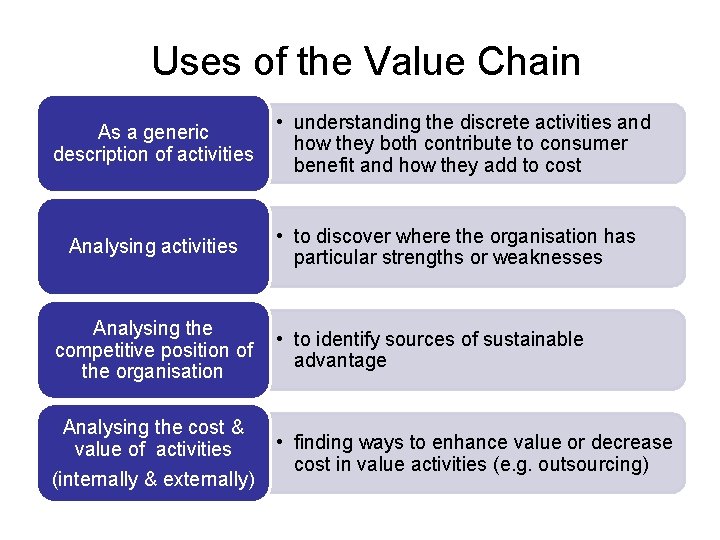
Uses of the Value Chain As a generic description of activities Analysing activities • understanding the discrete activities and how they both contribute to consumer benefit and how they add to cost • to discover where the organisation has particular strengths or weaknesses Analysing the • to identify sources of sustainable competitive position of advantage the organisation Analysing the cost & value of activities (internally & externally) • finding ways to enhance value or decrease cost in value activities (e. g. outsourcing)
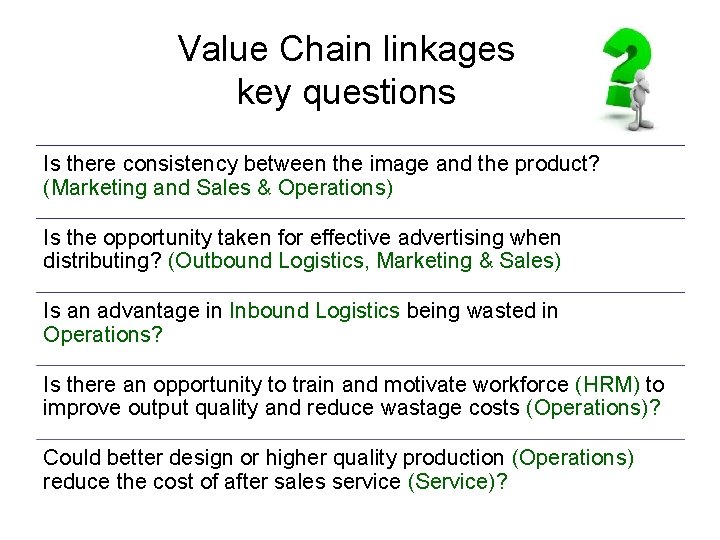
Value Chain linkages key questions Is there consistency between the image and the product? (Marketing and Sales & Operations) Is the opportunity taken for effective advertising when distributing? (Outbound Logistics, Marketing & Sales) Is an advantage in Inbound Logistics being wasted in Operations? Is there an opportunity to train and motivate workforce (HRM) to improve output quality and reduce wastage costs (Operations)? Could better design or higher quality production (Operations) reduce the cost of after sales service (Service)?
The Value Network Figure 3. 5 (p 101) The Value Network Source: Adapted with the permission of The Free Press, a Division of Simon & Schuster, Inc. , from Competitive Advantage: Creating and Sustaining Superior Performance by Michael E. Porter. Copyright © 1985, 1998 by Michael E. Porter. All rights reserved
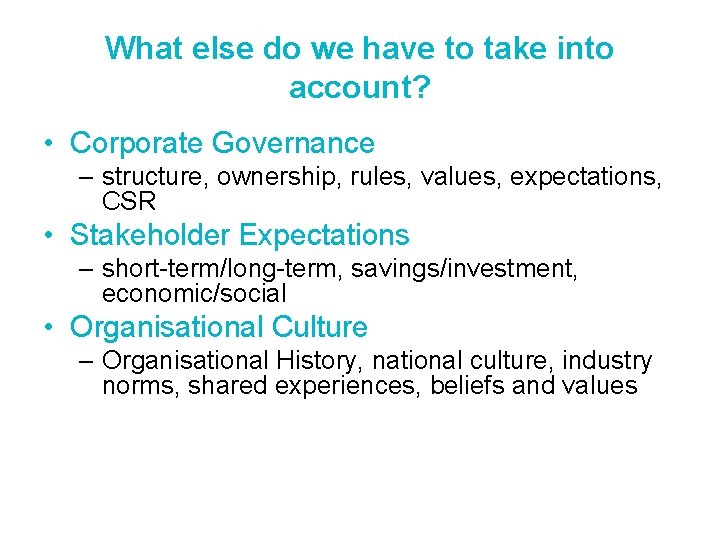
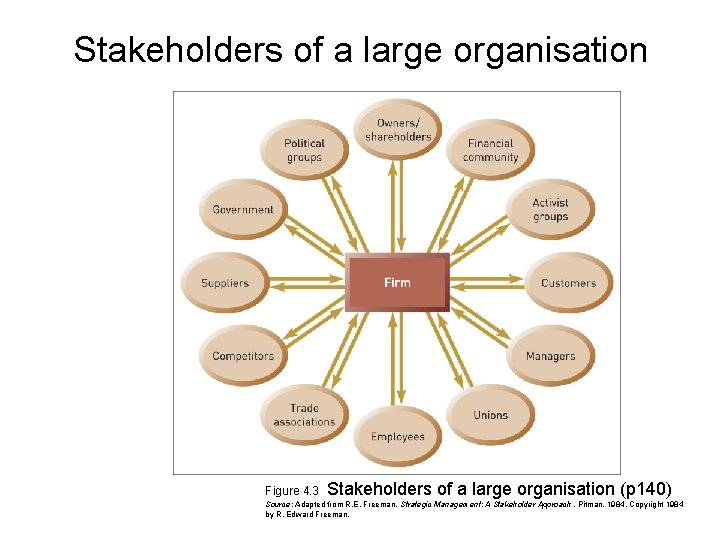
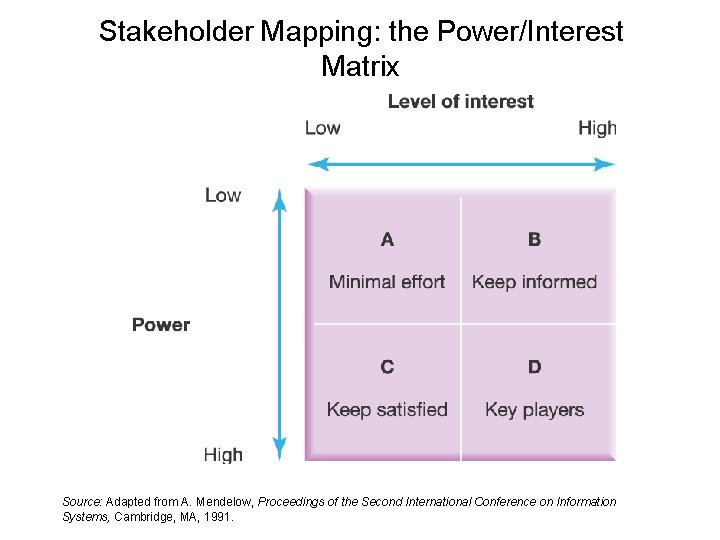
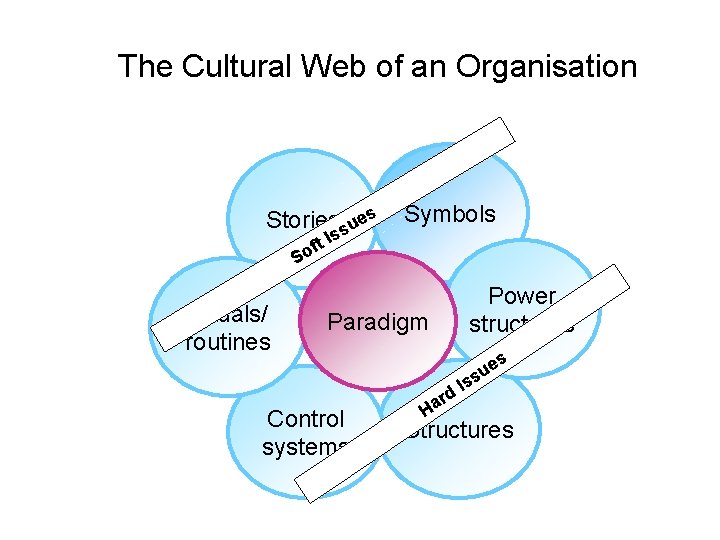
What else do we have to take into account? • Corporate Governance – structure, ownership, rules, values, expectations, CSR • Stakeholder Expectations – short-term/long-term, savings/investment, economic/social • Organisational Culture – Organisational History, national culture, industry norms, shared experiences, beliefs and values
Stakeholders of a large organisation Figure 4. 3 Stakeholders of a large organisation (p 140) Source: Adapted from R. E. Freeman, Strategic Management: A Stakeholder Approach , Pitman, 1984. Copyright 1984 by R. Edward Freeman.
Stakeholder Mapping: the Power/Interest Matrix Source: Adapted from A. Mendelow, Proceedings of the Second International Conference on Information Systems, Cambridge, MA, 1991.
The Cultural Web of an Organisation Stories sues s S Rituals/ routines Symbols I oft Power structures Paradigm es u s s Control systems d. I r a H Structures
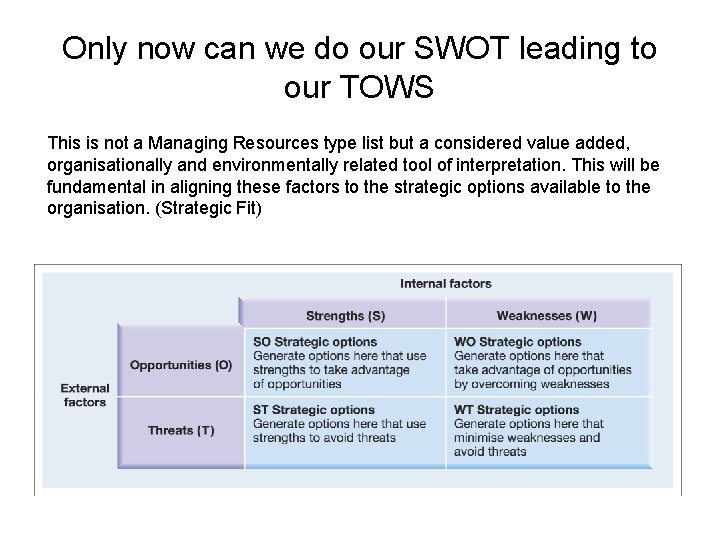
Only now can we do our SWOT leading to our TOWS This is not a Managing Resources type list but a considered value added, organisationally and environmentally related tool of interpretation. This will be fundamental in aligning these factors to the strategic options available to the organisation. (Strategic Fit)
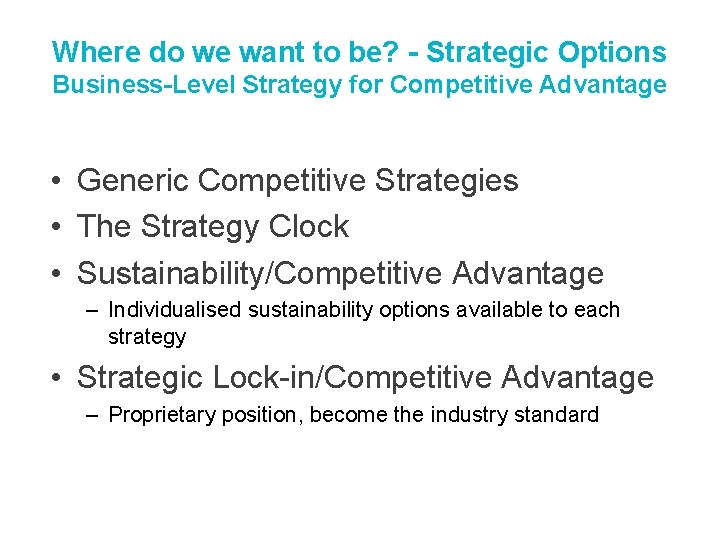
Where do we want to be? - Strategic Options Business-Level Strategy for Competitive Advantage • Generic Competitive Strategies • The Strategy Clock • Sustainability/Competitive Advantage – Individualised sustainability options available to each strategy • Strategic Lock-in/Competitive Advantage – Proprietary position, become the industry standard
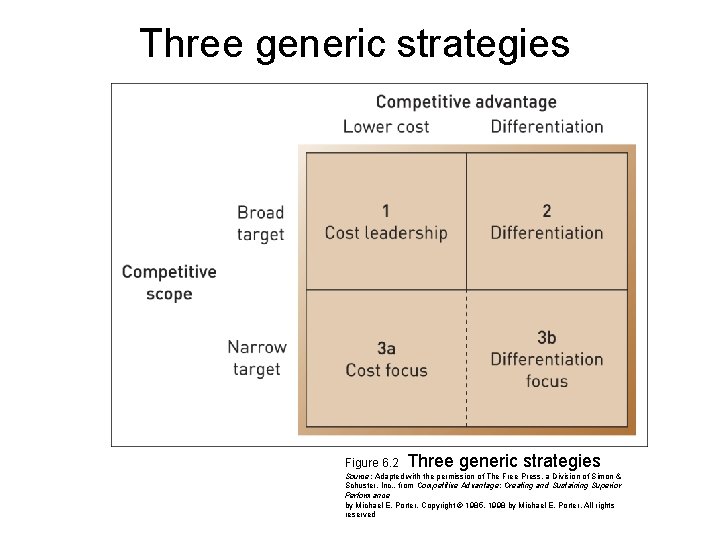
Three generic strategies Figure 6. 2 Three generic strategies Source: Adapted with the permission of The Free Press, a Division of Simon & Schuster, Inc. , from Competitive Advantage: Creating and Sustaining Superior Performance by Michael E. Porter. Copyright © 1985, 1998 by Michael E. Porter. All rights reserved
Strategy clock Figure 6. 6 The Strategy Clock Source: Adapted from D. Faulkner and C. Bowman, The Essence of Competitive Strategy, Prentice Hall, 1995
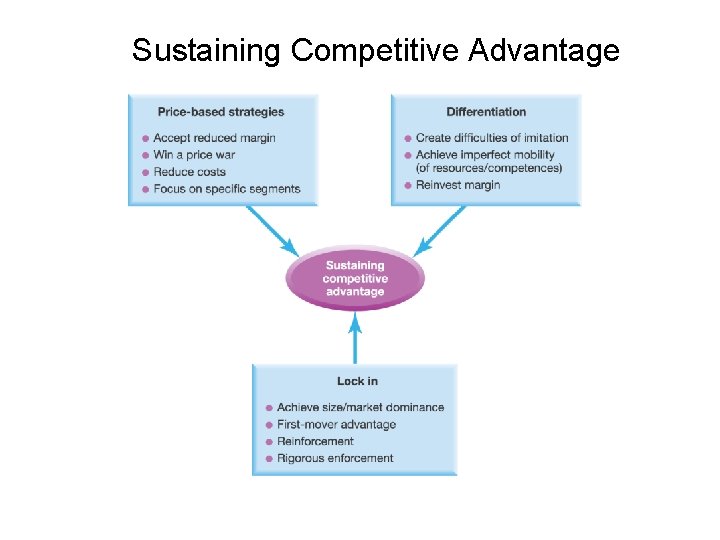
Sustaining Competitive Advantage
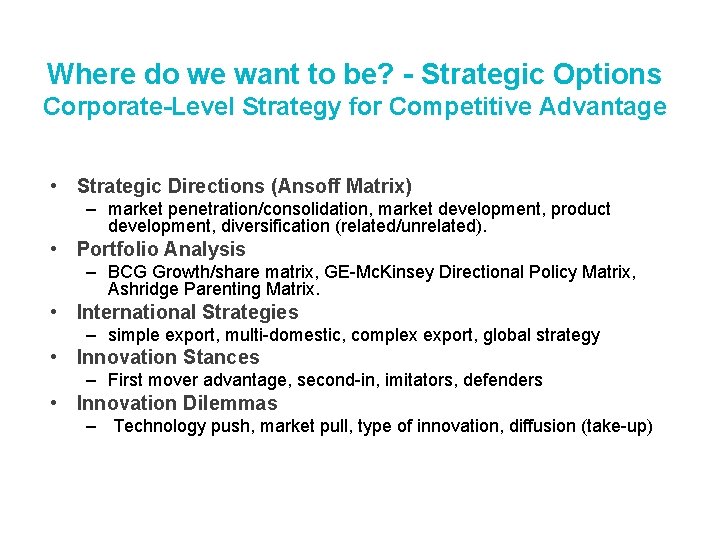
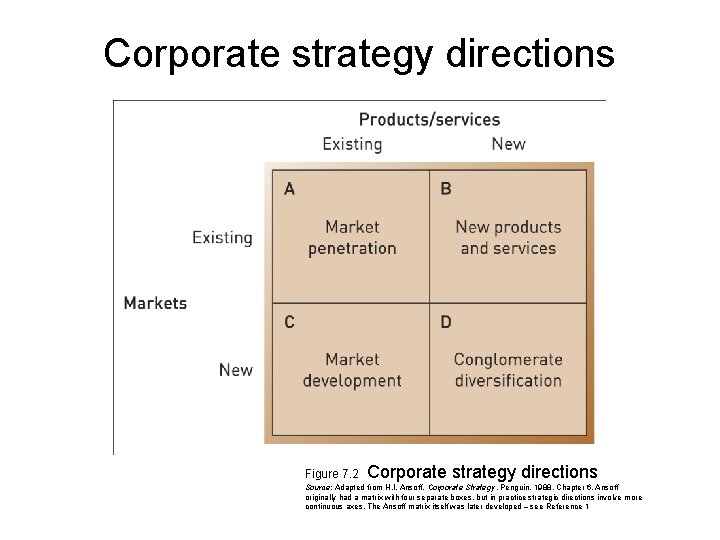
Where do we want to be? - Strategic Options Corporate-Level Strategy for Competitive Advantage • Strategic Directions (Ansoff Matrix) – market penetration/consolidation, market development, product development, diversification (related/unrelated). • Portfolio Analysis – BCG Growth/share matrix, GE-Mc. Kinsey Directional Policy Matrix, Ashridge Parenting Matrix. • International Strategies – simple export, multi-domestic, complex export, global strategy • Innovation Stances – First mover advantage, second-in, imitators, defenders • Innovation Dilemmas – Technology push, market pull, type of innovation, diffusion (take-up)
Corporate strategy directions Figure 7. 2 Corporate strategy directions Source: Adapted from H. I. Ansoff, Corporate Strategy, Penguin, 1988, Chapter 6. Ansoff originally had a matrix with four separate boxes, but in practice strategic directions involve more continuous axes. The Ansoff matrix itself was later developed – see Reference 1
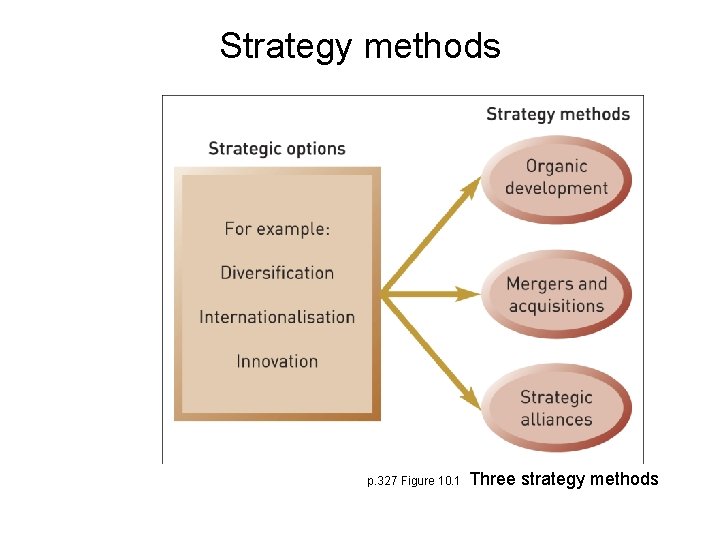
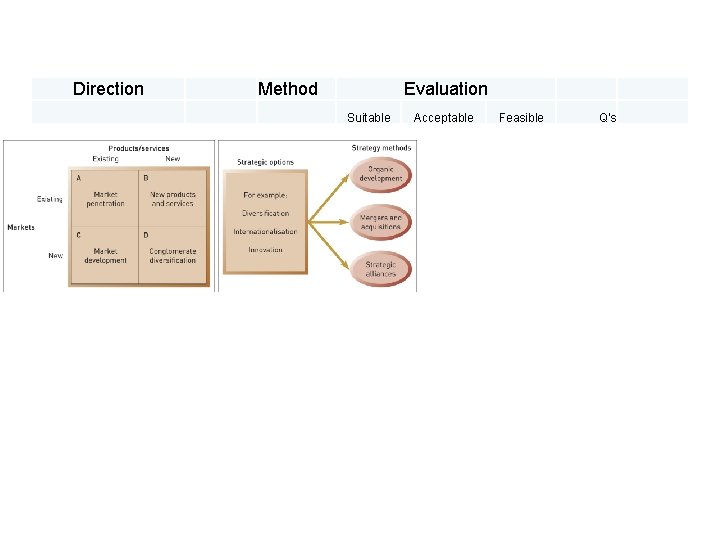
Strategy methods p. 327 Figure 10. 1 Three strategy methods
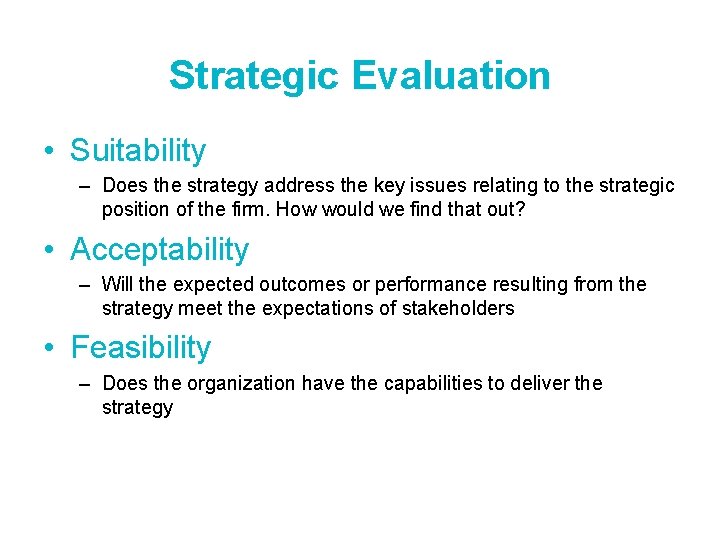
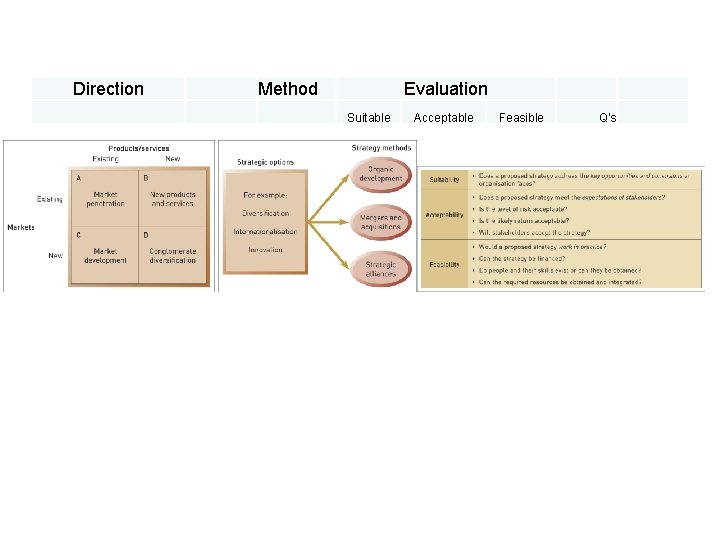
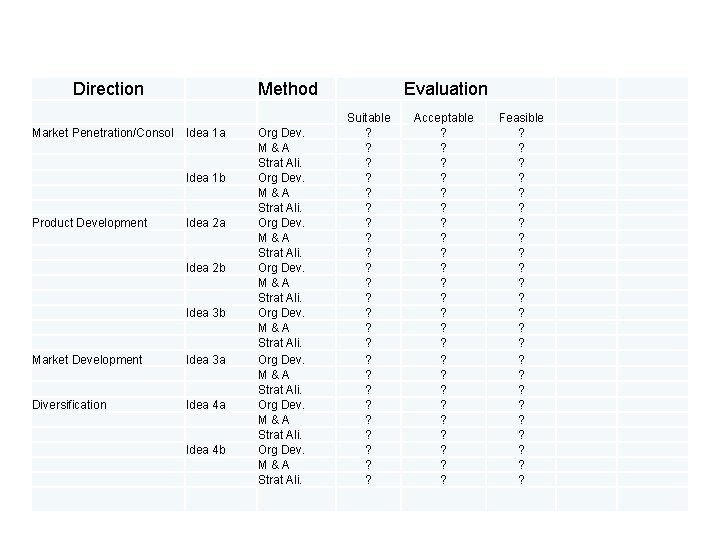
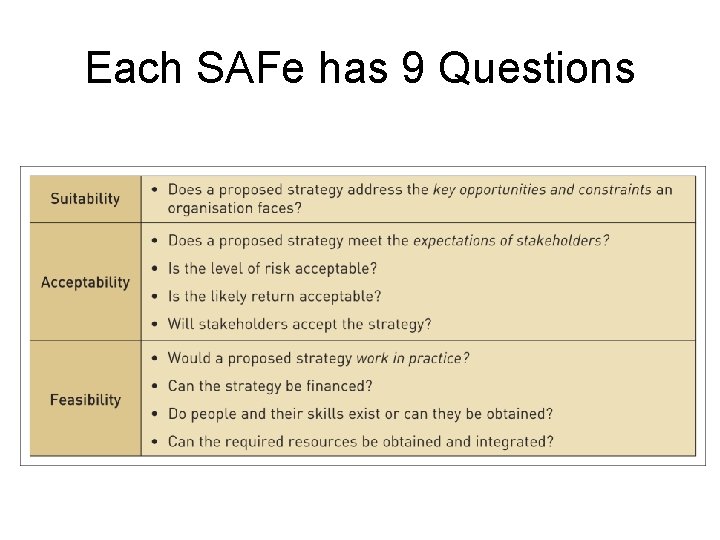
Strategic Evaluation • Suitability – Does the strategy address the key issues relating to the strategic position of the firm. How would we find that out? • Acceptability – Will the expected outcomes or performance resulting from the strategy meet the expectations of stakeholders • Feasibility – Does the organization have the capabilities to deliver the strategy
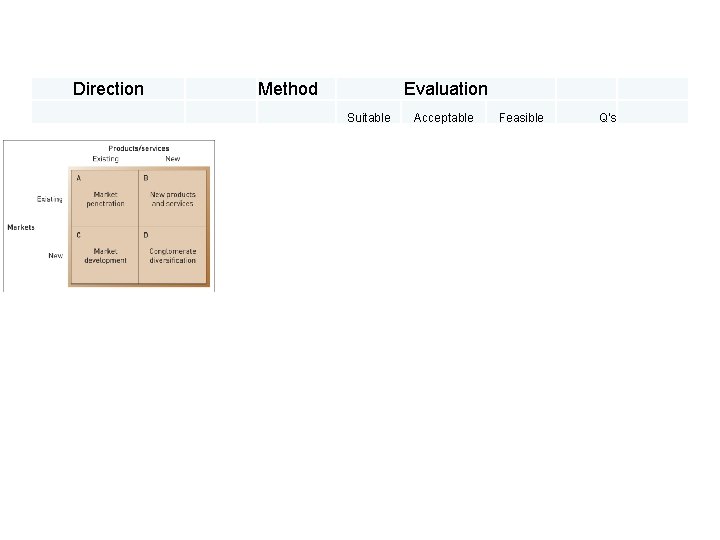
Direction Method Evaluation Suitable Acceptable Feasible Q's
Direction Method Evaluation Suitable Acceptable Feasible Q's
Direction Method Evaluation Suitable Acceptable Feasible Q's
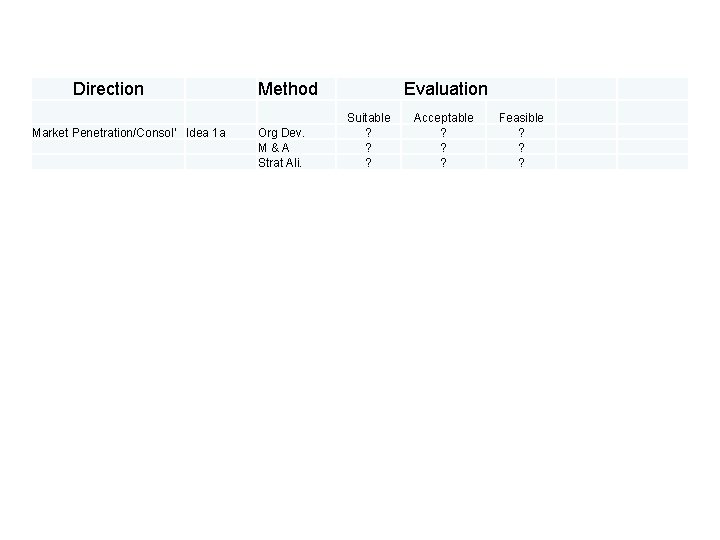
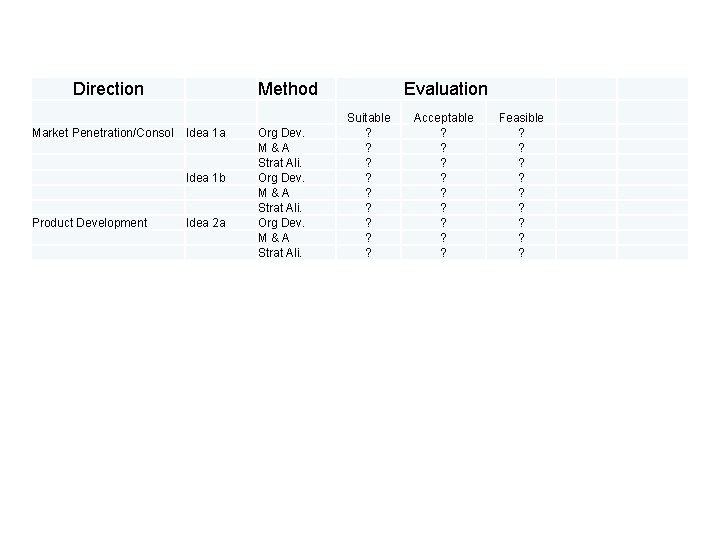
Direction Market Penetration/Consol' Idea 1 a Method Org Dev. M & A Strat Ali. Evaluation Suitable ? ? ? Acceptable ? ? ? Feasible ? ? ?
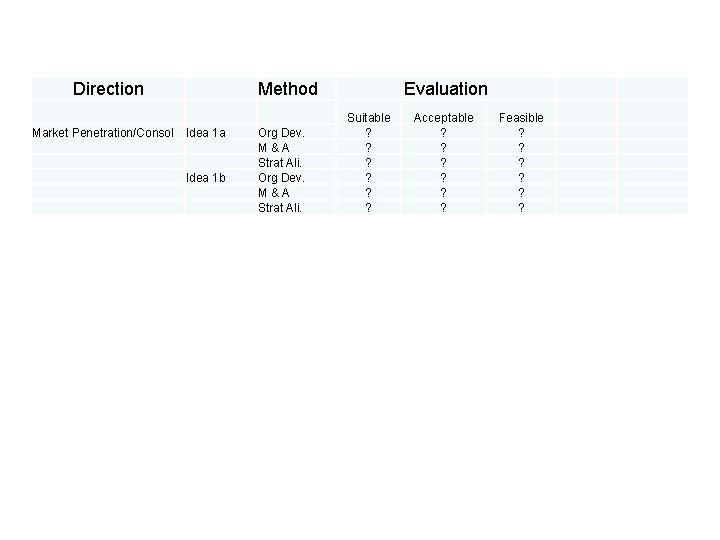
Direction Market Penetration/Consol Idea 1 a Idea 1 b Method Org Dev. M & A Strat Ali. Evaluation Suitable ? ? ? Acceptable ? ? ? Feasible ? ? ?
Direction Market Penetration/Consol Product Development Idea 1 a Idea 1 b Idea 2 a Method Org Dev. M & A Strat Ali. Evaluation Suitable ? ? ? ? ? Acceptable ? ? ? ? ? Feasible ? ? ? ? ?
Direction Method Market Penetration/Consol Product Development Market Development Diversification Idea 1 a Idea 1 b Idea 2 a Idea 2 b Idea 3 a Idea 4 b Org Dev. M & A Strat Ali. Evaluation Suitable ? ? ? ? ? ? Acceptable ? ? ? ? ? ? Feasible ? ? ? ? ? ?
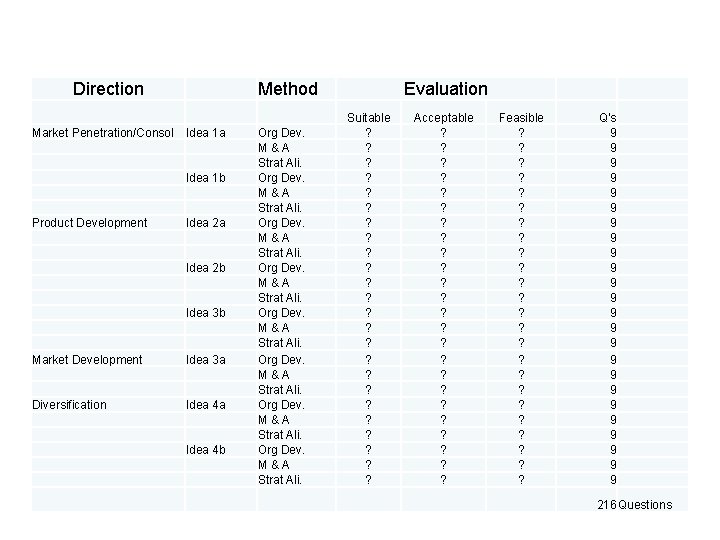
Each SAFe has 9 Questions
Direction Method Market Penetration/Consol Product Development Market Development Diversification Idea 1 a Idea 1 b Idea 2 a Idea 2 b Idea 3 a Idea 4 b Org Dev. M & A Strat Ali. Evaluation Suitable ? ? ? ? ? ? Acceptable ? ? ? ? ? ? Feasible ? ? ? ? ? ? Q's 9 9 9 9 9 9 216 Questions