Status of HF PMT Simulation Anthony Moeller Taylan
- Slides: 21
Status of HF PMT Simulation Anthony Moeller, Taylan Yetkin University of Iowa S. Banerjee FNAL S. Kunori U. of Maryland 10/29/09 1
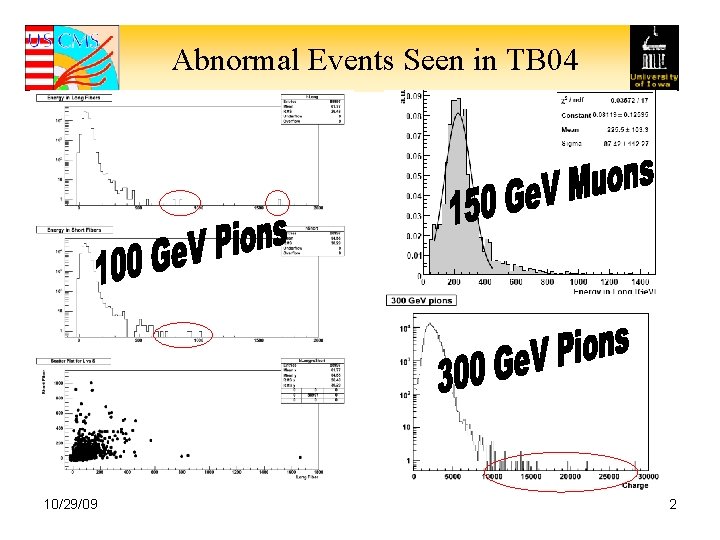
Abnormal Events Seen in TB 04 10/29/09 2
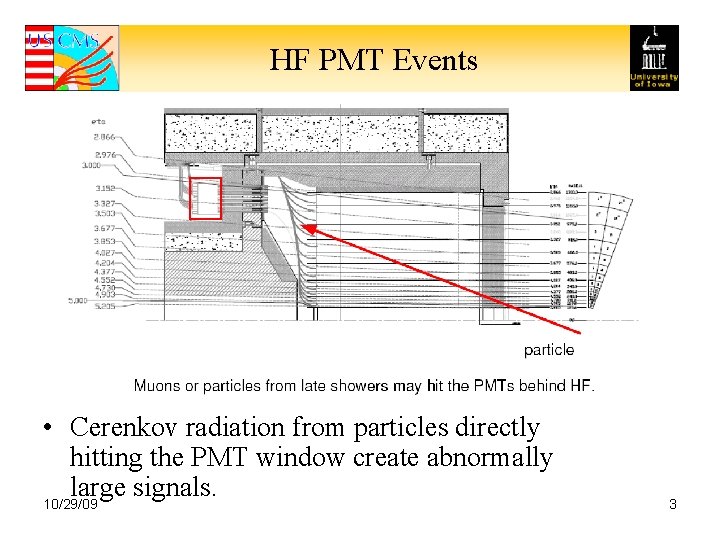
HF PMT Events • Cerenkov radiation from particles directly hitting the PMT window create abnormally large signals. 10/29/09 3
Overall Status and Plan • HF PMT Simulation updated to CMSSW_3_2_4 – – – Parameterization for body of HF (not full HF simulation) PMTs are included. PMT hits exist for muons and pions, but not electrons. Digitization and Reconstruction appear to work properly. Timing results look like what we expect. Looked at two simple methods to discriminate PMT hits: • Timing based, L and S fiber energy ratio based – Still need to add simple Pythia jets that were in the CMSSW_2_1_10 version. • In progress, will show a few old jet results from CMSSW_2_10. 10/29/09 4
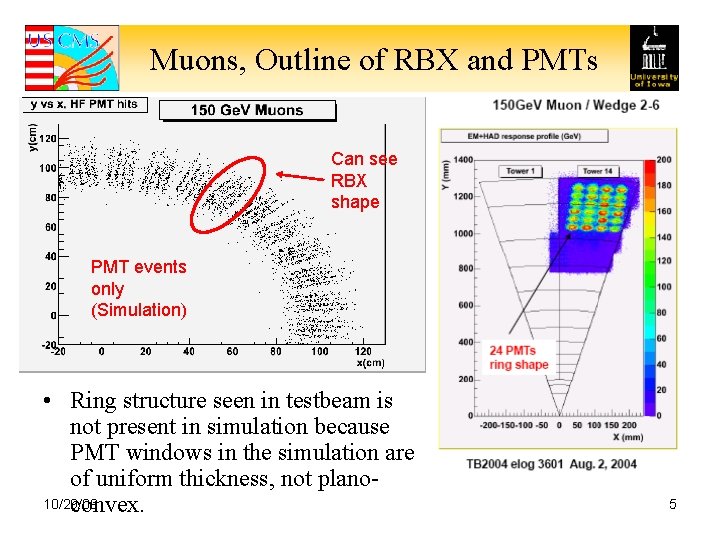
Muons, Outline of RBX and PMTs Can see RBX shape PMT events only (Simulation) • Ring structure seen in testbeam is not present in simulation because PMT windows in the simulation are of uniform thickness, not plano 10/29/09 convex. 5
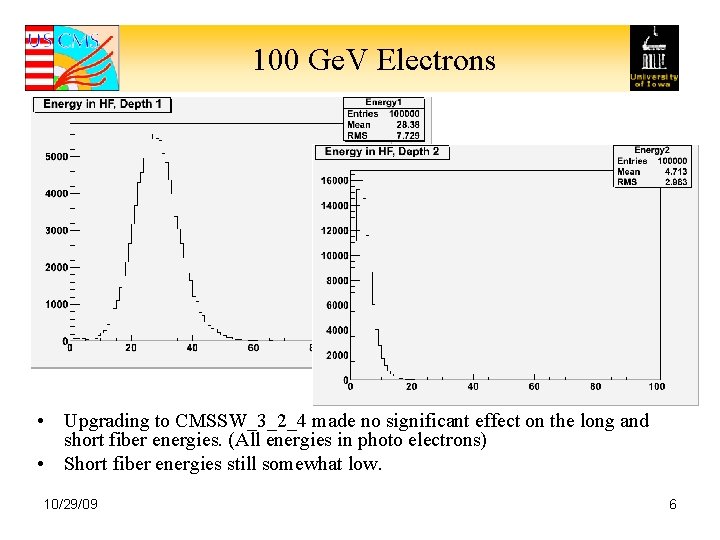
100 Ge. V Electrons • Upgrading to CMSSW_3_2_4 made no significant effect on the long and short fiber energies. (All energies in photo electrons) • Short fiber energies still somewhat low. 10/29/09 6
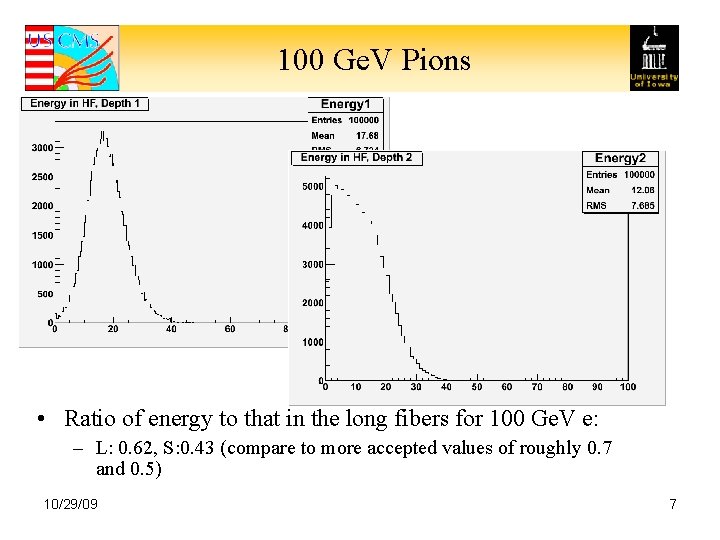
100 Ge. V Pions • Ratio of energy to that in the long fibers for 100 Ge. V e: – L: 0. 62, S: 0. 43 (compare to more accepted values of roughly 0. 7 and 0. 5) 10/29/09 7
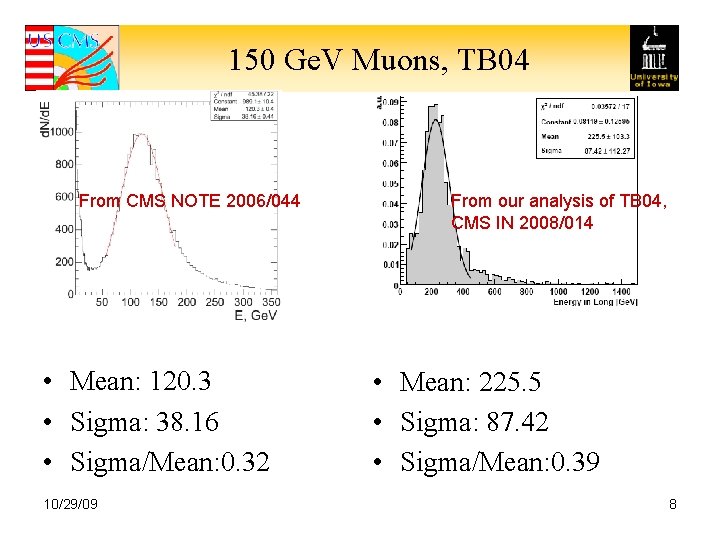
150 Ge. V Muons, TB 04 From CMS NOTE 2006/044 • Mean: 120. 3 • Sigma: 38. 16 • Sigma/Mean: 0. 32 10/29/09 From our analysis of TB 04, CMS IN 2008/014 • Mean: 225. 5 • Sigma: 87. 42 • Sigma/Mean: 0. 39 8
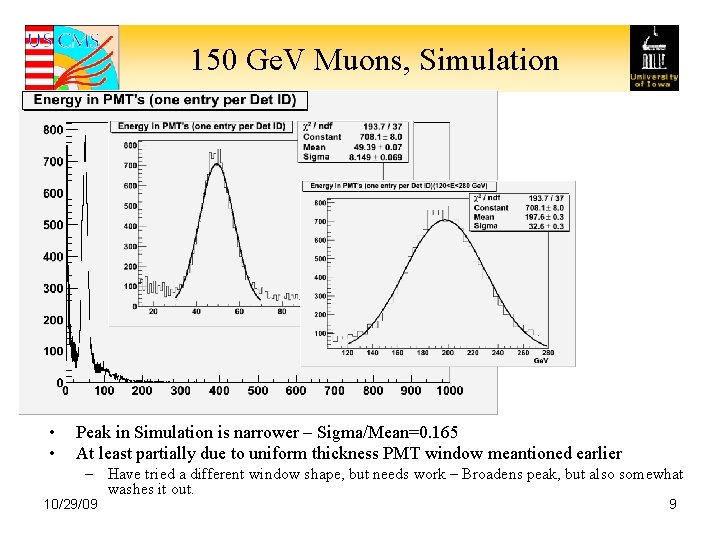
150 Ge. V Muons, Simulation • • Peak in Simulation is narrower – Sigma/Mean=0. 165 At least partially due to uniform thickness PMT window meantioned earlier – Have tried a different window shape, but needs work – Broadens peak, but also somewhat washes it out. 10/29/09 9
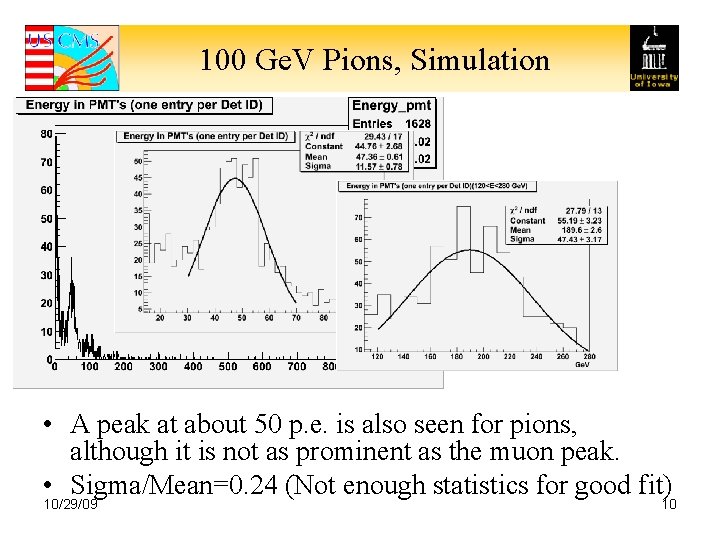
100 Ge. V Pions, Simulation • A peak at about 50 p. e. is also seen for pions, although it is not as prominent as the muon peak. • Sigma/Mean=0. 24 (Not enough statistics for good fit) 10/29/09 10
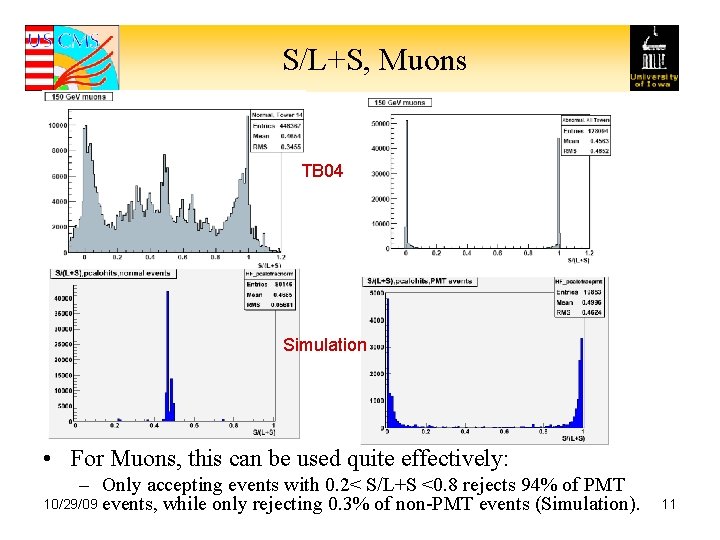
S/L+S, Muons TB 04 Simulation • For Muons, this can be used quite effectively: – Only accepting events with 0. 2< S/L+S <0. 8 rejects 94% of PMT 10/29/09 events, while only rejecting 0. 3% of non-PMT events (Simulation). 11
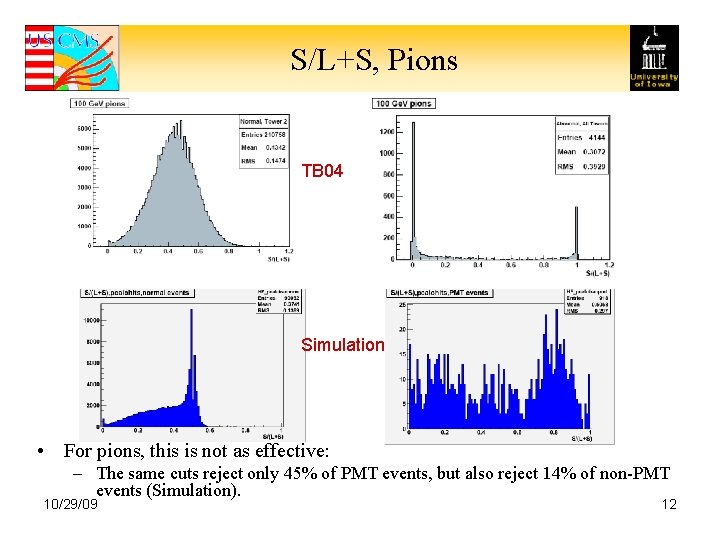
S/L+S, Pions TB 04 Simulation • For pions, this is not as effective: – The same cuts reject only 45% of PMT events, but also reject 14% of non-PMT events (Simulation). 10/29/09 12
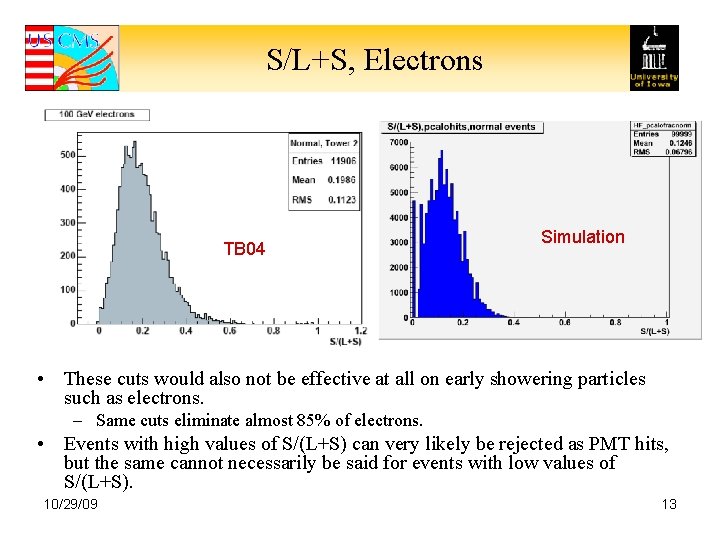
S/L+S, Electrons TB 04 Simulation • These cuts would also not be effective at all on early showering particles such as electrons. – Same cuts eliminate almost 85% of electrons. • Events with high values of S/(L+S) can very likely be rejected as PMT hits, but the same cannot necessarily be said for events with low values of S/(L+S). 10/29/09 13
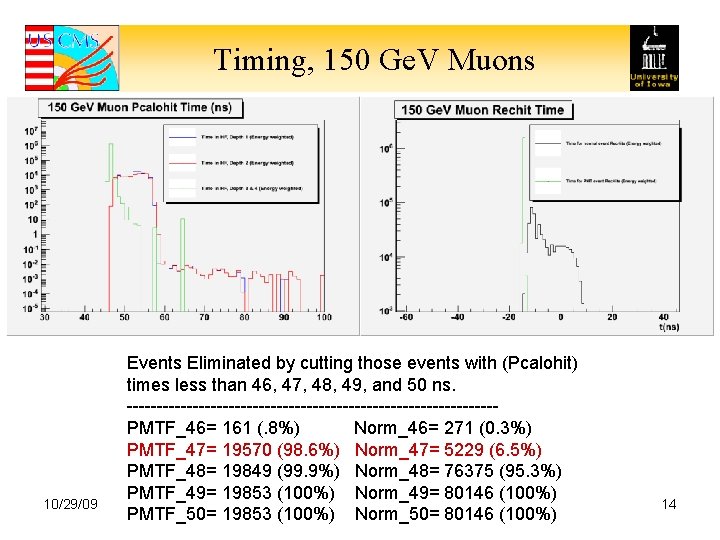
Timing, 150 Ge. V Muons 10/29/09 Events Eliminated by cutting those events with (Pcalohit) times less than 46, 47, 48, 49, and 50 ns. -------------------------------PMTF_46= 161 (. 8%) Norm_46= 271 (0. 3%) PMTF_47= 19570 (98. 6%) Norm_47= 5229 (6. 5%) PMTF_48= 19849 (99. 9%) Norm_48= 76375 (95. 3%) PMTF_49= 19853 (100%) Norm_49= 80146 (100%) PMTF_50= 19853 (100%) Norm_50= 80146 (100%) 14
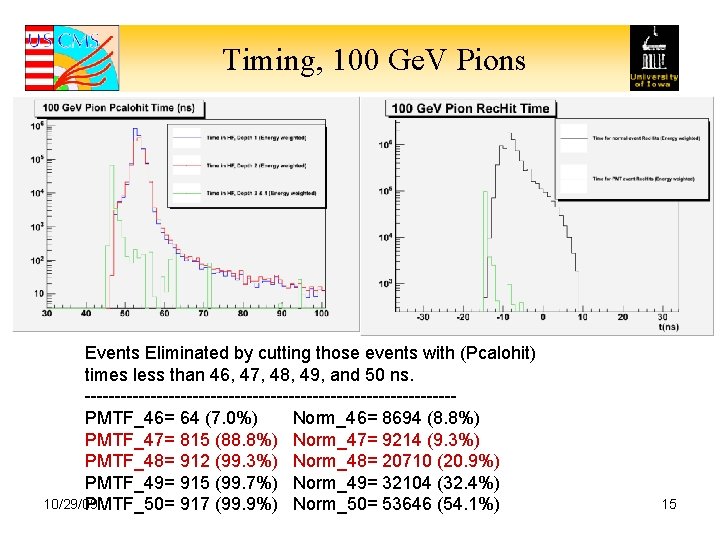
Timing, 100 Ge. V Pions Events Eliminated by cutting those events with (Pcalohit) times less than 46, 47, 48, 49, and 50 ns. -------------------------------PMTF_46= 64 (7. 0%) Norm_46= 8694 (8. 8%) PMTF_47= 815 (88. 8%) Norm_47= 9214 (9. 3%) PMTF_48= 912 (99. 3%) Norm_48= 20710 (20. 9%) PMTF_49= 915 (99. 7%) Norm_49= 32104 (32. 4%) 10/29/09 PMTF_50= 917 (99. 9%) Norm_50= 53646 (54. 1%) 15
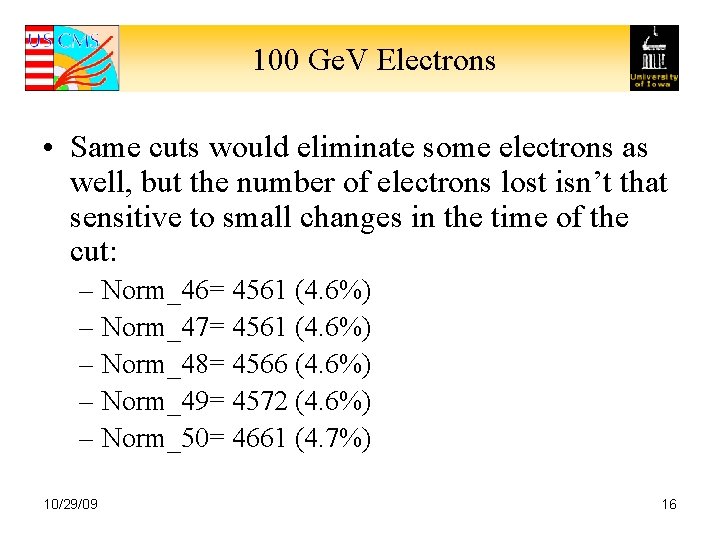
100 Ge. V Electrons • Same cuts would eliminate some electrons as well, but the number of electrons lost isn’t that sensitive to small changes in the time of the cut: – Norm_46= 4561 (4. 6%) – Norm_47= 4561 (4. 6%) – Norm_48= 4566 (4. 6%) – Norm_49= 4572 (4. 6%) – Norm_50= 4661 (4. 7%) 10/29/09 16
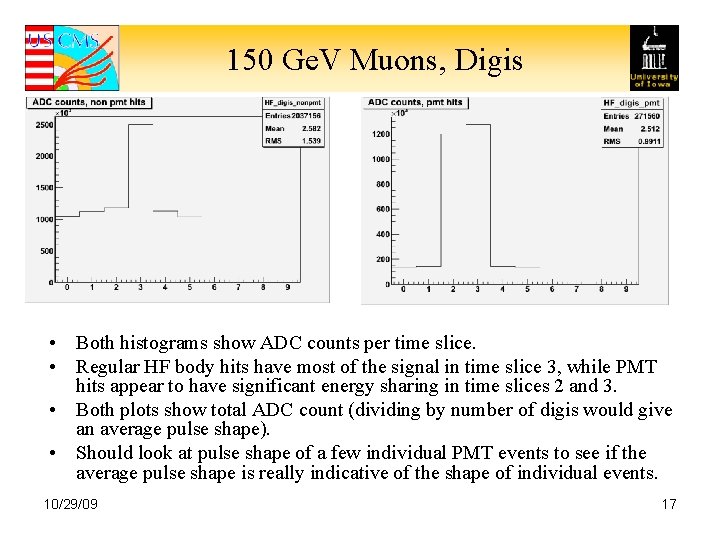
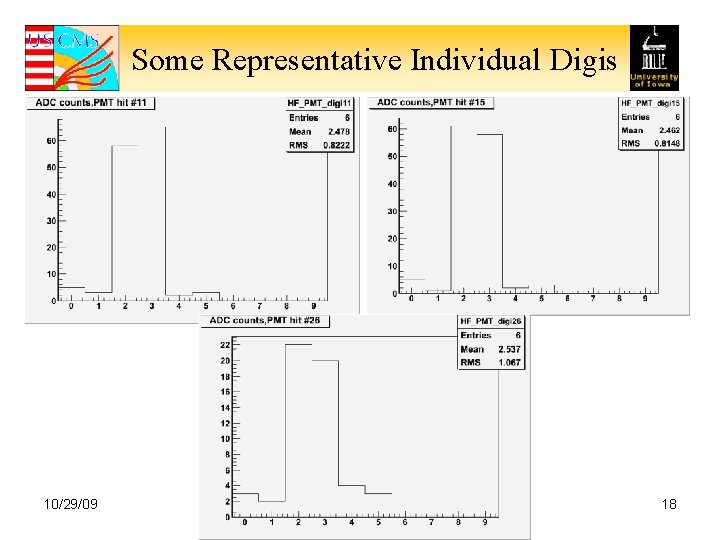
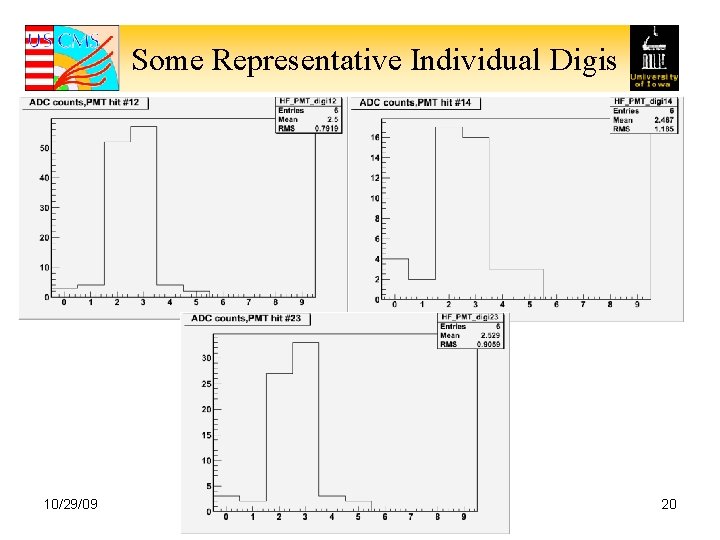
150 Ge. V Muons, Digis • Both histograms show ADC counts per time slice. • Regular HF body hits have most of the signal in time slice 3, while PMT hits appear to have significant energy sharing in time slices 2 and 3. • Both plots show total ADC count (dividing by number of digis would give an average pulse shape). • Should look at pulse shape of a few individual PMT events to see if the average pulse shape is really indicative of the shape of individual events. 10/29/09 17
Some Representative Individual Digis 10/29/09 18
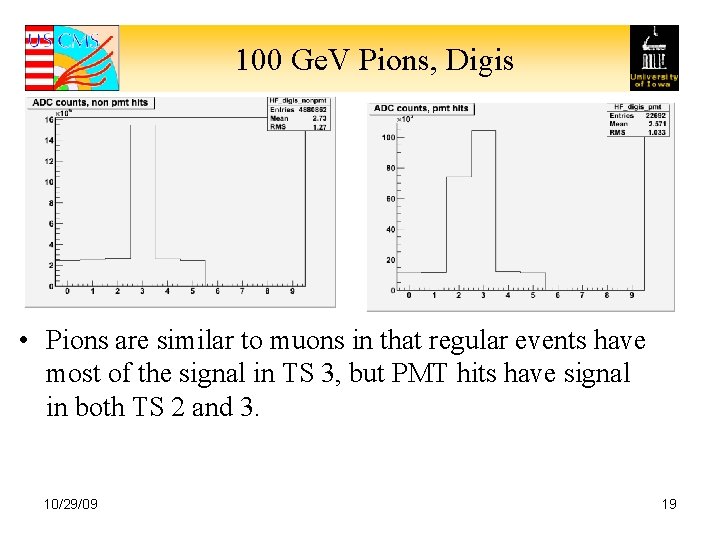
100 Ge. V Pions, Digis • Pions are similar to muons in that regular events have most of the signal in TS 3, but PMT hits have signal in both TS 2 and 3. 10/29/09 19
Some Representative Individual Digis 10/29/09 20
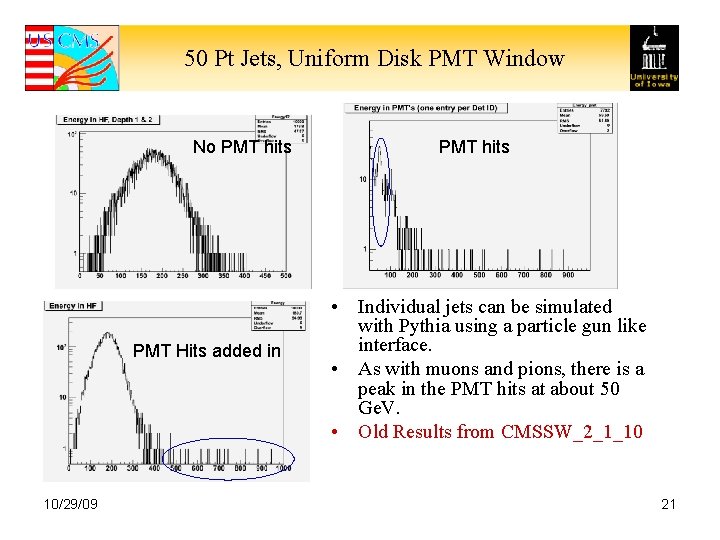
50 Pt Jets, Uniform Disk PMT Window No PMT hits PMT Hits added in 10/29/09 PMT hits • Individual jets can be simulated with Pythia using a particle gun like interface. • As with muons and pions, there is a peak in the PMT hits at about 50 Ge. V. • Old Results from CMSSW_2_1_10 21