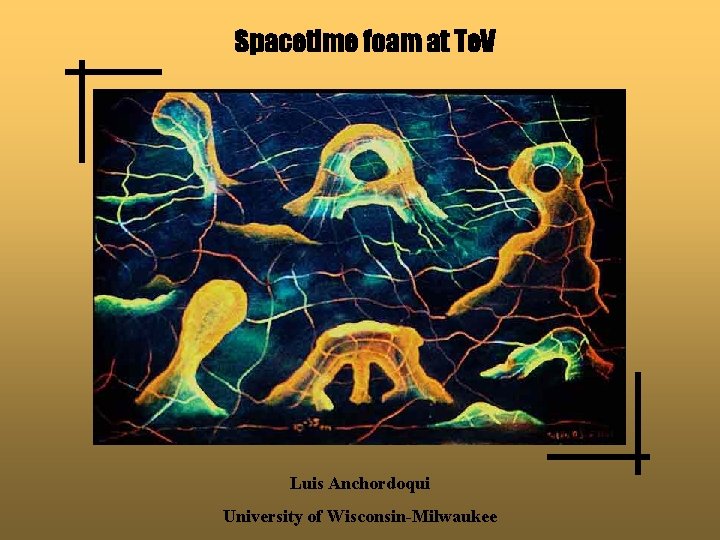
Spacetime foam at Te V Luis Anchordoqui University
- Slides: 11
Spacetime foam at Te. V Luis Anchordoqui University of Wisconsin-Milwaukee
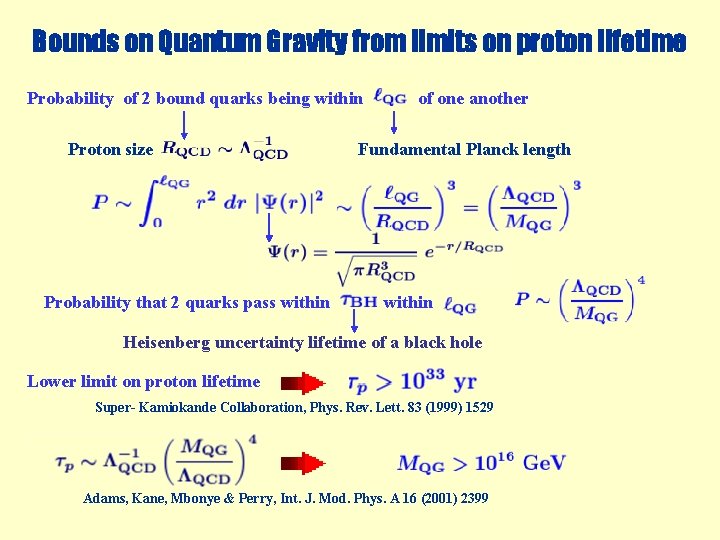
Bounds on Quantum Gravity from limits on proton lifetime Probability of 2 bound quarks being within Proton size Probability that 2 quarks pass within of one another Fundamental Planck length within Heisenberg uncertainty lifetime of a black hole Lower limit on proton lifetime Super- Kamiokande Collaboration, Phys. Rev. Lett. 83 (1999) 1529 Adams, Kane, Mbonye & Perry, Int. J. Mod. Phys. A 16 (2001) 2399
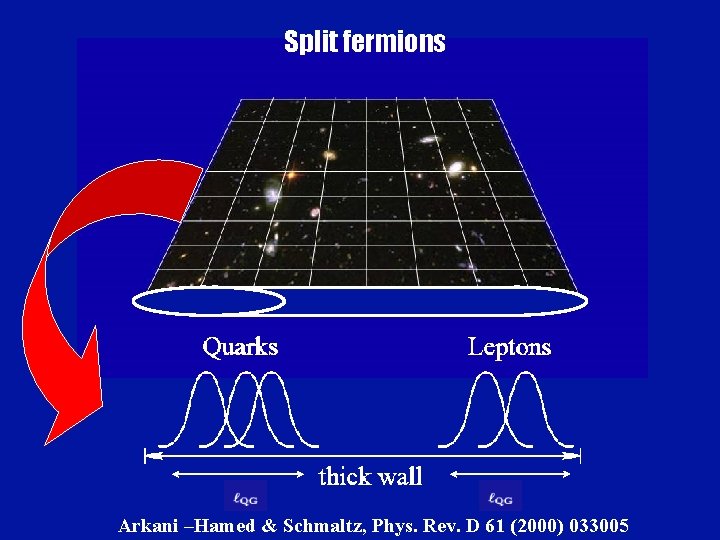
Split fermions Arkani –Hamed & Schmaltz, Phys. Rev. D 61 (2000) 033005
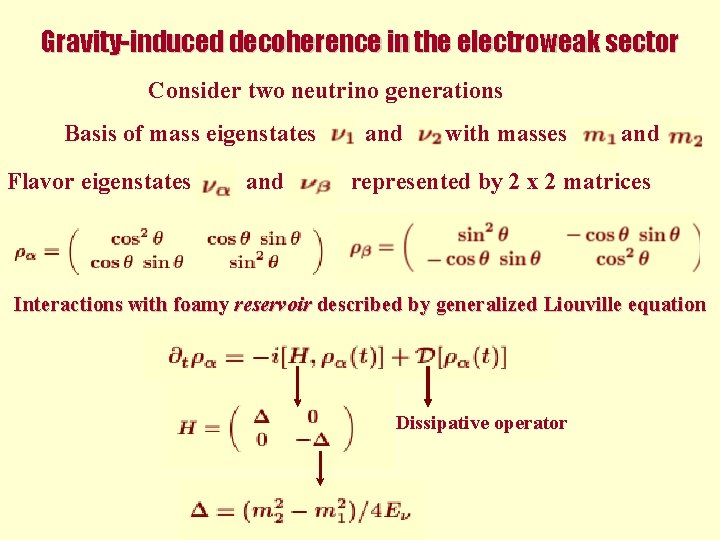
Gravity-induced decoherence in the electroweak sector Consider two neutrino generations Basis of mass eigenstates Flavor eigenstates and with masses and represented by 2 x 2 matrices Interactions with foamy reservoir described by generalized Liouville equation Dissipative operator
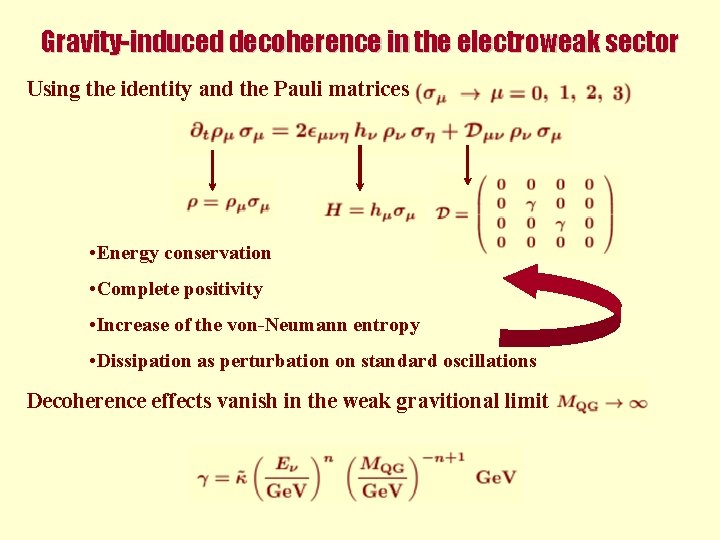
Gravity-induced decoherence in the electroweak sector Using the identity and the Pauli matrices • Energy conservation • Complete positivity • Increase of the von-Neumann entropy • Dissipation as perturbation on standard oscillations Decoherence effects vanish in the weak gravitional limit
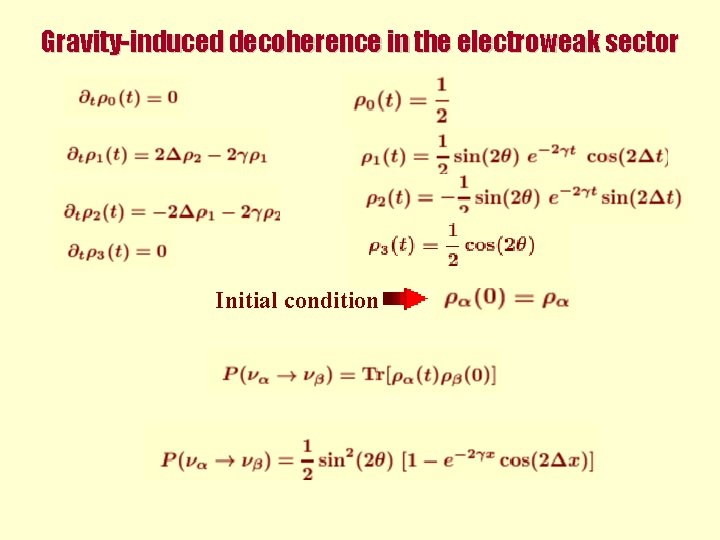
Gravity-induced decoherence in the electroweak sector Initial condition
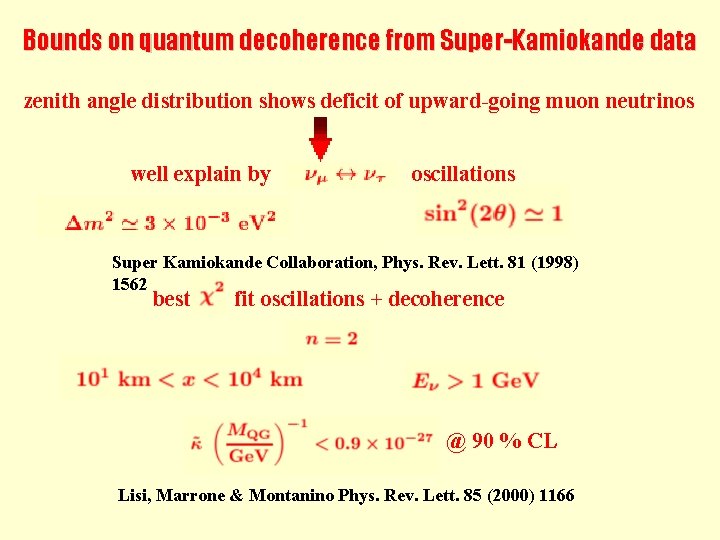
Bounds on quantum decoherence from Super-Kamiokande data zenith angle distribution shows deficit of upward-going muon neutrinos well explain by oscillations Super Kamiokande Collaboration, Phys. Rev. Lett. 81 (1998) 1562 best fit oscillations + decoherence @ 90 % CL Lisi, Marrone & Montanino Phys. Rev. Lett. 85 (2000) 1166
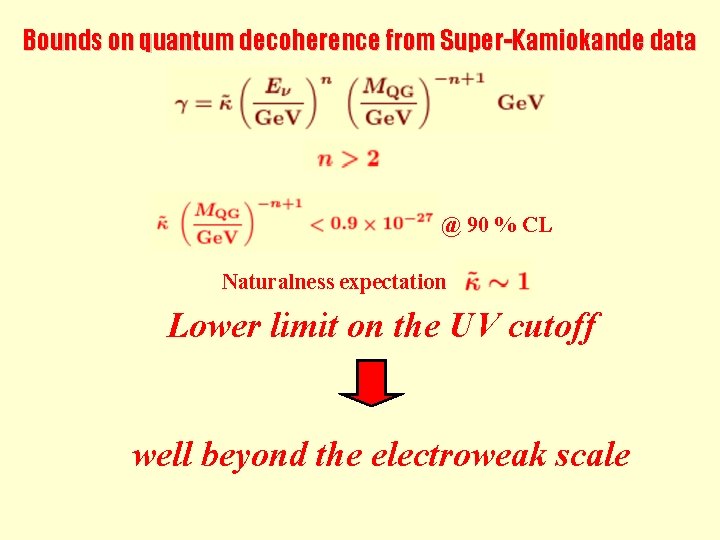
Bounds on quantum decoherence from Super-Kamiokande data @ 90 % CL Naturalness expectation Lower limit on the UV cutoff well beyond the electroweak scale
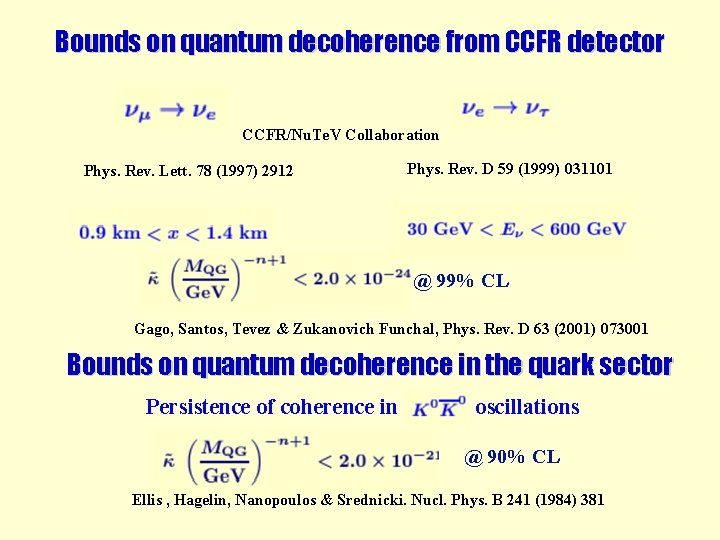
Bounds on quantum decoherence from CCFR detector CCFR/Nu. Te. V Collaboration Phys. Rev. Lett. 78 (1997) 2912 Phys. Rev. D 59 (1999) 031101 @ 99% CL Gago, Santos, Tevez & Zukanovich Funchal, Phys. Rev. D 63 (2001) 073001 Bounds on quantum decoherence in the quark sector Persistence of coherence in oscillations @ 90% CL Ellis , Hagelin, Nanopoulos & Srednicki. Nucl. Phys. B 241 (1984) 381
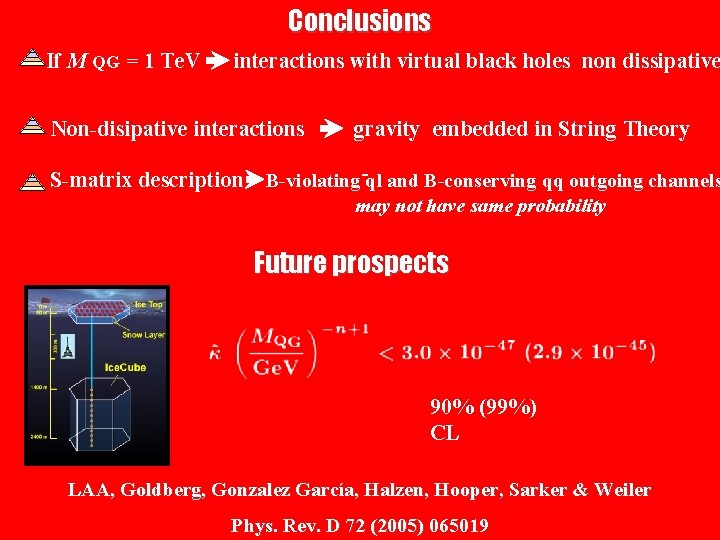
Conclusions If M QG = 1 Te. V interactions with virtual black holes non dissipative Non-disipative interactions S-matrix description gravity embedded in String Theory B-violating -ql and B-conserving qq outgoing channels may not have same probability Future prospects 90% (99%) CL LAA, Goldberg, Gonzalez García, Halzen, Hooper, Sarker & Weiler Phys. Rev. D 72 (2005) 065019