
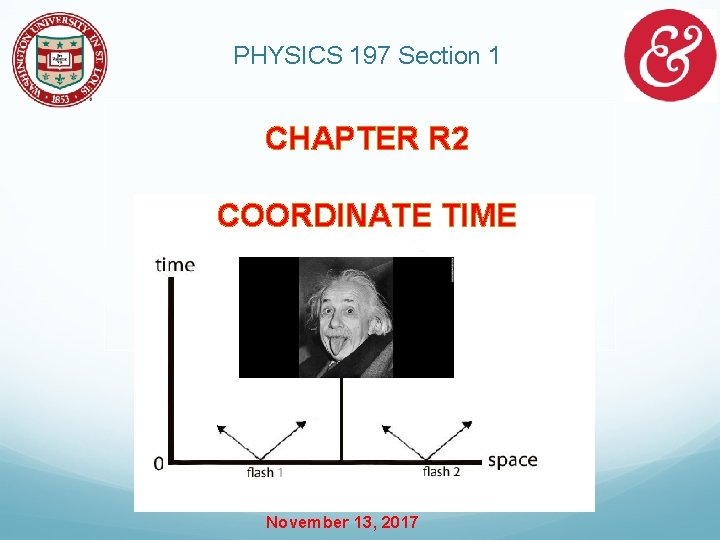
PHYSICS 197 Section 1 CHAPTER R 2 COORDINATE


- Slides: 19
PHYSICS 197 Section 1 CHAPTER R 2 COORDINATE TIME November 13, 2017
Announcements Wednesday, November 15: Review of Unit N part 2. Last chance: Please email me the problems you want to be discussed in class by 9 pm Tuesday, November 14). Last 3 years’ exams with solutions posted on Blackboard Course Home Page Exam Info Exam 2. First 3 pages of Exam paper also posted there (please go over them carefully BEFORE the exam!) Thursday, November 16: Exam #2 (6. 30 – 11 pm). Last Names A-G: Rebstock 215 Last Names H-Z: Hillman 070
Overview of R 2 Review of problem raised by Maxwell’s equations and Einstein’s brilliant solution. First steps toward developing a concept of time consistent with Maxwell equations. v Clock Synchronization v SR Units v Spacetime Diagram v Radar Method v Frame-dependence of Coordinate Time
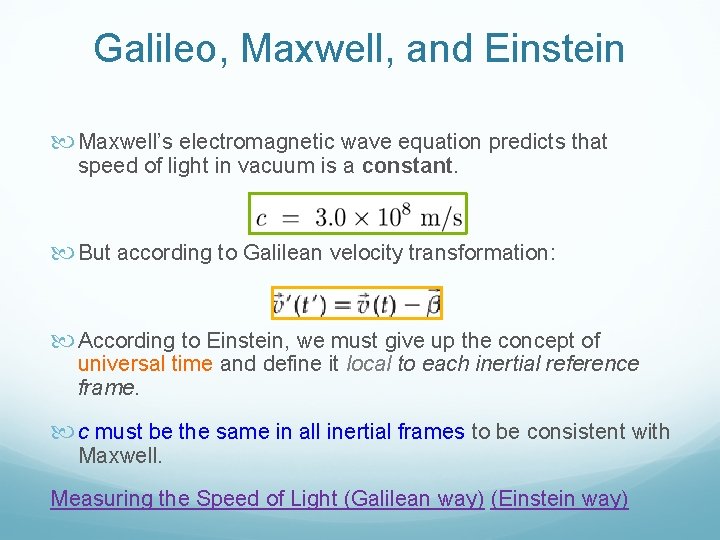
Galileo, Maxwell, and Einstein Maxwell’s electromagnetic wave equation predicts that speed of light in vacuum is a constant. But according to Galilean velocity transformation: According to Einstein, we must give up the concept of universal time and define it local to each inertial reference frame. c must be the same in all inertial frames to be consistent with Maxwell. Measuring the Speed of Light (Galilean way) (Einstein way)
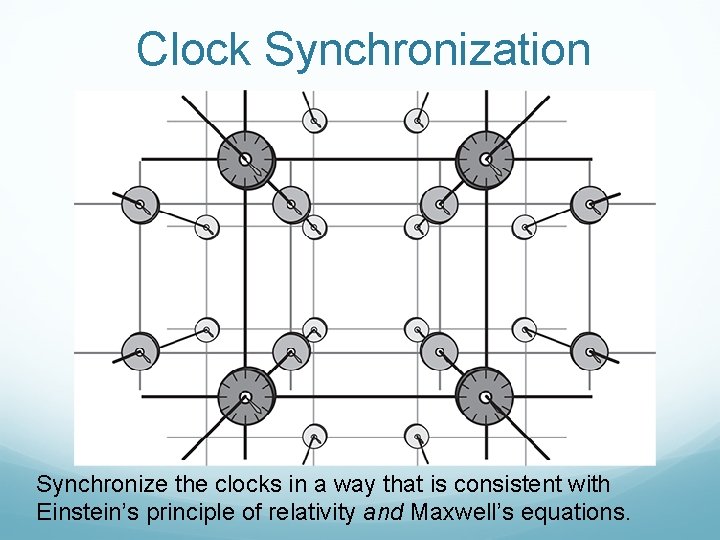
Clock Synchronization Synchronize the clocks in a way that is consistent with Einstein’s principle of relativity and Maxwell’s equations.
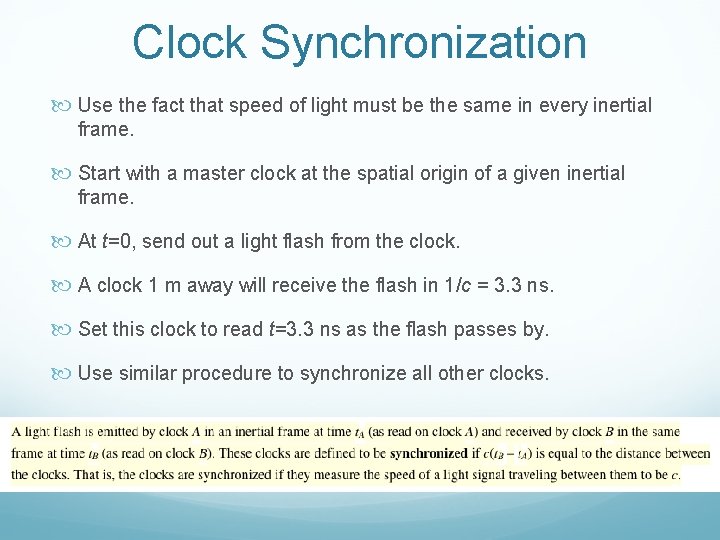
Clock Synchronization Use the fact that speed of light must be the same in every inertial frame. Start with a master clock at the spatial origin of a given inertial frame. At t=0, send out a light flash from the clock. A clock 1 m away will receive the flash in 1/c = 3. 3 ns. Set this clock to read t=3. 3 ns as the flash passes by. Use similar procedure to synchronize all other clocks.
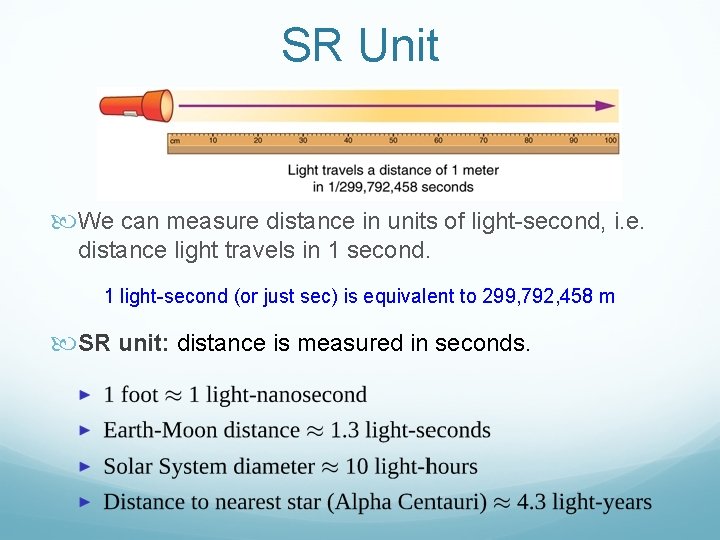
SR Unit We can measure distance in units of light-second, i. e. distance light travels in 1 second. 1 light-second (or just sec) is equivalent to 299, 792, 458 m SR unit: distance is measured in seconds.
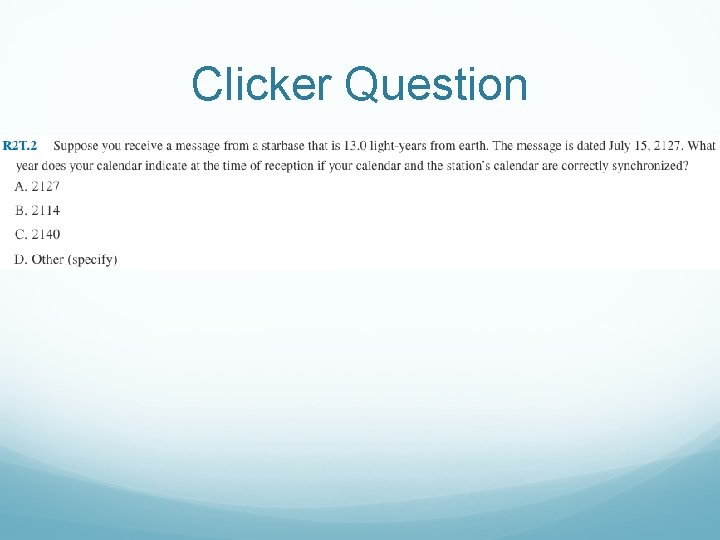
Clicker Question
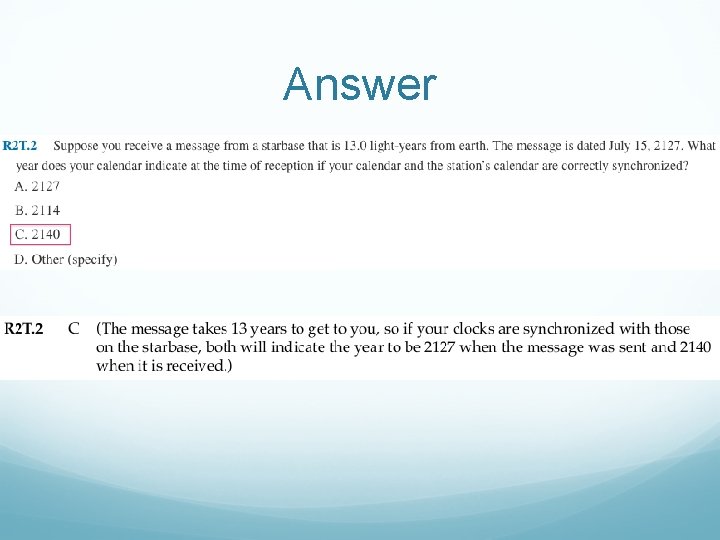
Answer
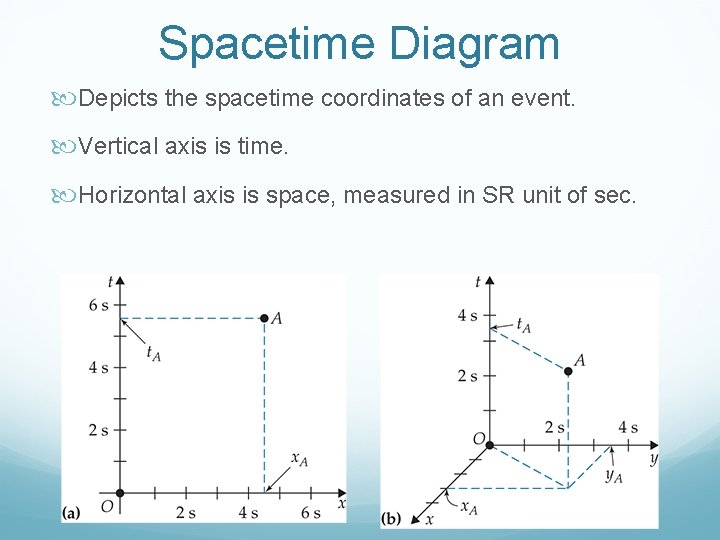
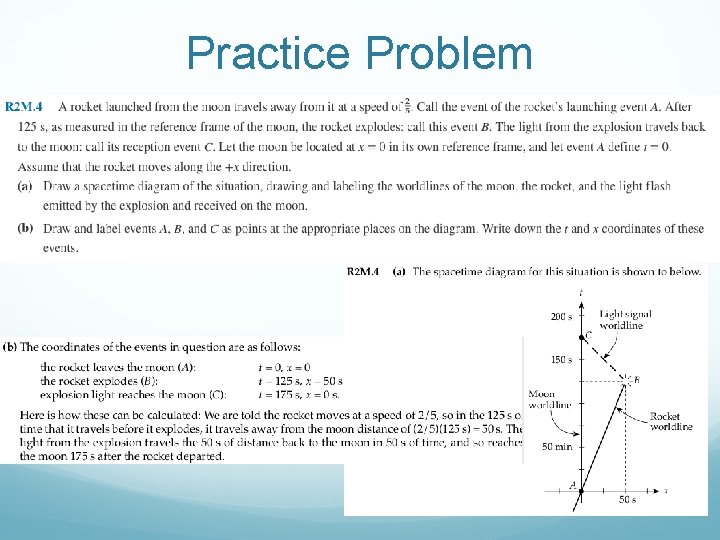
Spacetime Diagram Depicts the spacetime coordinates of an event. Vertical axis is time. Horizontal axis is space, measured in SR unit of sec.
wo rld line Spacetime Diagram
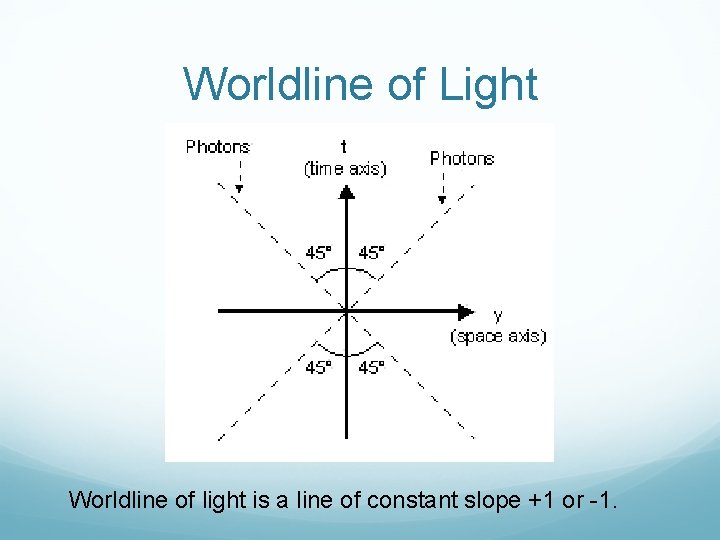
Worldline of Light Worldline of light is a line of constant slope +1 or -1.
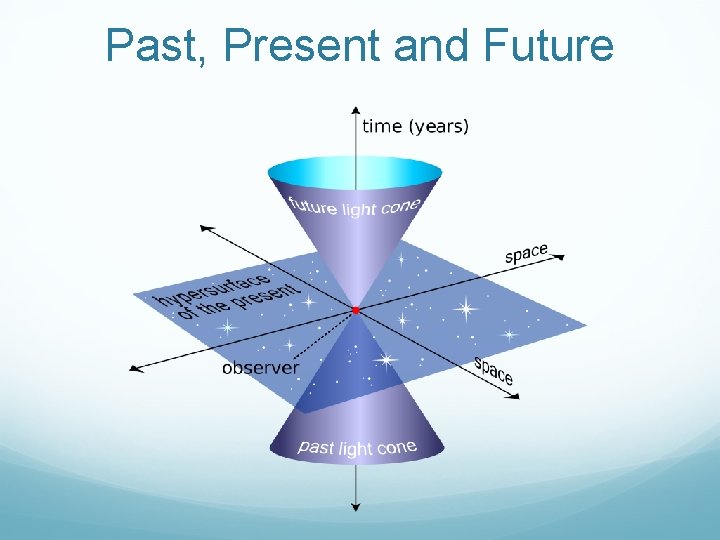
Past, Present and Future
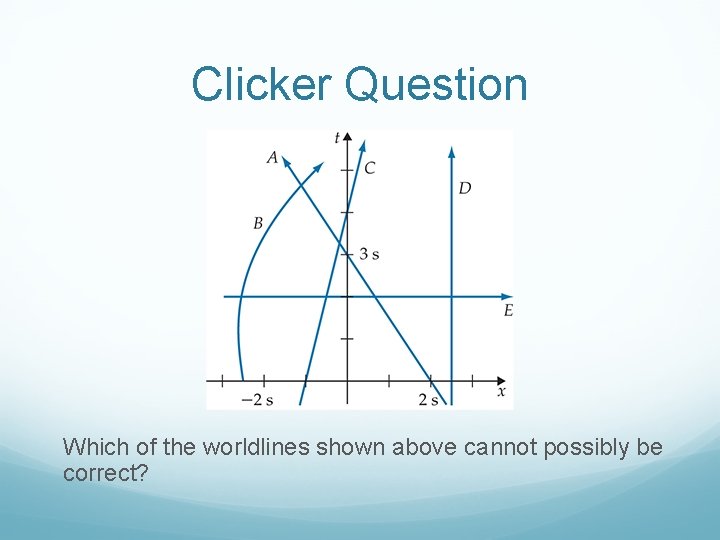
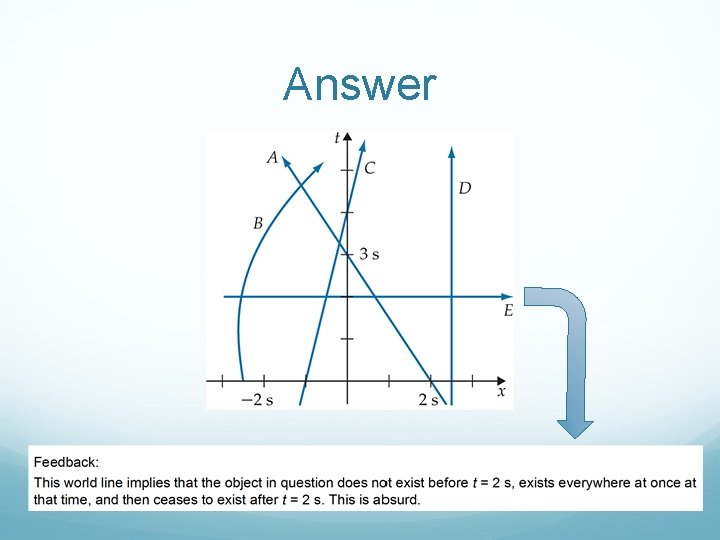
Clicker Question Which of the worldlines shown above cannot possibly be correct?
Answer
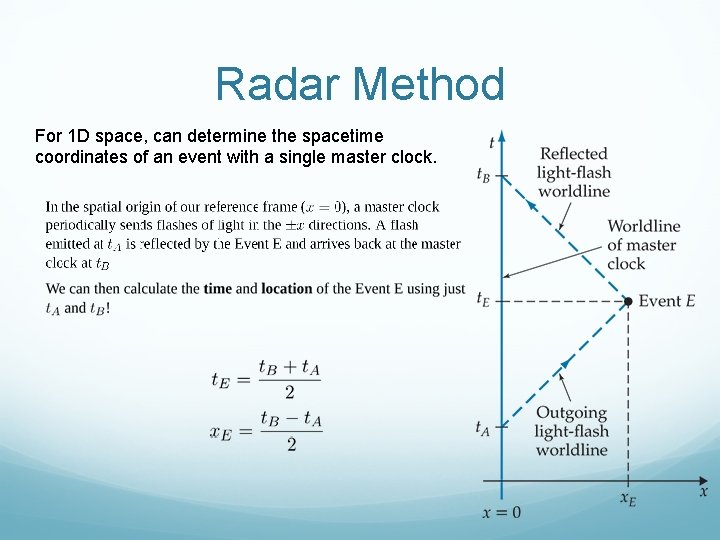
Radar Method For 1 D space, can determine the spacetime coordinates of an event with a single master clock.
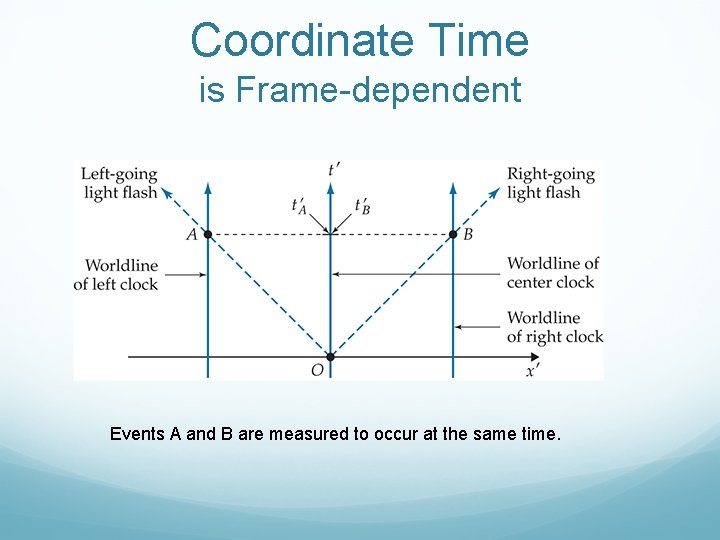
Coordinate Time is Frame-dependent Events A and B are measured to occur at the same time.
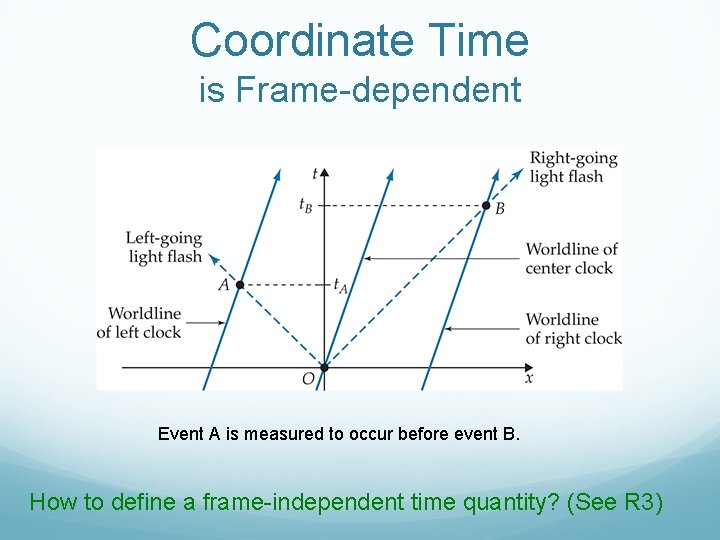
Coordinate Time is Frame-dependent Event A is measured to occur before event B. How to define a frame-independent time quantity? (See R 3)
Practice Problem