
Sounding water vapor ozone and particle SWOP campaign


- Slides: 32
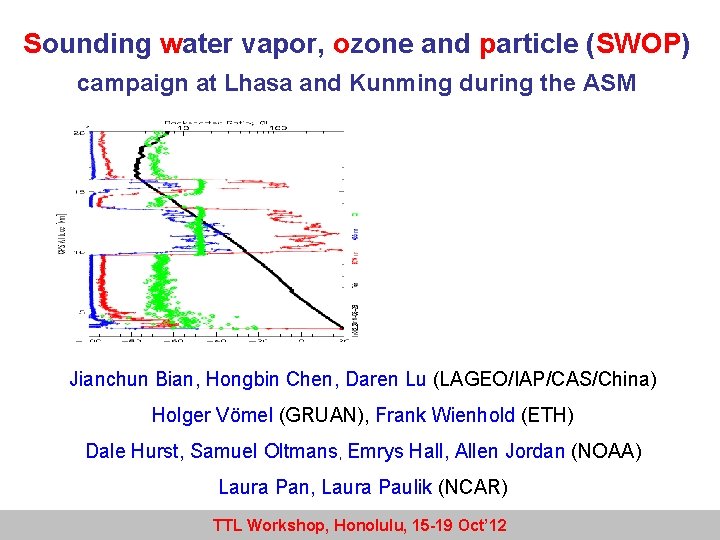
Sounding water vapor, ozone and particle (SWOP) campaign at Lhasa and Kunming during the ASM Jianchun Bian, Hongbin Chen, Daren Lu (LAGEO/IAP/CAS/China) Holger Vömel (GRUAN), Frank Wienhold (ETH) Dale Hurst, Samuel Oltmans, Emrys Hall, Allen Jordan (NOAA) Laura Pan, Laura Paulik (NCAR) TTL Workshop, Honolulu, 15 -19 Oct’ 12
Outline • • • Scientific motivation Campaign information Some key results (Bian et al. , 2012, GRL) Some interesting cases Plan for next year Summary Bian, et al. (2012), In situ water vapor and ozone measurements in Lhasa and Kunming during the Asian summer monsoon, GRL, doi: 10. 1029/2012 GL 052996.
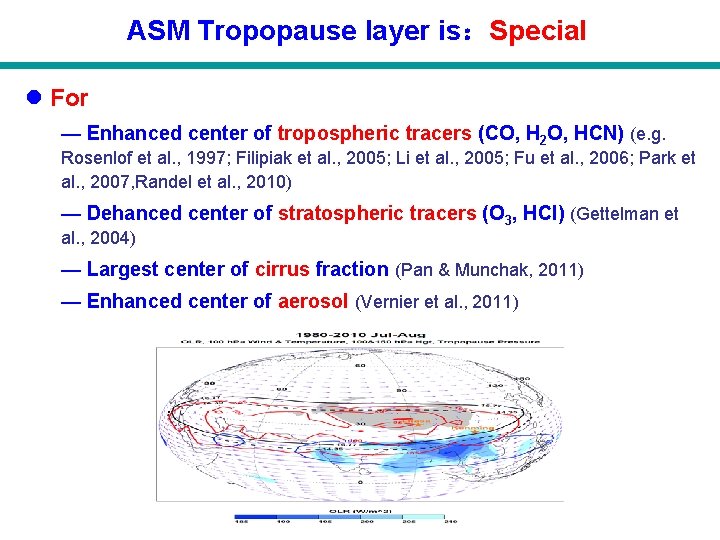
ASM Tropopause layer is:Special l For — Enhanced center of tropospheric tracers (CO, H 2 O, HCN) (e. g. Rosenlof et al. , 1997; Filipiak et al. , 2005; Li et al. , 2005; Fu et al. , 2006; Park et al. , 2007, Randel et al. , 2010) — Dehanced center of stratospheric tracers (O 3, HCl) (Gettelman et al. , 2004) — Largest center of cirrus fraction (Pan & Munchak, 2011) — Enhanced center of aerosol (Vernier et al. , 2011)
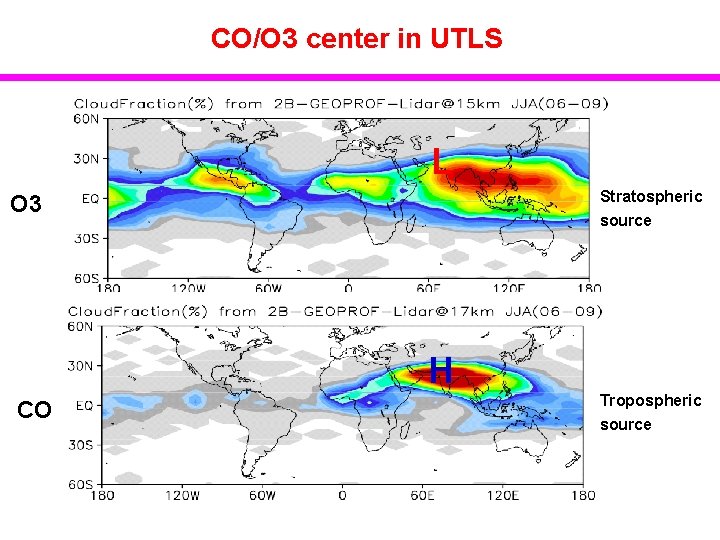
CO/O 3 center in UTLS L Stratospheric source O 3 H CO Tropospheric source
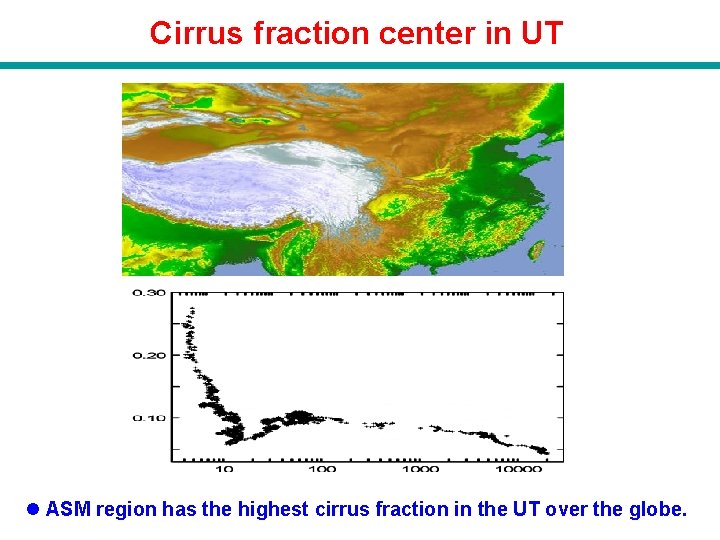
Cirrus fraction center in UT l ASM region has the highest cirrus fraction in the UT over the globe.
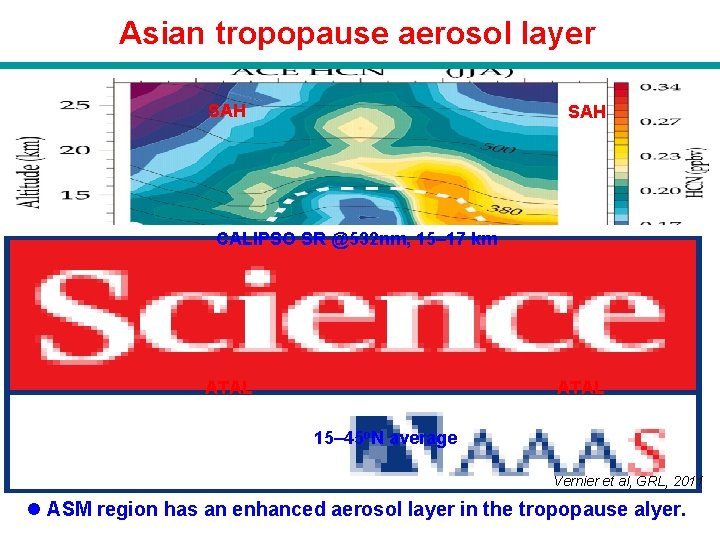
Asian tropopause aerosol layer SAH CALIPSO SR @532 nm, 15– 17 km ATAL 15– 45 o. N average Vernier et al, GRL, 2011 l ASM region has an enhanced aerosol layer in the tropopause alyer.
Summertime ozone-valley over TP and pollutants pathway to LS In explaining formation of summertime ozone valley, Zhou et al (1994) remarked that surface pollutants surrounding the TP converge towards TP, and is then lifted into the lower stratosphere by convection over TP. Zhou et al. (1994)
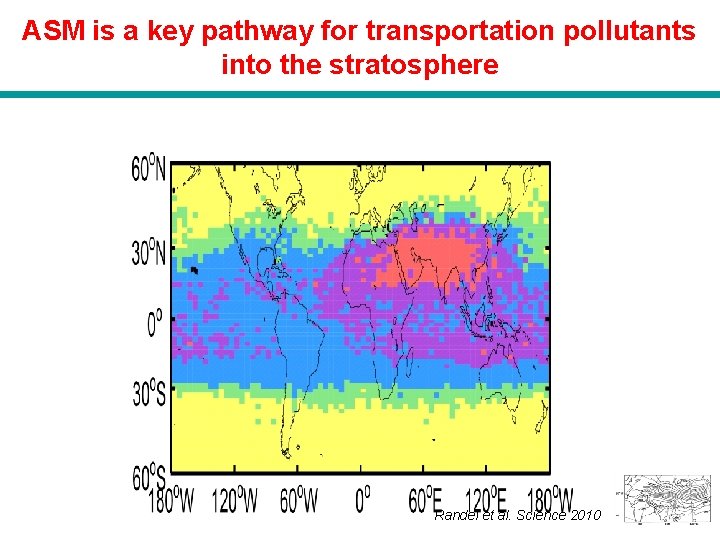
ASM is a key pathway for transportation pollutants into the stratosphere Randel et al. Science 2010
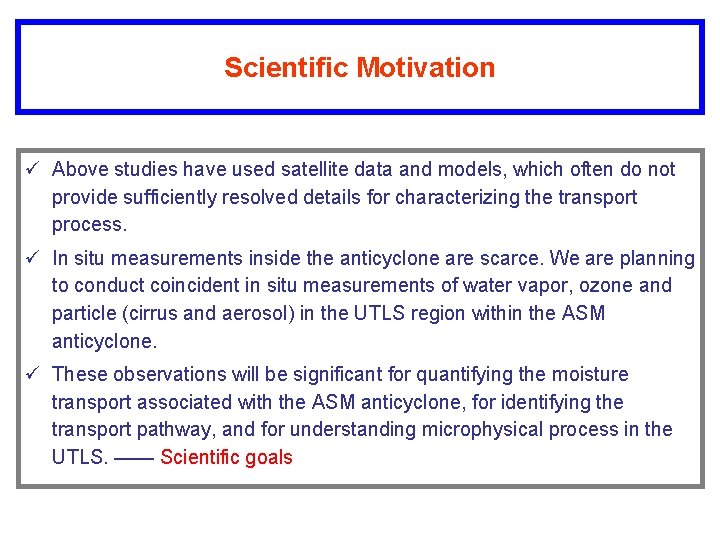
Overview Scientific Motivation ü Above studies have used satellite data and models, which often do not provide sufficiently resolved details for characterizing the transport process. ü In situ measurements inside the anticyclone are scarce. We are planning to conduct coincident in situ measurements of water vapor, ozone and particle (cirrus and aerosol) in the UTLS region within the ASM anticyclone. ü These observations will be significant for quantifying the moisture transport associated with the ASM anticyclone, for identifying the transport pathway, and for understanding microphysical process in the UTLS. —— Scientific goals
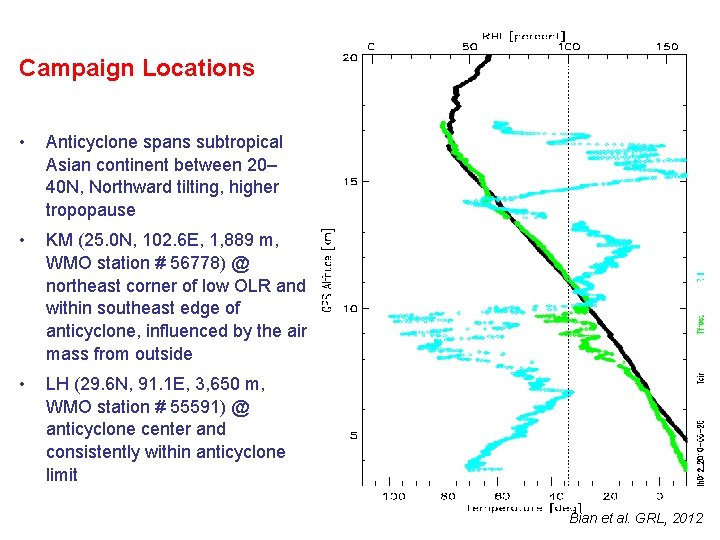
Campaign Locations • Anticyclone spans subtropical Asian continent between 20– 40 N, Northward tilting, higher tropopause • KM (25. 0 N, 102. 6 E, 1, 889 m, WMO station # 56778) @ northeast corner of low OLR and within southeast edge of anticyclone, influenced by the air mass from outside • LH (29. 6 N, 91. 1 E, 3, 650 m, WMO station # 55591) @ anticyclone center and consistently within anticyclone limit Bian et al. GRL, 2012
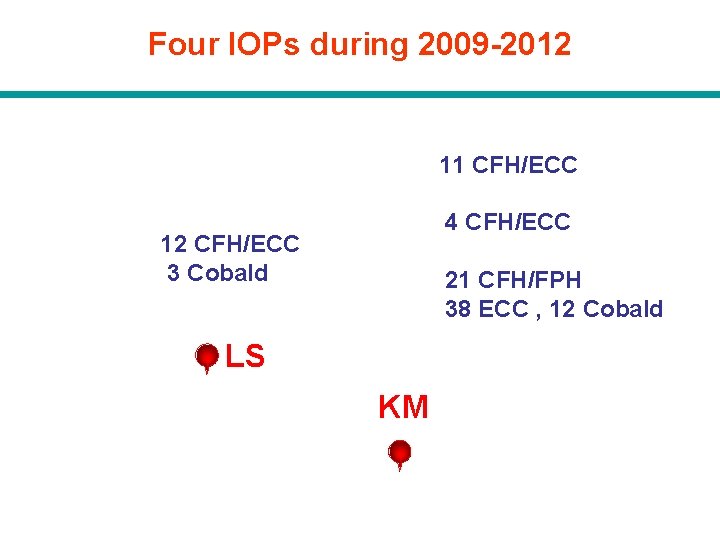
Four IOPs during 2009 -2012 2010 Aug 22 -28 12 CFH/ECC 3 Cobald 2009, Aug 7 -13 11 CFH/ECC 2011, Sep 12 -15 4 CFH/ECC 2012, Aug 11 -Sep 6 21 CFH/FPH 38 ECC , 12 Cobald LS KM
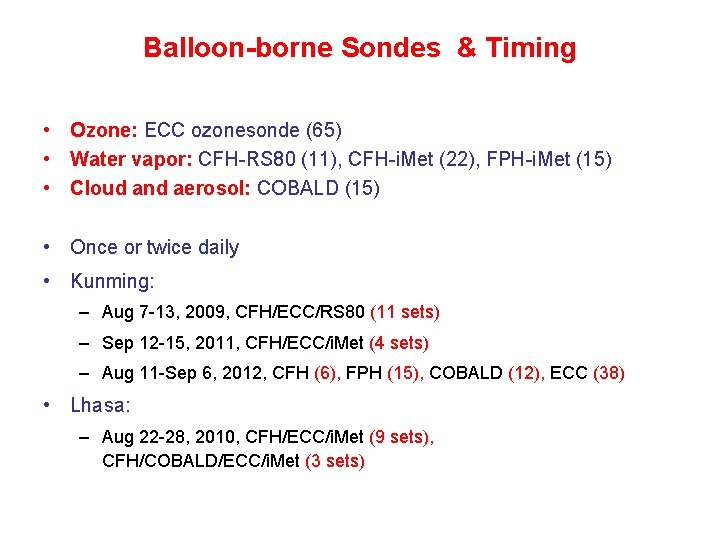
Balloon-borne Sondes & Timing • Ozone: ECC ozonesonde (65) • Water vapor: CFH-RS 80 (11), CFH-i. Met (22), FPH-i. Met (15) • Cloud and aerosol: COBALD (15) • Once or twice daily • Kunming: – Aug 7 -13, 2009, CFH/ECC/RS 80 (11 sets) – Sep 12 -15, 2011, CFH/ECC/i. Met (4 sets) – Aug 11 -Sep 6, 2012, CFH (6), FPH (15), COBALD (12), ECC (38) • Lhasa: – Aug 22 -28, 2010, CFH/ECC/i. Met (9 sets), CFH/COBALD/ECC/i. Met (3 sets)
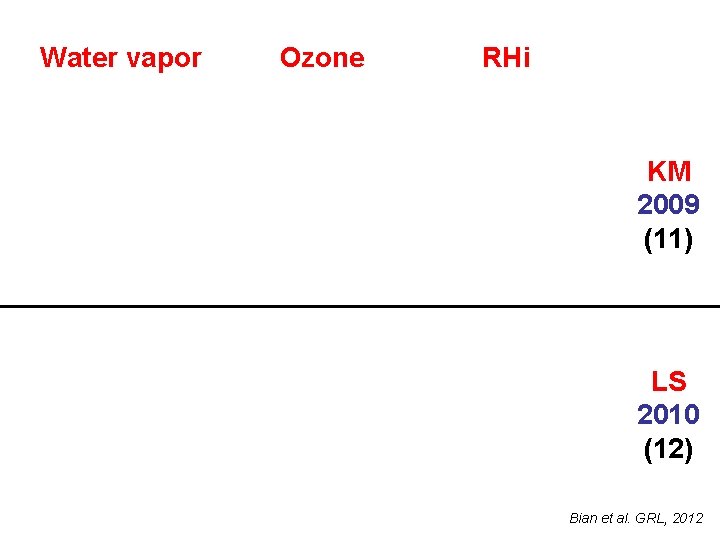
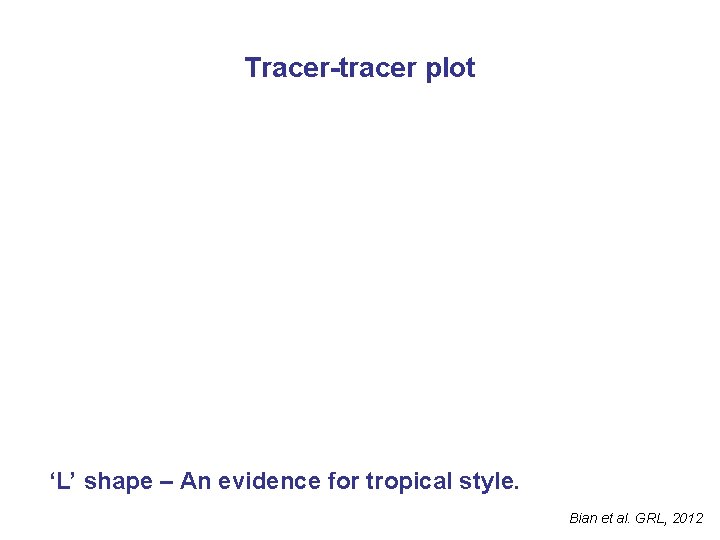
Some key results from GRL paper KM-2009 vs LS-2010 • The in situ measurements provide first set of high-resolution, highaccuracy H 2 O and O 3 profiles inside the ASM anticyclone. • Compared to measurements from TC 4 campaign (equatorial), the ASM results show higher H 2 O and lower O 3 in the UTLS. • Level of CPT over Tibetan plateau during ASM is higher (~1 km) in altitude and potential temperature (~13 K) than in the deep tropics as represented by the TC 4 results. • These findings confirm the satellite retrieval based conclusion that the anticyclone is a significant transport pathway for water vapor to enter the stratosphere. Bian et al. GRL, 2012
Water vapor Ozone RHi KM 2009 (11) LS 2010 (12) Bian et al. GRL, 2012
Tracer-tracer plot ‘L’ shape – An evidence for tropical style. Bian et al. GRL, 2012
Water vapor Ozone RHi KM 2009 (11) KM 2012 (21/38)
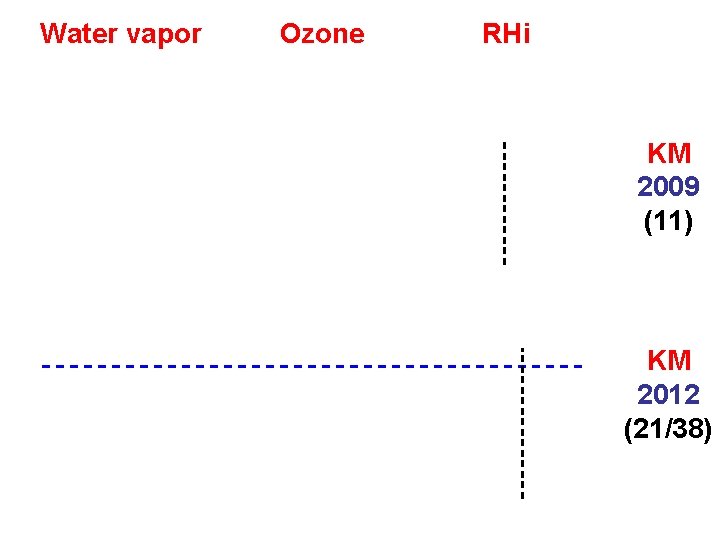
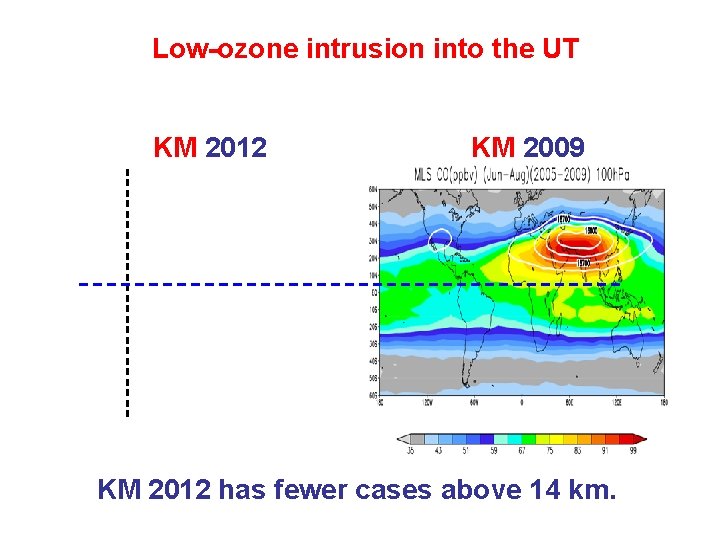
Low-ozone intrusion into the UT KM 2012 KM 2009 KM 2012 has fewer cases above 14 km.
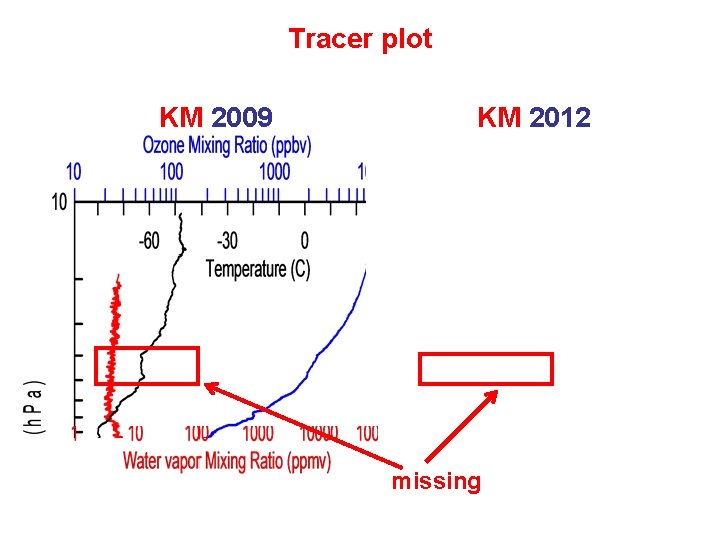
Tracer plot KM 2009 KM 2012 missing
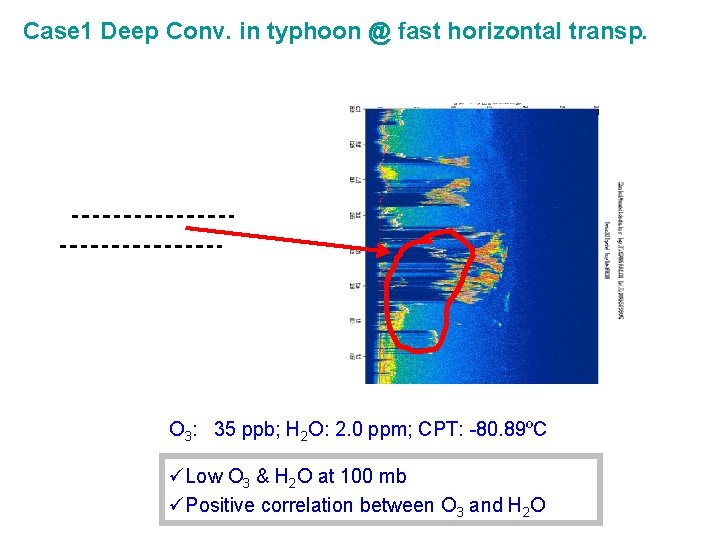
Case 1 Deep Conv. in typhoon @ fast horizontal transp. O 3: 35 ppb; H 2 O: 2. 0 ppm; CPT: -80. 89ºC üLow O 3 & H 2 O at 100 mb üPositive correlation between O 3 and H 2 O
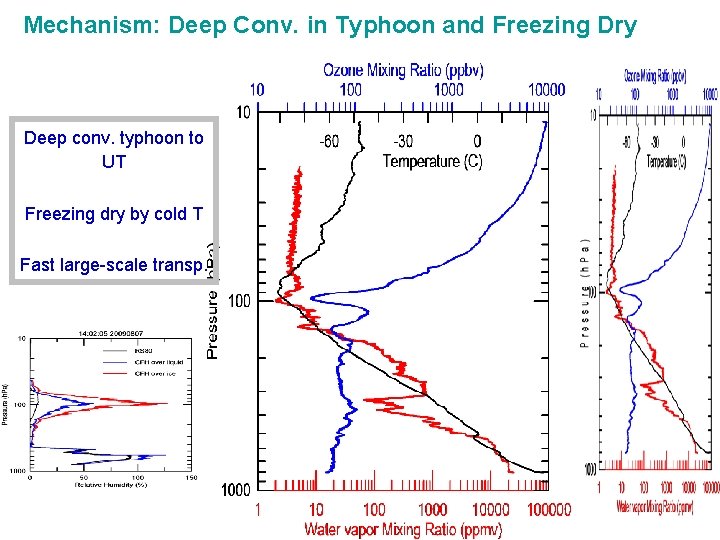
Mechanism: Deep Conv. in Typhoon and Freezing Dry Deep conv. typhoon to UT Freezing dry by cold T Fast large-scale transp.
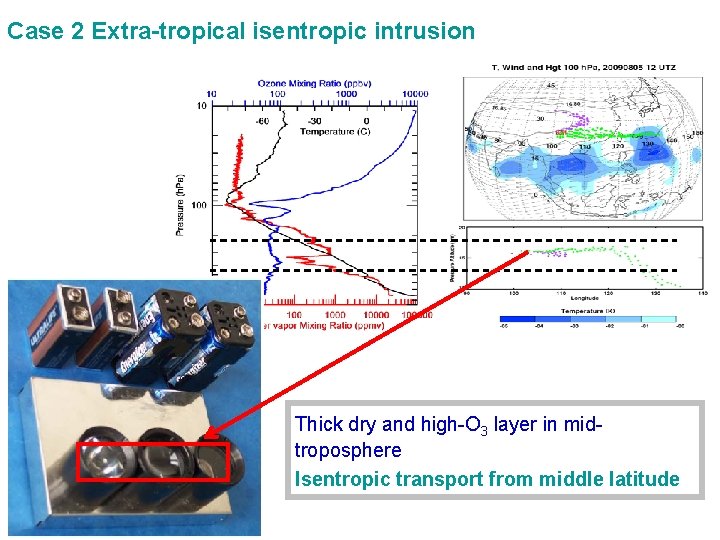
Case 2 Extra-tropical isentropic intrusion Thick dry and high-O 3 layer in midtroposphere Isentropic transport from middle latitude
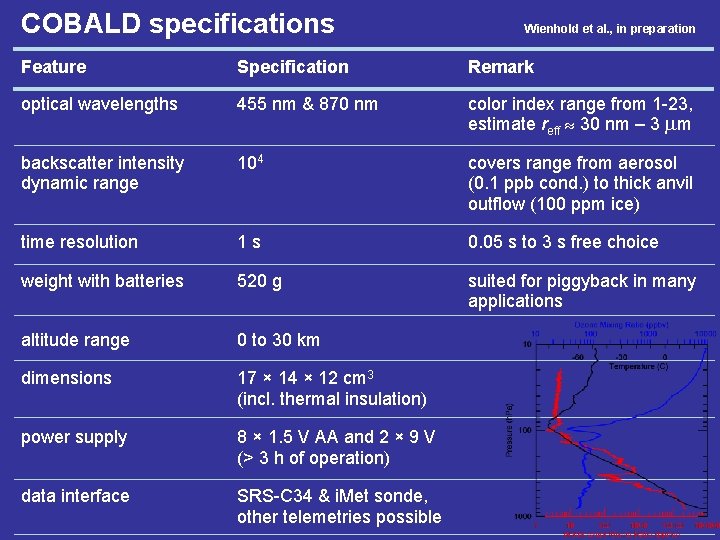
COBALD specifications Wienhold et al. , in preparation Feature Specification Remark optical wavelengths 455 nm & 870 nm color index range from 1 -23, estimate reff 30 nm – 3 m backscatter intensity dynamic range 104 covers range from aerosol (0. 1 ppb cond. ) to thick anvil outflow (100 ppm ice) time resolution 1 s 0. 05 s to 3 s free choice weight with batteries 520 g suited for piggyback in many applications altitude range 0 to 30 km dimensions 17 × 14 × 12 cm 3 (incl. thermal insulation) power supply 8 × 1. 5 V AA and 2 × 9 V (> 3 h of operation) data interface SRS-C 34 & i. Met sonde, other telemetries possible
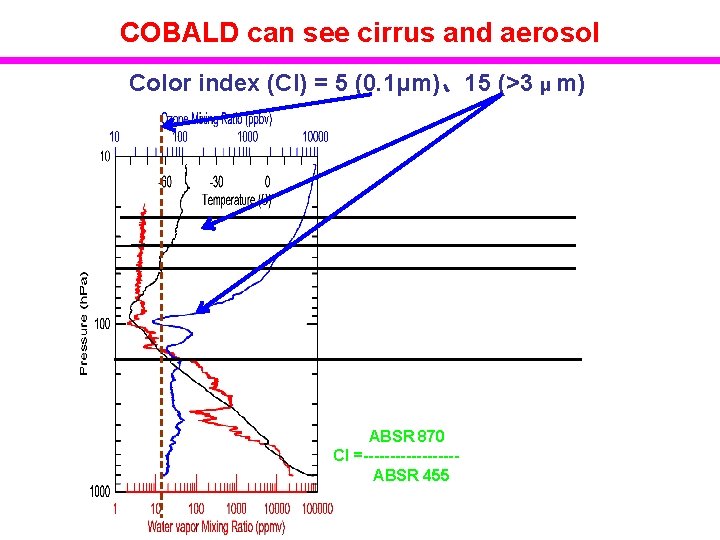
COBALD can see cirrus and aerosol Color index (CI) = 5 (0. 1μm)、15 (>3 μ m) ABSR 870 CI =---------ABSR 455
Inter-comparison between Calipso and Cobald Asian tropopause aerosol layer
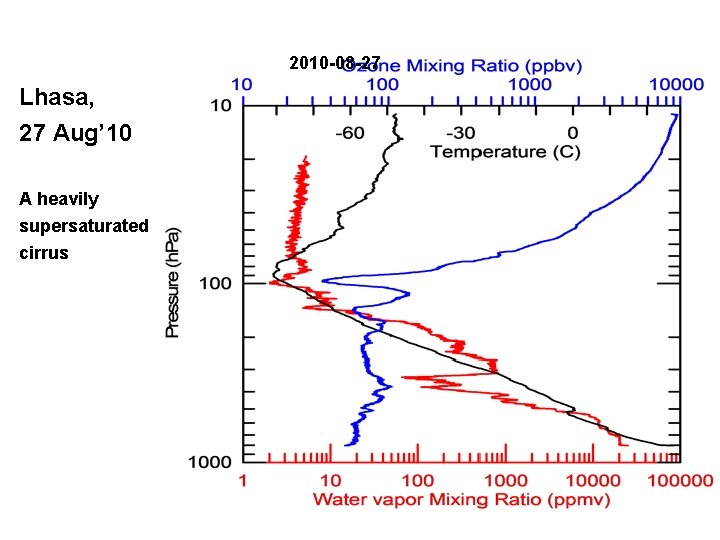
2010 -08 -27 Lhasa, 27 Aug’ 10 A heavily supersaturated cirrus
Interesting case on RHi & Cirrus from Eric Jensen
Similar case from sounding (Kunming, 20 Aug’ 12) • Similar, but not the same • Very thick cirrus layer with large horizontal scale
Cloud image during that time .
RHi distribution changes with temperature
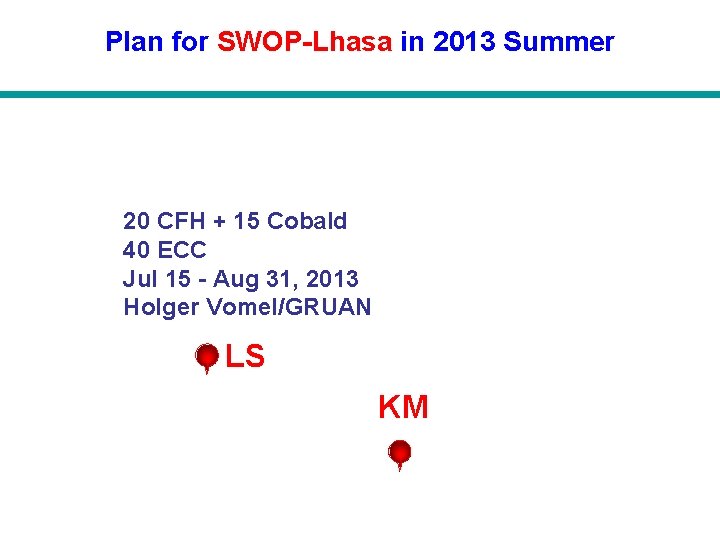
Plan for SWOP-Lhasa in 2013 Summer 20 CFH + 15 Cobald 40 ECC Jul 15 - Aug 31, 2013 Holger Vomel/GRUAN LS KM
Summary ü For the first time, in situ observing H 2 O, O 3 and particle in the UTLS were conducted during Asian summer monsoon ü Some specific features in the UTLS region are revealed, but further investigation should be done by using back-trajectory model combined with convective parameterization and convective cloud information. ü Further sounding experiment over Tibet is under plan. What can we learn from this experiment? Thank you very much for your attention!
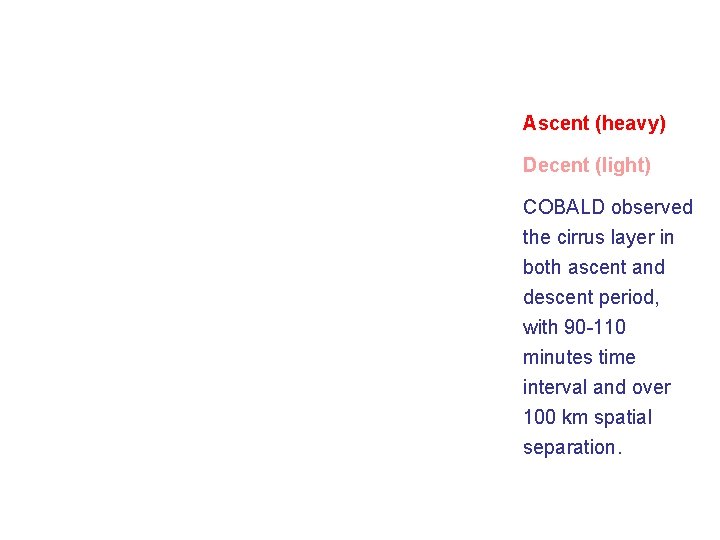
Ascent (heavy) Decent (light) COBALD observed the cirrus layer in both ascent and descent period, with 90 -110 minutes time interval and over 100 km spatial separation.