Sorting Part 4 CS 221 32509 Sort Matrix





- Slides: 34
Sorting Part 4 CS 221 – 3/25/09
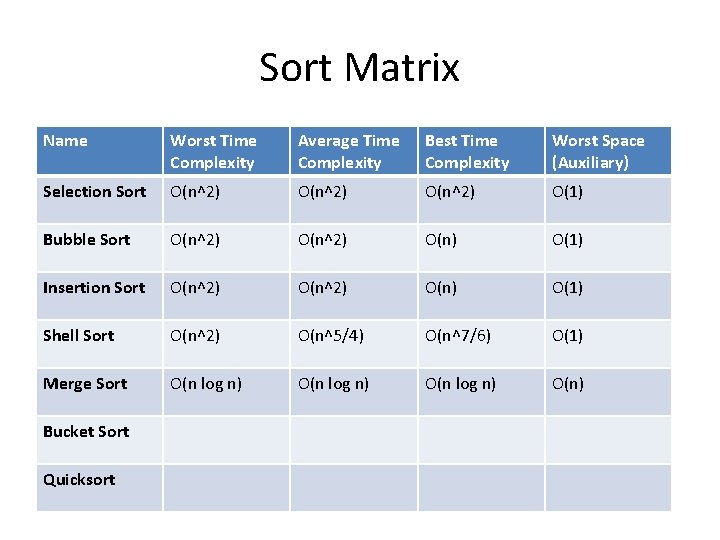
Sort Matrix Name Worst Time Complexity Average Time Complexity Best Time Complexity Worst Space (Auxiliary) Selection Sort O(n^2) O(1) Bubble Sort O(n^2) O(n) O(1) Insertion Sort O(n^2) O(n) O(1) Shell Sort O(n^2) O(n^5/4) O(n^7/6) O(1) Merge Sort O(n log n) O(n) Bucket Sort Quicksort
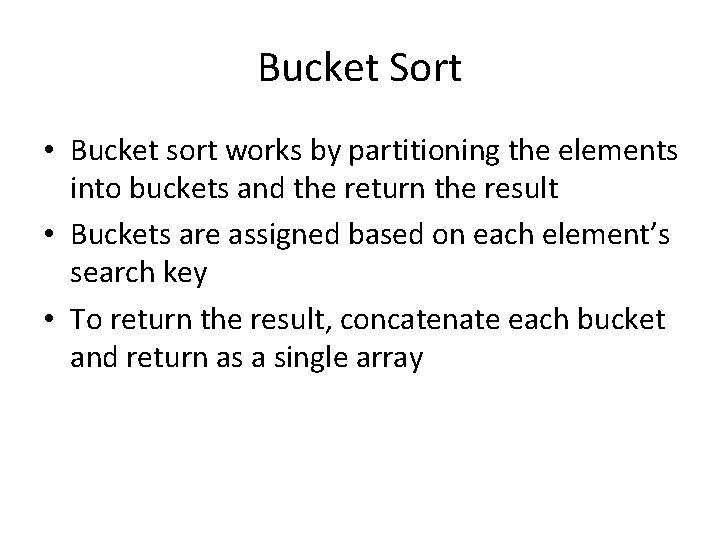
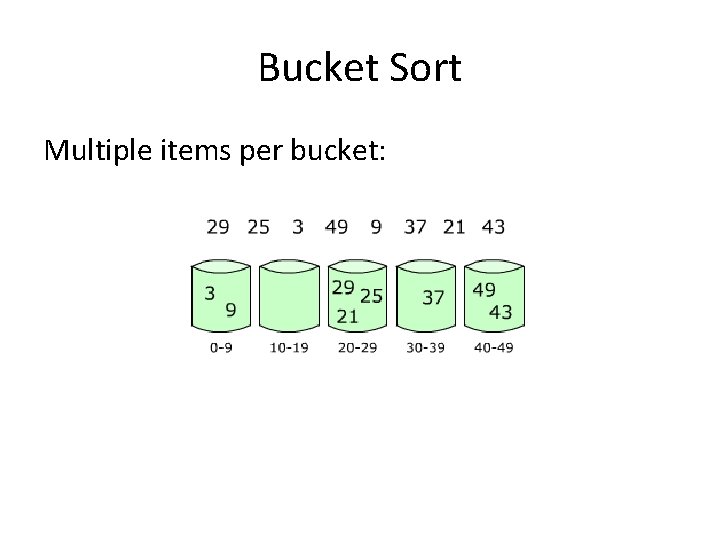
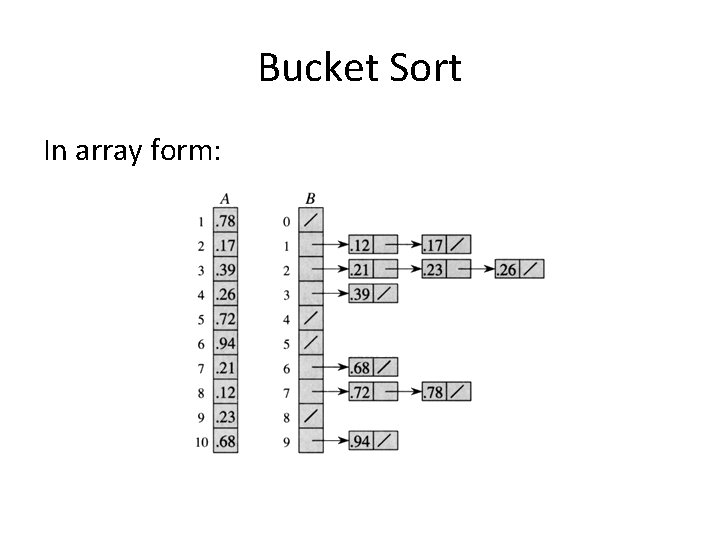
Bucket Sort • Bucket sort works by partitioning the elements into buckets and the return the result • Buckets are assigned based on each element’s search key • To return the result, concatenate each bucket and return as a single array
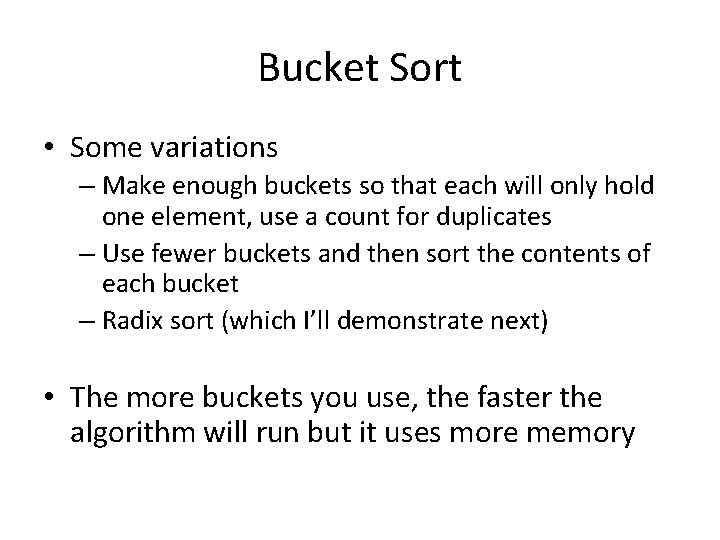
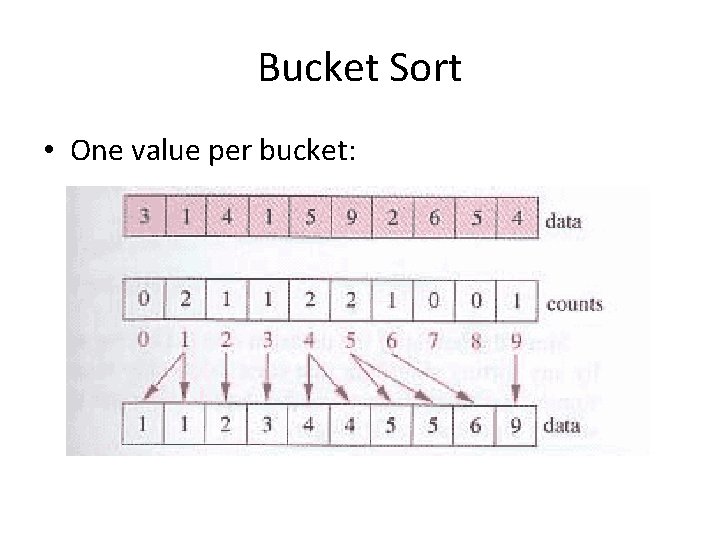
Bucket Sort • Some variations – Make enough buckets so that each will only hold one element, use a count for duplicates – Use fewer buckets and then sort the contents of each bucket – Radix sort (which I’ll demonstrate next) • The more buckets you use, the faster the algorithm will run but it uses more memory
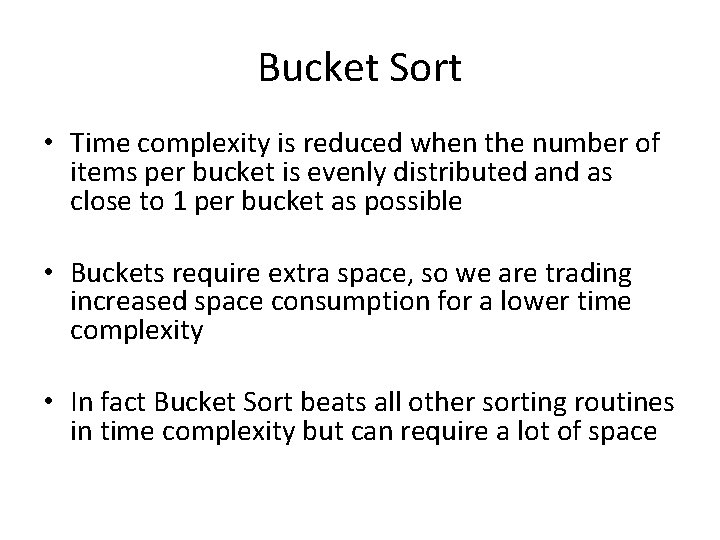
Bucket Sort • Time complexity is reduced when the number of items per bucket is evenly distributed and as close to 1 per bucket as possible • Buckets require extra space, so we are trading increased space consumption for a lower time complexity • In fact Bucket Sort beats all other sorting routines in time complexity but can require a lot of space
Bucket Sort • One value per bucket:
Bucket Sort Animation http: //www. cs. auckland. ac. nz/software/Alg. Ani m/binsort. html
Bucket Sort Multiple items per bucket:
Bucket Sort In array form:
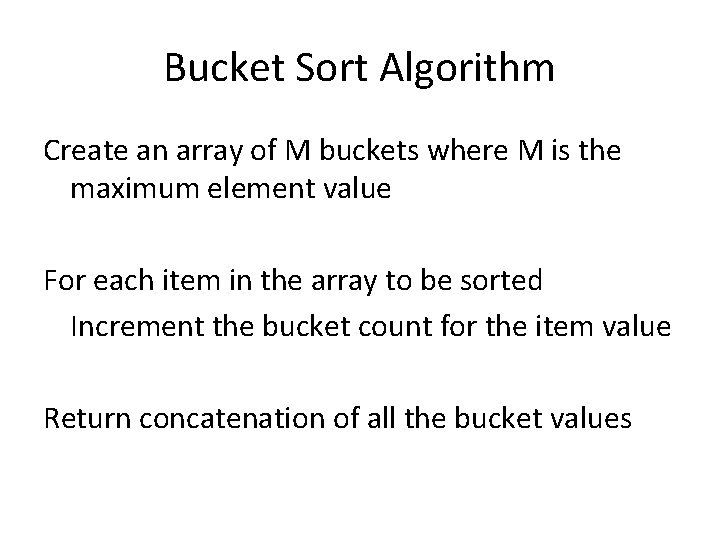
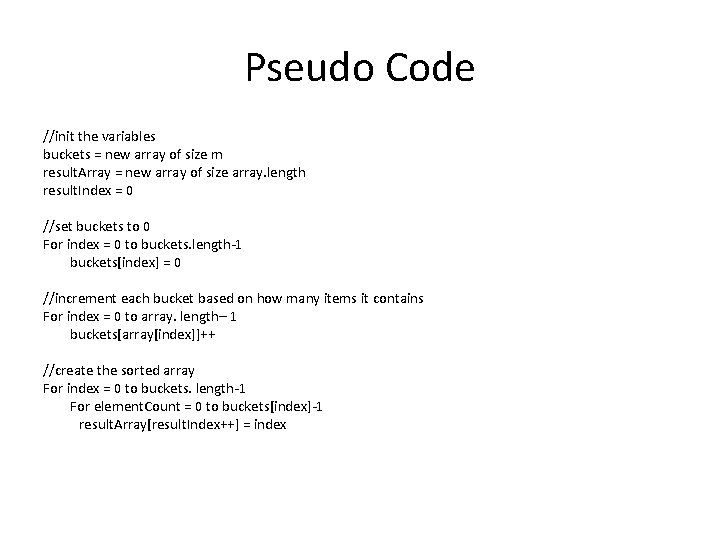
Bucket Sort Algorithm Create an array of M buckets where M is the maximum element value For each item in the array to be sorted Increment the bucket count for the item value Return concatenation of all the bucket values
Pseudo Code //init the variables buckets = new array of size m result. Array = new array of size array. length result. Index = 0 //set buckets to 0 For index = 0 to buckets. length-1 buckets[index] = 0 //increment each bucket based on how many items it contains For index = 0 to array. length– 1 buckets[array[index]]++ //create the sorted array For index = 0 to buckets. length-1 For element. Count = 0 to buckets[index]-1 result. Array[result. Index++] = index
Bucket Sort Complexity • What is the time complexity? • What is the space complexity? – Is the data exchanged in-place? – Does the algorithm require auxiliary storage?
Sort Matrix Name Worst Time Complexity Average Time Complexity Best Time Complexity Worst Space (Auxiliary) Selection Sort O(n^2) O(1) Bubble Sort O(n^2) O(n) O(1) Insertion Sort O(n^2) O(n) O(1) Shell Sort O(n^2) O(n^5/4) O(n^7/6) O(1) Merge Sort O(n log n) O(n) Bucket Sort O(n) O(m) Quicksort
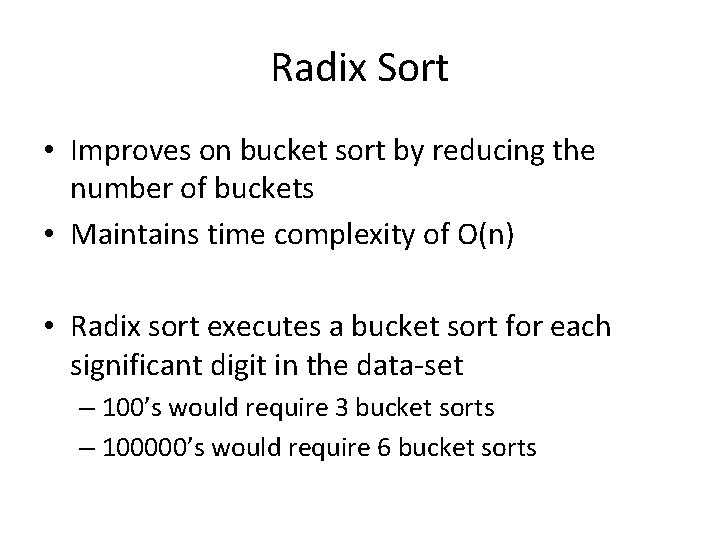
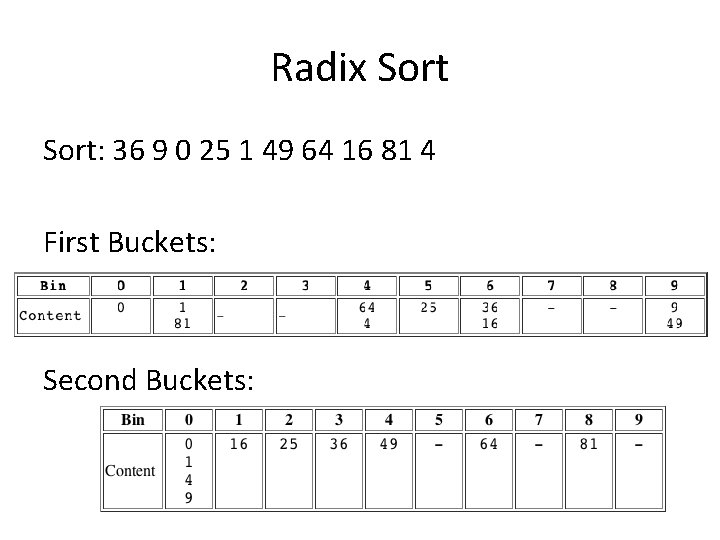
Radix Sort • Improves on bucket sort by reducing the number of buckets • Maintains time complexity of O(n) • Radix sort executes a bucket sort for each significant digit in the data-set – 100’s would require 3 bucket sorts – 100000’s would require 6 bucket sorts
Radix Sort: 36 9 0 25 1 49 64 16 81 4 First Buckets: Second Buckets:
Radix Sort Animation • http: //www. cs. auckland. ac. nz/software/Alg. An im/radixsort. html
Why are they so fast? • What’s unique about bucket and radix sort? • Why are they faster than merge sort, quicksort, etc?
Why are they so fast? • They make no comparisons! • The only work we do is partitioning and concatenating
What’s the downside?
What’s the downside? • Works best for integers • Hard to generalize to other data types
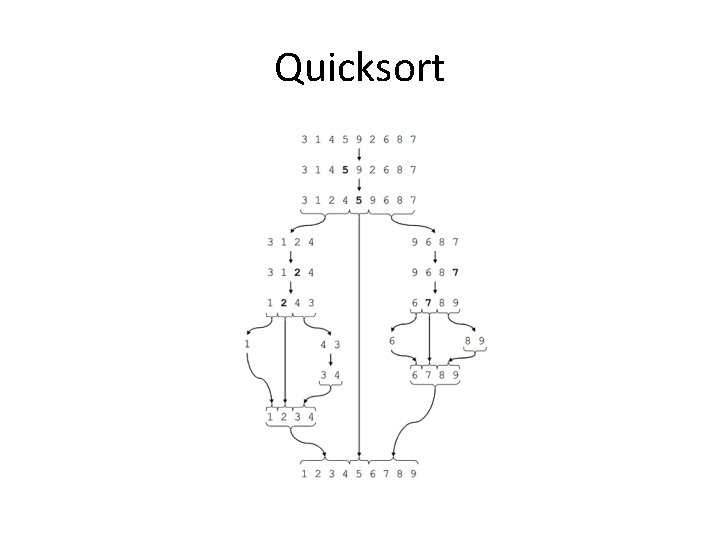
Quicksort • Divide and conquer approach to sorting • Pick a pivot in the list • Ensure all elements to the left of the pivot are less than the pivot • Ensure all the elements to the right of the pivot are greater than the pivot • Recursively repeat this process on each sub-array
Quicksort
Quicksort Animation • http: //coderaptors. com/? Quick. Sort
Quicksort Recursion • Basecase – Array is 0 or 1 elements • Recursive logic – Use quicksort on the left side of the pivot – Use quicksort on the right side of the pivot
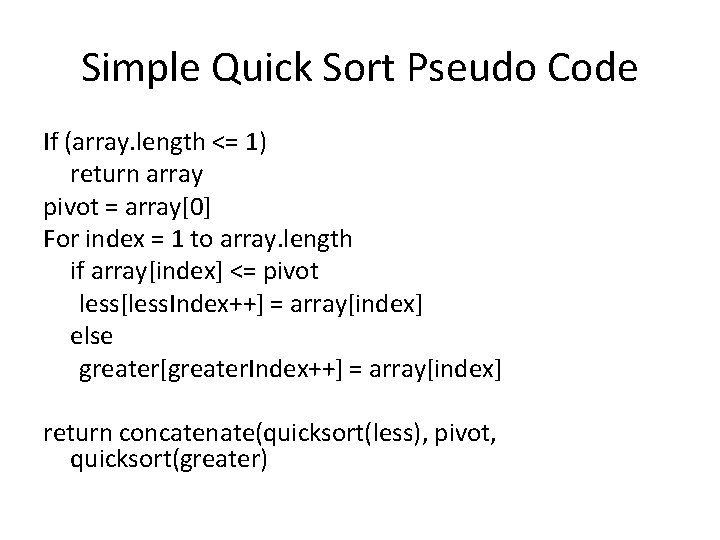
Quicksort Algorithm If the array is <= 1, return the array Pick a pivot in the array Partition the array into two arrays, one less than and one greater than the pivot Quicksort the less array Quicksort the greater array Concatenate less array, pivot and greater array
How would you pick the pivot? • Goal is to pick a pivot that will result in two arrays of roughly equal size
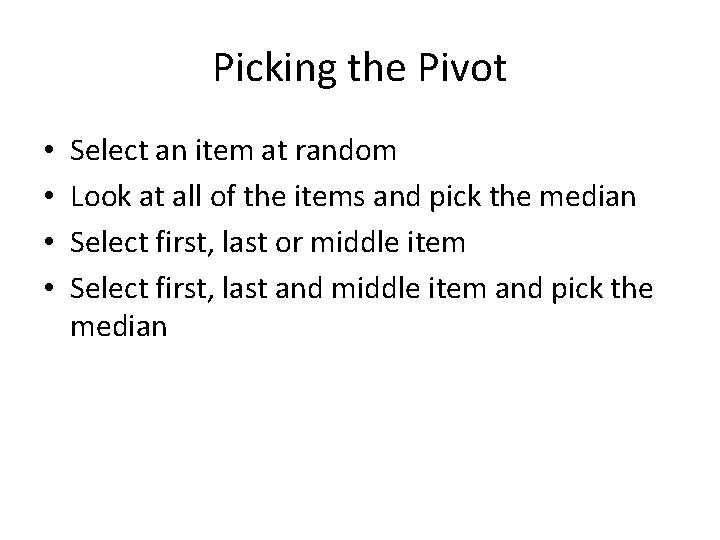
Picking the Pivot • • Select an item at random Look at all of the items and pick the median Select first, last or middle item Select first, last and middle item and pick the median
Simple Quick Sort Pseudo Code If (array. length <= 1) return array pivot = array[0] For index = 1 to array. length if array[index] <= pivot less[less. Index++] = array[index] else greater[greater. Index++] = array[index] return concatenate(quicksort(less), pivot, quicksort(greater)
Quicksort Complexity • What is the time complexity? – How many comparisons? – How many exchanges? – What’s the worst case? • What is the space complexity? – Is the data exchanged in-place? – Does the algorithm require auxiliary storage?
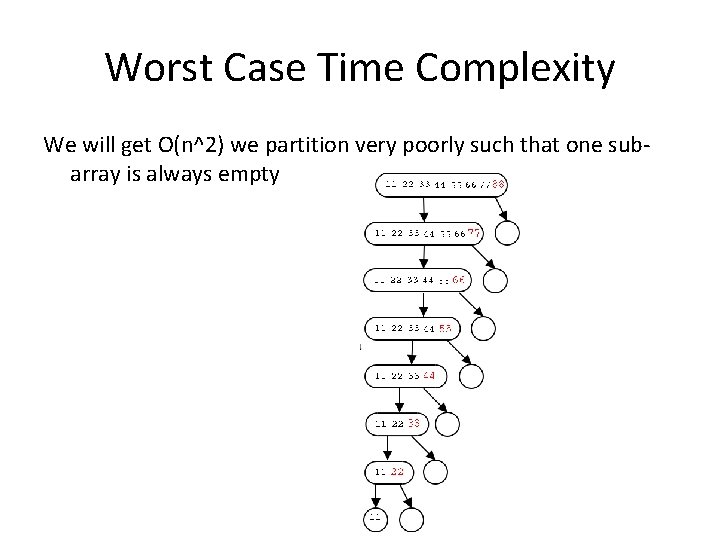
Worst Case Time Complexity We will get O(n^2) we partition very poorly such that one subarray is always empty
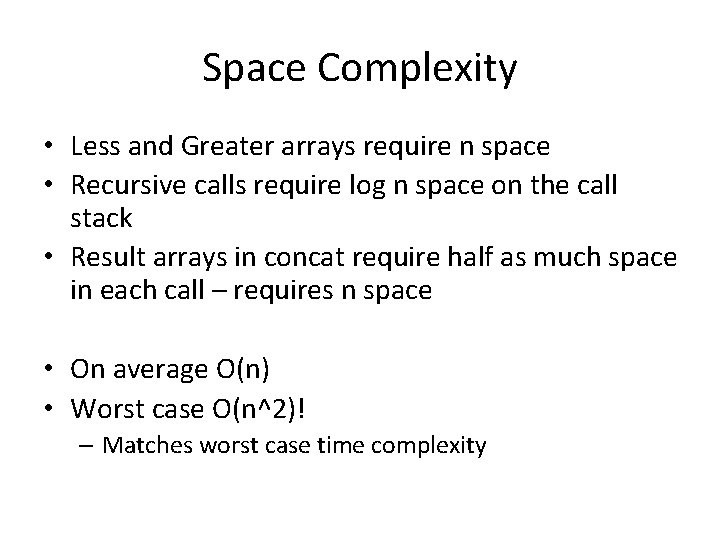
Space Complexity • Less and Greater arrays require n space • Recursive calls require log n space on the call stack • Result arrays in concat require half as much space in each call – requires n space • On average O(n) • Worst case O(n^2)! – Matches worst case time complexity
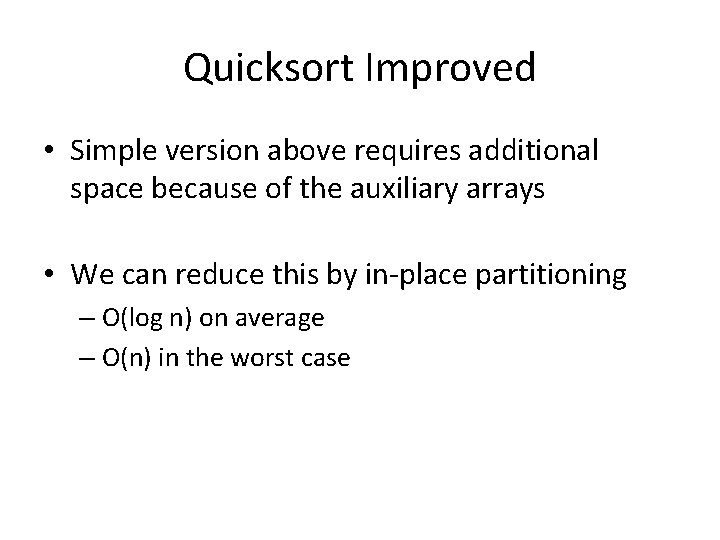
Quicksort Improved • Simple version above requires additional space because of the auxiliary arrays • We can reduce this by in-place partitioning – O(log n) on average – O(n) in the worst case
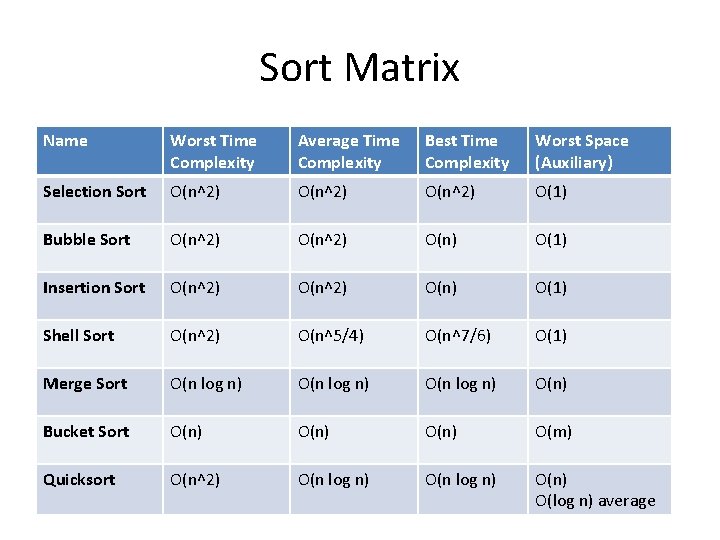
Sort Matrix Name Worst Time Complexity Average Time Complexity Best Time Complexity Worst Space (Auxiliary) Selection Sort O(n^2) O(1) Bubble Sort O(n^2) O(n) O(1) Insertion Sort O(n^2) O(n) O(1) Shell Sort O(n^2) O(n^5/4) O(n^7/6) O(1) Merge Sort O(n log n) O(n) Bucket Sort O(n) O(m) Quicksort O(n^2) O(n log n) O(n) O(log n) average