SLOVENIAN MOUNTAINS INTRODUCTION Slovenia is a small country
- Slides: 43
SLOVENIAN MOUNTAINS
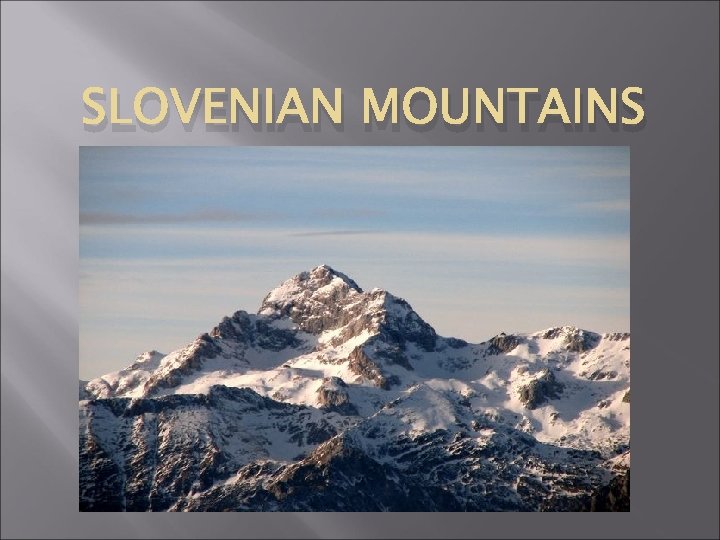
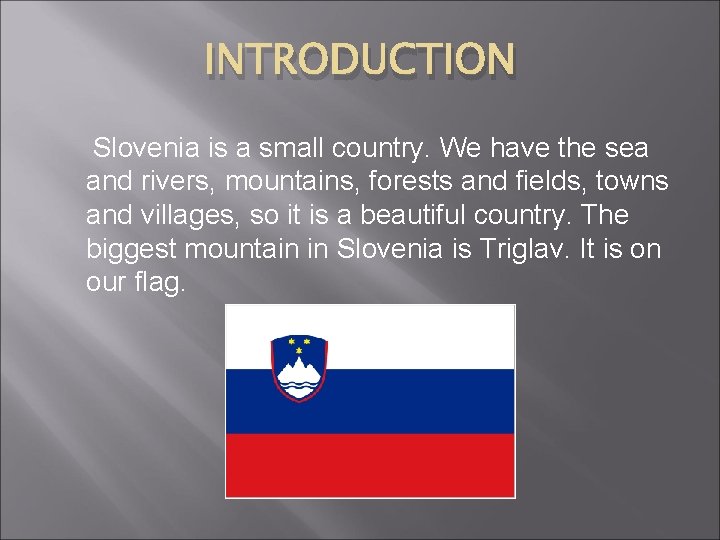
INTRODUCTION Slovenia is a small country. We have the sea and rivers, mountains, forests and fields, towns and villages, so it is a beautiful country. The biggest mountain in Slovenia is Triglav. It is on our flag.
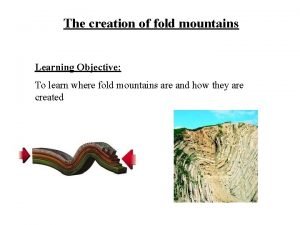
THE ALPS The Alps are stretching from Austria over Slovenia to the east. It is surprising to know that the Alps were created by the mezozoic sediments. Later, tectonic forces created cracks and wide slits and transformed them into different facets. The Alps are made of limestone. The limestone is very breakable, so we must have suitable equipment for climbing in the Alps.
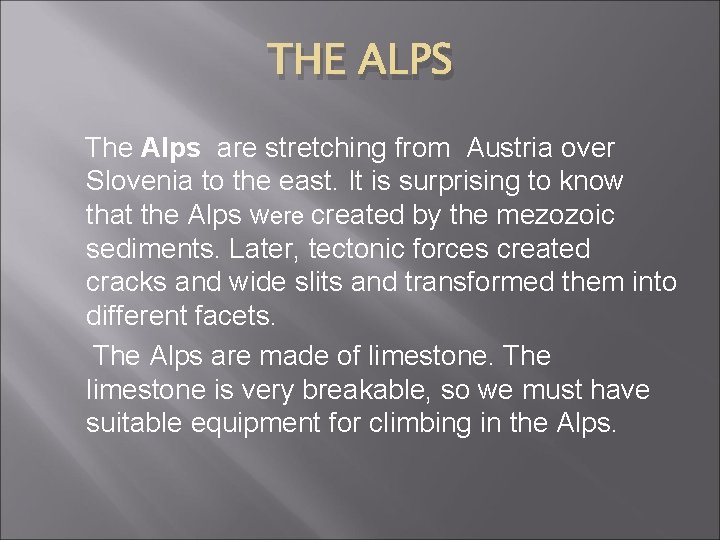
The Julian Alps are a part of the great Alpine arc. A range of about 150 mountains extends in the Northwest of Slovenia. The surface area is 4400 square kilometres. The entire mountain range is divided into two sections – the Western Julian Alps and the Eastern Julian Alps.
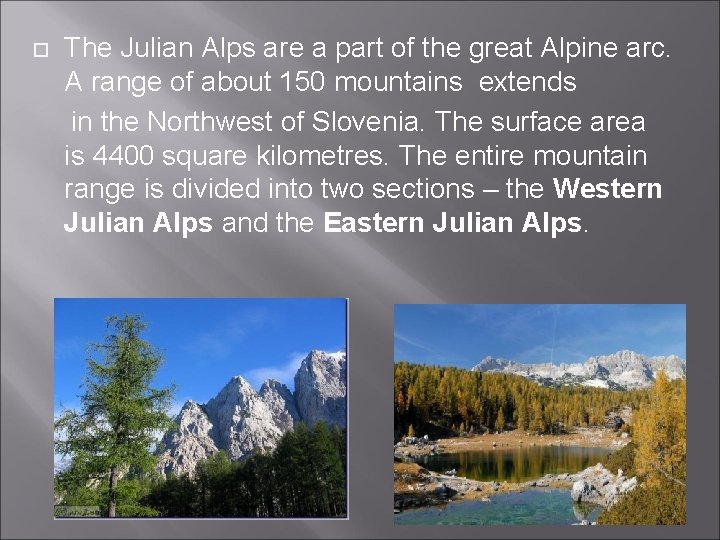
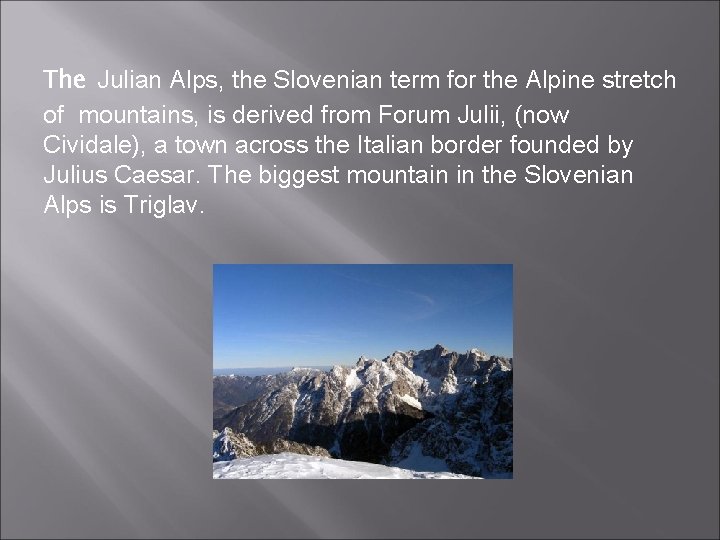
The Julian Alps, the Slovenian term for the Alpine stretch of mountains, is derived from Forum Julii, (now Cividale), a town across the Italian border founded by Julius Caesar. The biggest mountain in the Slovenian Alps is Triglav.
Slovenian Alps are divided into three groups: q Julijske alpe - there is the only national park in Slovenia called Triglavski narodni park, the highest mountain is Triglav (2864 m); q Kamniško Savinjske alpe - on the Austrian border, the highest mountain is Grintovec (2558 m); q Karavanke (Stol 2236 m ).
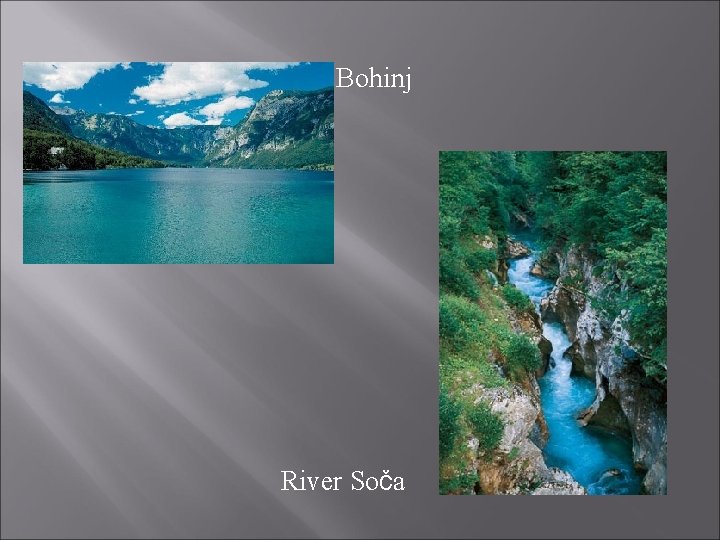
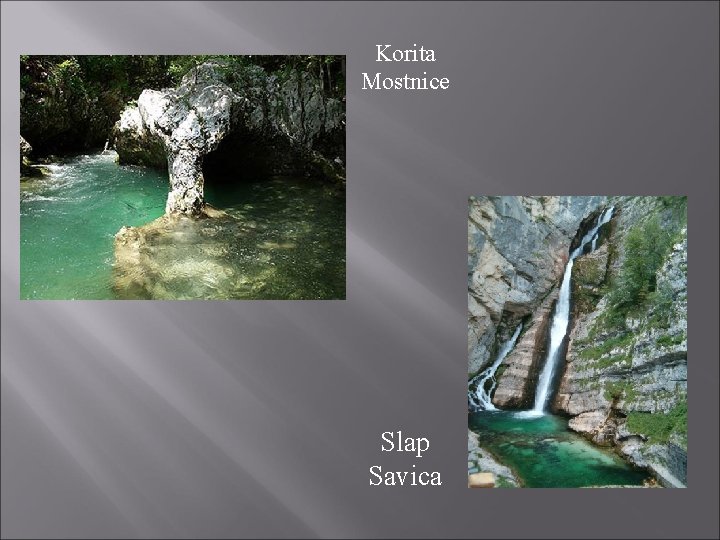
Triglavski narodni park - tourism This is the only national park in Slovenia. This national park in the area of the Julian Alps got its name from Slovenia’s highest mountain, Triglav. The most picturesque part of the park is Slovenia’s biggest glacial lake – Lake Bohinj. Various water sports are popular there in summer, while in cold winters, crowds come to ski ressorts to enjoy winter sports. Many other lakes are well known in the park, for instance Krnsko jezero. There also numerous waterfalls, two of the finest being Savica and Peričnik. One of the most popular tourist attractions is the enchanting Radovna River gorge of Blejski Vintgar. In the Soča River area, which also falls within the park, the most popular pastimes are highadrenaline sports along the Soča River. Rafting and hydrospeeding are unforgettable experiences.
Lake Bohinj River Soča
Korita Mostnice Slap Savica
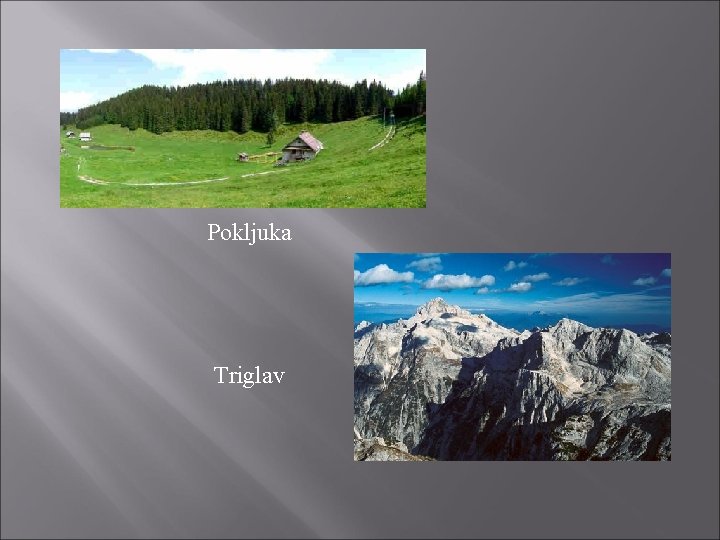
Pokljuka Triglav
Slovenian Lakes All the mountain lakes in Slovenia were derived from a glacier a long time ago. Because of the Karst surface the glacier easily carved and erased the surface. Many mountain paths to the lakes are not very easy to take, so that is why they are not very popular among tourists. However, if you manage to get there you will be awarded with a magnificent sight. The most famous glacier lakes in Slovenia are :
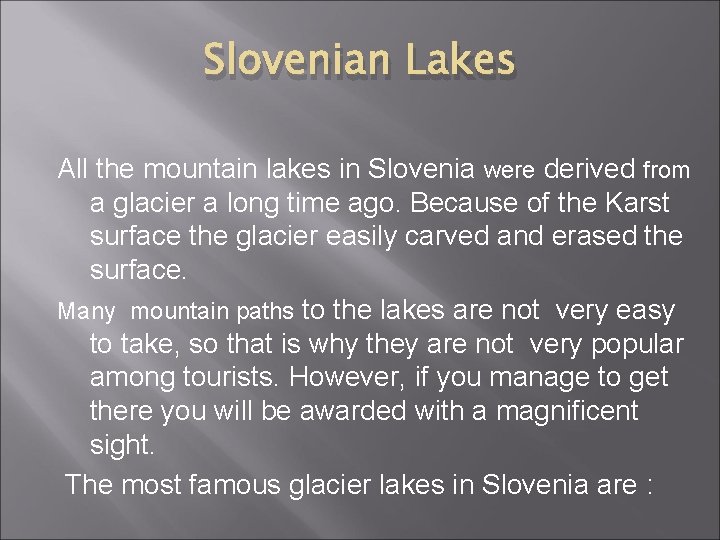
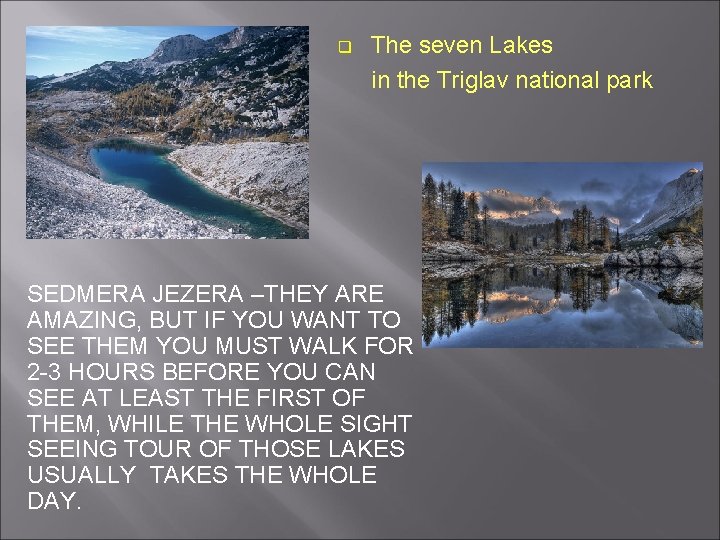
The seven Lakes in the Triglav national park q SEDMERA JEZERA –THEY ARE AMAZING, BUT IF YOU WANT TO SEE THEM YOU MUST WALK FOR 2 -3 HOURS BEFORE YOU CAN SEE AT LEAST THE FIRST OF THEM, WHILE THE WHOLE SIGHT SEEING TOUR OF THOSE LAKES USUALLY TAKES THE WHOLE DAY.
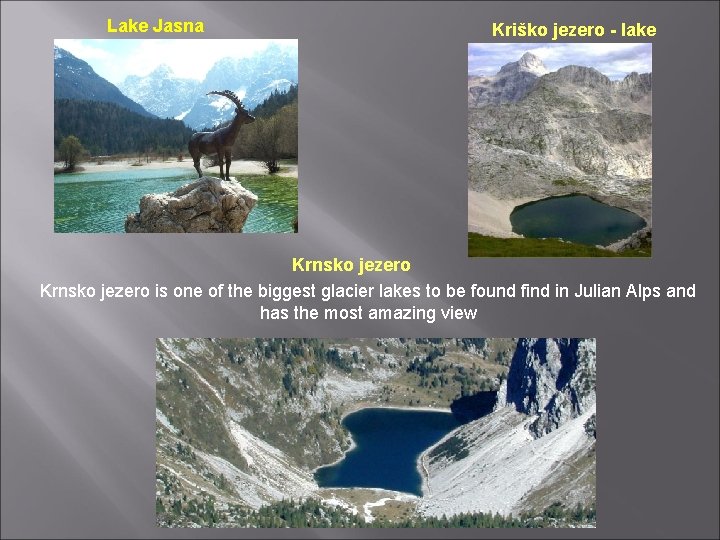
Lake Jasna Kriško jezero - lake Krnsko jezero is one of the biggest glacier lakes to be found find in Julian Alps and has the most amazing view
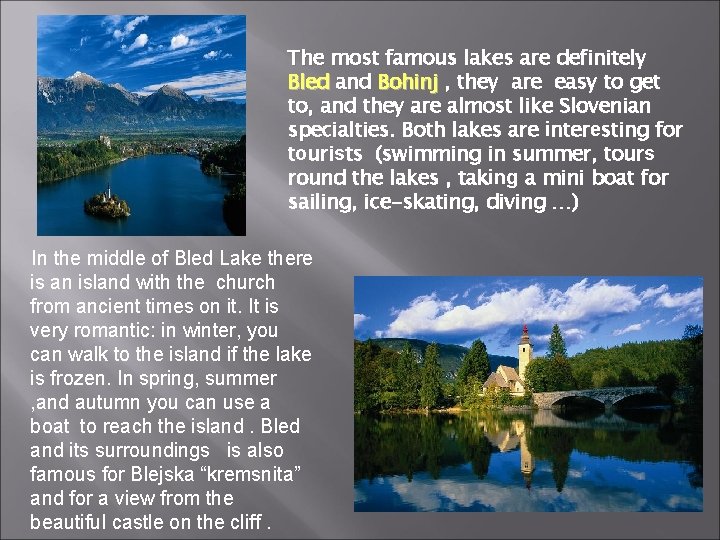
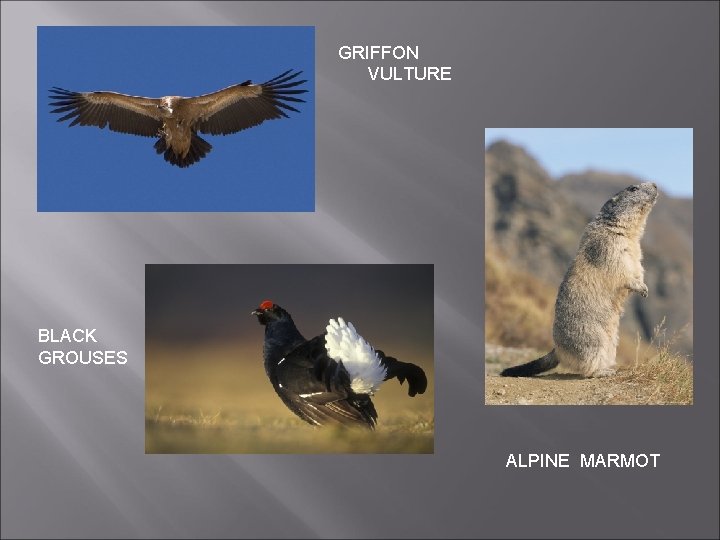
The most famous lakes are definitely Bled and Bohinj , they are easy to get to, and they are almost like Slovenian specialties. Both lakes are interesting for tourists (swimming in summer, tours round the lakes , taking a mini boat for sailing, ice-skating, diving …) In the middle of Bled Lake there is an island with the church from ancient times on it. It is very romantic: in winter, you can walk to the island if the lake is frozen. In spring, summer , and autumn you can use a boat to reach the island. Bled and its surroundings is also famous for Blejska “kremsnita” and for a view from the beautiful castle on the cliff.
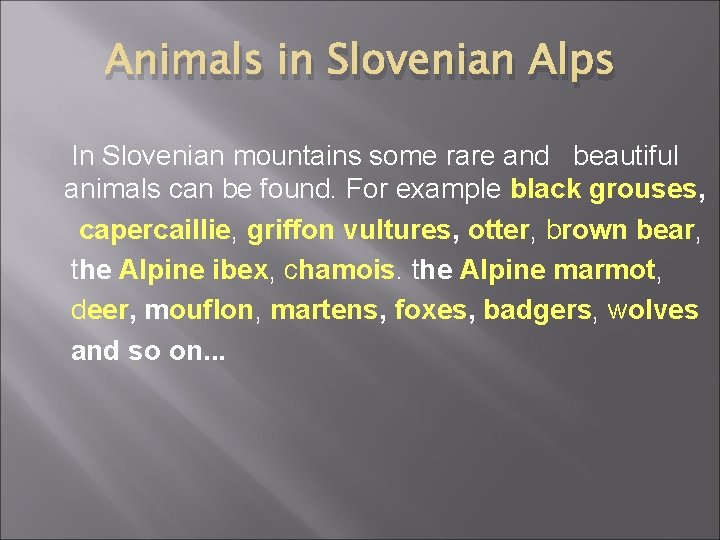
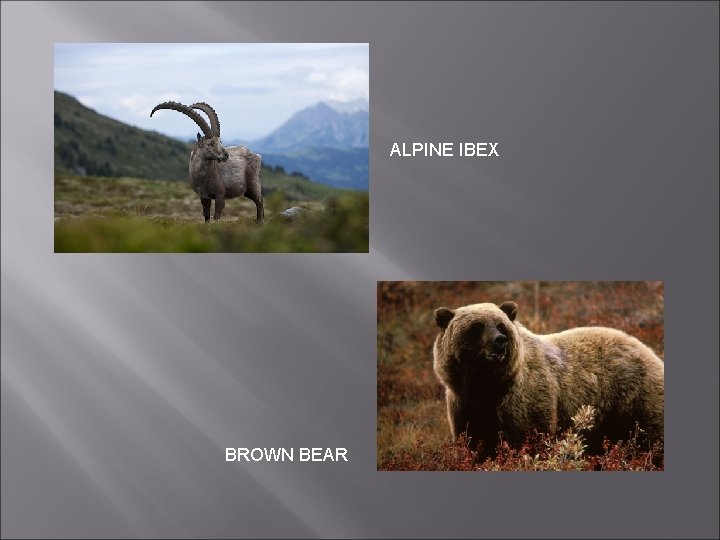
Animals in Slovenian Alps In Slovenian mountains some rare and beautiful animals can be found. For example black grouses, capercaillie, griffon vultures, otter, brown bear, the Alpine ibex, chamois. the Alpine marmot, deer, mouflon, martens, foxes, badgers, wolves and so on. . .
ALPINE IBEX BROWN BEAR
GRIFFON VULTURE BLACK GROUSES ALPINE MARMOT
Alpine flora q In the Julian Alps tree line in the most massive and highest central part reaches the maximum up to 1900 m above the sea level. q Elsewhere, the line is lower and drops up/down to 1600 m. Kamnisko Savnijske alpe are lower and there the tree line is at 1600 m. q In Karavanke the tree line is lower because the mountains are much lower than Julian Alps. q The tree line on the high Kras/Karst plateau is lower because of the human activities. Tree line is at altitudes from 1450 to 1550 m, and mainly consists of beech trees.
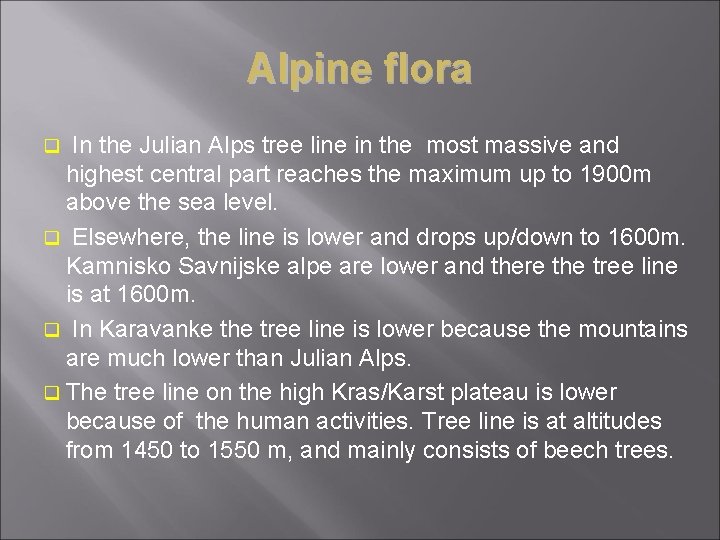
In Slovenia, according to the environmental legislation approximately 8% of the territory is protected. It occupies the largest area of Triglav National Park (83, 807 ha).
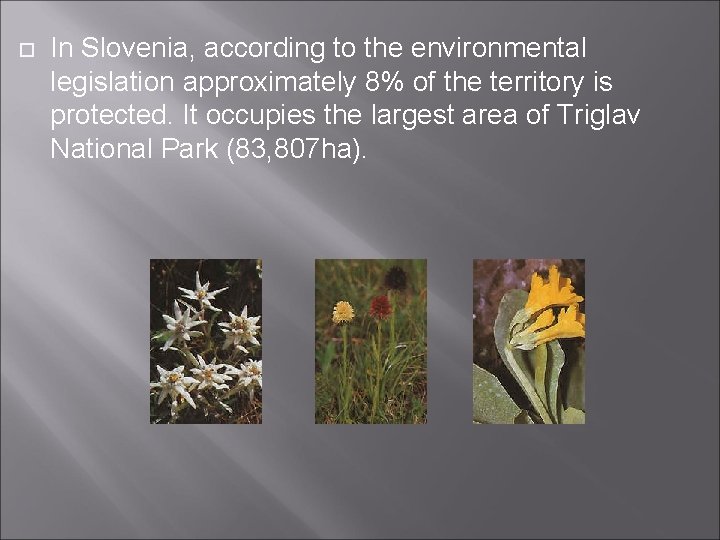
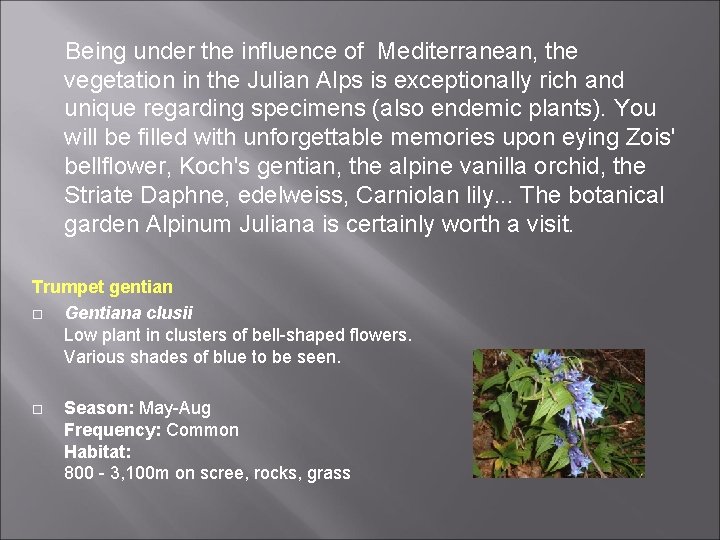
Being under the influence of Mediterranean, the vegetation in the Julian Alps is exceptionally rich and unique regarding specimens (also endemic plants). You will be filled with unforgettable memories upon eying Zois' bellflower, Koch's gentian, the alpine vanilla orchid, the Striate Daphne, edelweiss, Carniolan lily. . . The botanical garden Alpinum Juliana is certainly worth a visit. Trumpet gentian Gentiana clusii Low plant in clusters of bell-shaped flowers. Various shades of blue to be seen. Season: May-Aug Frequency: Common Habitat: 800 - 3, 100 m on scree, rocks, grass
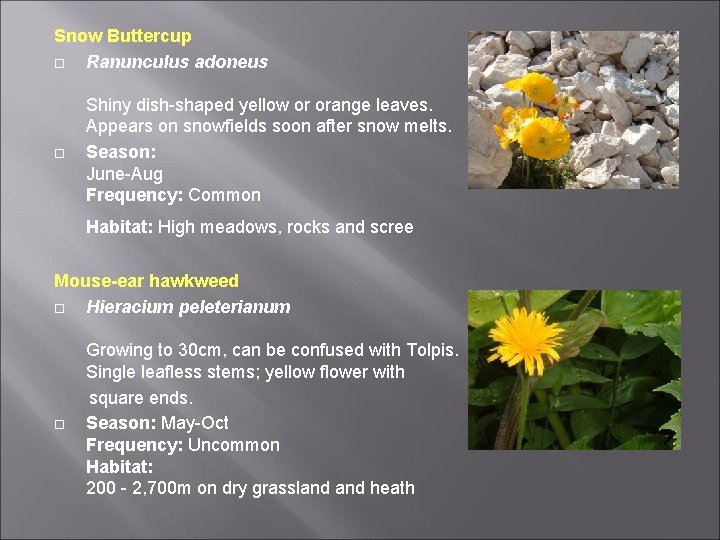
Snow Buttercup Ranunculus adoneus Shiny dish-shaped yellow or orange leaves. Appears on snowfields soon after snow melts. Season: June-Aug Frequency: Common Habitat: High meadows, rocks and scree Mouse-ear hawkweed Hieracium peleterianum Growing to 30 cm, can be confused with Tolpis. Single leafless stems; yellow flower with square ends. Season: May-Oct Frequency: Uncommon Habitat: 200 - 2, 700 m on dry grassland heath
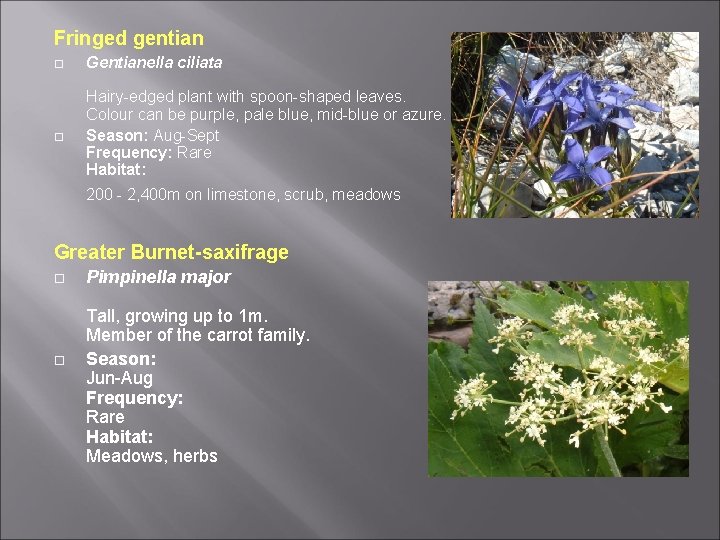
Fringed gentian Gentianella ciliata Hairy-edged plant with spoon-shaped leaves. Colour can be purple, pale blue, mid-blue or azure. Season: Aug-Sept Frequency: Rare Habitat: 200 - 2, 400 m on limestone, scrub, meadows Greater Burnet-saxifrage Pimpinella major Tall, growing up to 1 m. Member of the carrot family. Season: Jun-Aug Frequency: Rare Habitat: Meadows, herbs
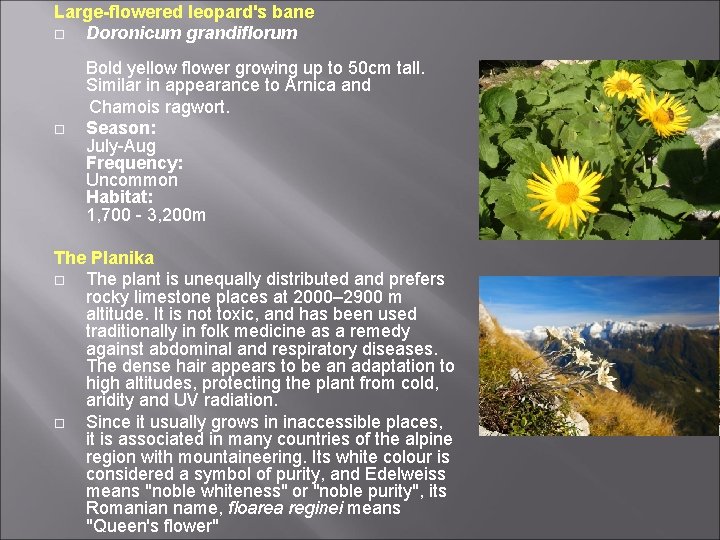
Large-flowered leopard's bane Doronicum grandiflorum Bold yellow flower growing up to 50 cm tall. Similar in appearance to Arnica and Chamois ragwort. Season: July-Aug Frequency: Uncommon Habitat: 1, 700 - 3, 200 m The Planika The plant is unequally distributed and prefers rocky limestone places at 2000– 2900 m altitude. It is not toxic, and has been used traditionally in folk medicine as a remedy against abdominal and respiratory diseases. The dense hair appears to be an adaptation to high altitudes, protecting the plant from cold, aridity and UV radiation. Since it usually grows in inaccessible places, it is associated in many countries of the alpine region with mountaineering. Its white colour is considered a symbol of purity, and Edelweiss means "noble whiteness" or "noble purity", its Romanian name, floarea reginei means "Queen's flower"
The High Tatras of Slovakia
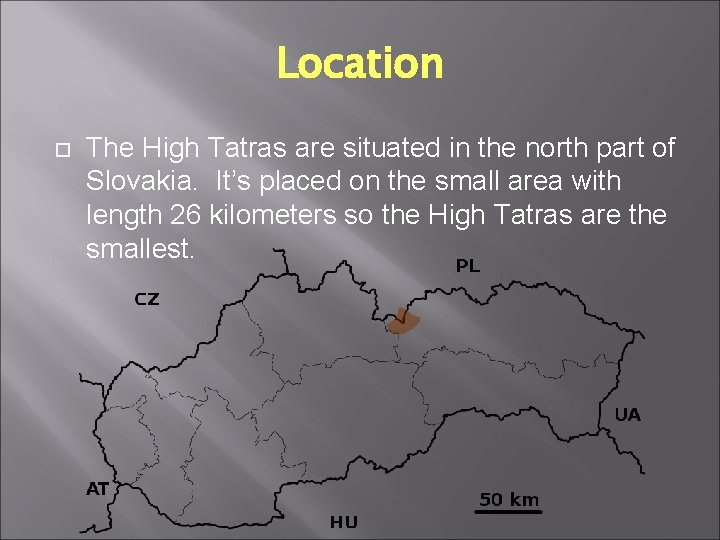
Location The High Tatras are situated in the north part of Slovakia. It’s placed on the small area with length 26 kilometers so the High Tatras are the smallest.
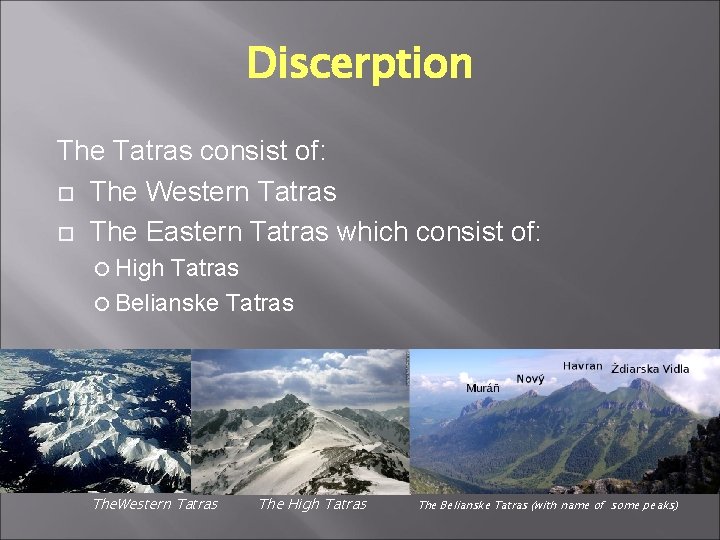
Discerption The Tatras consist of: The Western Tatras The Eastern Tatras which consist of: High Tatras Belianske Tatras The. Western Tatras The High Tatras The Belianske Tatras (with name of some peaks)
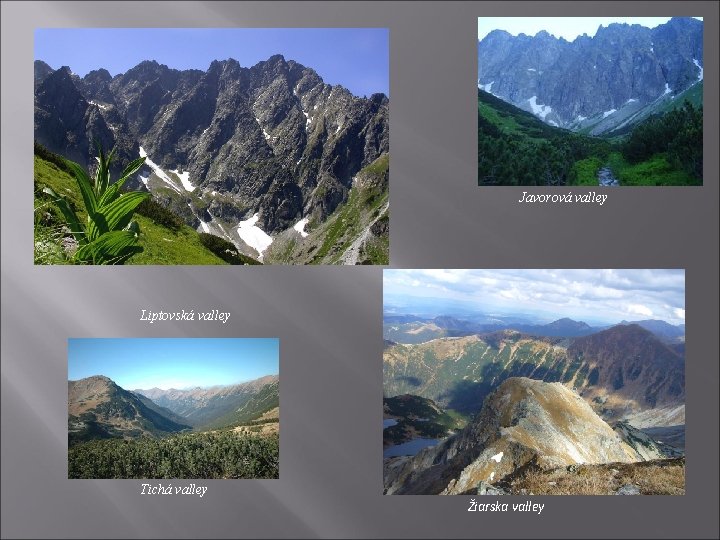
Relief Tatras relief is the work of rivers and mountain glaciers. There were together 41 mountain glaciers which rolled down the valleys and created a distinctive V-shaped valley, U. In several places the moraine walls consisting of huge boulders, gravel and clay.
Javorová valley Liptovská valley Tichá valley Žiarska valley
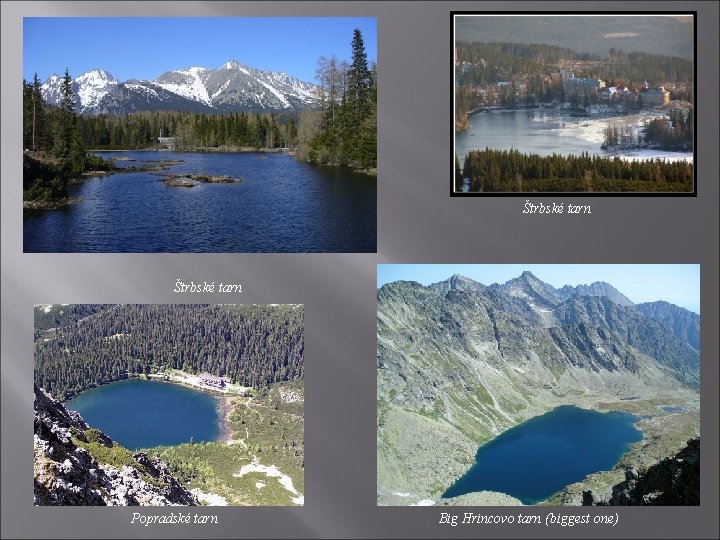
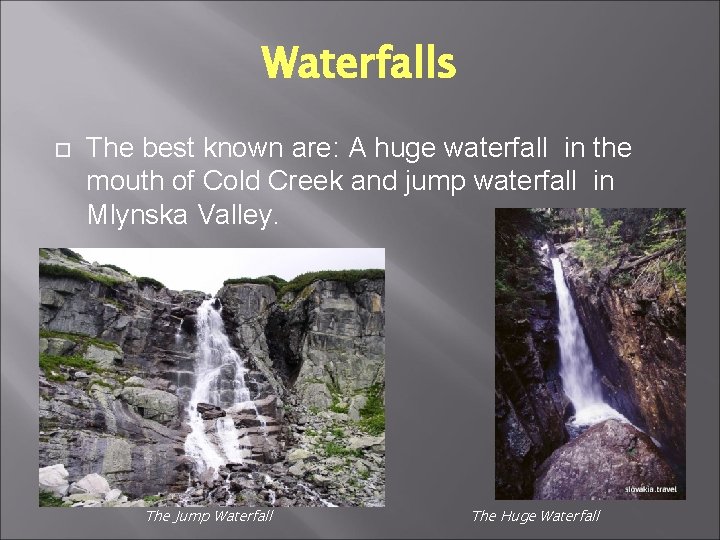
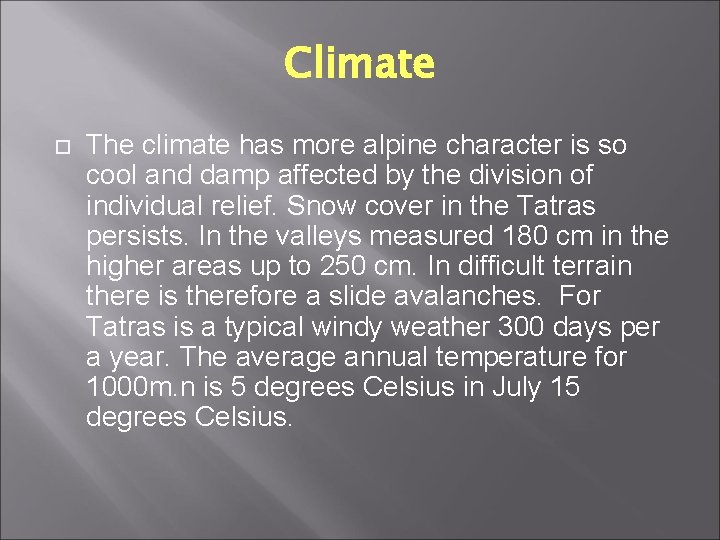
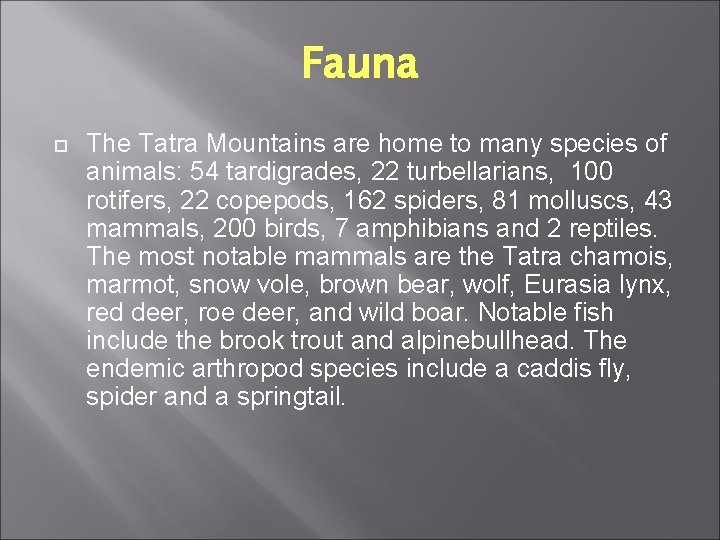
Tarns In Quaternary the early warming was melting of glaciers. In some places are glacial lakes- tarns. In the Tatra Mountains is more than 200 lakes. Largest in the territory of Slovakia is Large Hincovo tarn in Mengus valley. They are also known Nižné and Vyšné Tarn, Štrbské tarn, Popradské tarn, Rocky and Green Tarn. The territory of Tatras belongs to the Drainage area Black Sea and Baltic Sea. Many famous rivers rise in the Tatras. For example, Vah.
Štrbské tarn Popradské tarn Big Hrincovo tarn (biggest one)
Waterfalls The best known are: A huge waterfall in the mouth of Cold Creek and jump waterfall in Mlynska Valley. The Jump Waterfall The Huge Waterfall
Climate The climate has more alpine character is so cool and damp affected by the division of individual relief. Snow cover in the Tatras persists. In the valleys measured 180 cm in the higher areas up to 250 cm. In difficult terrain there is therefore a slide avalanches. For Tatras is a typical windy weather 300 days per a year. The average annual temperature for 1000 m. n is 5 degrees Celsius in July 15 degrees Celsius.
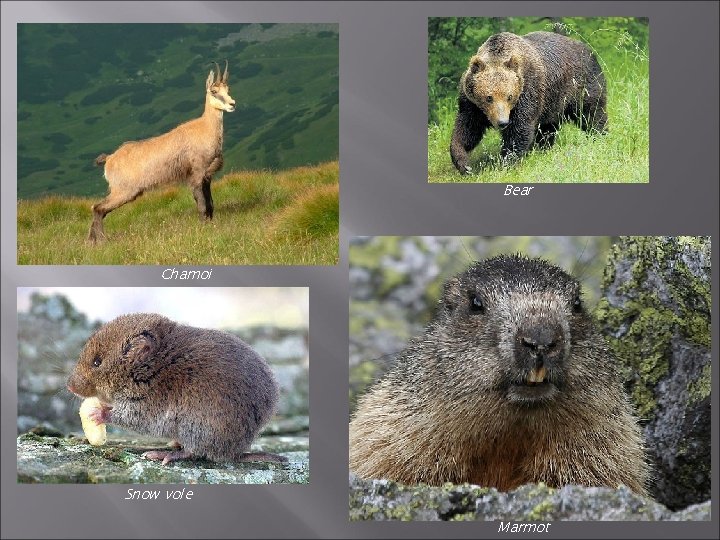
Fauna The Tatra Mountains are home to many species of animals: 54 tardigrades, 22 turbellarians, 100 rotifers, 22 copepods, 162 spiders, 81 molluscs, 43 mammals, 200 birds, 7 amphibians and 2 reptiles. The most notable mammals are the Tatra chamois, marmot, snow vole, brown bear, wolf, Eurasia lynx, red deer, roe deer, and wild boar. Notable fish include the brook trout and alpinebullhead. The endemic arthropod species include a caddis fly, spider and a springtail.
Bear Chamoi Snow vole Marmot
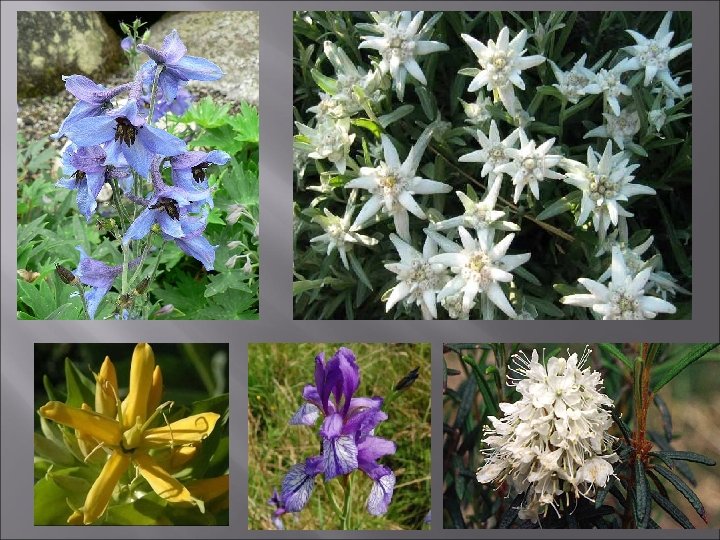
Flora The Mountains have a diverse variety of plants. They are home to more than 1, 000 species of vascular plants, about 450 mosses, 200 liverworts, 700 lichens, 900 fungi, and 70 slime moulds. There are five climatic-vegetation belts in the Tatras: The distribution of plants depends on altitude: up to 1, 300 m: Carpathian beech forest; almost no shrub layer, herb layer occupies most of the forest floor to 1, 550 m: Spruce forest; shrub layer poorly developed, mosses are a major component to 1, 800 m: Mountain Pine, numerous herbs to 2, 300 m: high altitude grasslands from 2, 300 m up: Subnivean - bare rock and almost no vegetation (mostly lichens)
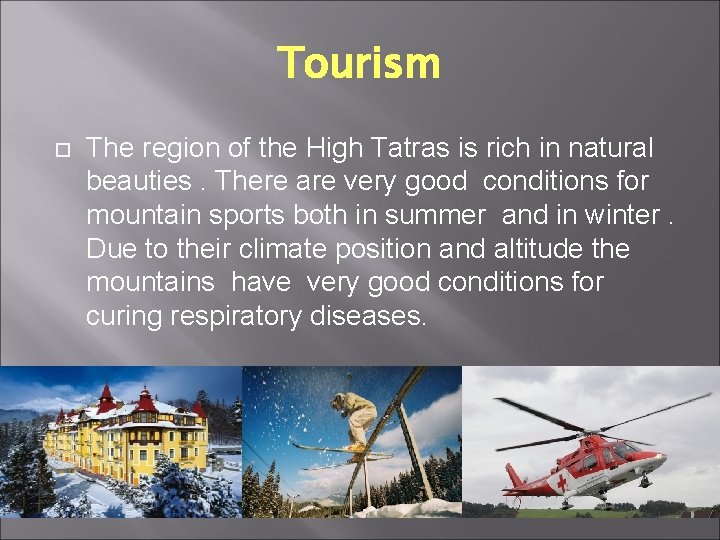
Tourism The region of the High Tatras is rich in natural beauties. There are very good conditions for mountain sports both in summer and in winter. Due to their climate position and altitude the mountains have very good conditions for curing respiratory diseases.
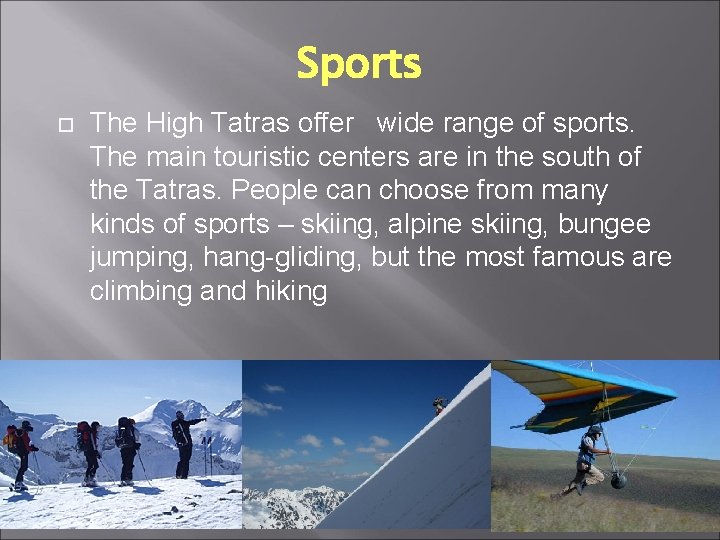
Sports The High Tatras offer wide range of sports. The main touristic centers are in the south of the Tatras. People can choose from many kinds of sports – skiing, alpine skiing, bungee jumping, hang-gliding, but the most famous are climbing and hiking
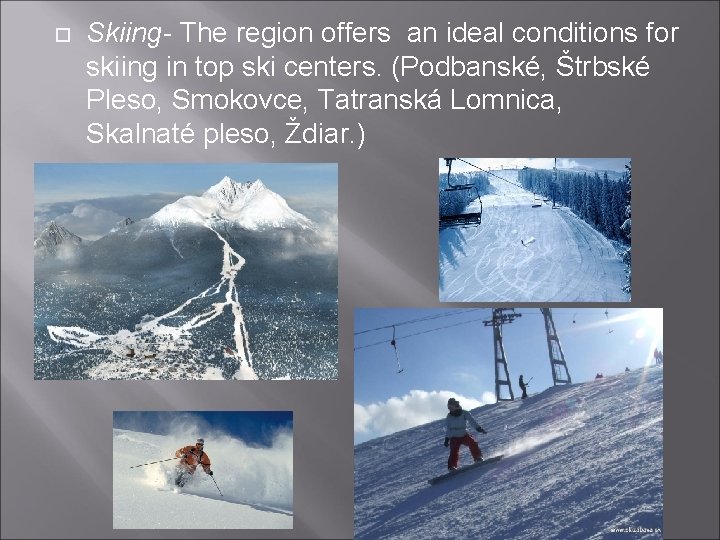
Skiing- The region offers an ideal conditions for skiing in top ski centers. (Podbanské, Štrbské Pleso, Smokovce, Tatranská Lomnica, Skalnaté pleso, Ždiar. )
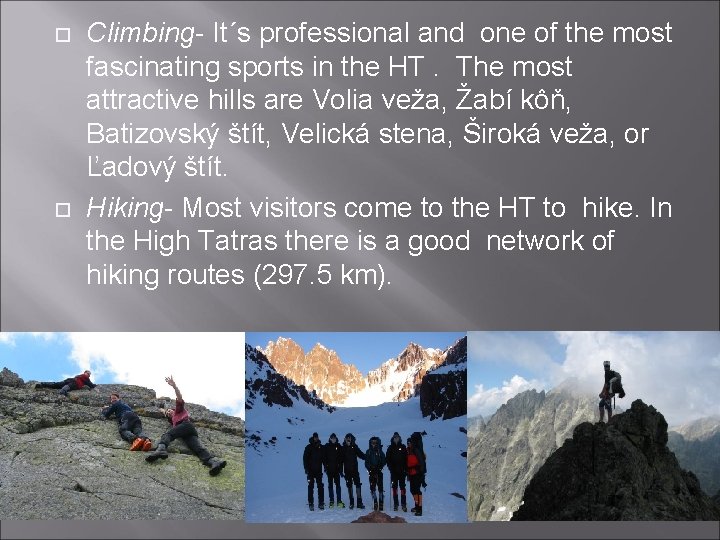
Climbing- It´s professional and one of the most fascinating sports in the HT. The most attractive hills are Volia veža, Žabí kôň, Batizovský štít, Velická stena, Široká veža, or Ľadový štít. Hiking- Most visitors come to the HT to hike. In the High Tatras there is a good network of hiking routes (297. 5 km).
The most frequently visited places Popradské pleso- it´s a starting-point for important hiking tours. There is a symbolic cementery where people can see memorial boards of people who died in the HT Štrbské pleso- it´s a tourist and medical centre. It is famous for its sports complex and one of the world winter events is held there every year. The area has six ski tows and chairlifts. Skalnaté pleso- it´s the ski resort with the highest altitude and also the best downhill skiing resort.
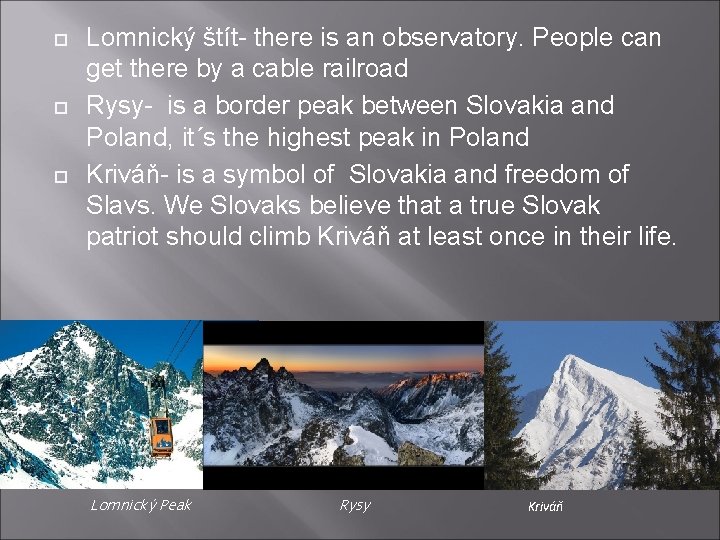
Lomnický štít- there is an observatory. People can get there by a cable railroad Rysy- is a border peak between Slovakia and Poland, it´s the highest peak in Poland Kriváň- is a symbol of Slovakia and freedom of Slavs. We Slovaks believe that a true Slovak patriot should climb Kriváň at least once in their life. Lomnický Peak Rysy Kriváň
Museums The museum of Liptovská dedina village was opened when LM dam was constructed. Some characteristic houses of the villages where moved to the museum because the villages were flooded during the construction of the dam. The museum of TANAP pictures Tatra´s nature and history of human relations to nature.