Slide 32 1 Chapter 32 Errors not affecting

- Slides: 15
Slide 32. 1 Chapter 32 Errors not affecting the balancing of the trial balance Frank Wood and Alan Sangster , Frank Wood’s Business Accounting 1 , 12 th Edition, © Pearson Education Limited 2012
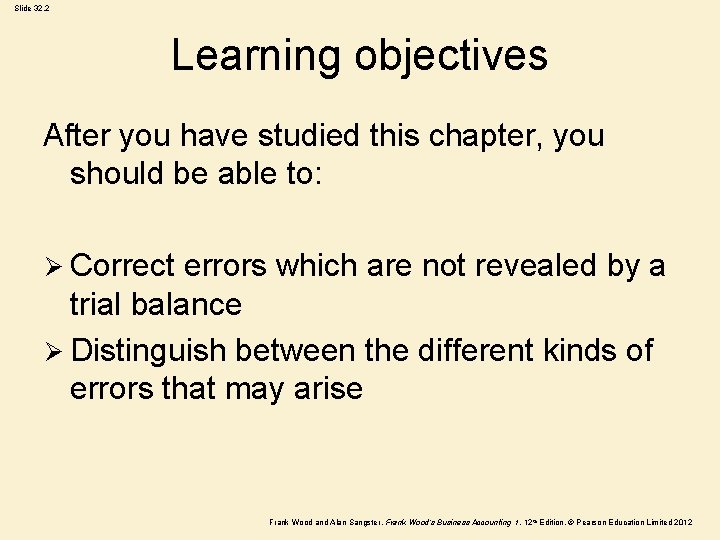
Slide 32. 2 Learning objectives After you have studied this chapter, you should be able to: Ø Correct errors which are not revealed by a trial balance Ø Distinguish between the different kinds of errors that may arise Frank Wood and Alan Sangster , Frank Wood’s Business Accounting 1 , 12 th Edition, © Pearson Education Limited 2012
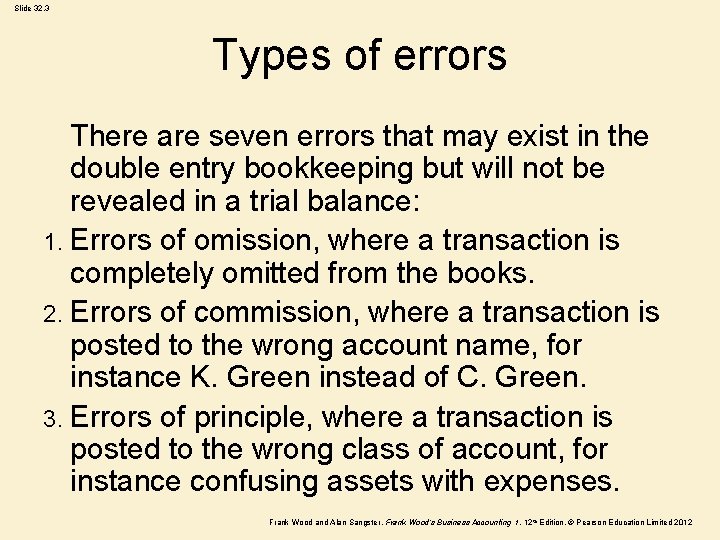
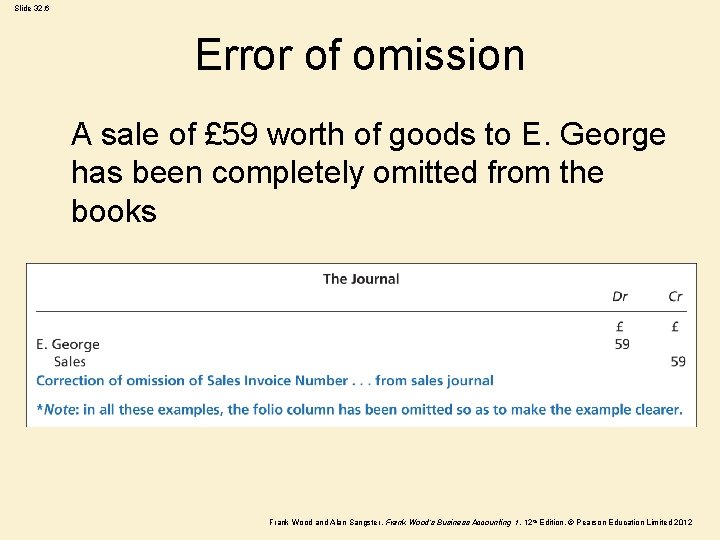
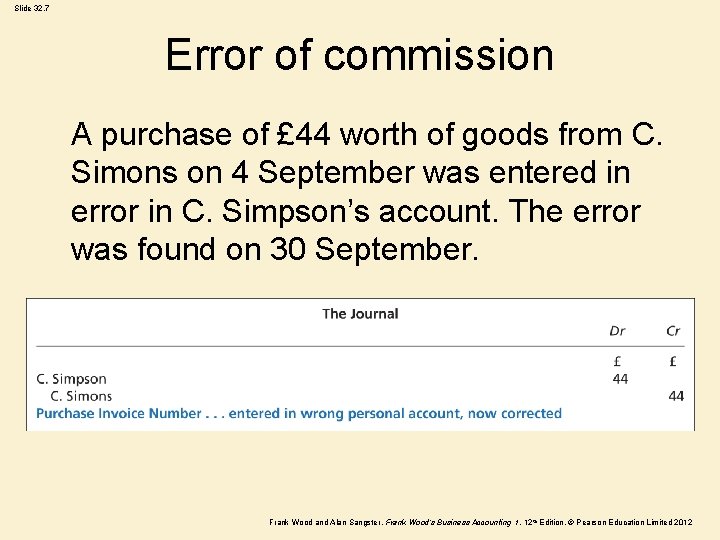
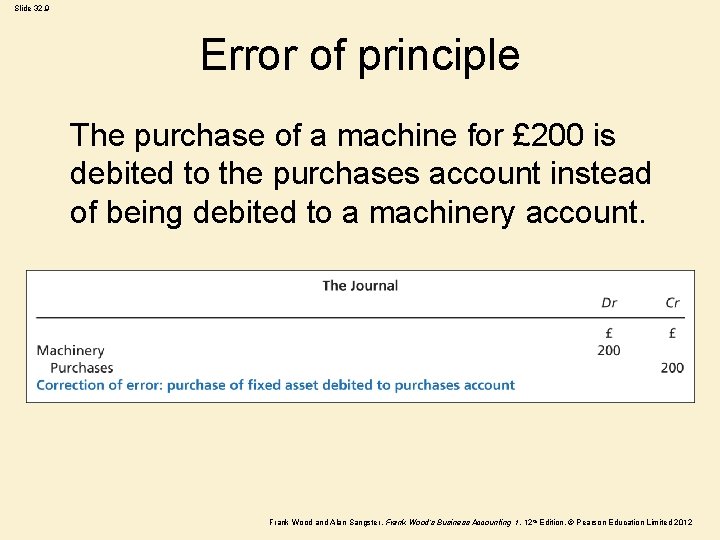
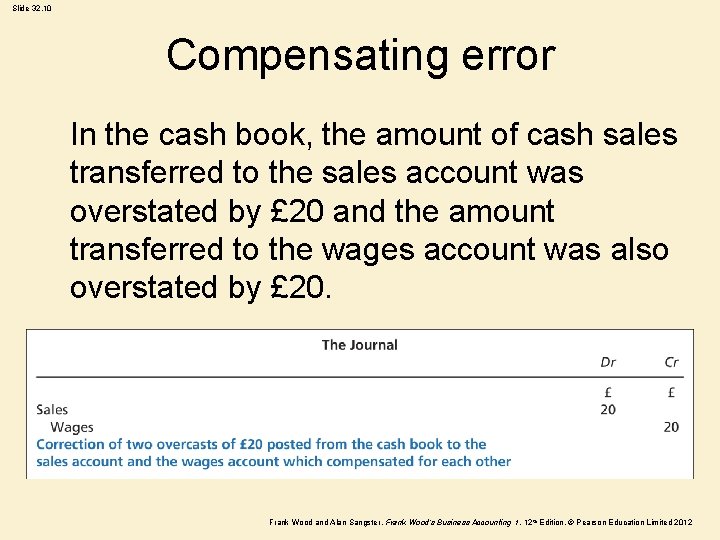
Slide 32. 3 Types of errors There are seven errors that may exist in the double entry bookkeeping but will not be revealed in a trial balance: 1. Errors of omission, where a transaction is completely omitted from the books. 2. Errors of commission, where a transaction is posted to the wrong account name, for instance K. Green instead of C. Green. 3. Errors of principle, where a transaction is posted to the wrong class of account, for instance confusing assets with expenses. Frank Wood and Alan Sangster , Frank Wood’s Business Accounting 1 , 12 th Edition, © Pearson Education Limited 2012
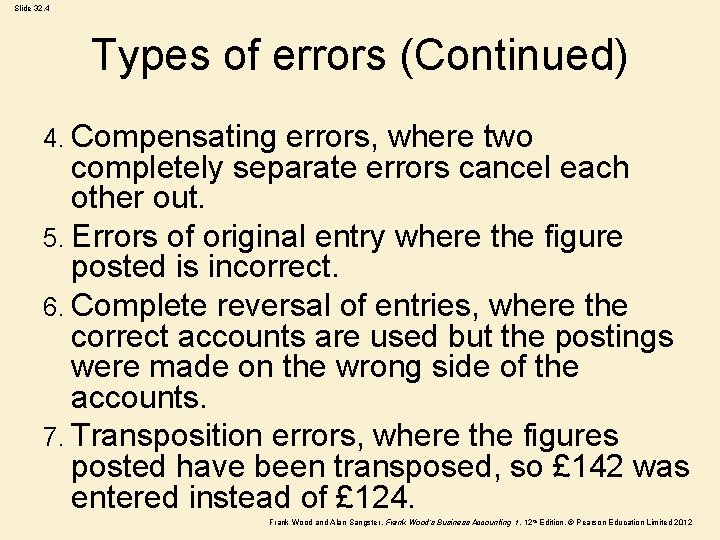
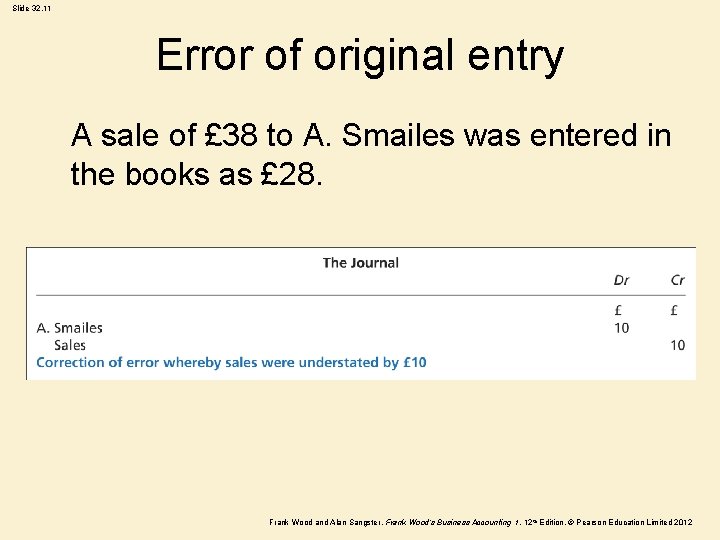
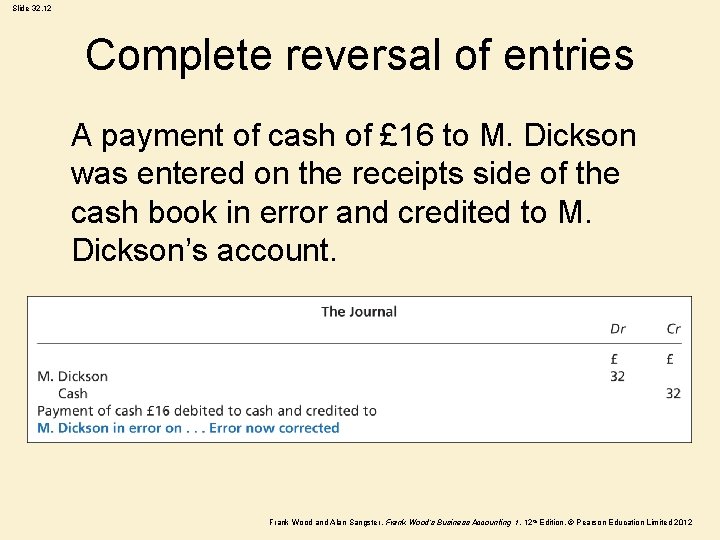
Slide 32. 4 Types of errors (Continued) 4. Compensating errors, where two completely separate errors cancel each other out. 5. Errors of original entry where the figure posted is incorrect. 6. Complete reversal of entries, where the correct accounts are used but the postings were made on the wrong side of the accounts. 7. Transposition errors, where the figures posted have been transposed, so £ 142 was entered instead of £ 124. Frank Wood and Alan Sangster , Frank Wood’s Business Accounting 1 , 12 th Edition, © Pearson Education Limited 2012
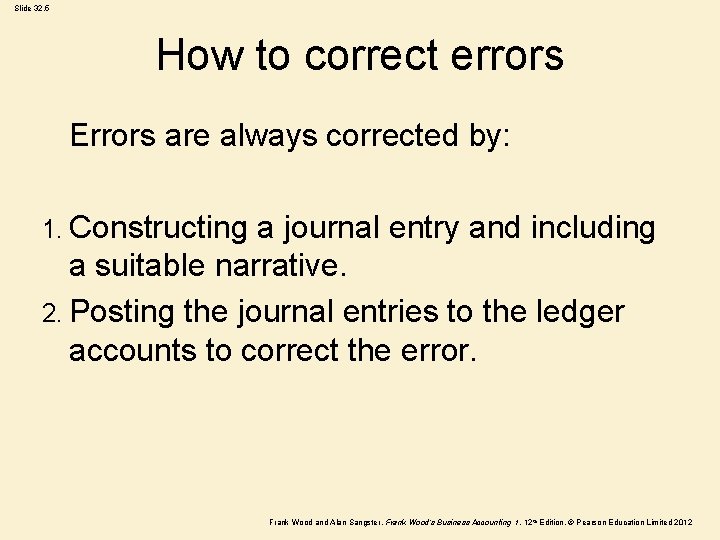
Slide 32. 5 How to correct errors Errors are always corrected by: 1. Constructing a journal entry and including a suitable narrative. 2. Posting the journal entries to the ledger accounts to correct the error. Frank Wood and Alan Sangster , Frank Wood’s Business Accounting 1 , 12 th Edition, © Pearson Education Limited 2012
Slide 32. 6 Error of omission A sale of £ 59 worth of goods to E. George has been completely omitted from the books Frank Wood and Alan Sangster , Frank Wood’s Business Accounting 1 , 12 th Edition, © Pearson Education Limited 2012
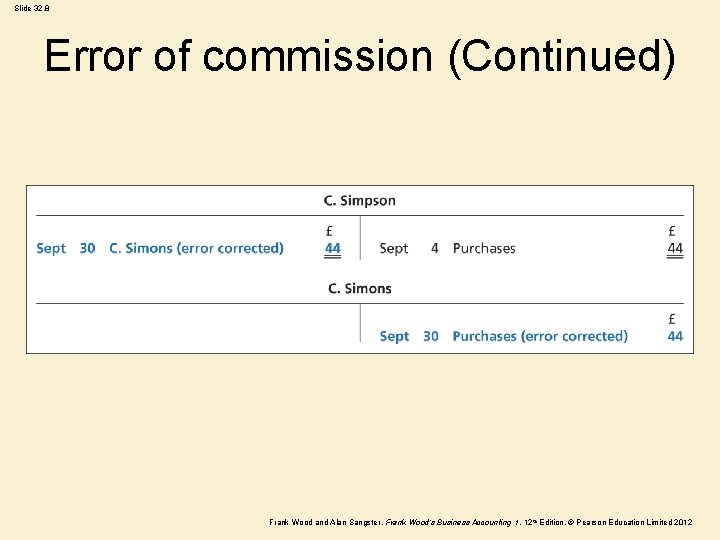
Slide 32. 7 Error of commission A purchase of £ 44 worth of goods from C. Simons on 4 September was entered in error in C. Simpson’s account. The error was found on 30 September. Frank Wood and Alan Sangster , Frank Wood’s Business Accounting 1 , 12 th Edition, © Pearson Education Limited 2012
Slide 32. 8 Error of commission (Continued) Frank Wood and Alan Sangster , Frank Wood’s Business Accounting 1 , 12 th Edition, © Pearson Education Limited 2012
Slide 32. 9 Error of principle The purchase of a machine for £ 200 is debited to the purchases account instead of being debited to a machinery account. Frank Wood and Alan Sangster , Frank Wood’s Business Accounting 1 , 12 th Edition, © Pearson Education Limited 2012
Slide 32. 10 Compensating error In the cash book, the amount of cash sales transferred to the sales account was overstated by £ 20 and the amount transferred to the wages account was also overstated by £ 20. Frank Wood and Alan Sangster , Frank Wood’s Business Accounting 1 , 12 th Edition, © Pearson Education Limited 2012
Slide 32. 11 Error of original entry A sale of £ 38 to A. Smailes was entered in the books as £ 28. Frank Wood and Alan Sangster , Frank Wood’s Business Accounting 1 , 12 th Edition, © Pearson Education Limited 2012
Slide 32. 12 Complete reversal of entries A payment of cash of £ 16 to M. Dickson was entered on the receipts side of the cash book in error and credited to M. Dickson’s account. Frank Wood and Alan Sangster , Frank Wood’s Business Accounting 1 , 12 th Edition, © Pearson Education Limited 2012
Slide 32. 13 Transposition error A credit purchase from P. Maclaran costing £ 56 was entered in the books as £ 65. Frank Wood and Alan Sangster , Frank Wood’s Business Accounting 1 , 12 th Edition, © Pearson Education Limited 2012
Slide 32. 14 Learning outcomes You should have now learnt: 1. How to describe each of a range of possible errors that can be made when recording financial transactions in the accounts that will not be detected by producing a trial balance 2. How to identify and correct each of these types of errors Frank Wood and Alan Sangster , Frank Wood’s Business Accounting 1 , 12 th Edition, © Pearson Education Limited 2012
Slide 32. 15 Learning outcomes (Continued) 3. That when errors are found, they should be amended by using proper double entry procedures 4. That all corrections of errors should take place via the Journal, where entries are first recorded before being posted to the appropriate ledger accounts Frank Wood and Alan Sangster , Frank Wood’s Business Accounting 1 , 12 th Edition, © Pearson Education Limited 2012