SIR PADAMPAT SINGHANIA UNIVERSITY UDAIPUR ENVIRONMENTAL ENGINEERINGII CE
- Slides: 19
SIR PADAMPAT SINGHANIA UNIVERSITY UDAIPUR ENVIRONMENTAL ENGINEERING-II CE – 452 By AKASH SINGH Assistant Professor Civil Department Mob No. +91 -8791385265 This work is licensed under a Creative Commons Attribution-Share. Alike 4. 0 International License. This presentation is released under Creative Commons-A 6 ribute, on 4. 0 License. You are free to use, distribute and modify it , including for commercial purposes, provided you acknowledge the source.
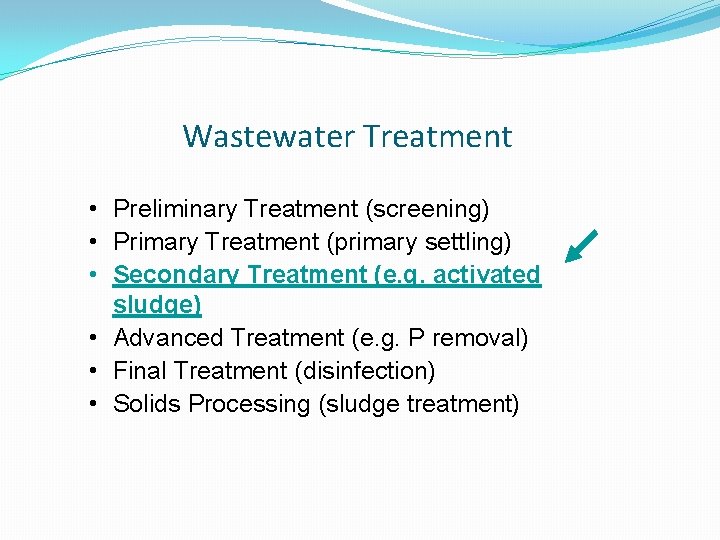
Wastewater Treatment • Preliminary Treatment (screening) • Primary Treatment (primary settling) • Secondary Treatment (e. g. activated sludge) • Advanced Treatment (e. g. P removal) • Final Treatment (disinfection) • Solids Processing (sludge treatment)
Secondary Treatment • Secondary treatment is biologica l treatment process that a dissolve organic matter from wastewater. removes d and • Sewage microorganisms are cultivated added to the wastewater. The microorganisms use organic matter from sewage as their food supply. This process leads to decomposition or biodegradation of organic wastes.
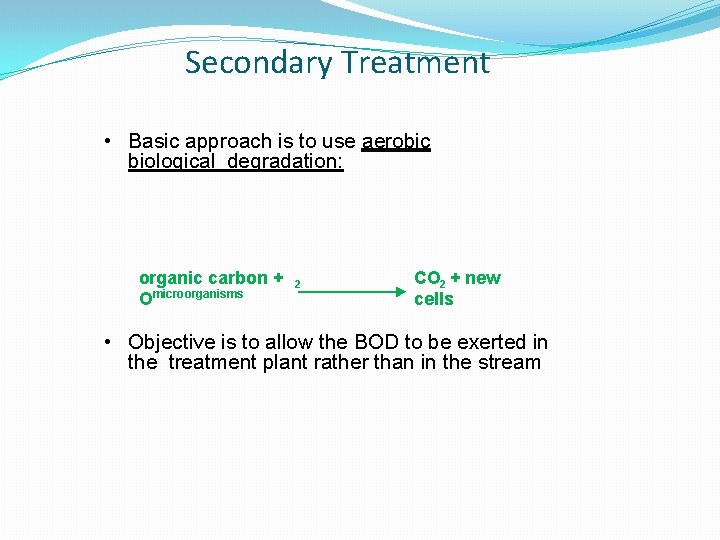
Secondary Treatment • Basic approach is to use aerobic biological degradation: organic carbon + Omicroorganisms 2 CO 2 + new cells • Objective is to allow the BOD to be exerted in the treatment plant rather than in the stream
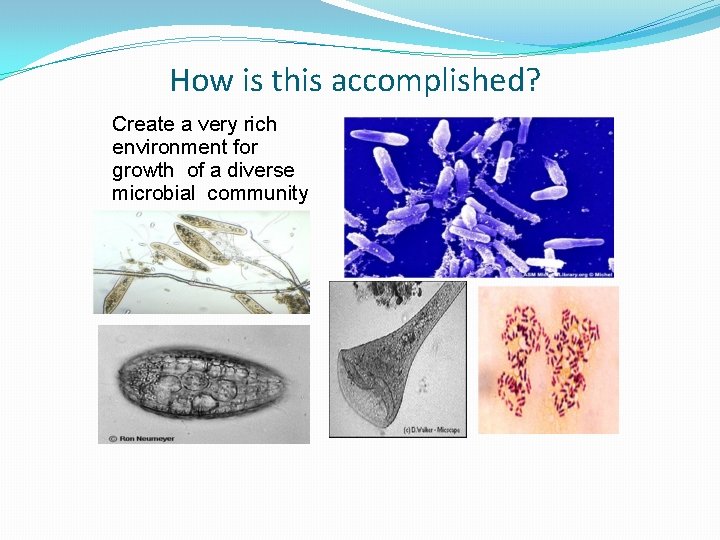
How is this accomplished? Create a very rich environment for growth of a diverse microbial community
Basic Ingredients • High density of microorganisms (keep organisms in system) • Good contact between organisms and wastes (provide mixing) • Provide high levels of oxygen (aeration) • Favorable temperature, p. H, nutrients (design and operation) • No toxic chemicals present (control industrial inputs)
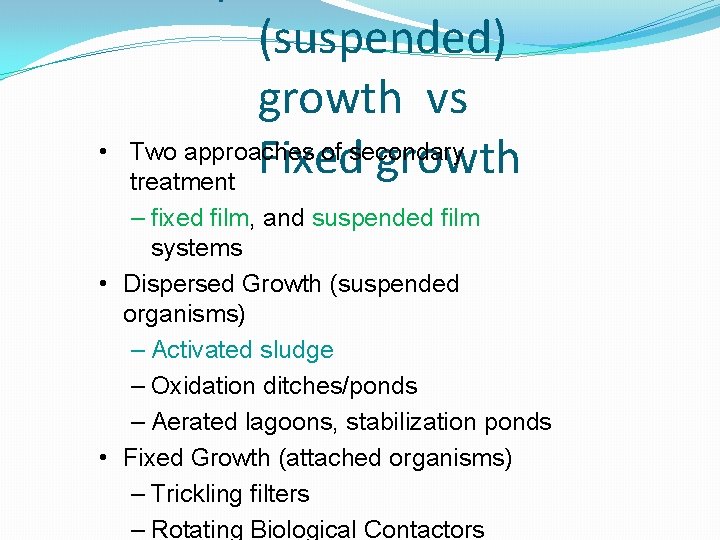
• (suspended) growth vs Two approaches of secondary Fixed growth treatment – fixed film, and suspended film systems • Dispersed Growth (suspended organisms) – Activated sludge – Oxidation ditches/ponds – Aerated lagoons, stabilization ponds • Fixed Growth (attached organisms) – Trickling filters – Rotating Biological Contactors
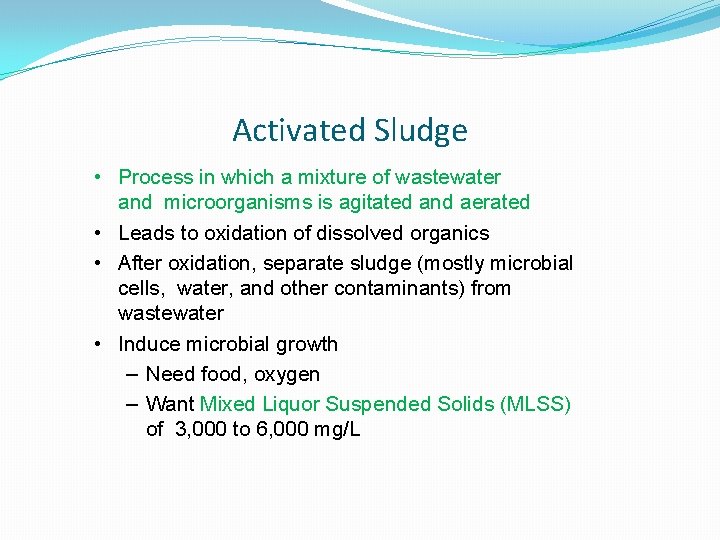
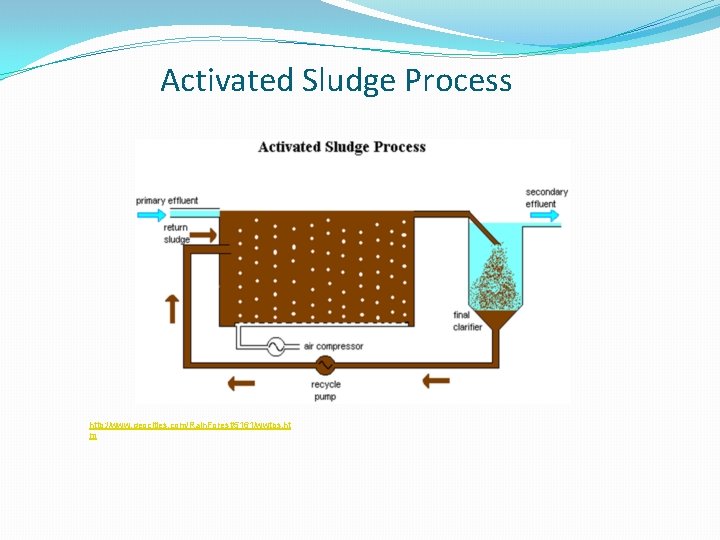
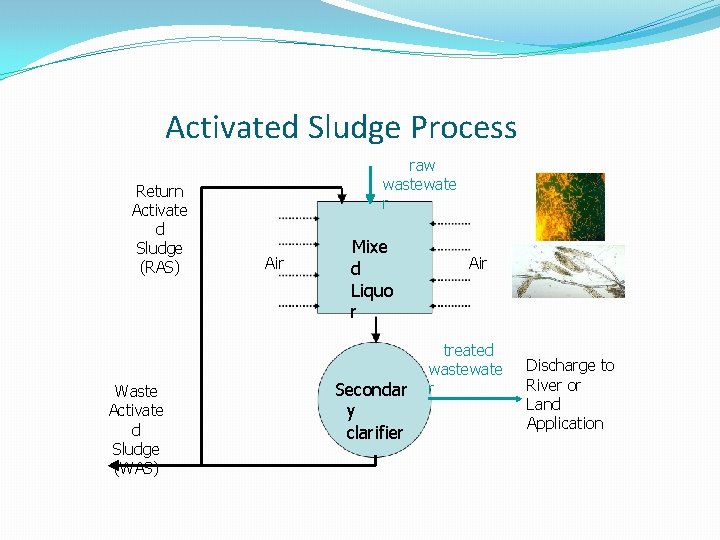
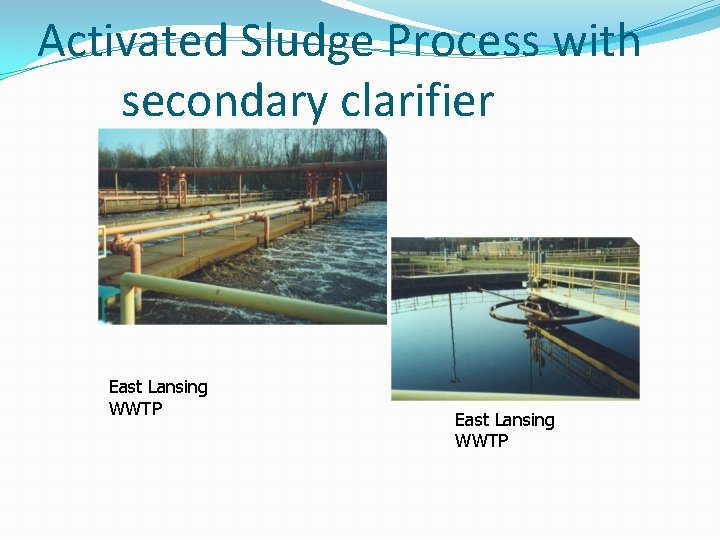
Activated Sludge • Process in which a mixture of wastewater and microorganisms is agitated and aerated • Leads to oxidation of dissolved organics • After oxidation, separate sludge (mostly microbial cells, water, and other contaminants) from wastewater • Induce microbial growth – Need food, oxygen – Want Mixed Liquor Suspended Solids (MLSS) of 3, 000 to 6, 000 mg/L
Activated Sludge Process http: //www. geocities. com/Rain. Forest/5161/wwtps. ht m
Activated Sludge Process Return Activate d Sludge (RAS) Waste Activate d Sludge (WAS) raw wastewate r Air Mixe d Liquo r Secondar y clarifier Air treated wastewate r Discharge to River or Land Application
Activated Sludge Process with secondary clarifier East Lansing WWTP
F/M Parameter • Low F/M (low rate of wasting) – starved organisms – more complete degradation – larger, more costly aeration tanks – more O 2 required – higher power costs (to supply O 2) – less sludge to handle • High F/M (high rate of wasting) – organisms are saturated with food – low treatment efficiency
Activated Sludge Design • Detention time: td = approximately 6 - 8 hr • Long rectangular aeration basins • Air is injected near bottom of aeration tanks through system of diffusers • Aeration system used to provide mixing • MLVSS and F/M controlled by wasting a portion of microorganisms
Other options
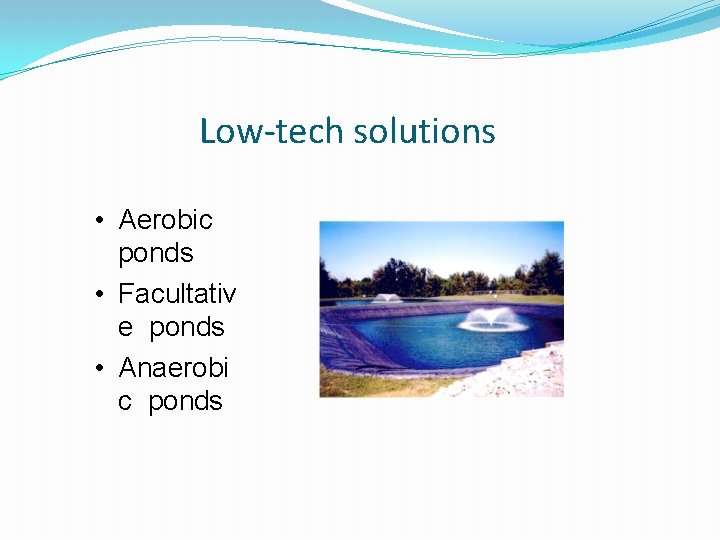
Low-tech solutions • Aerobic ponds • Facultativ e ponds • Anaerobi c ponds
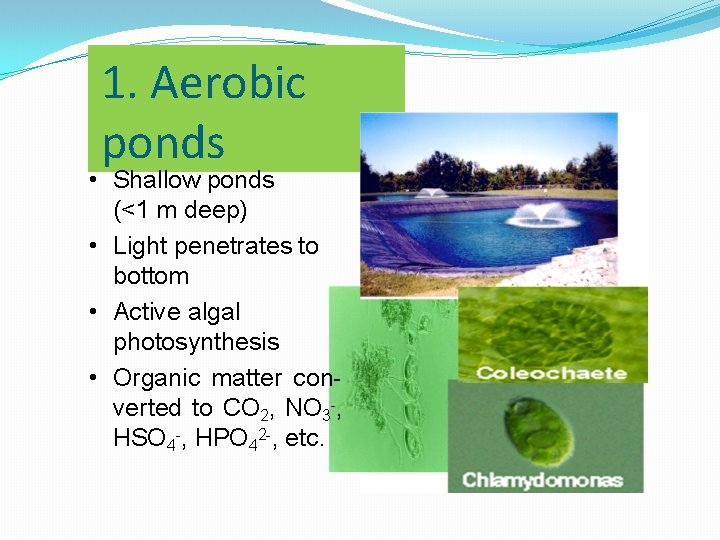
1. Aerobic ponds • Shallow ponds (<1 m deep) • Light penetrates to bottom • Active algal photosynthesis • Organic matter converted to CO 2, NO 3 -, HSO 4 -, HPO 42 -, etc.
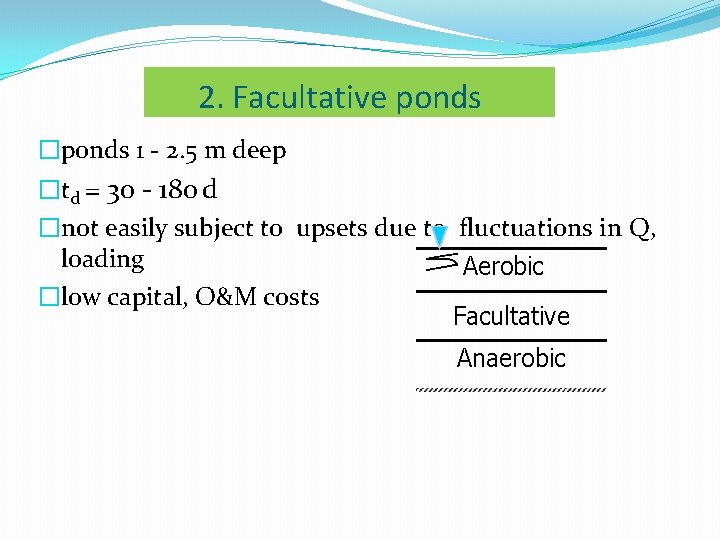
2. Facultative ponds �ponds 1 - 2. 5 m deep �td = 30 - 180 d �not easily subject to upsets due to fluctuations in Q, loading Aerobic �low capital, O&M costs Facultative Anaerobic
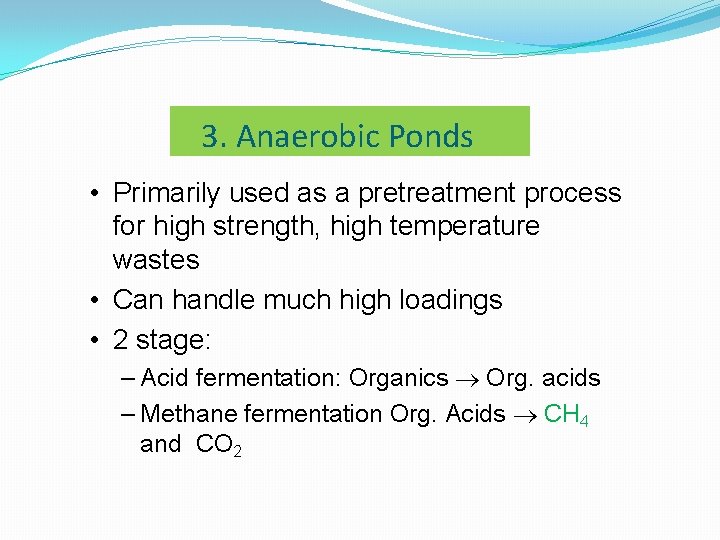
3. Anaerobic Ponds • Primarily used as a pretreatment process for high strength, high temperature wastes • Can handle much high loadings • 2 stage: – Acid fermentation: Organics Org. acids – Methane fermentation Org. Acids CH 4 and CO 2
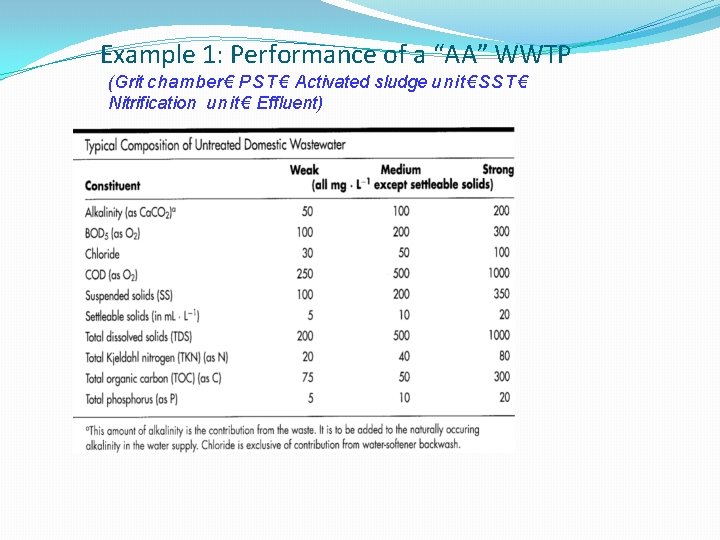
Example 1: Performance of a “AA” WWTP (Grit chamber€ PST€ Activated sludge unit€SST€ Nitrification unit€ Effluent)