Shaun Heldt and Tyler Merrell THERMAL ANALYSIS OF






- Slides: 11
Shaun Heldt and Tyler Merrell THERMAL ANALYSIS OF THE NECESSITY OF A CPU HEAT SINK FAN
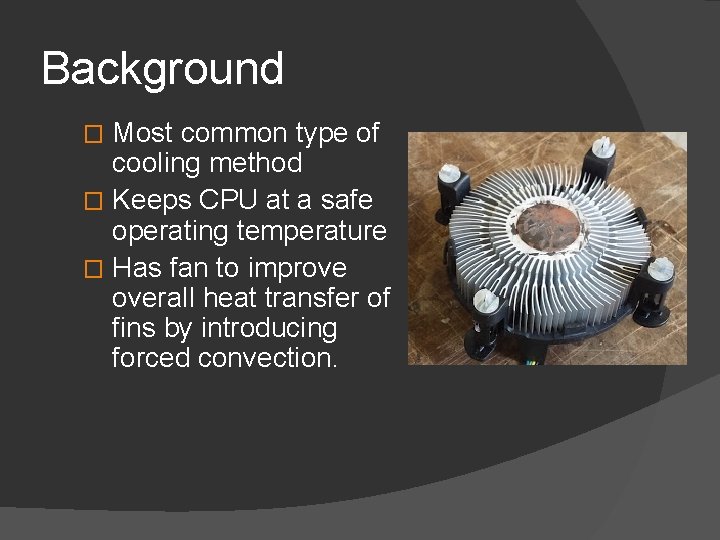
Background Most common type of cooling method � Keeps CPU at a safe operating temperature � Has fan to improve overall heat transfer of fins by introducing forced convection. �
Materials � 1 Intel I 7 -26000 K Processor heat sink � 1 Fluke 51 Thermometer with Kthermocouple � 1 Soldering Iron � 1 Hot Glue Gun
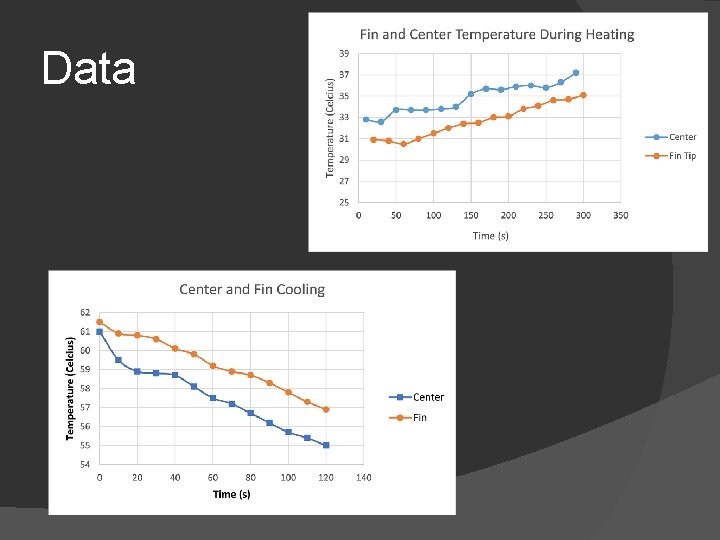
Experiment � Used glue gun and soldering iron to simulate a hot CPU � Measured temperature of the center of the heat sink and the fin tip while heating � Measured time to cool after heated � Compared with theoretical calculations to solve for Qout and the required air velocity forced convection
Data
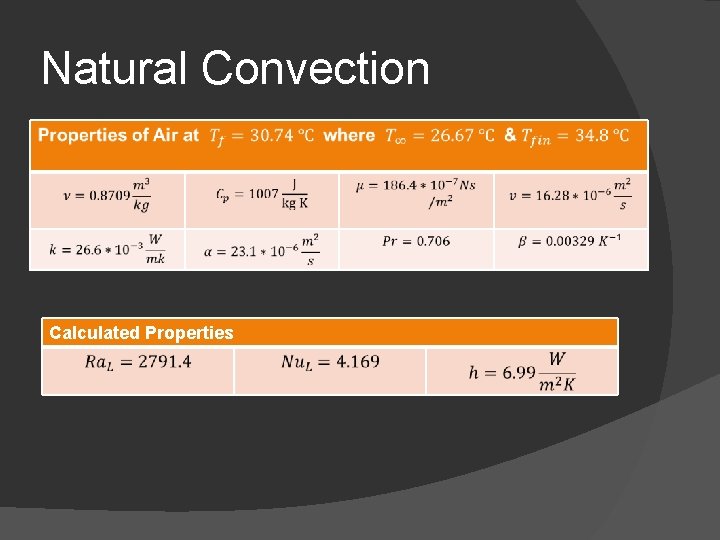
Natural Convection � Solve for Qout from natural convection of the heat sink to find if cooling due to natural convection is sufficient for cooling CPUs � Note: Qin from CPU equals 80 W � Therefore, Qout must be greater than or equal to 80 W for natural convection to be sufficient
Natural Convection Calculated Properties
Thermal Circuit
Compiled Calculations Thermal Circuit Method Qout= 6. 77 W Therefore, natural convection is not sufficient
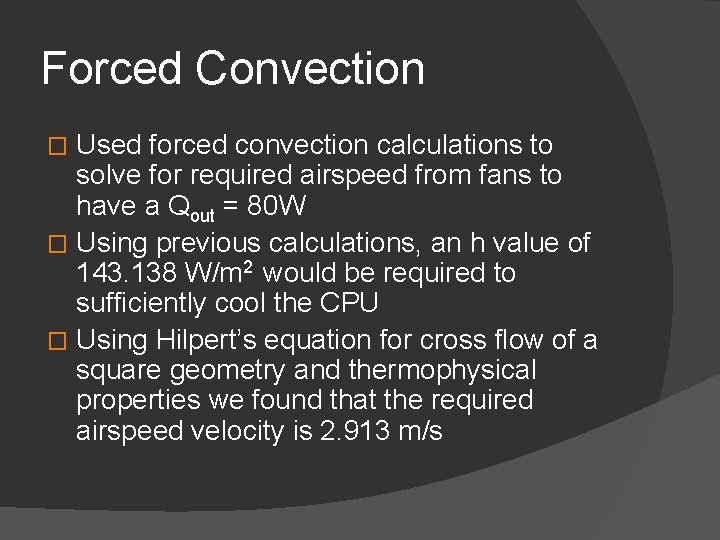
Forced Convection Used forced convection calculations to solve for required airspeed from fans to have a Qout = 80 W � Using previous calculations, an h value of 143. 138 W/m 2 would be required to sufficiently cool the CPU � Using Hilpert’s equation for cross flow of a square geometry and thermophysical properties we found that the required airspeed velocity is 2. 913 m/s �
Conclusion � Approximations were made to form the model used in calculating the presented values, however, we believe that this model was a reasonable approximation of the system. � We found that forced convection through a heat sink is necessary in CPU cooling