Shared Ontologies Christoph F Eick www cs uh
- Slides: 9
Shared Ontologies Christoph F. Eick www. cs. uh. edu/~ceick/ceick. html University of Houston Organization 1. What are Ontologies? 2. What are they good for? 3. Ontologies and Brokering 4. Critical Problems with Respect to Shared Ontologies
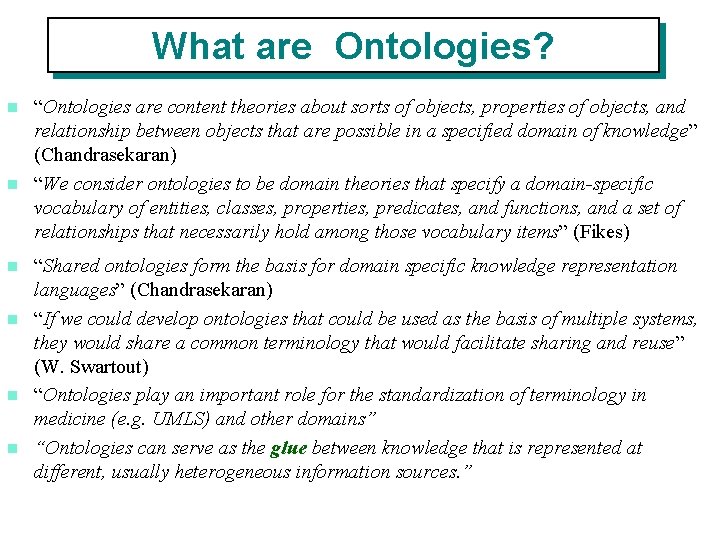
What are Ontologies? “Ontologies are content theories about sorts of objects, properties of objects, and relationship between objects that are possible in a specified domain of knowledge” (Chandrasekaran) n “We consider ontologies to be domain theories that specify a domain-specific vocabulary of entities, classes, properties, predicates, and functions, and a set of relationships that necessarily hold among those vocabulary items” (Fikes) n “Shared ontologies form the basis for domain specific knowledge representation languages” (Chandrasekaran) n “If we could develop ontologies that could be used as the basis of multiple systems, they would share a common terminology that would facilitate sharing and reuse” (W. Swartout) n “Ontologies play an important role for the standardization of terminology in medicine (e. g. UMLS) and other domains” n “Ontologies can serve as the glue between knowledge that is represented at different, usually heterogeneous information sources. ” n
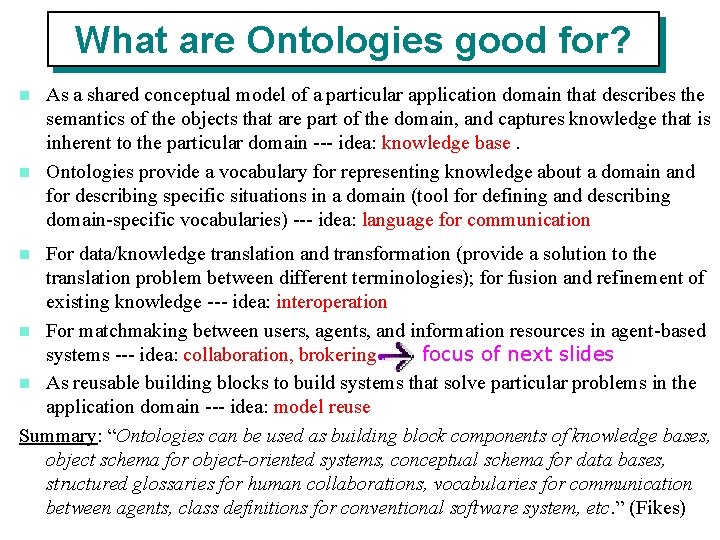
What are Ontologies good for? As a shared conceptual model of a particular application domain that describes the semantics of the objects that are part of the domain, and captures knowledge that is inherent to the particular domain --- idea: knowledge base. n Ontologies provide a vocabulary for representing knowledge about a domain and for describing specific situations in a domain (tool for defining and describing domain-specific vocabularies) --- idea: language for communication n For data/knowledge translation and transformation (provide a solution to the translation problem between different terminologies); for fusion and refinement of existing knowledge --- idea: interoperation n For matchmaking between users, agents, and information resources in agent-based systems --- idea: collaboration, brokering focus of next slides n As reusable building blocks to build systems that solve particular problems in the application domain --- idea: model reuse Summary: “Ontologies can be used as building block components of knowledge bases, object schema for object-oriented systems, conceptual schema for data bases, structured glossaries for human collaborations, vocabularies for communication between agents, class definitions for conventional software system, etc. ” (Fikes) n
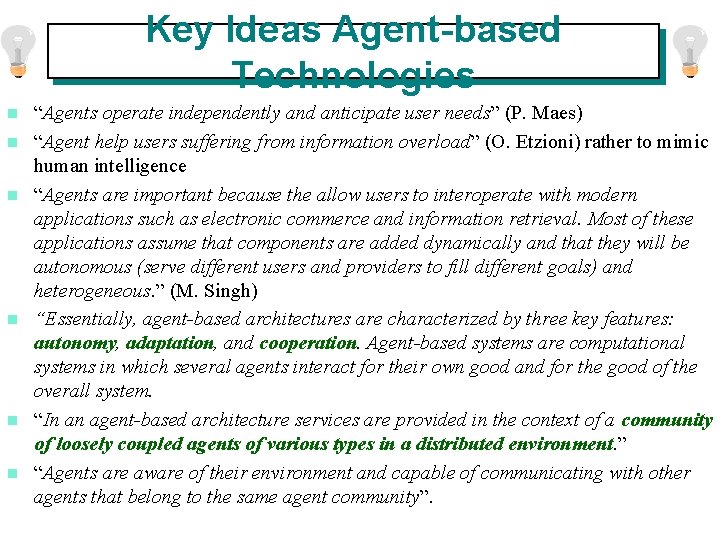
Key Ideas Agent-based Technologies n n n “Agents operate independently and anticipate user needs” (P. Maes) “Agent help users suffering from information overload” (O. Etzioni) rather to mimic human intelligence “Agents are important because the allow users to interoperate with modern applications such as electronic commerce and information retrieval. Most of these applications assume that components are added dynamically and that they will be autonomous (serve different users and providers to fill different goals) and heterogeneous. ” (M. Singh) “Essentially, agent-based architectures are characterized by three key features: autonomy, adaptation, and cooperation. Agent-based systems are computational systems in which several agents interact for their own good and for the good of the overall system. “In an agent-based architecture services are provided in the context of a community of loosely coupled agents of various types in a distributed environment. ” “Agents are aware of their environment and capable of communicating with other agents that belong to the same agent community”.
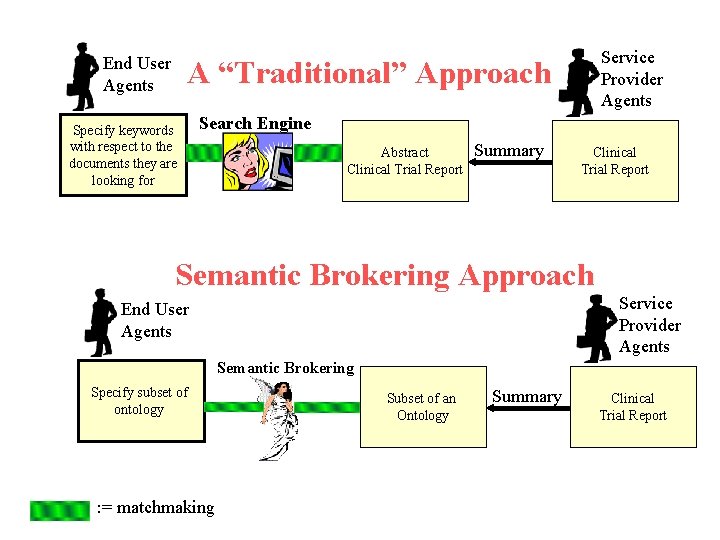
Ontologies and Brokering Service providers describe their capabilities in terms of a domain (or task) ontology n Agents that seek services describe their needs in terms of a domain (or task) ontology n Broker agents server as matchmakers between service providers and service seekers by finding suitable agents and by evaluating the extent to which they can provide those services relying on a semantic brokering approach. n Various languages have been advocated in the recent years to specify ontologies: OKBC, CKML/OML, ONTOLINGUA, XML, UMLS, SNOMED, GALEN. . . n
End User Agents Service Provider Agents A “Traditional” Approach Specify keywords with respect to the documents they are looking for Search Engine Abstract Clinical Trial Report Summary Clinical Trial Report Semantic Brokering Approach Service Provider Agents End User Agents Semantic Brokering Specify subset of ontology : = matchmaking Subset of an Ontology Summary Clinical Trial Report
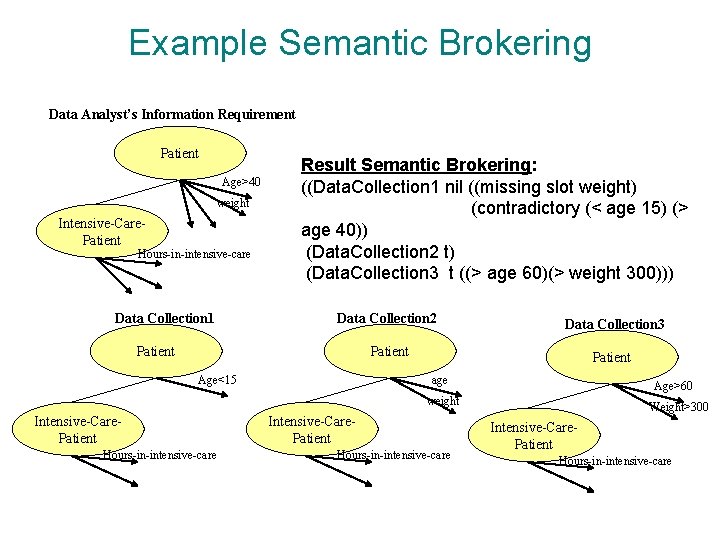
Example Semantic Brokering Data Analyst’s Information Requirement Patient Age>40 weight Intensive-Care. Patient Hours-in-intensive-care Data Collection 1 Result Semantic Brokering: ((Data. Collection 1 nil ((missing slot weight) (contradictory (< age 15) (> age 40)) (Data. Collection 2 t) (Data. Collection 3 t ((> age 60)(> weight 300))) Data Collection 2 Data Collection 3 Patient Age<15 age Age>60 weight Intensive-Care. Patient Hours-in-intensive-care Weight>300 Intensive-Care. Patient Hours-in-intensive-care
Critical Problems with Respect to Shared Ontologies Scientific communities have to agree on ontologies; otherwise, the whole approach is flawed. n Development of ontologies for a particular domain is a difficult task (see Digital Anatomist project at UW, development of UMLS). The development of user friendly, and intelligent knowledge acquisition tools is very important for the successful development of shared ontologies. n Expressiveness of languages that are used to define ontologies limits what can be done with domain ontologies. n Reasoning capabilities are important for systems that use shared ontologies (we need a language to specify ontologies and an inference engine that can reason with the given ontologies) – finding inconsistencies in knowledge bases, for finding errors at data entry – semantic brokering – more intelligent mappings between terms –. . . n
References n WWW-Links: – http: //ksl-web. stanford. edu/Reusable-ontol/P 001. html (Richard Fikes’ (Stanford University) Slide Show on “Reusable Ontologies” – http: //www. cs. cmu. edu/~softagents/ (CMU Intelligent Software Agents Page) n Papers: – Special Issue IEEE Intelligent Systems on “Coming to Terms with Ontologies”, Jan. /Feb. 1999.