
Interactive Matting Christoph Rhemann Supervised by Margrit Gelautz
Interactive Matting Christoph Rhemann Supervised by: Margrit Gelautz and Carsten Rother
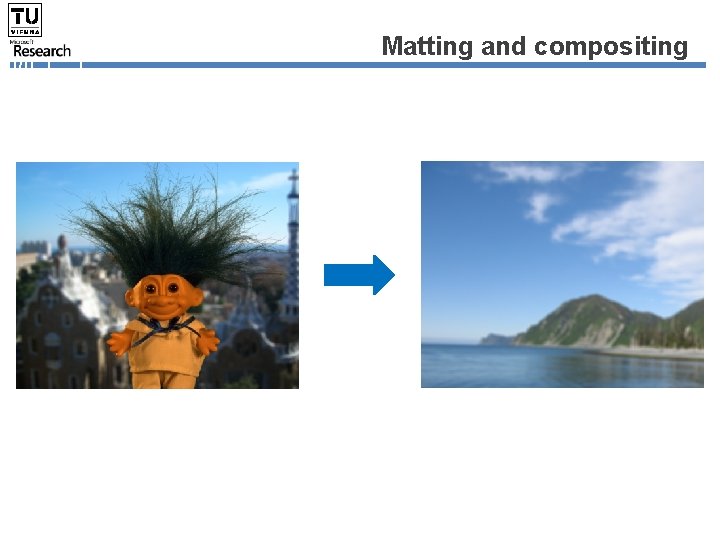
Matting and compositing
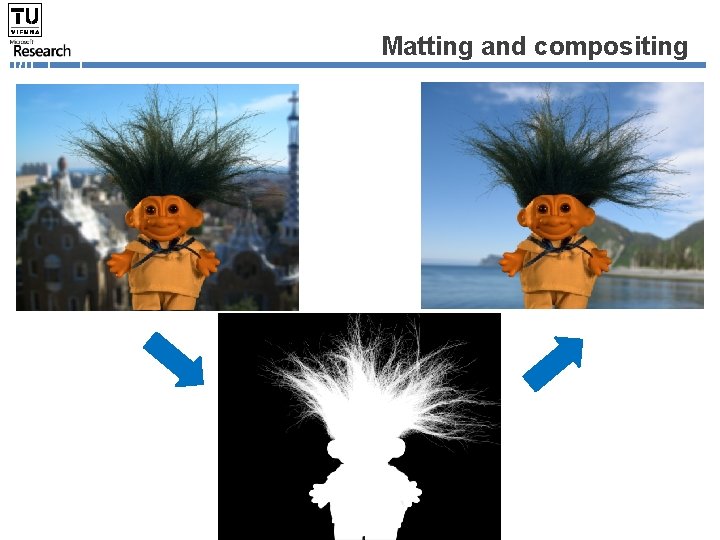
Matting and compositing

Outline Talk Outline: • Introduction & previous approaches • Our matting model • Evaluation strategy

Matting is ill posed C r, g, b = ● α + F r, g, b Inverse process of compositing: Determine: F, B, α Given: C + (1 - α) ● ● B r, g, b
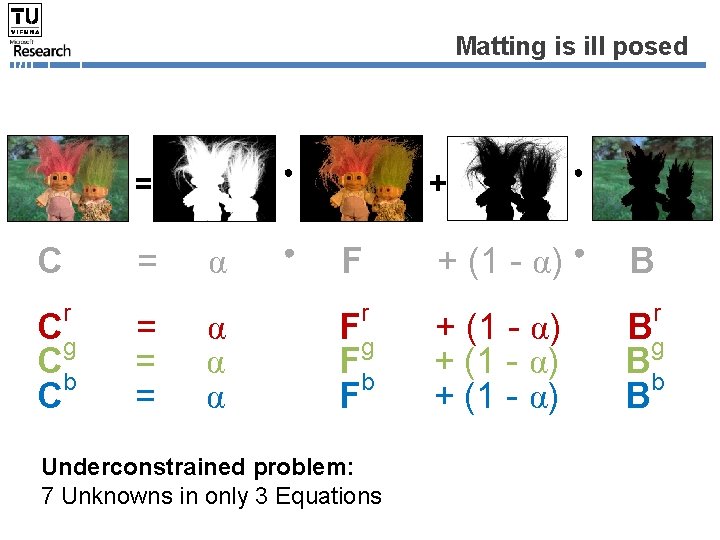
Matting is ill posed C r, g, b r Cg Cb C = ● = = = α α + F r, g, b r Fg Fb F Underconstrained problem: 7 Unknowns in only 3 Equations + (1 - α) ● ● B r, g, b r Bg Bb B
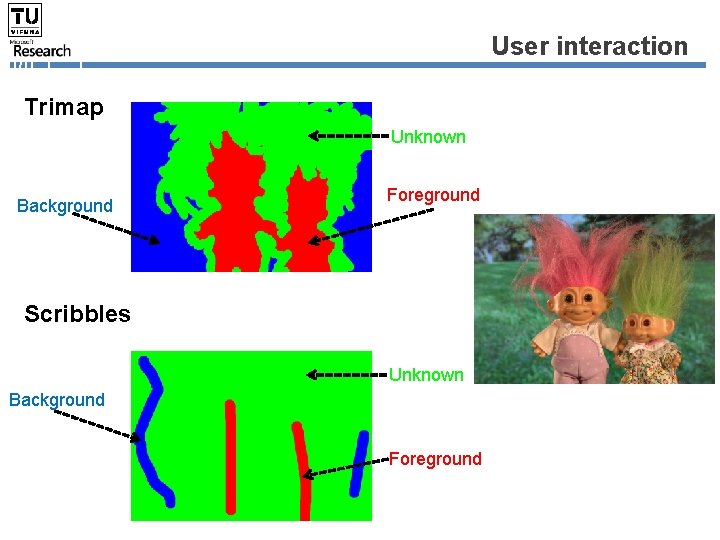
User interaction Trimap Unknown Background Foreground Scribbles Unknown Background Foreground
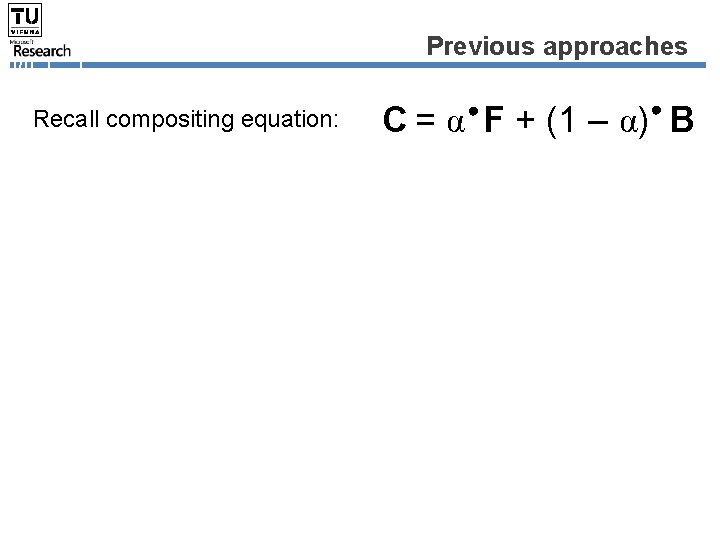
Previous approaches Recall compositing equation: ● ● C = α F + (1 – α) B
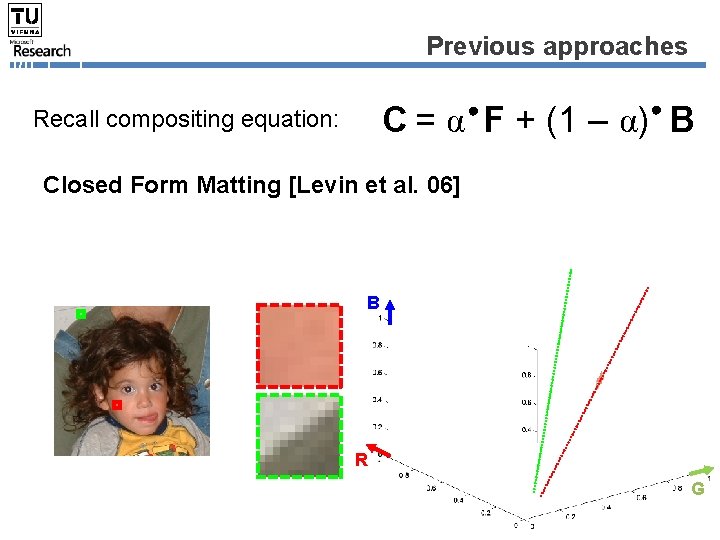
Previous approaches ● ● C = α F + (1 – α) B Recall compositing equation: Closed Form Matting [Levin et al. 06] B R G
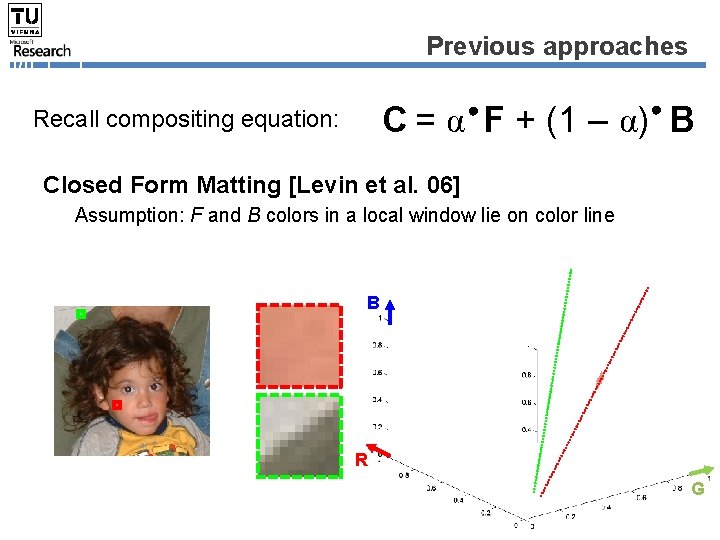
Previous approaches ● ● C = α F + (1 – α) B Recall compositing equation: Closed Form Matting [Levin et al. 06] Assumption: F and B colors in a local window lie on color line B R G
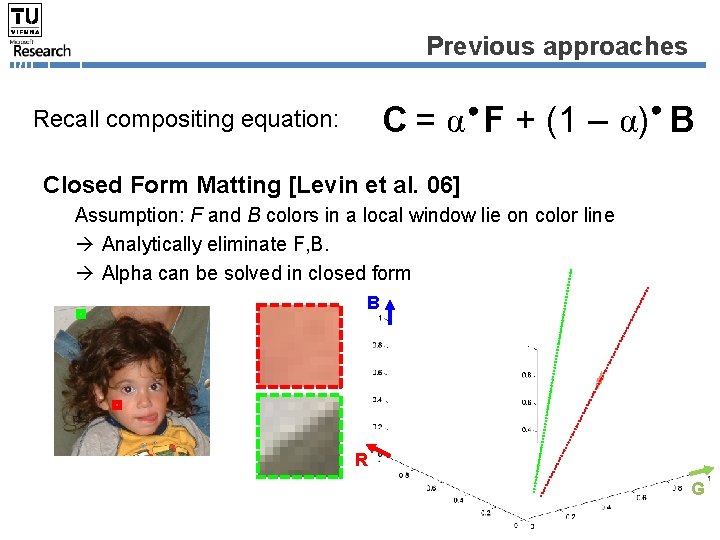
Previous approaches ● ● C = α F + (1 – α) B Recall compositing equation: Closed Form Matting [Levin et al. 06] Assumption: F and B colors in a local window lie on color line à Analytically eliminate F, B. à Alpha can be solved in closed form B R G
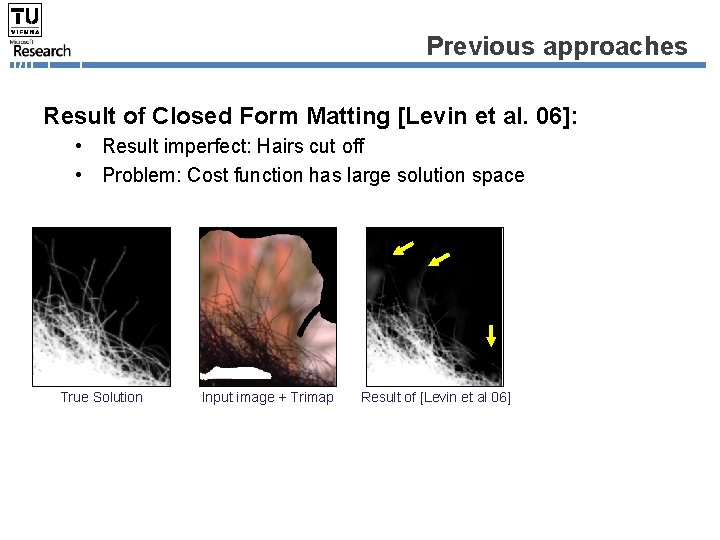
Previous approaches Result of Closed Form Matting [Levin et al. 06]: • Result imperfect: Hairs cut off • Problem: Cost function has large solution space True Solution Input image + Trimap Result of [Levin et al 06]
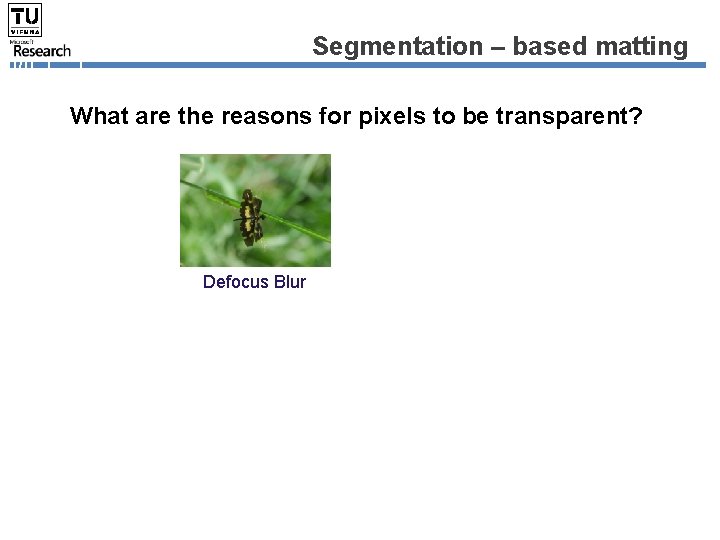
Segmentation – based matting What are the reasons for pixels to be transparent? Defocus Blur
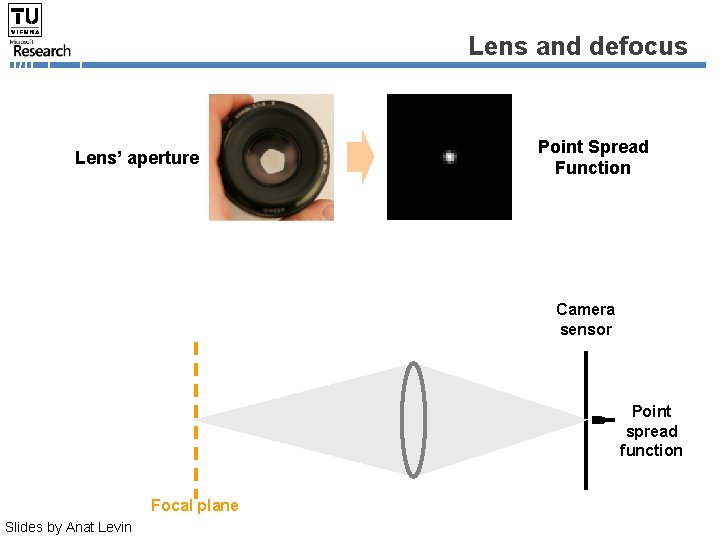
Lens and defocus Point Spread Function Lens’ aperture Lens Camera sensor Point spread function Focal plane Slides by Anat Levin
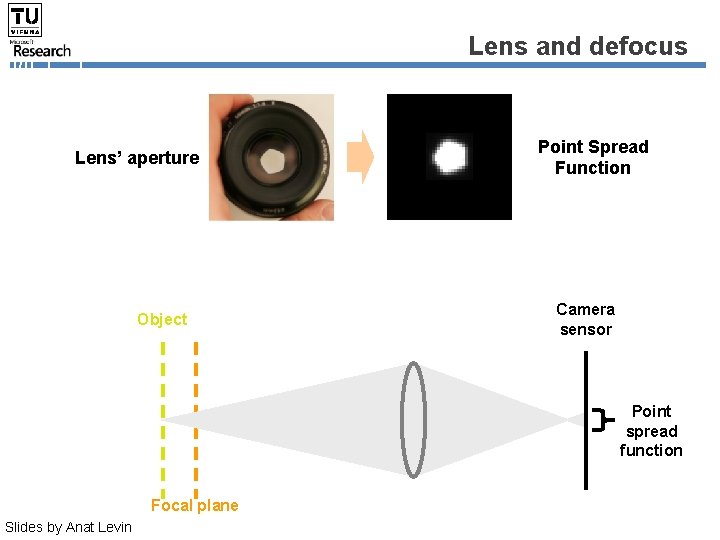
Lens and defocus Point Spread Function Lens’ aperture Object Lens Camera sensor Point spread function Focal plane Slides by Anat Levin
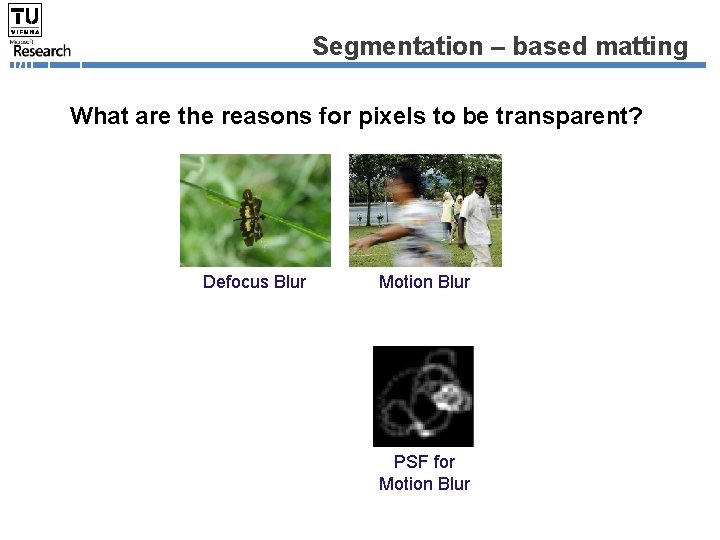
Segmentation – based matting What are the reasons for pixels to be transparent? Defocus Blur Motion Blur PSF for Motion Blur
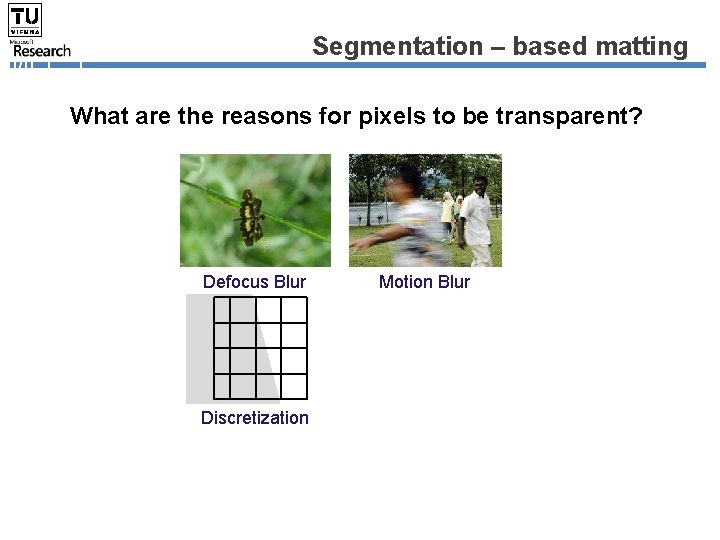
Segmentation – based matting What are the reasons for pixels to be transparent? Defocus Blur Discretization Motion Blur
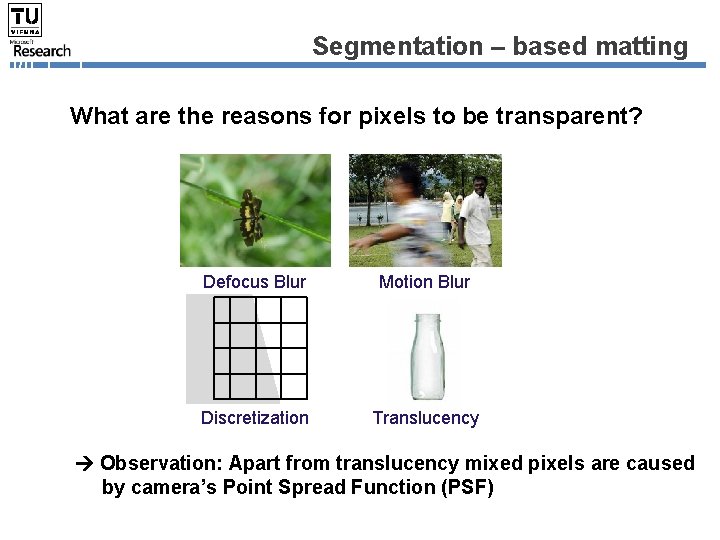
Segmentation – based matting What are the reasons for pixels to be transparent? Defocus Blur Motion Blur Discretization Translucency Observation: Apart from translucency mixed pixels are caused by camera’s Point Spread Function (PSF)
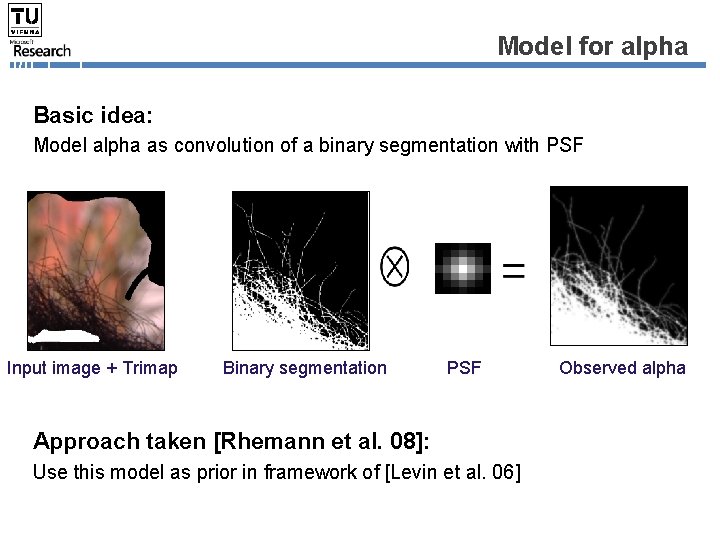
Model for alpha Basic idea: Model alpha as convolution of a binary segmentation with PSF Input image + Trimap Binary segmentation PSF Approach taken [Rhemann et al. 08]: Use this model as prior in framework of [Levin et al. 06] Observed alpha
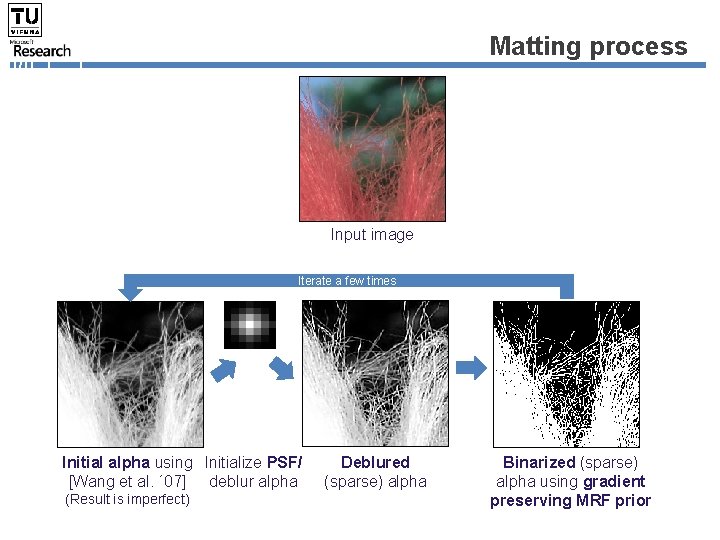
Matting process Input image Iterate a few times Initial alpha using Initialize PSF/ [Wang et al. ´ 07] deblur alpha (Result is imperfect) Deblured (sparse) alpha Binarized (sparse) alpha using gradient preserving MRF prior
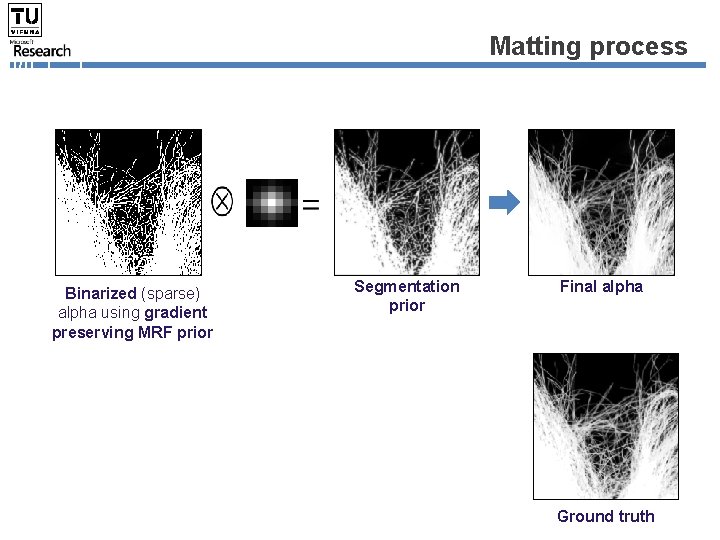
Matting process Binarized (sparse) alpha using gradient preserving MRF prior Segmentation prior Final alpha Ground truth
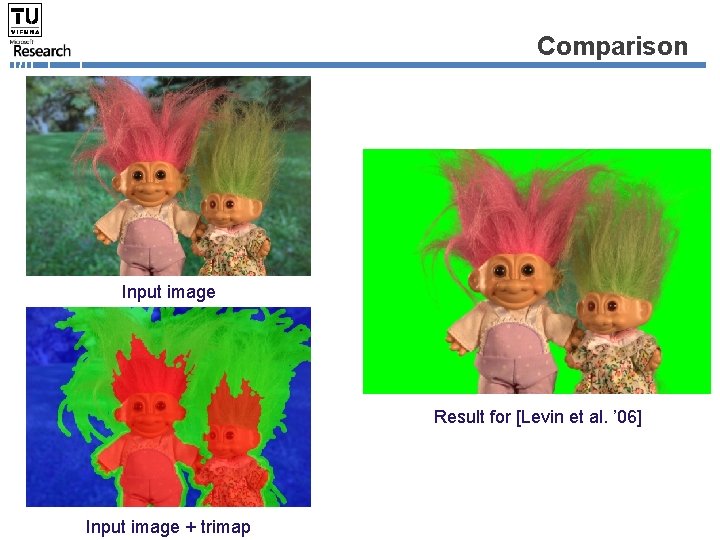
Comparison Input image Result for [Levin et al. ’ 06] Input image + trimap
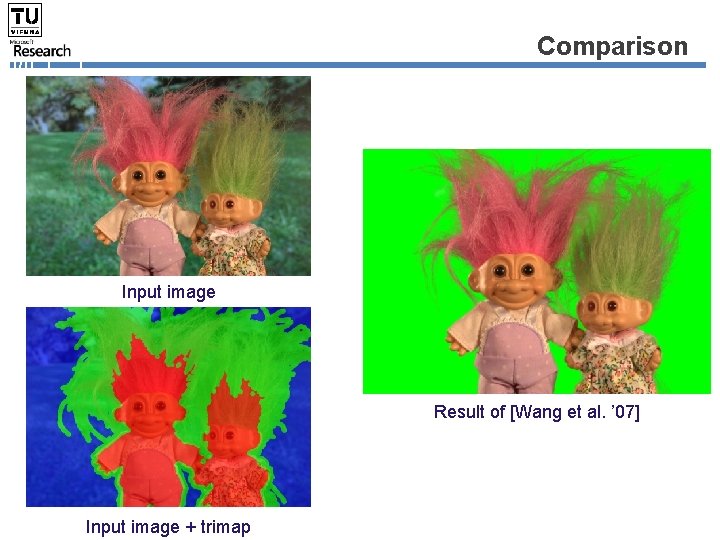
Comparison Input image Result of [Wang et al. ’ 07] Input image + trimap
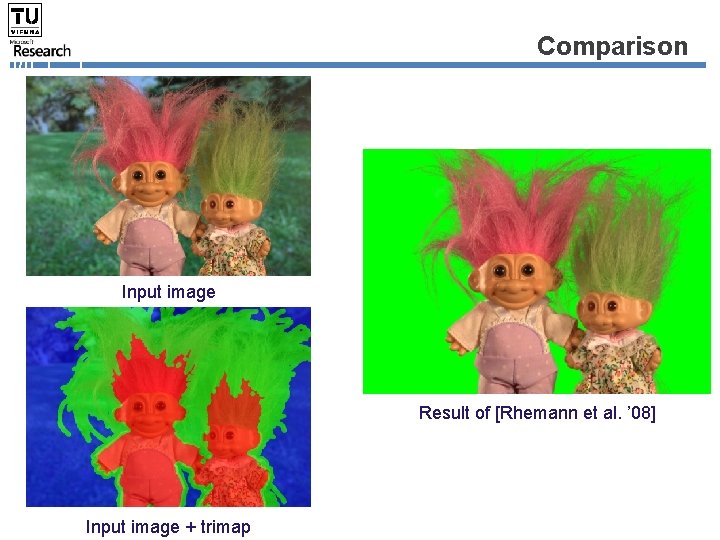
Comparison Input image Result of [Rhemann et al. ’ 08] Input image + trimap
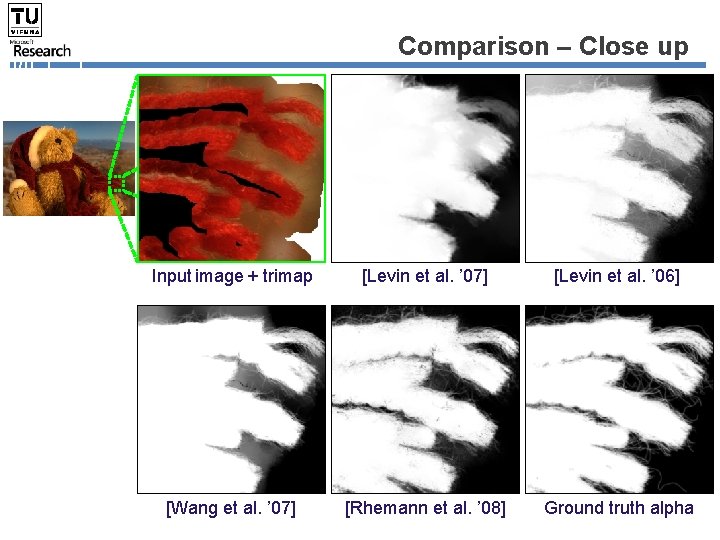
Comparison – Close up Input image + trimap [Levin et al. ’ 07] [Levin et al. ’ 06] [Wang et al. ’ 07] [Rhemann et al. ’ 08] Ground truth alpha
Evaluation of matting algorithms How to compare performance of algorithms? Showing some qualitative results OR Quantitative evaluation using reference solutions
Evaluation of matting algorithms • Key Factors for a good quantitative evaluation • Ground truth dataset • Online evaluation • Perceptual error functions
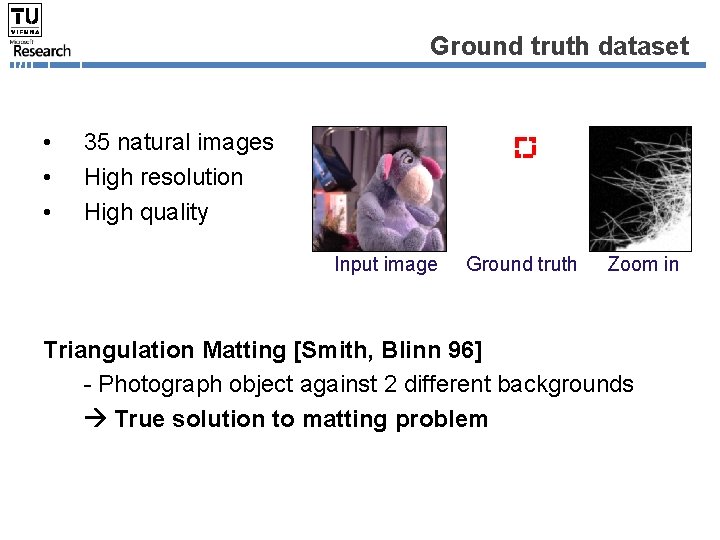
Ground truth dataset • • • 35 natural images High resolution High quality Input image Ground truth Zoom in Triangulation Matting [Smith, Blinn 96] - Photograph object against 2 different backgrounds True solution to matting problem
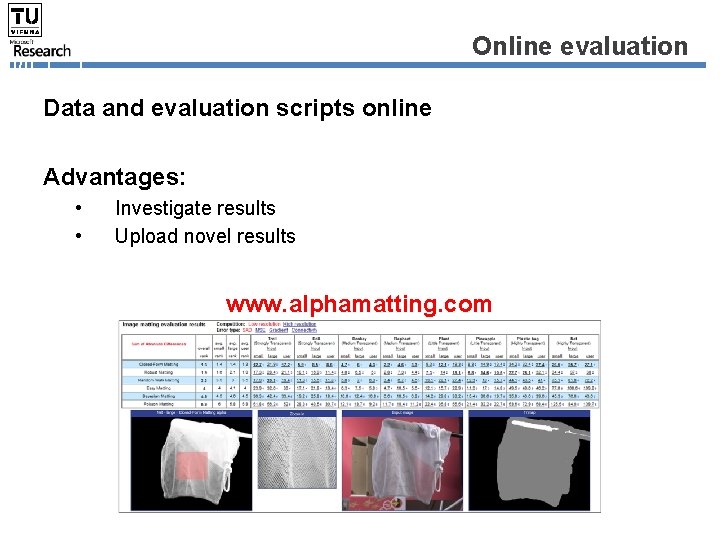
Online evaluation Data and evaluation scripts online Advantages: • • Investigate results Upload novel results www. alphamatting. com
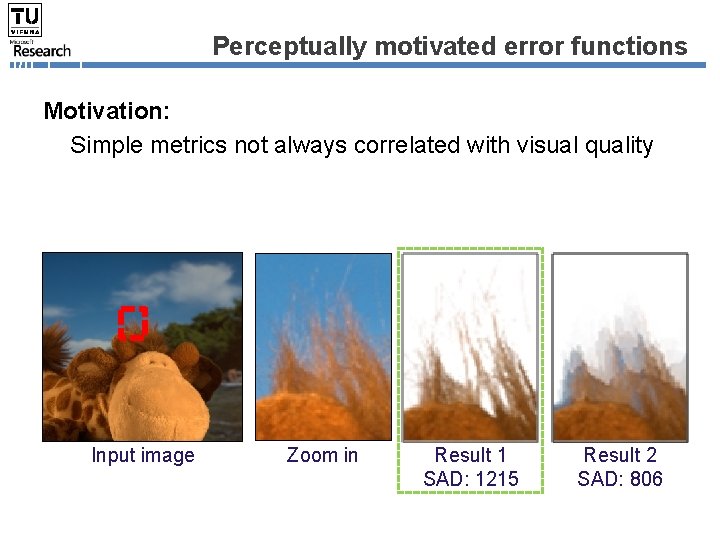
Perceptually motivated error functions Motivation: Simple metrics not always correlated with visual quality Input image Zoom in Result 1 SAD: 1215 Result 2 SAD: 806
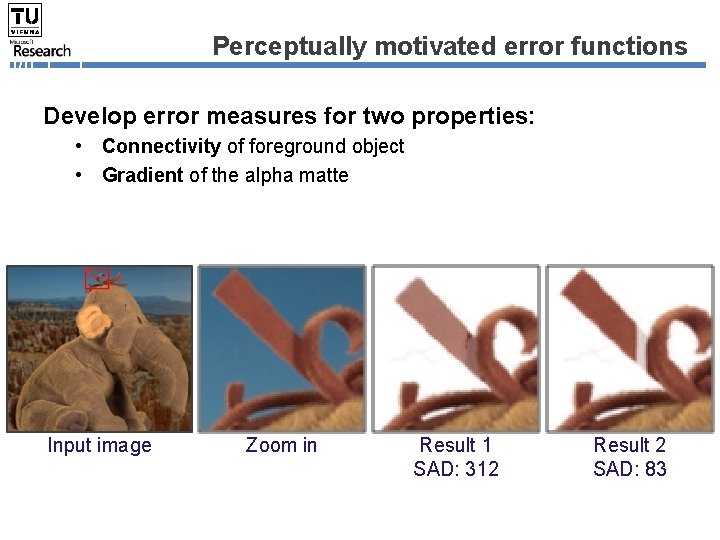
Perceptually motivated error functions Develop error measures for two properties: • Connectivity of foreground object • Gradient of the alpha matte Input image Zoom in Result 1 SAD: 312 Result 2 SAD: 83
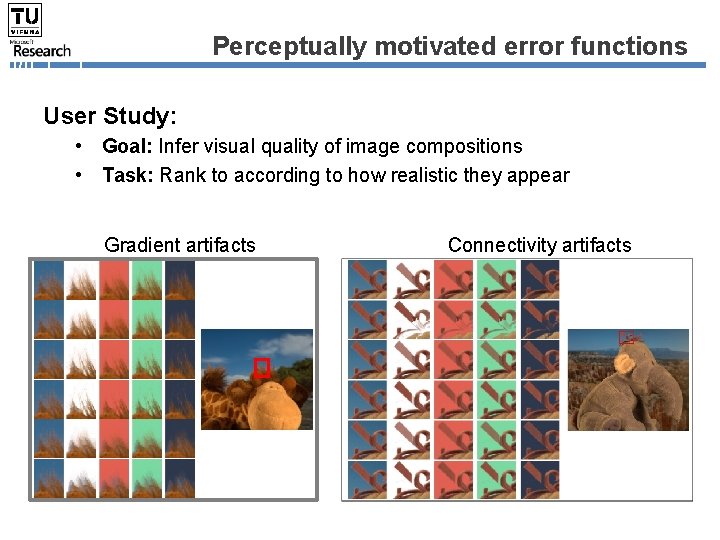
Perceptually motivated error functions User Study: • Goal: Infer visual quality of image compositions • Task: Rank to according to how realistic they appear Gradient artifacts Connectivity artifacts
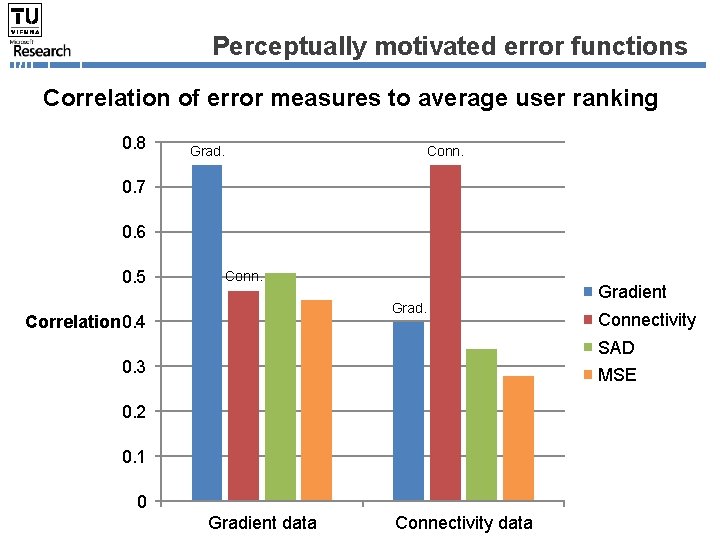
Perceptually motivated error functions Correlation of error measures to average user ranking 0. 8 Grad. Conn. 0. 7 0. 6 0. 5 Conn. Grad. Correlation 0. 4 Gradient Connectivity SAD 0. 3 MSE 0. 2 0. 1 0 Gradient data Connectivity data

Conclusions • Model for alpha overcomes ambiguities • Model-based algorithm: Performs better than competitors • Perceptual motivated evaluation • Message to you: Evaluation of your algorithm is important • Use ground truth data to make quantitative comparisons • Use a large dataset • Use a training / test split

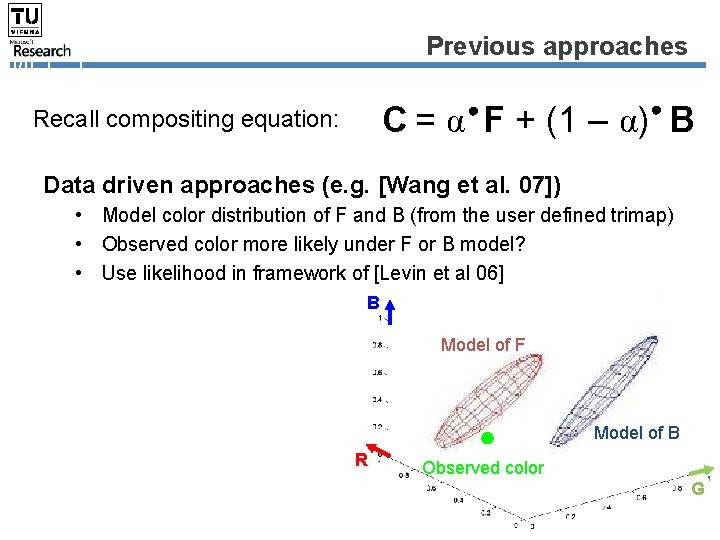
Previous approaches ● ● C = α F + (1 – α) B Recall compositing equation: Data driven approaches (e. g. [Wang et al. 07]) • Model color distribution of F and B (from the user defined trimap) • Observed color more likely under F or B model? • Use likelihood in framework of [Levin et al 06] B Model of F Model of B R Observed color G
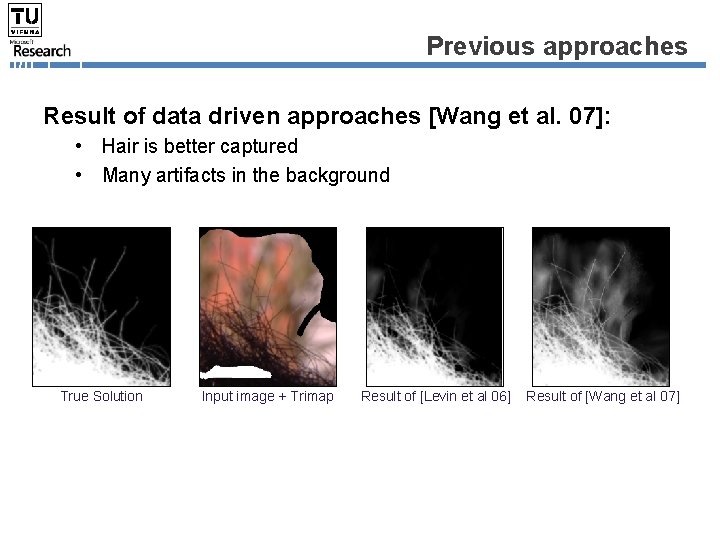
Previous approaches Result of data driven approaches [Wang et al. 07]: • Hair is better captured • Many artifacts in the background True Solution Input image + Trimap Result of [Levin et al 06] Result of [Wang et al 07]
- Slides: 37