Section 9 1 Properties of Radicals Section 9



- Slides: 23
Section 9. 1 “Properties of Radicals”
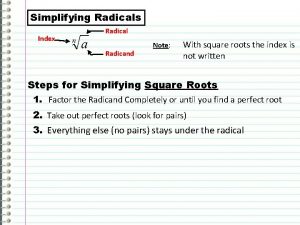
Section 9. 1 “Properties of Radicals” n. A radical expression is in simplest form if the following conditions are true: -No perfect square factors other than 1 are in the radicand. -No fractions are in the radicand. -No radicals appear in the denominator of a fraction. The rules also apply for simplifying cube roots and nth roots.
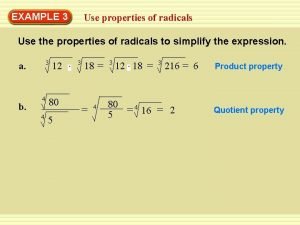
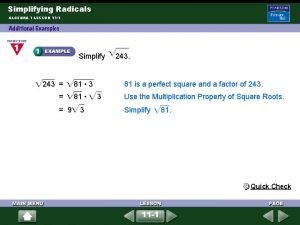
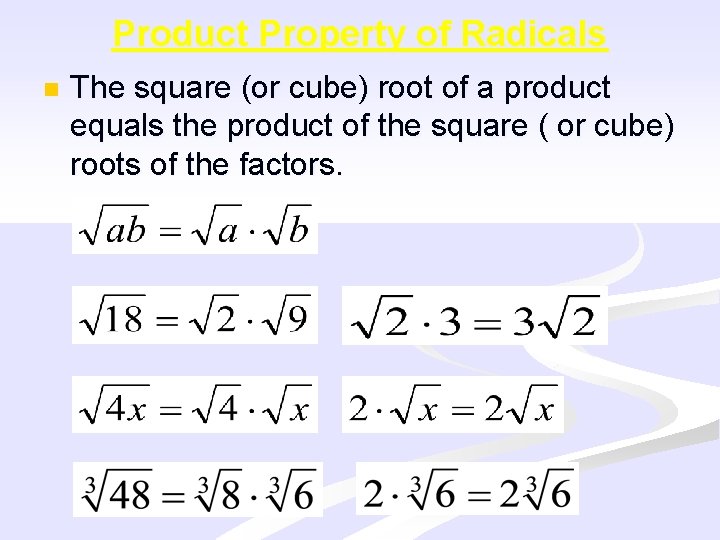
Product Property of Radicals n The square (or cube) root of a product equals the product of the square ( or cube) roots of the factors.
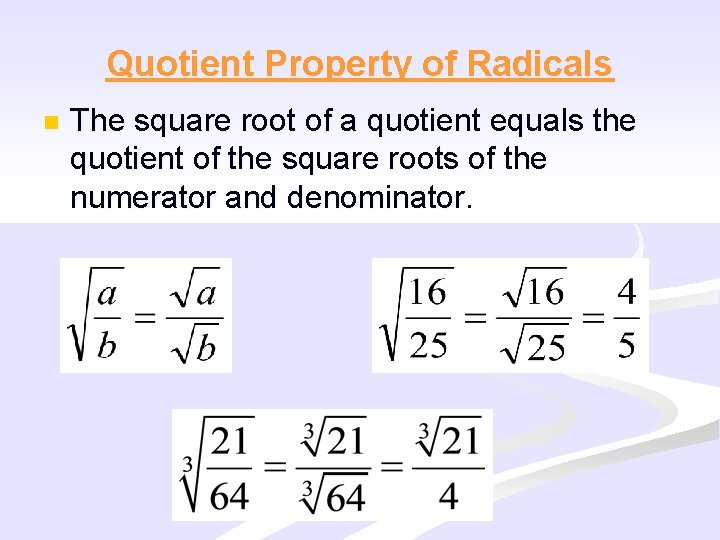
Quotient Property of Radicals n The square root of a quotient equals the quotient of the square roots of the numerator and denominator.
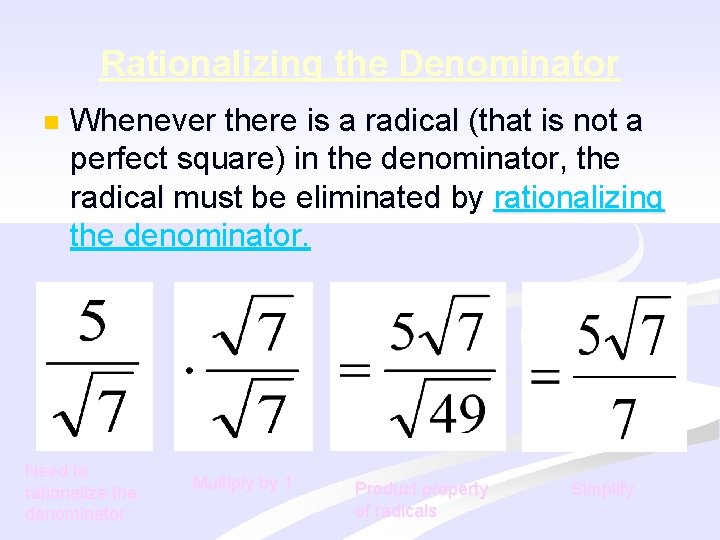
Rationalizing the Denominator n Whenever there is a radical (that is not a perfect square) in the denominator, the radical must be eliminated by rationalizing the denominator. Need to rationalize the denominator Multiply by 1 Product property of radicals Simplify
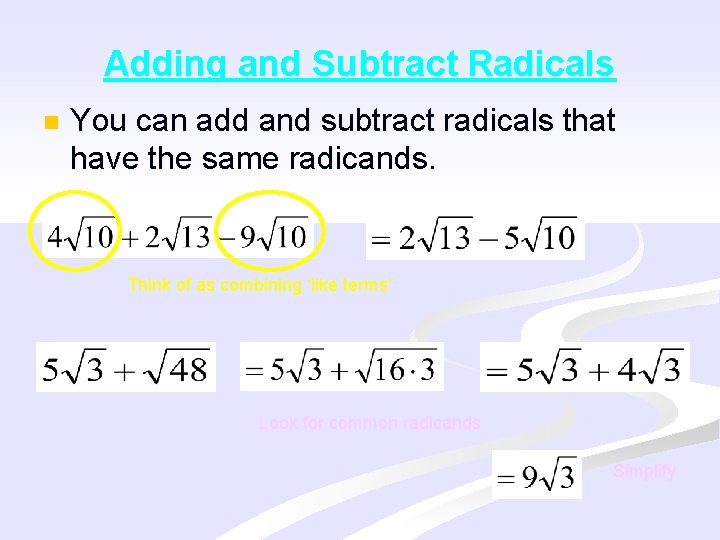
Adding and Subtract Radicals n You can add and subtract radicals that have the same radicands. Think of as combining ‘like terms’ Look for common radicands Simplify
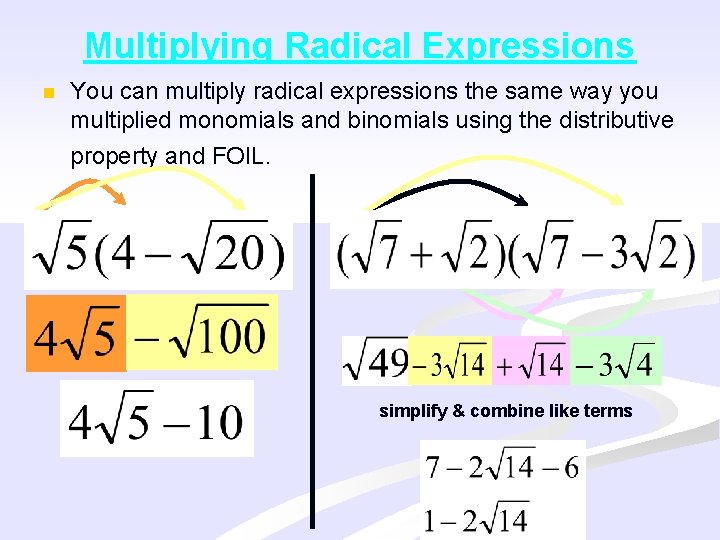
Multiplying Radical Expressions n You can multiply radical expressions the same way you multiplied monomials and binomials using the distributive property and FOIL. simplify & combine like terms
Conjugates and are called which can be used to simplify radical expressions containing the sum or difference involving square roots in a denominator. Need to use a conjugate to rationalize the denominator Multiply by 1 Simplify Product property of radicals
Section 9. 3 “Solving Quadratic Equations Using Square Roots”
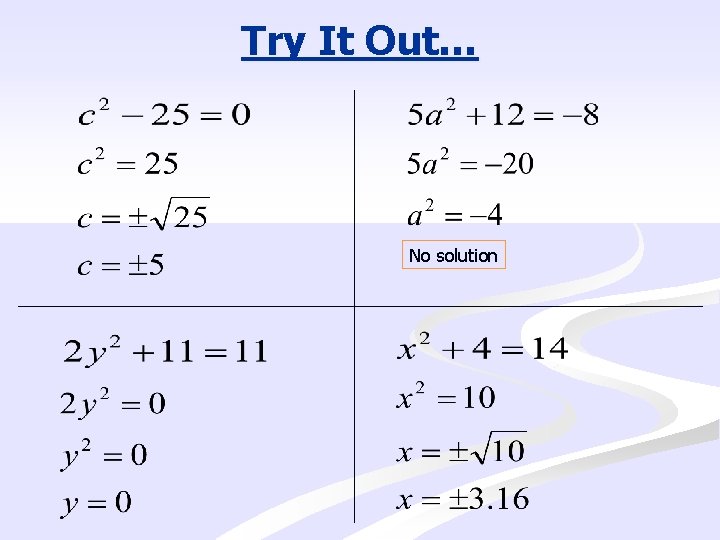
Section 9. 3 “Solving Quadratic Equations Using Square Roots” n To use square roots to solve a quadratic equation of the form ax² + bx + c = 0, first isolate x² on one side of the equation to obtain x² = d. Solving x² = d by Taking Square Roots Examples - If d > 0, then x² = d has two solutions: - If d = 0, then x² = d has one solution: - If d < 0, then x² = d has no solution: no solution
Try It Out… No solution
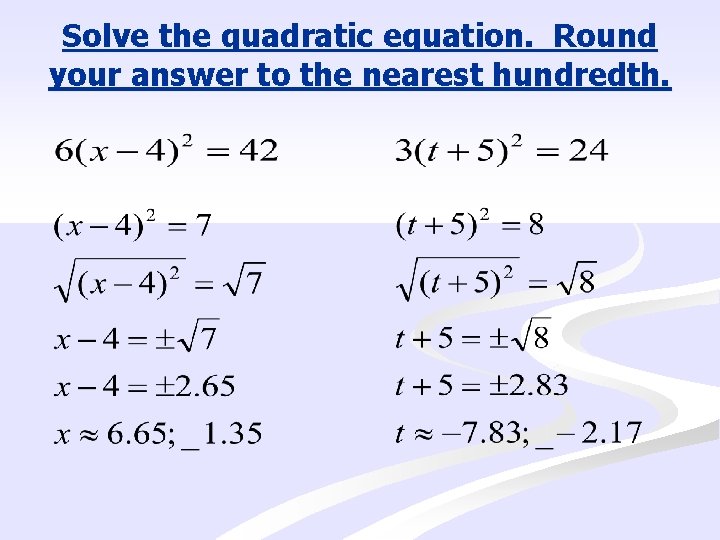
Solve the quadratic equation. Round your answer to the nearest hundredth.
Section 9. 4 “Solving Quadratic Equations by Completing the Square”
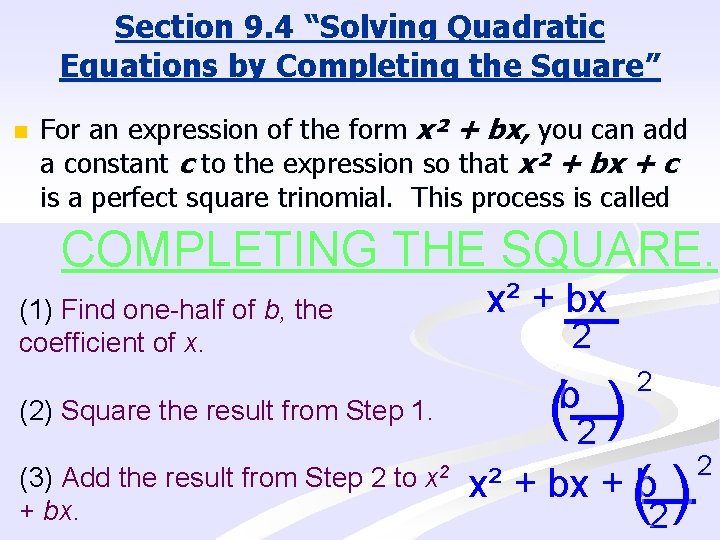
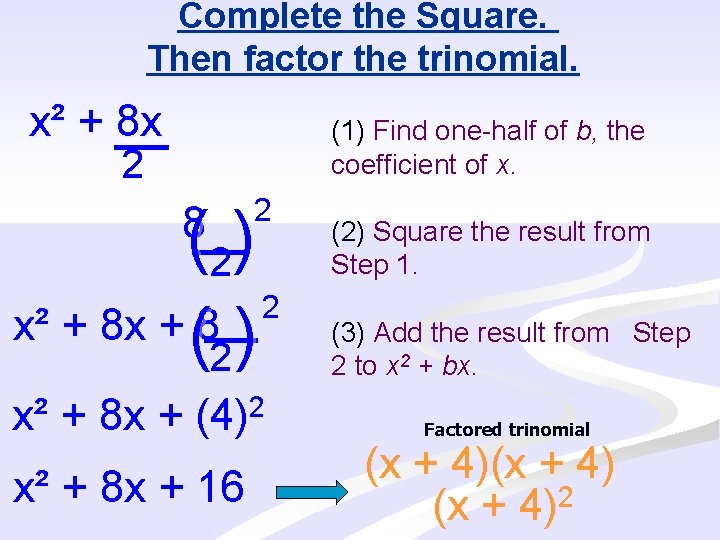
Section 9. 4 “Solving Quadratic Equations by Completing the Square” n For an expression of the form x² + bx, you can add a constant c to the expression so that x² + bx + c is a perfect square trinomial. This process is called COMPLETING THE SQUARE. (1) Find one-half of b, the coefficient of x. (2) Square the result from Step 1. (3) Add the result from Step 2 to x 2 + bx. x² + bx 2 (2) b 2 (2 ) x² + bx + b 2
Complete the Square. Then factor the trinomial. x² + 8 x (1) Find one-half of b, the coefficient of x. 2 2 (2) 2 x² + 8 x + (8 ) 2 8 x² + 8 x + (4)2 x² + 8 x + 16 (2) Square the result from Step 1. (3) Add the result from Step 2 to x 2 + bx. Factored trinomial (x + 4) 2 (x + 4)
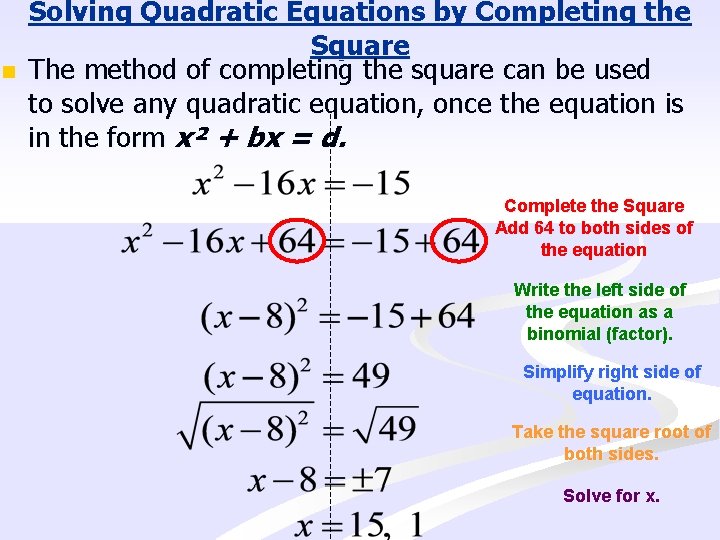
n Solving Quadratic Equations by Completing the Square The method of completing the square can be used to solve any quadratic equation, once the equation is in the form x² + bx = d. Complete the Square Add 64 to both sides of the equation Write the left side of the equation as a binomial (factor). Simplify right side of equation. Take the square root of both sides. Solve for x.
Section 9. 5 “Solve Quadratic Equations by the Quadratic Formula”
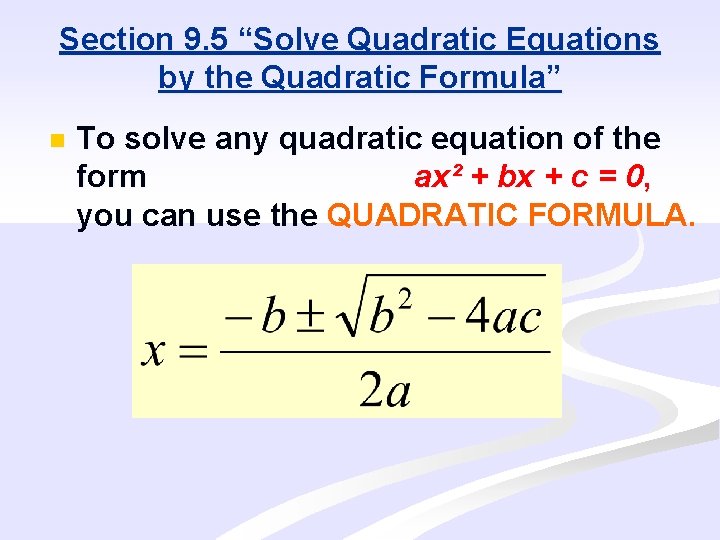
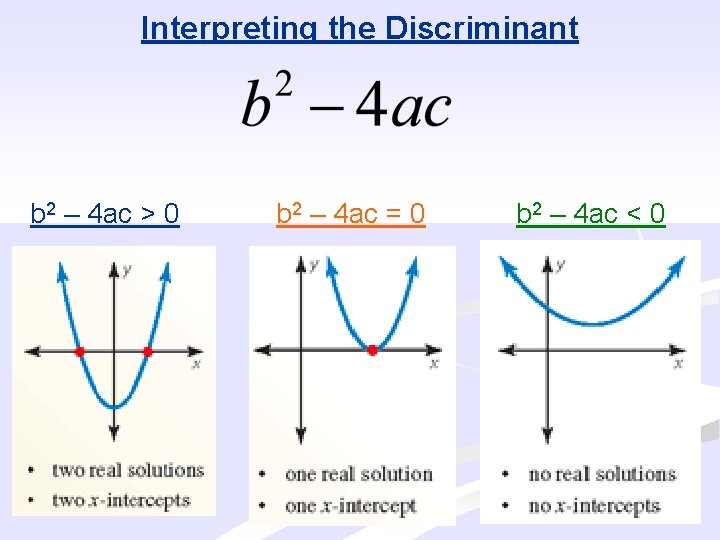
Section 9. 5 “Solve Quadratic Equations by the Quadratic Formula” n To solve any quadratic equation of the form ax² + bx + c = 0, you can use the QUADRATIC FORMULA.
Interpreting the Discriminant b 2 – 4 ac > 0 b 2 – 4 ac = 0 b 2 – 4 ac < 0
Section 9. 6 “Solving Systems of Nonlinear Equations”
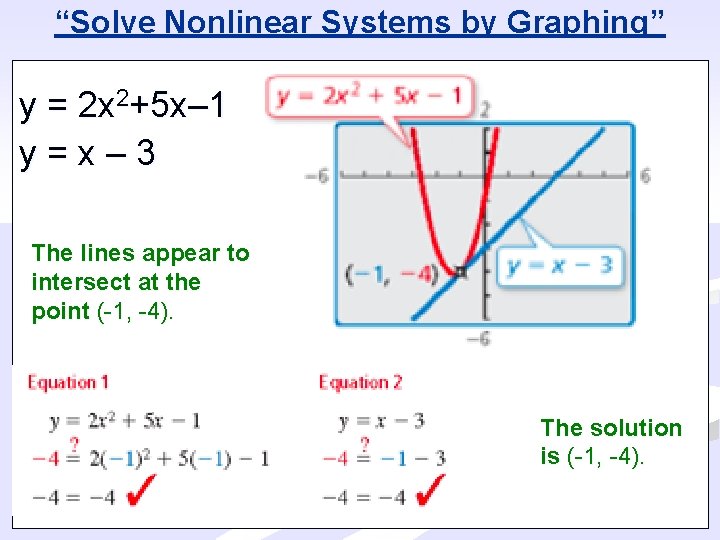
“Solve Nonlinear Systems by Graphing” y = 2 x 2+5 x– 1 y=x– 3 Equation 1 Equation 2 The lines appear to intersect at the point (-1, -4). The solution is (-1, -4).
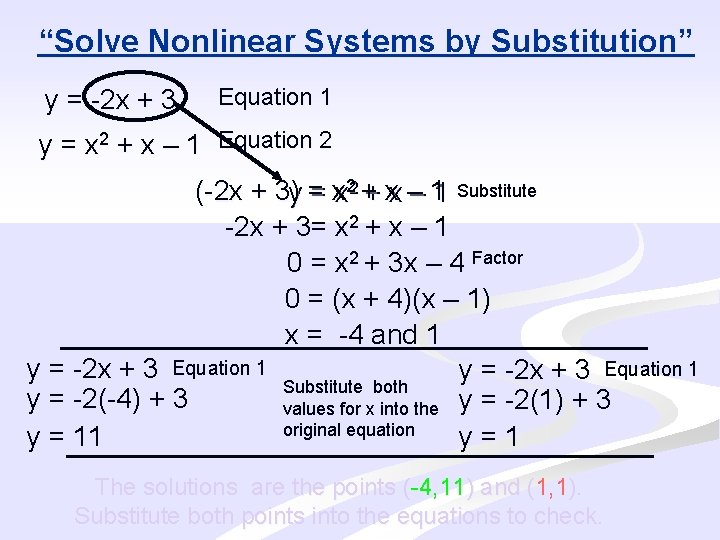
“Solve Nonlinear Systems by Substitution” y = -2 x + 3 Equation 1 y = x 2 + x – 1 Equation 2 (-2 x + 3)y == xx 22 ++ xx –– 11 Substitute -2 x + 3= x 2 + x – 1 0 = x 2 + 3 x – 4 Factor 0 = (x + 4)(x – 1) x = -4 and 1 y = -2 x + 3 Equation 1 Substitute both y = -2(-4) + 3 values for x into the y = -2(1) + 3 original equation y = 11 y=1 The solutions are the points (-4, 11) and (1, 1). Substitute both points into the equations to check.
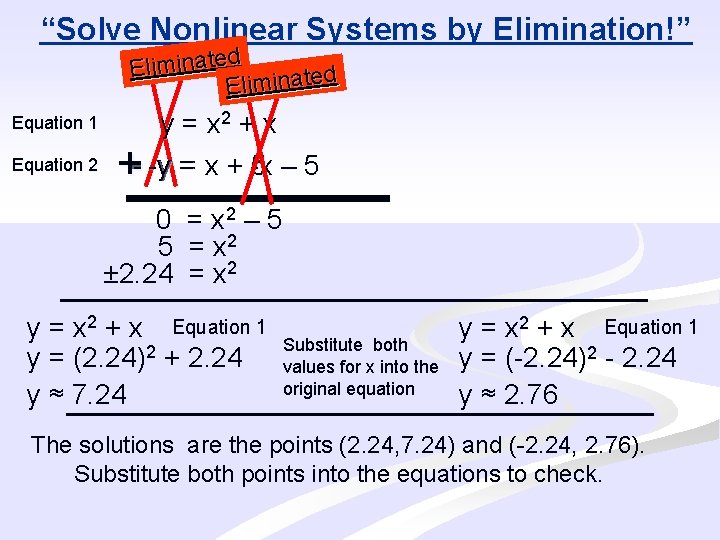
“Solve Nonlinear Systems by Elimination!” d Eliminate Equation 1 Equation 2 y = x 2 + x 5 – 5 +- -yy = x + -x 0 5 ± 2. 24 = x 2 – 5 = x 2 y = x 2 + x Equation 1 y = (2. 24)2 + 2. 24 y ≈ 7. 24 Substitute both values for x into the original equation y = x 2 + x Equation 1 y = (-2. 24)2 - 2. 24 y ≈ 2. 76 The solutions are the points (2. 24, 7. 24) and (-2. 24, 2. 76). Substitute both points into the equations to check.