School of Electrical Engineering Computer Science Report Writing
- Slides: 23
School of Electrical Engineering & Computer Science Report Writing Skills FYP – ELEC 4840/ELEC 4840 A/ELEC 4840 B Slide 1 Brendan Mc. Grath Coordinator
Overview • Introduction – Technical Writing • Thesis Requirements • Thesis Structure • Writing Style Slide 2
Technical Writing • Communication - the most important engineering skill Ø What’s the point of having an idea if you can’t tell anyone! • Written communication is particularly challenging. It is a skill that must be developed and practiced. • The act of writing helps you learn! Ø About the problem Ø And also how to write technical documents Slide 3
Technical Writing • To write a technical document, you must: Ø Know the purpose of your document Ø Know your audience • This defines your document structure and style: Ø E. g. Software documentation for a PC user, verses a code cutter Ø E. g. Academic research paper, verses technical specification Slide 4
Thesis Requirements • The thesis will be a new style of document to you: Ø A research/development/scientific report Ø Unlike under-graduate assignments Ø No clear-cut, pre-defined answer • The audience may know very little about your problem. They are experts, and will know the broad literature • This leads to a distinct thesis style Slide 5
Thesis Requirements • In general a thesis addresses four key considerations: Ø The problem that must be addressed - “What I did!” Ø The context and relevance of the problem - “Why I did it!” Ø The results/analysis/development - “What I found!” Ø The conclusions and relationship to context - “So what!” • Interim reports will also include: Ø Long and Short term goals – “How and when I will do it!” Slide 6
Thesis Requirements • The thesis must CLEARLY identify your contributions Ø The thesis must contain sufficient detail to allow the reader to fully understand what you have done Ø The reader should be able to replicate your results Ø But! If you use results, figures, software, hardware from a 3 rd party, this must be clearly identified Ø Plagiarism and academic conduct will be discussed separately Slide 7
Thesis Structure - Preamble • The necessary preamble information Ø Title Page Ø Table of Contents Ø Identification of your original contribution Ø Acknowledgements (if required) Slide 8
Thesis Structure – The Abstract • Abstract – A concise summary of the project. Ø Not more than one page Ø A self contained document – could be published in its own right Ø It should convey: o The problem o The solution o Closure and extensions - “What it means, and what’s next. ” Slide 9
Thesis Structure – Introduction • Introduction – The context of the project Ø What is the topic, and why is it important? Ø State the problem, as simply as possible Ø Take a broad – high level view of the problem Ø How does the problem relate to the broader discipline? • Assume the reader is not familiar with the field Ø Recall – examiners know Maxwell’s equations, but what’s CDMA? Slide 10
Thesis Structure – Literature Review • The purpose of a literature review is to position your work in context with the broader discipline • Key questions include: Ø Where did your problem come from? Ø What approaches are currently used to address it? Ø Why do they fall short? Ø Who is interested in a resolution to the problem? Slide 11
Thesis Structure – Literature Review Ø Where do the techniques you use come from? Ø How do these techniques work? Ø What are their limitations? • The literature review should not be a list of papers with a comment on each • Group the references and extract the key concepts in context to your problem Slide 12
Thesis Structure – The Body • The Body of thesis (i. e. the central chapters) present your major contributions • The exact structure can vary greatly – depends on content • Generic Scientific Format: Ø Materials and Methods (Often just methods/algorithms) Ø Theory (Often incorporate in the above) Ø Results and Discussion Slide 13
Thesis Structure – The Conclusion • This chapter should : Ø Summarise the problem and its relevance Ø State the approach used to address the problem Ø Present the conclusions of the work Ø Show the limitations to the completed work Ø Illustrate avenues for improvement and extension • It should relate back to the Introductory chapter Slide 14
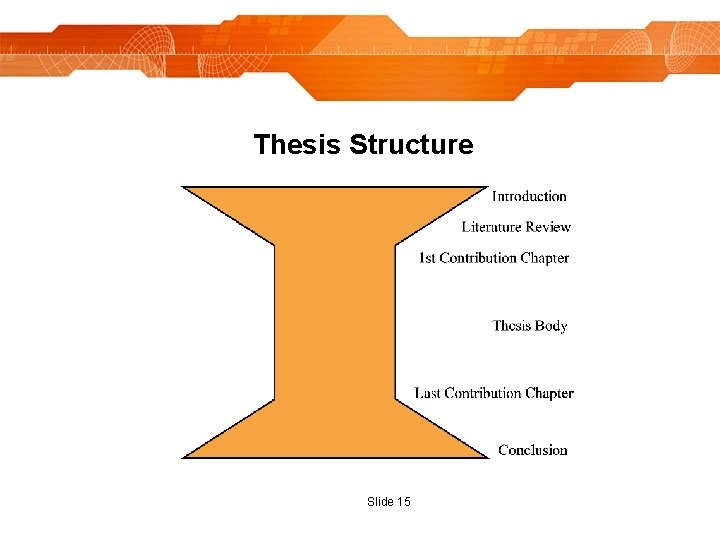
Thesis Structure Slide 15
Appendices • A thesis in general will be highly detailed • However - excessive detail obscures the work • Appendices should be used to show: Ø A complete mathematical development Ø Software listings Ø Circuit and system schematics (CAD) • Thesis Body refers to the Appendices Slide 16
Writing Style • For technical writing – STYLE counts • Technical readers expect a certain structure • This helps to focus purely on content • Technical readers notice the English only when it’s bad • Key style points follow Slide 17
Writing Style – The Topic Sentence • Paragraphs – One idea only • The topic sentence : Ø The 1 st sentence of any paragraph Ø It should flag the key idea of the paragraph Ø Helps avoids waffle – gets to the point quickly Ø It greatly assists the reader Slide 18
Writing Style – The Topic Sentence • Good Example - The AGE newspaper, May 1 st 2006 : Ø “Women in stressful jobs who become pregnant should virtually halve their time at work right from the start of their pregnancy. ” • Bad Example – “Lonely Planet Guide – Korea” : Ø “Despite rapid economic development and modernisation in recent years, Korea is still Confucian. ” Ø [Paragraph’s actual topic – Gender roles and female employment in Korea] Slide 19
Writing Style – Chapter Entry • There should be one to two introductory paragraphs to each chapter • They state the Ø Purpose of the chapter Ø Structure of the chapter Ø Central themes of the chapter Slide 20
Writing Style – Chapter Exit • The exit paragraphs provide the summary/conclusion • The Summary should: Ø State the major conclusions from the chapter Ø Relate these conclusions back to the introductory remarks and the central themes of the chapter Ø State the relevance of these conclusions Ø Show this leads into the next chapter Slide 21
Resources and Tips • Project Web site has a list of resources: • http: //www. eng. newcastle. edu. au/eecs/fyweb/4 thyearproje cts/index. html • Read Theses (Masters, Ph. D’s, FYP) Ø Take a Meta position – Look at the writing style, not content Ø If thesis reads well – WHY? Slide 22
Figures and Diagrams • Figures and Diagrams are key to a thesis • Use appropriate drawing packages: Ø VISIO, Auto. CAD, CORREL, CANVAS • Minimum font in figures = 9 pt Slide 23