Scattering and Attenuation Propagating seismic waves loose energy



- Slides: 17
Scattering and Attenuation Propagating seismic waves loose energy due to • geometrical spreading e. g. the energy of spherical wavefront emanating from a point source is distributed over a spherical surface of ever increasing size • intrinsic attenuation elastic wave propagation consists of a permanent exchange between potential (displacement) and kinetic (velocity) energy. This process is not completely reversible. There is energy loss due to shear heating at grain boundaries, mineral dislocations etc. • scattering attenuation whenever there are material changes the energy of a wavefield is scattered in different phases. Depending on the material properties this will lead to amplitude decay and dispersive effects. Seismology and the Earth’s Deep Interior Scattering and Attenuation
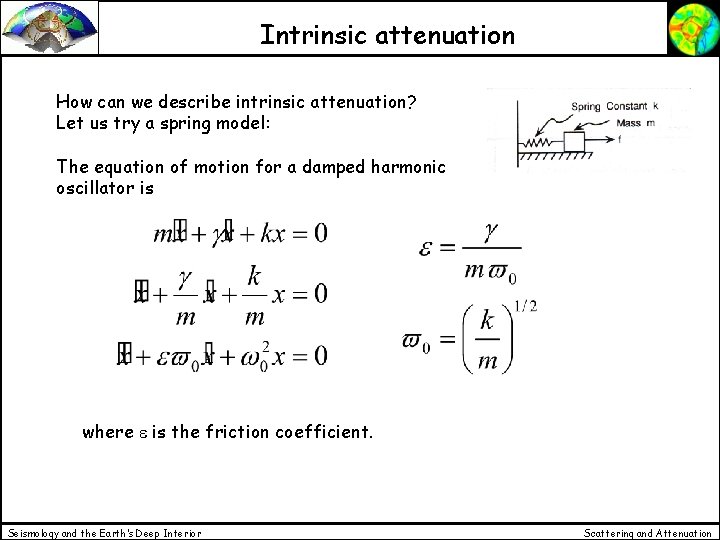
Intrinsic attenuation How can we describe intrinsic attenuation? Let us try a spring model: The equation of motion for a damped harmonic oscillator is where e is the friction coefficient. Seismology and the Earth’s Deep Interior Scattering and Attenuation
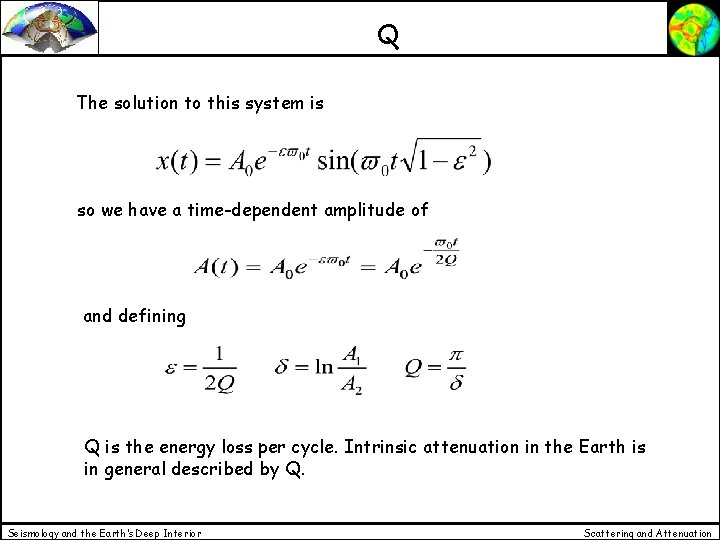
Q The solution to this system is so we have a time-dependent amplitude of and defining Q is the energy loss per cycle. Intrinsic attenuation in the Earth is in general described by Q. Seismology and the Earth’s Deep Interior Scattering and Attenuation
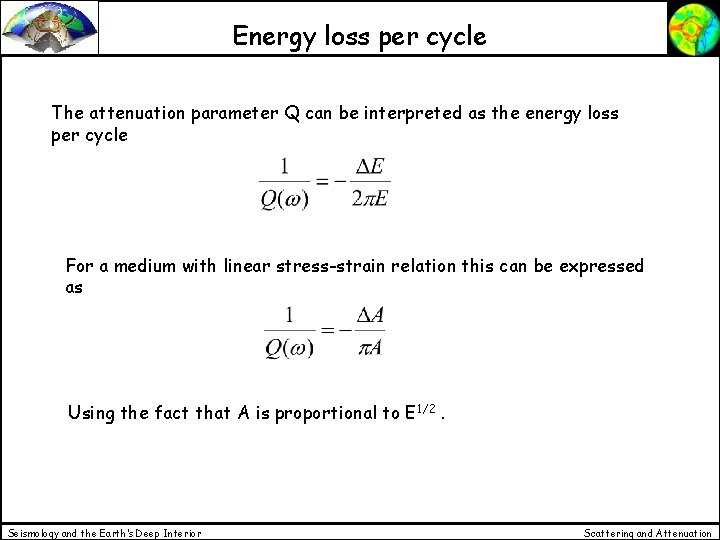
Energy loss per cycle The attenuation parameter Q can be interpreted as the energy loss per cycle For a medium with linear stress-strain relation this can be expressed as Using the fact that A is proportional to E 1/2. Seismology and the Earth’s Deep Interior Scattering and Attenuation
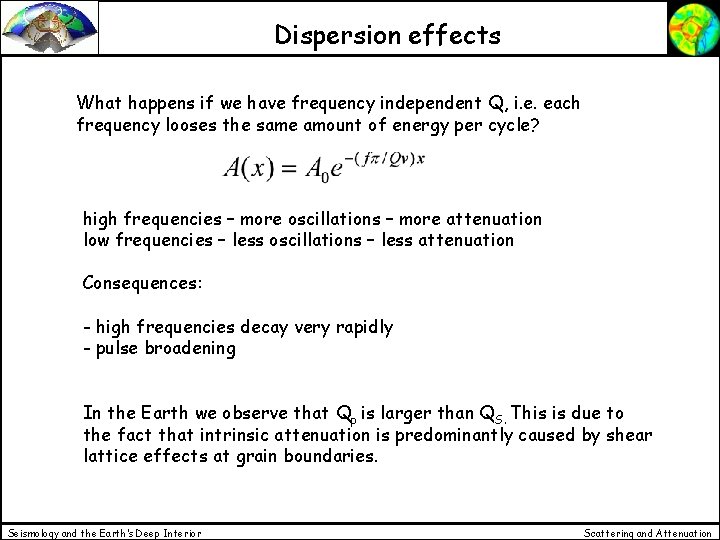
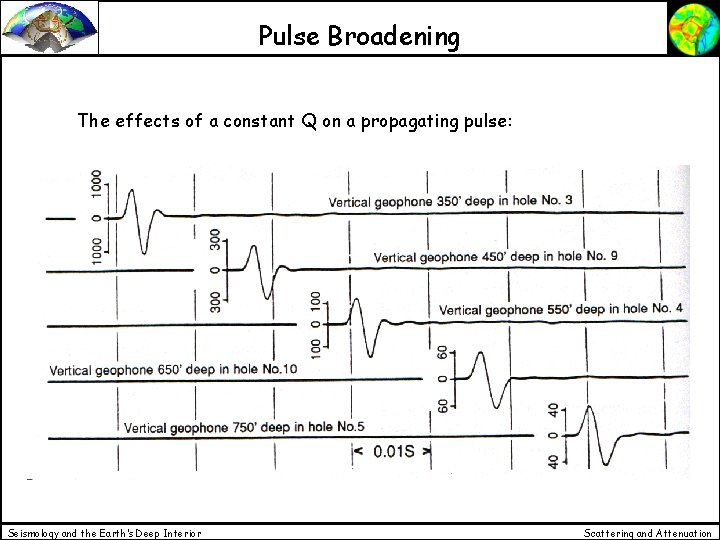
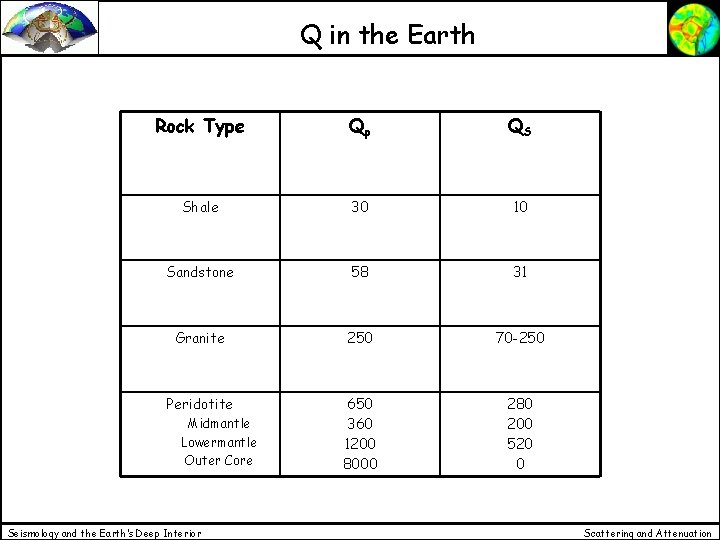
Dispersion effects What happens if we have frequency independent Q, i. e. each frequency looses the same amount of energy per cycle? high frequencies – more oscillations – more attenuation low frequencies – less oscillations – less attenuation Consequences: - high frequencies decay very rapidly - pulse broadening In the Earth we observe that Qp is larger than QS. This is due to the fact that intrinsic attenuation is predominantly caused by shear lattice effects at grain boundaries. Seismology and the Earth’s Deep Interior Scattering and Attenuation
Pulse Broadening The effects of a constant Q on a propagating pulse: Seismology and the Earth’s Deep Interior Scattering and Attenuation
Q in the Earth Rock Type Qp QS Shale 30 10 Sandstone 58 31 Granite 250 70 -250 Peridotite 650 360 1200 8000 280 200 520 0 Midmantle Lowermantle Outer Core Seismology and the Earth’s Deep Interior Scattering and Attenuation
Scattering in random media How is a propagating wavefield affected by random heterogeneities? Seismology and the Earth’s Deep Interior Scattering and Attenuation
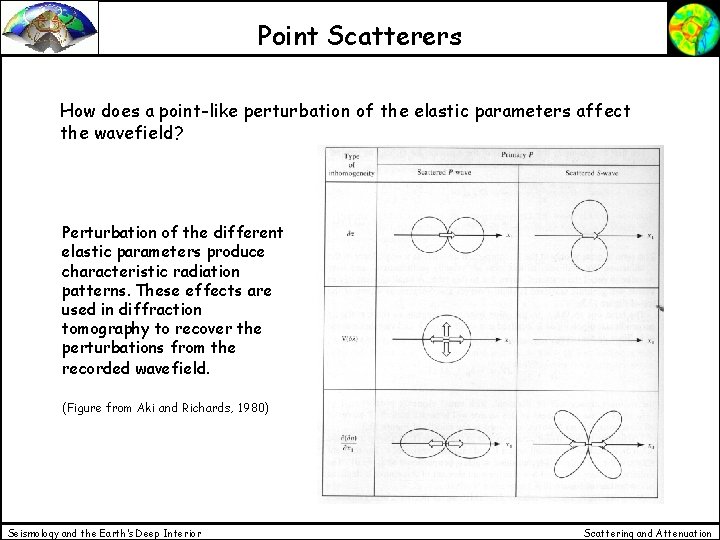
Point Scatterers How does a point-like perturbation of the elastic parameters affect the wavefield? Perturbation of the different elastic parameters produce characteristic radiation patterns. These effects are used in diffraction tomography to recover the perturbations from the recorded wavefield. (Figure from Aki and Richards, 1980) Seismology and the Earth’s Deep Interior Scattering and Attenuation
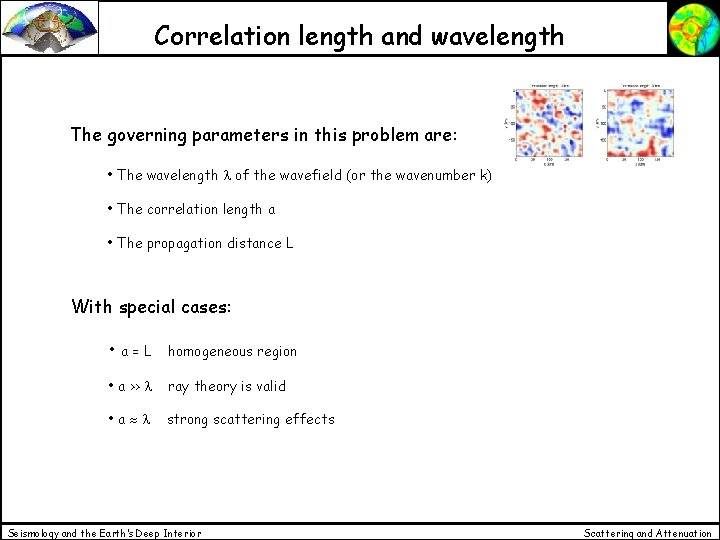
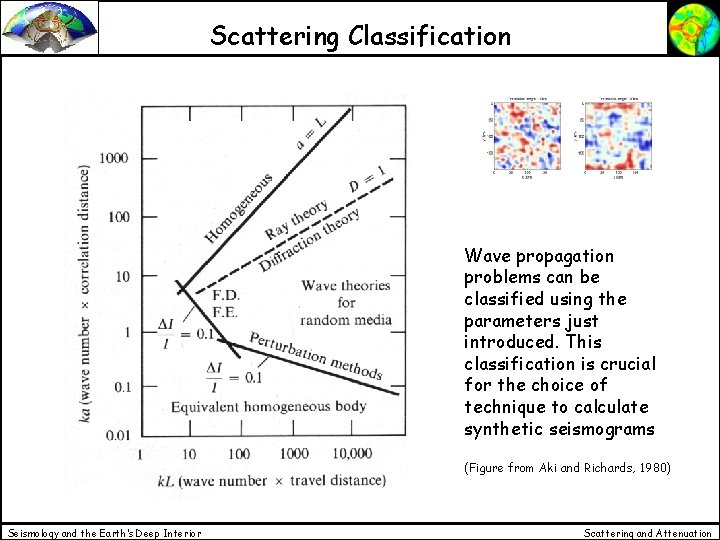
Correlation length and wavelength The governing parameters in this problem are: • The wavelength l of the wavefield (or the wavenumber k) • The correlation length a • The propagation distance L With special cases: • a=L homogeneous region • a >> l ray theory is valid • a l strong scattering effects Seismology and the Earth’s Deep Interior Scattering and Attenuation
Scattering Classification Wave propagation problems can be classified using the parameters just introduced. This classification is crucial for the choice of technique to calculate synthetic seismograms (Figure from Aki and Richards, 1980) Seismology and the Earth’s Deep Interior Scattering and Attenuation
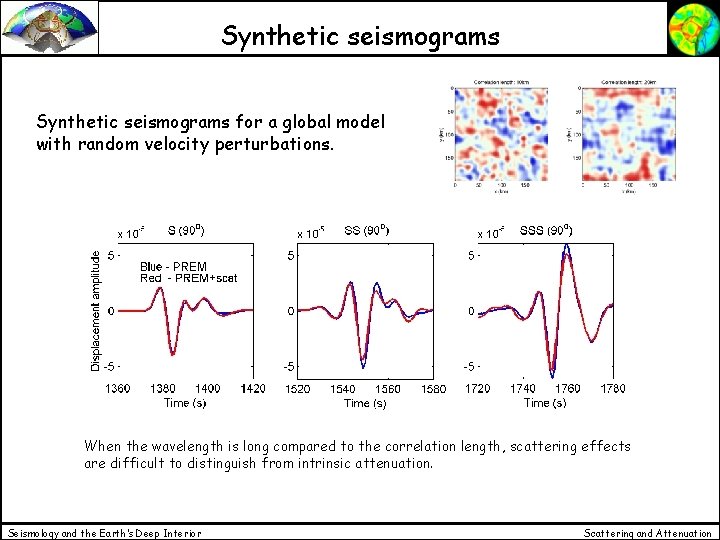
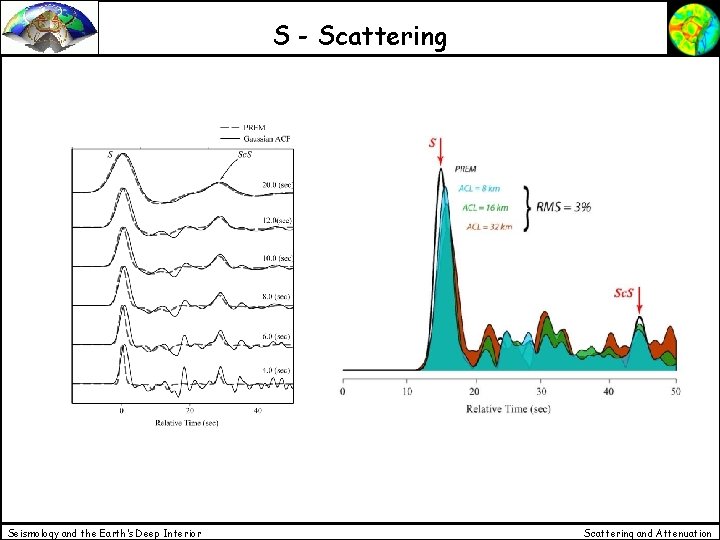
Synthetic seismograms for a global model with random velocity perturbations. When the wavelength is long compared to the correlation length, scattering effects are difficult to distinguish from intrinsic attenuation. Seismology and the Earth’s Deep Interior Scattering and Attenuation
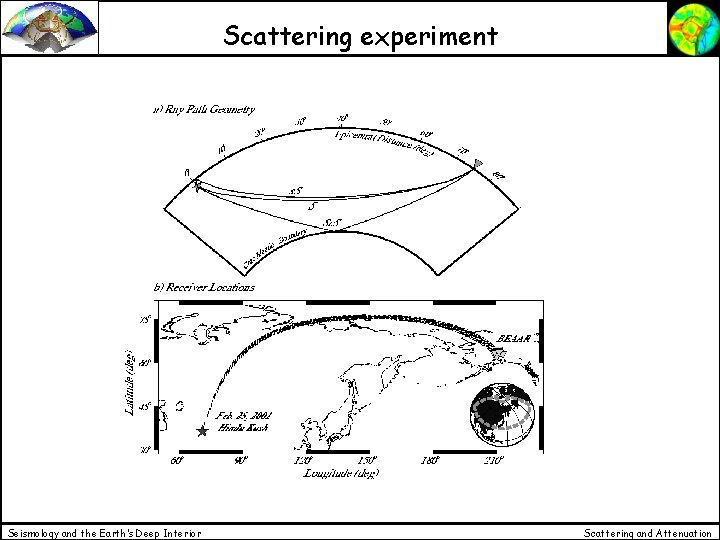
Scattering experiment Seismology and the Earth’s Deep Interior Scattering and Attenuation
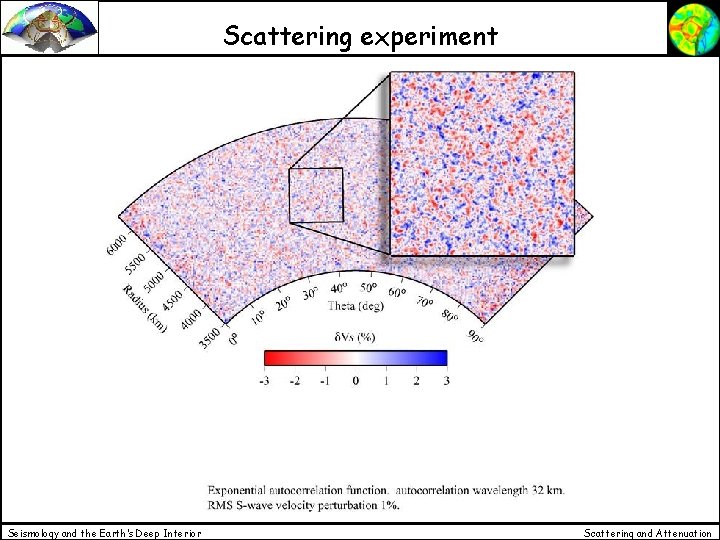
Scattering experiment Seismology and the Earth’s Deep Interior Scattering and Attenuation
S - Scattering Seismology and the Earth’s Deep Interior Scattering and Attenuation
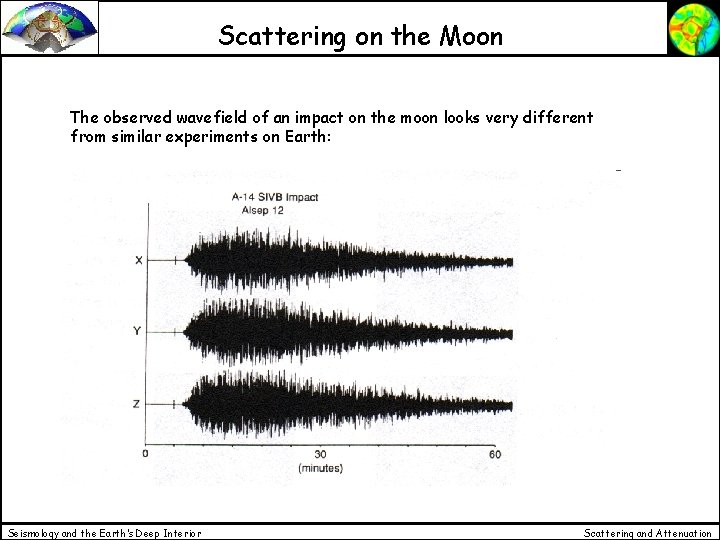
Scattering on the Moon The observed wavefield of an impact on the moon looks very different from similar experiments on Earth: Seismology and the Earth’s Deep Interior Scattering and Attenuation
Scattering and Attenuation: Summary Elastic wavefields not only loose energy through geometrical spreading effects but also through intrinsic and scattering attenuation. Intrinsic attenuation is described by the frequency-dependent attenuation parameter Q(w). Q describes the energy loss per cycle. In the Earth’s crust and mantle Q ranges from 10 to 1000. Any material heterogeneities (point-like, interfaces, etc. ) causes a wavefield to be scattered. The parameters governing the kind of scattering are the wavenumber (or wavelength), the correlation length of the scatterers and the propagation distance in the scattering medium. The classification of scattering is important for the way synthetic seismograms have to be calculated for a particular problem. Ray theory is applicable when the correlation length of the heterogeneities is much larger than the wavelength. Numerical methods have to be used when the correlation length is close to the wavelength. Seismology and the Earth’s Deep Interior Scattering and Attenuation