Scaffolding Early Learning IMMATURE VS MATURE PLAY Why

- Slides: 8
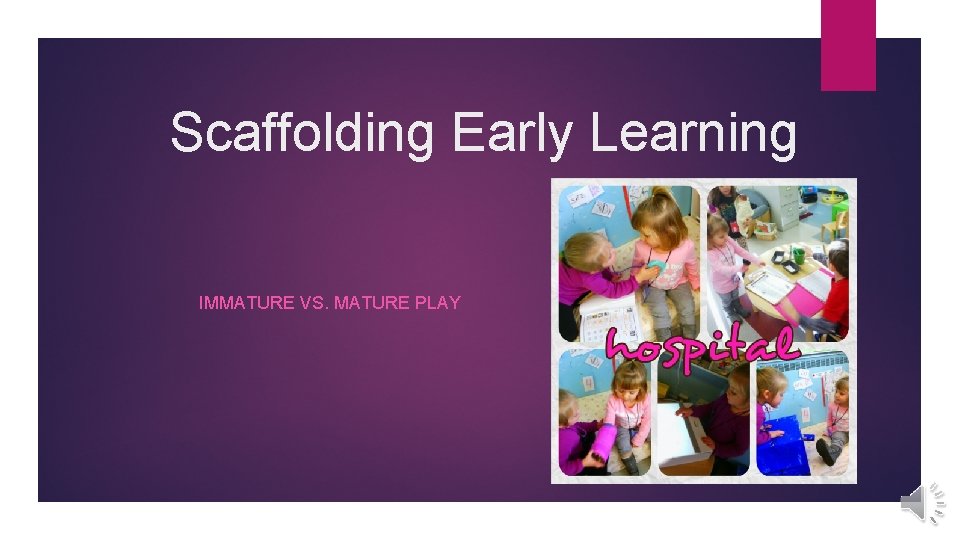
Scaffolding Early Learning IMMATURE VS. MATURE PLAY
Why the push for more dramatic play? In 2000 a study was replicated that found a parallelogram has shifted; 5 year olds are more like 3 year olds, 7 year olds are more like 5 years, etc. (Gudareva, 2005) Something has changed so that children no longer know how to play Today’s children: o Spend more time watching TV o Have toys that require less imagination to play with them o Spend less time in mixed age groups o Spend more time in scheduled activities
“Play also creates the zone of proximal development of the child. In play, the child is always behaving beyond his age, above his usual everyday behavior; in play he is as it were, a head above himself. ” (Vygotsky, 1933/1978, p. 74)
What Children Learn Through Play Symbolic thinking Self-regulation Emotional thinking and thoughtful emotions Oral language Beginnings of literacy
Immature vs. Mature Play Immature Mature Children use realistic props only Children invent props to fit their roles Children fight and argue over props Children solve disputes by inventing props No attempts to use imagination Children talk about play before playing Pretend actions are repetitive and stereotypical Children play roles that have specific characteristics or rules of action Play actions imitate isolated everyday actions Children may play several roles at once, changing their language and actions to indicate a new role Children play in solitary or parallel manner Play scenarios may extend over days Play episodes are short
The Defining Elements of Mature Play Children create an imaginary situation Children take on explicit roles and use objects in a symbolic way Children follow implicit rules The use of language is an integral part of play *All families have given signed written consent for photos to be shared.
Works Cited Barnett, W. S. , Jung, K. , Yarosz, D. J. , Thomas, J. , Hornbeck, A. , Stechuk, R. , Educational effects of the Tools of the Mind Curriculum: A Randomized Trial & Burns, S. (2008). Early Childhood Research Quarterly, 23(3), 299 -313 Bodrova E. , Germeroth, C. , & Leong, D. J. (2013). Play and self-regulation: Lessons from Vygotsky. American Journal of Play, 6(1) Bodrova, E. & Leong, D. J. (2012) Chopsticks and counting chips: Do play and foundational skills need to compete for the teacher’s attention in an early childhood classroom? In: C. Copple (ed. ) Growing minds: Building strong cognitive foundations in early childhood. Washington DC: NAEYC Bodrova E. , & Leong, D. J. (2012). Tools of the mind: Vygotskian approach to early childhood education. In: Rooparine, J. L. & J. Jones. Approaches to early childhood education (6 th ed. ). Columbus, OH: Merrill/Prentice Hall, pp. 241 -260 Bodrova, E. & Leong, D. J. (2012) Scaffolding self-regulated learning in young children: Lessons from tools of the mind. In S. Sheridan, R. Pianta, L. Justice, & W. Barnett (Eds) Handbook of early education. New York, NY: Guilford Press, pp. 352 -369
Work Cited Continued Bodrova, E. , Leong, D. , & Akhutina, T. (2011) When everything new is well forgotten old: Vygotsky/Luria insights in the development of executive functions. New Directions in Child and Adolescent Development, 133, 11– 28 Bodrova E. , & Leong, D. (2011). Revisiting Vygotskian perspectives on play and pedagogy, In Rogers, S. (year). Rethinking play and pedagogy in early childhood education: Concepts, contexts, and cultures. Routledge, pp. 60 -72. Cordova, E. , & Leong, D. J. (2001). Tools of The Mind: A Case Study of Implementing the Vygotsky Approach in American Early Childhood and Primary Classrooms. (UNESCO Innodata Monographs: Educational Innovations in Action No. 7) Geneva, Switzerland: International Bureau of Education, UNESCO Diamond, A. , Barnett, W. , Thomas, J. , & Murno, S. (2007, November 3). Preschool Improves Cognitive Control. Science, 318(585)5, pp. 1387 -1388. doi: 10. 1126/science. 1151148 Imholz, S. & Petrosino, A. (2012). Teacher observations on the implementation of the Tools of the Mind curriculum in the classroom: Analysis of interviews conducted over a one-year period. Creative Education, 3, 185 -192. Program