Satyaspeak CEO Talk e Growth July 6 th
- Slides: 20
Satyaspeak CEO Talk@ e. Growth July 6 th, New Delhi ‘GYAN VAHINI’ National Knowledge Transport Grid - NKTG Unlocking the Potential of Digital Backbone Infrastructure Satya N Gupta Chairman - BLUETOWN India & BIMSTEC, Asia Chairman – India IPv 6 Council Hon. Secretary General, NGN Forum India Secretary General, ITU-APT Foundation of India Vice- President and Trustee, Digital Communication Forum, India
Components of Backbone Infrastructure: • Towers/ Antennae (IBS, DAS, Elements viz. RAN, Small Cells, Transmission) Transport Infrastructure has become ‘Digital’ • Optic Fibre Networks (OFC) • Wireline infra • Wi-Fi & Public Wi-Fi Hotspots • Sat. Com 3
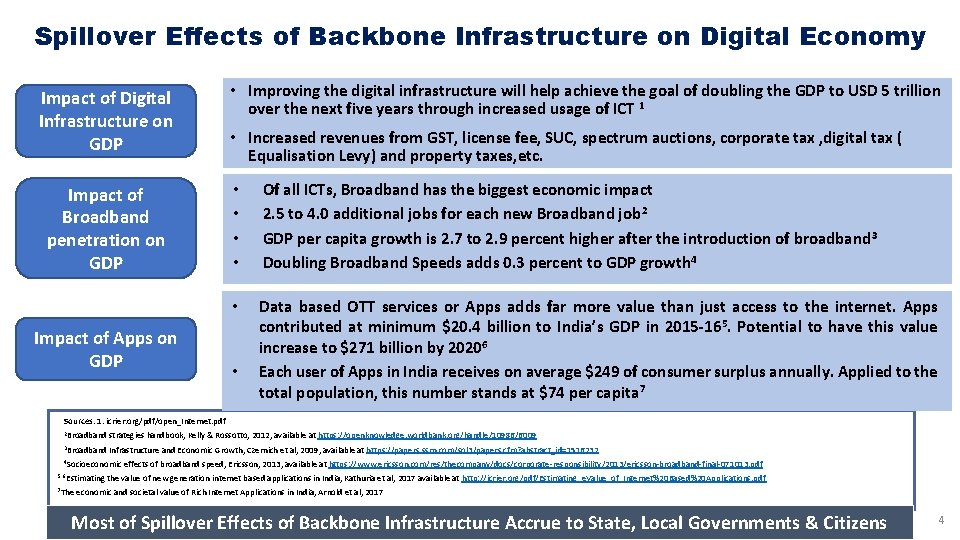
Spillover Effects of Backbone Infrastructure on Digital Economy Impact of Digital Infrastructure on GDP Impact of Broadband penetration on GDP Impact of Apps on GDP • Improving the digital infrastructure will help achieve the goal of doubling the GDP to USD 5 trillion over the next five years through increased usage of ICT 1 • Increased revenues from GST, license fee, SUC, spectrum auctions, corporate tax , digital tax ( Equalisation Levy) and property taxes, etc. • • Of all ICTs, Broadband has the biggest economic impact 2. 5 to 4. 0 additional jobs for each new Broadband job 2 GDP per capita growth is 2. 7 to 2. 9 percent higher after the introduction of broadband 3 Doubling Broadband Speeds adds 0. 3 percent to GDP growth 4 • Data based OTT services or Apps adds far more value than just access to the internet. Apps contributed at minimum $20. 4 billion to India’s GDP in 2015 -165. Potential to have this value increase to $271 billion by 20206 Each user of Apps in India receives on average $249 of consumer surplus annually. Applied to the total population, this number stands at $74 per capita 7 • Sources: 1. icrier. org/pdf/open_Internet. pdf 2 Broadband strategies handbook, Kelly & Rossotto, 2012, available at https: //openknowledge. worldbank. org/handle/10986/6009 3 Broadband Infrastructure and Economic Growth, Czernich et al, 2009, available at https: //papers. ssrn. com/sol 3/papers. cfm? abstract_id=1516232 4 Socioeconomic effects of broadband speed, Ericsson, 2013, available at https: //www. ericsson. com/res/thecompany/docs/corporate-responsibility/2013/ericsson-broadband-final-071013. pdf 5 6 Estimating the value of new generation internet based applications in India, Kathuria et al, 2017 available at http: //icrier. org/pdf/Estimating_e. Value_of_Internet%20 Based%20 Applications. pdf 7 The economic and societal value of Rich Internet Applications in India, Arnold et al, 2017 Most of Spillover Effects of Backbone Infrastructure Accrue to State, Local Governments & Citizens 4
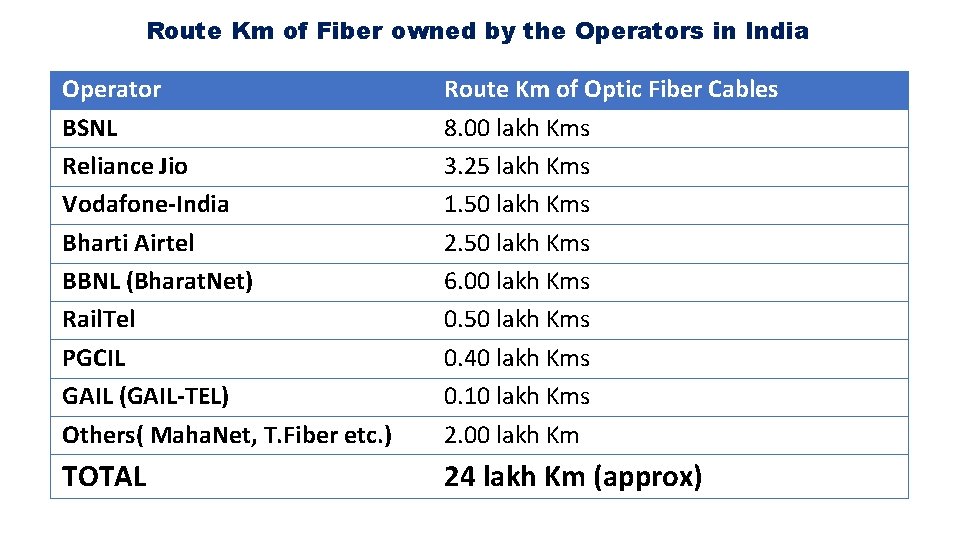
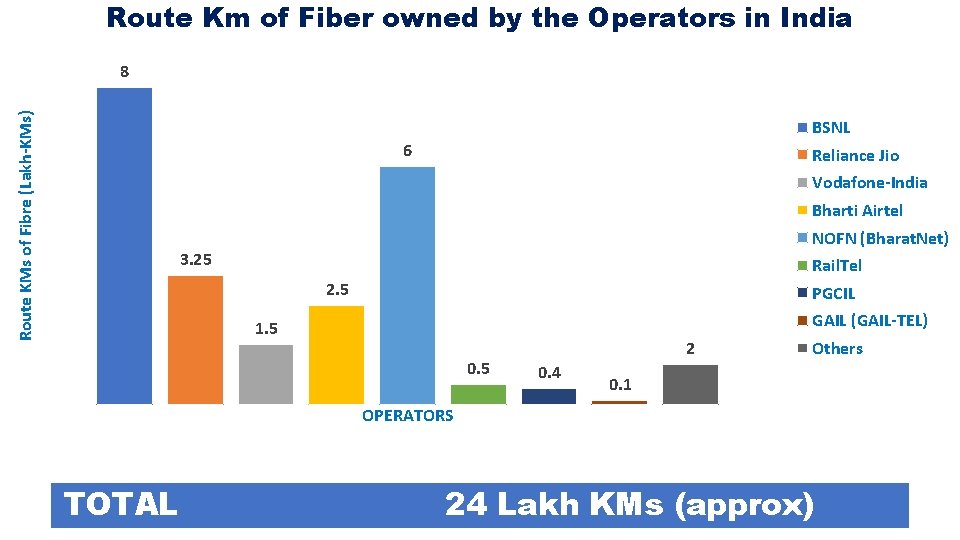
Route Km of Fiber owned by the Operators in India Operator BSNL Reliance Jio Vodafone-India Bharti Airtel BBNL (Bharat. Net) Rail. Tel PGCIL GAIL (GAIL-TEL) Others( Maha. Net, T. Fiber etc. ) Route Km of Optic Fiber Cables 8. 00 lakh Kms 3. 25 lakh Kms 1. 50 lakh Kms 2. 50 lakh Kms 6. 00 lakh Kms 0. 50 lakh Kms 0. 40 lakh Kms 0. 10 lakh Kms 2. 00 lakh Km TOTAL 24 lakh Km (approx)
Route Km of Fiber owned by the Operators in India Route KMs of Fibre (Lakh-KMs) 8 BSNL 6 Reliance Jio Vodafone-India Bharti Airtel NOFN (Bharat. Net) 3. 25 Rail. Tel 2. 5 PGCIL GAIL (GAIL-TEL) 1. 5 0. 5 2 0. 4 Others 0. 1 OPERATORS TOTAL 24 Lakh KMs (approx)
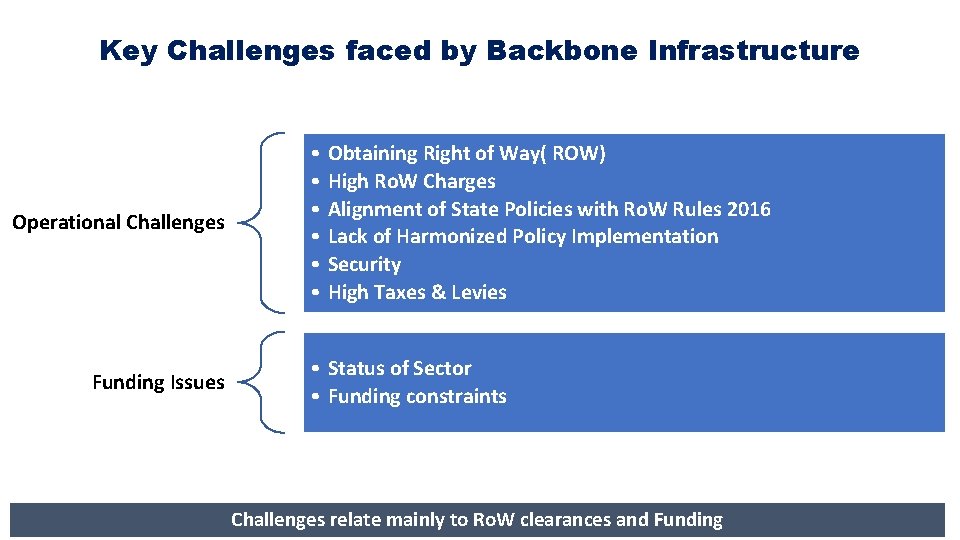
Key Challenges faced by Backbone Infrastructure Operational Challenges Funding Issues • • • Obtaining Right of Way( ROW) High Ro. W Charges Alignment of State Policies with Ro. W Rules 2016 Lack of Harmonized Policy Implementation Security High Taxes & Levies • Status of Sector • Funding constraints Challenges relate mainly to Ro. W clearances and Funding 7
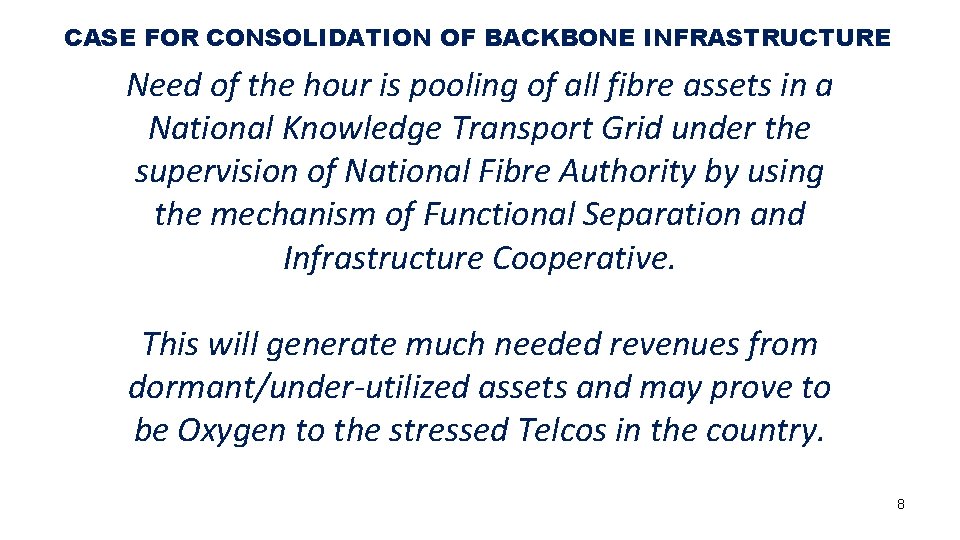
CASE FOR CONSOLIDATION OF BACKBONE INFRASTRUCTURE Need of the hour is pooling of all fibre assets in a National Knowledge Transport Grid under the supervision of National Fibre Authority by using the mechanism of Functional Separation and Infrastructure Cooperative. This will generate much needed revenues from dormant/under-utilized assets and may prove to be Oxygen to the stressed Telcos in the country. 8
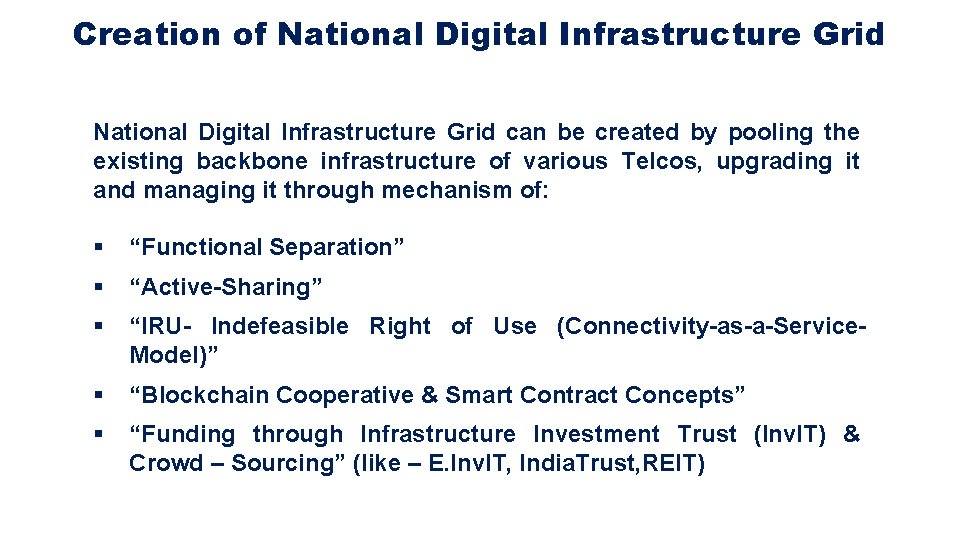
Creation of National Digital Infrastructure Grid can be created by pooling the existing backbone infrastructure of various Telcos, upgrading it and managing it through mechanism of: “Functional Separation” “Active-Sharing” “IRU- Indefeasible Right of Use (Connectivity-as-a-Service. Model)” “Blockchain Cooperative & Smart Contract Concepts” “Funding through Infrastructure Investment Trust (Inv. IT) & Crowd – Sourcing” (like – E. Inv. IT, India. Trust, REIT)
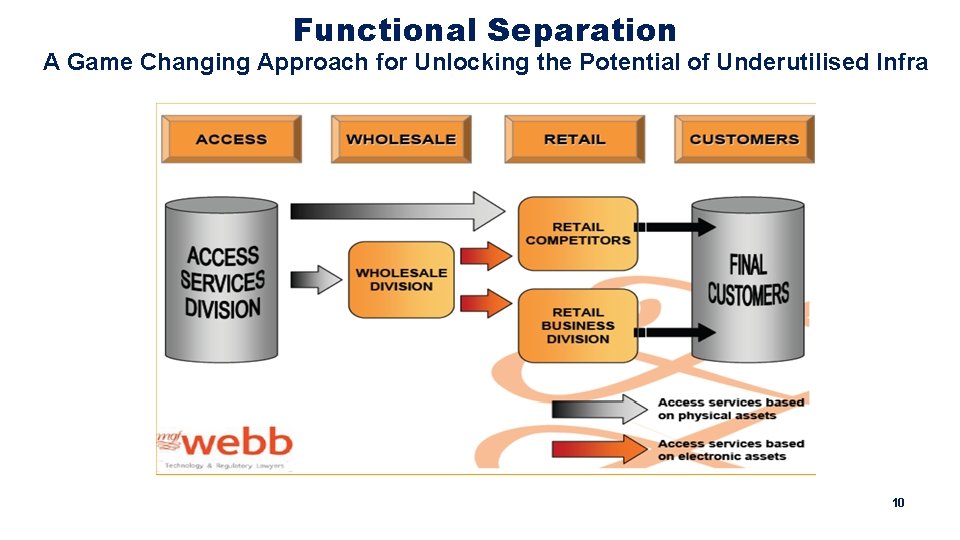
Functional Separation A Game Changing Approach for Unlocking the Potential of Underutilised Infra 10
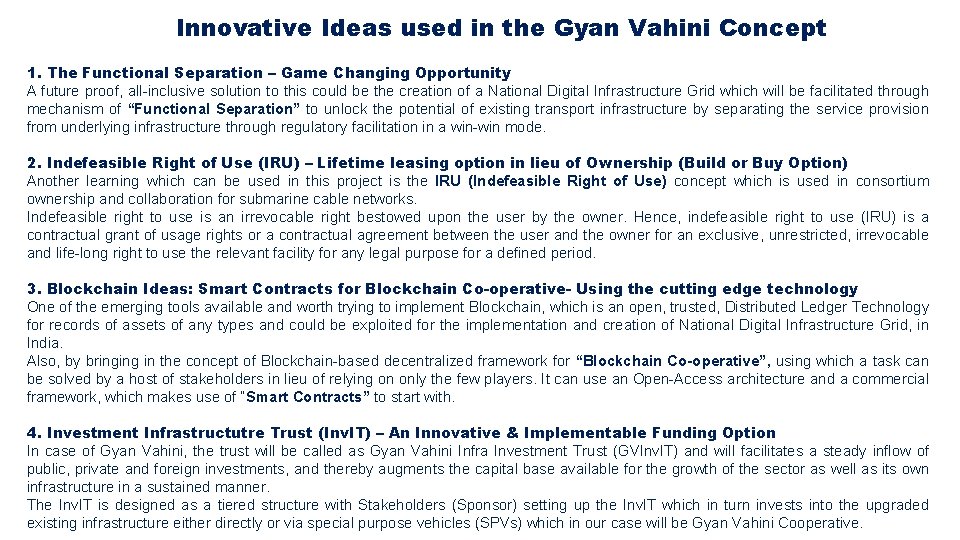
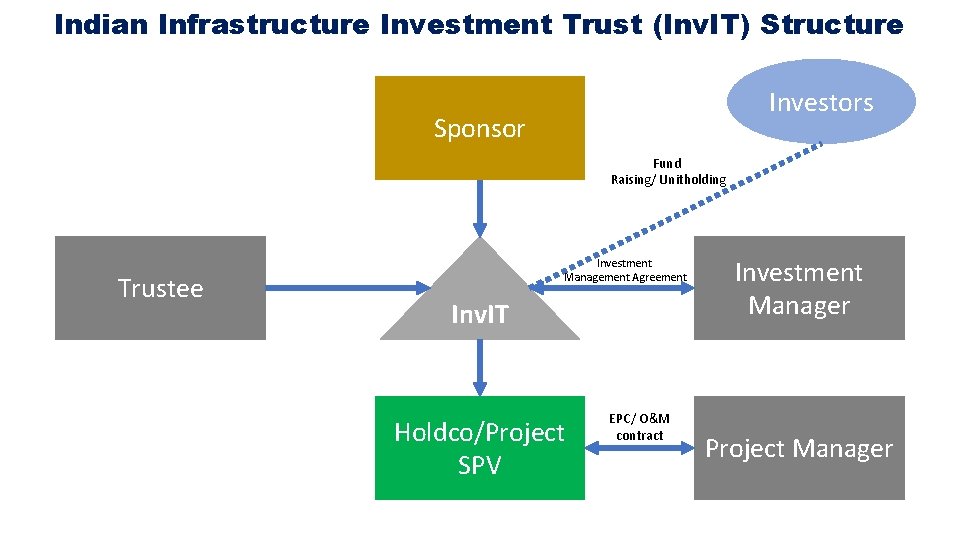
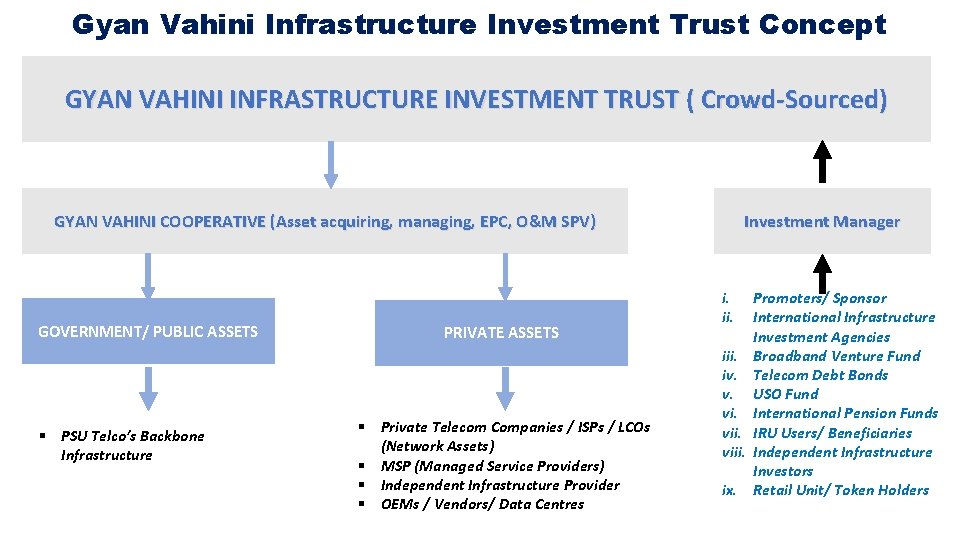
Innovative Ideas used in the Gyan Vahini Concept 1. The Functional Separation – Game Changing Opportunity A future proof, all-inclusive solution to this could be the creation of a National Digital Infrastructure Grid which will be facilitated through mechanism of “Functional Separation” to unlock the potential of existing transport infrastructure by separating the service provision from underlying infrastructure through regulatory facilitation in a win-win mode. 2. Indefeasible Right of Use (IRU) – Lifetime leasing option in lieu of Ownership (Build or Buy Option) Another learning which can be used in this project is the IRU (Indefeasible Right of Use) concept which is used in consortium ownership and collaboration for submarine cable networks. Indefeasible right to use is an irrevocable right bestowed upon the user by the owner. Hence, indefeasible right to use (IRU) is a contractual grant of usage rights or a contractual agreement between the user and the owner for an exclusive, unrestricted, irrevocable and life-long right to use the relevant facility for any legal purpose for a defined period. 3. Blockchain Ideas: Smart Contracts for Blockchain Co-operative- Using the cutting edge technology One of the emerging tools available and worth trying to implement Blockchain, which is an open, trusted, Distributed Ledger Technology for records of assets of any types and could be exploited for the implementation and creation of National Digital Infrastructure Grid, in India. Also, by bringing in the concept of Blockchain-based decentralized framework for “Blockchain Co-operative”, using which a task can be solved by a host of stakeholders in lieu of relying on only the few players. It can use an Open-Access architecture and a commercial framework, which makes use of “Smart Contracts” to start with. 4. Investment Infrastructutre Trust (Inv. IT) – An Innovative & Implementable Funding Option In case of Gyan Vahini, the trust will be called as Gyan Vahini Infra Investment Trust (GVInv. IT) and will facilitates a steady inflow of public, private and foreign investments, and thereby augments the capital base available for the growth of the sector as well as its own infrastructure in a sustained manner. The Inv. IT is designed as a tiered structure with Stakeholders (Sponsor) setting up the Inv. IT which in turn invests into the upgraded existing infrastructure either directly or via special purpose vehicles (SPVs) which in our case will be Gyan Vahini Cooperative.
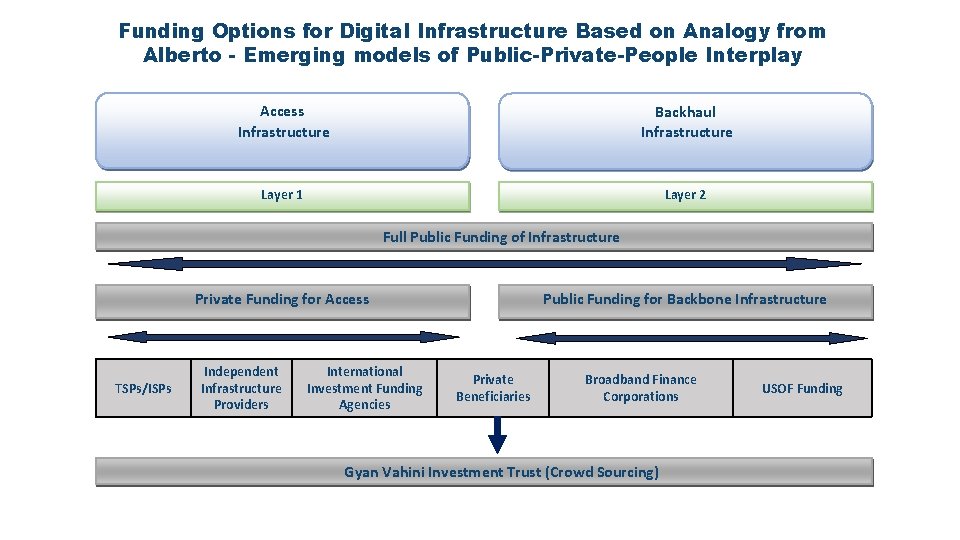
Funding Options for Digital Infrastructure Based on Analogy from Alberto - Emerging models of Public-Private-People Interplay Access Infrastructure Backhaul Infrastructure Layer 1 Layer 2 Full Public Funding of Infrastructure Private Funding for Access TSPs/ISPs Independent Infrastructure Providers International Investment Funding Agencies Public Funding for Backbone Infrastructure Private Beneficiaries Broadband Finance Corporations Gyan Vahini Investment Trust (Crowd Sourcing) USOF Funding
Indian Infrastructure Investment Trust (Inv. IT) Structure Investors Sponsor Fund Raising/ Unitholding Trustee Investment Management Agreement Inv. IT Holdco/Project SPV EPC/ O&M contract Investment Manager Project Manager
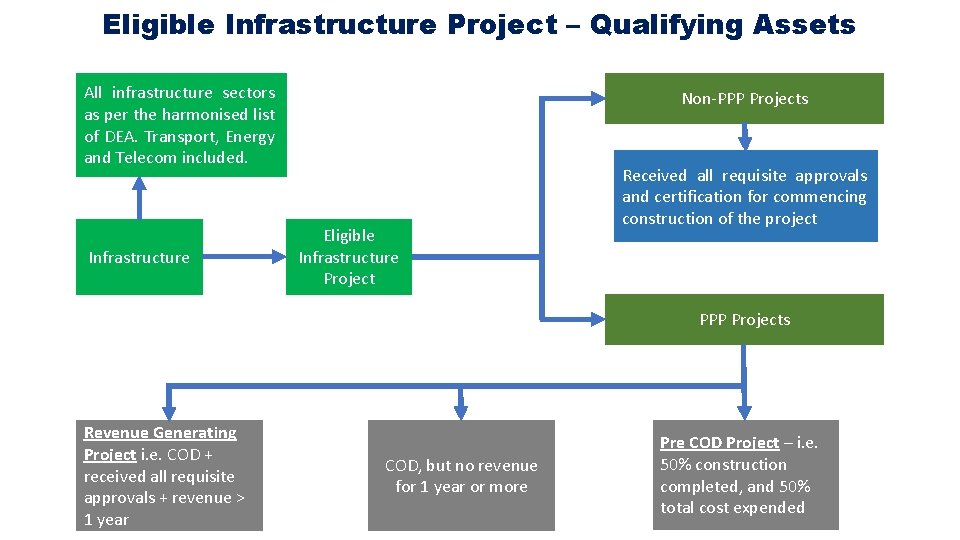
Eligible Infrastructure Project – Qualifying Assets All infrastructure sectors as per the harmonised list of DEA. Transport, Energy and Telecom included. Infrastructure Non-PPP Projects Eligible Infrastructure Project Received all requisite approvals and certification for commencing construction of the project PPP Projects Revenue Generating Project i. e. COD + received all requisite approvals + revenue > 1 year COD, but no revenue for 1 year or more Pre COD Project – i. e. 50% construction completed, and 50% total cost expended
Gyan Vahini Infrastructure Investment Trust Concept GYAN VAHINI INFRASTRUCTURE INVESTMENT TRUST ( Crowd-Sourced) GYAN VAHINI COOPERATIVE (Asset acquiring, managing, EPC, O&M SPV) GOVERNMENT/ PUBLIC ASSETS PSU Telco’s Backbone Infrastructure PRIVATE ASSETS Private Telecom Companies / ISPs / LCOs (Network Assets) MSP (Managed Service Providers) Independent Infrastructure Provider OEMs / Vendors/ Data Centres Investment Manager i. iii. iv. v. viii. ix. Promoters/ Sponsor International Infrastructure Investment Agencies Broadband Venture Fund Telecom Debt Bonds USO Fund International Pension Funds IRU Users/ Beneficiaries Independent Infrastructure Investors Retail Unit/ Token Holders
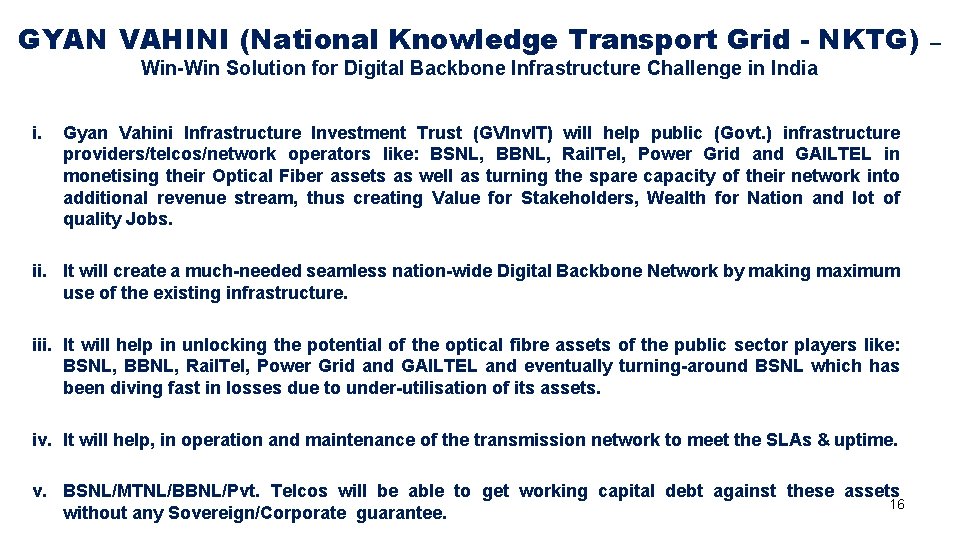
GYAN VAHINI (National Knowledge Transport Grid - NKTG) Win-Win Solution for Digital Backbone Infrastructure Challenge in India i. Gyan Vahini Infrastructure Investment Trust (GVInv. IT) will help public (Govt. ) infrastructure providers/telcos/network operators like: BSNL, BBNL, Rail. Tel, Power Grid and GAILTEL in monetising their Optical Fiber assets as well as turning the spare capacity of their network into additional revenue stream, thus creating Value for Stakeholders, Wealth for Nation and lot of quality Jobs. ii. It will create a much-needed seamless nation-wide Digital Backbone Network by making maximum use of the existing infrastructure. iii. It will help in unlocking the potential of the optical fibre assets of the public sector players like: BSNL, BBNL, Rail. Tel, Power Grid and GAILTEL and eventually turning-around BSNL which has been diving fast in losses due to under-utilisation of its assets. iv. It will help, in operation and maintenance of the transmission network to meet the SLAs & uptime. v. BSNL/MTNL/BBNL/Pvt. Telcos will be able to get working capital debt against these assets 16 without any Sovereign/Corporate guarantee. –
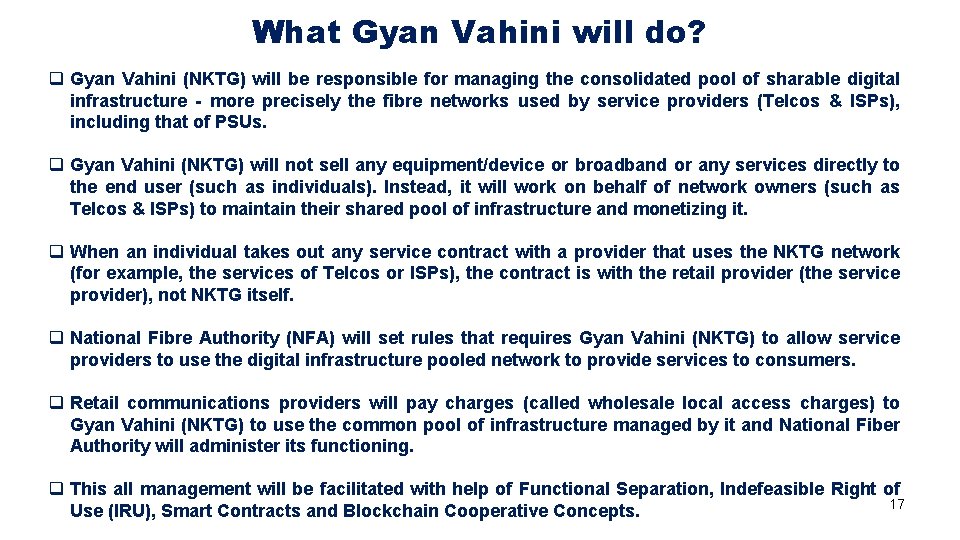
What Gyan Vahini will do? q Gyan Vahini (NKTG) will be responsible for managing the consolidated pool of sharable digital infrastructure - more precisely the fibre networks used by service providers (Telcos & ISPs), including that of PSUs. q Gyan Vahini (NKTG) will not sell any equipment/device or broadband or any services directly to the end user (such as individuals). Instead, it will work on behalf of network owners (such as Telcos & ISPs) to maintain their shared pool of infrastructure and monetizing it. q When an individual takes out any service contract with a provider that uses the NKTG network (for example, the services of Telcos or ISPs), the contract is with the retail provider (the service provider), not NKTG itself. q National Fibre Authority (NFA) will set rules that requires Gyan Vahini (NKTG) to allow service providers to use the digital infrastructure pooled network to provide services to consumers. q Retail communications providers will pay charges (called wholesale local access charges) to Gyan Vahini (NKTG) to use the common pool of infrastructure managed by it and National Fiber Authority will administer its functioning. q This all management will be facilitated with help of Functional Separation, Indefeasible Right of 17 Use (IRU), Smart Contracts and Blockchain Cooperative Concepts.
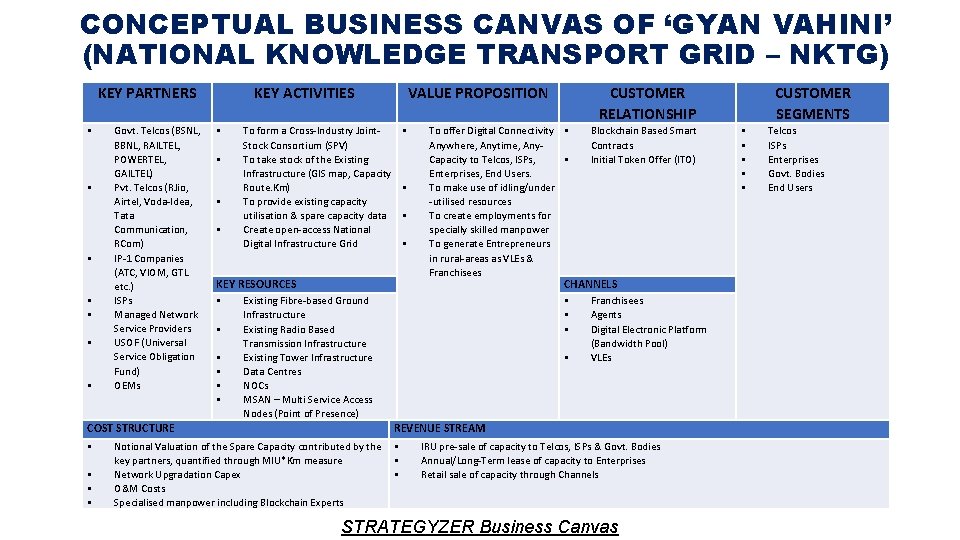
CONCEPTUAL BUSINESS CANVAS OF ‘GYAN VAHINI’ (NATIONAL KNOWLEDGE TRANSPORT GRID – NKTG) KEY PARTNERS Govt. Telcos (BSNL, BBNL, RAILTEL, POWERTEL, GAILTEL) Pvt. Telcos (RJio, Airtel, Voda-Idea, Tata Communication, RCom) IP-1 Companies (ATC, VIOM, GTL etc. ) ISPs Managed Network Service Providers USOF (Universal Service Obligation Fund) OEMs KEY ACTIVITIES To form a Cross-Industry Joint. Stock Consortium (SPV) To take stock of the Existing Infrastructure (GIS map, Capacity Route. Km) To provide existing capacity utilisation & spare capacity data Create open-access National Digital Infrastructure Grid VALUE PROPOSITION To offer Digital Connectivity Anywhere, Anytime, Any. Capacity to Telcos, ISPs, Enterprises, End Users. To make use of idling/under -utilised resources To create employments for specially skilled manpower To generate Entrepreneurs in rural-areas as VLEs & Franchisees KEY RESOURCES Existing Fibre-based Ground Infrastructure Existing Radio Based Transmission Infrastructure Existing Tower Infrastructure Data Centres NOCs MSAN – Multi Service Access Nodes (Point of Presence) CUSTOMER RELATIONSHIP Blockchain Based Smart Contracts Initial Token Offer (ITO) Telcos ISPs Enterprises Govt. Bodies End Users CHANNELS Franchisees Agents Digital Electronic Platform CUSTOMER SEGMENTS (Bandwidth Pool) VLEs COST STRUCTURE REVENUE STREAM Notional Valuation of the Spare Capacity contributed by the IRU pre-sale of capacity to Telcos, ISPs & Govt. Bodies key partners, quantified through MIU*Km measure Annual/Long-Term lease of capacity to Enterprises Network Upgradation Capex Retail sale of capacity through Channels O&M Costs Specialised manpower including Blockchain Experts STRATEGYZER Business Canvas
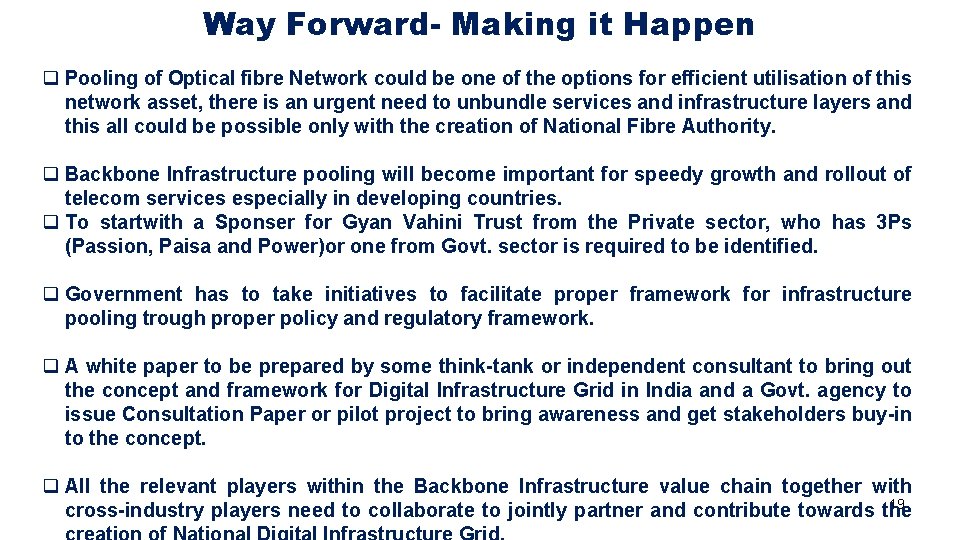
Way Forward- Making it Happen q Pooling of Optical fibre Network could be one of the options for efficient utilisation of this network asset, there is an urgent need to unbundle services and infrastructure layers and this all could be possible only with the creation of National Fibre Authority. q Backbone Infrastructure pooling will become important for speedy growth and rollout of telecom services especially in developing countries. q To startwith a Sponser for Gyan Vahini Trust from the Private sector, who has 3 Ps (Passion, Paisa and Power)or one from Govt. sector is required to be identified. q Government has to take initiatives to facilitate proper framework for infrastructure pooling trough proper policy and regulatory framework. q A white paper to be prepared by some think-tank or independent consultant to bring out the concept and framework for Digital Infrastructure Grid in India and a Govt. agency to issue Consultation Paper or pilot project to bring awareness and get stakeholders buy-in to the concept. q All the relevant players within the Backbone Infrastructure value chain together with 19 cross-industry players need to collaborate to jointly partner and contribute towards the
Thank You Let us Make it Happen Cooperatively Satya N Gupta sg. ngnguru@gmail. com www. gyanvahini. org