Safety Culture Diana Engstrm Operational Safety Section Division

- Slides: 18
Safety Culture Diana Engström Operational Safety Section Division of Nuclear Installation Safety IAEA International Atomic Energy Agency
IAEA Activities • Produce publications • Provide practical support, services and guidance to the Member States, including training and support on safety culture self-assessment • Safety culture independent assessments IAEA
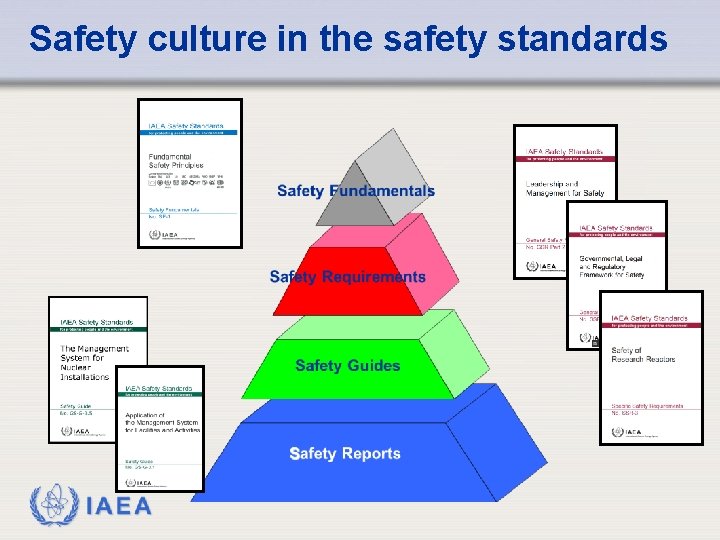
Safety culture in the safety standards IAEA
Safety fundamentals Principle 3: Effective leadership and management for safety must be established and sustained in organizations concerned with, and facilities and activities that give rise to, radiation risks. A safety culture that governs the attitudes and behaviour in relation to safety of all organizations and individuals concerned must be integrated in the management system. An important factor in a management system is the recognition of the entire range of interactions of individuals at all levels with technology and with organizations. IAEA 4
Safety Requirements Individuals in the organization, from senior managers downwards, shall foster a strong safety culture. The management system and leadership for safety shall be such as to foster and sustain a strong safety culture. Senior management shall ensure that self-assessment of leadership for safety and of safety culture includes assessment at all organizational levels and for all functions in the organization… Senior management shall ensure that an independent assessment of leadership for safety and of safety culture is conducted. The results of such assessments shall be acted upon to foster and sustain a strong safety culture… In the national policy and strategy, account shall be taken of the following: … The promotion of leadership and management for safety, including safety culture. The management system of the regulatory body has three purposes: … To foster and support a safety culture in the regulatory body through the development and reinforcement of leadership as well as good attitudes and behaviour in relation to safety on the part of individuals and teams. In conducting inspections, the regulatory body shall consider a number of aspects, including: … Safety culture In order to ensure rigour and thoroughness at all levels of staff in the achievement and maintenance in safety, the operating organization shall develop and sustain a strong safety culture, and shall prepare a statement of safety policy and safety objectives, which is disseminated to and understood by all staff The safety policy shall promote a strong safety culture, including a questioning attitude and a commitment to excellent performance in all safety actives IAEA 5
Safety Guides The regulatory body and the operating organization should start developing and implementing effective management systems in their respective organizations and should promote a strong safety culture. Review and assessment by the regulatory body should therefore include consideration of the operator’s organization, management, procedures and safety culture… Regulatory inspection is performed to make an independent check on the operator… This should be achieved by confirming that: …The operator has a strong and effective management, good safety culture and self-assessment systems. . IAEA RPTC/Ses. 9 6
Safety Guides IAEA
The complexity of the systems we deal with are increasing • Higher standards of safety – added safety barriers, procedures, etc. • Increased regulatory requirements • Accumulation of operating experience • Globalized industry – multicultural workforce, contracts, etc… IAEA
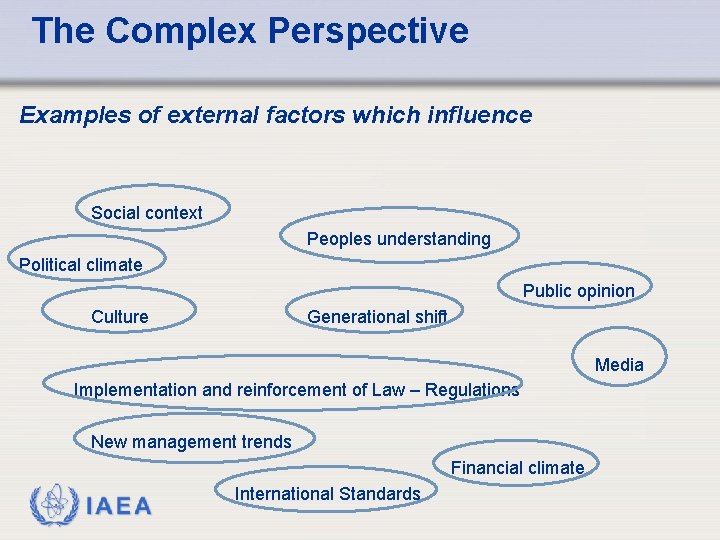
The Complex Perspective Examples of external factors which influence Social context Peoples understanding Political climate Public opinion Culture Generational shift Media Implementation and reinforcement of Law – Regulations New management trends Financial climate IAEA International Standards
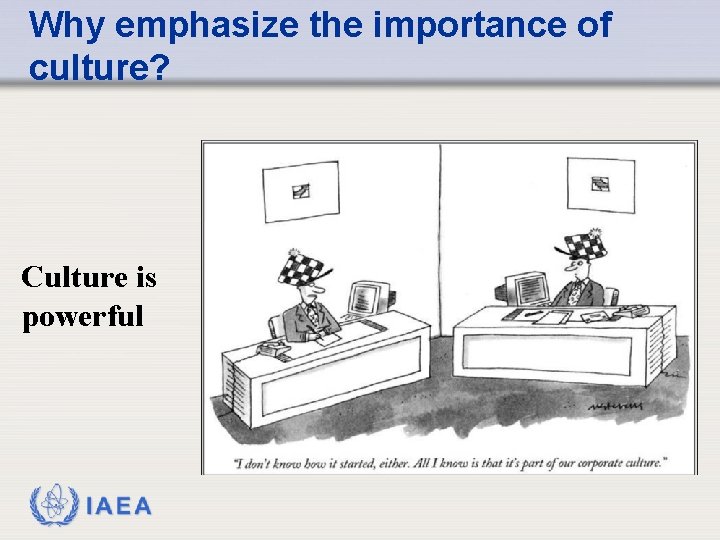
Why emphasize the importance of culture? Culture is powerful IAEA
Why is culture so powerful? • We are human beings… • Act upon basic assumptions • We are social human beings… • Conform to our surroundings • Imitate and listen to the people we respect / we think are respected and listened to by others • Influence each other through story telling, norming ALMOST ALL THE TIME, THIS HAPPENS UNCONCIOUSLY IAEA
People adjust to their environment… https: //www. youtube. com/watch? v =Aeg. Ld. B 7 UI 4 U IAEA 12
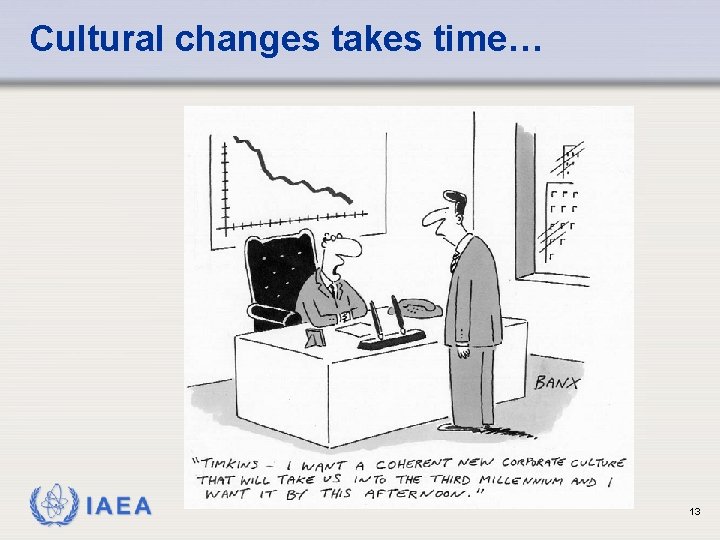
Cultural changes takes time… IAEA 13
Improving (safety) culture Not a ‘quick fix’ - culture can be changed, this often takes Ø time, Ø effort, and Ø does not always end up the way it is planned IAEA 14
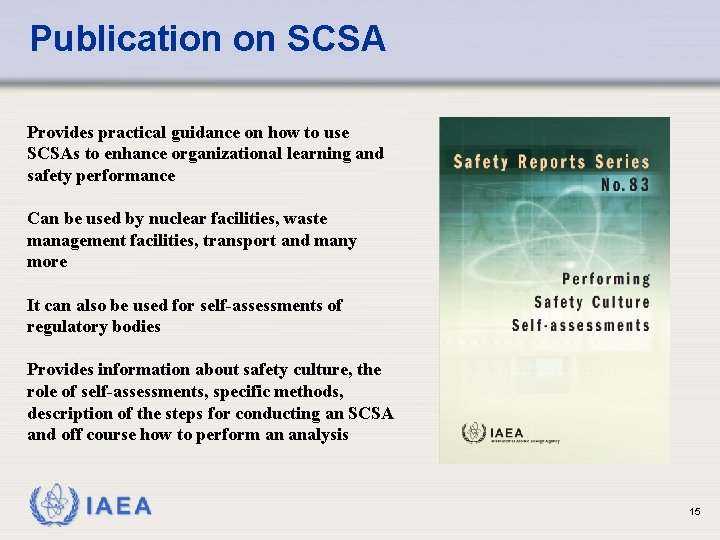
Publication on SCSA Provides practical guidance on how to use SCSAs to enhance organizational learning and safety performance Can be used by nuclear facilities, waste management facilities, transport and many more It can also be used for self-assessments of regulatory bodies Provides information about safety culture, the role of self-assessments, specific methods, description of the steps for conducting an SCSA and off course how to perform an analysis IAEA 15
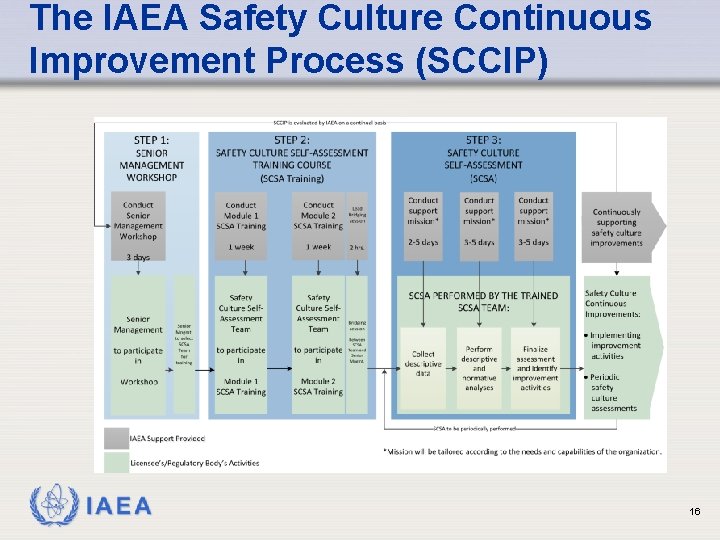
The IAEA Safety Culture Continuous Improvement Process (SCCIP) IAEA 16
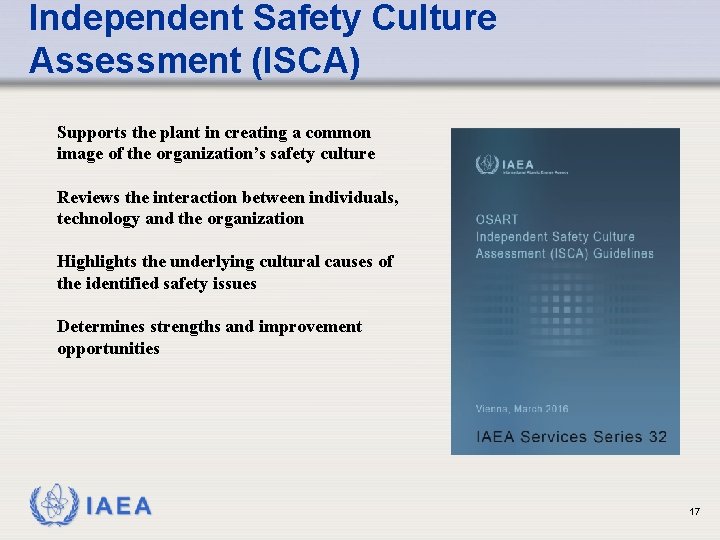
Independent Safety Culture Assessment (ISCA) Supports the plant in creating a common image of the organization’s safety culture Reviews the interaction between individuals, technology and the organization Highlights the underlying cultural causes of the identified safety issues Determines strengths and improvement opportunities IAEA 17
…Thank you for your attention 18