Rudiger Korff Media in Southeast Asia Rudiger Korff
- Slides: 21
Rudiger Korff Media in Southeast Asia
Rudiger Korff Approaches to Media-Studies: • Content Analysis and meaning • Structures of integration into state and economy • Media as system with an own logic • Mediatization • Media and public sphere and civil society
Rudiger Korff A different perspective: • Media are part of communication or „un-intended effects“ of communication • Media are embedded into society
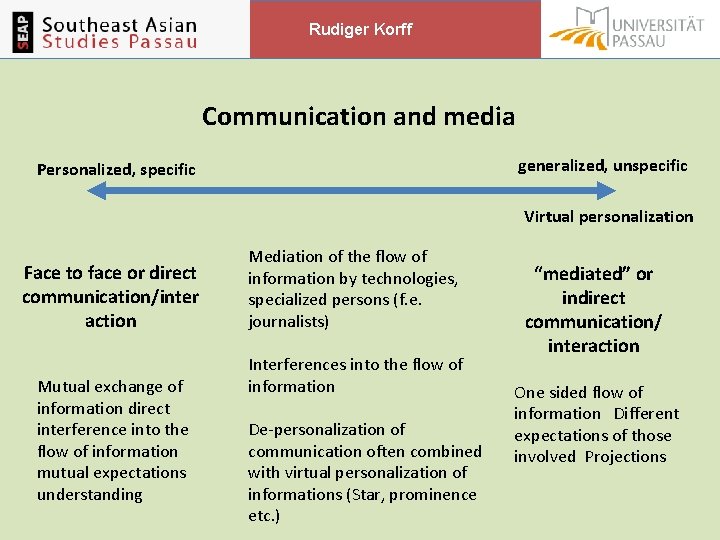
Rudiger Korff Communication and media generalized, unspecific Personalized, specific Virtual personalization Face to face or direct communication/inter action Mutual exchange of information direct interference into the flow of information mutual expectations understanding Mediation of the flow of information by technologies, specialized persons (f. e. journalists) Interferences into the flow of information De-personalization of communication often combined with virtual personalization of informations (Star, prominence etc. ) “mediated” or indirect communication/ interaction One sided flow of information Different expectations of those involved Projections
Rudiger Korff The analysis of communication: Goffmann Communication takes place within given settings as frames These define expectations, forms and pattern of communication Possibilities for communication Frames result from institutions but as well given physical settings (noise etc. )
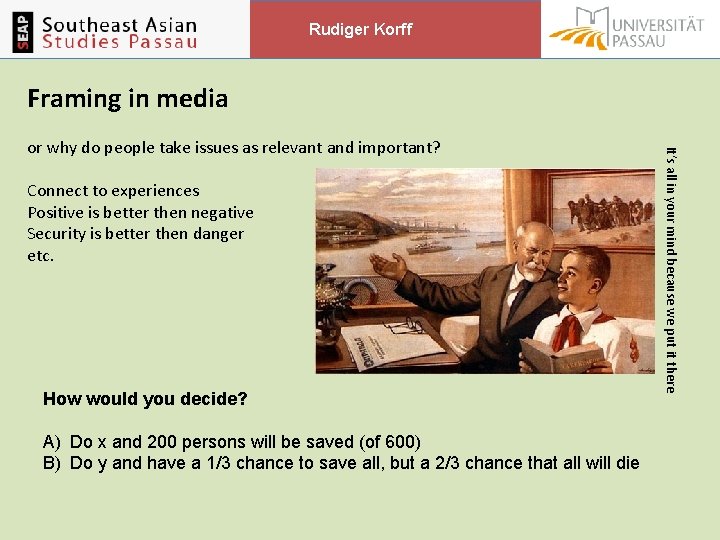
Rudiger Korff Framing in media Connect to experiences Positive is better then negative Security is better then danger etc. How would you decide? A) Do x and 200 persons will be saved (of 600) B) Do y and have a 1/3 chance to save all, but a 2/3 chance that all will die It‘s all in your mind because we put it there or why do people take issues as relevant and important?
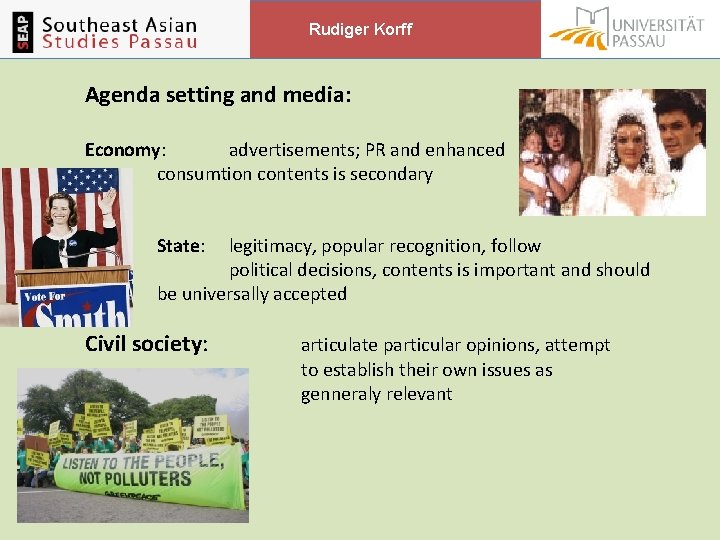
Rudiger Korff Agenda setting and media: Economy: advertisements; PR and enhanced consumtion contents is secondary State: legitimacy, popular recognition, follow political decisions, contents is important and should be universally accepted Civil society: articulate particular opinions, attempt to establish their own issues as genneraly relevant
Rudiger Korff Information media can not determine how we think and act But agenda setting has an impact on what we think about and regard as important Framing can influence how it is interpreted
Rudiger Korff Agenda setting and framing in a societal perspective Agenda setting: Only those agendas can be set by media that are connected to and reflect existing discourses within society. Media are expressions of these discourses and they do not make them! Examples: Allah dispute in Malaysia is irrelevant in Thailand, Goebbels “total war” speech is not understand in a different culture, Thai royal news is not understand f. e. in Germany etc.
Rudiger Korff Framing : Frames of communication are not only those related to the interpretation of information! Frames concern the information that can be disseminated like censorship, organisational setting, rationality of media organisations Often, especially among politicians, information is articulated as “open container” into which the audiences can project their own interpretations F. e. Our strategy (what strategy? ) is based on our strength (what are these? ). Thereby we can overcome weaknesses and face challenges (what are these). A first step is to work together. All will be well (what does this mean? ) when everybody is dedicated (what is meant by this? ) to the common goals (what are these? ) The commodification of information provides a special, new frame
Rudiger Korff Summary of the argument Media are based on communication. They facilitate communication with technologies Mass-Media are in-between media organisations and audiences. Media are framed by the organisations, socio-economic and political environment. They can frame information, but only if this corresponds to their own frames Media can not set agendas. Media communication is based on given discourses and connects to these. If not, they won’t be understood. Media are forms of “self-expression” of society. Often how society would like to see itself The analysis of media thereby shows dynamics of society
Rudiger Korff Some anecdotes on media information in Thailand These anecdotes are taken as example for information that is difficult to understand from a German background. They reflect “Thai culture” and discourses and thus are within different frames: 1. Kasit and the airplane in Munich 2. The importance to “explain” so that they “will understand” (understanding – agreement)
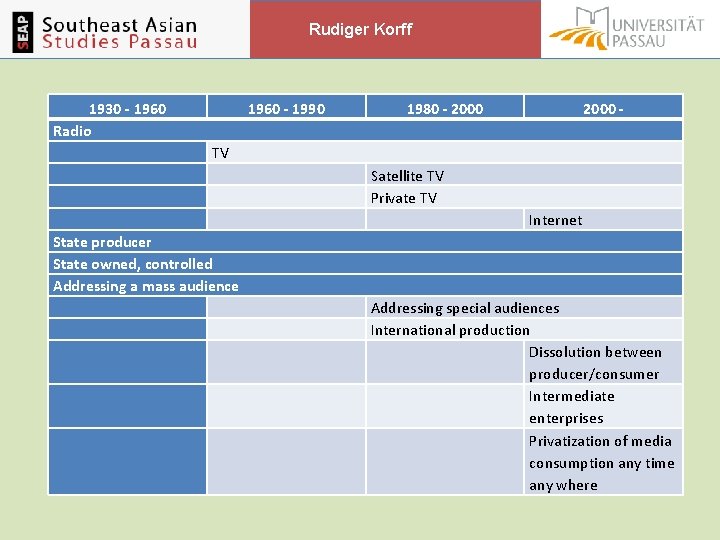
Rudiger Korff Development of broadcasting media in Southeast Asia Its diversification
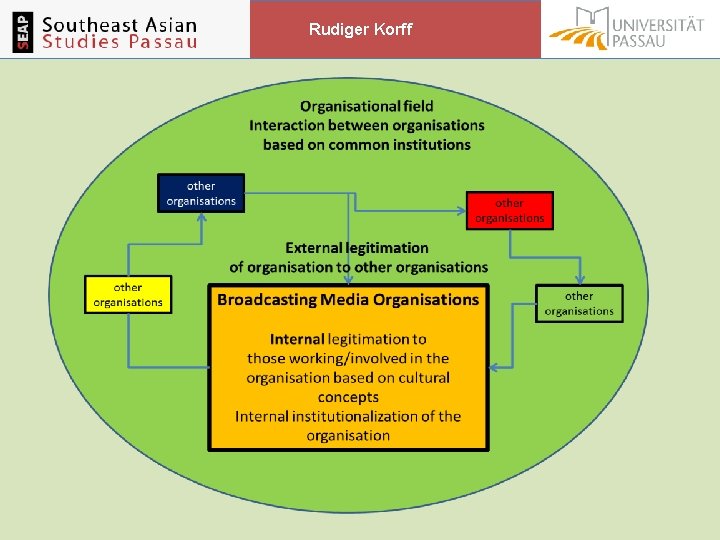
Rudiger Korff
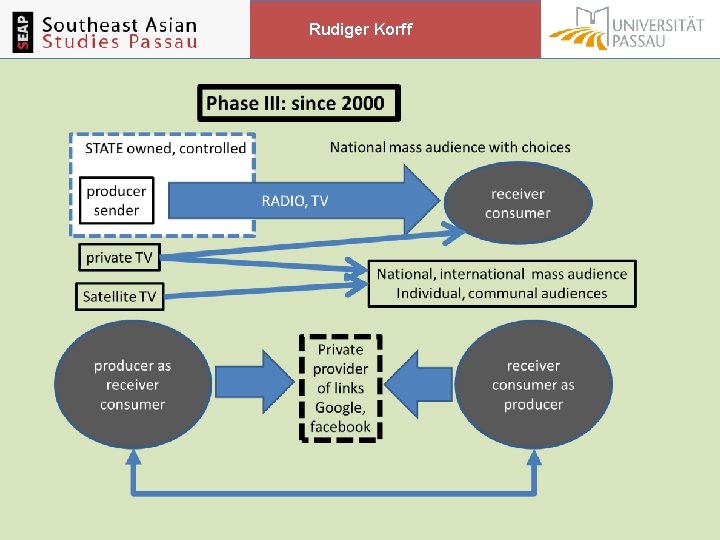
Rudiger Korff 1930 - 1960 - 1990 Radio TV State producer State owned, controlled Addressing a mass audience 1980 - 2000 Satellite TV Private TV 2000 - Internet Addressing special audiences International production Dissolution between producer/consumer Intermediate enterprises Privatization of media consumption any time any where
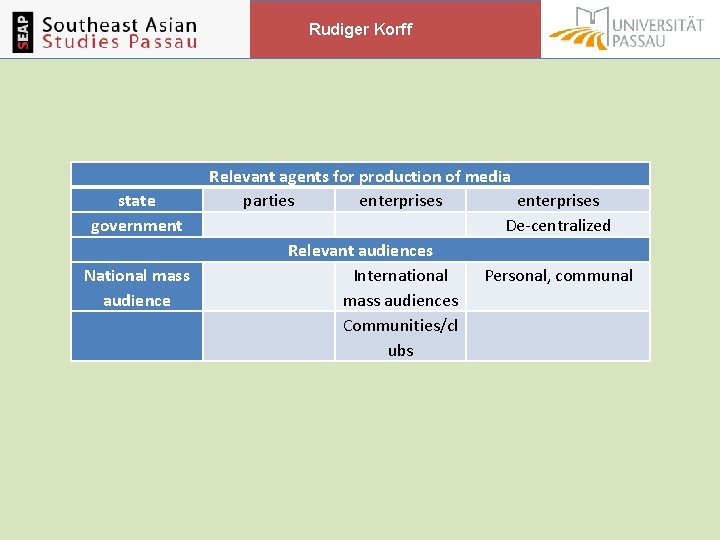
Rudiger Korff Relevant agents for production of media state parties enterprises government De-centralized Relevant audiences National mass International Personal, communal audience mass audiences Communities/cl ubs
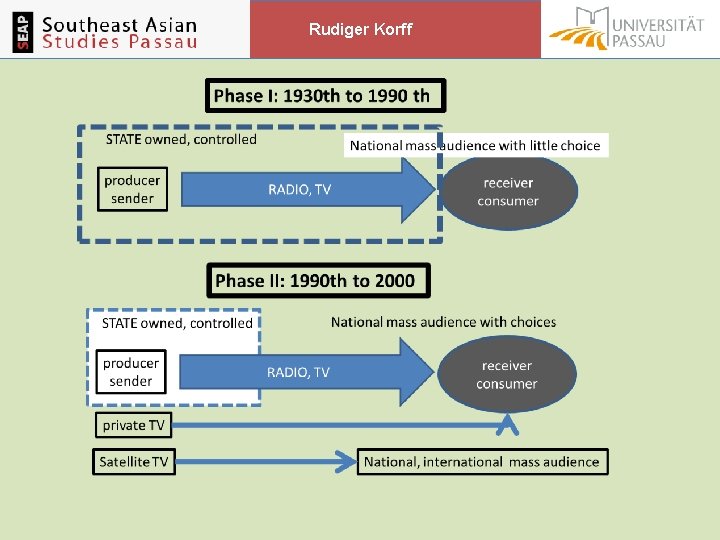
Rudiger Korff
Rudiger Korff
Rudiger Korff Conclusions Media in Southeast Asia are still controlled and/or strongly influenced by organisations and groups outside of the media field like state and business Media are thus not “independent”, but structured by society, politics and the economy and the respective ideologies of strategic groups connected to these Media are to some degree applied as a means for strategic groups to enhance their social and political legitimacy
Rudiger Korff Media and national and AEAN integration: In how far media are means for national integration can hardly be answered. The problem in Malaysia and Myanmar, where we have stronger government control is that audiences turn to other sources of information like internet, satellite TV, rumors etc. In Thailand Indonesia radio and TV are the main sources of information for the people, but these tend to be fragmenting. People are only following those programmes and are interested in those information that is in line with their own interests and interpretations. As a result media can even widen the gulf within society. One obvious trend in all countries is the use of more individualized media like internet, facebook etc. and a larger selection of stations by satellite TV.
Rudiger Korff Individualisation (social media) and globalization (satelitte): ndividualization and Globalization have in common to be beyond national regulation. In addition, those media depending on advertising to finance themselves have to take these shifts into account to maintain their audience. A requirement is to improve the quality of national programmes by taking up issues beyond a limited national perspective. Stations have to open themselves for critique, be it critique of the government, of morals taken for granted etc. They have to educate people how controversies can be based on mutual respect rather then emotions and hate etc. So far, media tend to have the tendency to either ignore interpretations and opinions different from the own, or to dis-credit these as nonsense, against conventions etc.