Role of the ILD Nurse in Management of

- Slides: 23
Role of the ILD Nurse in Management of patient with ILD Michelle Morales Naomi Rippon ILD Specialist Nurses Bristol Interstitial Lung Disease Service Exceptional healthcare, personally delivered
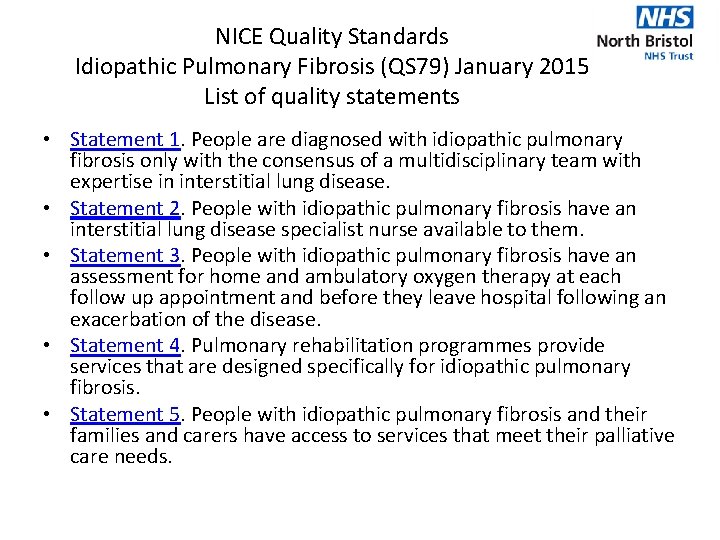
NICE Quality Standards Idiopathic Pulmonary Fibrosis (QS 79) January 2015 List of quality statements • Statement 1. People are diagnosed with idiopathic pulmonary fibrosis only with the consensus of a multidisciplinary team with expertise in interstitial lung disease. • Statement 2. People with idiopathic pulmonary fibrosis have an interstitial lung disease specialist nurse available to them. • Statement 3. People with idiopathic pulmonary fibrosis have an assessment for home and ambulatory oxygen therapy at each follow up appointment and before they leave hospital following an exacerbation of the disease. • Statement 4. Pulmonary rehabilitation programmes provide services that are designed specifically for idiopathic pulmonary fibrosis. • Statement 5. People with idiopathic pulmonary fibrosis and their families and carers have access to services that meet their palliative care needs.
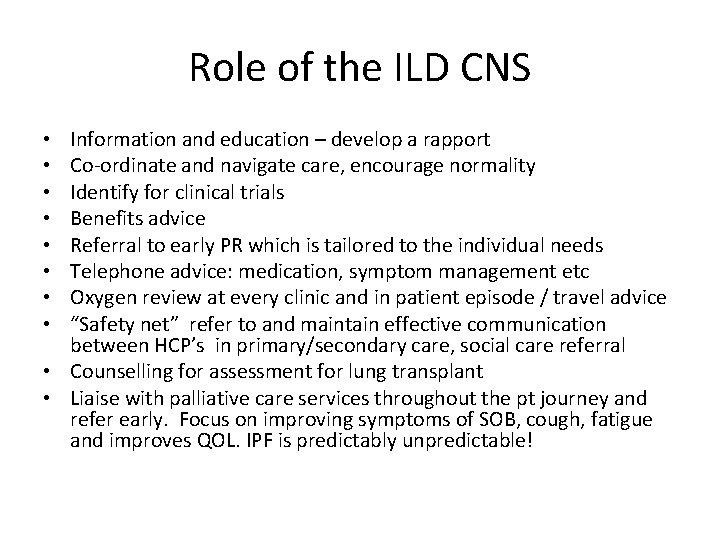
Role of the ILD CNS Information and education – develop a rapport Co-ordinate and navigate care, encourage normality Identify for clinical trials Benefits advice Referral to early PR which is tailored to the individual needs Telephone advice: medication, symptom management etc Oxygen review at every clinic and in patient episode / travel advice “Safety net” refer to and maintain effective communication between HCP’s in primary/secondary care, social care referral • Counselling for assessment for lung transplant • Liaise with palliative care services throughout the pt journey and refer early. Focus on improving symptoms of SOB, cough, fatigue and improves QOL. IPF is predictably unpredictable! • •
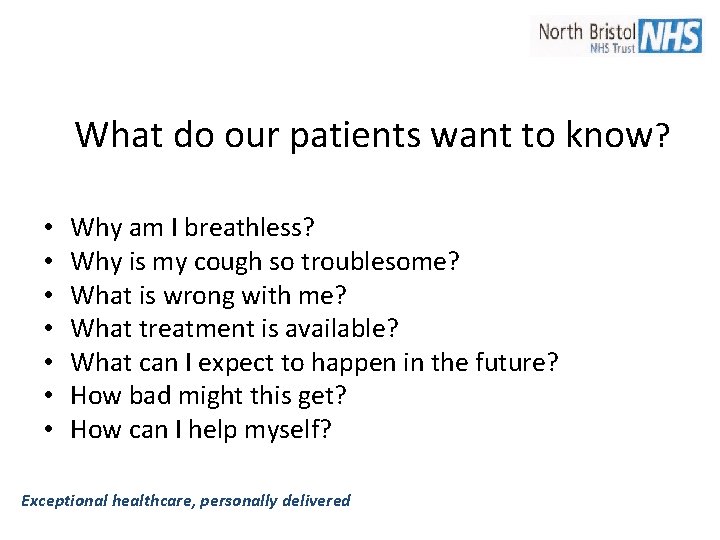
What do our patients want to know? • • Why am I breathless? Why is my cough so troublesome? What is wrong with me? What treatment is available? What can I expect to happen in the future? How bad might this get? How can I help myself? Exceptional healthcare, personally delivered
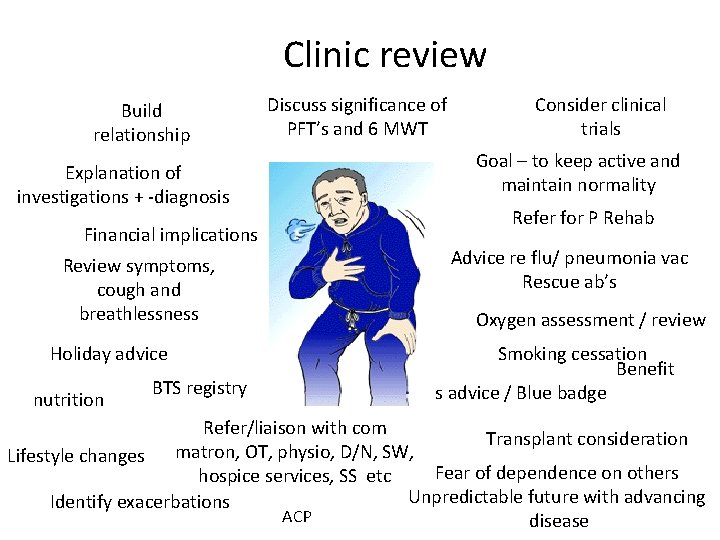
Clinic review Build relationship Explanation of investigations + -diagnosis Financial implications Review symptoms, cough and breathlessness Holiday advice nutrition BTS registry Discuss significance of PFT’s and 6 MWT Consider clinical trials Goal – to keep active and maintain normality Refer for P Rehab Advice re flu/ pneumonia vac Rescue ab’s Oxygen assessment / review Smoking cessation Benefit s advice / Blue badge Refer/liaison with com Transplant consideration matron, OT, physio, D/N, SW, Lifestyle changes Fear of dependence on others hospice services, SS etc Unpredictable future with advancing Identify exacerbations ACP disease
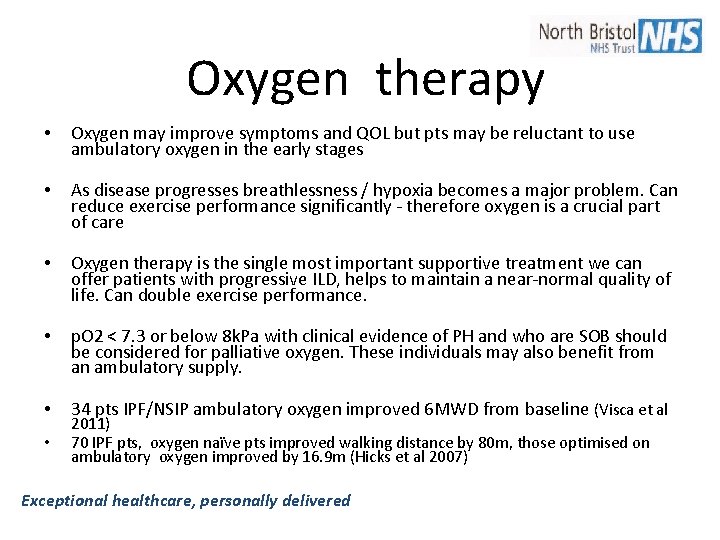
Oxygen therapy • Oxygen may improve symptoms and QOL but pts may be reluctant to use ambulatory oxygen in the early stages • As disease progresses breathlessness / hypoxia becomes a major problem. Can reduce exercise performance significantly - therefore oxygen is a crucial part of care • Oxygen therapy is the single most important supportive treatment we can offer patients with progressive ILD, helps to maintain a near-normal quality of life. Can double exercise performance. • p. O 2 < 7. 3 or below 8 k. Pa with clinical evidence of PH and who are SOB should be considered for palliative oxygen. These individuals may also benefit from an ambulatory supply. • 34 pts IPF/NSIP ambulatory oxygen improved 6 MWD from baseline (Visca et al • 2011) 70 IPF pts, oxygen naïve pts improved walking distance by 80 m, those optimised on ambulatory oxygen improved by 16. 9 m (Hicks et al 2007) Exceptional healthcare, personally delivered
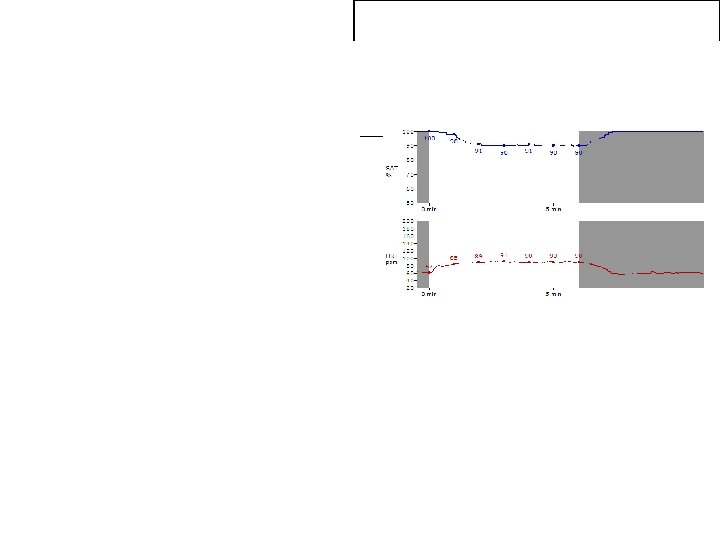
Ambulatory oxygen • Pts generally experience exertional breathlessness associated with hypoxia and are likely to require ambulatory oxygen before LTOT • Assessment : 6 MWT to assess walking distance, BORG Desaturation of >4% to a value of < 90% • Titrate O 2 to correct exercise desaturation where possible • May be reluctant to be seen in public with oxygen, pace activity • Signifies disease progression • However, can significantly improve QOL and exercise tolerance • Often require double rate required at rest, freeflow setting • Assess best mode of delivery • Consider how long O 2 supply will last – may require 2 units Exceptional healthcare, personally delivered
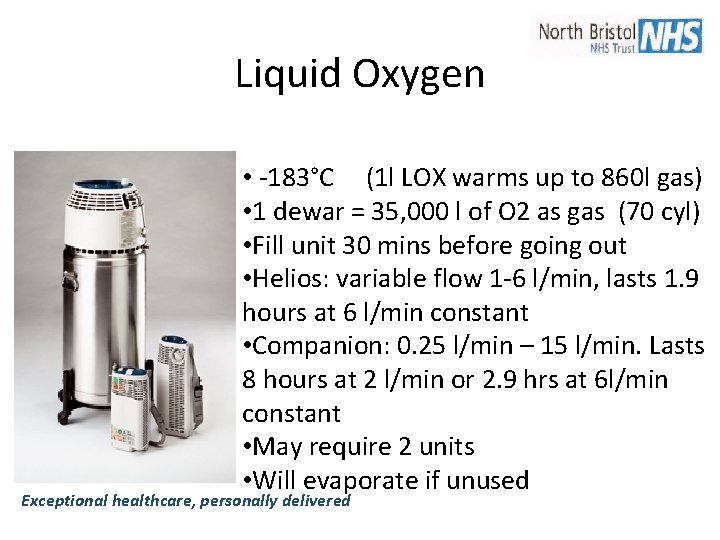
Liquid Oxygen • -183°C (1 l LOX warms up to 860 l gas) • 1 dewar = 35, 000 l of O 2 as gas (70 cyl) • Fill unit 30 mins before going out • Helios: variable flow 1 -6 l/min, lasts 1. 9 hours at 6 l/min constant • Companion: 0. 25 l/min – 15 l/min. Lasts 8 hours at 2 l/min or 2. 9 hrs at 6 l/min constant • May require 2 units • Will evaporate if unused Exceptional healthcare, personally delivered
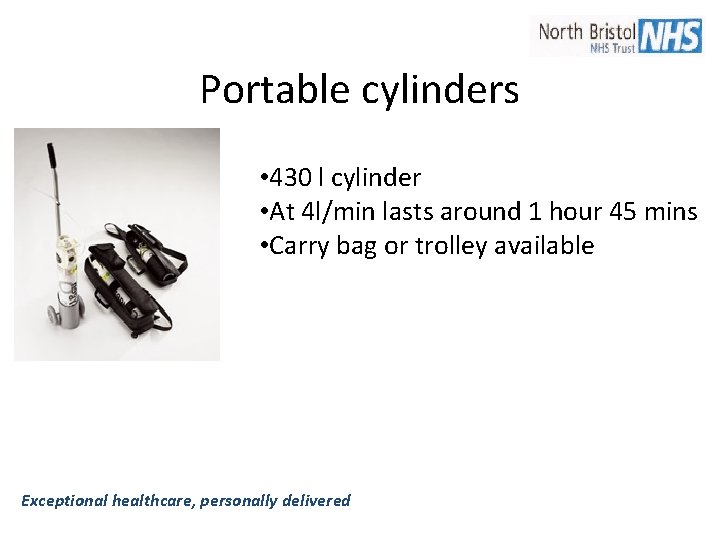
Portable cylinders • 430 l cylinder • At 4 l/min lasts around 1 hour 45 mins • Carry bag or trolley available Exceptional healthcare, personally delivered
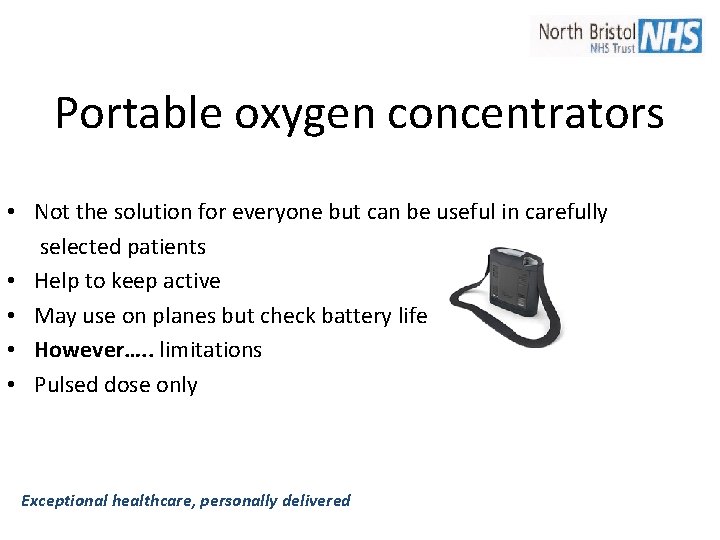
Portable oxygen concentrators • Not the solution for everyone but can be useful in carefully selected patients • Help to keep active • May use on planes but check battery life • However…. . limitations • Pulsed dose only Exceptional healthcare, personally delivered
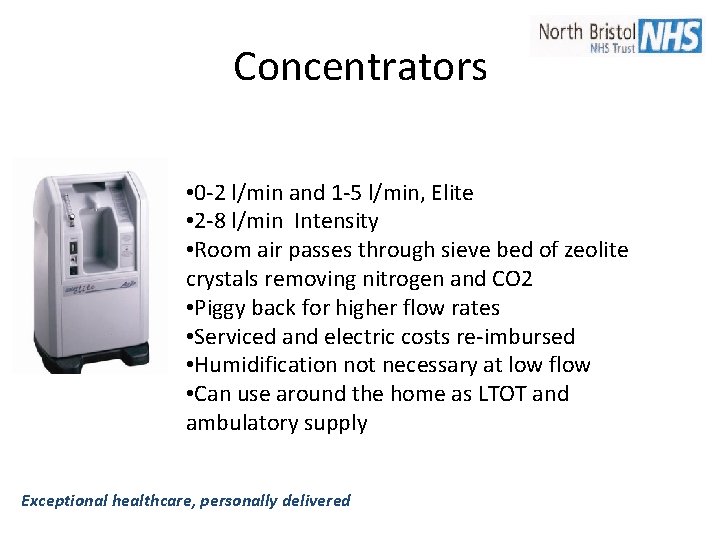
Concentrators • 0 -2 l/min and 1 -5 l/min, Elite • 2 -8 l/min Intensity • Room air passes through sieve bed of zeolite crystals removing nitrogen and CO 2 • Piggy back for higher flow rates • Serviced and electric costs re-imbursed • Humidification not necessary at low flow • Can use around the home as LTOT and ambulatory supply Exceptional healthcare, personally delivered
Holiday/travel advice • Discuss with HCP, fit to fly? • Oxygen in UK and abroad – NHS choices website, DOH, charges for abroad • DWP for EU re-imbursement if receipts kept • Request assistance • Travel insurance essential should the individual become ill and need to return home. Check it covers all medical conditions • EHIC (European Health Insurance Card) entitles you to reduced /free medical treatment if you fall in Europe – not a replacement for insurance • Emergency treatment and repatriation can be costly ! • BLF comprehensive travel pack Exceptional healthcare, personally delivered
Points to remember • All pts should be under the care of a centre for oxygen assessment • Oxygen prescriptions individualised to patient requirements, different flow rates at rest and exertion, and exercise (PR) • Can be complex • Require ongoing monitoring and regular review • CISS database can be accessed by all the Respiratory Teams Exceptional healthcare, personally delivered
When do you initiate palliative care? • “Would you be surprised if this patient were to die in the next 6 -12 months? ” Early stage of the disease all the way through EOL • Frequent hospitalisations, infections, exacerbations • Increasing oxygen requirements • Episodes of panic • Increasing breathlessness and reduced mobility • Hypoxic episodes “do you know how you would like things to be if this should get any worse? “have you any concerns, fears or worries for the future” “have you thought about where you would prefer to be cared for as your illness gets worse? ” Exceptional healthcare, personally delivered
Always better to start early • • IPF in particular is unpredictable Patients can deteriorate rapidly Recognise those patients reporting increased SOB Beware of patients who start to panic who otherwise have been coping well Exceptional healthcare, personally delivered
Breathlessness…… Why? • On exertion, consider assessment for cause of SOB and degree of hypoxia • Breathless at rest – assess cause of SOB and degree of hypoxia • Assess for ambulatory oxygen / LTOT • Psychosocial needs and offer referral to palliative care services • Pharmacological symptom relief with benzodiazepines and /or opioids • BUT always remember differential diagnosis! PH, PE, infection (pts on immunosuppressive Rx) etc IPF Clinical Guideline 2013 Exceptional healthcare, personally delivered
Respiratory failure • Often require high flow humidified oxygen on ward • As condition allows reduce flow and assess oxygen requirements with concentrator/s • Can piggy back, cold humidification? • High flow nasal cannula alternating with face mask • Increase flow rate when transferring /exertion – cylinder • Physiotherapist expertise • Use of fan, optimisation of symptom control, Palliative care team • Liaise with all HCP’s, primary / secondary care • Consider patient / family wishes – is home a viable option? i. e is sufficient care available in home surroundings, is safe transfer home possible? Feel safe Exceptional healthcare, personally delivered
Transplantation • • • Many pts are older, may have co-morbidities, so rarely an option Timely referral for assessment Lack of organs , 3 people die every day waiting for a transplant Talk about it. Let your family, and friends know your wishes about organ donation Exceptional healthcare, personally delivered
Our Support Group • Provides an opportunity to meet and talk to others to share stories and experiences with others who understand what they are going through • Exchange ideas, mutual support “not feeling alone” • Encourage involvement in pleasurable activities • Invest in friends and family, be positive! • Speaker, refreshments, provide accurate information Exceptional healthcare, personally delivered
Charities Pulmonary Fibrosis Trust Offer grants, information and support, raise awareness www. pulmonaryfibrosis. uk Action for Pulmonary Fibrosis UK www. actionpulmonaryfibrosis. org Raise awareness, patient and family education and support and promoting research. Aims to set up regional support groups , currently only 7 in the UK Pulmonary Fibrosis Foundation www. pulmonaryfibrosis. org for information & resources, webinars British Lung Foundation Irish Lung Fibrosis Association www. blf. org. uk Exceptional healthcare, personally delivered ilfa. ie
References Adamali HI, Anwar MS, Russell AM, Egan JJ Non-pharmacological treatment of idiopathic pulmonary fibrosis. Current Respiratory Care Reports. 2012 (4): 208 -215 Bajwah S, Koffman J, Higginson J et al. “ I wish I knew more” the end of life planning and information needs for end-stage fibrotic interstitial lung disease: views of patients, carers and health professionals BMJ Support Palliat Care Sept 27 th 2012 doi: 10. 1136/bmjspcare-2012 -000263 Bajwah S, Ross J, peacock J et al. Interventions to improve symptoms and quality of life of patients witrh fibrotic interstitial lung disease: a systematic review of the literature Thorax 2102 doi: 10. 1136/thoraxjnl-2012 -202040 Bradley B, Branley HM, Egan JJ, Greaves MS, Hansell DM, Harrison NK et al. Interstitial lung disease guideline: the British Thoracic Society in collaboration with the Thoracic Society of Australia and New Zealand the Irish Thoracic Society. Thorax. 2008; 63 Suppl 5: v 1 -58. (Guideline Ref ID BTS 2008) British Thoracic Society. Clinical component for the home oxygen service in England Wales, 2006 Available from: http: //www. britthoracic. org. uk/Portals/0/Clinical%20 Information/Home%20 Oxygen%20 Service/clinical%20 adultoxygenjan 06. pdf (Guideline Ref ID BTS 2006) Raghu G, Collard HR, Egan JJ, et al. ATS/ERS/JRS/ALAT Committee on Idiopathic Pulmonary Fibrosis. An official ATS/ERS/JRS/ALAT statement: idiopathic pulmonary fibrosis: evidence-based guidelines for diagnosis and management. Am J Respir Crit Care Med. 2011; 183(6): 788 -824 Travis W, Costabel U, Hansell D et al. An Official American Thoracic Society/European Respiratory Society Statement: Update of the International Multidisciplinary Classification of the Idiopathic Interstitial Pneumonias. Am J Respir Crit Care Med 2013: Vol 188 (6) 733– 748 Exceptional healthcare, personally delivered
Any questions? Exceptional healthcare, personally delivered