ROLE OF MAJOR PHYSIOLOGICAL ANIONS Ms Swagatika Dash

- Slides: 12
ROLE OF MAJOR PHYSIOLOGICAL ANIONS Ms. Swagatika Dash Asst. Professor SPLS
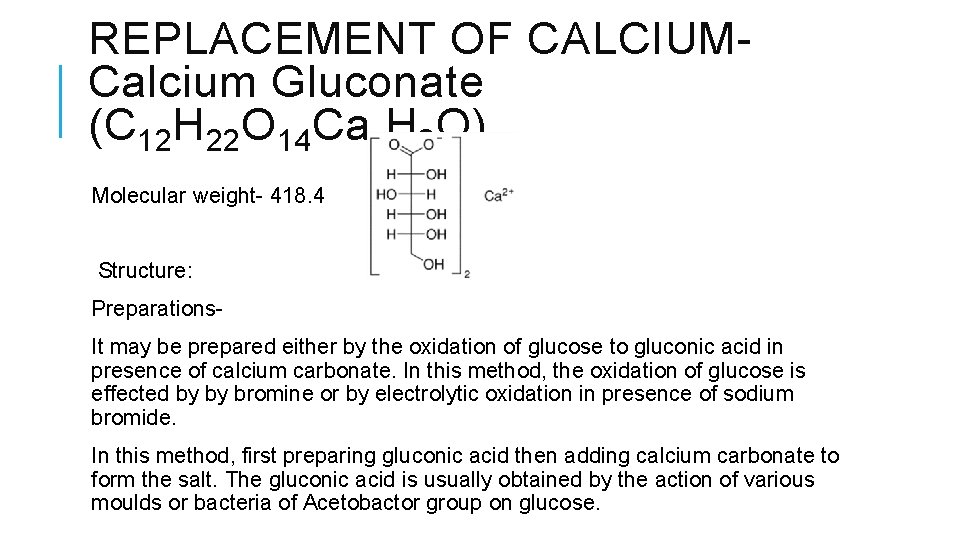
REPLACEMENT OF CALCIUMCalcium Gluconate (C 12 H 22 O 14 Ca. H 2 O) Molecular weight- 418. 4 Structure: Preparations. It may be prepared either by the oxidation of glucose to gluconic acid in presence of calcium carbonate. In this method, the oxidation of glucose is effected by by bromine or by electrolytic oxidation in presence of sodium bromide. In this method, first preparing gluconic acid then adding calcium carbonate to form the salt. The gluconic acid is usually obtained by the action of various moulds or bacteria of Acetobactor group on glucose.
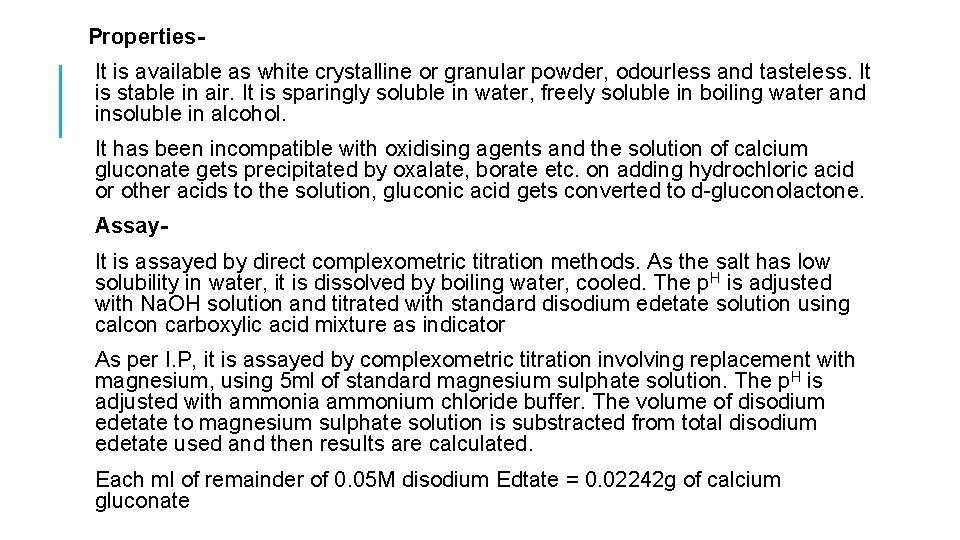
Properties. It is available as white crystalline or granular powder, odourless and tasteless. It is stable in air. It is sparingly soluble in water, freely soluble in boiling water and insoluble in alcohol. It has been incompatible with oxidising agents and the solution of calcium gluconate gets precipitated by oxalate, borate etc. on adding hydrochloric acid or other acids to the solution, gluconic acid gets converted to d-gluconolactone. Assay. It is assayed by direct complexometric titration methods. As the salt has low solubility in water, it is dissolved by boiling water, cooled. The p. H is adjusted with Na. OH solution and titrated with standard disodium edetate solution using calcon carboxylic acid mixture as indicator As per I. P, it is assayed by complexometric titration involving replacement with magnesium, using 5 ml of standard magnesium sulphate solution. The p. H is adjusted with ammonia ammonium chloride buffer. The volume of disodium edetate to magnesium sulphate solution is substracted from total disodium edetate used and then results are calculated. Each ml of remainder of 0. 05 M disodium Edtate = 0. 02242 g of calcium gluconate
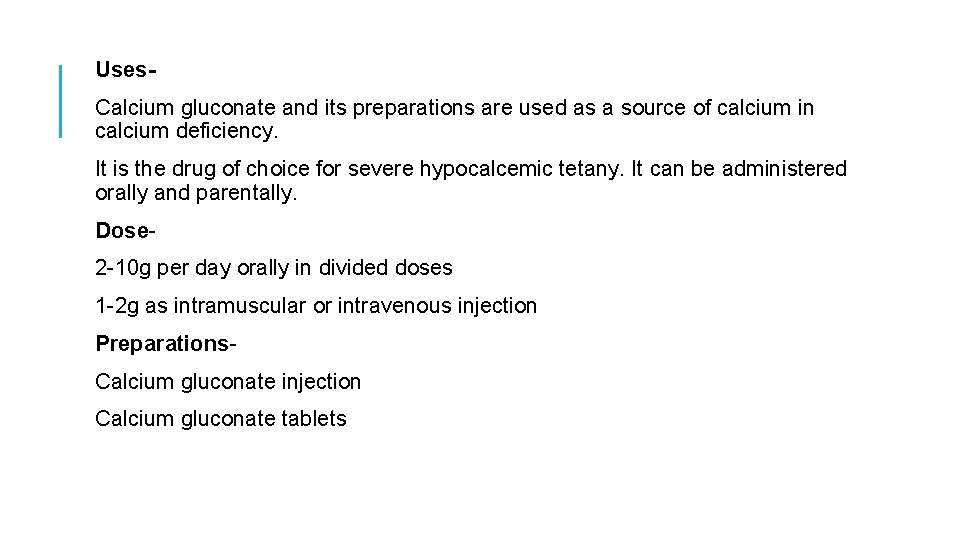
Uses. Calcium gluconate and its preparations are used as a source of calcium in calcium deficiency. It is the drug of choice for severe hypocalcemic tetany. It can be administered orally and parentally. Dose 2 -10 g per day orally in divided doses 1 -2 g as intramuscular or intravenous injection Preparations. Calcium gluconate injection Calcium gluconate tablets
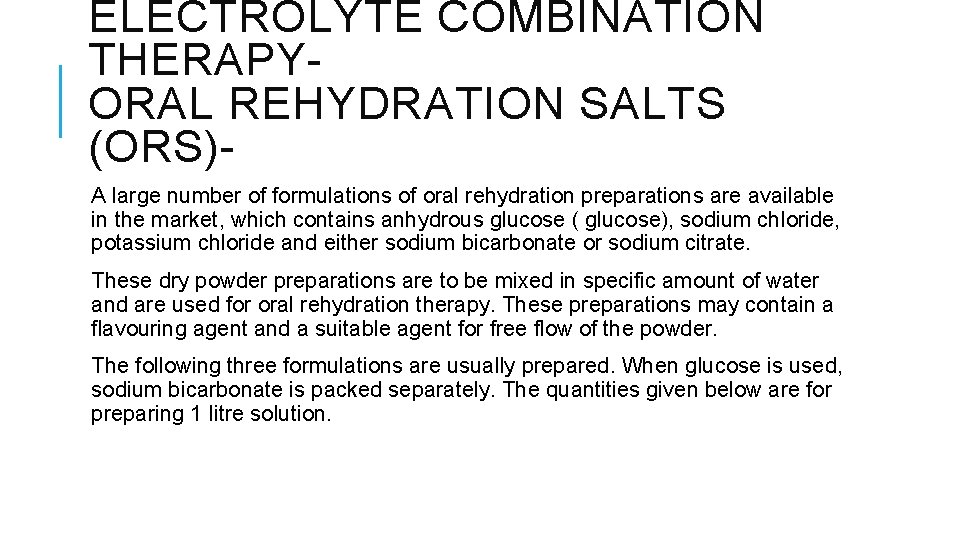
ELECTROLYTE COMBINATION THERAPYORAL REHYDRATION SALTS (ORS)A large number of formulations of oral rehydration preparations are available in the market, which contains anhydrous glucose ( glucose), sodium chloride, potassium chloride and either sodium bicarbonate or sodium citrate. These dry powder preparations are to be mixed in specific amount of water and are used for oral rehydration therapy. These preparations may contain a flavouring agent and a suitable agent for free flow of the powder. The following three formulations are usually prepared. When glucose is used, sodium bicarbonate is packed separately. The quantities given below are for preparing 1 litre solution.
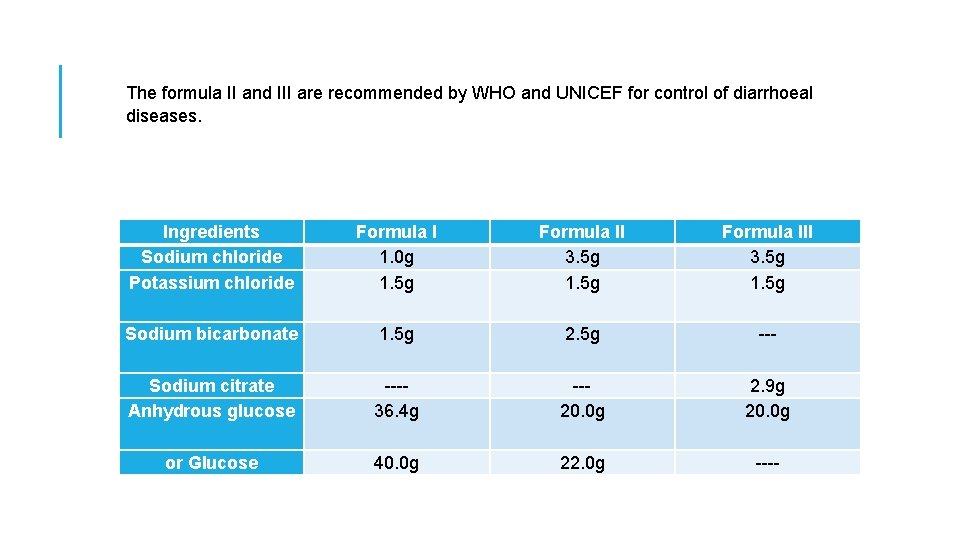
The formula II and III are recommended by WHO and UNICEF for control of diarrhoeal diseases. Ingredients Sodium chloride Potassium chloride Formula I 1. 0 g 1. 5 g Formula II 3. 5 g 1. 5 g Formula III 3. 5 g 1. 5 g Sodium bicarbonate 1. 5 g 2. 5 g --- Sodium citrate Anhydrous glucose ---36. 4 g --20. 0 g 2. 9 g 20. 0 g or Glucose 40. 0 g 22. 0 g ----
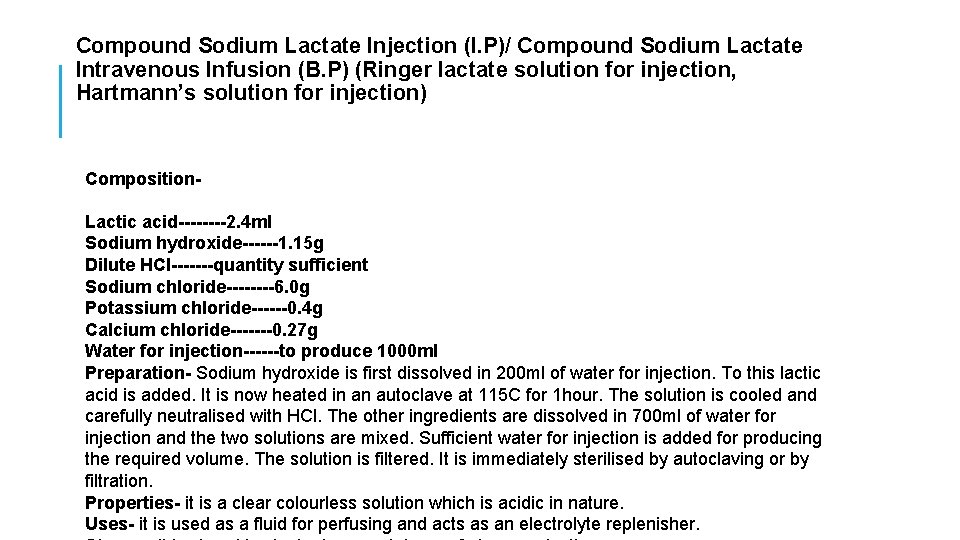
Compound Sodium Lactate Injection (I. P)/ Compound Sodium Lactate Intravenous Infusion (B. P) (Ringer lactate solution for injection, Hartmann’s solution for injection) Composition. Lactic acid----2. 4 ml Sodium hydroxide------1. 15 g Dilute HCl-------quantity sufficient Sodium chloride----6. 0 g Potassium chloride------0. 4 g Calcium chloride-------0. 27 g Water for injection------to produce 1000 ml Preparation- Sodium hydroxide is first dissolved in 200 ml of water for injection. To this lactic acid is added. It is now heated in an autoclave at 115 C for 1 hour. The solution is cooled and carefully neutralised with HCl. The other ingredients are dissolved in 700 ml of water for injection and the two solutions are mixed. Sufficient water for injection is added for producing the required volume. The solution is filtered. It is immediately sterilised by autoclaving or by filtration. Properties- it is a clear colourless solution which is acidic in nature. Uses- it is used as a fluid for perfusing and acts as an electrolyte replenisher.
COMPOUND SODIUM CHLORIDE INJECTION (RINGER’S INJECTION) Composition. Sodium chloride----8. 6 g Potassium chloride-----0. 3 g Calcium chloride------0. 3 g Water for injection sufficient to produce 1000 ml Preparations- The ingredients are dissolved in the water for injection. The solution is filtered until it becomes clear. Finally, it is sterilised by heating in an autoclave.
COMPOUND SODIUM LACTATE INJECTION (RINGER -LACTATE SOLUTION FOR INJECTION) Composition. Lactic acid-------2. 4 ml Sodium hydroxide-----1. 15 g Dilute hydrochloric acid-----sufficient quantity Sodium chloride----6. 0 g Potassium chloride------0. 4 g Calcium chloride, hydrated ------0. 4 g Water for injection sufficient to produce----1000 ml
PHYSIOLOGICAL ACID-BASE BALANCE The no of hydrogen ions present in the solution may be considered as a measure of the acidity of the solution. But p. H is related to the negative logarithm of activity of (H+) ion concentration. Thus, p. H may be considered to be a measure of the acidity of the solution. Body fluids have balanced quantities of acids and bases. The maintainenance of the normal range within the body has been essential because the biochemical reactions taking place in the living system are very sensitive to even small changes in acidity or alkalinity. For instance, the low p. H value in the stomach provides the environment suited for functioning of the enzyme pepsin that is involved in the digestion of dietary protein. Further saliva is having a p. H range of 5. 4 -7. 4 which provides the environment suited for functioning of ptyalin, an enzyme which is present in saliva digests the carbohydrates.
The p. H of certain body fluids are given as follows. Urine -------4. 5 --8. 0 Blood -------7. 4 --7. 5 Gastric juice ------ 1. 5— 3. 5 Saliva -------- 5. 4— 7. 5 Bile --------- 6. 0 – 8. 5 Semen ------7. 2— 7. 6 As the kidneys are involved in removing the excess acid from the body, urine can be quite acidic. The range of p. H of the blood is 7. 0 to 7. 8. The metabolic activity of the body cells gives rise to certain acids and alkalis which alter the blood p. H. Even strong acids and bases are taken into or formed by the body, but the p. H of fluids remain constant due to buffer system present in the human body. The function of a buffer system is to convert strong acids or bases into weak acids or bases.
The control of hydrogen ion concentration (p. H) is mainly controlled by 3 mechanism 1. Buffering system- Three major systems of buffering in the body are (i) carbonic acid/bicarbonate (H 2 CO 3/HCO 3 --) which mainly occurs in plasma and kidney, (ii) monohyrogen phosphate/dihydrogen (HPO 42 --/H 2 PO 4 --) phosphate found in cells and kidney and (iii) protein buffer system. 2. The other important p. H control is through the control of respiratory centre. When respiration gets decreased, the accumulated CO 2 combines with water to form carbonic acid. The latter dissociates to release hydrogen ion and results in acidosis. Similarly, in case of over breathing, excessive excretion of CO 2 leads to alkalosis. 3. The kidneys are having the ability to generate ammonia which neutralises the acid products of protein metabolism. The neutralisation product are then excreted in the urine. Metabolic Acidosis & Metabolic Alkalosis. The p. H of blood of healthy person remains constant around 7. 35. If the p. H of blood is low (high hydrogen ion concentration) ‘acidosis’ results and when p. H is high (low hydrogen ion concentration) ‘alkalosis’ results. Metabolic acidosis can result from (i) failure to excrete metabolic acids by kidney (ii) formation of excessive quantities of metabolic acids (carbonic acids) (iii) absorption or administration of excess metabolic or other acids. Metabolic acidosis results due to diarrhoea, vomiting, uremia or diabetes mellitus. Metabolic alkalosis does not normally occur. However, it may result under certain conditions like administration of diuretics or excessive ingestion of alkaline drugs.