
THE CHEMISTRY OF FIVE ANIONS Purpose 1 Explore

- Slides: 7
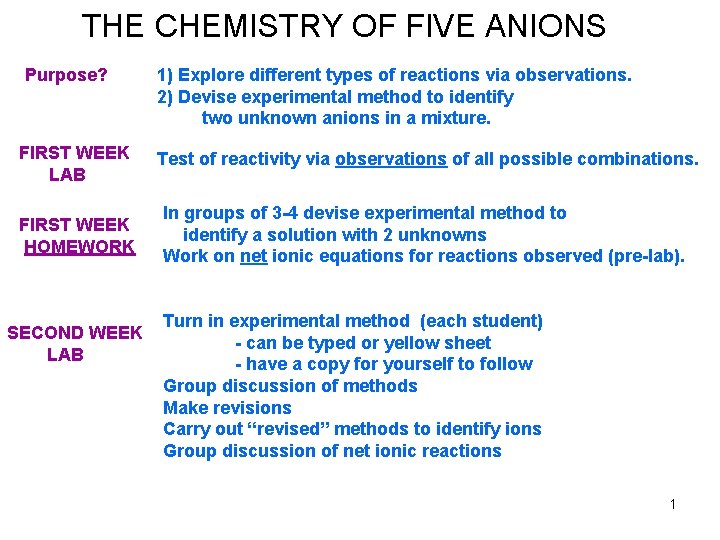
THE CHEMISTRY OF FIVE ANIONS Purpose? 1) Explore different types of reactions via observations. 2) Devise experimental method to identify two unknown anions in a mixture. FIRST WEEK LAB Test of reactivity via observations of all possible combinations. FIRST WEEK HOMEWORK In groups of 3 -4 devise experimental method to identify a solution with 2 unknowns Work on net ionic equations for reactions observed (pre-lab). SECOND WEEK LAB Turn in experimental method (each student) - can be typed or yellow sheet - have a copy for yourself to follow Group discussion of methods Make revisions Carry out “revised” methods to identify ions Group discussion of net ionic reactions 1
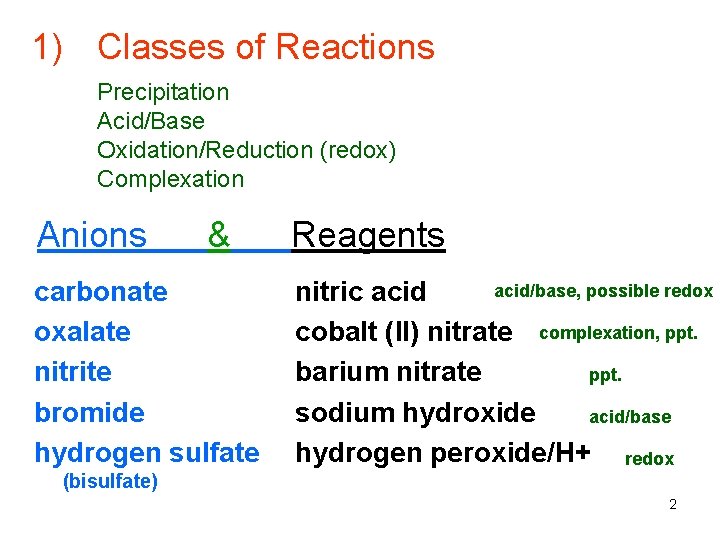
1) Classes of Reactions Precipitation Acid/Base Oxidation/Reduction (redox) Complexation Anions & Reagents carbonate oxalate nitrite bromide hydrogen sulfate acid/base, possible redox nitric acid cobalt (II) nitrate complexation, ppt. barium nitrate sodium hydroxide acid/base hydrogen peroxide/H+ redox (bisulfate) 2
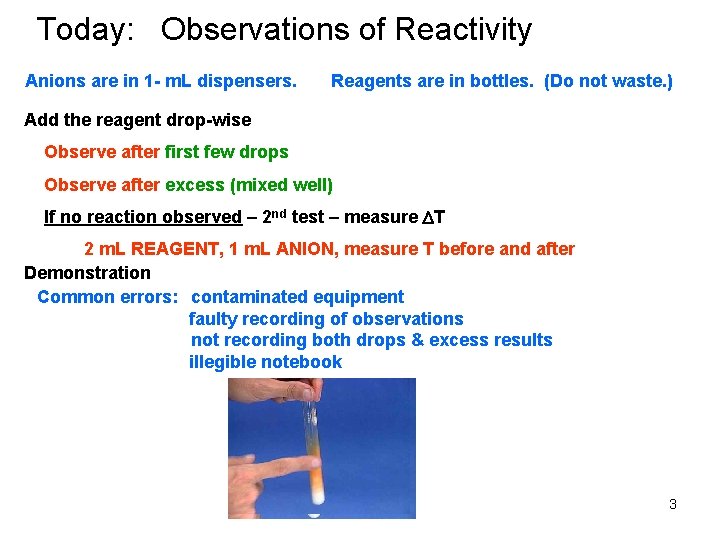
Today: Observations of Reactivity Anions are in 1 - m. L dispensers. Reagents are in bottles. (Do not waste. ) Add the reagent drop-wise Observe after first few drops Observe after excess (mixed well) If no reaction observed – 2 nd test – measure T 2 m. L REAGENT, 1 m. L ANION, measure T before and after Demonstration Common errors: contaminated equipment faulty recording of observations not recording both drops & excess results illegible notebook 3
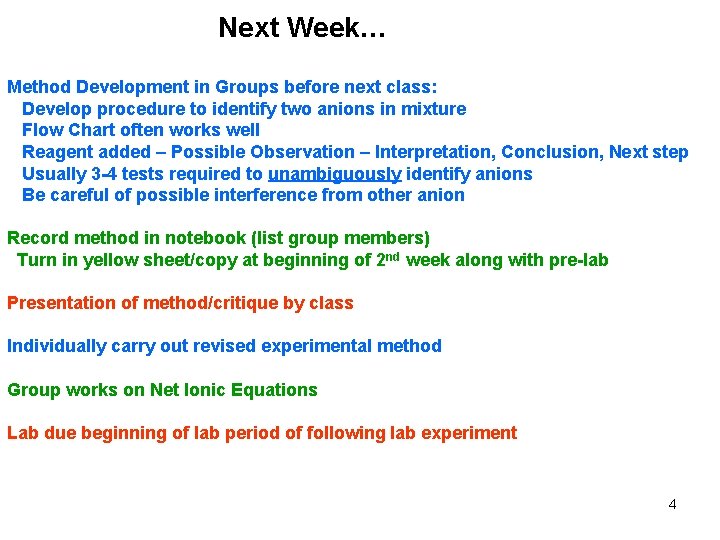
Next Week… Method Development in Groups before next class: Develop procedure to identify two anions in mixture Flow Chart often works well Reagent added – Possible Observation – Interpretation, Conclusion, Next step Usually 3 -4 tests required to unambiguously identify anions Be careful of possible interference from other anion Record method in notebook (list group members) Turn in yellow sheet/copy at beginning of 2 nd week along with pre-lab Presentation of method/critique by class Individually carry out revised experimental method Group works on Net Ionic Equations Lab due beginning of lab period of following lab experiment 4
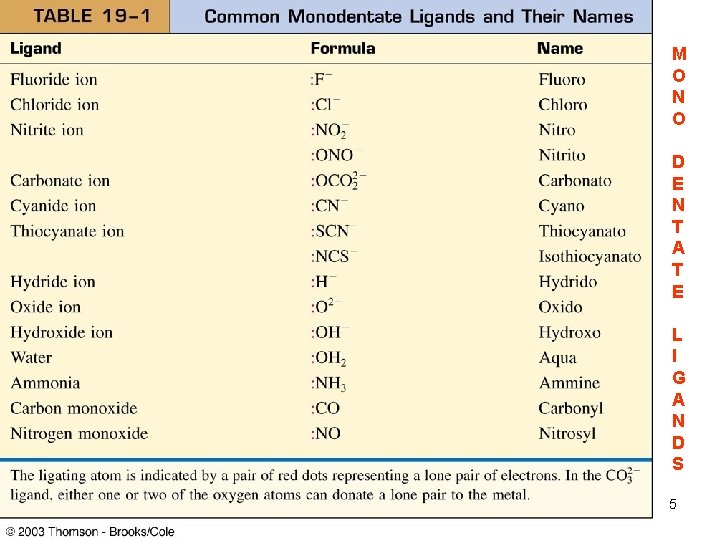
M O N O D E N T A T E L I G A N D S 5
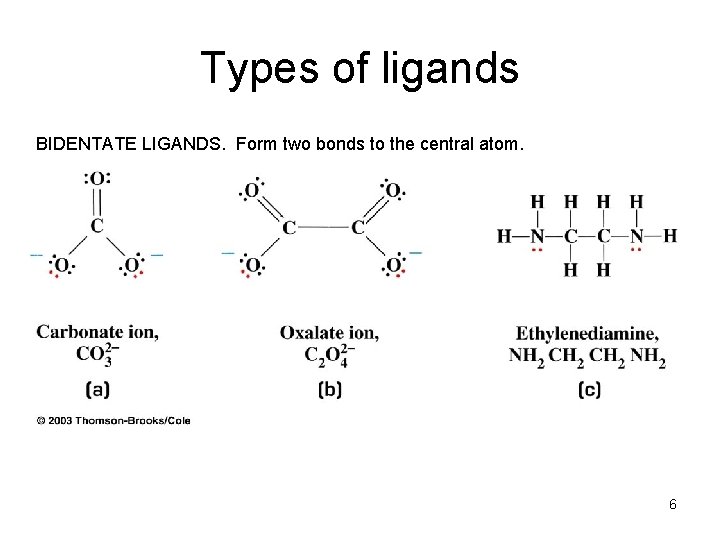
Types of ligands BIDENTATE LIGANDS. Form two bonds to the central atom. 6
EXTRA INFORMATION FOR 5 ANIONS EXPERIMENT Definition/ Experimental Observables Additional Information Precipitation formation of solids Acid/Base p. H change temperature change rxn of known acid/base pairs (solubility rules on page 147 -149 in Oxtoby, values of solubility product constants in Table 9 -1, p. 405 in Oxtoby) meaning of solubility product constants to be discussed later) lists of common acids/bases and their p. K's in Table 8 -2, p. 355 in Oxtoby) meaning of p. Ka's to be discussed later Redox Complexation involves transfer of electrons involves changes in oxidation states reactions with O 2, H 2, or other known oxidizers or reducers complexes often colored reaction of a transition metal with a ligand lists of common strong oxidants and reductants on website, standard reduction potentials in Appendix E in Oxtoby -- meaning of standard reduction potentials to be discussed later discussion pp. 131 -132, Oxtoby, examples of ligands given in Table 19 -1, p. 811 and bidentate ligands in Fig. 19 -2, p. 812 in Oxtoby 7