Response to an Argument Working smarter not harder
- Slides: 15
Response to an Argument Working smarter, not harder
Strategies for Mastering the Persuasive Essay On the AP Language exam, the persuasive essay calls for a different set of skills than does the rhetorical analysis essay. Two difficult areas on the persuasive essay for my students are offering credible, appropriate evidence to support their claims understanding the difference between defending, challenging, or qualifying their claims
What does it mean to offer evidence from your observations, experience, or reading? Use your knowledge of any specialized subject, such as history current events science technology music sports human behavior You can either use this knowledge in a way that directly applies to the subject (if that’s appropriate to the subject), or you can create an analogy between this specialized knowledge and your persuasive prompt.
To defend an assertion is to agree with it; to challenge is to disagree with it. To qualify is distinctly more complicated because qualifying demands that students assess the nuances and complexities of the assertion. Often the highest-scoring papers qualify because these students have thought through the complexities inherent in any tenable assertion.
Qualifying an Assertion in the Persuasive Essay Often the strongest persuasive essays are those in which the writer qualifies an assertion rather than strictly defending or challenging it. When you qualify, you force yourself to look at an issue from more angles than one and to view it from the vantage point of both sides. Qualifying an assertion shows you to be a person who considers points of view other than your own and a person who respects others’ opinions, all traits which develop your character and credibility as a writer, or your ethos. Students should be aware that rarely is any issue in the public forum cut and dried, right or wrong, black or white. To produce more sophisticated and finessed essays, students should learn how to qualify an assertion.
Look at some of the prompts appearing on past Language exams, and note that they all deal with issues that could be supported with evidence on each side. (The prompts have been paraphrased. ) Wealthy people can buy their justice in our courts system. Photography does not present an accurate view of the world. The entertainment business is ruining society. One’s spoken language is a key to his/her identity. Americans are more materialistic than people in other countries. One’s personal identity is bound up in that person’s external appearance and possessions. Our freedom is endangered when the government does not respect our basic right to privacy.
In each of these assertions, reasonable people can disagree. And each of these assertions represents a complicated interplay of ideas and beliefs. The more educated and civilized a society becomes, the more its citizens should be able to discern that most issues in the public forum cannot be simplistically stated. Thus, it becomes important for students to learn to qualify their position when they are defending an assertion or position. Qualifying deals with "on the one hand" and "on the other hand" reasoning. Since most (if not all) issues have two valid sides, reasonable people, people developing their ethos in public or written discourse, should be able to modify their own argument to reflect both sides of the issue. Qualifying, however, does not mean showing both sides of an issue and then leaving it there. In a persuasive essay, the writer’s purpose is to change the audience’s mind or to at least offer compelling evidence why a certain position is valid.
Below is an assertion with sample paragraphs defending, challenging, and qualifying the assertion. In these paragraphs, note that the “defend” and “challenge” paragraphs deal with only one side of the issue. The “qualify” paragraph addresses some of the complexities inherent in most issues in the public forum. This paragraph modifies the assertion to extend its focus only to certain situations. Assertion: Laws which protect citizens from themselves are justified. Defend: Our forefathers determined that it is the business of the government to provide all that shall affect our “life, liberty, and the pursuit of happiness. ” Democracy works because the people have entrusted that power to their elected officials. It is government’s right, yes, and its duty to enact laws that best protect and preserve the lives of Americans. Therefore, the government, through our elected officials, has the right to protect citizens and to make judgments regarding how best to protect citizens from themselves. Because society will have to pay (through health and mental care) for a person who harms himself, society has the right to limit a person’s rights when he tries to harm himself.
Challenge: All human beings are distinct entities, possessing a spirit, soul, and body. The right to make private decisions affecting one’s life is a precious one. Any government, even in its best intentions, never has the right to impose its will on its citizens, even when it proposes to protect them from themselves. According to the values of our country, people should have the “liberty” to choose “life” or “happiness” on their own terms.
What is a concession? A concession is an expression of concern for those who do not agree with you. Using concession is a good way to develop your ethos, or your credibility and character with your audience. Using concession shows your audience that you are a fair-minded person, one who recognizes that any issue has two sides. Read the paragraph below. The concession is bolded.
Defend or challenge with a concession: Our forefathers determined that it is the business of the government to provide all that shall affect our “life, liberty, and the pursuit of happiness. ” Democracy works because the people have entrusted that power to their elected officials. It is government’s right, yes, and its duty to enact laws that best protect and preserve the lives of Americans. Therefore, the government, through our elected officials, has the right to protect citizens and to make judgments regarding how best to protect citizens from themselves. Civil libertarians might argue that the right to make private decisions affecting one’s life is a precious one, one that government has no right to intrude upon. They would say that any government, even in its best intentions, never has the right to impose its will on its citizens, even when it purposes to protect them from themselves. Yet society will have to pay (through health and mental care) for a person who harms himself. Therefore, society has the ultimate right and duty to limit a person’s rights when he tries to harm himself.
Qualify: The Declaration of Independence states that all Americans have the right to “life, liberty, and the pursuit of happiness. ” Therefore, it can be argued that our right to “life” sometimes hinges on the government protecting us from ourselves. Thus we have laws such as those prohibiting the sale of alcohol to minors and requiring us to wear seat belts in automobiles. Sometimes city, state, or national governments go too far, however, in determining just how Americans should be protected. Some cities have banned trans fats in restaurants, for instance. When a law crosses over the line from protecting Americans’ lives and begins to interfere with their liberties, then that law has gone too far. Laws which protect citizens from themselves are justified as long as those laws do not infringe upon individual liberty.
Common errors in writing this essay: 1. Not understanding the task or the directions 2. Merely paraphrasing the passage 3. Not taking a definite stand 4. Using inappropriate or weak evidence to support your position 5. Writing a stylistic analysis of the passage instead of a persuasive essay
Building your case In the second part, take a stand support it. Back up your claims with solid evidence: Historical Personal Literary Cultural
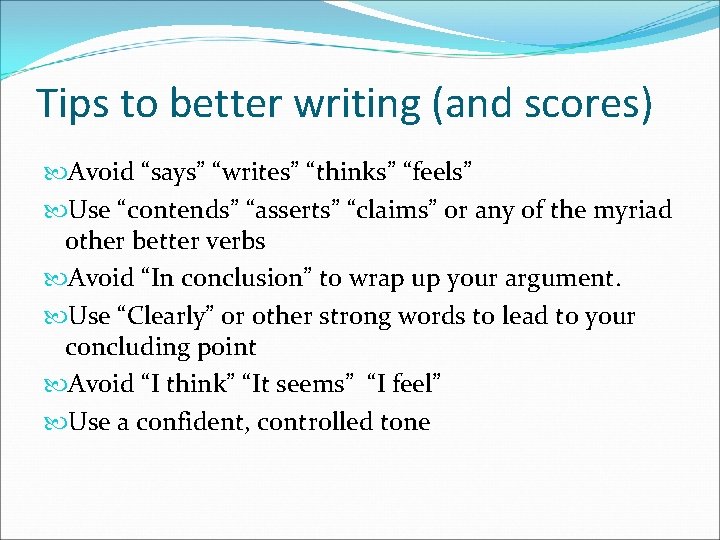
Tips to better writing (and scores) Avoid “says” “writes” “thinks” “feels” Use “contends” “asserts” “claims” or any of the myriad other better verbs Avoid “In conclusion” to wrap up your argument. Use “Clearly” or other strong words to lead to your concluding point Avoid “I think” “It seems” “I feel” Use a confident, controlled tone