Quantum Superresolution Imaging in Fluorescence Microscopy Osip Schwartz

- Slides: 25
Quantum Super-resolution Imaging in Fluorescence Microscopy Osip Schwartz, Dan Oron, Jonathan M. Levitt, Ron Tenne, Stella Itzhakov and Dan Oron Dept. of Physics of Complex Systems Weizmann Institute of Science, Israel FRISNO 12, Ein Gedi (February 2013)
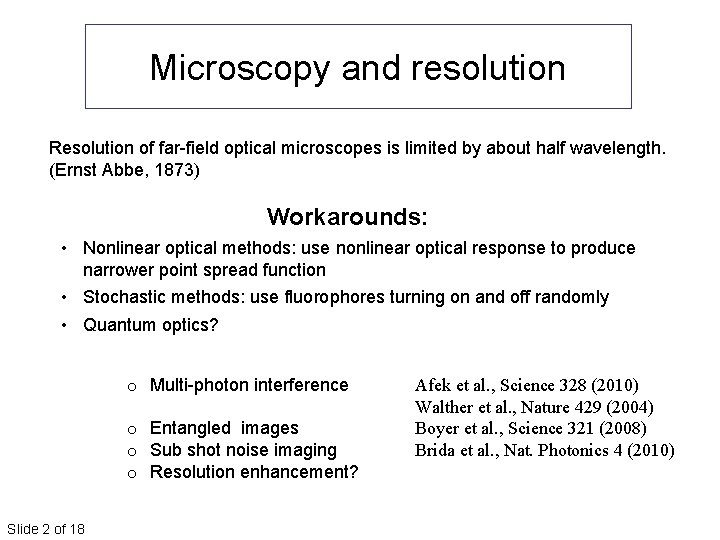
Microscopy and resolution Resolution of far-field optical microscopes is limited by about half wavelength. (Ernst Abbe, 1873) Workarounds: • Nonlinear optical methods: use nonlinear optical response to produce narrower point spread function • Stochastic methods: use fluorophores turning on and off randomly • Quantum optics? o Multi-photon interference o Entangled images o Sub shot noise imaging o Resolution enhancement? Slide 2 of 18 Afek et al. , Science 328 (2010) Walther et al. , Nature 429 (2004) Boyer et al. , Science 321 (2008) Brida et al. , Nat. Photonics 4 (2010)
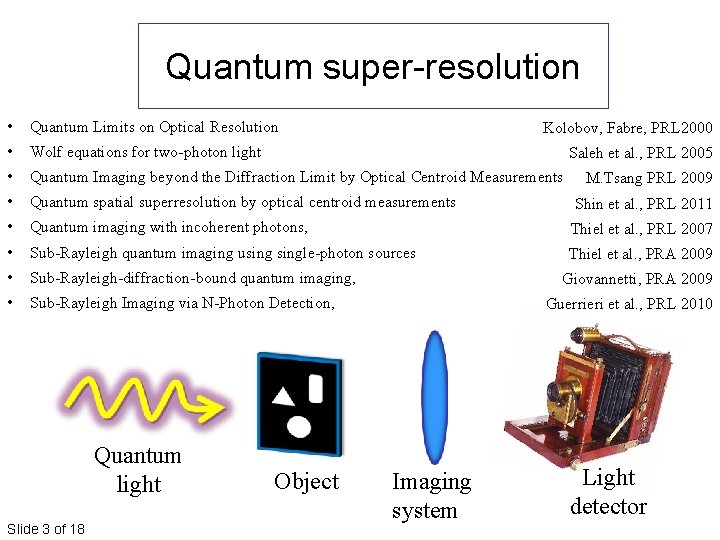
Quantum super-resolution • Quantum Limits on Optical Resolution • Wolf equations for two-photon light • Quantum Imaging beyond the Diffraction Limit by Optical Centroid Measurements • Quantum spatial superresolution by optical centroid measurements Shin et al. , PRL 2011 • Quantum imaging with incoherent photons, Thiel et al. , PRL 2007 • Sub-Rayleigh quantum imaging usingle-photon sources Thiel et al. , PRA 2009 • Sub-Rayleigh-diffraction-bound quantum imaging, • Sub-Rayleigh Imaging via N-Photon Detection, Quantum light Slide 3 of 18 Kolobov, Fabre, PRL 2000 Saleh et al. , PRL 2005 Object M. Tsang PRL 2009 Giovannetti, PRA 2009 Guerrieri et al. , PRL 2010 Imaging system Light detector
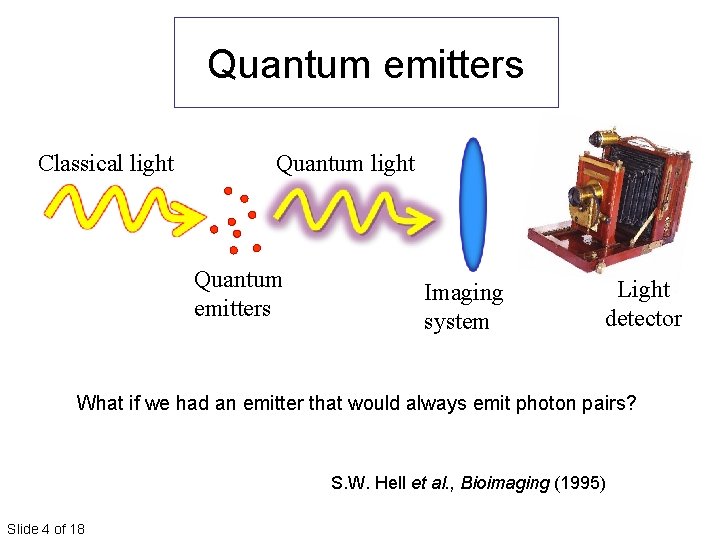
Quantum emitters Classical light Quantum emitters Imaging system Light detector What if we had an emitter that would always emit photon pairs? S. W. Hell et al. , Bioimaging (1995) Slide 4 of 18
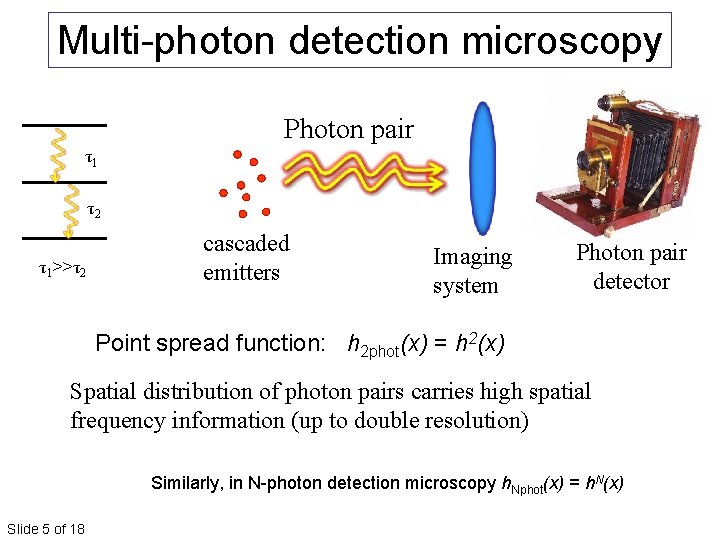
Multi-photon detection microscopy Photon pair τ1 τ2 τ1>>τ2 cascaded emitters Imaging system Photon pair detector Point spread function: h 2 phot(x) = h 2(x) Spatial distribution of photon pairs carries high spatial frequency information (up to double resolution) Similarly, in N-photon detection microscopy h. Nphot(x) = h. N(x) Slide 5 of 18
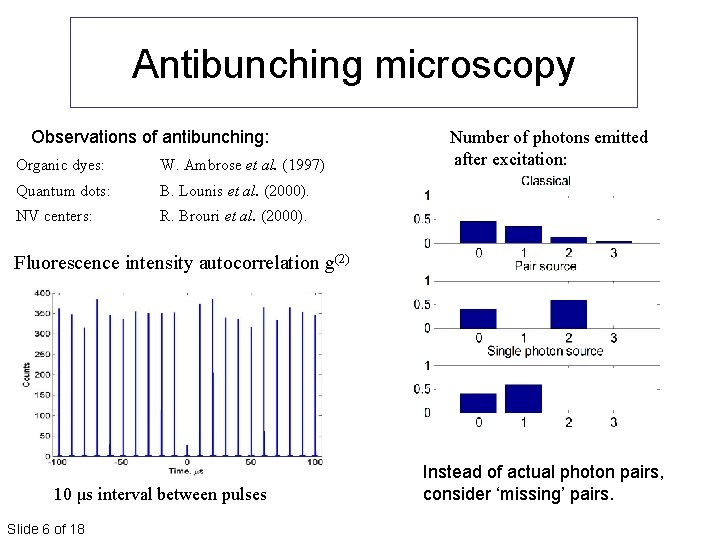
Antibunching microscopy Observations of antibunching: Organic dyes: W. Ambrose et al. (1997) Quantum dots: B. Lounis et al. (2000). NV centers: R. Brouri et al. (2000). Number of photons emitted after excitation: Fluorescence intensity autocorrelation g(2) 10 μs interval between pulses Slide 6 of 18 Instead of actual photon pairs, consider ‘missing’ pairs.
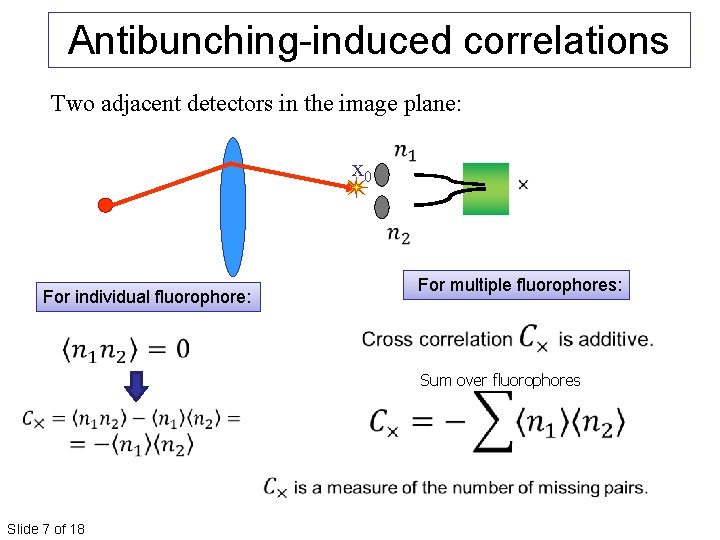
Antibunching-induced correlations Two adjacent detectors in the image plane: x 0 For multiple fluorophores: For individual fluorophore: Slide 7 of 18 Sum over fluorophores
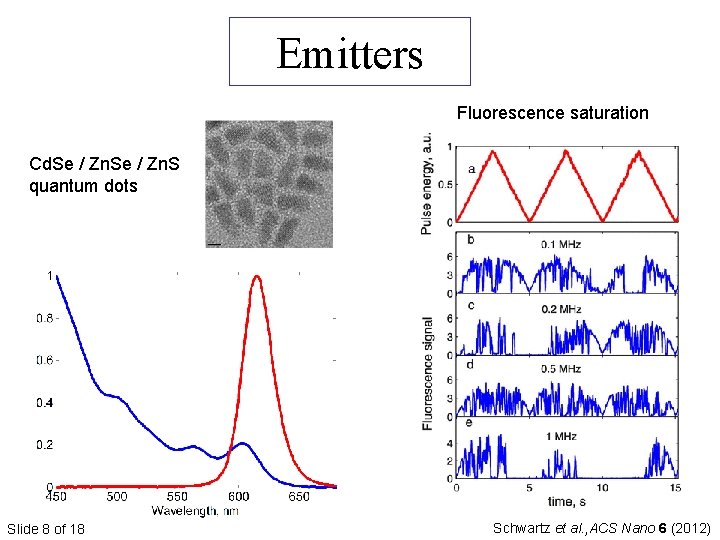
Emitters Fluorescence saturation Cd. Se / Zn. S quantum dots Slide 8 of 18 Schwartz et al. , ACS Nano 6 (2012)
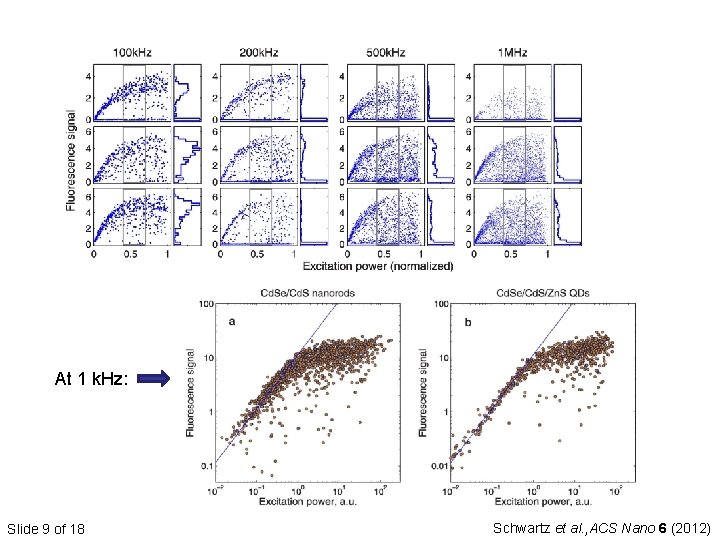
At 1 k. Hz: Slide 9 of 18 Schwartz et al. , ACS Nano 6 (2012)
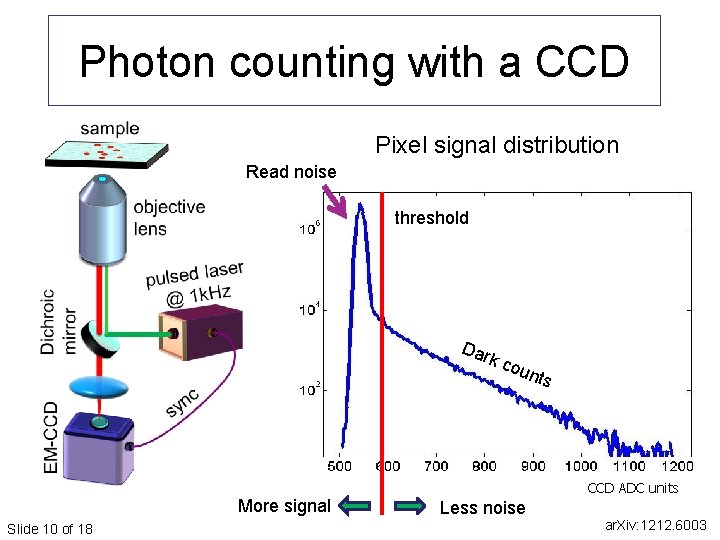
Photon counting with a CCD Pixel signal distribution Read noise threshold Dar k co u nts CCD ADC units More signal Slide 10 of 18 Less noise ar. Xiv: 1212. 6003
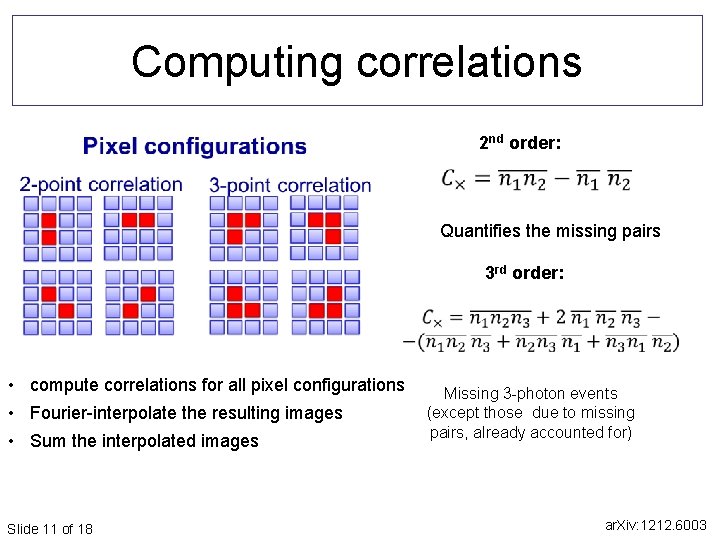
Computing correlations 2 nd order: Quantifies the missing pairs 3 rd order: • compute correlations for all pixel configurations • Fourier-interpolate the resulting images • Sum the interpolated images Slide 11 of 18 Missing 3 -photon events (except those due to missing pairs, already accounted for) ar. Xiv: 1212. 6003
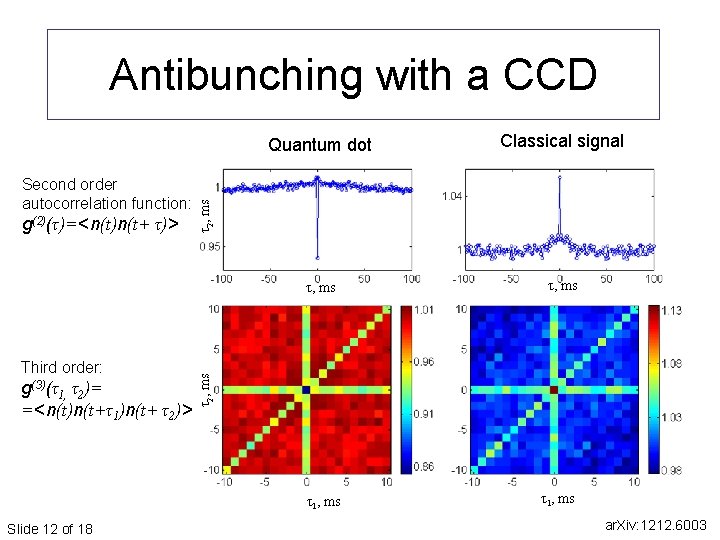
Antibunching with a CCD Third order: g(3)(τ1, τ2)= =<n(t)n(t+τ1)n(t+ τ2)> τ, ms τ2, ms g(2)(τ)=<n(t)n(t+ τ)> Classical signal τ2, ms Second order autocorrelation function: Quantum dot τ1, ms Slide 12 of 18 τ1, ms ar. Xiv: 1212. 6003
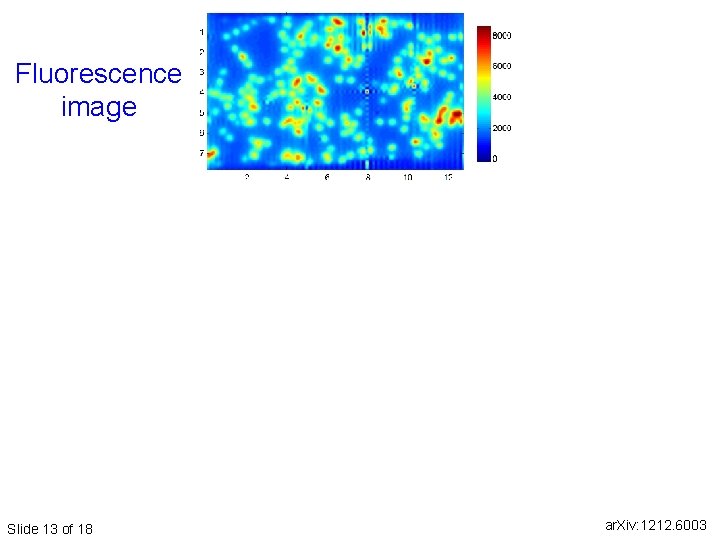
Fluorescence image Slide 13 of 18 ar. Xiv: 1212. 6003
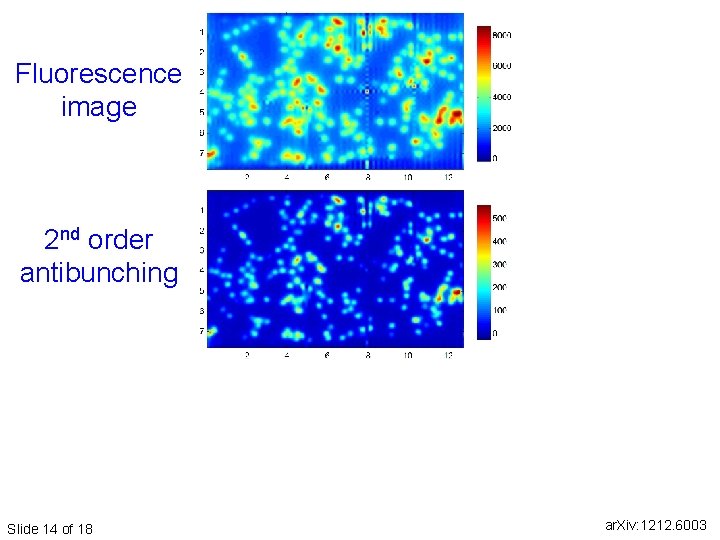
Fluorescence image 2 nd order antibunching Slide 14 of 18 ar. Xiv: 1212. 6003
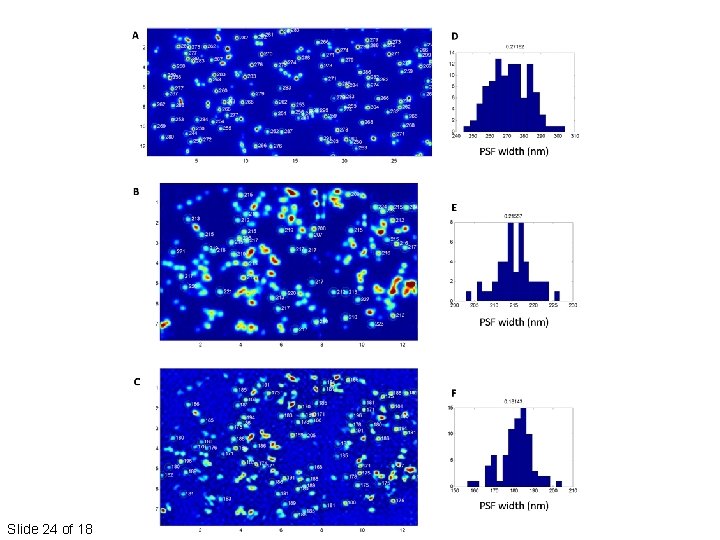
Fluorescence image Resolution: 271 nm FWHM 2 nd order antibunching 216 nm FWHM (x 1. 26) 3 rd order antibunching Slide 15 of 18 181 nm FWHM (x 1. 50) ar. Xiv: 1212. 6003
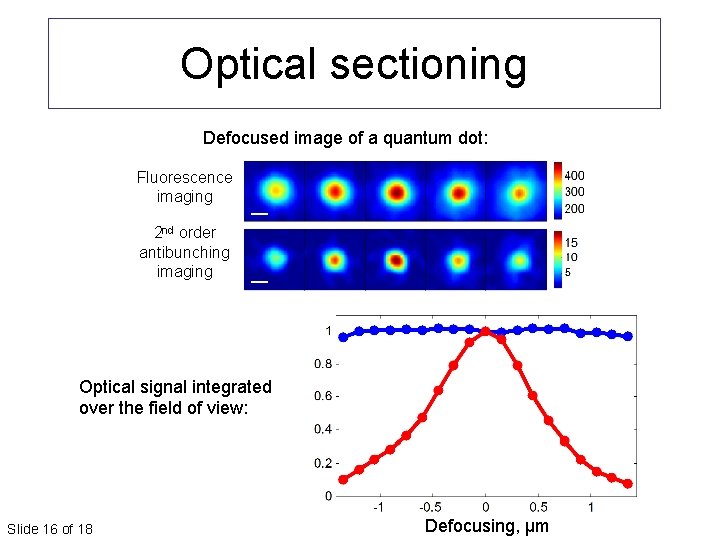
Optical sectioning Defocused image of a quantum dot: Fluorescence imaging 2 nd order antibunching imaging Optical signal integrated over the field of view: Slide 16 of 18 Defocusing, μm
Summary • Far-field super-resolution imaging demonstrated by using quantum properties of light naturally present in fluorescence microscopy • The experiment was performed with commercially available equipment, at room temperature, with commonly used quantum dot fluorophores • With further development of detector technology, antibunching imaging may become feasible as a practical imaging method Slide 17 of 18
The team Jonathan M. Levitt Stella Itzhakov Ron Tenne Slide 18 of 18 Zvicka Deutsch Dan Oron
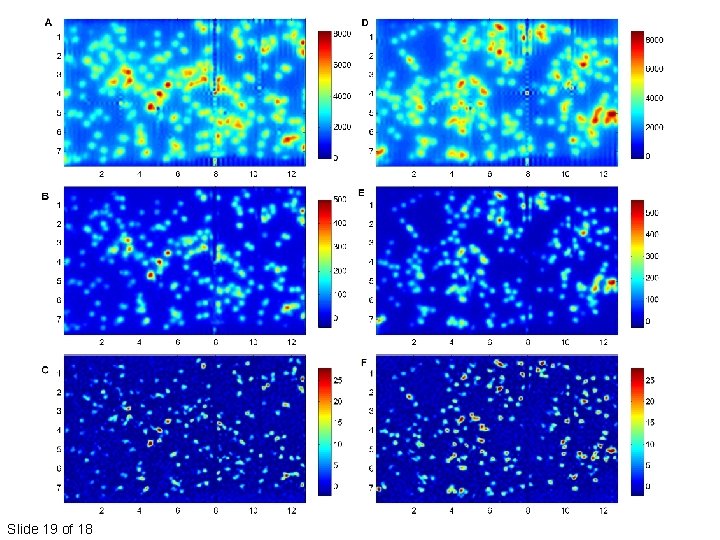
Slide 19 of 18
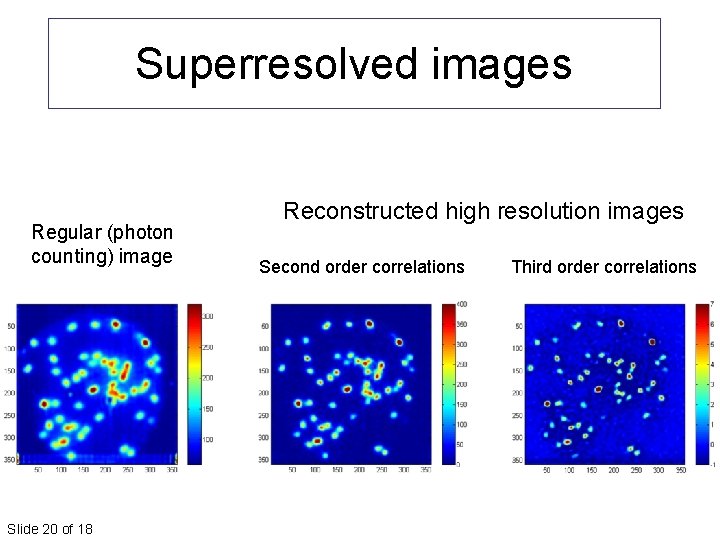
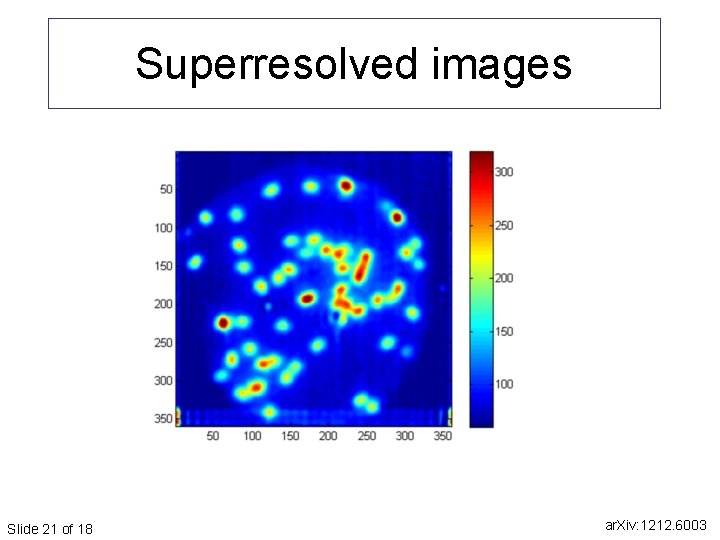
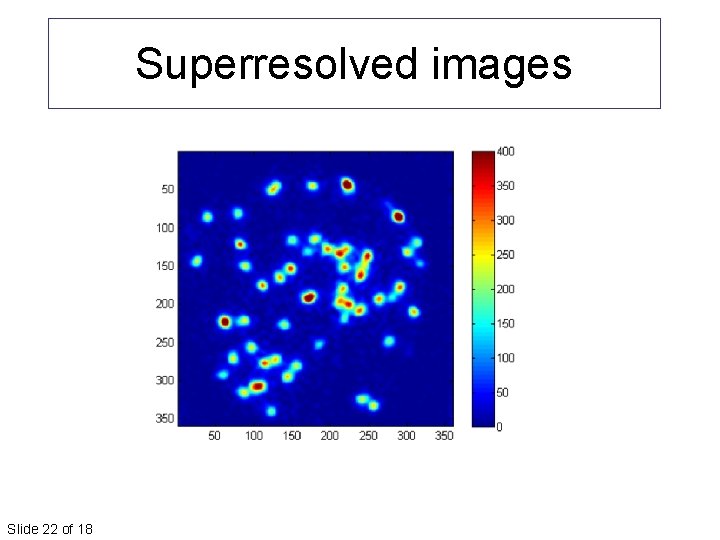
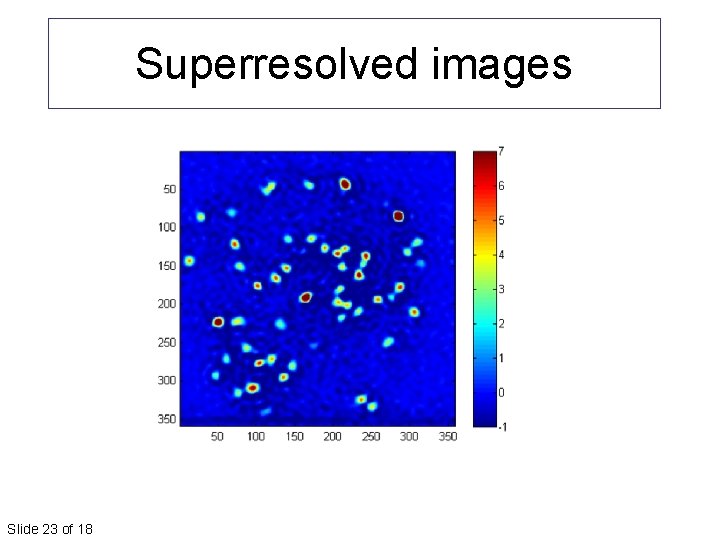
Superresolved images Regular (photon counting) image Slide 20 of 18 Reconstructed high resolution images Second order correlations Third order correlations
Superresolved images Slide 21 of 18 ar. Xiv: 1212. 6003
Superresolved images Slide 22 of 18
Superresolved images Slide 23 of 18
Slide 24 of 18
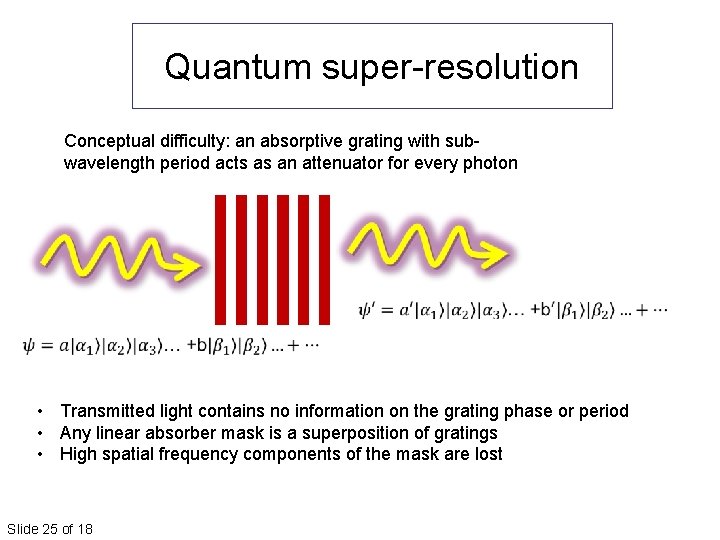
Quantum super-resolution Conceptual difficulty: an absorptive grating with subwavelength period acts as an attenuator for every photon • Transmitted light contains no information on the grating phase or period • Any linear absorber mask is a superposition of gratings • High spatial frequency components of the mask are lost Slide 25 of 18