Quality in Preschool How do Danish high quality

- Slides: 20
Quality in Preschool How do Danish high quality day care centers sustain children’s learning outcome and how can this be measured? ECERS- network meeting 2016 Torben Næsby, trn@ucn. dk 1
Policy & Education There’s no doubt, professions should use research based knowledge to inform practice (Hammersley 2007, Levin 2013) High quality depends on the approach to children and knowledge of children’s development and needs (Sheridan 2009). For this reason, the professionals should have access to the latest scientific knowledge. Preschools of high quality have the outmost significance for European growth and welfare (EU 2011) Despite the potential links between research and evaluation on the one hand program development, practices, and public policy on the other, there are too many key areas in which public policy and practice are not well aligned with the knowledge base (Pianta et al, 2009) Pianta, R. C. ; Barnett, W. S. ; Burchinal, M. & Thornburg, K. R. (2009 )
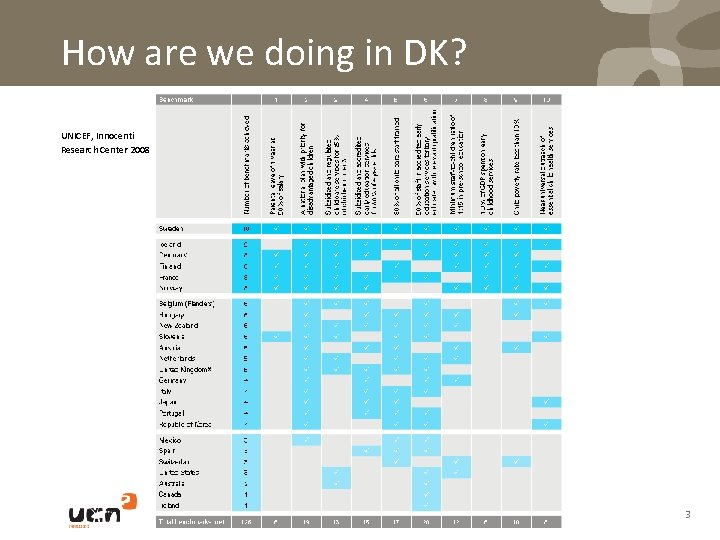
How are we doing in DK? UNICEF, Innocenti Research Center 2008 3
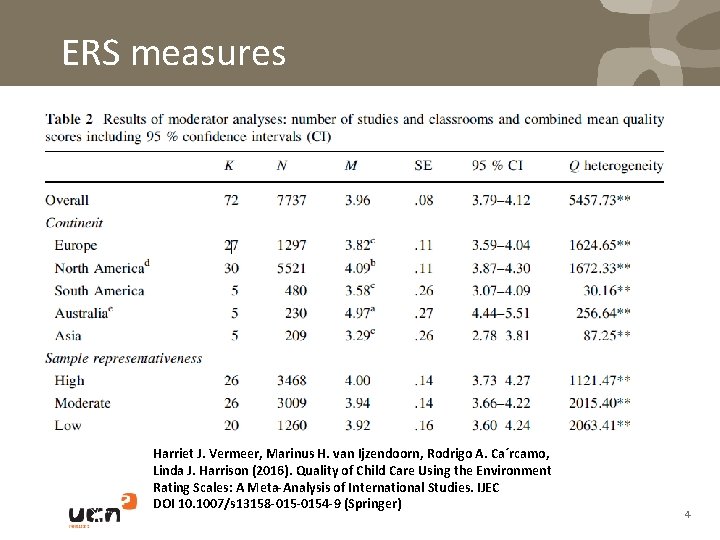
ERS measures Harriet J. Vermeer, Marinus H. van Ijzendoorn, Rodrigo A. Ca´rcamo, Linda J. Harrison (2016). Quality of Child Care Using the Environment Rating Scales: A Meta-Analysis of International Studies. IJEC DOI 10. 1007/s 13158 -0154 -9 (Springer) 4
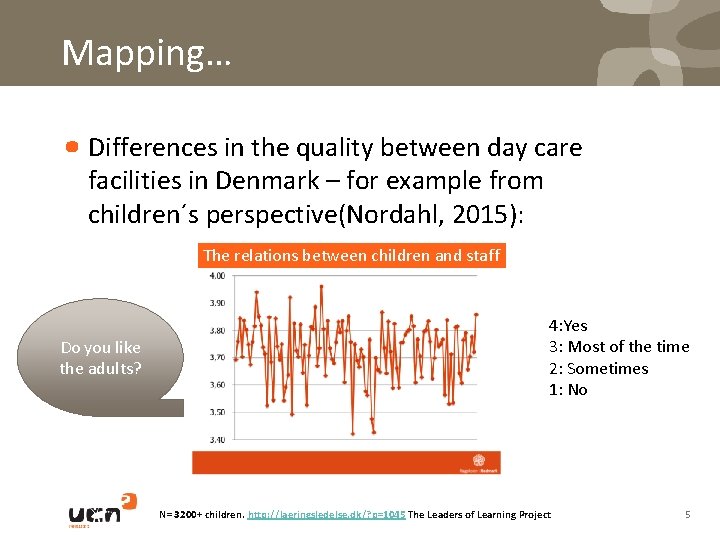
Mapping… Differences in the quality between day care facilities in Denmark – for example from children´s perspective(Nordahl, 2015): The relations between children and staff Do you like the adults? 4: Yes 3: Most of the time 2: Sometimes 1: No N= 3200+ children. http: //laeringsledelse. dk/? p=1045 The Leaders of Learning Project 5
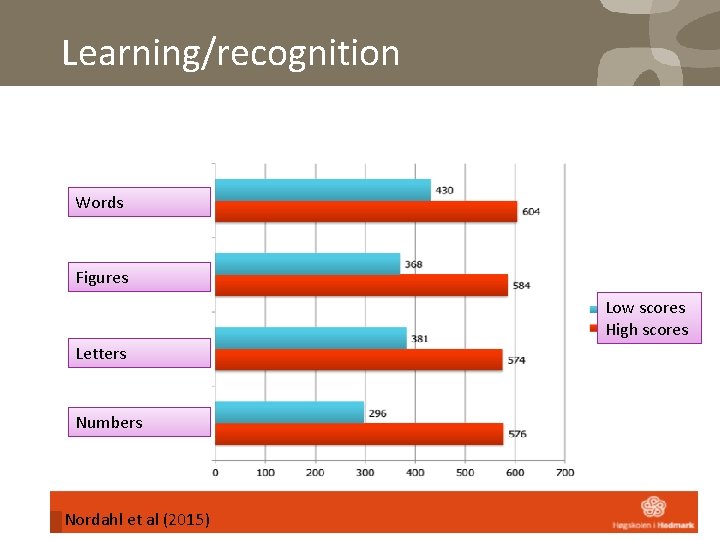
Learning/recognition Words Figures Low scores High scores Letters Numbers Nordahl et al (2015) 6
Nordahl et al, 2015 Girls have better relations to adults than boys Children from low-income families scores lower Differences between the preschools on children recognizing words, geometric figures, numbers and letters are surprisingly large (Nordahl et al 2015) Danish pedagogues are “champions in relations” (socio-emotional development) Poor when it comes to support children’s learning (cognition, literacy and language) Winther-Lindqvist, Allerup, Ringsmose, 2012; Markussen-Brown, 2015; Nordahl, 2015 7
A New Research Project What is high-quality in Danish preschool, how do we see, meet and develop it? The Danish Day Care Facilities Act, which provides the curriculum on which day care education is based, does not stipulate very clearly what children should learn and therefore how educational processes should be organized. This means that we must accept that there are large local differences in the quality of day care facilities in Denmark, and also that we in fact have little knowledge of whether the desired politically determined targets are being met and what the quality is really like. Children’s development does not come by itself. There is therefore considerable interest in the quality of the learning environment and the impact of education on children’s wellbeing, learning and development. 8
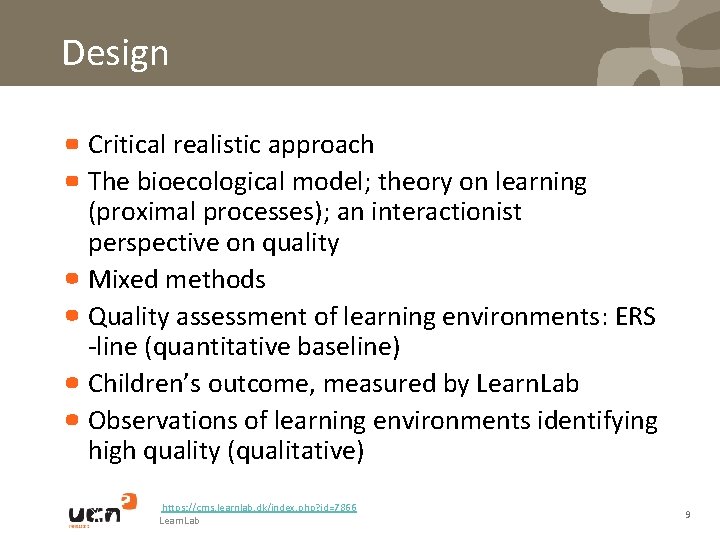
Design Critical realistic approach The bioecological model; theory on learning (proximal processes); an interactionist perspective on quality Mixed methods Quality assessment of learning environments: ERS -line (quantitative baseline) Children’s outcome, measured by Learn. Lab Observations of learning environments identifying high quality (qualitative) https: //cms. learnlab. dk/index. php? id=7866 Learn. Lab 9
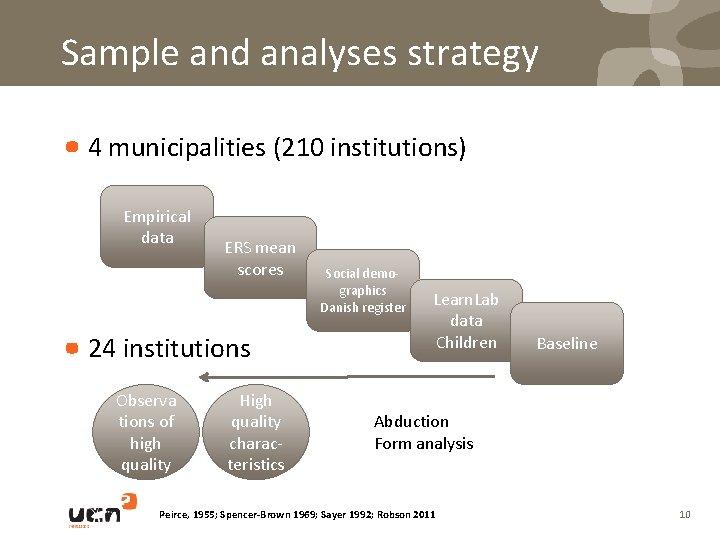
Sample and analyses strategy 4 municipalities (210 institutions) Empirical data ERS mean scores 24 institutions Observa tions of high quality High quality characteristics Social demographics Danish register Learn. Lab data Children Baseline Abduction Form analysis Peirce, 1955; Spencer-Brown 1969; Sayer 1992; Robson 2011 10
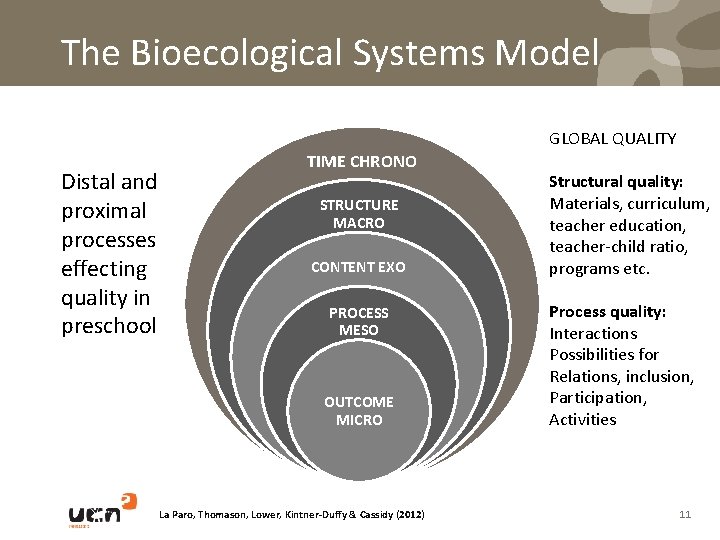
The Bioecological Systems Model GLOBAL QUALITY Distal and proximal processes effecting quality in preschool TIME CHRONO STRUCTURE MACRO CONTENT EXO PROCESS MESO OUTCOME MICRO La Paro, Thomason, Lower, Kintner-Duffy & Cassidy (2012) Structural quality: Materials, curriculum, teacher education, teacher-child ratio, programs etc. Process quality: Interactions Possibilities for Relations, inclusion, Participation, Activities 11
Global Quality Global definitions make it difficult to inform policy and practice Do not provide the level of specificity to guide initiatives Do not provide the information necessary to understand characteristics of settings most important to child outcomes Do not capture the depth needed to understand what we need to know to positively affect child outcomes La Paro, Thomason, Lower, Kintner-Duffy & Cassidy (2012) 12
The Model GLOBAL AND LOCAL/NARROW QUALITY Distal and Proximal Processes TIME CHRONO STRUCTURE MACRO CONTENT EXO Process. Person. Context. Time PROCESS MESO OUTCOME MICRO Structural and content quality What is being taught Organization and Leading Measuring across dimensions Process and effect quality Approach to children What children learn and their well-being The balance between child-initiated and staff -lead activities 13 Evaluation
Proximal Processes In the Process-Person-Context-Time model proximal processes are defined as key factors in development/ engines of development The form, power, content, and direction of the proximal processes effecting development vary systematically as a joint function of the • characteristics of the developing person, • the quality of the environment, producing increasingly more complex activities • the direction and interaction (goals, effects, predicted developmental outcome • social continuities and changes, relations to significant others The quality of proximal processes determines the outcome Bronfenbrenner & Morris, 2006 14
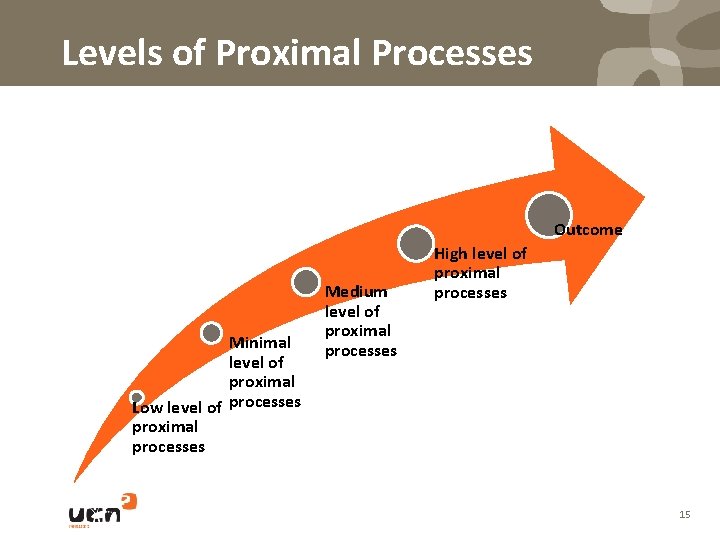
Levels of Proximal Processes Outcome Minimal level of proximal Low level of processes proximal processes Medium level of proximal processes High level of proximal processes 15
Pedagogical Quality A pedagogical perspective of quality has to originate from research and documented evidence but must also inherit the children’s perspectives It has to be viewed interactively. Neither the objective (global) nor the subjective (or relative) perspective, with their limitations, should be dominant (Siraj. Blatchford & Mayo, 2012) In an interactionist perspective, dimensions of the society, the pedagogues, the children’s development and the learning environment continuously and dialectically influence and are influenced by each other (Sheridan, 2009) 16
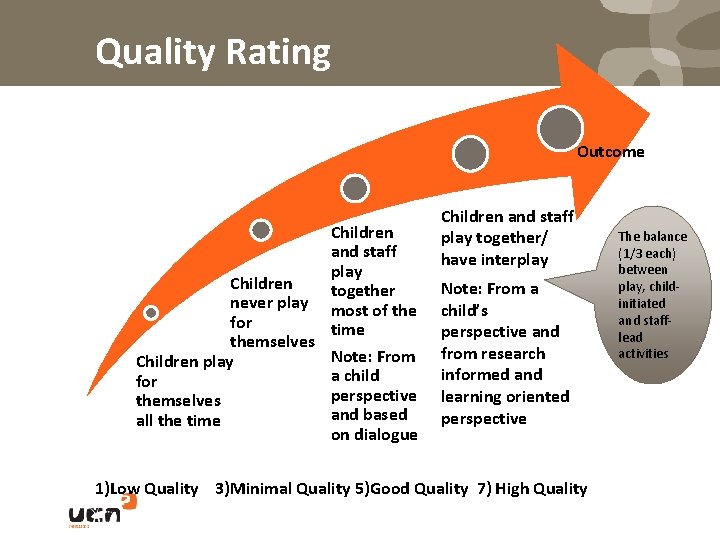
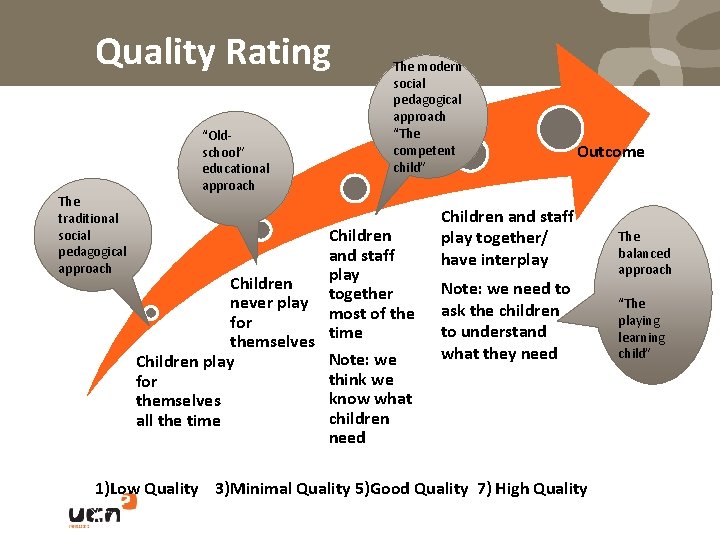
Pedagocial Quality Divided environments = low quality Constraining environments = minimal quality Child-centred and dialogue-based environments = good quality Innovative and learning-oriented environments = high quality Sheridan, Samuelsson & Johansson (2009): Barns tidiga läranda. Gøteborg Næsby, T. (2014): Kvalitet i pædagogisk arbejde. I: Kornerup I. & Næsby, T. (red. ): Pædagogens grundfaglighed. Dafolo. s. 69 - 95
Quality Rating Outcome Children and staff play Children together never play most of the for time themselves Note: From Children play a child for perspective themselves and based all the time on dialogue Children and staff play together/ have interplay Note: From a child’s perspective and from research informed and learning oriented perspective 1)Low Quality 3)Minimal Quality 5)Good Quality 7) High Quality The balance (1/3 each) between play, childinitiated and stafflead activities
Quality Rating The traditional social pedagogical approach “Oldschool” educational approach The modern social pedagogical approach “The competent child” Children and staff play Children never play together most of the for themselves time Note: we Children play think we for know what themselves children all the time need Outcome Children and staff play together/ have interplay Note: we need to ask the children to understand what they need 1)Low Quality 3)Minimal Quality 5)Good Quality 7) High Quality The balanced approach “The playing learning child”
References Bronfenbrenner, U. (1994). Ecological models of human development. In International Encyclopedia of Education 2 nd ed. , Vol. 3, pp. 1643 -1647. Oxford: Elsevier. Bronfenbrenner, U. & Morris, P. A. (2006). The Bioecological Model of Human Development. In Siraj-Blatchford, I. & Mayo, A. (eds)(2012). Early Childhood Education. Vol 1. pp. 201 -262. London: Sage. Broström, S. (2016): Ten-year-olds’ reflections on their life In preschool. In Nordic Studies in Education, Vol 36, 1 -2016, pp. 3 – 19. Du. Four, R. & Marzano, R. (2011). Leaders of Learning. Solution Tree Press. EU-Commission (2011): Communication from the Commission: Early Childhood Education and Care: Providing all our children with the best start for the world of tomorrow. COM: 2011: 0066 Hammersley, M. (ed. ). (2007). Educational research and evidence-based practice. London: SAGE. Harms, Th. ; Clifford, R. M. & Cryer, D. (2015). Early Childhood Environment Rating Scale. 3 rd. edition. Teachers College press. La Paro, K. M. ; Thomason, A. C. ; Lower, J. K. ; Kintner-Duffy, V. L. & Cassidy, D. J. (2012). Examining the Definition and Measurement of Quality in Early Childhood Education: A review of Studies Using the ECERS-R from 2003 to 2010. Early Childhood Research and Practice. No. 14/1. Levin, B. (2013). To know is not enough: Research knowledge and its use. Review of Education, 1 (1), 2 -31. DOI: 10. 1002/rev 3. 3001. Nordahl, T. (2015): Kartleggingsresultater. [Data from survey conducted in the development and research program “Leaders of Learning”], Aalborg University. http: //laeringsledelse. dk/? p=1045 Næsby, T. (2014). Quality in Preschool. Pedagogical Quality and Development of Professional Competencies. Thesis. Aalborg Universitetsforlag. (In Danish. ) Pianta, R. C. ; Barnett, W. S. ; Burchinal, M. & Thornburg, K. R. (2009). The effects of preschool education. What we know, How public policy is or is not aligned with the evidence base, and what we need to know. Psychological Science in the Public Interest, 10(2), 49– 88. Robson, C. (2011): Real World Research: . A Resource for Users of Social Research Methods in Applied Settings. Oxford: Blackwell Publishing. (3. ed. ). Sayer, A. (1992): Method in Social Science. A Realist Approach. 2. udg. London: Routledge. Sheridan, S. , Pramling-Samuelsson, I. & Johansson, E. (2009). Barns tidiga lärande. [Childrens learning in the early years; in Swedish]. Göteborg: Göteborg Universitet. Sheridan, S. (2009). Discerning pedagogical quality in preschool. Scandinavian Journal of Educational Research, 53 (3), 245 -261. Siraj-Blatchford, I. & Mayo, A. (2012). Early Childhood Education. Vol 1. London: Sage Siraj-Blatchford, I. & Wong, Y-l. (1999): Defining and Evaluating “Quality” Early Childhood Education in an International Context: Dilemmas and Possibilities. Early Years, 20 (1), 7 -18. I: Siraj-Blatchford, I. & Mayo, A. (eds)(2012): Early Childhood Education. London: Sage Library of Educational Thought and Practice. Vol 4, s. 77 – 90 Spencer-Brown, G. (1979): Laws of Form (rev. ed. ). New York: E. P. Dutton. UNICEF, The child care transition, Innocenti Report Card 8, (2008). UNICEF Innocenti Research Centre, Florence. trn@ucn. dk 20