Psychology From Inquiry to Understanding 1e Scott O


- Slides: 37
Psychology: From Inquiry to Understanding 1/e Scott O. Lilienfeld Steven Jay Lynn Laura Namy Nancy J. Woolf Prepared by Jennifer Sage This multimedia product and its contents are protected under copyright law. The following are prohibited by law: any public performance or display, including transmission of any image over a network; preparation of any derivative work, including the extraction, in whole or part, of any images; any rental, lease, or lending of the program.
Chapter 15: Psychological Disorders When Adaptation Breaks Down Copyright © Allyn & Bacon 2009
Lecture Preview n n n Discuss conceptions of mental illness and identify criteria for defining mental disorders Describe and explain how people experience anxiety Identify the characteristics of different mood disorders Explore dissociative disorders and schizophrenia Examine the link between personality disorders and substance abuse Copyright © Allyn & Bacon 2009
What Defines a Mental Disorder? n n n Statistical rarity Subjective distress Impairment Societal disapproval Biological dysfunction Family resemblance view – mental disorders don’t all have one thing in common, rather they share a loose set of features Copyright © Allyn & Bacon 2009
Historical Conceptions of Mental Illness n Demonic model – view of mental illness in which odd behavior, hearing voices, or talking to oneself was attributed to evil spirits infesting the body n Medical model – perception that mental illness was due to a physical disorder requiring medical treatment n n Governments began to house troubled individuals in asylums Bloodletting and snake pits were often used as treatments Copyright © Allyn & Bacon 2009
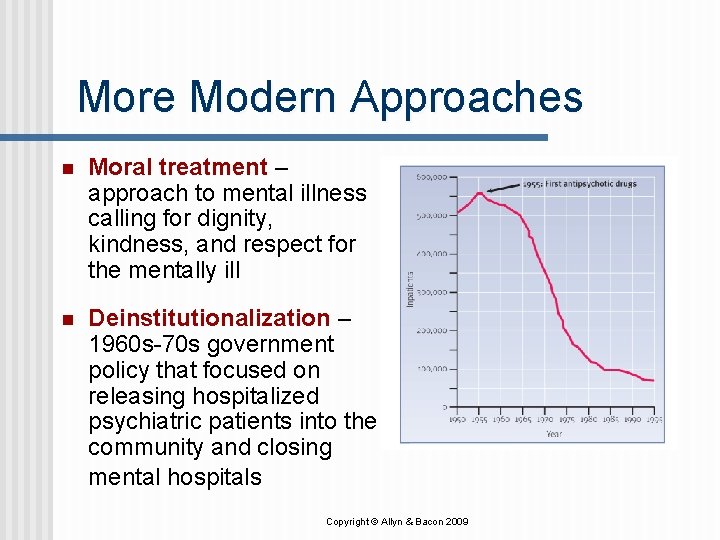
More Modern Approaches n Moral treatment – approach to mental illness calling for dignity, kindness, and respect for the mentally ill n Deinstitutionalization – 1960 s-70 s government policy that focused on releasing hospitalized psychiatric patients into the community and closing mental hospitals Copyright © Allyn & Bacon 2009
Apply Your Thinking n What are some of the benefits and costs of the governmental policy of deinstitutionalization? n Benefits: Some patients returned to normal lives and continued outpatient programs. It has saved the government a large amount of money. n Costs: Many patients ended up homeless. This can still be seen today as a recent study indicated that 15% of all patients treated for mental disorders are homeless. Copyright © Allyn & Bacon 2009
Psychiatric Diagnoses Over Time n Diagnostic labels devoid of scientific support: Codependency n Sexual addiction n Road rage disorder n Compulsive shopping disorder n Copyright © Allyn & Bacon 2009
Psychiatric Diagnosis Across Cultures n Many mental illnesses are specific to certain cultures (culture-bound) n n Koro – in a number of Asian countries, men with this condition falsely believe their penis and testicles are disappearing and receding into their abdomen Bulimia nervosa - unique to Western cultures • Likely genetic, but triggered by sociocultural expectations n n Anorexia nervosa - more culturally universal Many mental disorders are culturally universal (schizophrenia, alcoholism, psychopathic personality) Copyright © Allyn & Bacon 2009
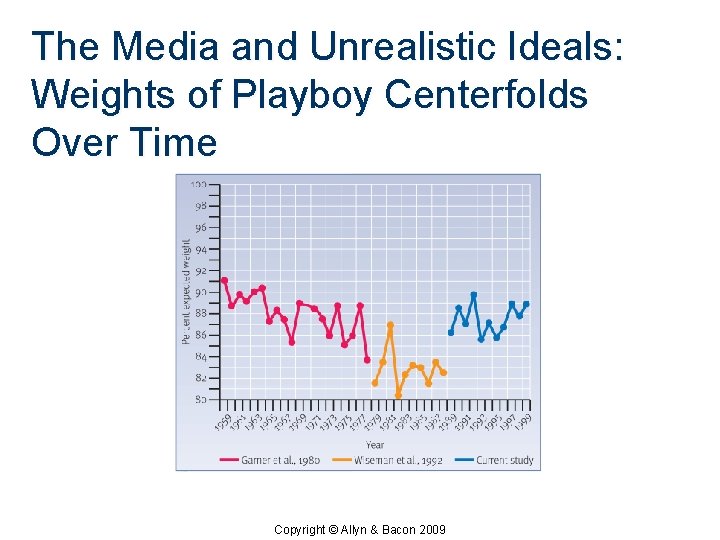
The Media and Unrealistic Ideals: Weights of Playboy Centerfolds Over Time Copyright © Allyn & Bacon 2009
Popular Misconceptions about Psychiatric Diagnosis n Psychiatric diagnosis is nothing more than pigeonholing, like sorting people into different “boxes” n n Psychiatric diagnoses are unreliable n n For major mental disorders, interrater reliability is high Psychiatric diagnoses are invalid n n Psychiatrists actually realize that people differ Diagnoses do tell us something new about the person Psychiatric diagnoses stigmatize people n Contrary to labeling theorists’ claims, diagnoses may improve others’ perceptions of the mentally ill Copyright © Allyn & Bacon 2009
Psychiatric Diagnosis Today: The DSM-IV n Diagnostic and Statistical Manual of Mental Disorders (DSM-IV) - diagnostic system containing the American Psychiatric Association (APA) criteria for mental disorders n Provides a list of symptoms and a decision rule on how many of these symptoms must be present for a diagnosis n Biopsychosocial approach – acknowledges the interplay between biological, psychological, and social influences n Utilizes prevalence of mental disorders and assesses patients along multiple axes (dimensions of functioning) Copyright © Allyn & Bacon 2009
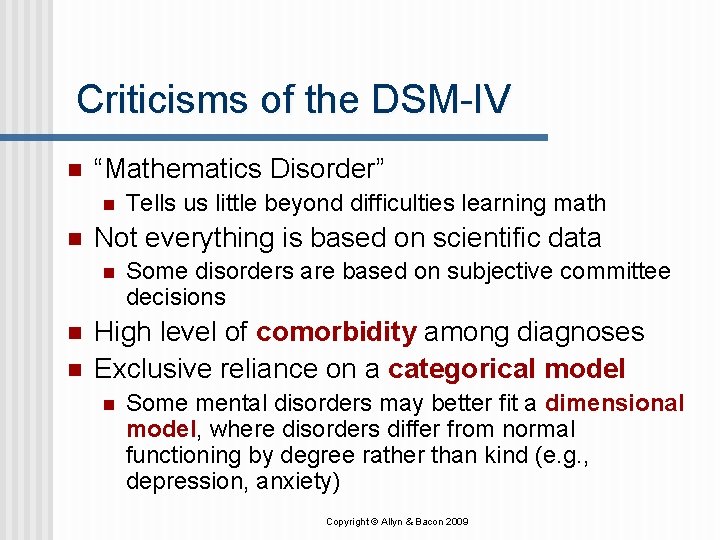
Criticisms of the DSM-IV n “Mathematics Disorder” n n Not everything is based on scientific data n n n Tells us little beyond difficulties learning math Some disorders are based on subjective committee decisions High level of comorbidity among diagnoses Exclusive reliance on a categorical model n Some mental disorders may better fit a dimensional model, where disorders differ from normal functioning by degree rather than kind (e. g. , depression, anxiety) Copyright © Allyn & Bacon 2009
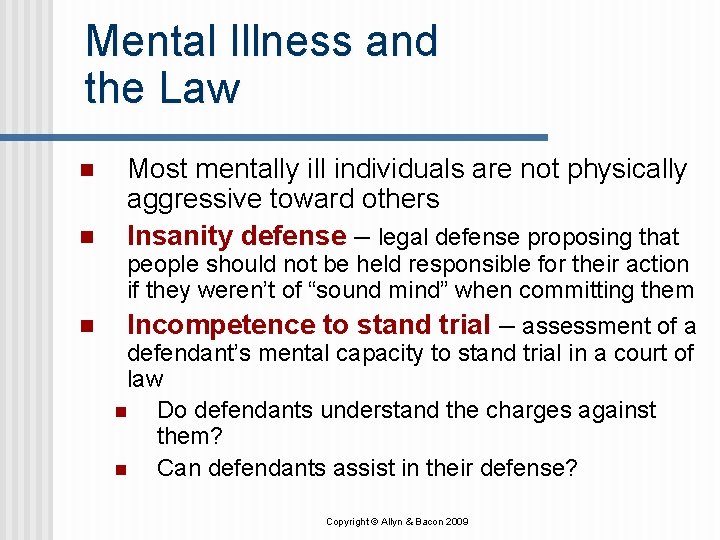
Mental Illness and the Law n n Most mentally ill individuals are not physically aggressive toward others Insanity defense – legal defense proposing that people should not be held responsible for their action if they weren’t of “sound mind” when committing them n Incompetence to stand trial – assessment of a defendant’s mental capacity to stand trial in a court of law n Do defendants understand the charges against them? n Can defendants assist in their defense? Copyright © Allyn & Bacon 2009
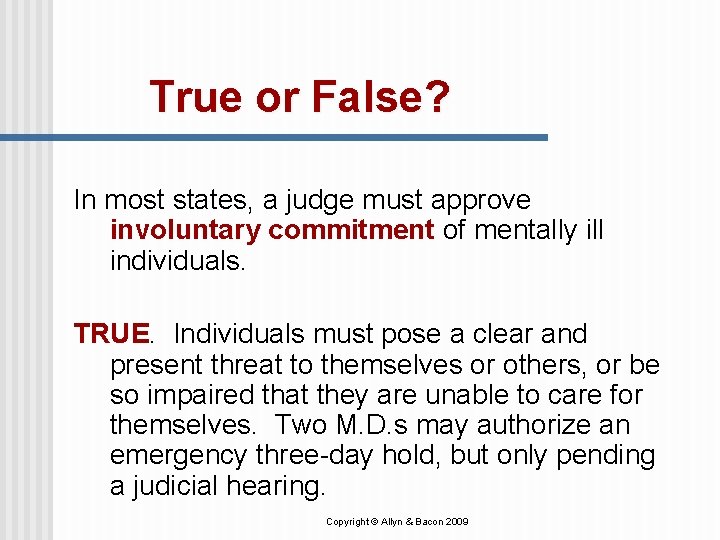
True or False? In most states, a judge must approve involuntary commitment of mentally ill individuals. TRUE. Individuals must pose a clear and present threat to themselves or others, or be so impaired that they are unable to care for themselves. Two M. D. s may authorize an emergency three-day hold, but only pending a judicial hearing. Copyright © Allyn & Bacon 2009
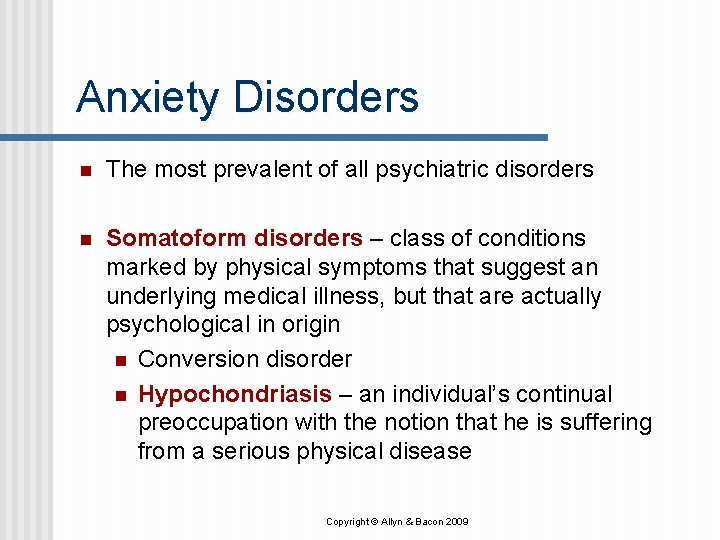
Anxiety Disorders n The most prevalent of all psychiatric disorders n Somatoform disorders – class of conditions marked by physical symptoms that suggest an underlying medical illness, but that are actually psychological in origin n Conversion disorder n Hypochondriasis – an individual’s continual preoccupation with the notion that he is suffering from a serious physical disease Copyright © Allyn & Bacon 2009
Anxiety Disorders n Panic disorder – repeated and unexpected panic attacks, along with a change in behavior to avoid panic attacks n Nervous feelings escalate to fear/terror n About 20 -25 percent of college students report at least one panic attack within a year n Generalized anxiety disorder – continual feelings of worry, anxiety, physical tension, and irritability n Spend on average 60% of each day worrying, compared with 18% of the general population n Often experience other anxiety disorders such as panic disorder or phobias Copyright © Allyn & Bacon 2009
Anxiety Disorders n Phobia – intense fear of an object or situation that’s greatly out of proportion to its actual threat n n n Agoraphobia – fear of being in a place or situation from which escape is difficult or embarrassing Specific phobia – intense fear of objects, places, or situations Social phobia – marked fear of public appearances in which embarrassment or humiliation is possible, such as public speaking, eating, or performing Copyright © Allyn & Bacon 2009
Anxiety Disorders n Posttraumatic stress disorder (PTSD) – marked emotional disturbance after experiencing or witnessing a severely stressful event n n Includes sleep loss, anxiety, increased sensitivity to stimuli, nightmares, and flashbacks Obsessive-compulsive disorder (OCD) – marked by repeated and lengthy (>1 hour/day) immersion in obsessions, compulsions, or both n n Obsessions – persistent ideas, thoughts, or impulses that are unwanted and inappropriate, cause marked distress (e. g. , contamination, aggression) Compulsions – repetitive behaviors or mental acts preformed to reduce or prevent stress (e. g. , repeated checking) Copyright © Allyn & Bacon 2009
Explanations for Anxiety Disorders n n n Learning models – fears arise from learned associations n Through classical conditioning (Little Albert), operant conditioning (reinforcement/punishment), observing others, or being given information from others Catastrophizing and anxiety sensitivity – the negative misinterpretation of minor physical symptoms Genetic and biological influences – twin studies show that many anxiety disorders are genetically influenced Copyright © Allyn & Bacon 2009
Mood Disorders n Major depressive episode – state in which a person experiences a lingering depressed mood or diminished interest in pleasurable activities n n Symptoms include weight loss, sleep difficulties, fatigue, lack of concentration, and feelings of worthlessness DSM-IV mood disorders: n Manic episode, bipolar disorder, dysthymic disorder, hypomanic episode, cyclothymia, postpartum depression, seasonal affective disorder Copyright © Allyn & Bacon 2009
Explanations for Major Depressive Disorder n n n Life events – stressful events that represent loss are closely tied to depression Interpersonal model – depressed people seek excessive reassurance which leads them to being disliked and rejected Behavioral model – depressed people have a lack of positive reinforcement and this leads them to stop engaging in enjoyable behavior Copyright © Allyn & Bacon 2009
Explanations for Major Depressive Disorder n Learned helplessness – tendency to feel helpless in the face of events we can’t control n n Depressed individuals attribute negative outcomes to internal factors (i. e. , ‘I failed because I am stupid’) Attribute positive outcomes to external factors (i. e. , ‘I did well because the test was easy’) Copyright © Allyn & Bacon 2009
Apply Your Thinking n It’s unlikely that most non-human animals, even intelligent ones, can engage in complex attributions about themselves and the world. What does this imply about the relevance of the animal model of learned helplessness? n It implies that while these complex attributions may play a role in depression, there is likely a much simpler mechanism that is also working to control behavior. Copyright © Allyn & Bacon 2009
Explanations for Major Depressive Disorder n Cognitive model – depression is caused by negative views of self, the future, and the world n n Includes cognitive distortions such as overgeneralization or selective abstraction The role of biology – genes exert a moderate influence on the risk of developing major depression n May be due to low levels of serotonin, norepinephrine, and/or dopamine Copyright © Allyn & Bacon 2009
Bipolar Disorder n n Manic episode – experience marked by dramatically elevated mood, decreased need for sleep, increased energy, inflated self-esteem, increased talkativeness, and irresponsible behavior Bipolar disorder – condition marked by a history of at least one manic episode n n More than half the time a major depressive episode precedes or follows a manic episode Very heritable (perhaps around 85%) Increased activity in amygdala (associated with emotions), decreased activity in prefrontal cortex (associated with planning) Increased risk of suicide (as with major depression) Copyright © Allyn & Bacon 2009
Major Suicide Risk Factors n n n n Depression Hopelessness Substance abuse Schizophrenia Homosexuality Unemployment Chronic, painful, or disfiguring physical illness Recent loss of a loved one; being divorced, separated or widowed Family history of suicide Personality disorder Anxiety disorders (panic, social phobia) Old age (especially men) Recent discharge from a hospital Copyright © Allyn & Bacon 2009
Dissociative Disorders: The Divided Self n Dissociative disorders – conditions involving disruptions in consciousness, memory, identity, or perception n Depersonalization disorder – frequent episodes of observing your body from the perspective of an outsider, the external world seems unreal n Dissociative amnesia – inability to recall important personal information • Most often related to a stressful experience n Dissociative fugue – sudden, unexpected travel away from home or the workplace, accompanied by amnesia for significant life events Copyright © Allyn & Bacon 2009
Dissociative Disorders: The Divided Self n Dissociative identity disorder (DID) – the presence of two or more distinct identities (called alters) that recurrently take control of the person’s behavior n Up to 4, 500 identities have been found in one person n Can have differences in brain waves, eyeglass prescriptions, handedness, voice patterns, handwriting n However, information presented to one alter is generally available to the others Copyright © Allyn & Bacon 2009
Explanations for DID n Posttraumatic model – DID arises from a history of n Sociocognitive model – expectancies and beliefs severe abuse during childhood n Up to 90% of patients with DID were abused as a child n However, childhood abuse is not unique to DID from psychotherapy and cultural influences shape and maintain the disorder n Most DID patients show no signs of the disorder before psychotherapy n Dramatic increase in DID after the release of the best -selling book Sybil, which showcased a woman with 16 personalities Copyright © Allyn & Bacon 2009
Schizophrenia n Disturbances in thinking, language, emotion, and relationships, often confused with DID n n n Psychotic symptoms – serious distortions of reality Delusions – strongly held, fixed beliefs that have no basis in reality Hallucinations – sensory perceptions that occur in the absence of an external stimulus • Mostly auditory, but can also be gustatory, tactile, or visual n n Disorganized speech – language jumps from topic to topic Catatonia – motor problems • Resistance to comply with simple suggestions, holding the body in rigid postures, curling up in the fetal position Copyright © Allyn & Bacon 2009
Explanations for Schizophrenia n Family interactions play a role, but are not a cause of schizophrenia n n Brain abnormalities n n Criticism, hostility, and overinvolvement (high expressed emotion) can induce relapse (varies across ethnic groups) Increased size of ventricles and sulci in the brain Decreased hemispherical symmetry Decreased activation of the amygdala, hippocampus, and frontal lobe Neurotransmitter differences n Dopamine hypothesis – excess dopamine signaling, likely through dopamine receptors Copyright © Allyn & Bacon 2009
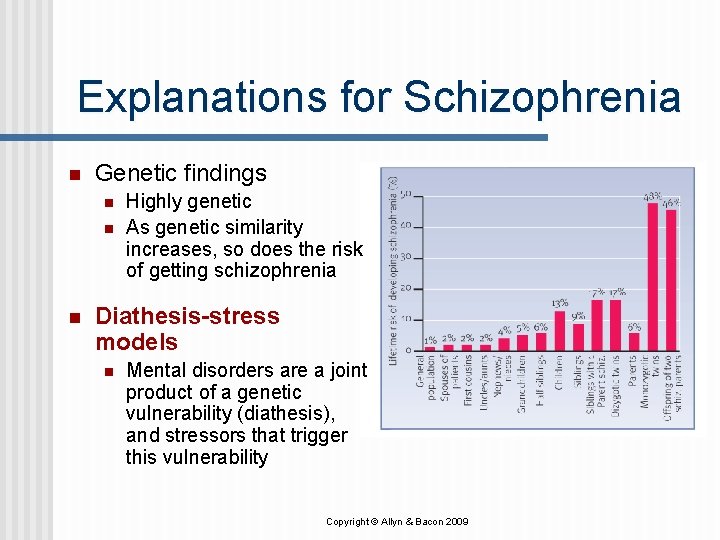
Explanations for Schizophrenia n Genetic findings n n n Highly genetic As genetic similarity increases, so does the risk of getting schizophrenia Diathesis-stress models n Mental disorders are a joint product of a genetic vulnerability (diathesis), and stressors that trigger this vulnerability Copyright © Allyn & Bacon 2009
Apply Your Thinking n What other disorders could the diathesis-stress model account for? n The diathesis-stress model could account for numerous mental disorders that contain a heritable component, but which are not 100% heritable. Major depression and anxiety disorders are examples. Copyright © Allyn & Bacon 2009
Personality Disorders n Personality disorder – condition in which personality traits, appearing first in adolescence, are inflexible, stable, expressed in a wide variety of situations, and lead to distress or impairment n Borderline personality disorder – extreme instability in mood, identity, and impulse control n Increased impulsivity and rapidly fluctuating emotions n Many engage in drug abuse, sexual promiscuity, overeating, and self-mutilation n Sociobiological model – individuals inherit tendency to overreact to stress and cannot properly control their emotions Copyright © Allyn & Bacon 2009
Personality Disorders n Psychopathic personality – condition marked by a distinctive set of personality traits, including superficial charm, dishonesty, manipulativeness, self-centeredness, and risk-taking n Possible deficit in fear: reduced classical conditioning n Possible deficit in arousal n Antisocial personality disorder – condition marked by a lengthy history of irresponsible and/or illegal actions n Often overlaps with psychopathic personality Copyright © Allyn & Bacon 2009
Substance Abuse and Dependence n Substance abuse – recurrent problems associated with a drug n Problems often surface in the family, with friends, on the job, or with the law n Substance dependence – pattern of substance use associated with tolerance and withdrawal n Addictive personality? Tied to impulsivity, sociability, and negative disposition (but correlation or causation? ) n Tension reduction hypothesis – people take drugs to relieve anxiety, “self-medication” n Genetic predisposition for alcoholism Copyright © Allyn & Bacon 2009