
Publication notes When to publish Assembling a manuscript
Publication notes
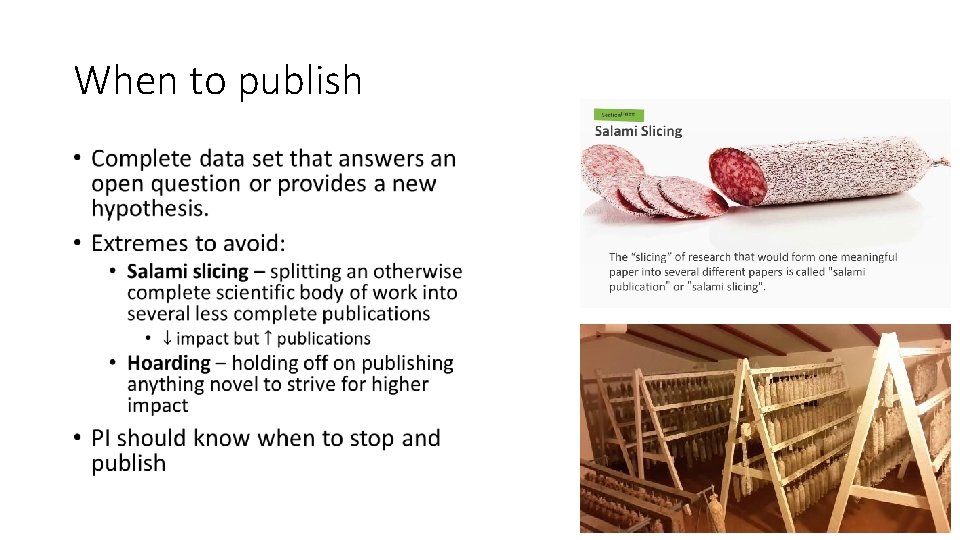
When to publish •
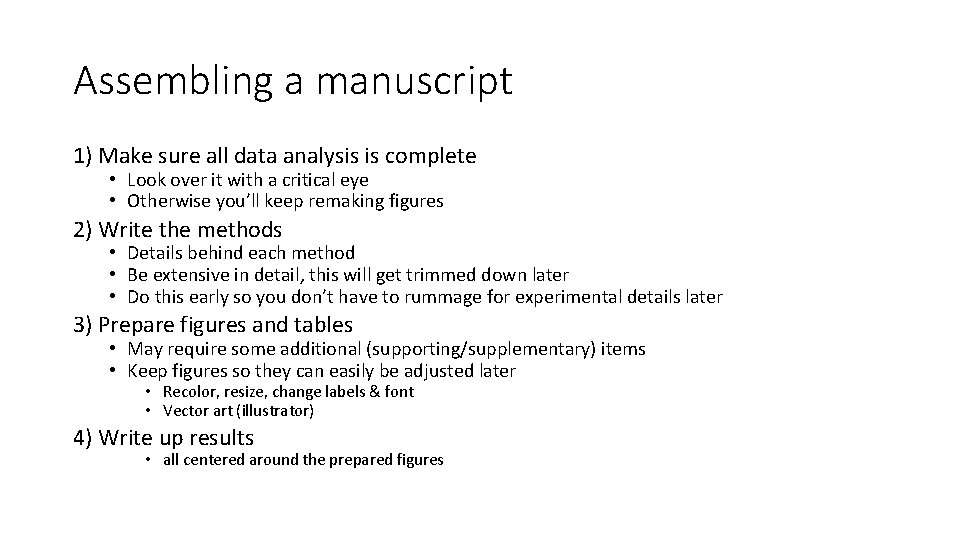
Assembling a manuscript 1) Make sure all data analysis is complete • Look over it with a critical eye • Otherwise you’ll keep remaking figures 2) Write the methods • Details behind each method • Be extensive in detail, this will get trimmed down later • Do this early so you don’t have to rummage for experimental details later 3) Prepare figures and tables • May require some additional (supporting/supplementary) items • Keep figures so they can easily be adjusted later • Recolor, resize, change labels & font • Vector art (illustrator) 4) Write up results • all centered around the prepared figures
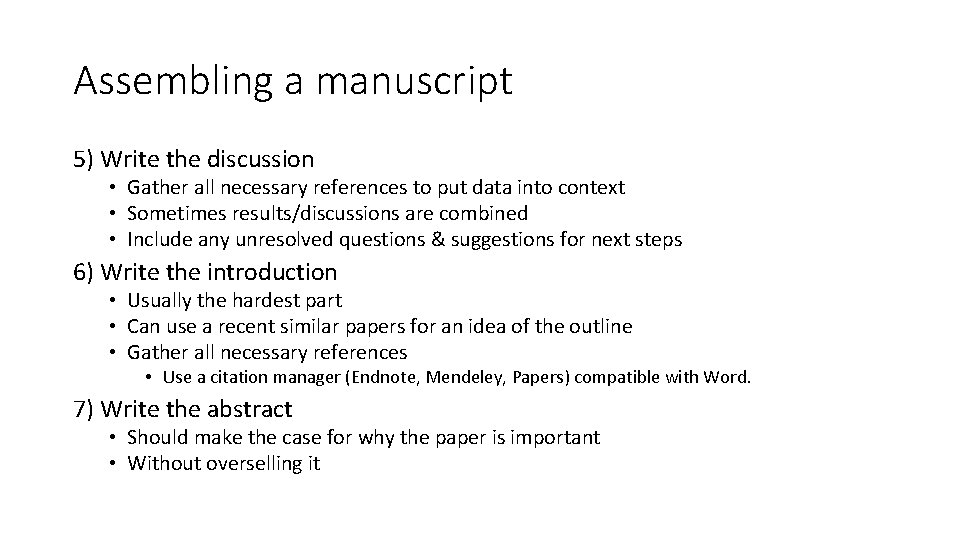
Assembling a manuscript 5) Write the discussion • Gather all necessary references to put data into context • Sometimes results/discussions are combined • Include any unresolved questions & suggestions for next steps 6) Write the introduction • Usually the hardest part • Can use a recent similar papers for an idea of the outline • Gather all necessary references • Use a citation manager (Endnote, Mendeley, Papers) compatible with Word. 7) Write the abstract • Should make the case for why the paper is important • Without overselling it
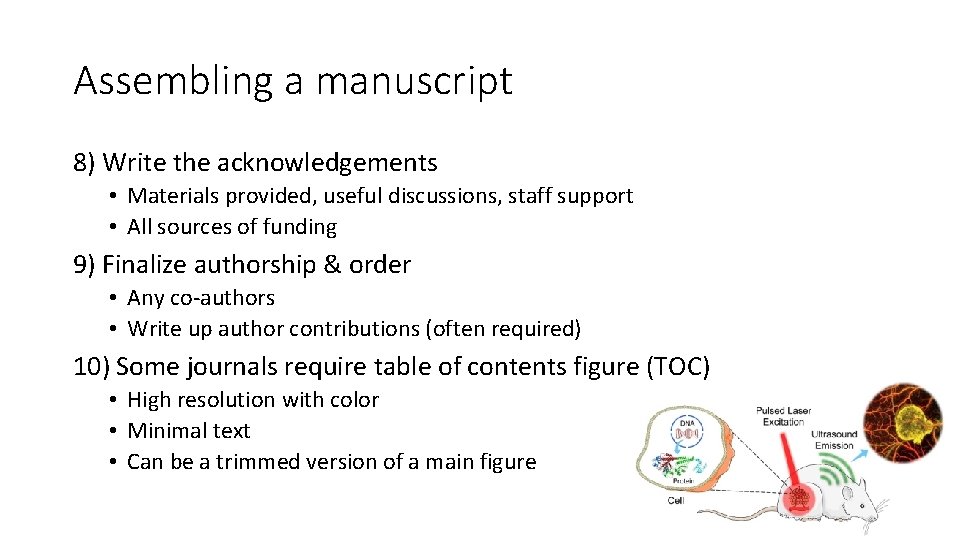
Assembling a manuscript 8) Write the acknowledgements • Materials provided, useful discussions, staff support • All sources of funding 9) Finalize authorship & order • Any co-authors • Write up author contributions (often required) 10) Some journals require table of contents figure (TOC) • High resolution with color • Minimal text • Can be a trimmed version of a main figure
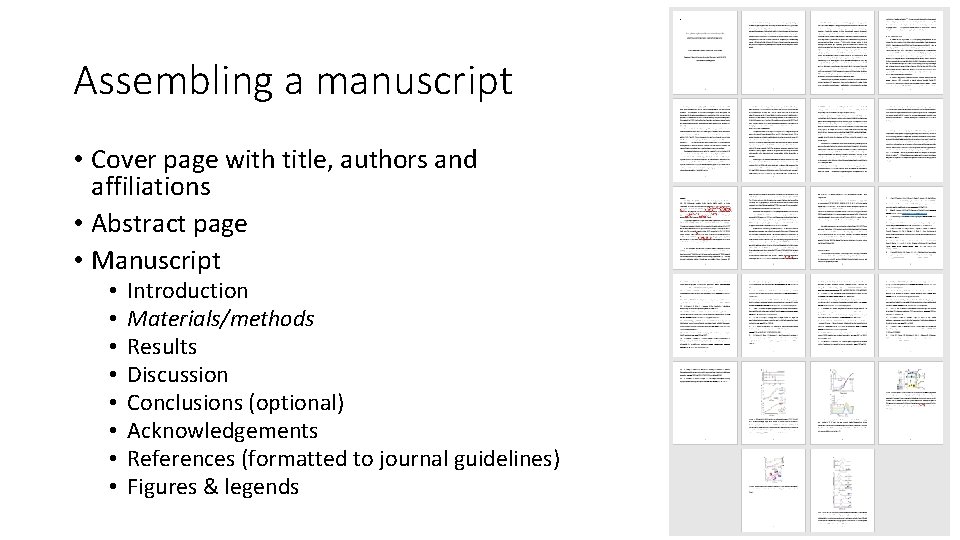
Assembling a manuscript • Cover page with title, authors and affiliations • Abstract page • Manuscript • • Introduction Materials/methods Results Discussion Conclusions (optional) Acknowledgements References (formatted to journal guidelines) Figures & legends
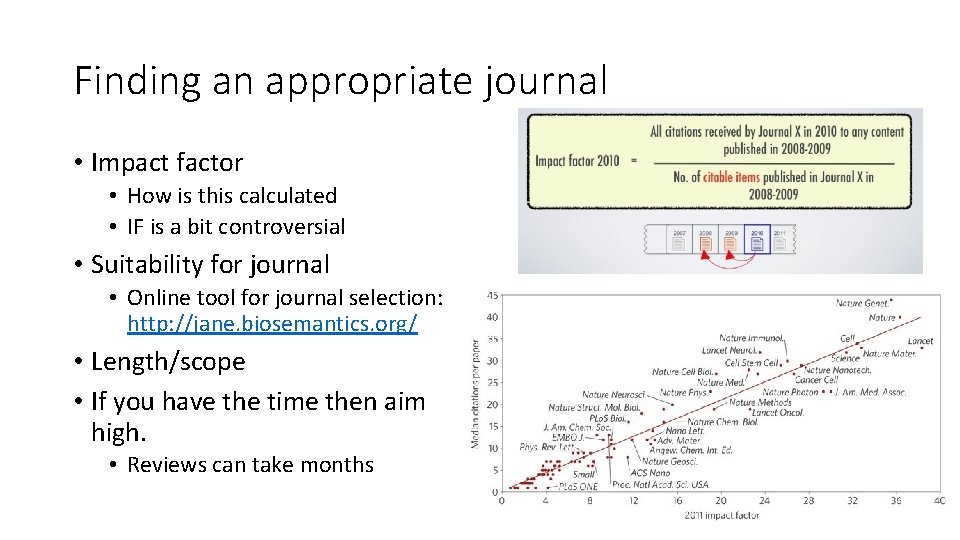
Finding an appropriate journal • Impact factor • How is this calculated • IF is a bit controversial • Suitability for journal • Online tool for journal selection: http: //jane. biosemantics. org/ • Length/scope • If you have the time then aim high. • Reviews can take months
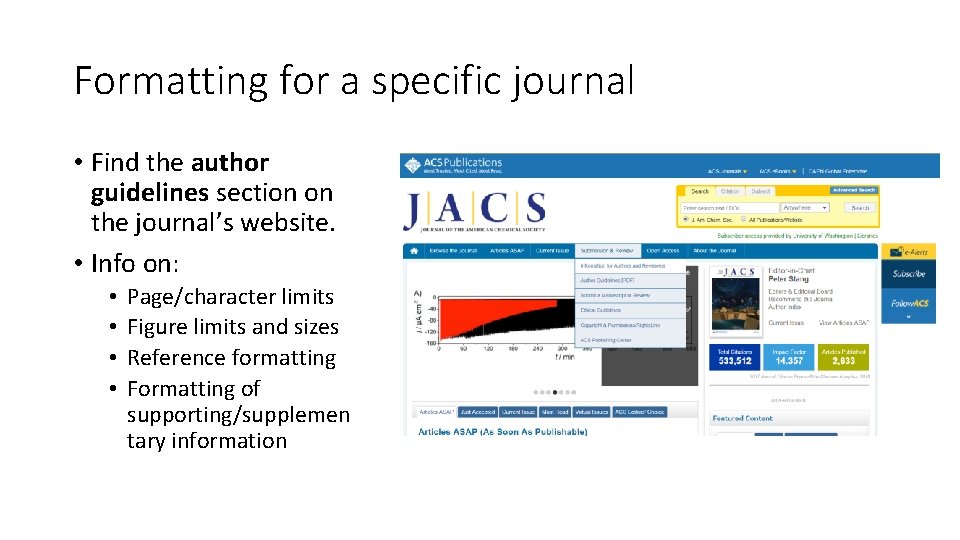
Formatting for a specific journal • Find the author guidelines section on the journal’s website. • Info on: • • Page/character limits Figure limits and sizes Reference formatting Formatting of supporting/supplemen tary information
Optional: Presubmission inquiry • High tier journals suggest (and sometimes require) a presubmission inquiry • Brief summary of the work, how it is a significant advance, and why this journal • Often they just delay the process • Takes just as long to get a response as if the paper was submitted for initial consideration • Sometimes they ask for the full paper and reject it then • Only saves time in terms of potentially reformatting the length, figures, and references.
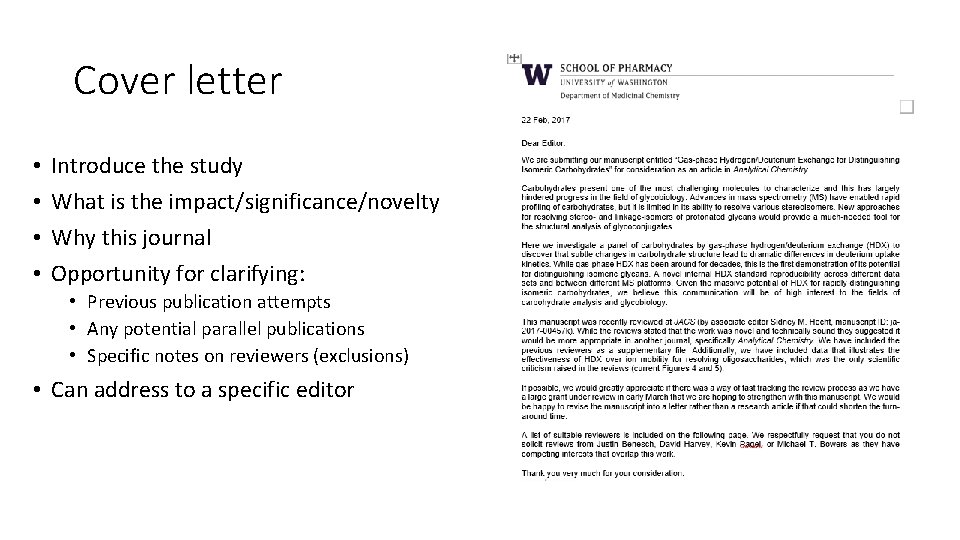
Cover letter • • Introduce the study What is the impact/significance/novelty Why this journal Opportunity for clarifying: • Previous publication attempts • Any potential parallel publications • Specific notes on reviewers (exclusions) • Can address to a specific editor
Selection of potential reviewers • Suggested: • Know the field and understand the experimental methods • Not a collaborator or scientific relative • Usually suggest at least 4, but more can help speed thing up • Some that know the methods, some that know the system • With papers using many methods there may need to be several that can effectively rate the paper. • Ideally does not work on the same system • Is not a demanding perfectionist (requesting unrelated follow up experiments) • Exclude: • Anyone known to be a unfair reviewer or in direct competition • Anyone who’s work is slandered by the new findings
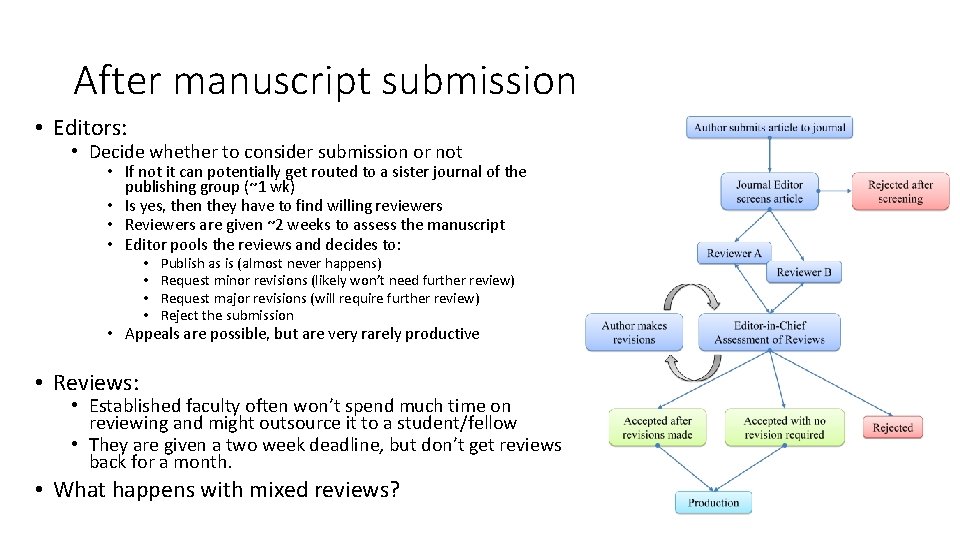
After manuscript submission • Editors: • Decide whether to consider submission or not • If not it can potentially get routed to a sister journal of the publishing group (~1 wk) • Is yes, then they have to find willing reviewers • Reviewers are given ~2 weeks to assess the manuscript • Editor pools the reviews and decides to: • • Publish as is (almost never happens) Request minor revisions (likely won’t need further review) Request major revisions (will require further review) Reject the submission • Appeals are possible, but are very rarely productive • Reviews: • Established faculty often won’t spend much time on reviewing and might outsource it to a student/fellow • They are given a two week deadline, but don’t get reviews back for a month. • What happens with mixed reviews?
The peer review process • What type of peer review does the journal use • Single blinded: reviewers anonymous • Double blinded: reviewers and authors anonymous • Open review: reviewers and authors all known and reviews are ultimately published • When to decline being a reviewer • Working in the same field or same topic • Won’t have time or effort to provide a thorough review • Look over the figures and read the results/discussion • • Is this potentially interesting and does it look like quality work? Are they claiming anything unsupported by the data? Any of it already published? Usually run a brief search. Look at methods and references • Did they cite the appropriate related articles • Are their methods sound and clearly described • Provide notes to the editor (authors won’t see) • E. g. methods are sounds, but I can’t judge the novelty, or vice versa.
Responding to reviews • Wait a day before writing responses • Reviews will nearly always upset the author • They usually misunderstand something “obvious” or request a useless revision/update • Thank the reviewers and placate their requests on minor things • You can probably get away with fixing 4 of the 5 things they request and make a case for keeping the 5 th. • Include all details of what was updated • Including figure numbers, page numbers and lines of text • Here are some guidelines on putting together good responses: • https: //journals. plos. org/ploscompbiol/article? id=10. 1371/journal. pcbi. 1005730 • If anything is odd or suspect about the review then mention it in the cover letter to the editor during the revision submission.
Responding to reviews – round 2 • If major revisions were requested • Usually gets sent to reviewers again • They have the option of wishing to see the revisions • If criticisms were addressed • Additional experiments conducted • Cannot ask for more additional experiments only minor revisions • If they missed something the 1 st round then too bad. • But this is all ultimately up to the editor.
Galley Proofs • After the paper is accepted proofs arrive the month before it goes into print • Usually expect a very fast turn-around 24 -48 hours. • Get all authors to inspect everything in the paper • Spelling errors, incorrect units (µM becomes m. M) • Check all numbers, decimal places sometimes get shifted • Citations may be misnumbered • Major corrections usually not allowed at this stage.
Post-publication • Highlight • Short feature article to advertise the paper or place it into broader context • Comment • From another group finds an error or an alternative interpretation to correct something in the article. • Can be supportive or critical. • Addendum • If something needs to be corrected in a published article by the original authors/PI • Incorrect protocols, omitted details, corrected data • Retraction • Corrupted peer review • Fabricated/falsified data
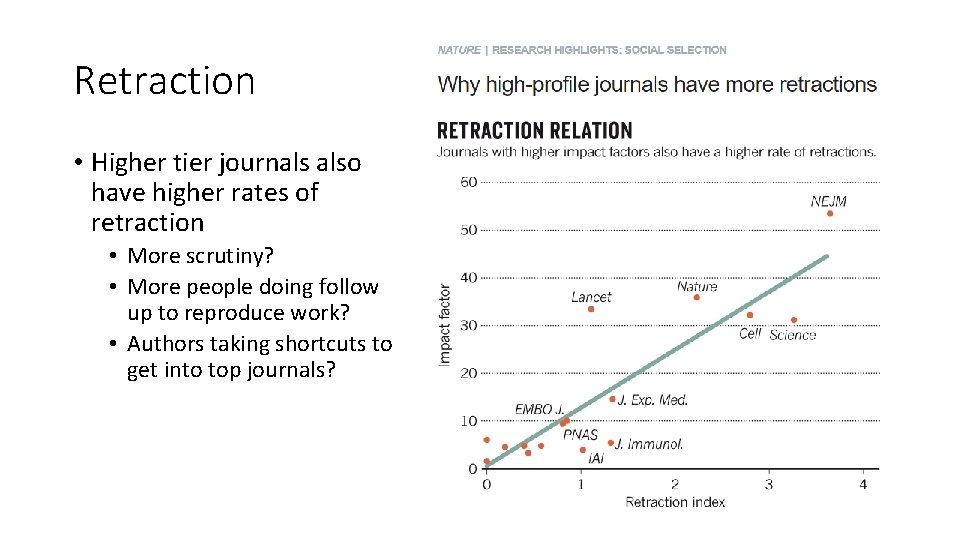
Retraction • Higher tier journals also have higher rates of retraction • More scrutiny? • More people doing follow up to reproduce work? • Authors taking shortcuts to get into top journals?
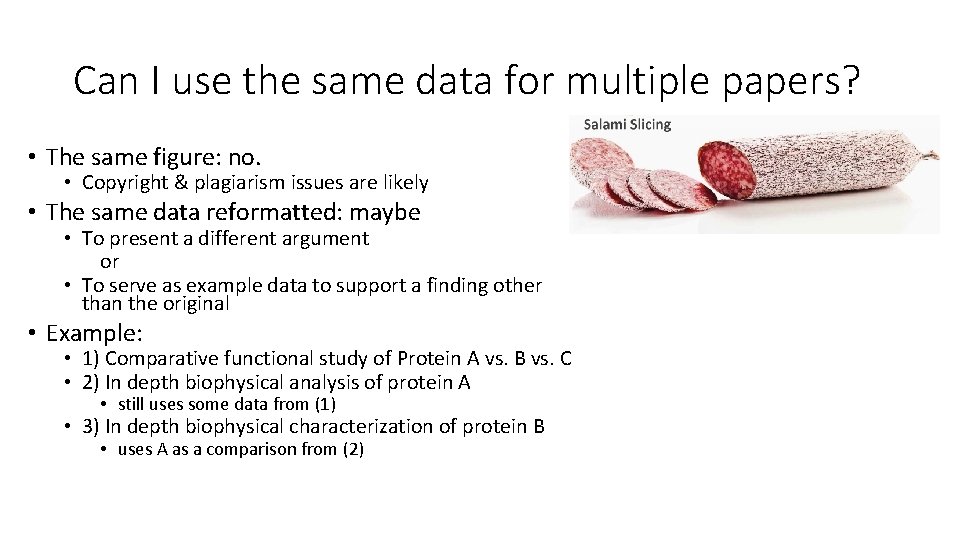
Can I use the same data for multiple papers? • The same figure: no. • Copyright & plagiarism issues are likely • The same data reformatted: maybe • To present a different argument or • To serve as example data to support a finding other than the original • Example: • 1) Comparative functional study of Protein A vs. B vs. C • 2) In depth biophysical analysis of protein A • still uses some data from (1) • 3) In depth biophysical characterization of protein B • uses A as a comparison from (2)
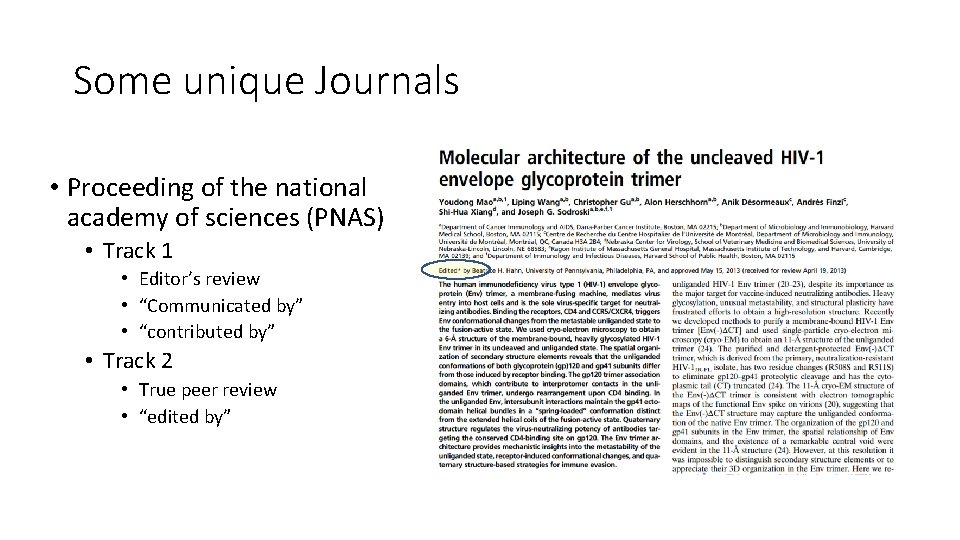
Some unique Journals • Proceeding of the national academy of sciences (PNAS) • Track 1 • Editor’s review • “Communicated by” • “contributed by” • Track 2 • True peer review • “edited by”
Open access journals • Public Library of Science (PLo. S) • e. Life • Pure open access as soon as articles are accepted. • PLo. S One – reviews conclusions from data • Not prior dogma • ↑ publication fees • Federally funded work gets open access 1 year after publication
- Slides: 21