Psychological Disorders Chapter 18 Psychological Disorders Section 1


- Slides: 27
Psychological Disorders Chapter 18: Psychological Disorders Section 1: Understanding Psychological Disorders Section 2: Anxiety and Mood Disorders Section 3: Dissociative and Somatoform Disorders Section 4: Schizophrenia Original Content Copyright by HOLT Mc. Dougal. Additions and changes to the original content are the responsibility of the instructor.
Psychological Disorders Think-Write-Pair-Share: • What do you know about mental illness or psychological disorders? Original Content Copyright by HOLT Mc. Dougal. Additions and changes to the original content are the responsibility of the instructor.
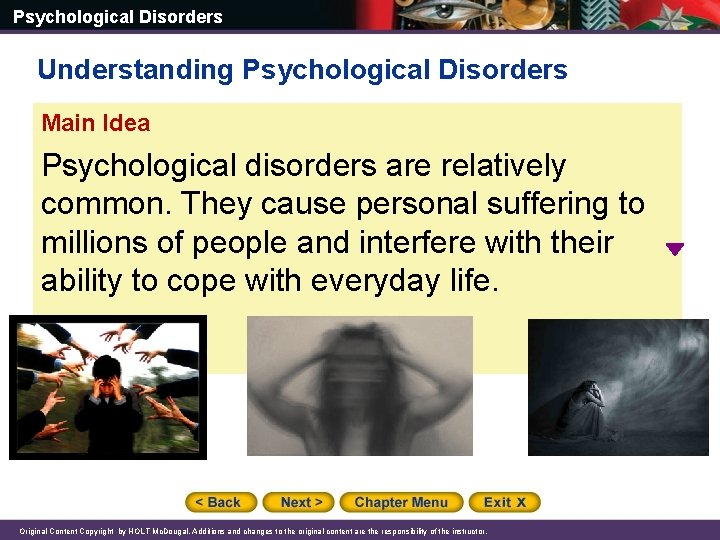
Psychological Disorders Understanding Psychological Disorders Main Idea Psychological disorders are relatively common. They cause personal suffering to millions of people and interfere with their ability to cope with everyday life. Original Content Copyright by HOLT Mc. Dougal. Additions and changes to the original content are the responsibility of the instructor.
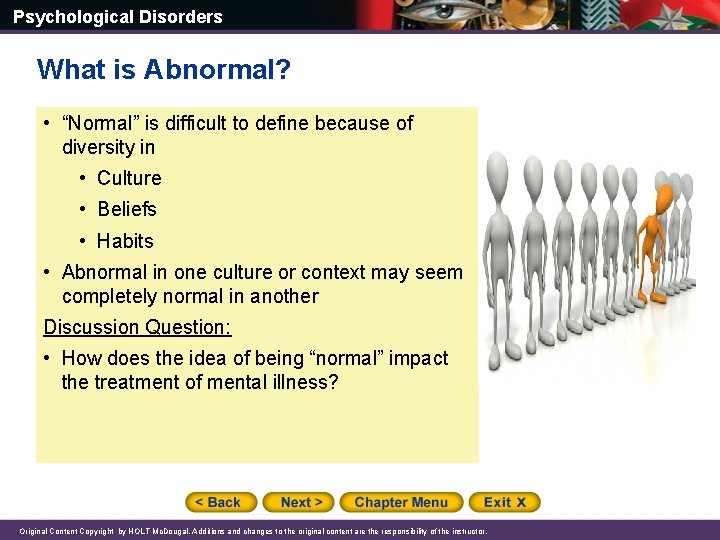
Psychological Disorders What is Abnormal? • “Normal” is difficult to define because of diversity in • Culture • Beliefs • Habits • Abnormal in one culture or context may seem completely normal in another Discussion Question: • How does the idea of being “normal” impact the treatment of mental illness? Original Content Copyright by HOLT Mc. Dougal. Additions and changes to the original content are the responsibility of the instructor.
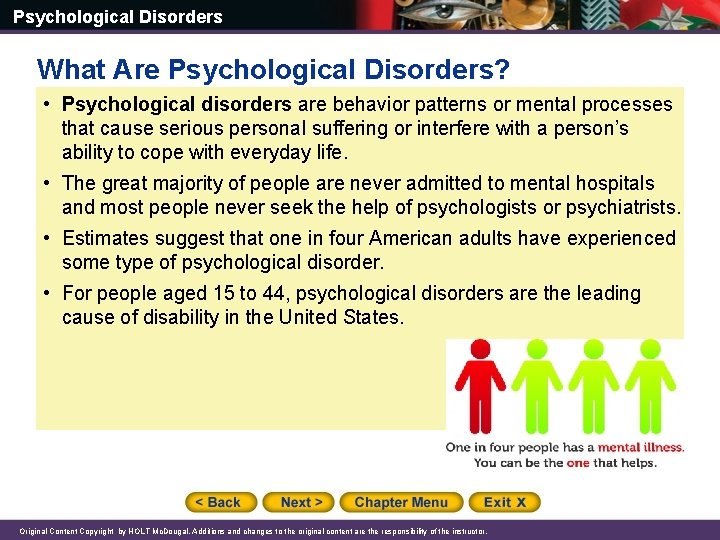
Psychological Disorders What Are Psychological Disorders? • Psychological disorders are behavior patterns or mental processes that cause serious personal suffering or interfere with a person’s ability to cope with everyday life. • The great majority of people are never admitted to mental hospitals and most people never seek the help of psychologists or psychiatrists. • Estimates suggest that one in four American adults have experienced some type of psychological disorder. • For people aged 15 to 44, psychological disorders are the leading cause of disability in the United States. Original Content Copyright by HOLT Mc. Dougal. Additions and changes to the original content are the responsibility of the instructor.
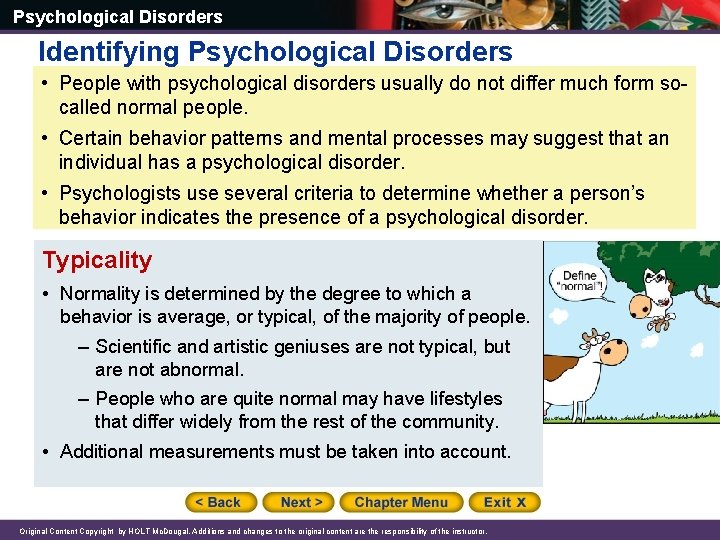
Psychological Disorders Identifying Psychological Disorders • People with psychological disorders usually do not differ much form socalled normal people. • Certain behavior patterns and mental processes may suggest that an individual has a psychological disorder. • Psychologists use several criteria to determine whether a person’s behavior indicates the presence of a psychological disorder. Typicality • Normality is determined by the degree to which a behavior is average, or typical, of the majority of people. – Scientific and artistic geniuses are not typical, but are not abnormal. – People who are quite normal may have lifestyles that differ widely from the rest of the community. • Additional measurements must be taken into account. Original Content Copyright by HOLT Mc. Dougal. Additions and changes to the original content are the responsibility of the instructor.
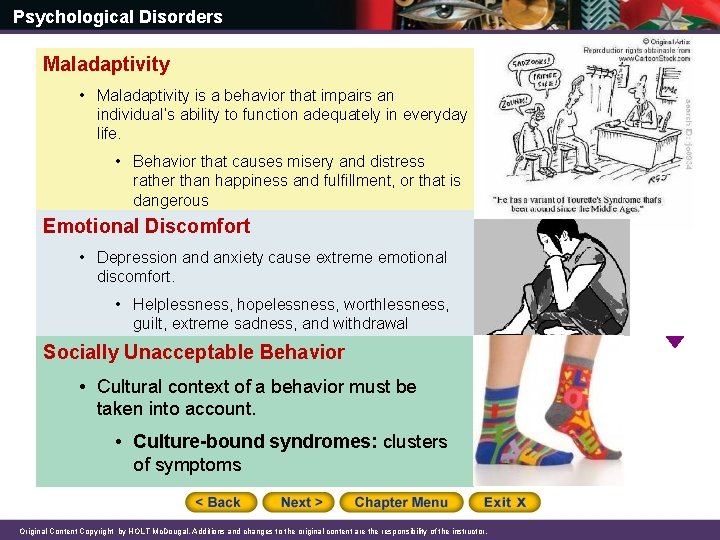
Psychological Disorders Maladaptivity • Maladaptivity is a behavior that impairs an individual’s ability to function adequately in everyday life. • Behavior that causes misery and distress rather than happiness and fulfillment, or that is dangerous Emotional Discomfort • Depression and anxiety cause extreme emotional discomfort. • Helplessness, hopelessness, worthlessness, guilt, extreme sadness, and withdrawal Socially Unacceptable Behavior • Cultural context of a behavior must be taken into account. • Culture-bound syndromes: clusters of symptoms Original Content Copyright by HOLT Mc. Dougal. Additions and changes to the original content are the responsibility of the instructor.
Psychological Disorders Reading Check Find the Main Idea What are four features that might indicate a psychological disorder? Answer: The four features are typicality, maladaptivity, emotional discomfort, and socially unacceptable behavior. Original Content Copyright by HOLT Mc. Dougal. Additions and changes to the original content are the responsibility of the instructor.
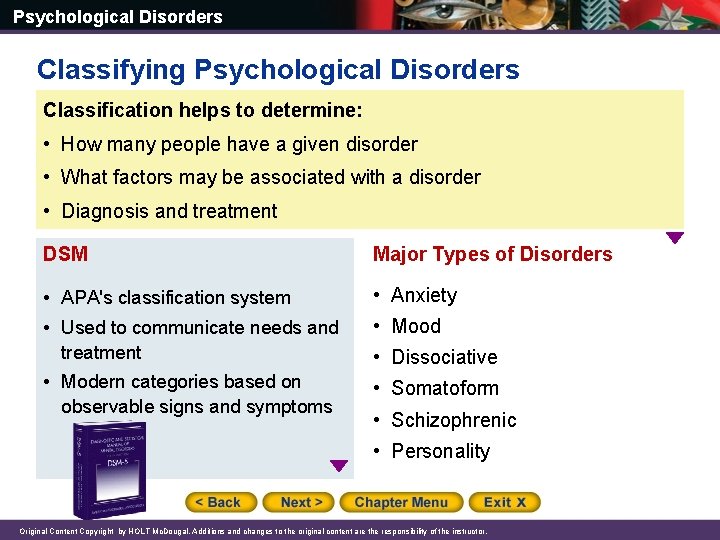
Psychological Disorders Classifying Psychological Disorders Classification helps to determine: • How many people have a given disorder • What factors may be associated with a disorder • Diagnosis and treatment DSM Major Types of Disorders • APA's classification system • Anxiety • Used to communicate needs and treatment • Mood • Modern categories based on observable signs and symptoms • Somatoform • Dissociative • Schizophrenic • Personality Original Content Copyright by HOLT Mc. Dougal. Additions and changes to the original content are the responsibility of the instructor.
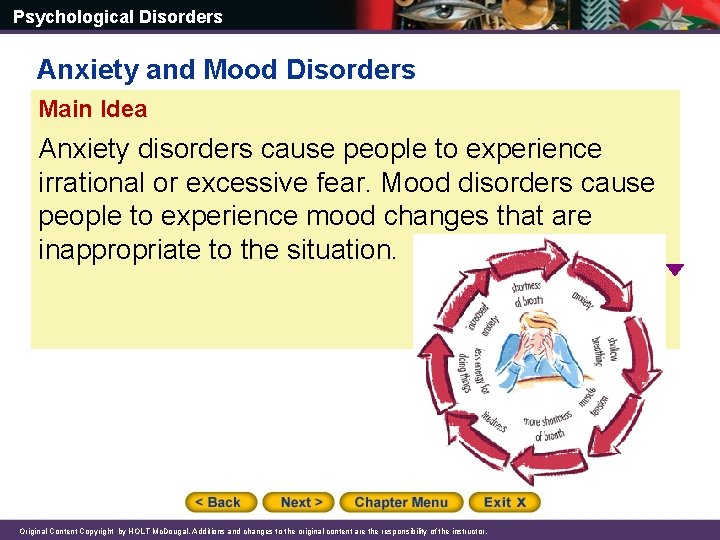
Psychological Disorders Anxiety and Mood Disorders Main Idea Anxiety disorders cause people to experience irrational or excessive fear. Mood disorders cause people to experience mood changes that are inappropriate to the situation. Original Content Copyright by HOLT Mc. Dougal. Additions and changes to the original content are the responsibility of the instructor.
Psychological Disorders What Is Anxiety? • Anxiety refers to a generalized state of dread or uneasiness that occurs in response to a vague or imagined danger, as opposed to fear, which is a response to a real danger or threat. – Characterized by • Nervousness • Inability to relax • Concern about losing control • Trembling • Sweating • Rapid heart rate • Shortness of breath • Increased blood pressure • Everyone feels anxious at times, but constant anxiety can interfere with effective living. Original Content Copyright by HOLT Mc. Dougal. Additions and changes to the original content are the responsibility of the instructor.
Psychological Disorders Anxiety Disorders Original Content Copyright by HOLT Mc. Dougal. Additions and changes to the original content are the responsibility of the instructor.
Psychological Disorders Obsessive Compulsive Disorder • One of the most debilitating anxiety disorders • More than just extreme attention to detail • Characterized by obsessive thoughts and compulsive behaviors • Obsessions: Repeated, intrusive, unwanted thoughts that create anxiety or psychological discomfort • Compulsions: Repeated, ritualistic behaviors that usually reduce the anxiety from obsessive thoughts • Example: Someone with obsessive thoughts about germs might compulsively wash their hands, in some cases even hundreds of times a day • One type of OCD that has received a lot of attention is Compulsive Hoarding Original Content Copyright by HOLT Mc. Dougal. Additions and changes to the original content are the responsibility of the instructor.
Psychological Disorders Anxiety Disorder: Compulsive Hoarding Original Content Copyright by HOLT Mc. Dougal. Additions and changes to the original content are the responsibility of the instructor.
Psychological Disorders Reading Check Analyze How are anxiety disorders different from normal anxious reactions? Answer: constant anxiety, out of proportion to event, interferes with normal effective living Original Content Copyright by HOLT Mc. Dougal. Additions and changes to the original content are the responsibility of the instructor.
Psychological Disorders Types of Mood Disorders • Most people have mood changes that reflect the normal ups and downs of life, but mood changes that are inappropriate to a situation can signal a mood disorder. Major Depression • Two types: depression and bipolar disorder • The DSM-V contains a list of symptoms to help diagnose Bipolar Disorder Postpartum Depression • A cycle of mood changes from depression to wild elation and back again • Some women suffer symptoms of depression after giving birth • Feelings of helplessness, hopelessness, worthlessness, guilt, and great sadness • Can harm both mother and child • Period of mania, or extreme excitement characterized by hyperactivity and chaotic behavior Original Content Copyright by HOLT Mc. Dougal. Additions and changes to the original content are the responsibility of the instructor.
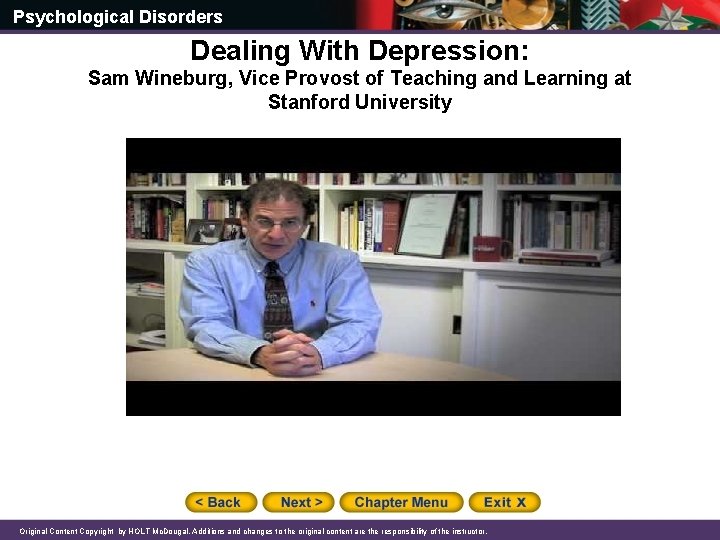
Psychological Disorders Dealing With Depression: Sam Wineburg, Vice Provost of Teaching and Learning at Stanford University Original Content Copyright by HOLT Mc. Dougal. Additions and changes to the original content are the responsibility of the instructor.
Psychological Disorders Reading Check Analyze What are some ways that mood disorders can disrupt one’s daily life? Answer: persistent depressed mood, loss of interest in activities, significant weight loss or gain, sleeping more or less, fatigue, reduced ability to concentrate or make meaningful decisions, recurrent thoughts of death or suicide Original Content Copyright by HOLT Mc. Dougal. Additions and changes to the original content are the responsibility of the instructor.
Psychological Disorders Dissociative and Somatoform Disorders Main Idea Dissociative disorders cause people to lose their memory or identity. Somatoform disorders cause people to express psychological distress through physical symptoms. Original Content Copyright by HOLT Mc. Dougal. Additions and changes to the original content are the responsibility of the instructor.
Psychological Disorders Dissociative Disorders • Dissociation: the separation of certain personality components or mental processes from conscious thought • In some situations, it is normal (becoming engrossed in a book). • If dissociation occurs as a way to avoid stressful events or feelings, it can signal a disorder. Dissociative Amnesia • Characterized by a sudden loss of memory, usually following a particularly stressful or traumatic event. • It cannot be explained biologically. • The incidence of dissociative amnesia rises markedly during wartime and natural disasters. Original Content Copyright by HOLT Mc. Dougal. Additions and changes to the original content are the responsibility of the instructor.
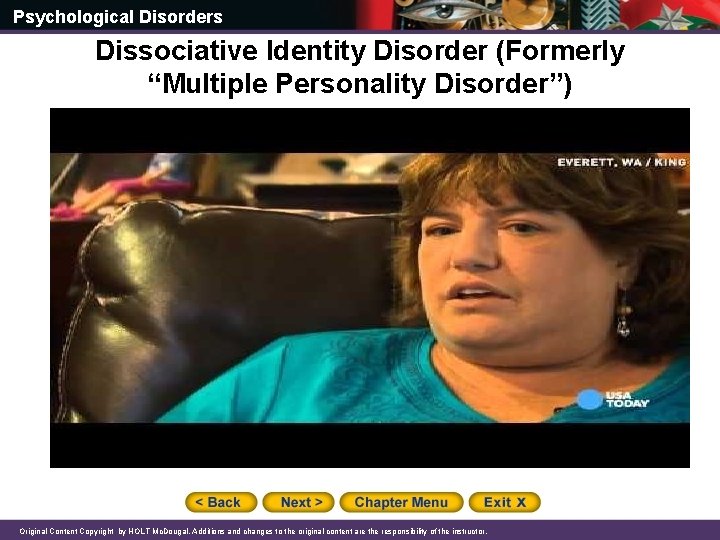
Psychological Disorders Dissociative Identity Disorder (Formerly “Multiple Personality Disorder”) Original Content Copyright by HOLT Mc. Dougal. Additions and changes to the original content are the responsibility of the instructor.
Psychological Disorders Somatoform Disorders Somatization: the expression of psychological distress through physical symptoms. People with somatoform disorders have psychological problems (such as depression) but experience inexplicable physical symptoms (such as paralysis). Conversion Disorder Hypochondriasis • Patients experience a change in or loss of physical functioning in a major part of the body for which there is no known medical explanation • A person’s unrealistic preoccupation with thoughts that he or she has a serious disease. • Patients often show a lack of concern for their symptoms. • Patients may become absorbed by minor physical symptoms and sensations. Original Content Copyright by HOLT Mc. Dougal. Additions and changes to the original content are the responsibility of the instructor.
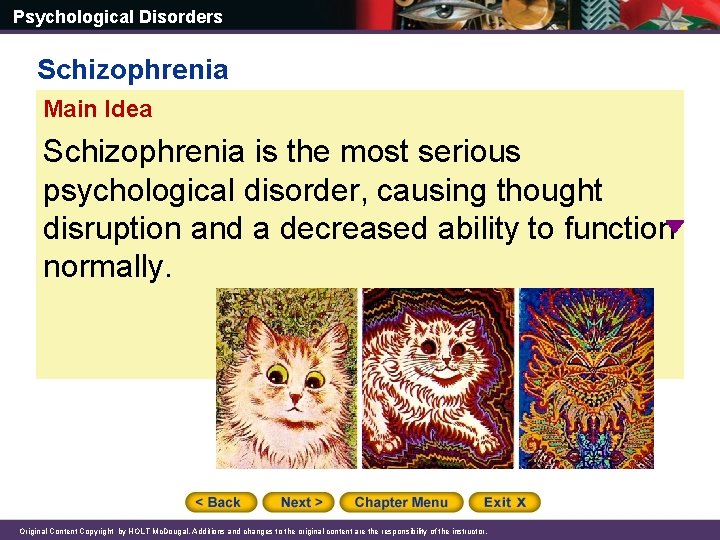
Psychological Disorders Schizophrenia Main Idea Schizophrenia is the most serious psychological disorder, causing thought disruption and a decreased ability to function normally. Original Content Copyright by HOLT Mc. Dougal. Additions and changes to the original content are the responsibility of the instructor.
Psychological Disorders The “Hollywood” Version of Schizophrenia Original Content Copyright by HOLT Mc. Dougal. Additions and changes to the original content are the responsibility of the instructor.
Psychological Disorders What Is Schizophrenia? • Schizophrenia: characterized by loss of contact with reality. – Can be very disabling and can lead to the affected person’s inability to function independently – First appears in young adulthood – Usually develops gradually, but can also appear suddenly • Most striking symptoms are: – Hallucinations – Delusions – Thought disorders • Other symptoms include social withdrawal, impaired social skills, loss of normal emotional responses. • Occasionally, may go into a catatonic stupor: an immobile, expressionless, comalike state. Original Content Copyright by HOLT Mc. Dougal. Additions and changes to the original content are the responsibility of the instructor.
Psychological Disorders How can psychological disorders impact creativity? Original Content Copyright by HOLT Mc. Dougal. Additions and changes to the original content are the responsibility of the instructor.
Psychological Disorders Reading Check Summarize What is the basic characteristic of schizophrenia? Answer: loss of contact with reality Original Content Copyright by HOLT Mc. Dougal. Additions and changes to the original content are the responsibility of the instructor.