Proportionality Review in Japan Shigenori Matsui University of
- Slides: 24
Proportionality Review in Japan Shigenori Matsui, University of British Columbia
Introduction • Protection of Fundamental Human Rights under the Constitution of Japan, 1946 • Judiciary, equipped with the power of judicial review, can review the constitutionality of restriction on fundmantal human rights. 2020/12/5 2018/11/10 2
• The Supreme Court of Japan (hereinafter cited as the Supreme Court) has developed the highly deferential constitutional jurisprudence on the permissibility of restriction. • It has not accepted the proportionallity review. 2020/12/5 2018/11/10 3
– What are the characteristics of the framwork of judicial review in Japan? – What are the similarities? And what are the differences? 2020/12/5 2018/11/10 4
I Framework of Judicial Review – The Supreme Court has not elaborated the established framework of judicial review. – It rather prefers to decide a case on its own facts and is reluctant to articulate the general framework. 2020/12/5 2018/11/10 5
– A. Early Stance – The early stance of the Supreme Court is well illustrated in the Lay Chatterley’s Lover Case. 2020/12/5 – Constitutionality of the ban on publication of obscenity under the Criminal Code – Supreme Court admitted that freedom of expression is subject to restriction for the public welfare. – It then concluded that the ban on publication of obscenity for the protection of sexual morality is acceptable. 2018/11/10 6
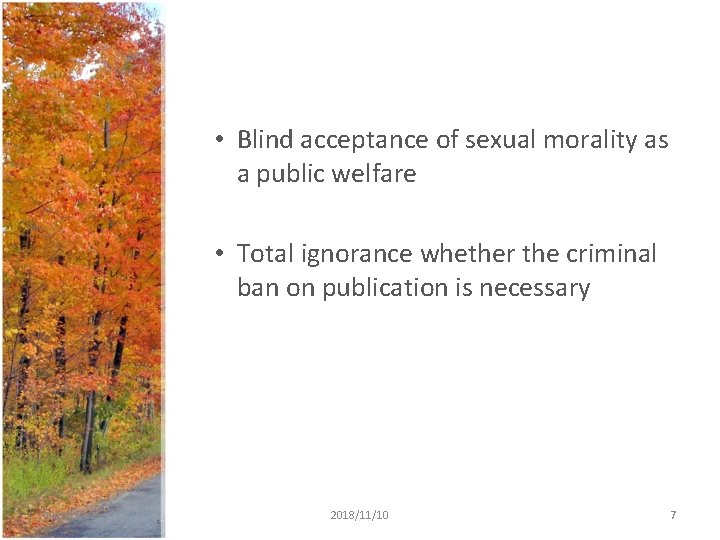
• Blind acceptance of sexual morality as a public welfare • Total ignorance whether the criminal ban on publication is necessary 2020/12/5 2018/11/10 7
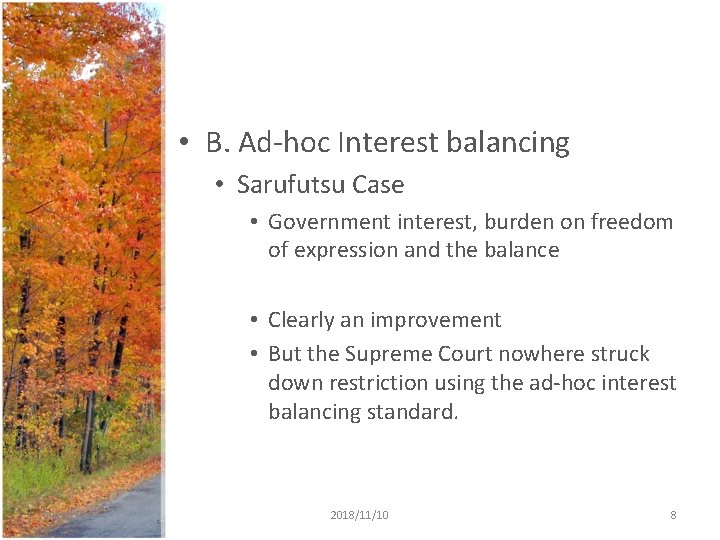
• B. Ad-hoc Interest balancing • Sarufutsu Case • Government interest, burden on freedom of expression and the balance • Clearly an improvement • But the Supreme Court nowhere struck down restriction using the ad-hoc interest balancing standard. 2020/12/5 2018/11/10 8
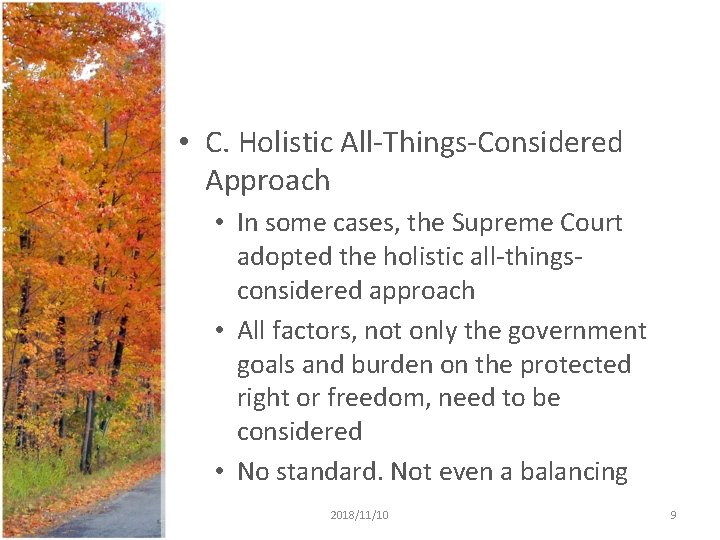
• C. Holistic All-Things-Considered Approach • In some cases, the Supreme Court adopted the holistic all-thingsconsidered approach • All factors, not only the government goals and burden on the protected right or freedom, need to be considered • No standard. Not even a balancing 2020/12/5 2018/11/10 9
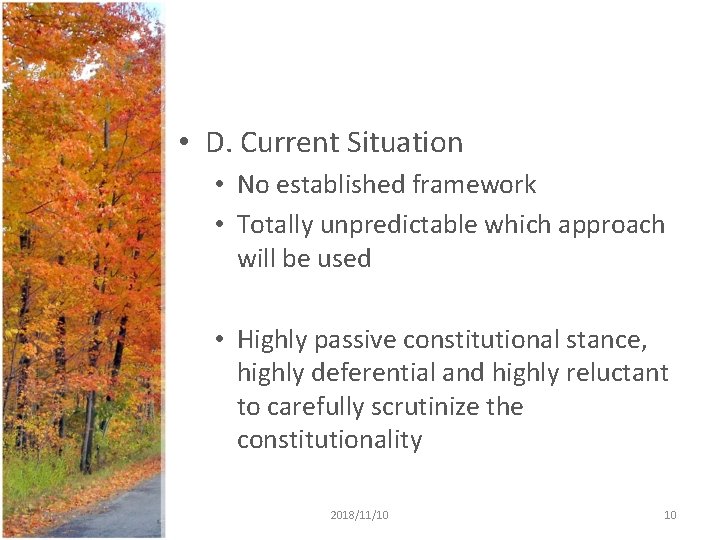
• D. Current Situation • No established framework • Totally unpredictable which approach will be used • Highly passive constitutional stance, highly deferential and highly reluctant to carefully scrutinize the constitutionality 2020/12/5 2018/11/10 10
II Some Hints of Proportionality Review • In some cases, the Supreme Court employed careful review, somewhat similar to the proportionality review, and struck down the restriction 2020/12/5 2018/11/10 11
• The Parricide Case • Imposing life or death sentence to parricide • Permissibility of distinction • Proportionality as a means/necessity 2020/12/5 2018/11/10 12
• The Pharmaceutical Act Case • Proper distance requirement for a permit for drugstore/pharmacy • Importance of government goals • Necessity as a means to accomplish the goals 2020/12/5 2018/11/10 13
• In these cases, the Supreme Court separately analyzed the ends and means and closely analyzed them to find out whether the means are really necessary or proportionate. 2020/12/5 • The Supreme Court has never explained why it has closely reviewed the ends/means and not in other cases. 2018/11/10 14
III Each Stages of Proportionality Review • A. Contexual Factors • Reluctance to clearly state which freedom is more valuable or which freedom has only low value • But apprently, the Supreme Court is assuming that the restricted freedom does not have much value 2020/12/5 2018/11/10 15
• B. Scope of Protection • Reluctance to clearly define the protected right or freedom • Acceptance of some un-enumerated constitutional right • Reluctance to clearly face the definitional issues • Exclusion of foreigners from the protection 2020/12/5 2018/11/10 16
– C. Infringement – Rather narrow definition of infringement – The Kimigayo Case 2020/12/5 2018/11/10 17
• D. Government Ends • Extremely willing to accept the government interests as important • No decision which denies the legitimacy or importance of government goal as impermissible or insufficient 2020/12/5 2018/11/10 18
• E. Means • When the Supreme Court struck down restrictions, it has focused on the means and found that the means are not necessary or disproportionate 2020/12/5 2018/11/10 19
• F. Overall Balance 2020/12/5 2018/11/10 20
IV Future of Proportionality Review in Japan • A. Drawbacks of Japanese Appraoch 2020/12/5 2018/11/10 21
• B. Academic Insistence on adoption of Constitutional Double Standards Similar to the US Supreme Court 2020/12/5 2018/11/10 22
• C. Possible Adoption of Proportionality Review 2020/12/5 2018/11/10 23
Conclusion 2020/12/5 2018/11/10 24