Process Analysis Toolkit PAT is A SPINlike selfcontained
- Slides: 13
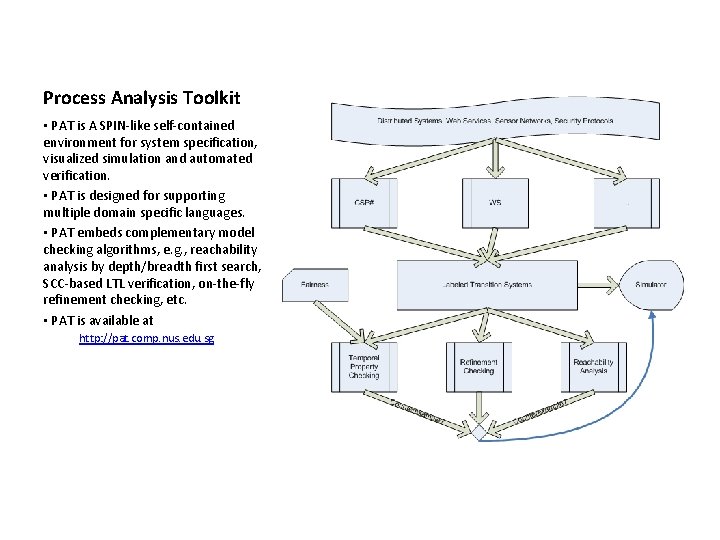
Process Analysis Toolkit • PAT is A SPIN-like self-contained environment for system specification, visualized simulation and automated verification. • PAT is designed for supporting multiple domain specific languages. • PAT embeds complementary model checking algorithms, e. g. , reachability analysis by depth/breadth first search, SCC-based LTL verification, on-the-fly refinement checking, etc. • PAT is available at http: //pat. comp. nus. edu. sg
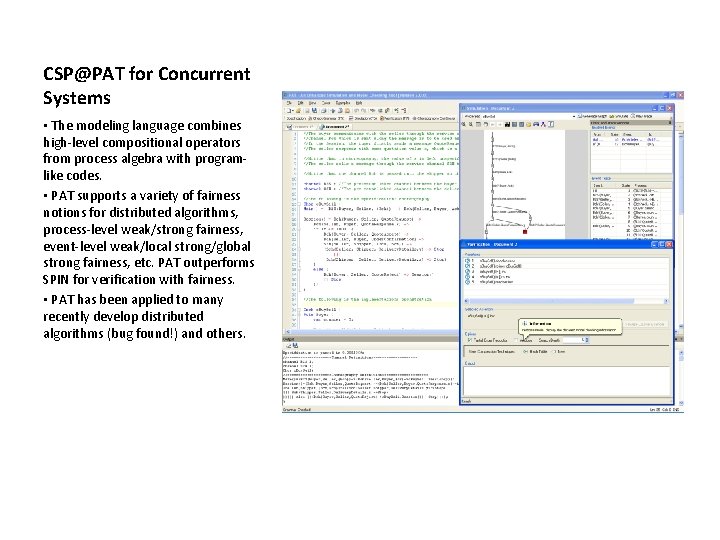
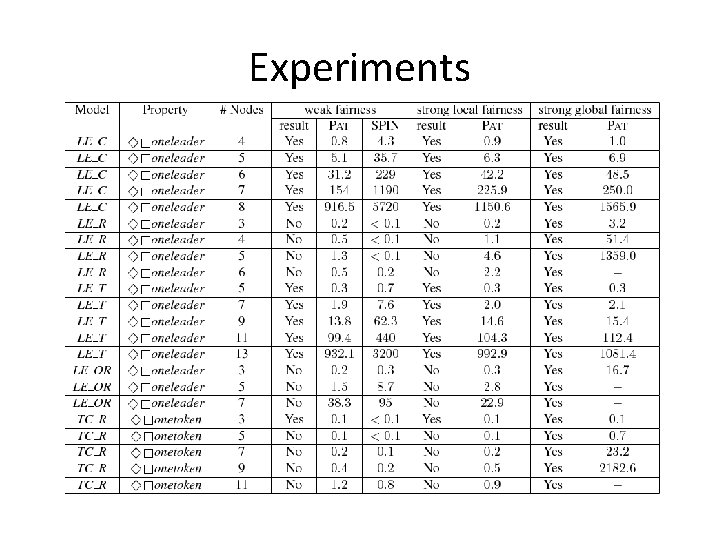
CSP@PAT for Concurrent Systems • The modeling language combines high-level compositional operators from process algebra with programlike codes. • PAT supports a variety of fairness notions for distributed algorithms, process-level weak/strong fairness, event-level weak/local strong/global strong fairness, etc. PAT outperforms SPIN for verification with fairness. • PAT has been applied to many recently develop distributed algorithms (bug found!) and others.
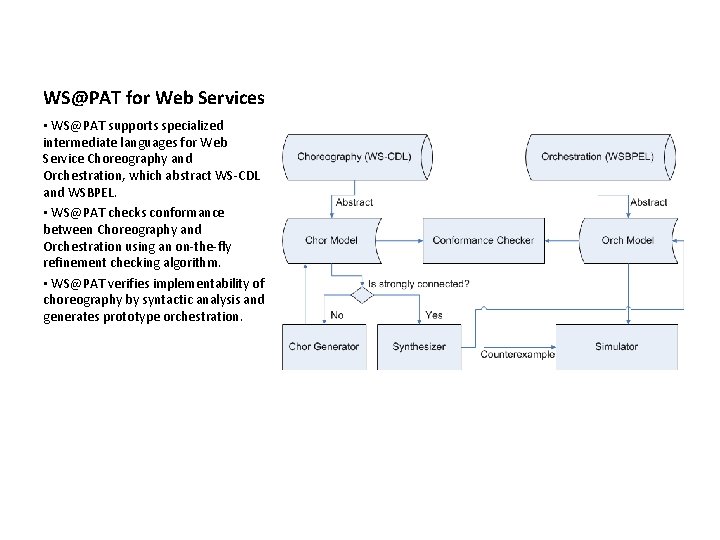
WS@PAT for Web Services • WS@PAT supports specialized intermediate languages for Web Service Choreography and Orchestration, which abstract WS-CDL and WSBPEL. • WS@PAT checks conformance between Choreography and Orchestration using an on-the-fly refinement checking algorithm. • WS@PAT verifies implementability of choreography by syntactic analysis and generates prototype orchestration.
Fairness: Motivating Examples • Peterson’s algorithm – Bounded by-pass requires weak process-level weak fairness • Population Protocols – Leader election in complete network graph (requires weak fairness) – Leader election in network rings (requires strong global fairness) – Token circulation in rings (requires strong global fairness)
Process-level Fairness • Process-level weak fairness (e. g. , SPIN) – Each process must make infinite progress if always possible. • Process-level strong fairness (e. g. , CHESS) – Each process must make infinite progress if repeated possible.
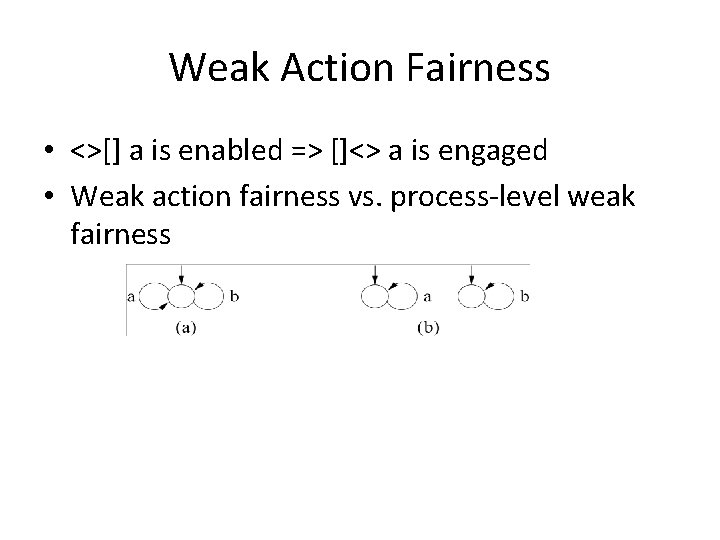
Weak Action Fairness • <>[] a is enabled => []<> a is engaged • Weak action fairness vs. process-level weak fairness
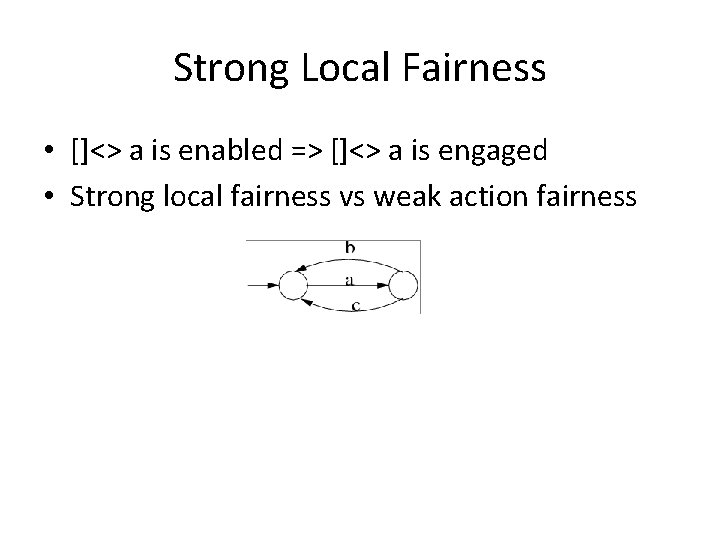
Strong Local Fairness • []<> a is enabled => []<> a is engaged • Strong local fairness vs weak action fairness
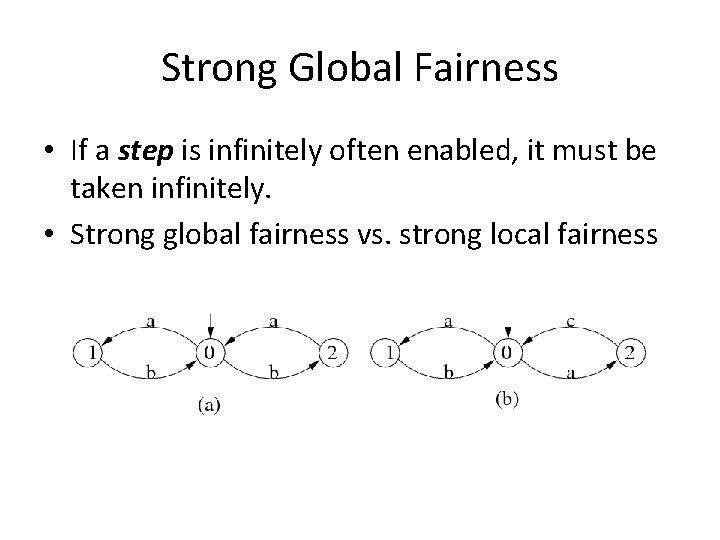
Strong Global Fairness • If a step is infinitely often enabled, it must be taken infinitely. • Strong global fairness vs. strong local fairness
Verification under Fairness • Setting 1: one notion of fairness is applied to the whole system. – Verification under fairness = Loop searching, i. e. , given a (liveness) property, a counterexample is a fair loop which fails the property. – Fair loop searching = Fair SCC searching, i. e. , an on -the-fly model checking algorithm based Tarjan’s algorithm
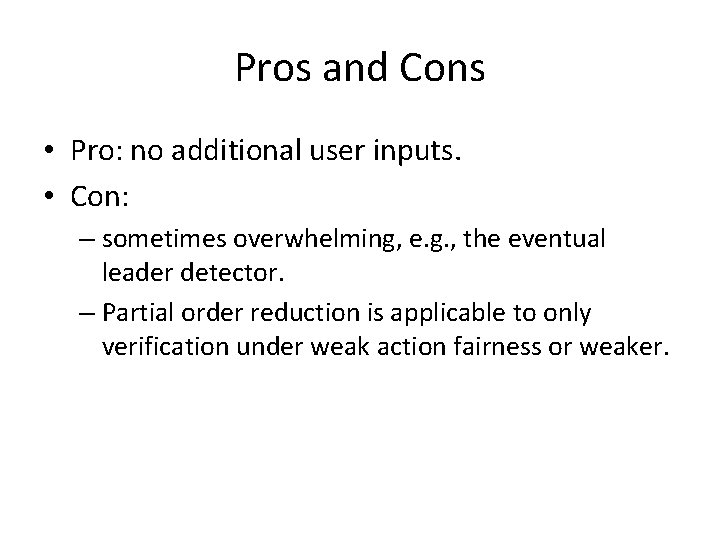
Pros and Cons • Pro: no additional user inputs. • Con: – sometimes overwhelming, e. g. , the eventual leader detector. – Partial order reduction is applicable to only verification under weak action fairness or weaker.
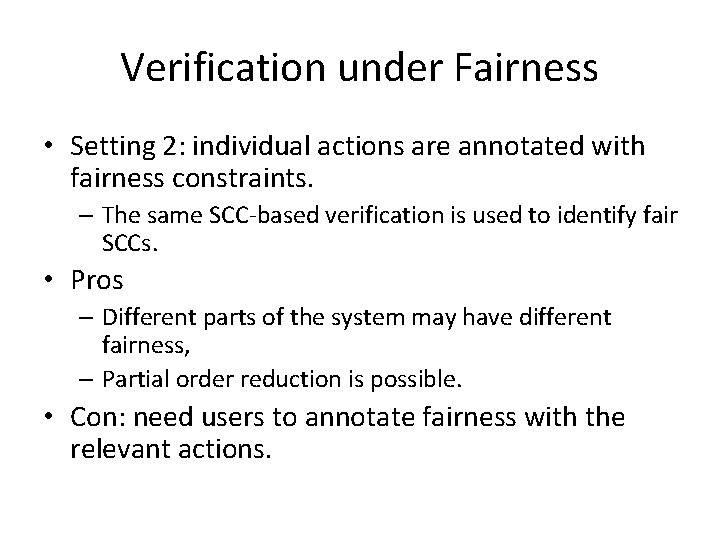
Verification under Fairness • Setting 2: individual actions are annotated with fairness constraints. – The same SCC-based verification is used to identify fair SCCs. • Pros – Different parts of the system may have different fairness, – Partial order reduction is possible. • Con: need users to annotate fairness with the relevant actions.
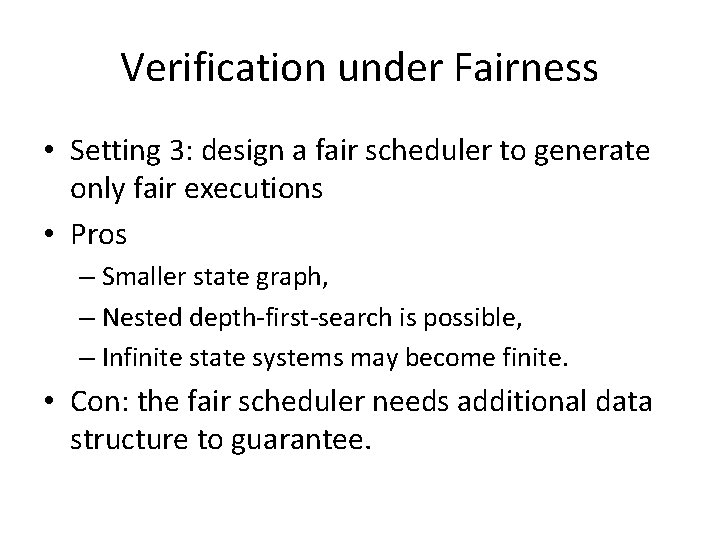
Verification under Fairness • Setting 3: design a fair scheduler to generate only fair executions • Pros – Smaller state graph, – Nested depth-first-search is possible, – Infinite state systems may become finite. • Con: the fair scheduler needs additional data structure to guarantee.
Experiments