
Pat Arnott ATMS 360 Atmospheric Instrumentation How do
- Slides: 22
Pat Arnott, ATMS 360 Atmospheric Instrumentation
How do we know about the hydrometeors in clouds? (hydrometeors: particles primarily made of water or ice. A precipitation product, such as rain, snow, fog, or clouds, formed from the condensation of water vapor in the atmosphere. ) Cloud microphysics instruments: A brief introduction. (Cloud microphysics: Characterization of the number, size, morphology, origin, life-cycle, and transformation of hydrometeors in fog and clouds. ) Pat Arnott, ATMS 360 Atmospheric Instrumentation
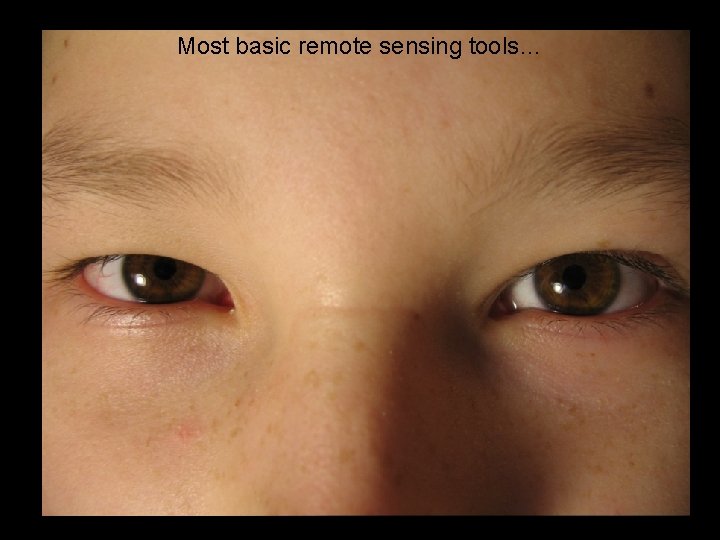
Most basic remote sensing tools… Pat Arnott, ATMS 360 Atmospheric Instrumentation
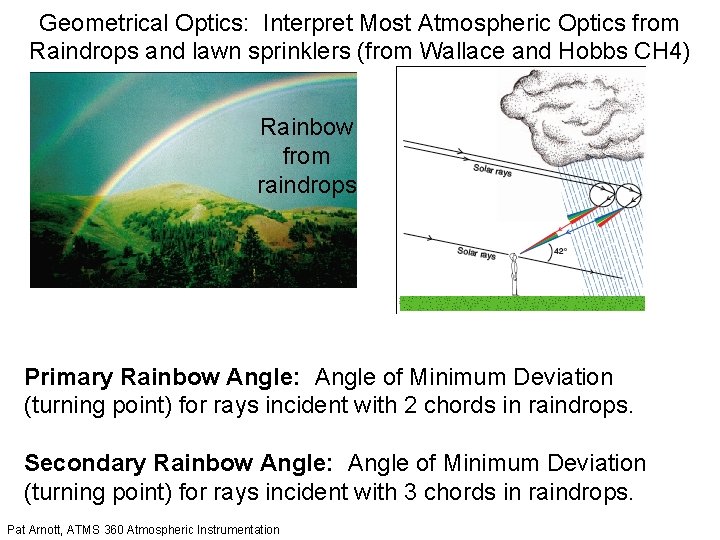
Geometrical Optics: Interpret Most Atmospheric Optics from Raindrops and lawn sprinklers (from Wallace and Hobbs CH 4) Rainbow from raindrops Primary Rainbow Angle: Angle of Minimum Deviation (turning point) for rays incident with 2 chords in raindrops. Secondary Rainbow Angle: Angle of Minimum Deviation (turning point) for rays incident with 3 chords in raindrops. Pat Arnott, ATMS 360 Atmospheric Instrumentation
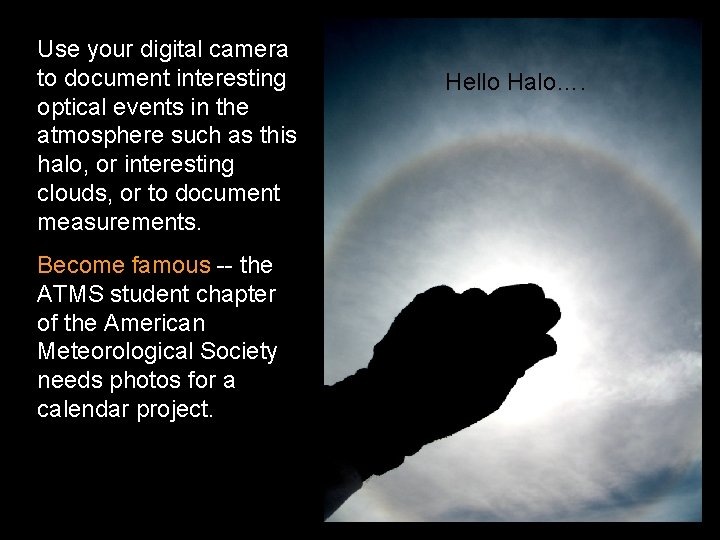
Use your digital camera to document interesting optical events in the atmosphere such as this halo, or interesting clouds, or to document measurements. Become famous -- the ATMS student chapter of the American Meteorological Society needs photos for a calendar project. Pat Arnott, ATMS 360 Atmospheric Instrumentation Hello Halo….
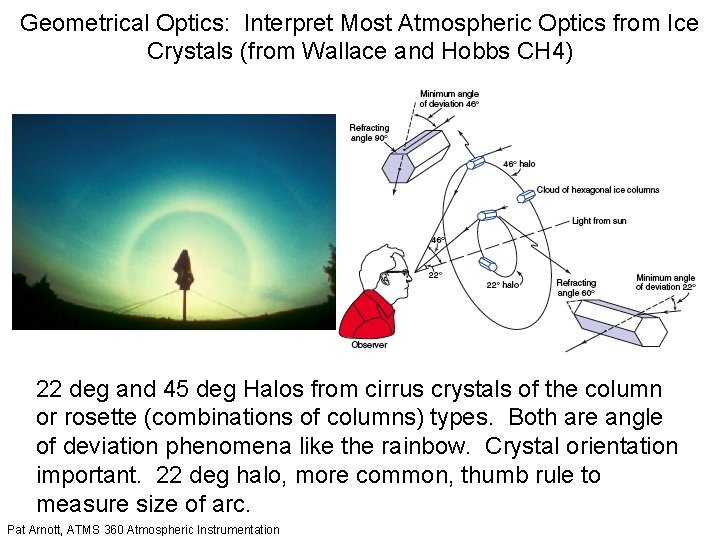
Geometrical Optics: Interpret Most Atmospheric Optics from Ice Crystals (from Wallace and Hobbs CH 4) 22 deg and 45 deg Halos from cirrus crystals of the column or rosette (combinations of columns) types. Both are angle of deviation phenomena like the rainbow. Crystal orientation important. 22 deg halo, more common, thumb rule to measure size of arc. Pat Arnott, ATMS 360 Atmospheric Instrumentation
AWE some website for explaining Halos… Click here http: //www. atoptics. co. uk/halo/circ 1. htm Pat Arnott, ATMS 360 Atmospheric Instrumentation
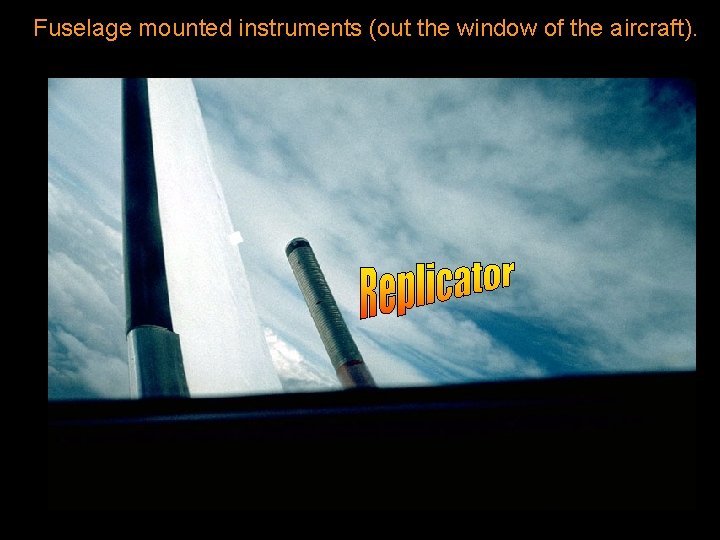
Fuselage mounted instruments (out the window of the aircraft). Pat Arnott, ATMS 360 Atmospheric Instrumentation
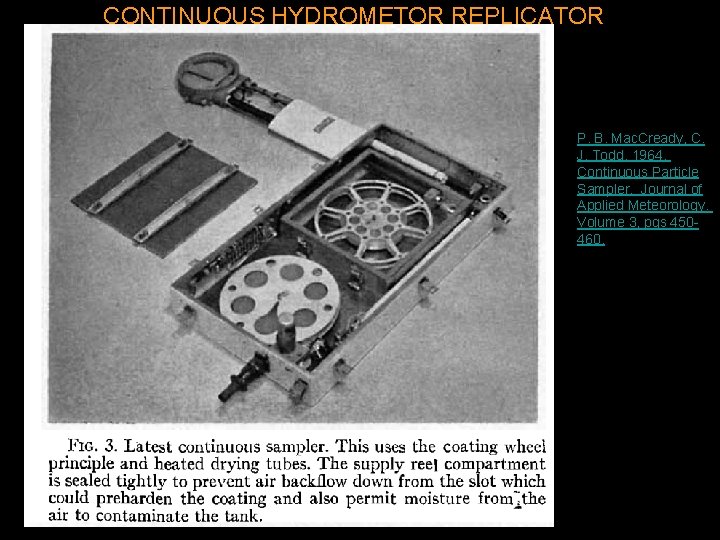
CONTINUOUS HYDROMETOR REPLICATOR P. B. Mac. Cready, C. J. Todd, 1964. Continuous Particle Sampler. Journal of Applied Meteorology. Volume 3, pgs 450460. Pat Arnott, ATMS 360 Atmospheric Instrumentation
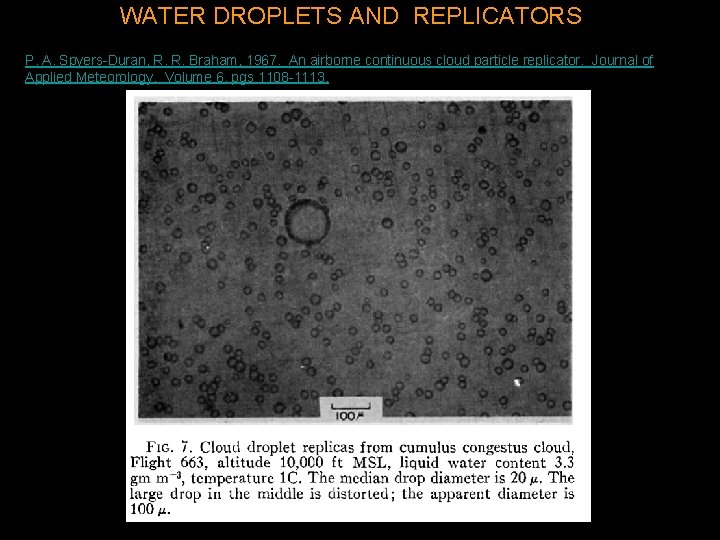
WATER DROPLETS AND REPLICATORS P. A. Spyers-Duran, R. R. Braham, 1967. An airborne continuous cloud particle replicator. Journal of Applied Meteorology. Volume 6, pgs 1108 -1113. Pat Arnott, ATMS 360 Atmospheric Instrumentation
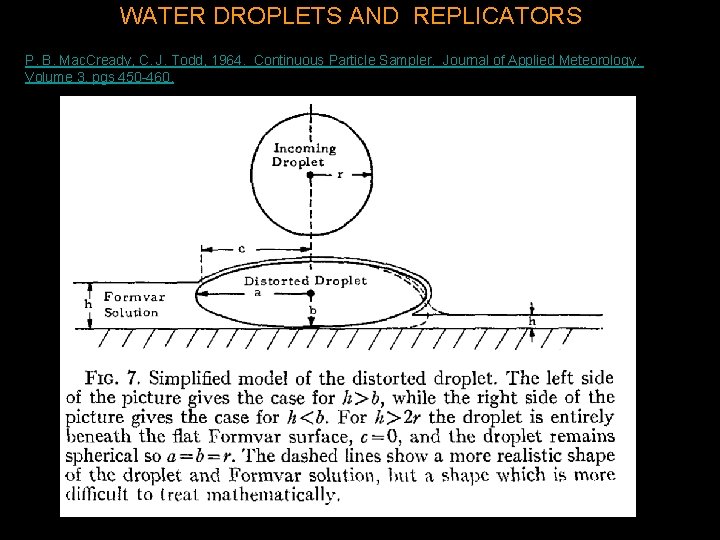
WATER DROPLETS AND REPLICATORS P. B. Mac. Cready, C. J. Todd, 1964. Continuous Particle Sampler. Journal of Applied Meteorology. Volume 3, pgs 450 -460. Pat Arnott, ATMS 360 Atmospheric Instrumentation
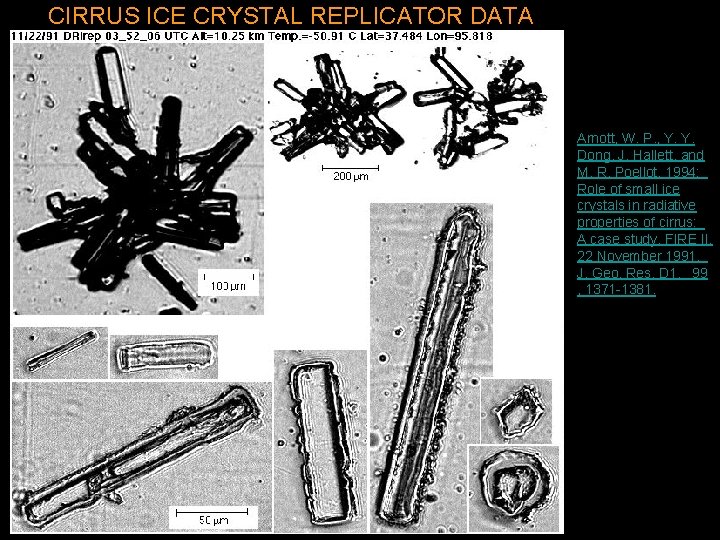
CIRRUS ICE CRYSTAL REPLICATOR DATA Arnott, W. P. , Y. Y. Dong, J. Hallett, and M. R. Poellot, 1994: Role of small ice crystals in radiative properties of cirrus: A case study, FIRE II, 22 November 1991. J. Geo. Res. D 1, 99 , 1371 -1381. Pat Arnott, ATMS 360 Atmospheric Instrumentation
Balloon Borne Ice Crystal Replicator The balloon-borne replicator collects and preserves ice crystals and cloud droplets using the Formvar replication technique. Details of the instrument design and measurement capabilities are described in Miloshevich and Heymsfield (1997, J. Atmos. Oc. Tech. , 14, 753). http: //www. mmm. ucar. edu/science/cirrus/docs/replsum. html Pat Arnott, ATMS 360 Atmospheric Instrumentation
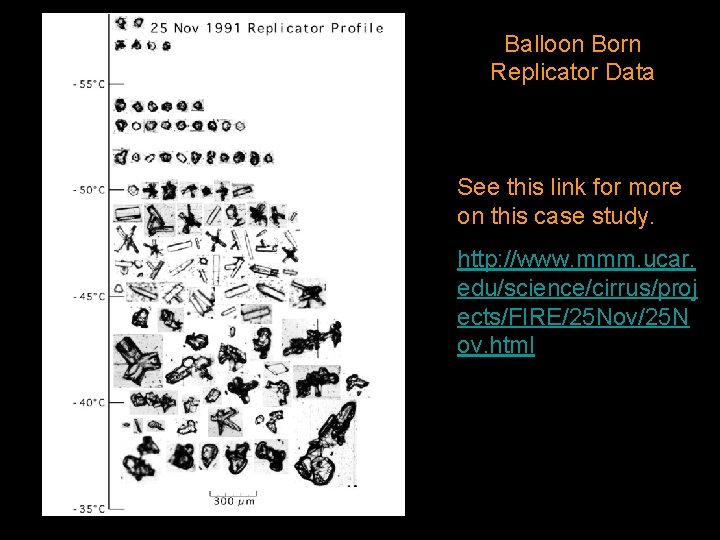
Balloon Born Replicator Data See this link for more on this case study. http: //www. mmm. ucar. edu/science/cirrus/proj ects/FIRE/25 Nov/25 N ov. html Pat Arnott, ATMS 360 Atmospheric Instrumentation
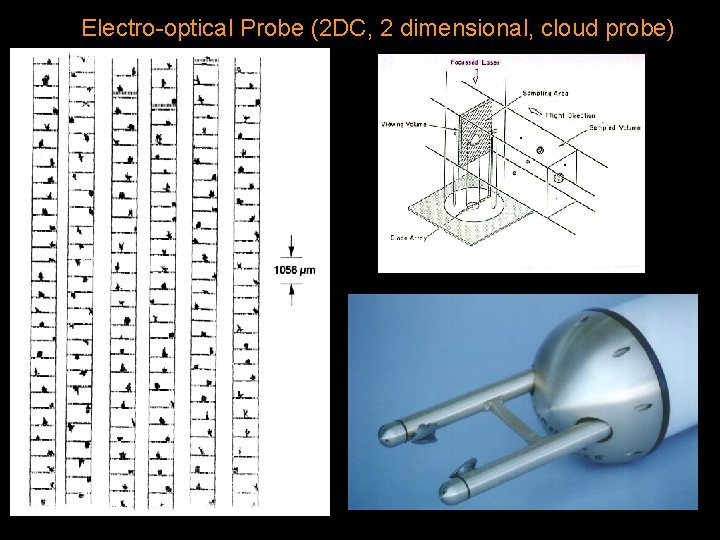
Electro-optical Probe (2 DC, 2 dimensional, cloud probe) Pat Arnott, ATMS 360 Atmospheric Instrumentation
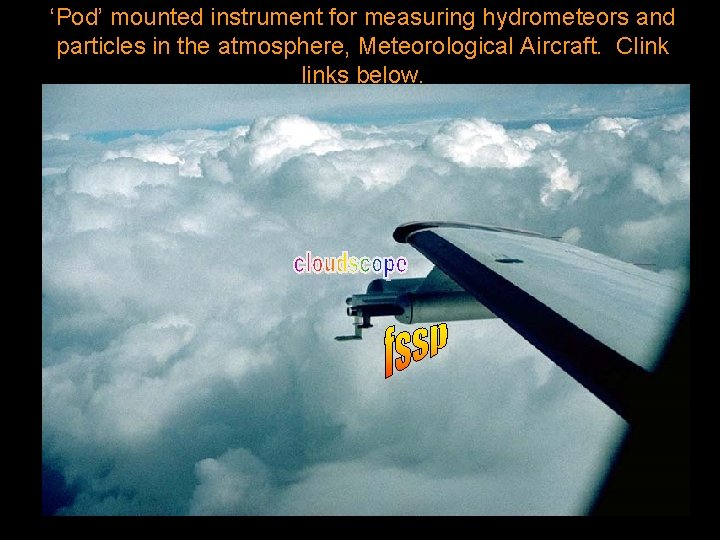
‘Pod’ mounted instrument for measuring hydrometeors and particles in the atmosphere, Meteorological Aircraft. Clinks below. Pat Arnott, ATMS 360 Atmospheric Instrumentation
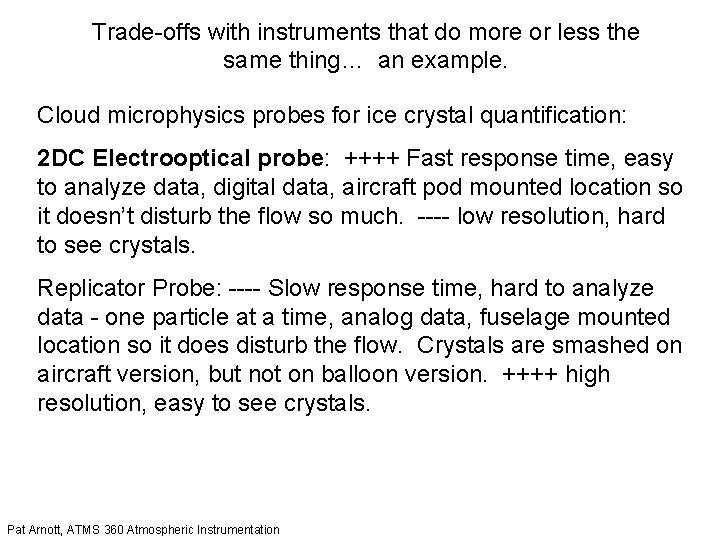
Trade-offs with instruments that do more or less the same thing… an example. Cloud microphysics probes for ice crystal quantification: 2 DC Electrooptical probe: ++++ Fast response time, easy to analyze data, digital data, aircraft pod mounted location so it doesn’t disturb the flow so much. ---- low resolution, hard to see crystals. Replicator Probe: ---- Slow response time, hard to analyze data - one particle at a time, analog data, fuselage mounted location so it does disturb the flow. Crystals are smashed on aircraft version, but not on balloon version. ++++ high resolution, easy to see crystals. Pat Arnott, ATMS 360 Atmospheric Instrumentation
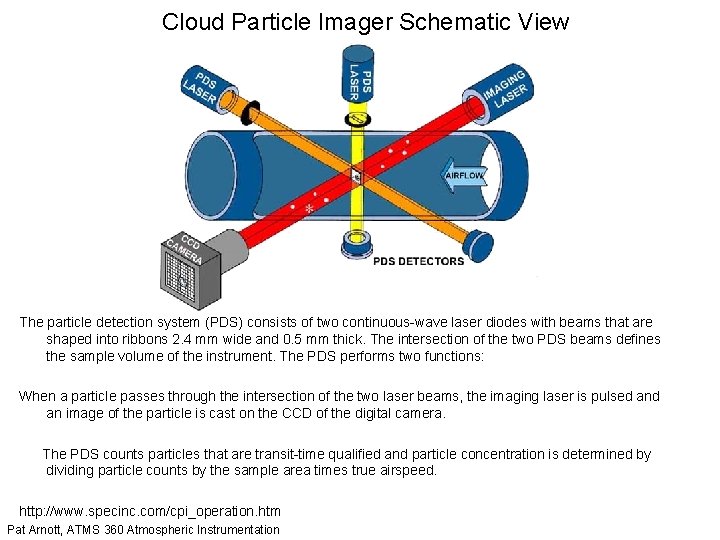
Cloud Particle Imager Schematic View The particle detection system (PDS) consists of two continuous-wave laser diodes with beams that are shaped into ribbons 2. 4 mm wide and 0. 5 mm thick. The intersection of the two PDS beams defines the sample volume of the instrument. The PDS performs two functions: When a particle passes through the intersection of the two laser beams, the imaging laser is pulsed an image of the particle is cast on the CCD of the digital camera. The PDS counts particles that are transit-time qualified and particle concentration is determined by dividing particle counts by the sample area times true airspeed. http: //www. specinc. com/cpi_operation. htm Pat Arnott, ATMS 360 Atmospheric Instrumentation
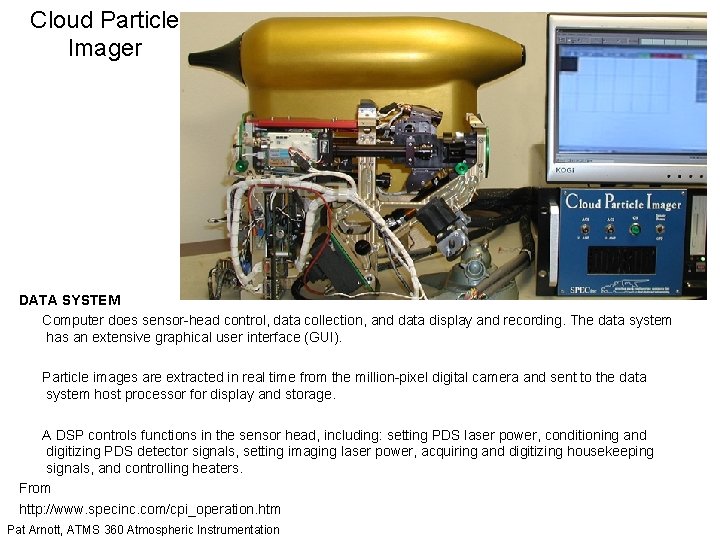
Cloud Particle Imager DATA SYSTEM Computer does sensor-head control, data collection, and data display and recording. The data system has an extensive graphical user interface (GUI). Particle images are extracted in real time from the million-pixel digital camera and sent to the data system host processor for display and storage. A DSP controls functions in the sensor head, including: setting PDS laser power, conditioning and digitizing PDS detector signals, setting imaging laser power, acquiring and digitizing housekeeping signals, and controlling heaters. From http: //www. specinc. com/cpi_operation. htm Pat Arnott, ATMS 360 Atmospheric Instrumentation
Cloud Particle Imager and Others on Lear Aircraft Pat Arnott, ATMS 360 Atmospheric Instrumentation
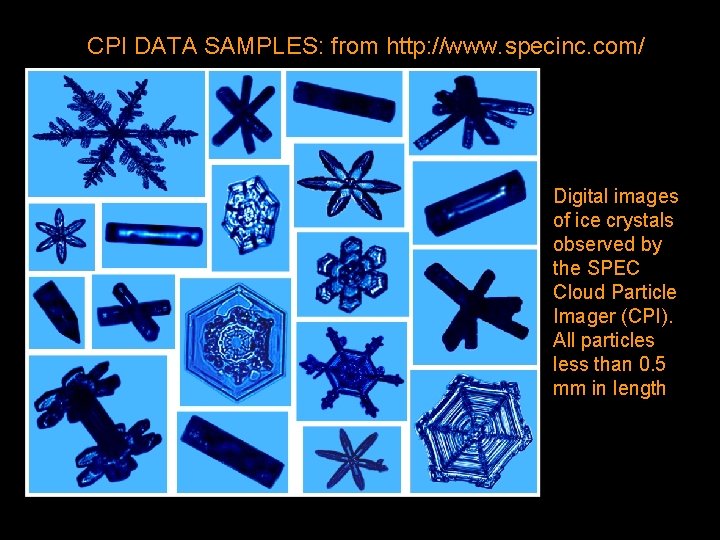
CPI DATA SAMPLES: from http: //www. specinc. com/ Digital images of ice crystals observed by the SPEC Cloud Particle Imager (CPI). All particles less than 0. 5 mm in length Pat Arnott, ATMS 360 Atmospheric Instrumentation
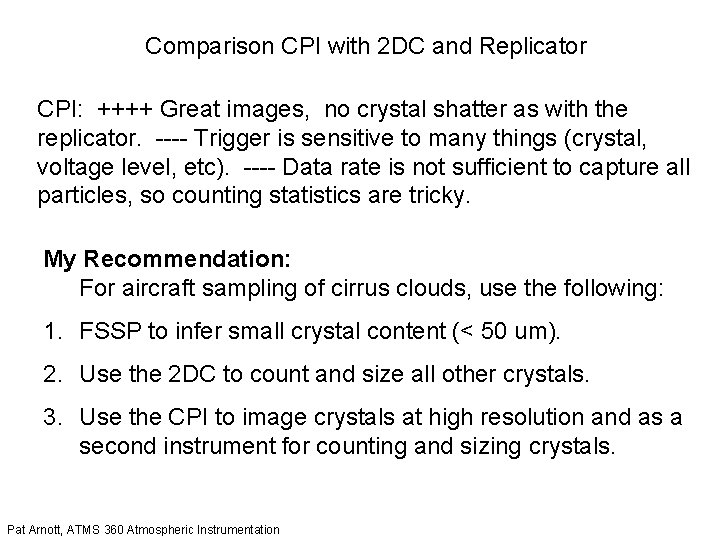
Comparison CPI with 2 DC and Replicator CPI: ++++ Great images, no crystal shatter as with the replicator. ---- Trigger is sensitive to many things (crystal, voltage level, etc). ---- Data rate is not sufficient to capture all particles, so counting statistics are tricky. My Recommendation: For aircraft sampling of cirrus clouds, use the following: 1. FSSP to infer small crystal content (< 50 um). 2. Use the 2 DC to count and size all other crystals. 3. Use the CPI to image crystals at high resolution and as a second instrument for counting and sizing crystals. Pat Arnott, ATMS 360 Atmospheric Instrumentation