Procedural Recommendations for the Reduced EDCT Window Evaluation
- Slides: 6
Procedural Recommendations for the Reduced EDCT Window Evaluation Prepared by The CDM Airline Task Group Presented by Roger Beatty - AAL To the CDM A&D meeting January 24 th, 2001
Recommended Test Evaluation Criteria • • Verify the following benefits: CTA accuracy is improved Target AARs are more precisely achieved MIT & other restrictions are actually reduced While keeping to a minimum: Delays incurred obtaining new EDCTs Additional delay because the new EDCT may be significantly later then the original EDCT
Recommended evaluation of why EDCT window was missed • If “OUT” time is at least EDCT -10 min at small airports and -20 min at large airports FAA will attempt to establish reason for miss. • If “OUT” time is later then the above tolerance and no CDM revised departure is sent then it is recommended that the airline should attempt to establish the reason for miss. • Attempts to resolve delays beyond assigned EDCT through airline Subs are expected.
Reduced Window Evaluation Teams • It is believed that a joint airline/FAA analysis team is not feasible. • Airlines are encouraged to do independent analysis using ADL and internal data. • FAA will use ETMS/CDM and CODAS data to do independent analysis and should encourage airline input while the data is collected analysis is in progress.
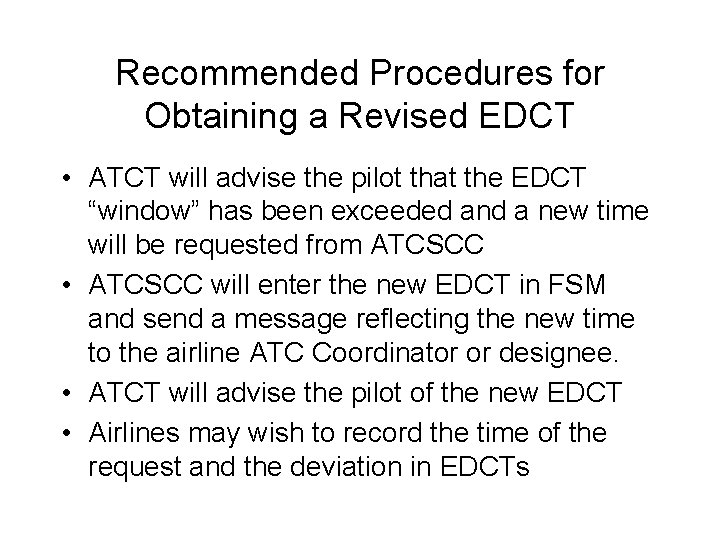
Recommended Procedures for Obtaining a Revised EDCT • ATCT will advise the pilot that the EDCT “window” has been exceeded and a new time will be requested from ATCSCC • ATCSCC will enter the new EDCT in FSM and send a message reflecting the new time to the airline ATC Coordinator or designee. • ATCT will advise the pilot of the new EDCT • Airlines may wish to record the time of the request and the deviation in EDCTs
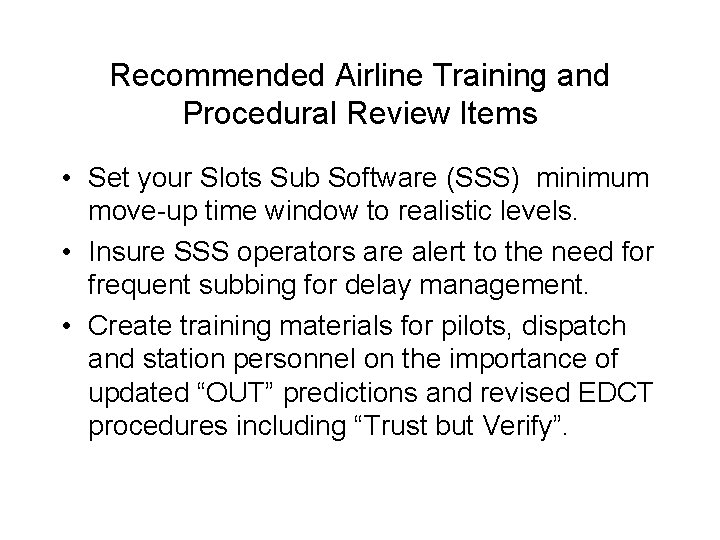
Recommended Airline Training and Procedural Review Items • Set your Slots Sub Software (SSS) minimum move-up time window to realistic levels. • Insure SSS operators are alert to the need for frequent subbing for delay management. • Create training materials for pilots, dispatch and station personnel on the importance of updated “OUT” predictions and revised EDCT procedures including “Trust but Verify”.