PRIMARY LANGUAGE PORTFOLIO PLP PROJECT progress report Nida
- Slides: 18
PRIMARY LANGUAGE PORTFOLIO (PLP) PROJECT progress report Nida Burneikaitė LITHUANIA Nida Burneikaite LITHUANIA ECML ELP-WSU 2010 report
background § validated ELPs in Lithuania: Øgrades 9 -12, 2006 Øgrades 5 -8, 2010 § portfolio methodolody at primary level Øall subjects Ønon-compulsory Nida Burneikaite LITHUANIA ECML ELP-WSU 2010 report
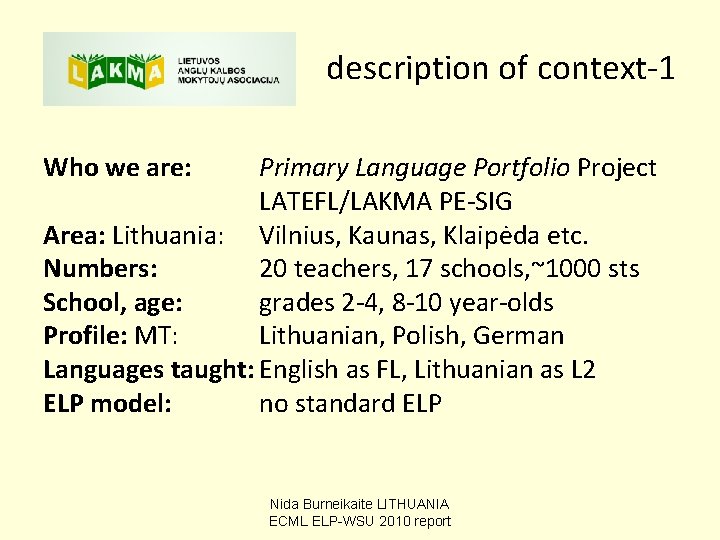
description of context-1 Who we are: Primary Language Portfolio Project LATEFL/LAKMA PE-SIG Area: Lithuania: Vilnius, Kaunas, Klaipėda etc. Numbers: 20 teachers, 17 schools, ~1000 sts School, age: grades 2 -4, 8 -10 year-olds Profile: MT: Lithuanian, Polish, German Languages taught: English as FL, Lithuanian as L 2 ELP model: no standard ELP Nida Burneikaite LITHUANIA ECML ELP-WSU 2010 report
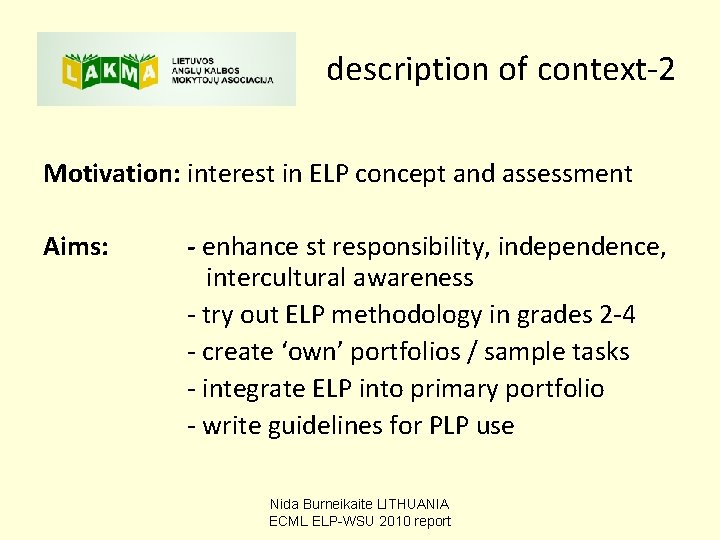
description of context-2 Motivation: interest in ELP concept and assessment Aims: - enhance st responsibility, independence, intercultural awareness - try out ELP methodology in grades 2 -4 - create ‘own’ portfolios / sample tasks - integrate ELP into primary portfolio - write guidelines for PLP use Nida Burneikaite LITHUANIA ECML ELP-WSU 2010 report
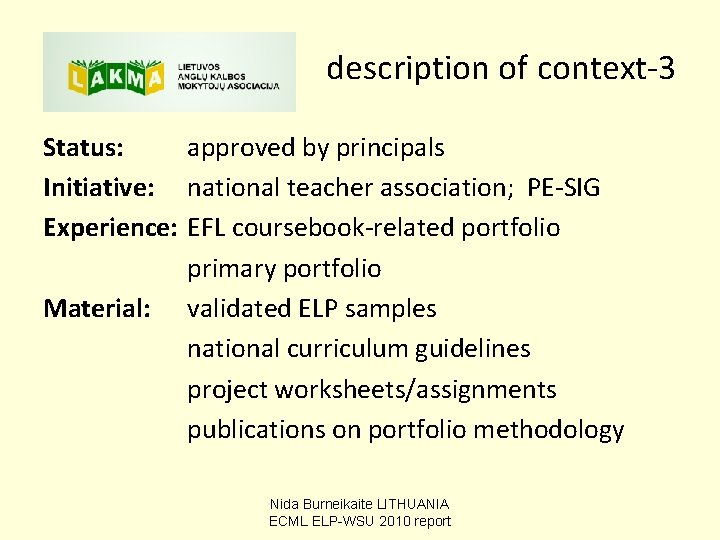
description of context-3 Status: approved by principals Initiative: national teacher association; PE-SIG Experience: EFL coursebook-related portfolio primary portfolio Material: validated ELP samples national curriculum guidelines project worksheets/assignments publications on portfolio methodology Nida Burneikaite LITHUANIA ECML ELP-WSU 2010 report
organisation-1 Coordinator: Incentives: Cooperation: myself as LATEFL PE-SIG ECML certificate LAKMA certificate monthly meetings/seminars online consultations analysis of ELP elements designing and trying out ‘own’ tasks evaluation of effectiveness Nida Burneikaite LITHUANIA ECML ELP-WSU 2010 report
organisation-2 Duration of project: § 2009/10 – the learning stage - producing sample tasks / portfolios - writing guidelines for PLP use § 2010/11 – the sharing stage [hopefully] - school teams - more teachers /schools - more languages Nida Burneikaite LITHUANIA ECML ELP-WSU 2010 report
pedagogical exploitations-1 § Techniques to develop learner autonomy: - monthly self-assessment activity (topic-based) - sts set own learning targets - sts revise dossier - peer-assesment - end of term/year self-assessment (skills-based) - ‘what helps me learn’ activity Nida Burneikaite LITHUANIA ECML ELP-WSU 2010 report
pedagogical exploitations-2 § Plurilingualism and intercultural awareness: - languages inside /outside the country - countries I have visited / would like to visit - people I have met / would like to meet - countries, capitals, holidays, traditions, foods - TV channels, films, games etc - words I know in other languages Nida Burneikaite LITHUANIA ECML ELP-WSU 2010 report
pedagogical exploitations-3 § Involving parents: - monthly Parents’ Day for Primary Portfolio - parents give feedback on sts portfolio work - home assignments on - intercultural experience - using/learning languages outside the classroom Nida Burneikaite LITHUANIA ECML ELP-WSU 2010 report
evaluation-1 § Impact on teachers - increased confidence in achieving goals - better focus on skills (what sts can do) - more humanistic approach to assessment - cooperation between FL+MT+L 2 teachers § Indicator of impact - tasks designed for (self-)assessment - terminology and symbols used - self-perception as reflected in feedback Nida Burneikaite LITHUANIA ECML ELP-WSU 2010 report
evaluation-2 § Impact on students - increased independence, responsibility § Indicator of impact - positive emotions - better self-assessment skills § Data collected - continuous observation - end of project feedback Nida Burneikaite LITHUANIA ECML ELP-WSU 2010 report
evaluation-3 § Impact on parents - increased interest in children’s work - cooperation in home assignments § Indicator of impact - changed behaviour at parents’ meetings - feedback on sts’ porfolio work Nida Burneikaite LITHUANIA ECML ELP-WSU 2010 report
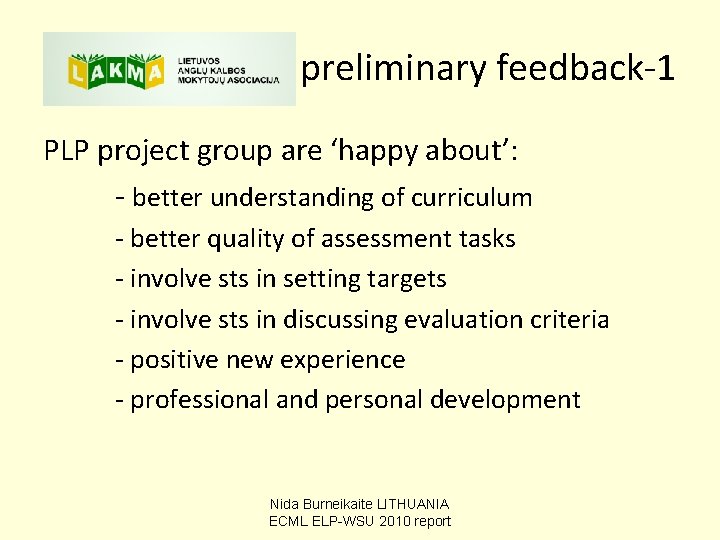
preliminary feedback-1 PLP project group are ‘happy about’: - better understanding of curriculum - better quality of assessment tasks - involve sts in setting targets - involve sts in discussing evaluation criteria - positive new experience - professional and personal development Nida Burneikaite LITHUANIA ECML ELP-WSU 2010 report
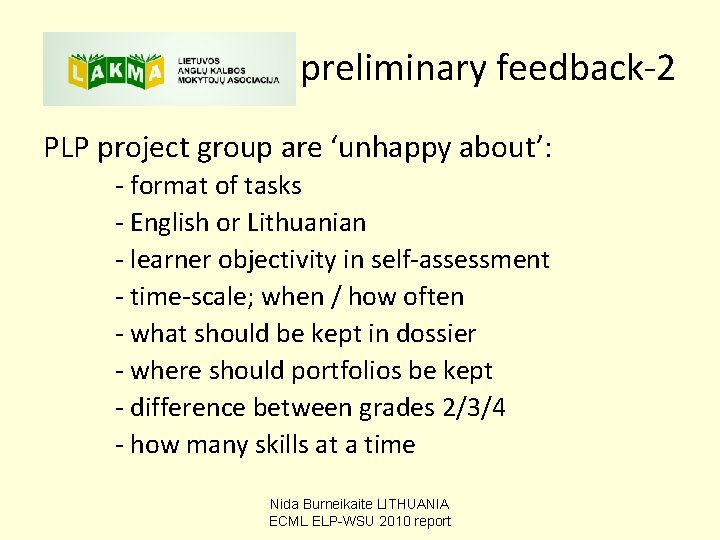
preliminary feedback-2 PLP project group are ‘unhappy about’: - format of tasks - English or Lithuanian - learner objectivity in self-assessment - time-scale; when / how often - what should be kept in dossier - where should portfolios be kept - difference between grades 2/3/4 - how many skills at a time Nida Burneikaite LITHUANIA ECML ELP-WSU 2010 report
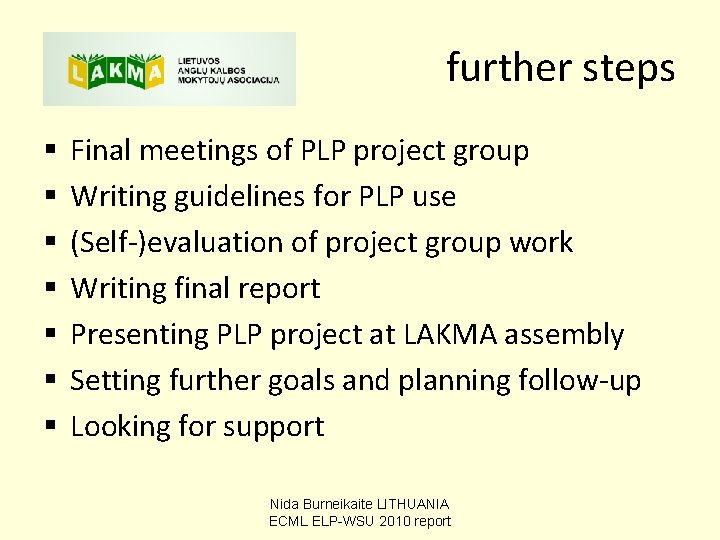
further steps § § § § Final meetings of PLP project group Writing guidelines for PLP use (Self-)evaluation of project group work Writing final report Presenting PLP project at LAKMA assembly Setting further goals and planning follow-up Looking for support Nida Burneikaite LITHUANIA ECML ELP-WSU 2010 report
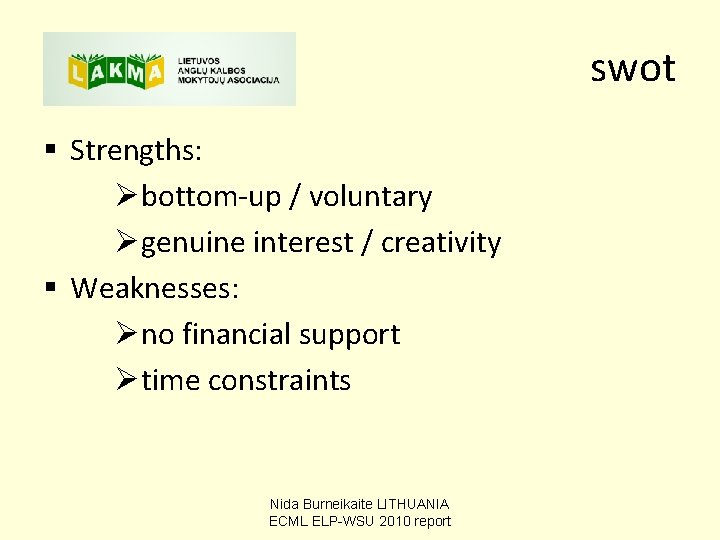
swot § Strengths: Øbottom-up / voluntary Øgenuine interest / creativity § Weaknesses: Øno financial support Øtime constraints Nida Burneikaite LITHUANIA ECML ELP-WSU 2010 report
swot § Opportunities: Øfinding support Øinvolving other language associations § Threats: Ølack of interest / enthusiasm Ølack of support at all levels Nida Burneikaite LITHUANIA ECML ELP-WSU 2010 report