Presentation to Canadian Gas Processors Association Calgary May


- Slides: 18
Presentation to Canadian Gas Processors Association Calgary – May 29, 2007
ICO 2 N is: A concept for an Integrated CO 2 Network and is being advanced by 14 companies from multiple industries. All are capable of capturing CO 2.
THE ICO 2 N INITIATIVE An integrated system combining strong policy with infrastructure development to encourage CO 2 capture and storage (CCS) l The ICO 2 N group finalized an engineering/economic CCS analysis in early 2006. Results were shared with the governments of Canada and Alberta. l ICO 2 N offers an effective vehicle for governments to engage industry in an effort to overcome the challenges facing CCS. The Integrated CO 2 Network 3
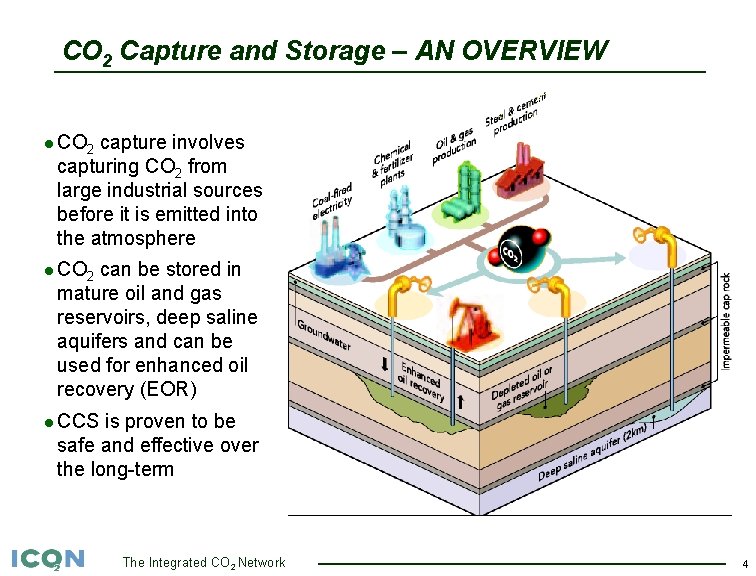
CO 2 Capture and Storage – AN OVERVIEW l CO 2 capture involves capturing CO 2 from large industrial sources before it is emitted into the atmosphere l CO 2 can be stored in mature oil and gas reservoirs, deep saline aquifers and can be used for enhanced oil recovery (EOR) l CCS is proven to be safe and effective over the long-term The Integrated CO 2 Network 4
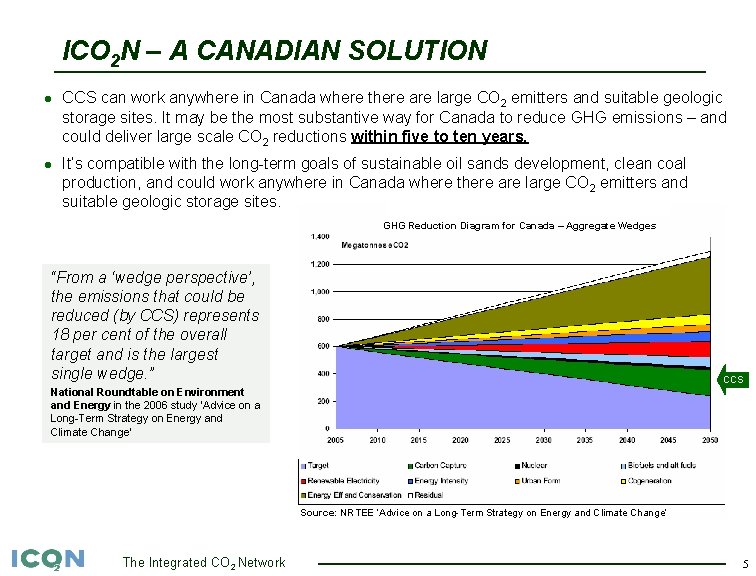
ICO 2 N – A CANADIAN SOLUTION l CCS can work anywhere in Canada where there are large CO 2 emitters and suitable geologic storage sites. It may be the most substantive way for Canada to reduce GHG emissions – and could deliver large scale CO 2 reductions within five to ten years. l It’s compatible with the long-term goals of sustainable oil sands development, clean coal production, and could work anywhere in Canada where there are large CO 2 emitters and suitable geologic storage sites. GHG Reduction Diagram for Canada – Aggregate Wedges “From a ‘wedge perspective’, the emissions that could be reduced (by CCS) represents 18 per cent of the overall target and is the largest single wedge. ” CCS National Roundtable on Environment and Energy in the 2006 study ‘Advice on a Long-Term Strategy on Energy and Climate Change’ Source: NRTEE ‘Advice on a Long-Term Strategy on Energy and Climate Change’ The Integrated CO 2 Network 5
Court of Public Opinion “What did I say, Boris, these new uniforms stry u d n I are a crock!” uel Fossil The Integrated CO 2 Network F 6
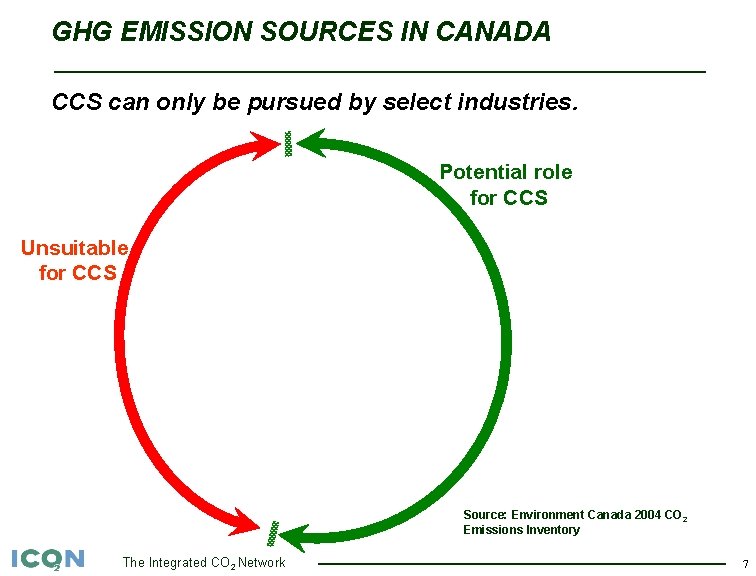
GHG EMISSION SOURCES IN CANADA CCS can only be pursued by select industries. Potential role for CCS Unsuitable for CCS Source: Environment Canada 2004 CO 2 Emissions Inventory The Integrated CO 2 Network 7
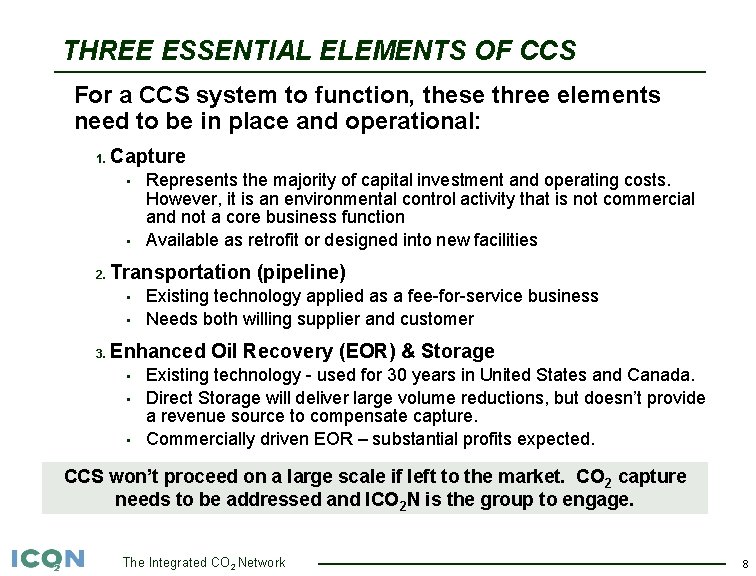
THREE ESSENTIAL ELEMENTS OF CCS For a CCS system to function, these three elements need to be in place and operational: 1. Capture • • 2. Transportation (pipeline) • • 3. Represents the majority of capital investment and operating costs. However, it is an environmental control activity that is not commercial and not a core business function Available as retrofit or designed into new facilities Existing technology applied as a fee-for-service business Needs both willing supplier and customer Enhanced Oil Recovery (EOR) & Storage • • • Existing technology - used for 30 years in United States and Canada. Direct Storage will deliver large volume reductions, but doesn’t provide a revenue source to compensate capture. Commercially driven EOR – substantial profits expected. CCS won’t proceed on a large scale if left to the market. CO 2 capture needs to be addressed and ICO 2 N is the group to engage. The Integrated CO 2 Network 8
CCS FITS WITHIN A CANADIAN STRATEGY Made in Canada l It is a “made-in-Canada” solution. Investment will be made in Canada and infrastructure will be developed in Canada – and the CO 2 emissions reductions will be realized in Canada. Technology Driven l CCS is based on advancing technology. It is also an enabling technology with the potential to transform Canadian energy production over the next 20 years – and will lower carbon fuels, while effectively using legacy infrastructure of the oil & gas and electricity generation industries. “Canada has the opportunity to be on the leading edge of deploying this technology (CCS). This not only has significant benefits for Canada in terms of resource development but it also becomes an important exportable expertise. ” National Roundtable on Environment and Energy in the study ‘Advice on a Long-Term Strategy on Energy and Climate Change’ The Integrated CO 2 Network 9
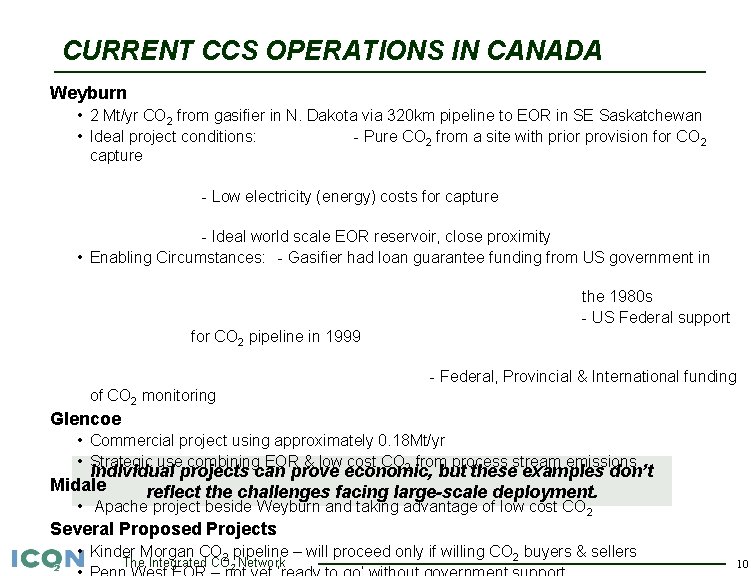
CURRENT CCS OPERATIONS IN CANADA Weyburn • 2 Mt/yr CO 2 from gasifier in N. Dakota via 320 km pipeline to EOR in SE Saskatchewan • Ideal project conditions: - Pure CO 2 from a site with prior provision for CO 2 capture - Low electricity (energy) costs for capture - Ideal world scale EOR reservoir, close proximity • Enabling Circumstances: - Gasifier had loan guarantee funding from US government in the 1980 s - US Federal support for CO 2 pipeline in 1999 - Federal, Provincial & International funding of CO 2 monitoring Glencoe • Commercial project using approximately 0. 18 Mt/yr • Strategic use combining EOR & low cost CO 2 from process stream emissions Individual projects can prove economic, but these examples don’t Midale reflect the challenges facing large-scale deployment. • Apache project beside Weyburn and taking advantage of low cost CO 2 Several Proposed Projects • Kinder Morgan CO 2 pipeline – will proceed only if willing CO 2 buyers & sellers The Integrated CO 2 Network 10
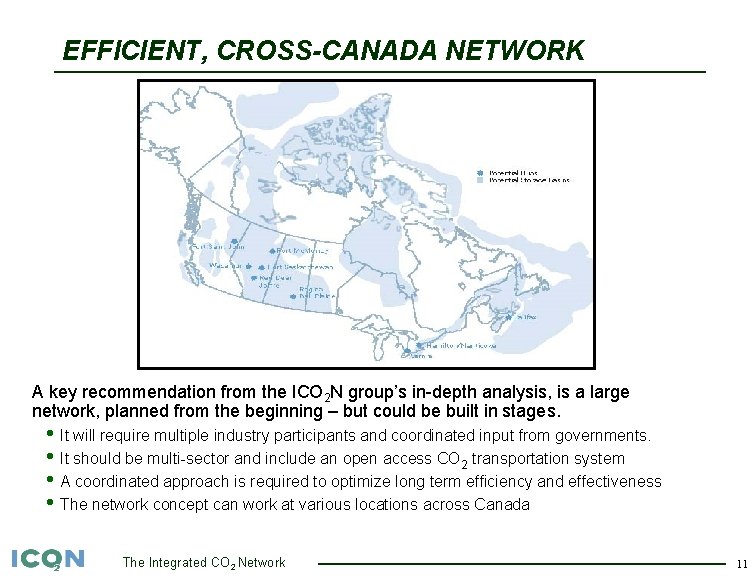
EFFICIENT, CROSS-CANADA NETWORK A key recommendation from the ICO 2 N group’s in-depth analysis, is a large network, planned from the beginning – but could be built in stages. • It will require multiple industry participants and coordinated input from governments. • It should be multi-sector and include an open access CO 2 transportation system • A coordinated approach is required to optimize long term efficiency and effectiveness • The network concept can work at various locations across Canada The Integrated CO 2 Network 11
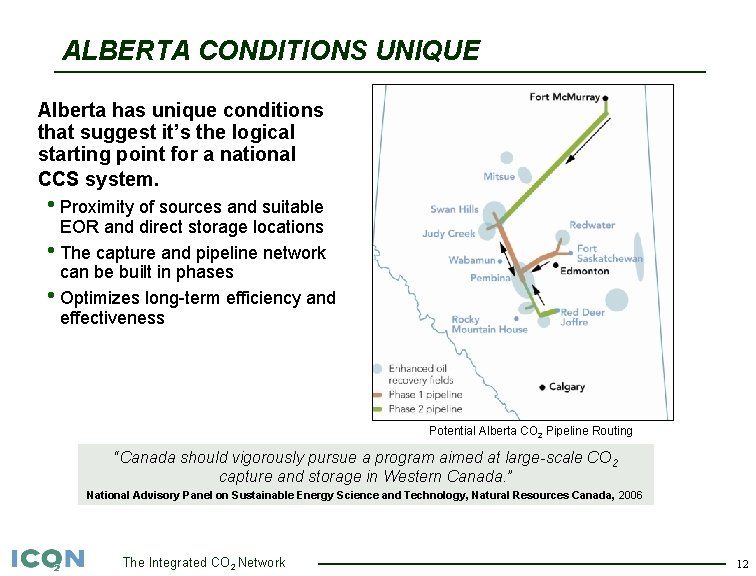
ALBERTA CONDITIONS UNIQUE Alberta has unique conditions that suggest it’s the logical starting point for a national CCS system. • Proximity of sources and suitable EOR and direct storage locations • The capture and pipeline network can be built in phases • Optimizes long-term efficiency and effectiveness Potential Alberta CO 2 Pipeline Routing “Canada should vigorously pursue a program aimed at large-scale CO 2 capture and storage in Western Canada. ” National Advisory Panel on Sustainable Energy Science and Technology, Natural Resources Canada, 2006 The Integrated CO 2 Network 12
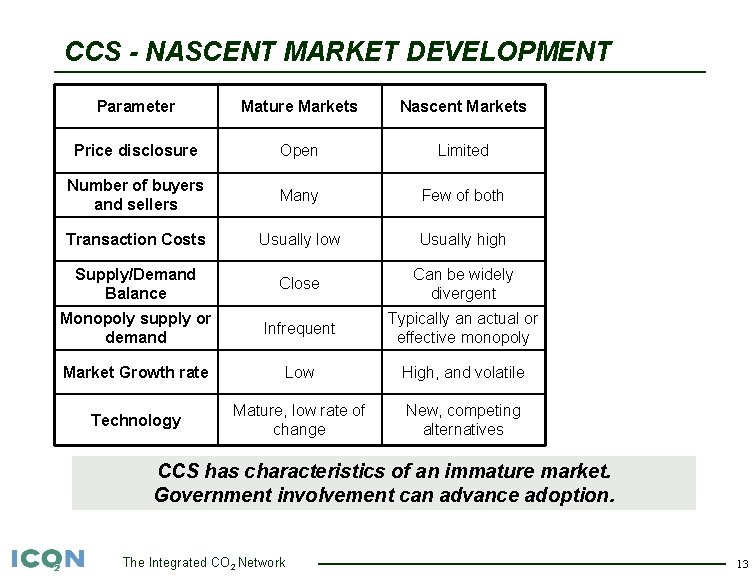
CCS - NASCENT MARKET DEVELOPMENT Parameter Mature Markets Nascent Markets Price disclosure Open Limited Number of buyers and sellers Many Few of both Transaction Costs Usually low Usually high Supply/Demand Balance Close Can be widely divergent Monopoly supply or demand Infrequent Typically an actual or effective monopoly Market Growth rate Low High, and volatile Technology Mature, low rate of change New, competing alternatives CCS has characteristics of an immature market. Government involvement can advance adoption. The Integrated CO 2 Network 13
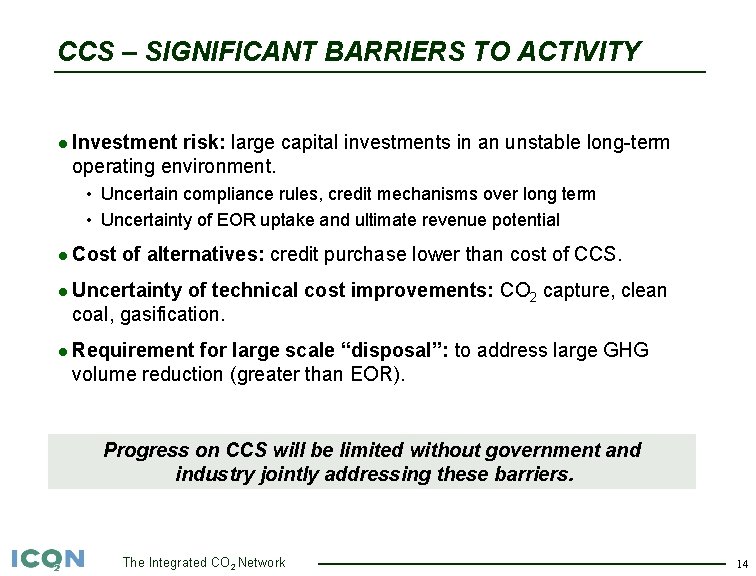
CCS – SIGNIFICANT BARRIERS TO ACTIVITY l Investment risk: large capital investments in an unstable long-term operating environment. • Uncertain compliance rules, credit mechanisms over long term • Uncertainty of EOR uptake and ultimate revenue potential l Cost of alternatives: credit purchase lower than cost of CCS. l Uncertainty of technical cost improvements: CO 2 capture, clean coal, gasification. l Requirement for large scale “disposal”: to address large GHG volume reduction (greater than EOR). Progress on CCS will be limited without government and industry jointly addressing these barriers. The Integrated CO 2 Network 14
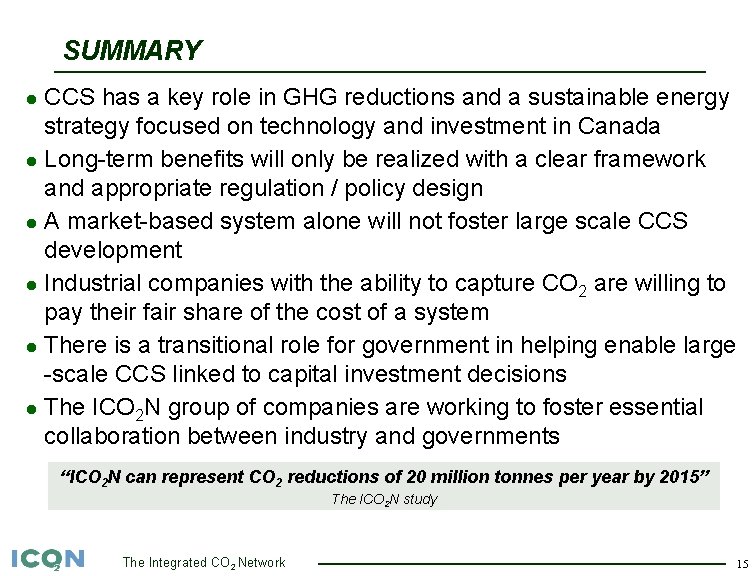
SUMMARY CCS has a key role in GHG reductions and a sustainable energy strategy focused on technology and investment in Canada l Long-term benefits will only be realized with a clear framework and appropriate regulation / policy design l A market-based system alone will not foster large scale CCS development l Industrial companies with the ability to capture CO 2 are willing to pay their fair share of the cost of a system l There is a transitional role for government in helping enable large -scale CCS linked to capital investment decisions l The ICO 2 N group of companies are working to foster essential collaboration between industry and governments l “ICO 2 N can represent CO 2 reductions of 20 million tonnes per year by 2015” The ICO 2 N study The Integrated CO 2 Network 15
Supplementary Information The Integrated CO 2 Network 16
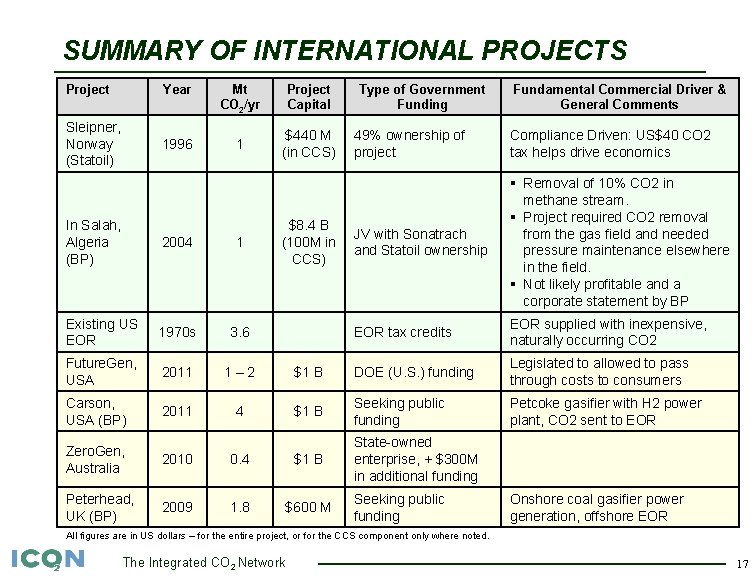
SUMMARY OF INTERNATIONAL PROJECTS Project Year Mt CO 2/yr Project Capital Sleipner, Norway (Statoil) 1996 1 $440 M (in CCS) $8. 4 B (100 M in CCS) Type of Government Funding Fundamental Commercial Driver & General Comments 49% ownership of project Compliance Driven: US$40 CO 2 tax helps drive economics JV with Sonatrach and Statoil ownership Removal of 10% CO 2 in methane stream. Project required CO 2 removal from the gas field and needed pressure maintenance elsewhere in the field. Not likely profitable and a corporate statement by BP EOR tax credits EOR supplied with inexpensive, naturally occurring CO 2 In Salah, Algeria (BP) 2004 1 Existing US EOR 1970 s 3. 6 Future. Gen, USA 2011 1– 2 $1 B DOE (U. S. ) funding Legislated to allowed to pass through costs to consumers Carson, USA (BP) 2011 4 $1 B Seeking public funding Petcoke gasifier with H 2 power plant, CO 2 sent to EOR State-owned enterprise, + $300 M in additional funding Zero. Gen, Australia 2010 0. 4 $1 B Peterhead, UK (BP) 2009 1. 8 $600 M Seeking public funding Onshore coal gasifier power generation, offshore EOR All figures are in US dollars – for the entire project, or for the CCS component only where noted. The Integrated CO 2 Network 17
CCS – WHAT THE EXPERTS ARE SAYING IPCC Special Report on CCS issued Sept 2005 • “In most scenario studies, the role of CCS in mitigation portfolios increases over the course of the century and including CCS in a mitigation portfolio is found to reduce the costs of stabilizing CO 2 concentrations by 30% or more” International Energy Agency - Claude Mandil, Executive Director June 2006 • “If we do not succeed in making CCS viable, the cost of mitigating CO 2 emissions will be much higher” Dr. Howard Herzog- Laboratory for Energy & Environment-MIT (Scientific American. com Feb 14, ‘ 05): • "There's still a gap between the marketplace and the technology, " Dr. Robert Socolow, Princeton University (July 2005, Scientific American): • “The good news is that the technology for capture and storage already exists and that the obstacles hindering implementation seem to be surmountable. ” David Hawkins- National Resource Defense Council (US NGO) (Scientific American. com Feb 14, ‘ 05): • “The best way to make CCS cheaper is for government to provide incentives to use it. Learning by doing is the thing that drives the cost down, not R&D dollars. " Dr. Judy Griffiths – the Pembina Institute in a report on CCS authored - October 2005: • “CCS might play an important role in reducing industrial emissions while the overall economy restructures to a de-carbonized energy system, especially as renewable energy and energy conservation may be insufficient to achieve the deep reductions (in the range of 50 -60%) required in the mid-term. ” NRCan CCS Technology Roadmap Document - May 2006: • “Developing world-class, low emissions energy sectors is the primary benefit of deploying domestic CCS infrastructure and systems. Achieving such an outcome would result in Canada becoming a leader in CCS technology deployment. However, this opportunity can only be realized if industry and government collaborate to address the technical, cost and policy barriers of CCS. ” Canadian National Roundtable on the Environment and the Economy - June 2006 • “Carbon capture and storage and “clean coal” technology virtually eliminate other forms of air pollution, such as emissions of SO 2, NOx, mercury and particulate matter. ” UK MP Alex Salmond on the proposed BP project in Scotland • “The viability of this project now depends on decisions to be made by the UK government. It is vital that an appropriate level of incentive is offered to this new technology, to match the current packages available through Renewables Obligation Certificates to other exciting developments. ” Buchan Observer July 12, 2006 The Integrated CO 2 Network 18