Presentation on Project Selection www assignmentpoint com q






- Slides: 31
Presentation on Project Selection www. assignmentpoint. com
q Project selection is the process of evaluating individual projects or groups of projects, and then choosing to implement some set of them so that the objectives of the parent organization will be achieved q Managers often use decision-aiding models to extract the relevant issues of a problem from the details in which the problem is embedded q Models represent the problem’s structure and can be useful in selecting and evaluating projects www. assignmentpoint. com
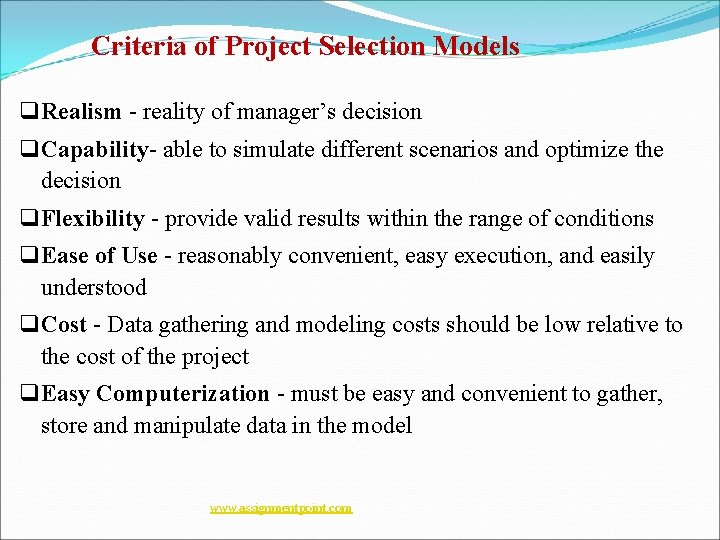
Criteria of Project Selection Models q Realism - reality of manager’s decision q Capability- able to simulate different scenarios and optimize the decision q Flexibility - provide valid results within the range of conditions q Ease of Use - reasonably convenient, easy execution, and easily understood q Cost - Data gathering and modeling costs should be low relative to the cost of the project q Easy Computerization - must be easy and convenient to gather, store and manipulate data in the model www. assignmentpoint. com
Nature of Project Selection Models q Models do not give any decision q Partially represent the reality www. assignmentpoint. com
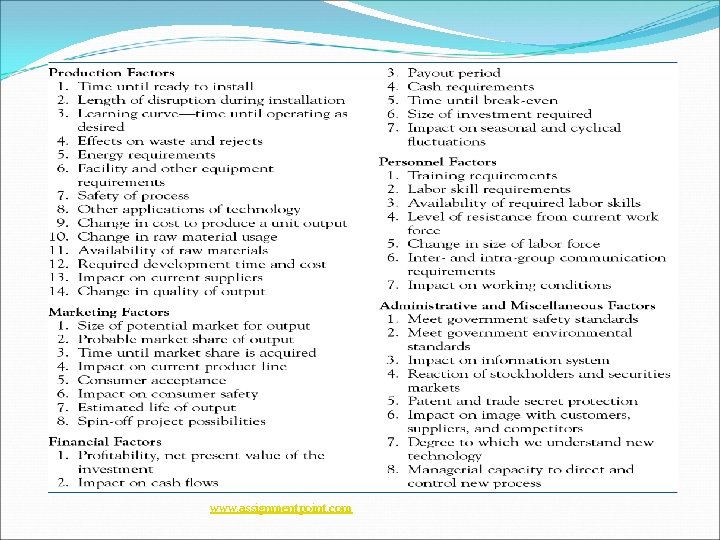
Project Evaluation Factors q Production Factors q Marketing q Financial q Personnel q Administrative www. assignmentpoint. com
www. assignmentpoint. com
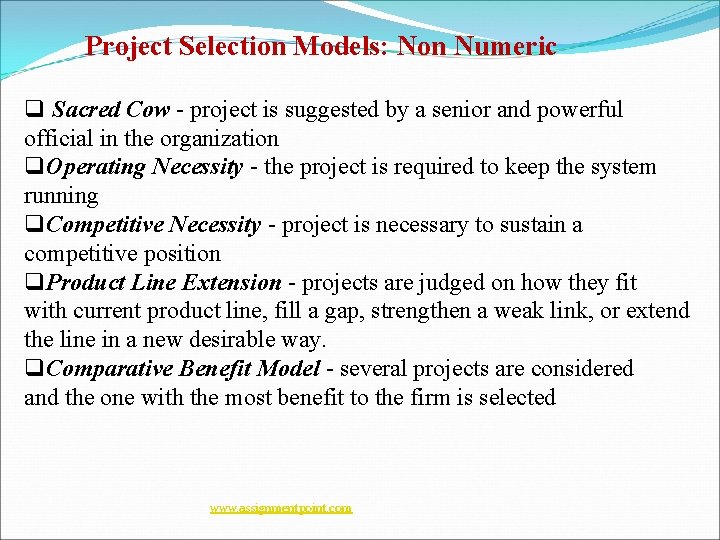
Project Selection Models: Non Numeric q Sacred Cow - project is suggested by a senior and powerful official in the organization q. Operating Necessity - the project is required to keep the system running q. Competitive Necessity - project is necessary to sustain a competitive position q. Product Line Extension - projects are judged on how they fit with current product line, fill a gap, strengthen a weak link, or extend the line in a new desirable way. q. Comparative Benefit Model - several projects are considered and the one with the most benefit to the firm is selected www. assignmentpoint. com
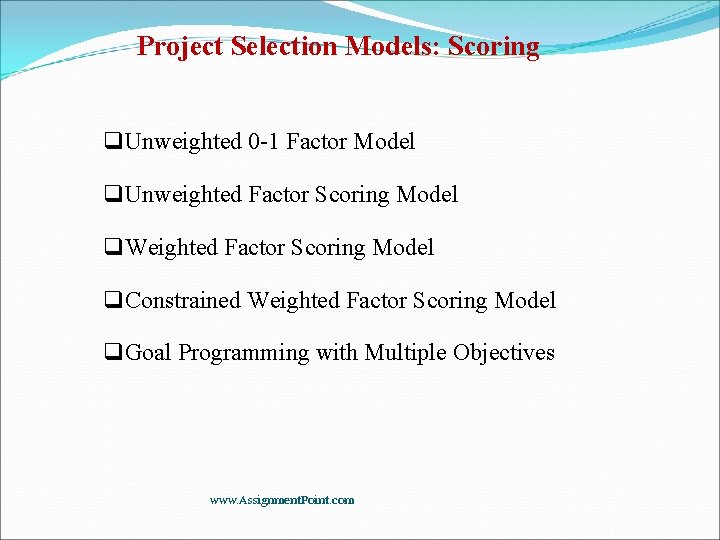
Project Selection Models: Scoring q. Unweighted 0 -1 Factor Model q. Unweighted Factor Scoring Model q. Weighted Factor Scoring Model q. Constrained Weighted Factor Scoring Model q. Goal Programming with Multiple Objectives www. Assignment. Point. com
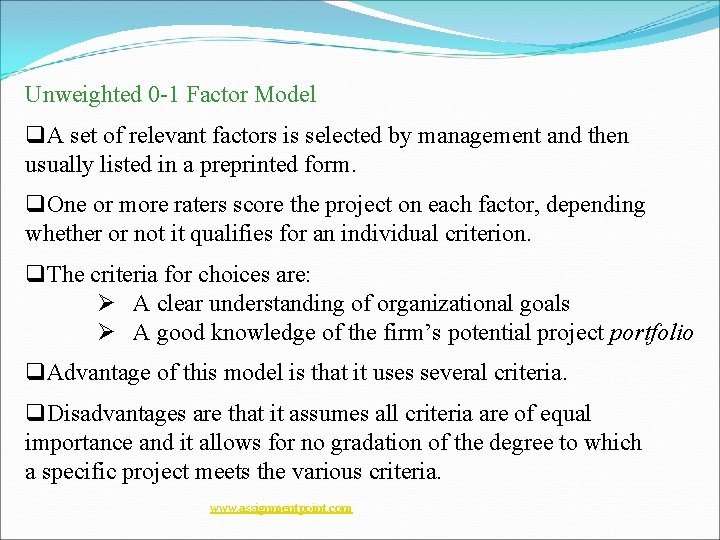
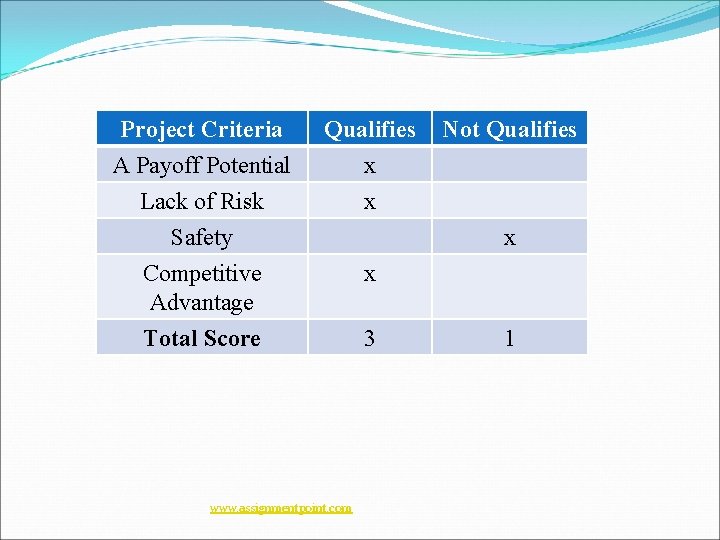
Unweighted 0 -1 Factor Model q. A set of relevant factors is selected by management and then usually listed in a preprinted form. q. One or more raters score the project on each factor, depending whether or not it qualifies for an individual criterion. q. The criteria for choices are: Ø A clear understanding of organizational goals Ø A good knowledge of the firm’s potential project portfolio q. Advantage of this model is that it uses several criteria. q. Disadvantages are that it assumes all criteria are of equal importance and it allows for no gradation of the degree to which a specific project meets the various criteria. www. assignmentpoint. com
Project Criteria A Payoff Potential Lack of Risk Safety Competitive Advantage Qualifies x x Total Score 3 www. assignmentpoint. com Not Qualifies x x 1
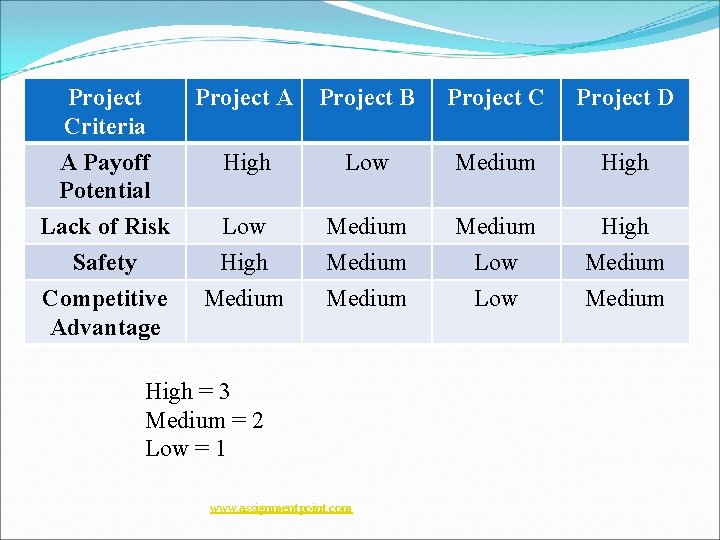
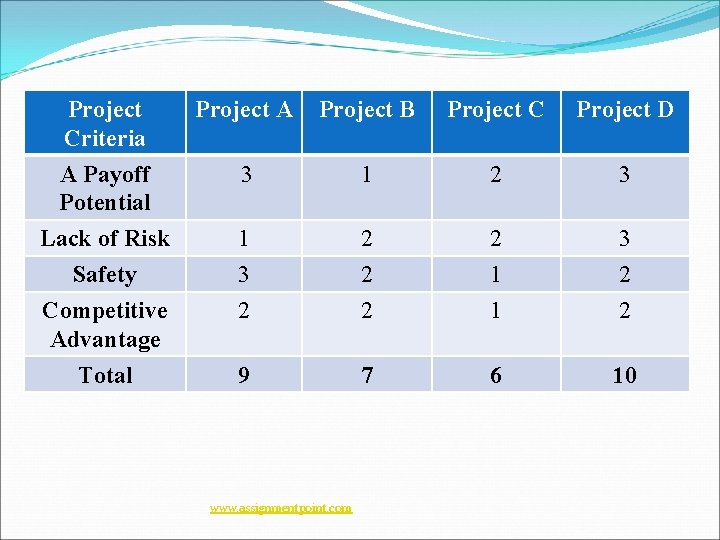
Unweighted Factor Scoring Model q. This model is used by constructing a simple linear measure of the degree to which the project being evaluated meets each of the criteria. q. Often a five-point scale is used to evaluate the project. q. A variant of this selection process might choose the highest scoring project. q. The criteria are all assumed to be of equal importance. www. assignmentpoint. com
Project Criteria A Payoff Potential Project A Project B Project C Project D High Low Medium High Lack of Risk Safety Competitive Advantage Low High Medium Medium Low High Medium High = 3 Medium = 2 Low = 1 www. assignmentpoint. com
Project Criteria A Payoff Potential Project A Project B Project C Project D 3 1 2 3 Lack of Risk Safety Competitive Advantage 1 3 2 2 2 1 1 3 2 2 Total 9 7 6 10 www. assignmentpoint. com
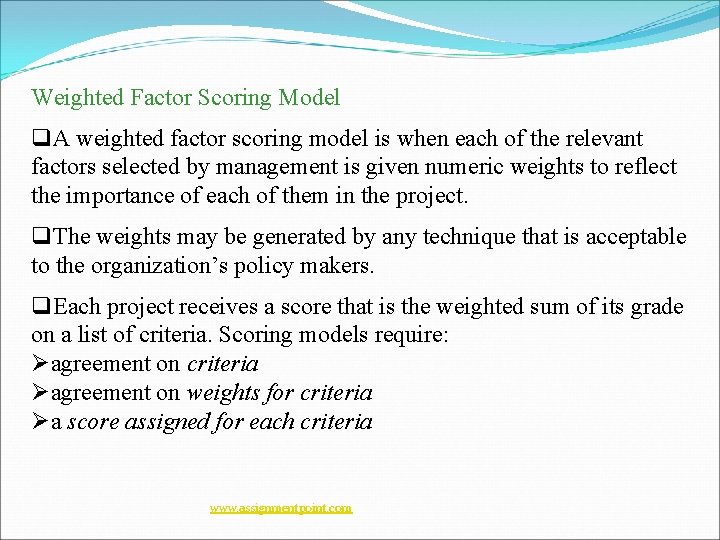
Weighted Factor Scoring Model q. A weighted factor scoring model is when each of the relevant factors selected by management is given numeric weights to reflect the importance of each of them in the project. q. The weights may be generated by any technique that is acceptable to the organization’s policy makers. q. Each project receives a score that is the weighted sum of its grade on a list of criteria. Scoring models require: Øagreement on criteria Øagreement on weights for criteria Øa score assigned for each criteria www. assignmentpoint. com
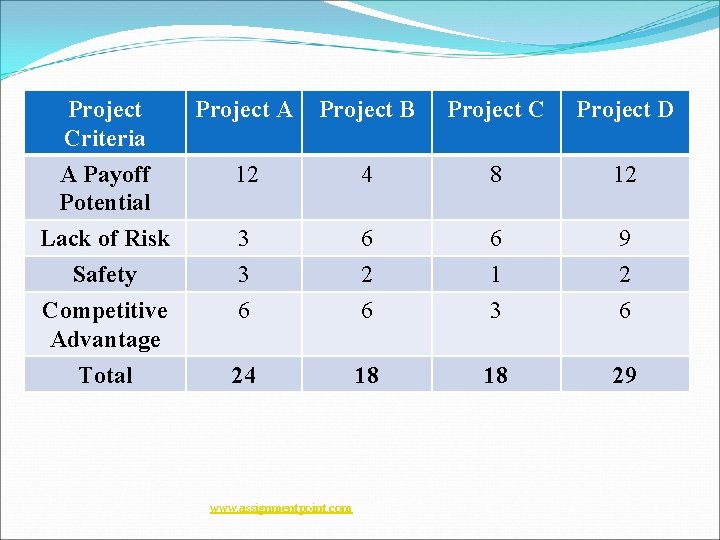
Assessment Criteria 1. Payoff potential 2. Lack of risk 3. Safety 4. Competitive advantage www. assignmentpoint. com Importance Weights 4 3 1 3
Project Criteria A Payoff Potential Project A Project B Project C Project D 12 4 8 12 Lack of Risk Safety Competitive Advantage 3 3 6 6 2 6 6 1 3 9 2 6 Total 24 18 18 29 www. assignmentpoint. com
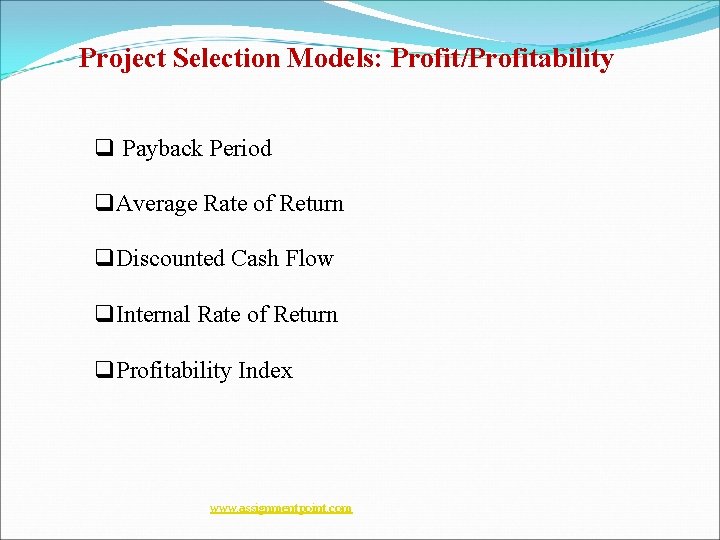
Project Selection Models: Profit/Profitability q Payback Period q. Average Rate of Return q. Discounted Cash Flow q. Internal Rate of Return q. Profitability Index www. assignmentpoint. com
Financial Appraisal of Project Basic questions Ø Is the project worthwhile financially (that is whether it will generate sufficient cash flows to repay debt and produce a satisfactory rate of return on investment)? ØHow to select the "best" project from a list of projects? Most common measures Net Present Value (NPV), Internal Rate of Return (IRR), Payback Period, Return on Investment (ROI), Discounted Cash Flow. www. Assignment. Point. com project management
Net Present Value (NPV) q Calculate the present value of all future cash flows with the discounting factor (MARR) q Add all the present values of cash in-flows (cash revenues) and subtract all the present values of cash out-flows (cash expenses) q What we obtain is the Net Present Value or NPV q Positive NPV means attractive financial return, and larger NPV means more attractive project alternative. NPV = www. Assignment. Point. com project management
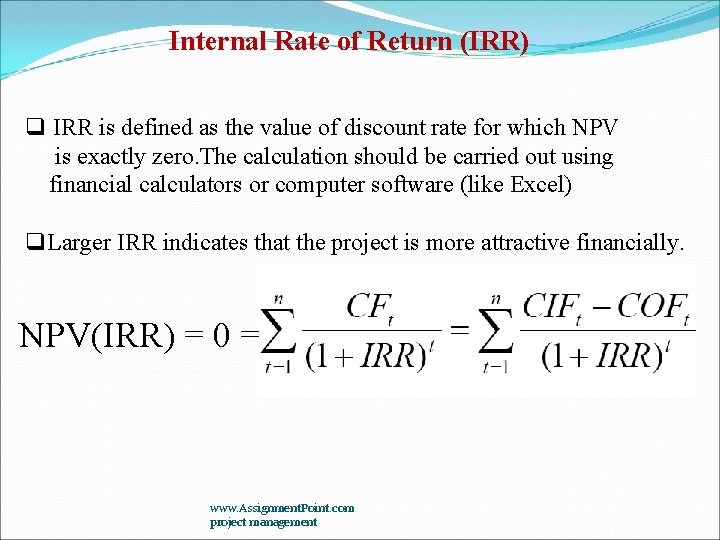
Internal Rate of Return (IRR) q IRR is defined as the value of discount rate for which NPV is exactly zero. The calculation should be carried out using financial calculators or computer software (like Excel) q. Larger IRR indicates that the project is more attractive financially. NPV(IRR) = 0 = www. Assignment. Point. com project management
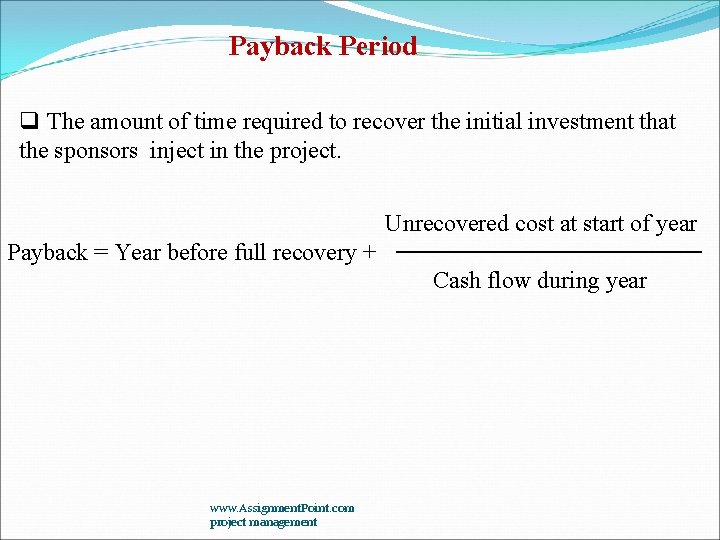
Payback Period q The amount of time required to recover the initial investment that the sponsors inject in the project. Unrecovered cost at start of year Payback = Year before full recovery + Cash flow during year www. Assignment. Point. com project management
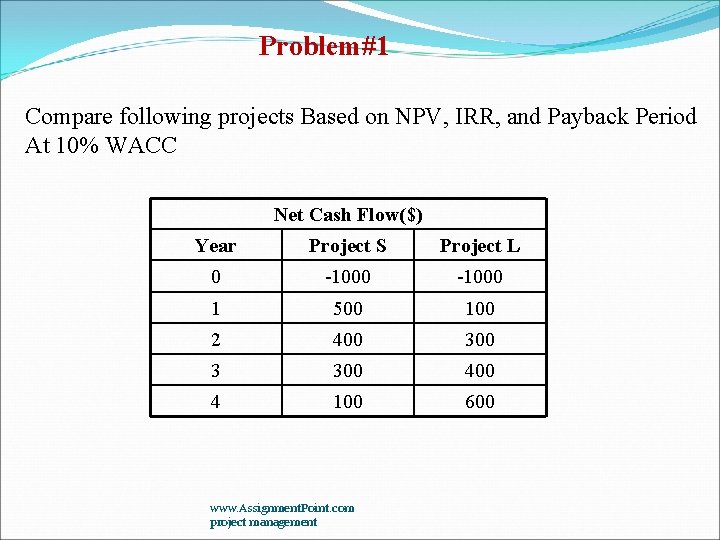
Problem#1 Compare following projects Based on NPV, IRR, and Payback Period At 10% WACC Net Cash Flow($) Year Project S Project L 0 -1000 1 500 100 2 400 3 300 4 100 600 www. Assignment. Point. com project management
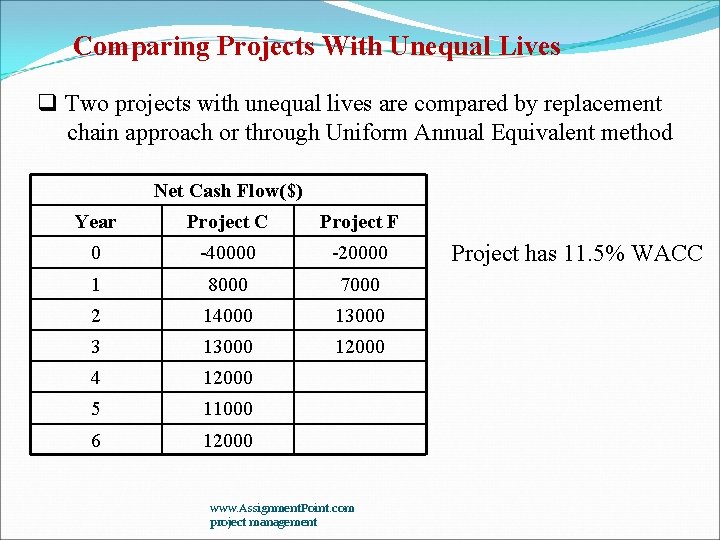
Comparing Projects With Unequal Lives q Two projects with unequal lives are compared by replacement chain approach or through Uniform Annual Equivalent method Net Cash Flow($) Year Project C Project F 0 -40000 -20000 1 8000 7000 2 14000 13000 3 13000 12000 4 12000 5 11000 6 12000 www. Assignment. Point. com project management Project has 11. 5% WACC
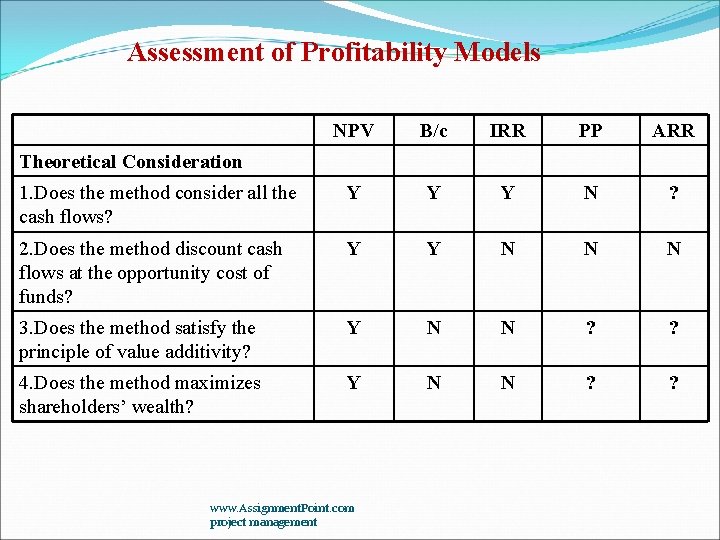
Assessment of Profitability Models NPV B/c IRR PP ARR 1. Does the method consider all the cash flows? Y Y Y N ? 2. Does the method discount cash flows at the opportunity cost of funds? Y Y N N N 3. Does the method satisfy the principle of value additivity? Y N N ? ? 4. Does the method maximizes shareholders’ wealth? Y N N ? ? Theoretical Consideration www. Assignment. Point. com project management
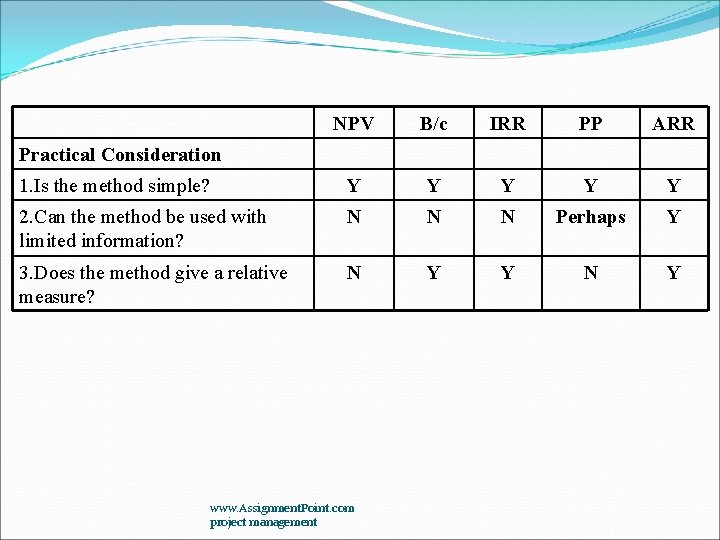
NPV B/c IRR PP ARR 1. Is the method simple? Y Y Y 2. Can the method be used with limited information? N N N Perhaps Y 3. Does the method give a relative measure? N Y Y N Y Practical Consideration www. Assignment. Point. com project management
Pros and Cons of Profitability Models Advantages ØSimple to use and understand ØUse readily available data ØModel output is familiar to decision makers ØAllows taking absolute decisions ØSome models account for project risk www. Assignment. Point. com project management
Disadvantages ØIgnore all momentary factors except risk ØSome models Ignore the timing of the cash flows and time value of money ØSome models strongly biased toward short run ØPay back type models ignore cash flows beyond the payback period ØThe IRR model can result in multiple result ØAll are sensitive to errors in input data for the early years of project ØAll discounting models are non-linear, and the effects of changes in the variables are generally not obvious to decision makers ØAll these models depend for input on a determination of cash flows www. Assignment. Point. com project management
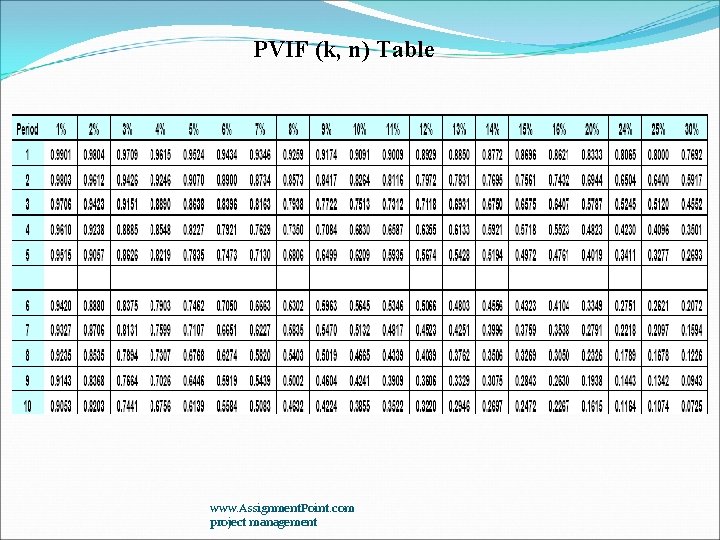
PVIF (k, n) Table www. Assignment. Point. com project management
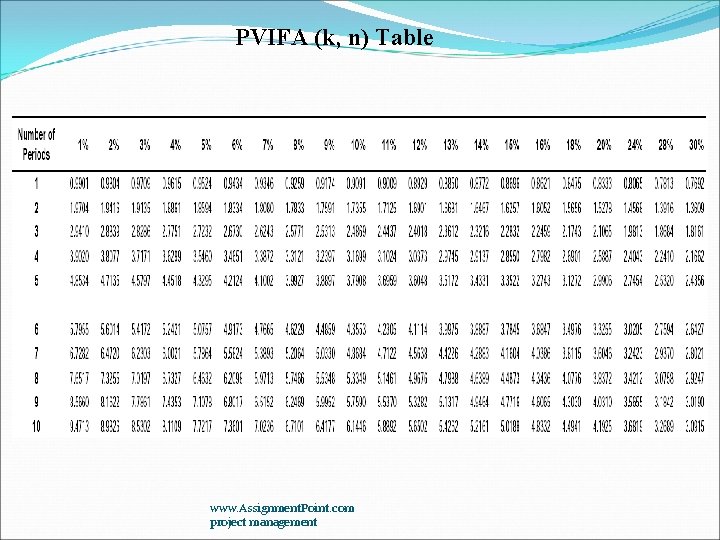
PVIFA (k, n) Table www. Assignment. Point. com project management
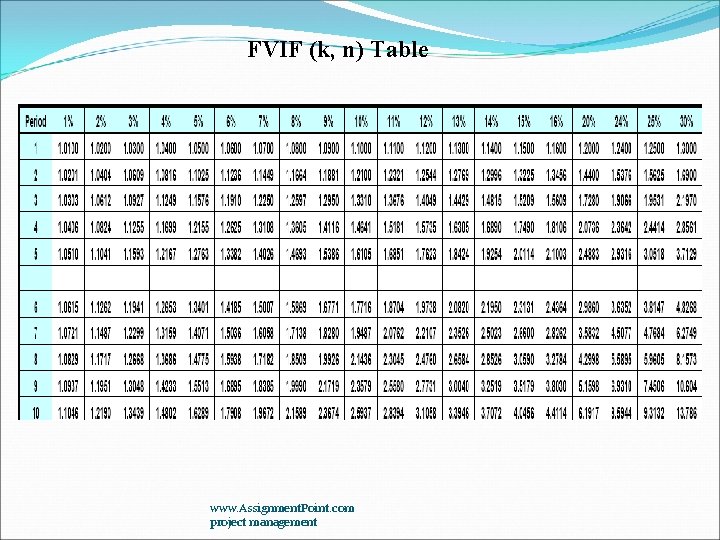
FVIF (k, n) Table www. Assignment. Point. com project management
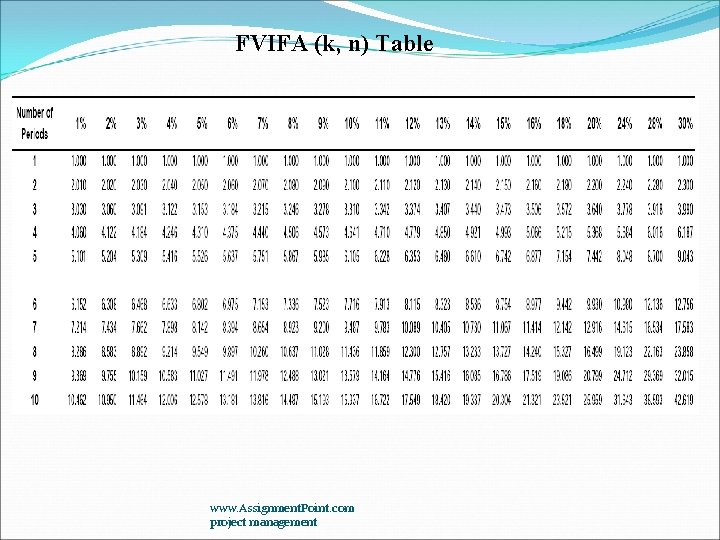
FVIFA (k, n) Table www. Assignment. Point. com project management