POETRY Traditionally poetry is a language arranged in




- Slides: 66
POETRY Traditionally, poetry is a language arranged in lines with a regular rhythm and often with a definite rhyme scheme.
SPEAKER § The speaker is the voice in a poem. A poem can sometimes have more than one voice.
5 Guidelines for Reading a Poem § Read the poem aloud at least once, following the punctuation for phrasing. § Be alert to key words and references. § Write a paraphrase of any lines that are not clear to you or need simplifying. § Arrive at the central idea or meaning of the poem. § Use internet sources to help with paraphrasing or analysis.
Diction § The words a poet chooses and the way he or she arranges the words to express a thought are referred to as the poet’s diction.
Connotation § The emotional meaning of the word § In poetry, diction is especially important because every word must relay the right connotation.
Poetic License § The poet’s freedom to use language creatively § Poets often invent (coin) words to relay an intended meaning. § The poet may change words, invent (coin) new ones, rearrange the normal order of words, and omit understood phrases in order to create a certain mood or create a special meaning.
Imagery § Words or phrases that use description to create pictures (images) in the reader’s mind
Tone § The attitude a writer takes toward the subject or the reader
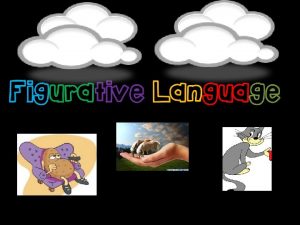
Figurative Language § The use of language to describe one thing in terms of something else § Figurative language is at the heart of poetry.
10 Major Figures of Speech § § § § § Personification Symbol Simile Metaphor Implied Metaphor Extended Metaphor Dead Metaphor Mixed Metaphor Pun Irony of Situation
Personification § A special form of metaphor in which an inanimate thing or animal is given human characteristics
Symbol § An object, such as a person, action, or an event that stands for something more than itself as well
Simile § A straightforward comparison of two unlike things, using either of the words like or as § Example: The clouds were like puffs of cotton candy.
Metaphor § A more powerful figure of speech comparing two unlike things, without the use of the words like or as § It omits the specific word of comparison and directly identifies the two unlike things § Example: The clouds were puffs of cotton candy.
Implied Metaphor § A comparison between two unlike objects. It is not directly stated, but only suggested.
Extended Metaphor § A comparison of two unlike things which is extended throughout the poem
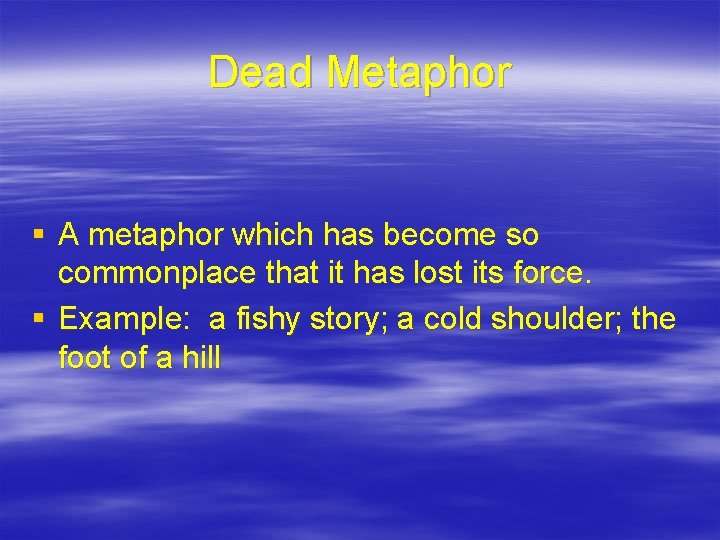
Dead Metaphor § A metaphor which has become so commonplace that it has lost its force. § Example: a fishy story; a cold shoulder; the foot of a hill
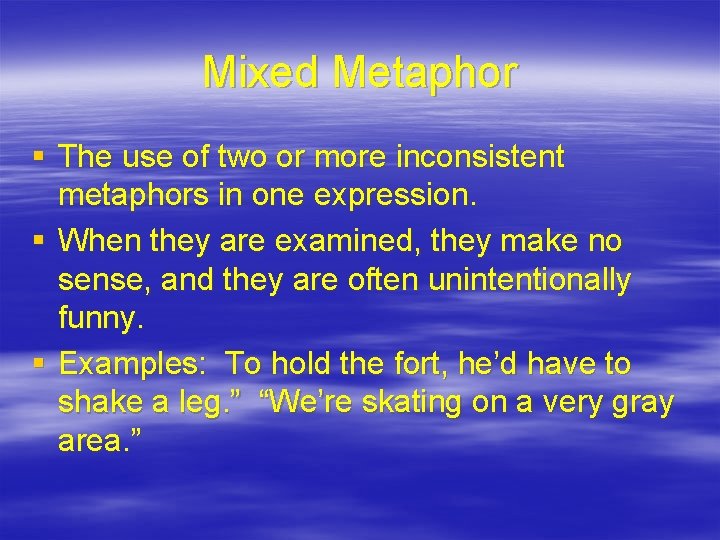
Mixed Metaphor § The use of two or more inconsistent metaphors in one expression. § When they are examined, they make no sense, and they are often unintentionally funny. § Examples: To hold the fort, he’d have to shake a leg. ” “We’re skating on a very gray area. ”
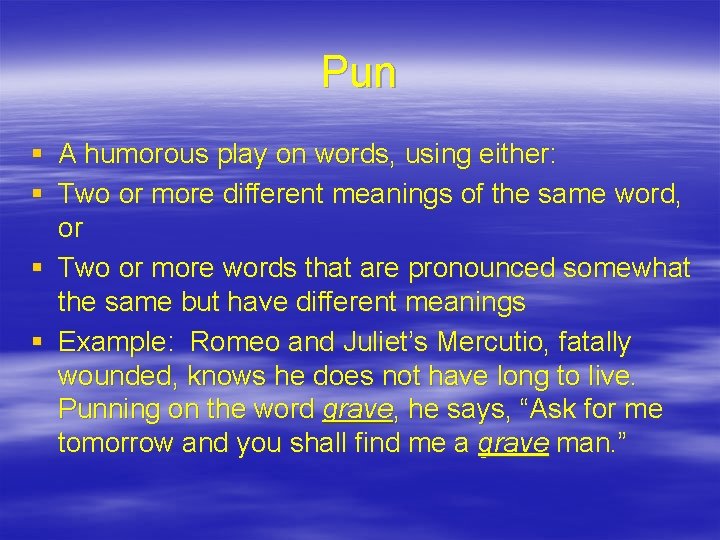
Pun § A humorous play on words, using either: § Two or more different meanings of the same word, or § Two or more words that are pronounced somewhat the same but have different meanings § Example: Romeo and Juliet’s Mercutio, fatally wounded, knows he does not have long to live. Punning on the word grave, he says, “Ask for me tomorrow and you shall find me a grave man. ”
Irony of Situation § The opposite of what the reader expects to happen
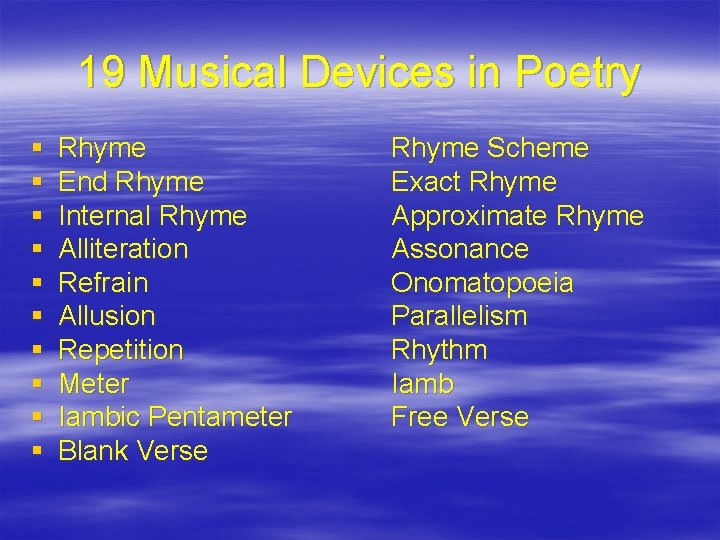
19 Musical Devices in Poetry § § § § § Rhyme End Rhyme Internal Rhyme Alliteration Refrain Allusion Repetition Meter Iambic Pentameter Blank Verse Rhyme Scheme Exact Rhyme Approximate Rhyme Assonance Onomatopoeia Parallelism Rhythm Iamb Free Verse
Rhyme § The repetition of accented vowel sounds and all succeeding sounds in words that appear close to each other
Rhyme Scheme § The pattern of rhymes in a stanza or poem
End Rhyme § Rhyming words that occur at the end of a poetic line
Exact Rhyme § Words that exactly repeat a sound
Internal Rhyme § Rhyme occurring within a line of poetry
Slant Rhyme or Approximate Rhyme § Rhyme in which the final sounds of words are similar but not identical Example: because/was
Alliteration or Consonance § The repetition of consonant sounds, usually at the beginning of words. § Example: “Peter Piper picked a peck of pickled peppers. ”
Assonance § The repetition of vowel sounds. § Example: “The bad, fat cat sat on the mat. ”
Refrain § The recurring use of a phrase, entire line, or stanza
Onomatopoeia § The sound of a word imitates or suggests its meaning. § Examples: “Whoosh!” “Tick-tock” “Zoom!”
Allusion § A reference to a person, place, an event, or a literary work to which the writer expects the reader to recognize and respond § Example: Biblical allusions are common in English literature
Parallelism § The repetition of structures of ideas § Example: “…of the people, by the people, and for the people…” (Gettysburg Address)
Repetition § The reappearance of a word, phrase, stanza, or structure in any literary work § 3 Common forms of Repetition: (1) refrain; (2) rhyme; (3) alliteration
Rhythm § Any regular, recurrent flow of motion or sound
Meter § Regularized rhythmic pattern in a line of poetry
Iamb § An unstressed syllable followed by a stressed syllable
Iambic Pentameter § One of the most popular metrical forms in English § It contains 5 (pent-) iambic feet (iambs) to a line of poetry.
Free Verse § Poetry that is not controlled by any regular metrical pattern. § This is the easiest type of poetry to write.
Blank Verse § Unrhymed iambic pentameter that conveys a natural, conversational rhythm.
Structures of Poetry § Structure is the form or pattern a poet chooses for the arrangement of his thought § There are 5 we will consider: 1. 2. 3. 4. 5. Stanzas Sonnets Terza Rima Villanelles Verse Paragraphs
Stanza § Any group of related lines that forms a division of a poem. They function somewhat like paragraphs do.
Sonnet § A fixed form of poetry that contains fourteen lines, usually written in iambic pentameter § The sonnet has 2 traditional rhyme schemes: (1) English and (2) Italian
English Sonnet § Also known as the Shakespearean Sonnet § It contains 3 quatrains (groups of 4 lines) + 1 couplet (2 lines) = 14 lines
Italian Sonnet § Also known as the Petrarchan Sonnet § It contains 1 octave ( 8 lines) + 1 sestet (6 lines) = 14 lines
Terza Rima § A verse form consisting of a sequence of interlocking 3 -line stanzas (tercets) § The 1 st and 3 rd lines of the first stanza rhyme. § The 2 nd line provides the rhyme for the 1 st and 3 rd lines of the next stanza. § Forms the rhyme scheme aba-bcb-cdc and so on
Villanelle § An intricate 19 -line poem of French origin § Only two rhymes are allowed in the villanelle, and 8 lines are refrains.
Verse Paragraph § Sometimes a poet chooses to divide units of thought into verse paragraphs of varying length rather than fixed stanzas. It allows the poet more flexibility in his thought. § Verse paragraphs are alternatives to stanzas.
9 Types of Poetry Narrative Epic Ballad Folk Ballad Dramatic Poem Dramatic Monologue Closet Dramas Lyric Poetry Literary Ballads
Narrative Poetry § A poem that tells a story
Epic § A long poem celebrating the deeds of a society’s hero. § Most epics are concerned with larger-thanlife heroes and heroines. § The language of an epic is stately and dignified. § Example: The Odyssey
Most Famous Epics § Greek: The Iliad and The Odyssey by Homer § Roman: The Aeneid by Virgil § Italian: The Divine Comedy by Dante § English: Paradise Lost by John Milton
Ballad § A relatively short narrative poem, originally meant to be sung
Folk Ballads § § § The oldest known ballads Also known as “popular ballads” The authors are unknown because they arose among the common people and were passed on by word of mouth for generations
Folk Ballads § Most are tragic in mood and concerned largely with sensational stories of murder, love, jealousy, treachery, and the supernatural § Most folk ballads use certain conventions, or widely accepted techniques and ways of saying things…
Conventions of Folk Ballads § Usually dramatize their action quickly by omitting unnecessary scenes or details § Often heighten the drama by using dialogue § Suspense is often created by giving out information a little at a time…
Conventions of Folk Ballads (continued) § Have their favorite colors, and often these colors suggest certain things § Example: milk-white steeds (horses); ruby lips; golden hair. White suggests purity; gold suggests perfection; red suggests blood
Conventions of Folk Ballads (continued) § Often use stock phrases § In structure, they usually use a ballad stanza – a 4 -line stanza in which the 2 nd and 4 th lines rhyme.
Dramatic Poem § Presents one or more characters speaking, usually to each other, but sometimes to themselves, or directly to the reader
Dramatic Monologue § A special kind of dramatic poem in which one character speaks to one or more characters whose replies are not given in the poem. § This is kind of like listening to one side of a phone conversation.
Closet Dramas § Plays written to be read, but not performed
Lyric Poetry § Poetry, usually short, which focuses on the emotions or thoughts of the speaker. § Examples: The sonnet and the elegy (poem written about the death of someone) are among the most popular forms of lyric poetry.
Literary Ballads § Written by known writers who tried to imitate the style of folk ballads § They tend to be more elaborate than folk ballads, both in language and form.
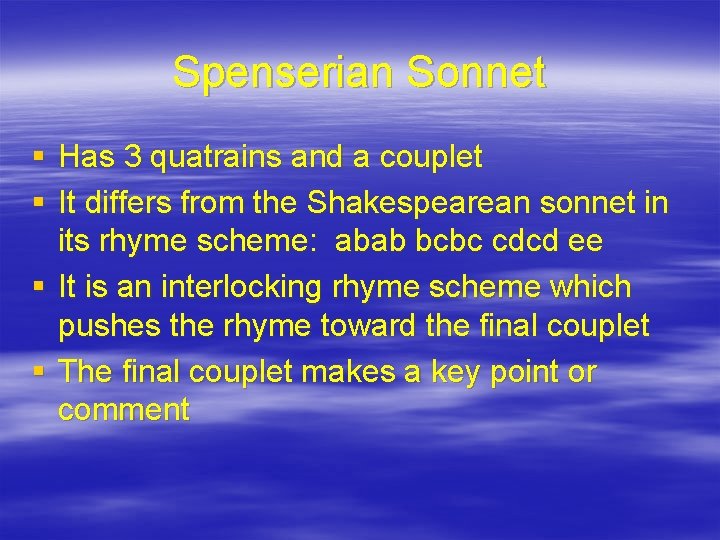
Spenserian Sonnet § Has 3 quatrains and a couplet § It differs from the Shakespearean sonnet in its rhyme scheme: abab bcbc cdcd ee § It is an interlocking rhyme scheme which pushes the rhyme toward the final couplet § The final couplet makes a key point or comment
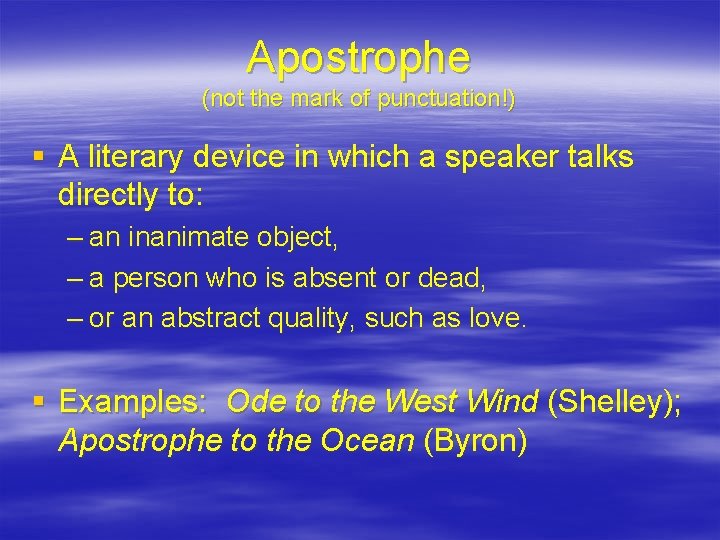
Apostrophe (not the mark of punctuation!) § A literary device in which a speaker talks directly to: – an inanimate object, – a person who is absent or dead, – or an abstract quality, such as love. § Examples: Ode to the West Wind (Shelley); Apostrophe to the Ocean (Byron)